

How to Build an Account Management Strategy That Doesn't Collect Dust
A RevOps lead we know spent six weeks building account plans for her top 50 clients. Beautiful decks. Stakeholder maps. Whitespace grids. Three months later, not a single plan had been opened twice. The expansion target? Missed by 40%.
She's not alone. On Reddit, account managers describe juggling 100+ accounts with nothing but OneNote and email folders, and 79% of sales organizations have rebuilt their KAM programs at least once. Most guides on account management strategy hand you 10 best practices and zero operational detail. That's why your account plans fail.
What You Need (Quick Version)
Segment accounts by growth potential, not just current revenue. Build a living account plan with a governance cadence - not a PowerPoint rotting in a shared drive. Verify your stakeholder data so you're not single-threaded into one contact who's about to leave. The full framework is below, along with a template, KPI formulas, and a tools comparison.
What Is Account Management Strategy?
Account management strategy is the system your team uses to retain, expand, and deepen revenue within existing accounts. It's not customer service. It's not "check in quarterly and hope they renew." It's a revenue function - one that compounds faster than new-logo acquisition when done right.
Acquiring a new customer costs 5-25x more than retaining an existing one. When account management gets treated as an afterthought, you end up with reactive relationship maintenance instead of proactive growth.
Here's the thing: most teams don't need a fancier KAM platform. They need to stop treating account management like a side quest for their sales team and start treating it like a business model. A single strategic account showing 70% growth can unlock more leadership buy-in than a dozen new logos.
Account Manager vs AE vs CSM
These three roles overlap enough to cause confusion, but they serve different purposes. Getting this wrong creates coverage gaps and internal friction.
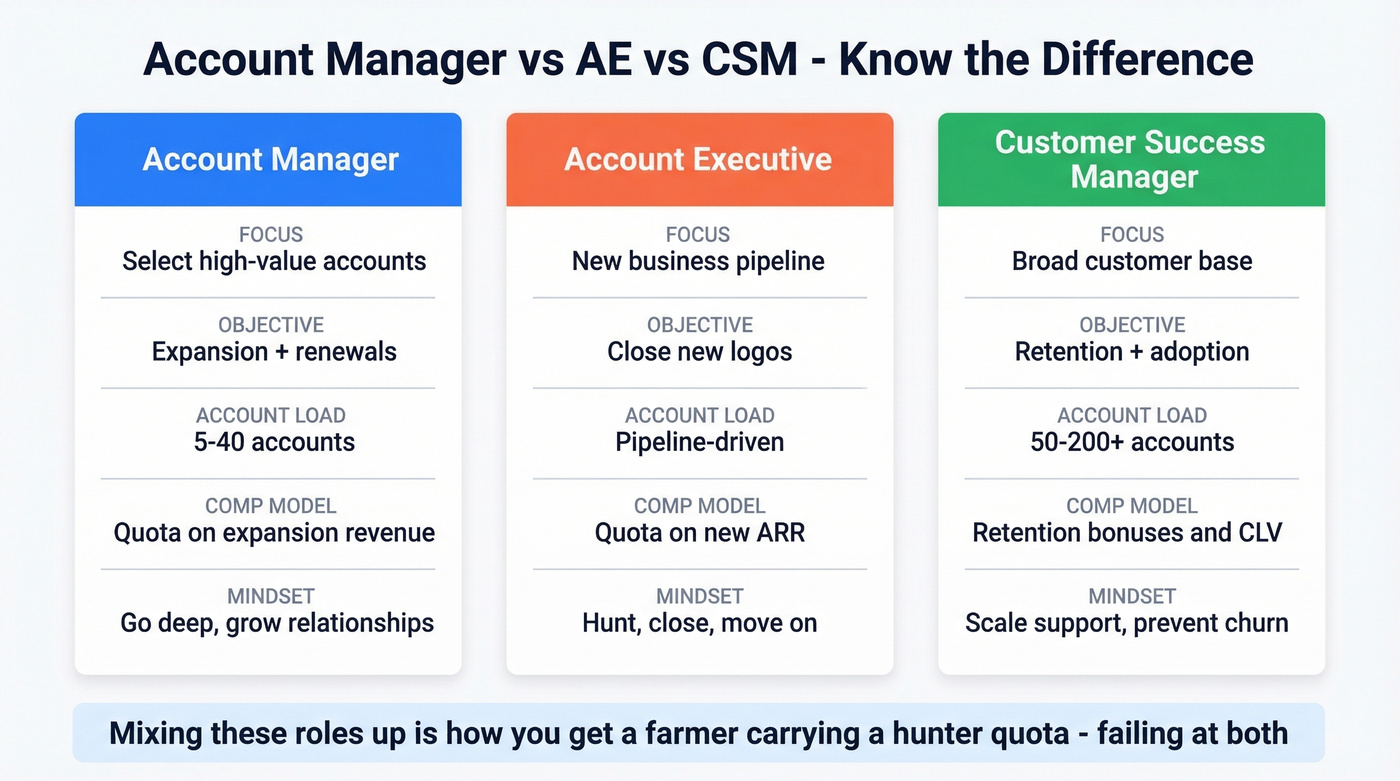
| Account Manager | Account Executive | Customer Success Manager | |
|---|---|---|---|
| Focus | Select high-value accounts | New business | Broad customer base |
| Objective | Expansion + renewals | Close new logos | Retention + adoption |
| Scale | 5-40 accounts | Pipeline-driven | 50-200+ accounts |
| Comp model | Quota on expansion revenue | Quota on new ARR | Retention bonuses / CLV |
In 2026, the global median baseline salary for a CSM sits around $75,000. Account managers handling strategic accounts typically earn more because their quota ties directly to revenue expansion. CSMs scale across many accounts to prevent churn; AMs go deep on fewer accounts to grow them. AEs hunt. Mixing these up is how you end up with a "farmer" carrying a hunter's quota and failing at both.
How to Build Your Strategy Step by Step
Seven steps, each building on the last. Skip one and the whole thing wobbles.
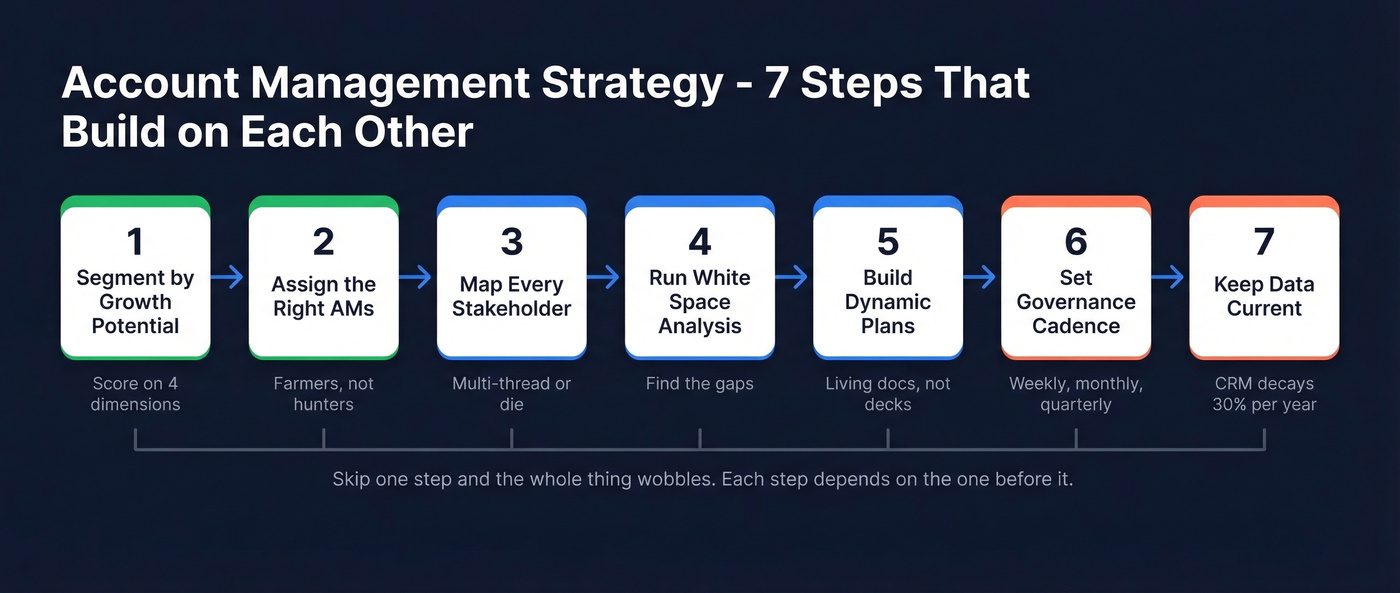
Step 1: Segment by Growth Potential
Most teams segment by current revenue or industry. That misses the point entirely. A $50k account with massive whitespace and a C-suite champion deserves more attention than a $200k account that's fully penetrated and stable.
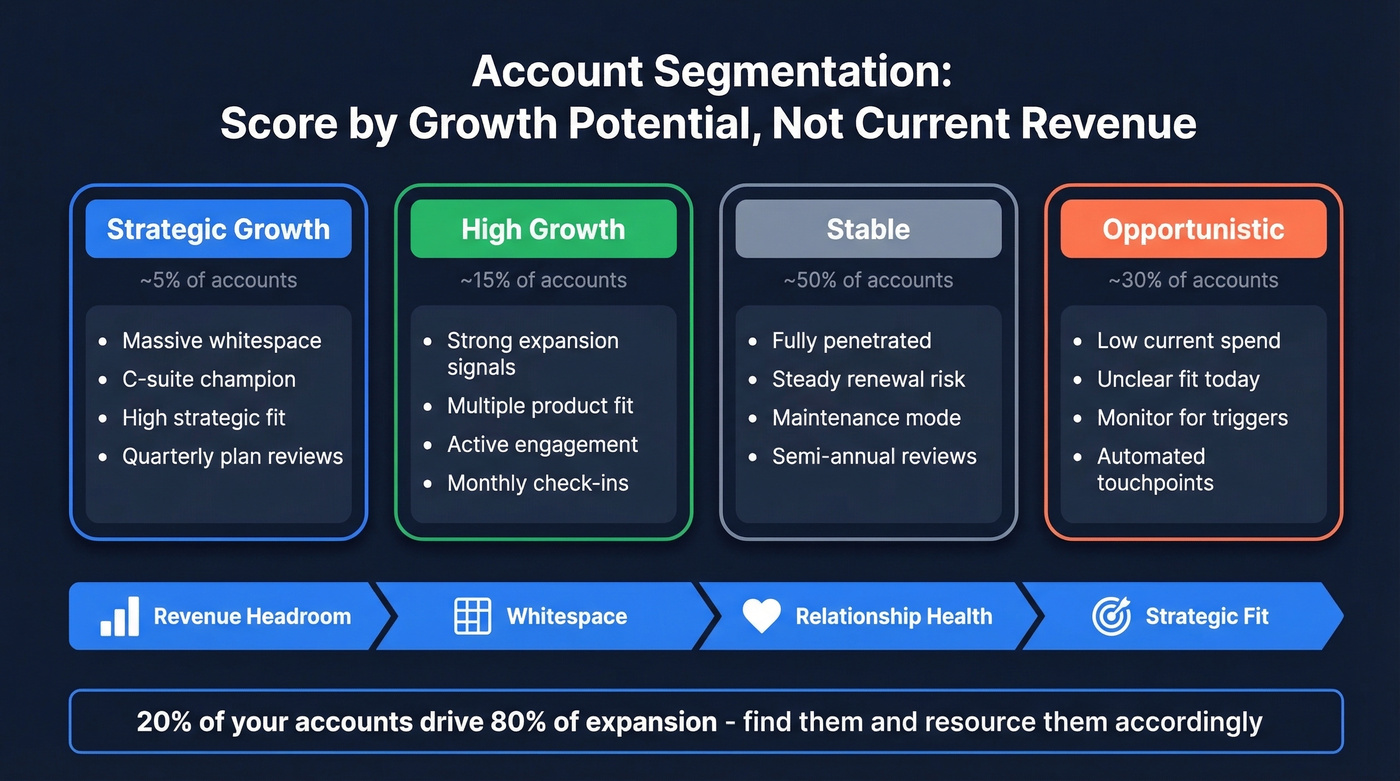
Blue Ridge Partners uses a four-tier model - Strategic Growth, High Growth, Stable, and Opportunistic - segmented by growth potential rather than current spend. Organizations that adopted this approach saw a 25%+ increase in upsell and cross-sell revenue.
Score each account on four dimensions: revenue headroom, whitespace (products they don't yet use), relationship health, and strategic fit. But don't stop at opportunity size - evaluate your alignment to capture that growth. A massive whitespace means nothing if the account's tech stack, buying culture, or timeline doesn't match your strengths. The Pareto principle applies here: roughly 20% of your accounts will drive 80% of your expansion. Find those 20% and resource them accordingly.
Step 2: Assign the Right Account Managers
Promoting your best closer into an account management role is almost always a mistake. Cranfield's research on KAM programs makes this clear - hunters and farmers require different skill sets. Your top AE thrives on the adrenaline of new deals. Account management rewards patience, consultative thinking, and long-horizon relationship building.
Design compensation around expansion and retention metrics, not new-logo quotas bolted onto an AM title. If your AMs are compensated like AEs, they'll behave like AEs - chasing shiny new opportunities inside the account instead of building the multi-threaded relationships that drive sustainable growth.
Step 3: Map Every Stakeholder
Single-threaded relationships are one of the biggest risks in key accounts. Your main contact leaves, and suddenly you're starting from zero with someone who didn't choose your product.
Map every stakeholder across the buying committee: champions, promoters, detractors, budget owners, and influence lines. Go beyond org charts to capture actual decision dynamics - who influences whom, who controls budget, and who's quietly blocking expansion. This is where we've seen the most account plans fall apart: the map looks complete, but half the contacts are outdated.
Prospeo's leads database lets you search by company, department, and seniority across 300M+ professional profiles to find verified emails and direct dials for the entire buying committee. With 98% email accuracy and a 7-day data refresh cycle, you're working with current information, not the stale record your predecessor left in the CRM.
Step 4: Run a White Space Analysis
White space is the gap between what your customer needs and what they're currently buying from you. This is where expansion revenue lives.
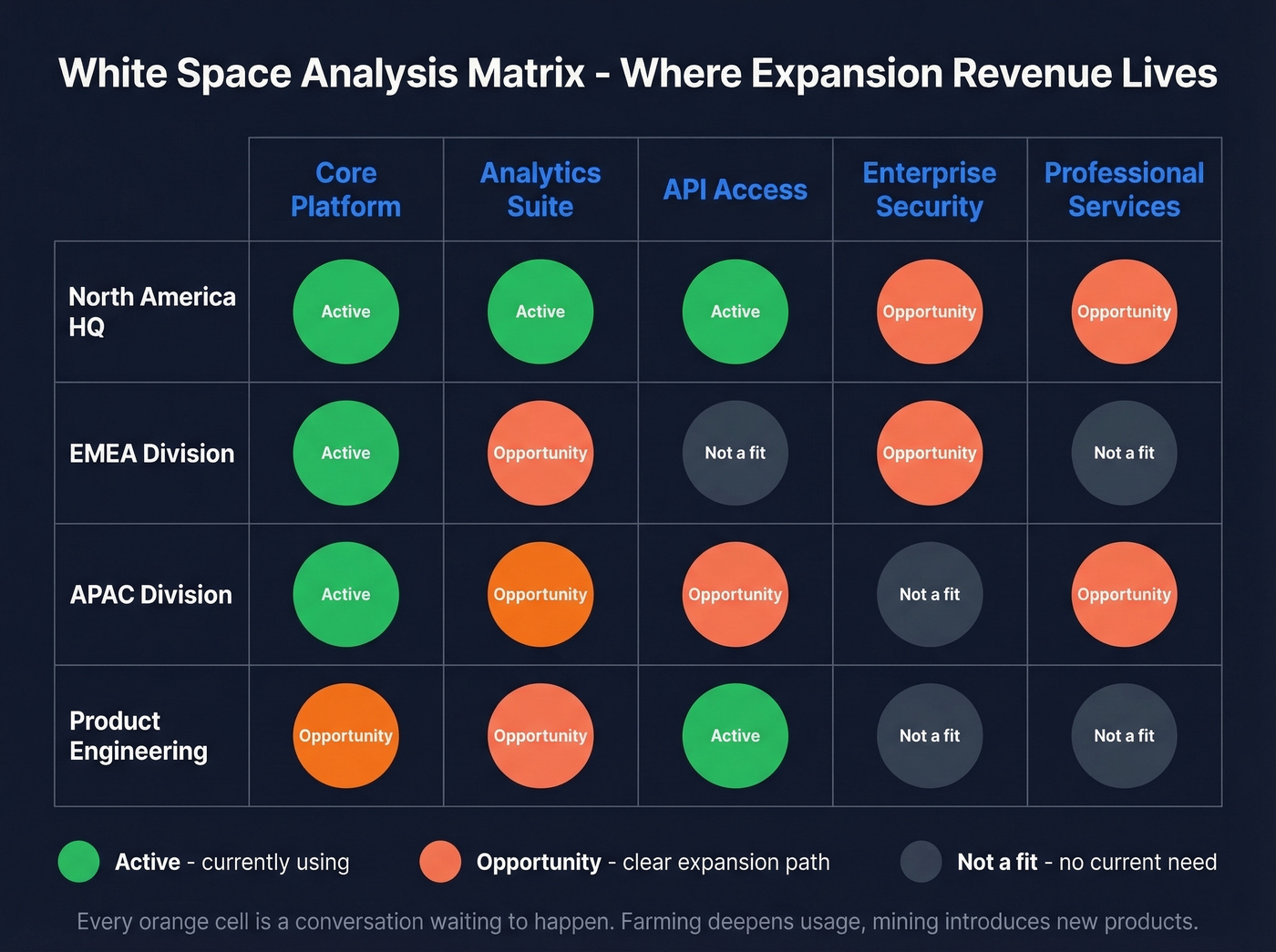
Build a simple matrix: your products on one axis, the customer's business units on the other. Fill in current adoption, and the empty cells are your whitespace. Then ask three questions. Where are we engaged today? Where do clear opportunities exist? Where does the customer have needs we can serve but haven't discussed yet?
The distinction between "farming" and "mining" matters here. Farming deepens existing product usage. Mining introduces new products or services. Both are expansion, but they require different playbooks and different conversations.
Step 5: Build a Dynamic Account Plan
If your account plan lives in a PowerPoint on a shared drive, you don't have an account plan. You have a document that was accurate for about two weeks.
Static quarterly plans go stale within weeks. Replace them with living, signal-driven plans that update when the account changes. Executive moves, funding rounds, product launches, regulatory shifts - these are triggers that should prompt plan revisions, not wait for the next quarterly review. For complex strategic accounts, revise quarterly at minimum. For stable mid-tier accounts, semi-annual works. The template section below gives you the structure.
Step 6: Set a Governance Cadence
The fix for "plans that just sit there" is governance. Without a cadence, even the best account plan becomes shelf-ware.
Three layers work well. Weekly internal check-ins run 15 minutes: what's moving, what's stuck. Monthly account reviews go deeper into pipeline and relationship health. Quarterly business reviews with the customer validate assumptions, surface new needs, and demonstrate value delivered. Build a communication matrix tracking interaction frequency so you can spot which accounts are getting heavy attention and which are going dark.
Beyond meeting cadence, think about structural stickiness: integrations between your product and the customer's stack, multi-year terms, and co-development partnerships all reduce churn risk in ways that no QBR alone can match.
Step 7: Keep Contact Data Current
CRM data decays roughly 30% per year. People change jobs, get promoted, move companies. A stakeholder map built in January is missing around 30% of its contacts by December.
Stale data means missed stakeholders, which means single-threaded risk - the exact problem your strategy is supposed to solve. Pair your CRM with a data platform that refreshes weekly and verifies emails before you send. Catch job changes, new hires, and departures before they blindside you. The difference between a current stakeholder map and a stale one is the difference between proactive account management and reactive firefighting.

Your stakeholder map is only as good as the data behind it. Prospeo gives you 98% accurate emails and verified direct dials across 300M+ profiles - refreshed every 7 days, not every 6 weeks. Search by company, department, and seniority to multi-thread every key account.
Build stakeholder maps with contacts that actually connect.
Account Plan Template
Every account plan needs these eight sections. Keep them concise - a plan that takes two hours to update won't get updated.
- Account Overview. Company snapshot, industry, key products used, contract value, renewal date. Two paragraphs max.
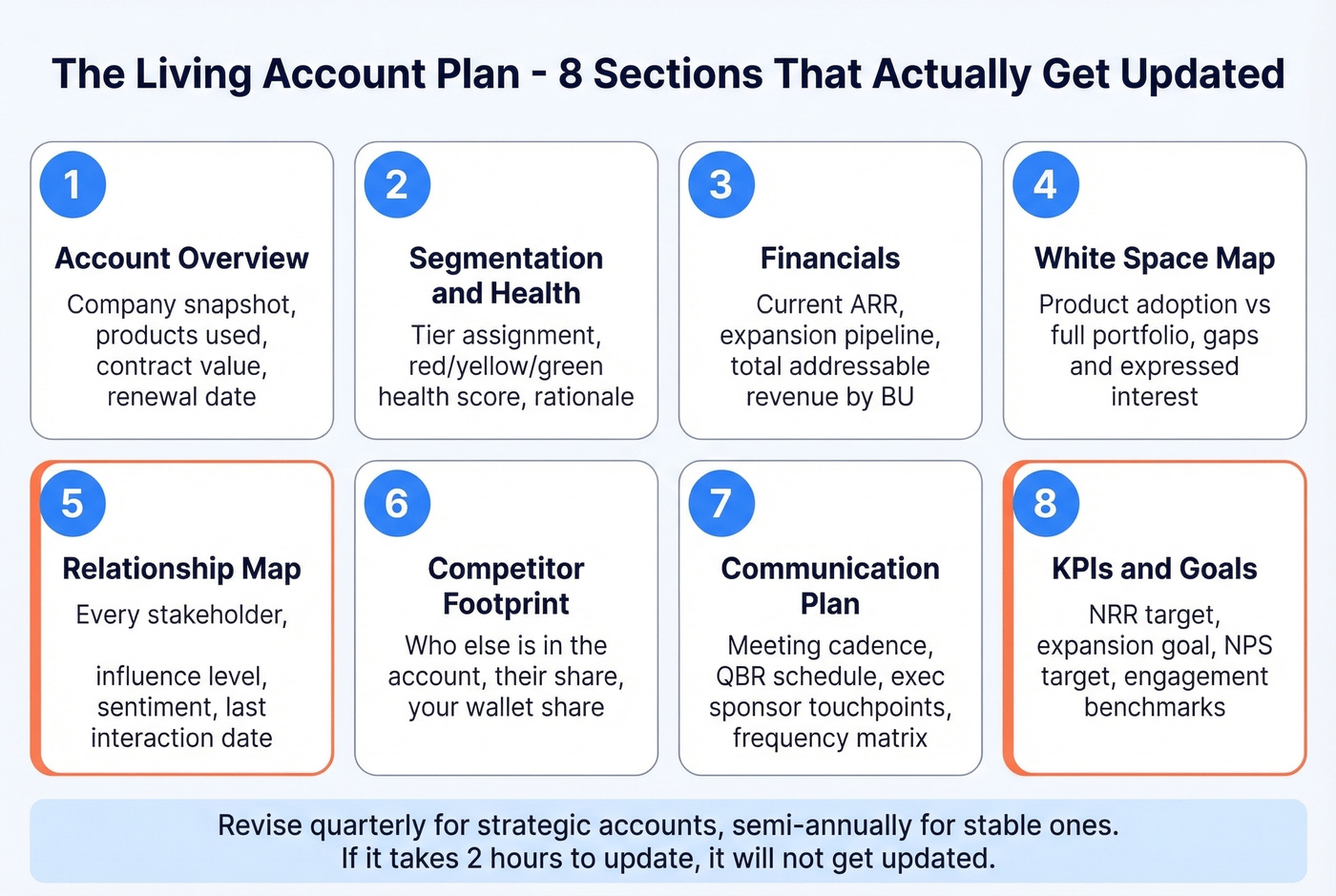
Account Segmentation. Which tier: Strategic Growth, High Growth, Stable, or Opportunistic? Include the health score using a red/yellow/green scale and the rationale.
Account Financials. Current ARR, expansion pipeline, total addressable revenue potential. Break down by business unit or region for large accounts.
White Space Analysis. Map current product adoption against the full portfolio. Where are the gaps? Where has the customer expressed interest but not committed budget?
Relationship Map. Every stakeholder with their role, influence level, sentiment (champion, neutral, or detractor), and last meaningful interaction date. Refresh monthly - this section decays fastest.
Competitor Analysis. Who else is in the account? What's their footprint? What's your wallet share versus theirs? (If you need a lightweight process, borrow a few ideas from a competitive intelligence strategy.)
Communication Plan. Meeting cadence, QBR schedule, executive sponsor touchpoints. Include an interaction frequency matrix showing the last 12 months.
KPIs and Goals. Net revenue retention target, expansion revenue goal, NPS target, engagement frequency benchmarks.
Revise quarterly for strategic accounts, semi-annually for stable ones. If a major signal fires - exec departure, funding round, reorg - update immediately.
How to Measure Success
Net Revenue Retention is the single most important metric for account management in SaaS. It captures churn, expansion, and contraction in one number. Above 110%, your existing accounts are growing faster than they're shrinking. Below 100%, you're leaking.
Here are the core formulas every AM team should track:
Customer Churn Rate = (Customers Lost / Customers at Start of Period) x 100
Example: 25 lost out of 500 = 5% churn. Early-stage SaaS companies typically see 5-10% monthly churn; mature SaaS targets 2-5%.
Customer Lifetime Value = Average Monthly Revenue x Average Customer Lifespan
Example: $2,000/month x 48 months = $96,000 CLV. This number should inform how much you invest in each account tier.
Net Promoter Score = % Promoters - % Detractors
Example: 70% promoters, 10% detractors = NPS of 60. Track this at the account level, not just company-wide.
Beyond these, measure account engagement frequency and digital interaction quality - not just volume. Ten low-value check-in emails don't equal one strategic QBR. Track the percentage of revenue coming from key accounts over time, and set per-account expansion targets tied to your white space analysis.
Lessons From Real Account Programs
We've seen these patterns destroy programs that looked great on paper - but we've also seen what happens when teams get it right. Let's break down the most common failure modes alongside what actually works:
Treating KAM as a sales tactic, not a business model change. Cranfield's research is blunt: KAM requires organization-wide standards across people, processes, data, and culture. Bolting it onto your existing sales motion doesn't work. Treat it as a change initiative with executive sponsorship.
The "Captain Super-KAM" anti-pattern. One hero AM holds all the relationships in their head. When they leave, the account craters. The fix is cross-functional KAM teams with shared documentation. The best-run programs we've seen assign a pod - AM, CSM, and solutions engineer - to each strategic account so no single departure derails the relationship.
Plans created then ignored. This is the #1 complaint on Reddit - leadership demands account plans, provides vague requirements, then never references them again. Governance cadence with real accountability solves this.
Too much gut instinct, not enough data. "I think they're happy" isn't a health score. Quantified engagement metrics and regular NPS at the account level are non-negotiable. (If you want a clean way to structure it, start with a simple churn analysis model and adapt it to expansion signals.)
Quarterly focus vs multi-year outcomes. KAM programs take years to mature. Judging them on one quarter's expansion number kills them before they can compound. One Cranfield case study showed a single strategic account growing 70% - but only after sustained investment over multiple quarters. Use a balanced scorecard with leading indicators.
Giving every account the same attention. If you're managing 100 accounts and treating them all equally, none of them get enough. Ruthless tiering and differentiated service models are the only way out.
Best Tools for Account Management
You don't need a $1,000/month KAM platform to start. A CRM, a solid contact data source, and a governance cadence will get you further than most enterprise software.
| Tool | Best For | Starting Price |
|---|---|---|
| Prospeo | Stakeholder contact verification | Free; ~$0.01/email |
| Kapta | Account planning templates | ~$1,000/mo |
| DemandFarm | Relationship mapping | Custom; typically $1,000-$3,000+/mo |
| Gainsight | Health scoring at scale | Typically $2,000-$5,000+/mo |
| Salesforce | Enterprise CRM + AI insights | $25/user/mo |
| HubSpot | Mid-market CRM | Free; paid Sales Hub ~$20-$100+/user/mo |
| monday CRM | Budget-friendly CRM | $10/user/mo |
| Zoho CRM | SMB-friendly CRM | $14/user/mo |

For most teams, the stack looks like this: your CRM handles pipeline and activity tracking, a contact data platform keeps your stakeholder emails and phone numbers verified and current, and your governance cadence does the rest. Layer in a dedicated KAM platform like Kapta or DemandFarm only when you've outgrown spreadsheets and your account count justifies the spend. Skip the expensive stuff until you've proven the basics work - we've watched too many teams buy Gainsight before they even had a consistent QBR cadence. If you're still evaluating CRM options, start with a few examples of a CRM to sanity-check fit and pricing.
White space analysis falls apart when your CRM is full of stale contacts from two job changes ago. Prospeo's 7-day data refresh and job change tracking ensure you're reaching the right buyers in every business unit - at roughly $0.01 per verified email.
Turn white space into pipeline with data you can trust.
FAQ
What's the difference between account management and key account management?
Key account management is a subset focused exclusively on your highest-value accounts. KAM programs dedicate cross-functional teams, executive sponsors, and custom strategies to a small number of accounts - typically 5-15% of your total book - that generate 50-80% of expansion revenue. Standard account management covers the broader book with lighter-touch engagement.
How many accounts should one AM handle?
Strategic accounts: 5-10. Mid-tier: 20-40. Transactional: 50-100+. If every account gets the same attention, none gets enough. Tier ruthlessly and match coverage model to growth potential - not just current revenue.
How often should you update an account plan?
Quarterly for complex strategic accounts, semi-annually for stable ones. Between cycles, update immediately when a major signal fires - executive departure, funding round, reorg, or competitive displacement. Plans that only update on a calendar schedule miss the moments that matter most.
What's the most important KPI for account management?
Net Revenue Retention. It captures churn, expansion, and contraction in a single number. An NRR above 110% means your existing accounts are growing faster than you're losing revenue - the clearest signal your AM program is working.
How do you keep stakeholder data accurate across key accounts?
CRM data decays roughly 30% per year as contacts change roles or leave companies. Use a data platform with a weekly refresh cycle and high email accuracy to keep contacts current - so your stakeholder map reflects reality, not last quarter's org chart.