

Account Management Upsell Strategy: A 5-Step System That Works
You inherited 30 accounts last quarter. Some spend $45k/month, others barely crack $3k - and most are using maybe 20% of what they bought. Your manager wants an "expansion plan" by Friday. Every guide you find says "understand your customer's needs" without telling you what that actually looks like in a QBR with a VP who has 25 minutes.
Selling to existing customers is 50-80% more effective than acquiring new ones. That's not a motivational poster stat - it's the single strongest argument for building a real account management upsell strategy instead of winging it account by account. The problem isn't that AMs don't know upselling matters. It's that most don't have a repeatable system for doing it.
Stop treating upselling as a sales tactic. It's an operating system.
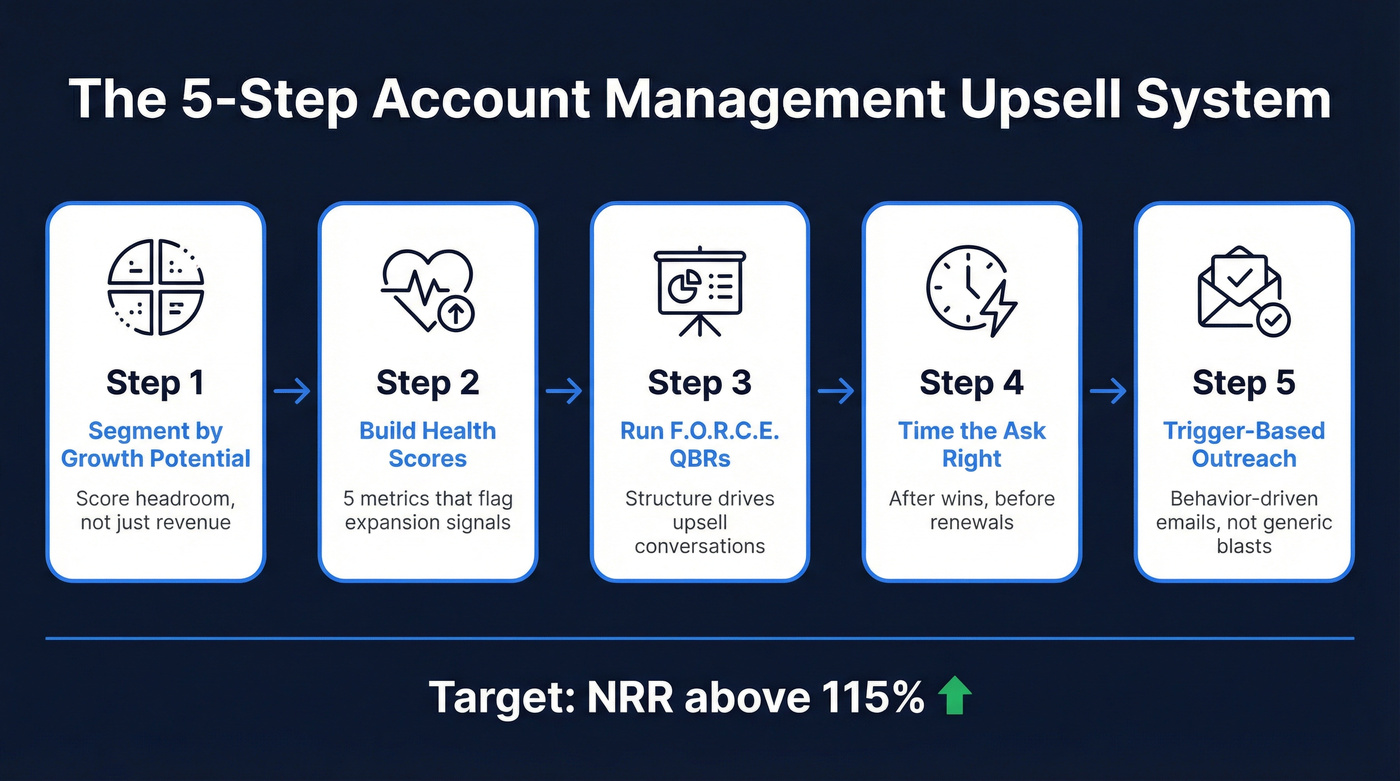
The Five Moves (Quick Version)
- Segment accounts by growth potential, not just revenue. A $5k/month account with 12% product adoption is a bigger expansion opportunity than a $40k account at 95% utilization.
- Replace status-update QBRs with the F.O.R.C.E. framework. Friction, Opportunities, Results, Client testimonials, External benchmarks. Structure drives outcomes.
- Build a 5-metric health score and act on expansion signals. Usage approaching limits, new teams onboarding, executive engagement - these are buying signals hiding in your data.
- Use trigger-based emails, not generic blasts. Behavior-driven outreach converts at 10-30%. Generic "quarterly check-in" emails don't.
- Clean your contact data before any outreach. Stale CRM records kill expansion plays before they start.
Why Most Expansion Strategies Fail
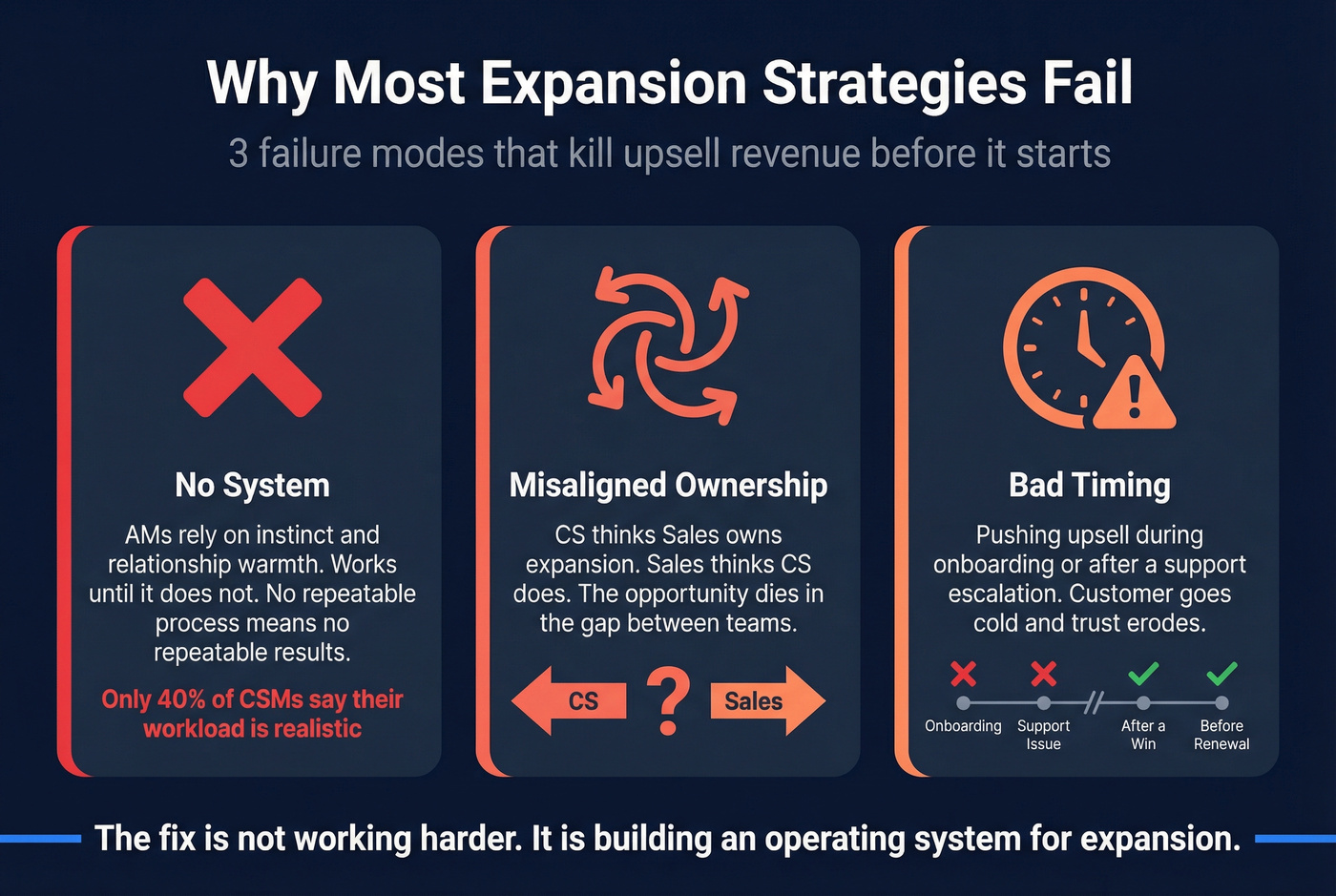
One AM on r/sales described inheriting massive accounts with low adoption and low spend and not knowing where to start - the instinct was to map the org chart, but without a system, that's just busywork. New AMs in tech consistently report the same pattern: the first few months are consumed by learning product, pricing, and internal processes. Sales fundamentals slip. Expansion becomes something you'll "get to eventually." Only [40% of CSMs](https://churnzero.com/press-release/customer-success-csms-survey/) say their workload is realistic, so expansion gets deprioritized because the day job already doesn't fit into business hours.
Meanwhile, 72% of CSMs say their QBRs feel like glorified status updates. No strategic framing, no forward-looking growth discussion, no expansion ask.
The first failure mode is no system at all. AMs rely on instinct and relationship warmth, which works until it doesn't. The second is misaligned ownership - CS thinks Sales owns expansion, Sales thinks CS does, and the opportunity dies in the gap. The third is bad timing - pushing an upsell during onboarding or after a support escalation, then wondering why the customer went cold.
Segment Accounts by Growth Potential
Most AM teams segment by revenue or industry. That's a reporting view, not a growth strategy. The accounts with the highest expansion potential aren't always your biggest spenders - they're the ones with the most unused headroom.
Blue Ridge Partners lays out a four-tier segmentation model built around growth potential rather than current spend. Companies that adopt this kind of segmentation see 25%+ increases in upsell and cross-sell revenue. The difference is simple: you stop giving equal attention to accounts with unequal potential.
The 4-Tier Growth Model
| Tier | Criteria | AM Coverage | Expansion Play |
|---|---|---|---|
| Strategic Growth | High spend, high headroom | Dedicated AM | Multi-product, enterprise |
| High Growth | Mid spend, high headroom | Dedicated AM | Seat expansion, tier upgrade |
| Stable | High spend, low headroom | Pooled/tech-touch | Retention-focused, minor adds |
| Opportunistic | Low spend, variable | Tech-touch + triggers | Usage-based, self-serve |
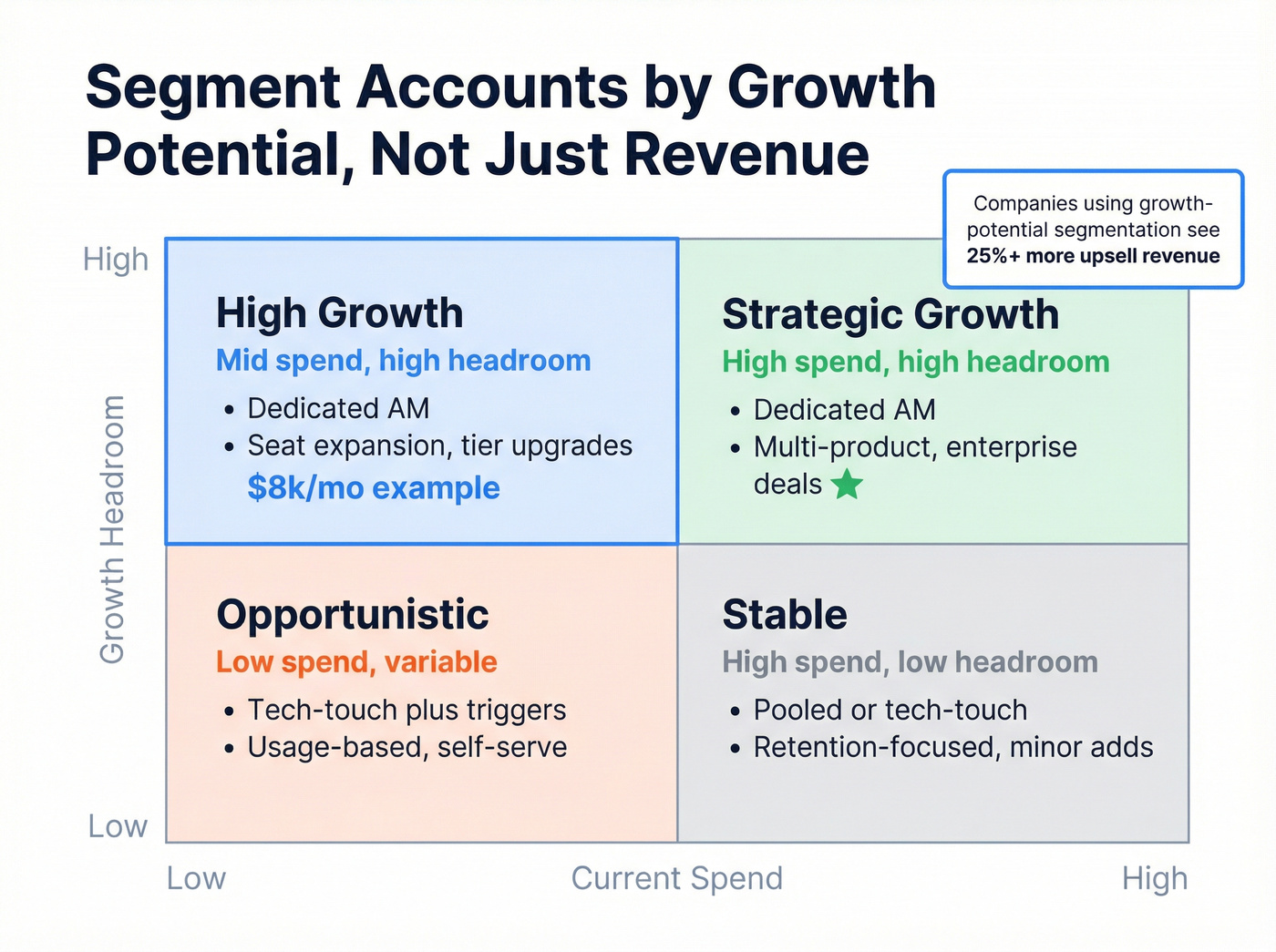
The key column is "headroom." A $40k/month account using 90% of their seats and all available modules is Stable - protect the revenue, don't push. An $8k/month account using one product across one department with six more departments that could adopt? That's High Growth, and it deserves a dedicated expansion plan.
Scoring Growth Potential
Four inputs make this practical without overengineering it. Usage headroom tells you how much room the customer has to grow within their current product. Whitespace departments - teams or business units not yet using the platform - represent the biggest expansion surface area and the richest source of cross-sell opportunities. Contract renewal timing matters because expansion conversations land better 60-90 days before renewal than deep mid-cycle. And executive engagement is the leading indicator: if the VP of Ops is showing up to QBRs, there's budget authority in the room.
One practical step most guides skip: map the org chart early. Identify which departments aren't on the platform yet and who leads them. This turns "whitespace" from an abstract concept into a named list of people you can build relationships with.
Score each factor on a 1-3 scale. Anything totaling 9+ goes into your High Growth or Strategic Growth tier. Revisit quarterly.
Build an Expansion-Ready Health Score
A health score isn't a vanity metric - it's an early warning system. Done right, health scores flag churn risk 60-90 days before renewal issues become obvious. More importantly for expansion, they tell you which accounts are ready to buy more.
Five Metrics That Matter
- Product usage depth - not just logins, but feature adoption. Are they using the capabilities that drive stickiness?
- Onboarding completion - customers who finish onboarding are 3-5x more likely to renew. Incomplete onboarding is a churn predictor and an expansion blocker.
- Support ticket trends - not volume alone, but trajectory. Declining tickets with increasing usage means healthy. Rising severity tickets means risk.
- NPS or CSAT trends - a single score is noise. The trend over three quarters is signal.
- CSM qualitative pulse - your gut read, formalized. Is the champion engaged? Are they responsive? Do they bring colleagues to calls?
Expansion Signals to Watch
These are the buying signals hiding in your health data:
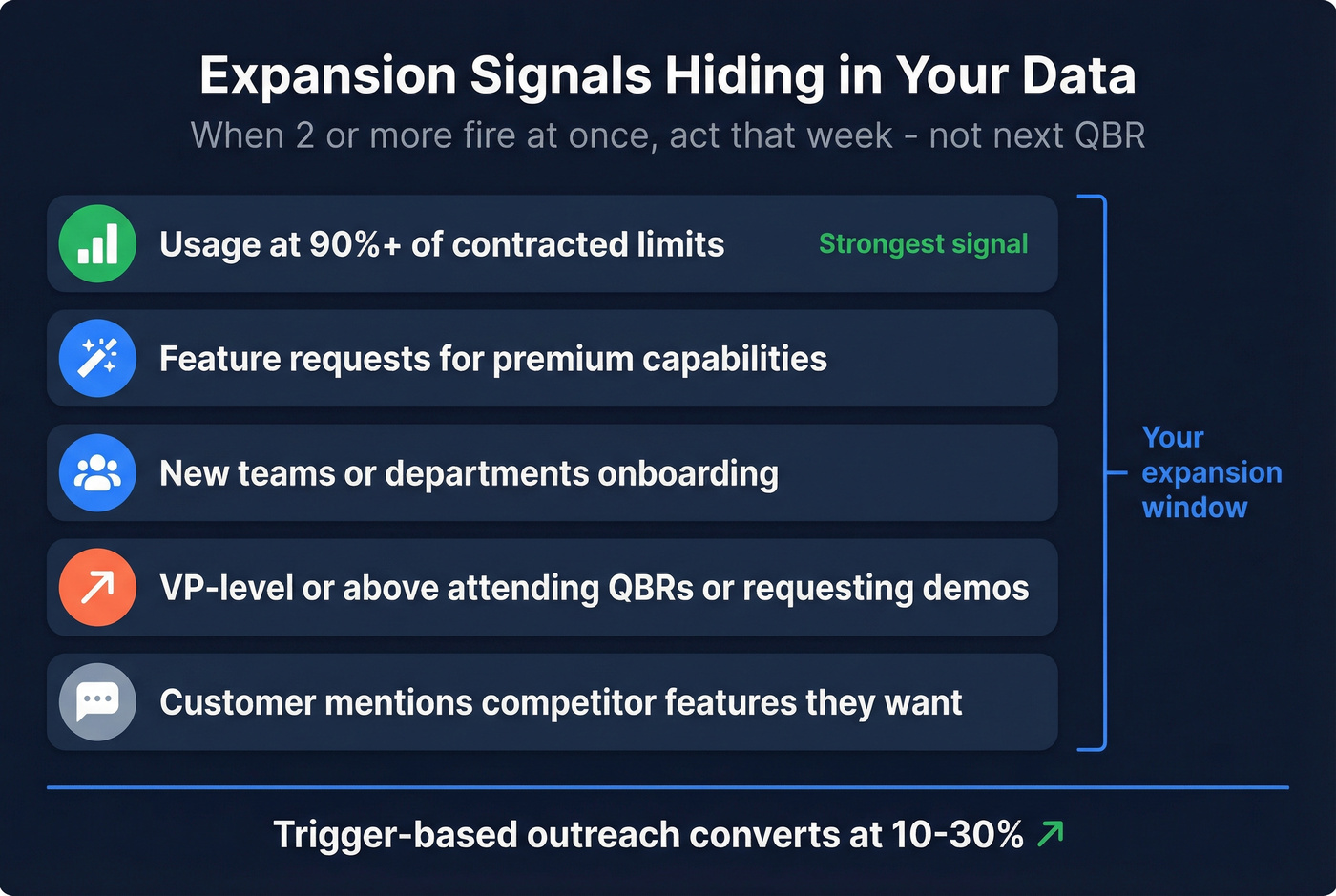
- Usage approaching 90%+ of contracted limits (seats, API calls, storage)
- Feature requests about advanced or premium capabilities
- New teams or departments onboarding onto the platform
- Executive-level engagement increasing - VP+ attending QBRs or requesting demos
- Customer mentions wanting features your competitors offer
When two or more of these fire simultaneously, that's your expansion window. Don't wait for the renewal cycle. Act on these signals the week they appear, not log them for the next QBR.
Don't Overcomplicate It
We've seen teams build 15-metric health scores that nobody updates and nobody trusts. Start with five metrics. Weight them simply - equal weights are fine for the first quarter. The biggest pitfall is relying on account-level averages that hide team-level issues. If one department is at 95% adoption and another is at 15%, the average looks fine while the expansion opportunity and the churn risk both go unnoticed.
Run QBRs That Drive Upsells
Your QBR is in two days. You've got a slide deck full of usage charts and support ticket summaries. The customer's VP will scan it, nod politely, and ask if there's anything else. You'll leave without an expansion conversation - this is how 72% of QBRs go.
Teams that run strategic QBRs close expansions 2.1x faster. One CS leader reported that reframing QBRs with a strategic framework helped uncover four new opportunities and close one upsell within two months. The difference isn't charisma - it's structure.
The F.O.R.C.E. Framework
Friction - Start by acknowledging what's not working. "We know onboarding for your APAC team took longer than planned. Here's what we've changed." Leading with friction builds credibility and disarms defensiveness.
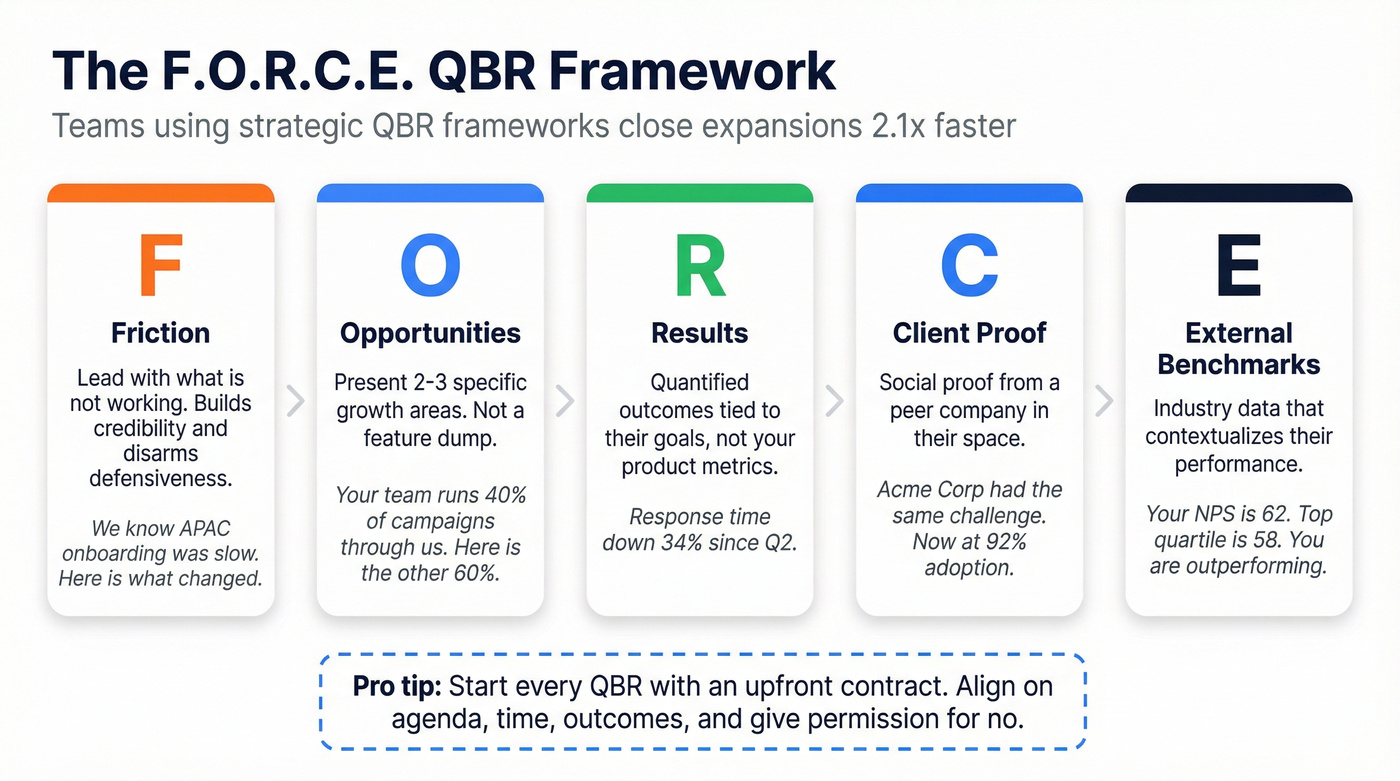
Opportunities - Present 2-3 specific growth opportunities you've identified. Not a feature dump. "Your marketing team is running 40% of campaigns through us. Here's what the other 60% looks like on the platform, based on what similar companies do."
Results - Quantified outcomes tied to their goals, not your product metrics. "You've reduced response time by 34% since Q2" beats "You've sent 12,000 messages."
Client testimonials - Social proof from a peer company. "Acme Corp had the same APAC rollout challenge. They're now at 92% adoption across all regions." One story is worth ten slides.
External benchmarks - Industry data that contextualizes their performance. "Your NPS is 62. Top quartile in your space is 58. You're outperforming - and here's how expansion could widen that gap."
Start With an Upfront Contract
Before you open a single slide, borrow the Sandler-style upfront contract. Align on the agenda, the time commitment, the desired outcomes - and give explicit permission for a "no." Something like: "We've got 30 minutes. I want to cover results from Q3, two areas where I think there's room to grow, and hear what's top of mind for you. If anything I suggest doesn't fit, just say so - that's genuinely useful feedback."
In our experience, the upfront contract is the single highest-leverage change you can make to a QBR. It reframes the meeting from a vendor presentation to a collaborative working session. The permission for "no" paradoxically makes "yes" more likely.
The Expansion Pivot
After presenting results, pause. "Based on what we're seeing, your team is getting strong ROI from [specific use case]. The natural next step for companies at your stage is usually [specific expansion - new department, higher tier, additional product]. Is that something worth exploring, or is the priority right now to deepen what you've already got?"
This gives the customer two positive options instead of a yes/no gate. Either answer moves the relationship forward.

You just mapped whitespace departments and scored growth potential. Now you need verified contacts for every decision-maker in those departments. Prospeo enriches your CRM with 50+ data points per contact at a 92% match rate - so your expansion outreach actually reaches the VP who controls the budget.
Stop mapping org charts you can't reach. Get verified contacts for every stakeholder.
Time the Upsell Right
Timing is the difference between a welcomed recommendation and an unwelcome pitch. The best time to propose expansion is immediately after a meaningful win - when momentum is high and trust is proven.
Best Windows
- Right after a KPI milestone - the customer just hit a goal your product helped deliver.
- When usage approaches contracted limits - they're bumping against seat caps or API thresholds. The need is self-evident.
- After a successful new team onboarding - proof of internal adoption creates demand from adjacent teams.
- During strategic planning cycles - Q4 budget planning or annual reviews are natural moments to discuss expanded investment.
- Post-executive engagement - a VP just attended a QBR or requested a demo. That's budget authority signaling interest.
When to Hold Off
Don't push expansion during onboarding (they haven't seen value yet), after a performance dip (fix it first), during a billing dispute (nothing kills expansion faster), or during major org changes when your champion might not have authority next month.
Here's why timing matters in dollar terms. Take 40 clients averaging $8k/month. Upsell just 10% of them into a $2k/month expansion. That's +$96,000 in ARR from four conversations. But those four conversations only work if they happen in the momentum window.
Skip the white-glove playbook if your average deal size is under $10k/year. Invest in product-led upsells and self-serve tier upgrades instead. Save the dedicated AM-driven expansion motions for accounts where the math justifies the time.
One guardrail worth noting: keep upsell suggestions within roughly 25% of the customer's current spend. A $10k/month account can absorb a $2,500 expansion naturally. Proposing a $10k add-on feels like a different buying decision entirely.
Define Expansion Ownership
The #1 complaint on r/sales about expansion isn't "we don't know how to upsell." It's "nobody knows who owns it." CS thinks Sales should close it. Sales thinks CS does. The opportunity dies in the handoff.
RACI by Expansion Type
| Motion | Responsible | Accountable | Consulted | Informed |
|---|---|---|---|---|
| Seat bump (<20%) | CSM | CS Lead | AE | Sales Mgr |
| Tier upgrade | AE | Sales Lead | CSM | CS Lead |
| Multi-product | AE | Sales Lead | CSM, SE | CS Lead |
| Enterprise expand | AE + SE | Sales Lead | CSM, Exec | CS Lead |
CS identifies the signal and nurtures the relationship. Sales runs the commercial conversation for anything beyond a minor seat bump. NRR becomes the shared KPI that keeps both teams aligned.
Build Cross-Functional Pods
Stable AE+CSM pairings outperform ad-hoc handoffs every time. Give each pod a standing biweekly agenda: expansion signals spotted this cycle, upcoming renewals, at-risk accounts, and QBR prep. This isn't a big org design change - it's a 30-minute meeting with a shared doc. The key is logging CS-sourced expansion leads in your CRM and attributing them in pipeline reviews. If CS doesn't get credit for surfacing opportunities, they'll stop surfacing them.
Trigger-Based Expansion Emails
Generic "time for a check-in" emails don't drive expansion. Trigger-based emails - sent when a specific behavior or milestone occurs - convert at 10-30% for SaaS upsells. Email sequence upsells specifically convert at 11.3% on average, which is strong for a low-effort motion.
Before sending any trigger-based expansion email, verify the contact is still at the company and that you have a valid address. Stale records are the fastest way to kill an expansion play. Tools like Prospeo return 50+ data points per contact on a 7-day refresh cycle with 98% email accuracy, so you're not running outreach on outdated stakeholders. If you need a tighter process for follow-ups, keep a few proven sales follow-up templates on hand.
Template 1 - Usage Limit Reached
Subject: You're at 92% of your seat limit
Hey [Name], your team hit 92% of your contracted seats last week - which is a great sign that adoption is working. Most teams at this stage either add a seat block or move to the [next tier] to unlock [specific feature]. Want me to model both options so you can see the cost difference? Takes 10 minutes.
Template 2 - Success Milestone
Subject: 34% faster response time - worth a quick look at what's next
[Name], your team just crossed the 34% improvement mark on response time since going live. That puts you in the top quartile of [industry] customers on our platform. Companies at your stage see the next big jump when they bring [adjacent team/use case] onto the platform. Worth a 15-minute call to explore?
Template 3 - Feature Attempt
Subject: Noticed your team tried [premium feature]
Hey [Name], I saw that three people on your team attempted to use [premium feature] last week. That feature's available on [higher tier] and it's designed for [outcome they care about]. Happy to set up a sandbox so your team can test it before committing. Interested?
We've tested all three of these templates across multiple accounts - the usage-limit email consistently outperforms the other two, probably because the need is most self-evident. The key to all three: reference a specific, real data point. "I noticed" is only credible when you actually noticed something specific.
Benchmarks - What Good Looks Like
Every section above is more useful when you know what "good" looks like.
| Metric | Average | Top Quartile | Source |
|---|---|---|---|
| Net Revenue Retention | ~100-110% | 115-120% | Gainsight / ChartMogul |
| SaaS Upsell Conversion | 27.6% | 42.3% | Focus Digital (n=1,847) |
| Expansion Velocity | Industry average | 2.1x faster w/ strategic QBRs | CS Cafe |
| Post-Sales Budget (% of Rev) | ~10% | 3.9% (Notion - aspirational) | SaaStr |
Let's be honest: if your NRR is below 100%, you have a churn problem, not an expansion problem. Fix retention first. If it's 100-110%, you're treading water - expansion is happening but barely offsetting contraction. Above 115% is where compounding kicks in and the board starts smiling. If you want to diagnose the root cause, start with a clean churn analysis.
Notion's 3.9% post-sales budget is aspirational, not typical. Most SaaS companies need closer to 10% of revenue allocated to post-sales motions to hit those top-quartile NRR numbers.
Mistakes That Kill Expansion Deals
Here's the thing - the problem isn't pushiness. It's irrelevance.
- Not understanding the customer's current state. Review usage data and health score before every expansion conversation. No exceptions.
- Being too aggressive on timing. If the customer hasn't achieved a measurable outcome yet, it's too early.
- Recommending the wrong product or tier. Limit suggestions to 2-3 options max. More choices create decision paralysis.
- Skipping A/B testing on expansion messaging. Test two email variants per trigger type before scaling.
- Bad timing during active escalations. Check for open support tickets, billing disputes, and org changes before any outreach.
- Insufficient value articulation. Every expansion proposal needs a quantified outcome, not just a feature list. "This will save your team 6 hours/week" beats "this includes advanced reporting."
The customer doesn't owe you expansion revenue. You earn it by making the current product indispensable first. (If you need a tighter way to spot and score intent, use a simple rubric for identifying buying signals.)
Clean Data - The Silent Killer
You've built the segmentation model, the health score, the QBR framework, and the trigger emails. Then your expansion email bounces because the VP of Operations left the company four months ago and your CRM still shows them as the primary contact. Your QBR invite goes to someone who moved to a different department. Your org chart is three reorgs behind reality.
Stale CRM data is the silent killer of expansion motions. Running your top accounts through an enrichment tool like Prospeo gets you updated job titles, new stakeholders, and verified emails refreshed every 7 days versus the 6-week industry average. At roughly $0.01 per email, cleaning your entire expansion target list costs less than a single bounced opportunity. If you're evaluating vendors, compare options in our roundup of data enrichment services.
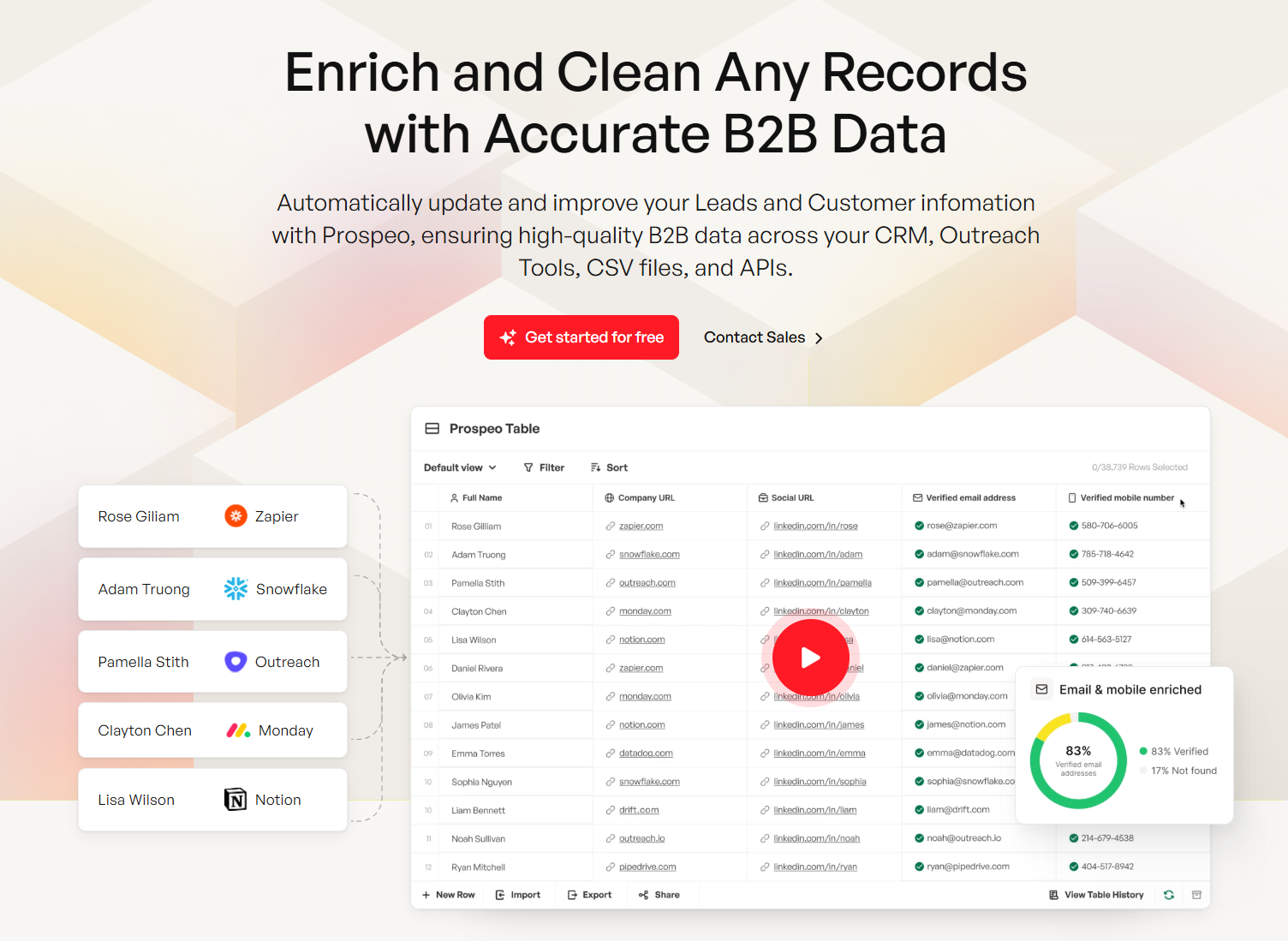
Trigger-based upsell emails only work when they land in real inboxes. Bad data from legacy providers means 35%+ bounce rates - killing your domain reputation and your expansion pipeline. Prospeo delivers 98% email accuracy with a 7-day refresh cycle, so your expansion signals convert to conversations, not bounces.
Clean contact data is the foundation of every expansion play. Start at $0.01 per email.
FAQ
What's the difference between upselling and cross-selling?
Upselling upgrades within the same product - more seats, higher tier, premium features. Cross-selling adds a different product entirely. Upselling converts at higher rates because the customer already trusts the product. Prioritize upselling first, then layer in cross-sell once the customer has realized value from their primary purchase.
Who should own expansion - Sales or CS?
Both, with clear boundaries defined by a RACI model. CS identifies signals through health scores and usage data; Sales runs the commercial conversation for anything beyond a minor seat bump. The worst outcome is both teams assuming the other will close it.
When should a new AM start upselling?
Not during onboarding. Wait until the customer achieves a measurable outcome - typically 60-90 days post-implementation. The momentum window opens after a documented win, not before one.
How do you keep contact data fresh for expansion outreach?
Run your top accounts through a CRM enrichment tool on a regular cadence. Weekly refreshes and 50+ data points per contact at 98% email accuracy are the benchmarks to aim for - compared to the 6-week industry average most providers operate on. Stale contacts are the fastest way to kill an expansion play before it starts.