

Account Planning: How to Build Plans That Don't Die in a Google Doc
It's Q1 planning week. You've got a slide deck, a spreadsheet, and a mandate from the CRO to "get strategic" with your top 50 accounts. You pull up the CRM. The VP of Engineering who championed your last deal left six months ago - nobody updated the record. The new procurement lead isn't in Salesforce at all. The CTO's email bounces.
This is what account planning looks like at most companies. It's already dead before you've written a word.
Fewer than 20% of companies have fully embedded account planning, per Momentum ITSMA research. The rest produce documents that get reviewed once, filed somewhere in Google Drive, and never opened again. Meanwhile, companies that do it well attribute up to 77% of revenue growth to account-based strategies. The gap between intention and execution is enormous - let's close it.
What You Need (Quick Version)
- A tiering model so you don't waste 20-page plans on accounts that don't warrant them
- A stakeholder map with verified contact data - not whatever's been rotting in your CRM for 18 months
- A repeatable 7-step process any rep can follow
- A monthly review cadence - not annual, not "when we get around to it"
That's the skeleton. Everything else is detail.
What Is Account Planning?
Account planning is the strategic process of analyzing a key account's business, mapping its stakeholders, identifying growth opportunities, and building a roadmap to expand the relationship. It's forward-looking and cross-functional - not a solo exercise for the AE.
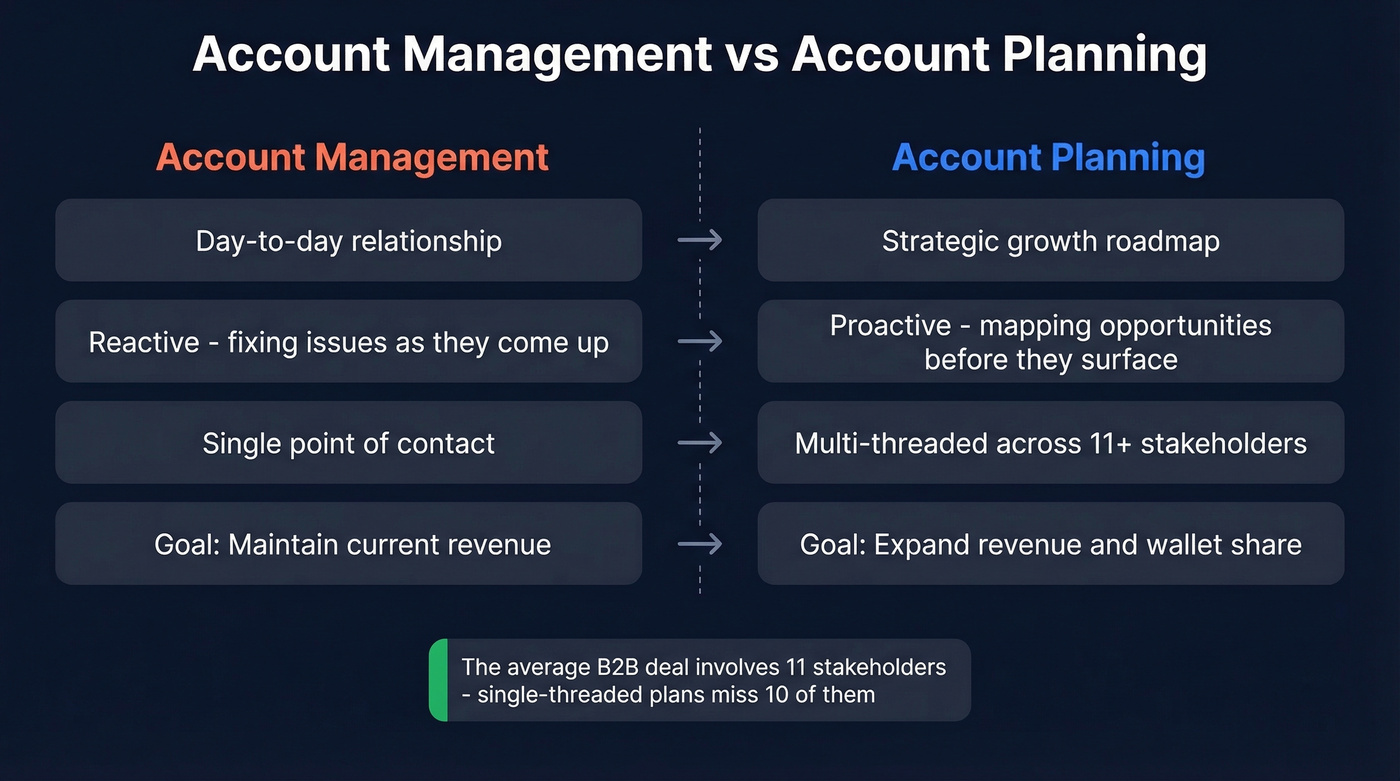
Don't confuse it with account management. They're different jobs.
| Account Management | Account Planning |
|---|---|
| Day-to-day relationship | Strategic growth roadmap |
| Reactive (issue resolution) | Proactive (opportunity mapping) |
| Single point of contact | Multi-threaded stakeholder map |
| Maintain revenue | Expand revenue |
The multi-threading piece is critical. The average B2B deal now involves 11 stakeholders, per Salesforce's State of Marketing report. If your plan only tracks the one person who signed the last contract, you're flying blind on the other ten.
Why Strategic Plans Matter
The data is unambiguous. DemandFarm's Account Planning Book of Evidence - a study of 1,034 respondents across 62 countries - found that organizations with embedded strategic account processes reported:
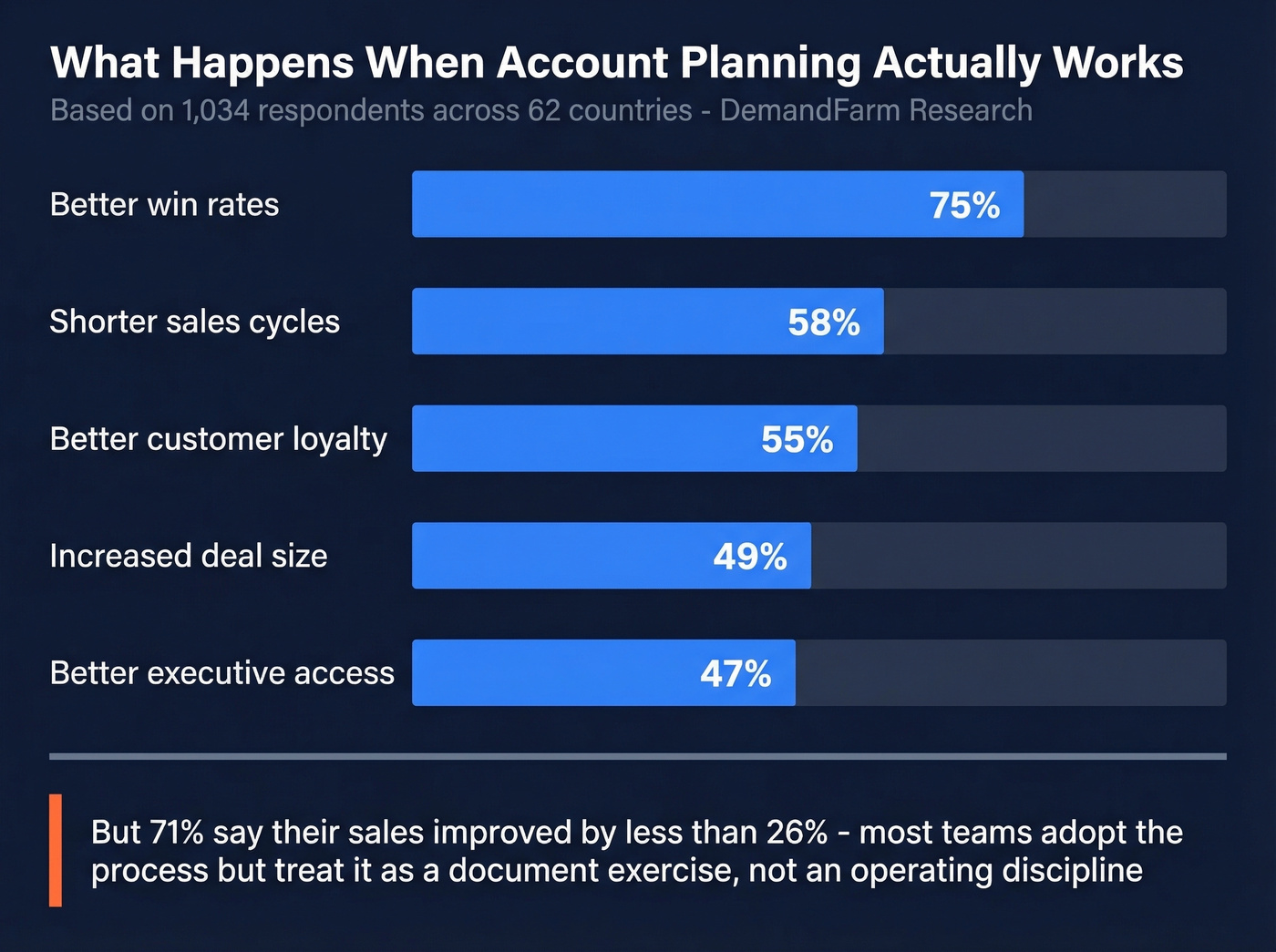
| Benefit | % Reporting |
|---|---|
| Better win rates | 75% |
| Shorter sales cycles | 58% |
| Better customer loyalty | 55% |
| Increased deal size | 49% |
| Better executive access | 47% |
Those aren't marginal improvements. 75% of respondents reporting better win rates from a process most teams already claim to do - but don't do well - reveals a massive execution gap.
Here's the sobering counterpoint from the same research: 71% of companies believe their sales improved by less than 26% since launching strategic account management programs. Most teams adopt the process and still underperform because they treat it as a document exercise rather than an operating discipline. The plan gets written, the plan gets filed, the plan gets ignored.
The retention economics reinforce the case. The probability of selling to an existing customer runs 60-70%, compared to 5-20% for new prospects. A 5% increase in customer retention can raise profits by 25-95%. And 80% of future profits typically come from just 20% of current customers. A rigorous account plan is how you identify and protect that 20%.
79% of sales organizations have rebuilt their key account programs at least once in the past seven years, per Gartner. Most teams know their current approach isn't working. They just haven't found the right framework yet.
When to Build a Plan (and When Not To)
If your average deal size is under $10K, you probably don't need formal account plans at all. Skip this and focus on volume and velocity instead. The process pays off when accounts are large enough and complex enough to justify the investment - typically $25K+ ACV with multi-stakeholder buying committees.
For accounts that do warrant planning, stop building 20-page plans for every one of them. A one-page plan reviewed weekly beats a 20-page plan reviewed never. Constrain the scope, increase the review frequency, and execution gets dramatically better.
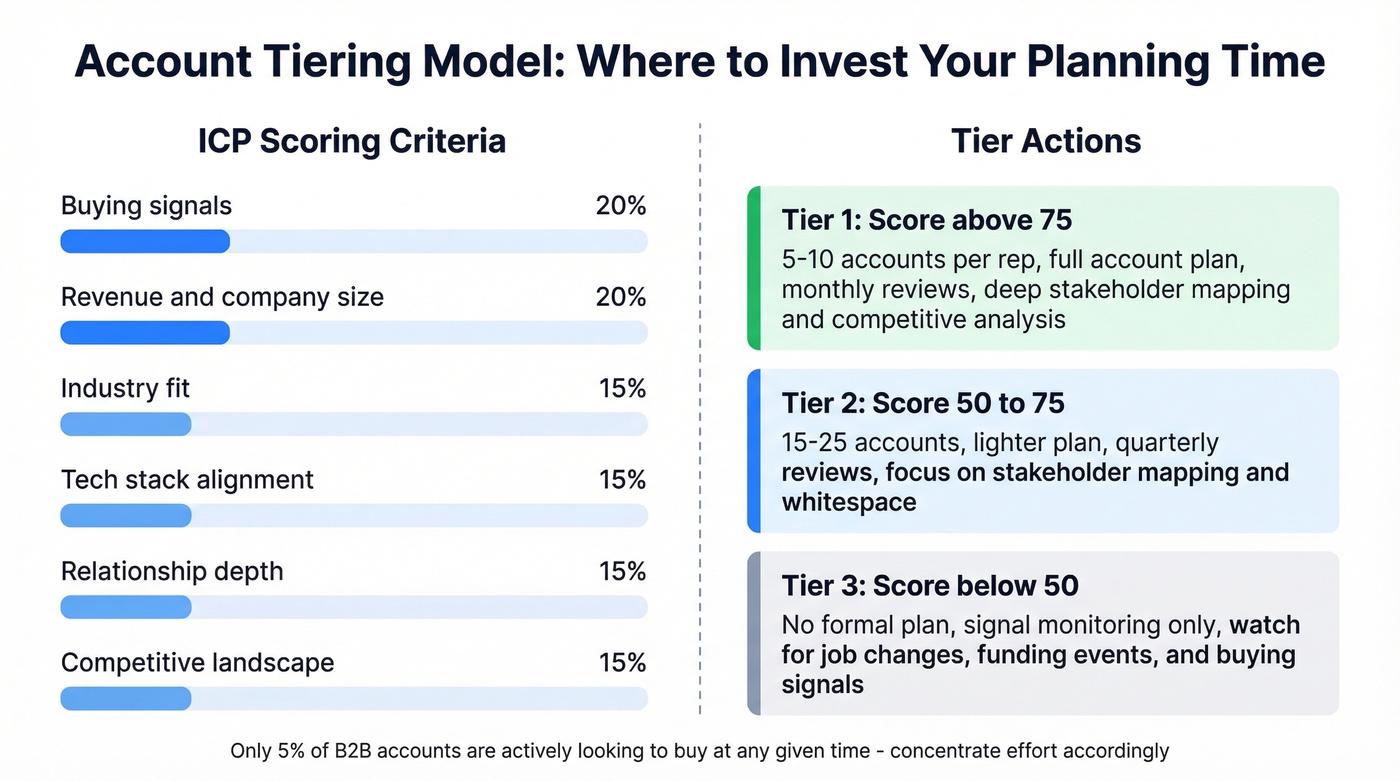
The first step is scoring your accounts:
| Criteria | Weight |
|---|---|
| Revenue / company size | 20% |
| Industry fit | 15% |
| Tech stack alignment | 15% |
| Buying signals | 20% |
| Relationship depth | 15% |
| Competitive landscape | 15% |
Score each account on a 0-100 scale using these weights, then tier them:
- Tier 1 (score >75%): Full account plan. 5-10 accounts per rep, reviewed monthly.
- Tier 2 (score 50-75%): Lighter plan. 15-25 accounts, reviewed quarterly. Focus on stakeholder mapping and whitespace; skip the deep competitive analysis.
- Tier 3 (score <50%): Signal monitoring only. No formal plan. Watch for buying signals, job changes, and funding events that push them into Tier 2.
The LinkedIn B2B Institute estimates only 5% of B2B accounts are actively looking to buy at any given time. Your tiering model concentrates effort on the accounts most likely to be in - or approaching - that 5%.
We see this pattern everywhere: reps forced to build full plans for huge account lists spend more time writing than executing, and the plans go stale within weeks. Constrain the number, increase the depth.

Half of account plans fail at stakeholder mapping because the contact data is stale. Prospeo enriches your entire account list with verified emails (98% accuracy) and direct dials from 300M+ profiles - refreshed every 7 days, not every 6 weeks.
Stop building account plans on bounced emails and dead phone numbers.
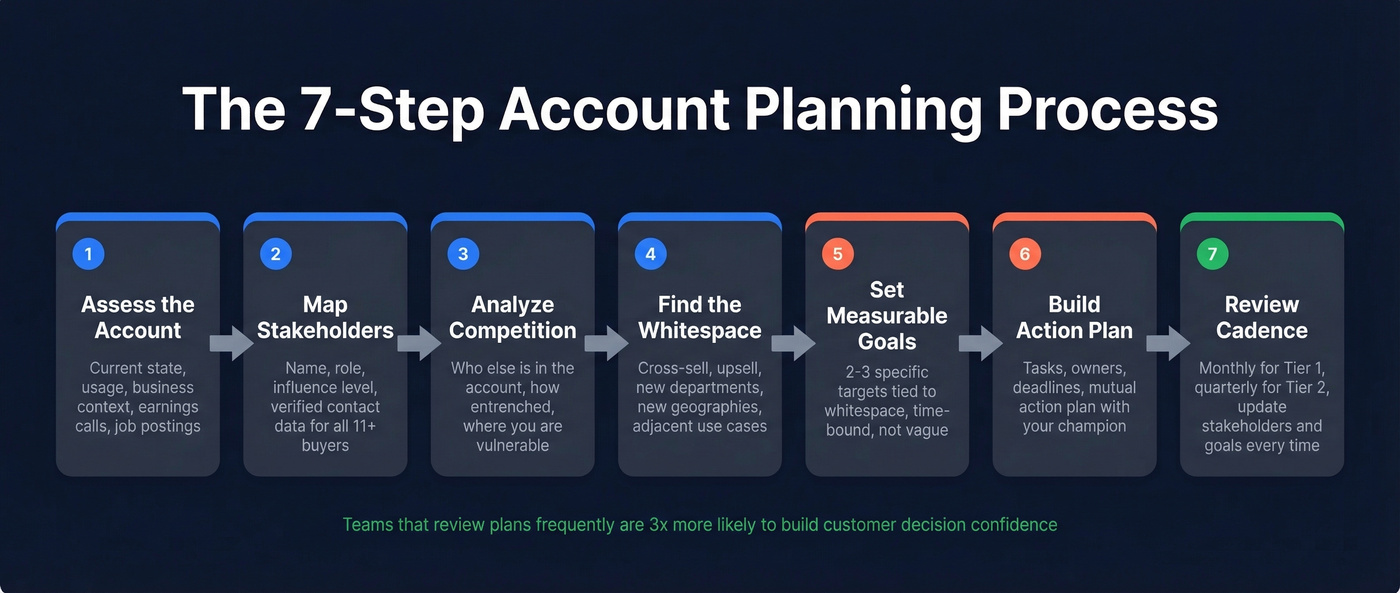
How to Build an Account Development Plan: 7 Steps
Step 1: Assess the Account
Start with the current state. What do they buy from you today? What's the contract value, renewal date, and product usage? What's happening in their business - are they growing, contracting, entering new markets, or dealing with leadership changes?
Pull their latest earnings call, press releases, and job postings. Job postings are an underrated signal: if they're hiring three data engineers, they're investing in infrastructure. That's an opportunity if you sell into that stack.
Step 2: Map Your Stakeholders
This is where most plans fail in practice. We've seen it repeatedly - teams build beautiful org charts with names and titles, then discover half the emails bounce and nobody has a direct dial for the new CFO.
Your stakeholder map needs four things for every contact: name, role, level of influence on the buying decision, and verified contact information. Not "contact info from 2023" - verified, current data.
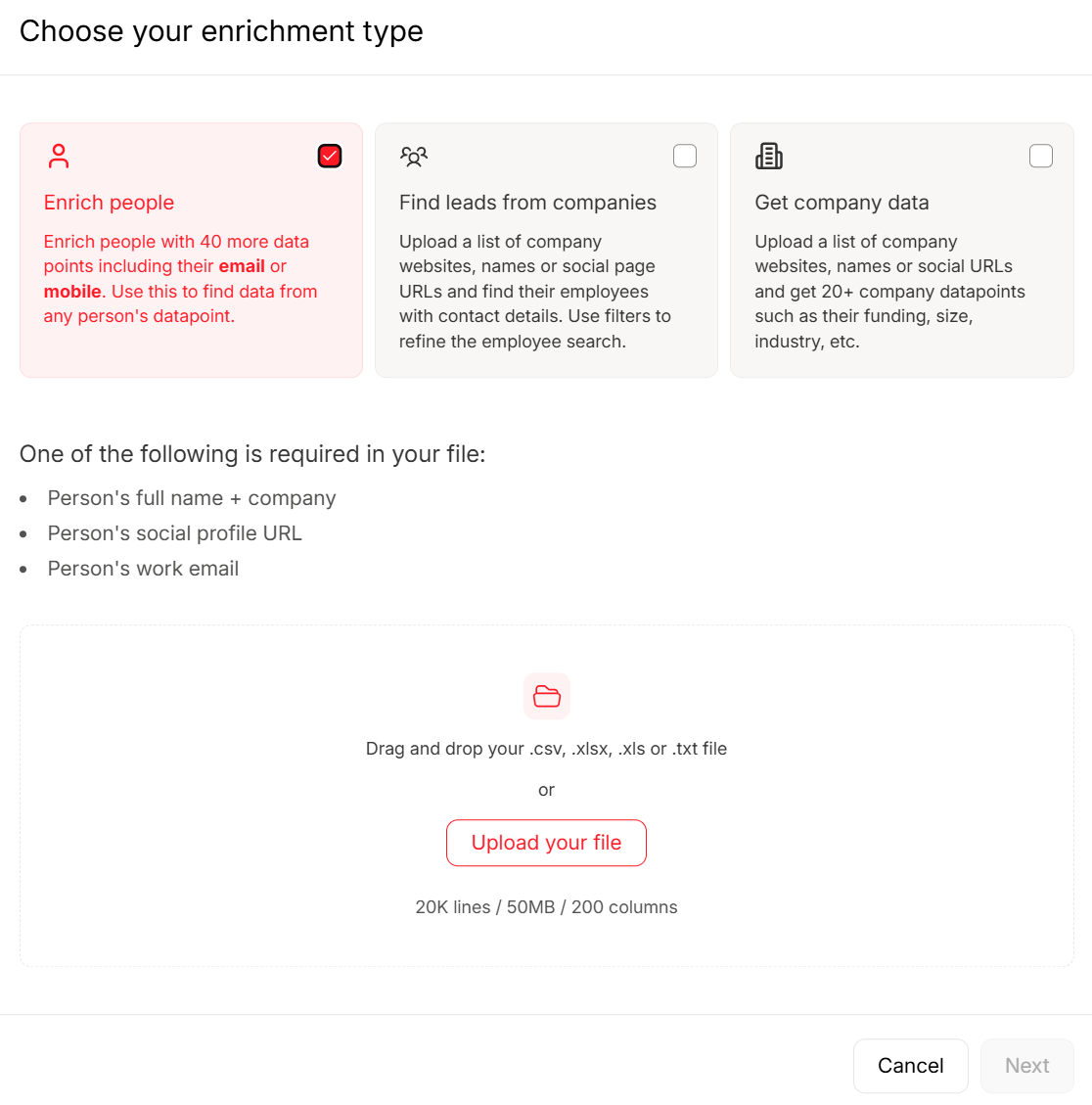
Prospeo makes this step executable. Upload your account list as a CSV, enrich it in minutes, and get verified emails and direct dials for the stakeholders you're targeting. With 300M+ professional profiles, 98% email accuracy, and a 7-day data refresh cycle, you're working with current information instead of whatever someone entered into Salesforce two years ago.
Map each stakeholder's role in the buying process: champion, decision-maker, influencer, blocker, or end user. Then identify the gaps. Who don't you know yet? Who's new to the organization? An 11-stakeholder deal with contact data for only three of them isn't a plan - it's a guess.
Step 3: Analyze the Competitive Landscape
Who else is in the account? What are they selling, and how entrenched are they? You need to know this before you propose anything.
Check their tech stack through tools like Wappalyzer or job postings, ask your champion directly, and review your CRM for competitive mentions from past conversations. The goal isn't a SWOT analysis - it's a clear-eyed view of where you're strong, where you're vulnerable, and where the competitor has a relationship you don't.
Step 4: Find the Whitespace
Whitespace is the gap between what the account buys today and what they could buy from you. Cross-sell opportunities, upsell paths, new departments, new geographies - this is where strategic planning creates revenue that pure account management misses.
Map your full product portfolio against the account's org chart. Which departments use your product? Which don't? Are there adjacent use cases nobody's pitched? Whitespace analysis helps you create demand in accounts where you already have trust, rather than waiting for them to raise their hand.
Step 5: Set Measurable Goals
"Grow the account" isn't a goal. "Expand from 3 departments to 5 by Q3, increasing ARR from $120K to $200K" is. Every account development plan needs specific, time-bound targets tied to the whitespace you uncovered.
Two untapped departments? The goal is penetrating them. Vulnerable incumbent? The goal is displacement. Keep it to 2-3 goals per account - more than that and nothing gets prioritized.
Step 6: Build the Action Plan
For each goal, define the specific actions, owners, and deadlines. A mutual action plan shared with your champion inside the account is even better - it creates joint accountability.
Include outreach sequences, meeting cadences, executive sponsorship activities, and content needs. If Step 2 revealed stakeholder gaps, the first action item is filling them.
Step 7: Set a Review Cadence
A plan that isn't reviewed regularly is just a document. Organizations with frequently updated account plans are 3x more likely to build customer decision confidence - and customers with high decision confidence are 10x more likely to make a low-regret purchase.
For Tier 1 accounts, review monthly. For Tier 2, quarterly. Every review should update the stakeholder map, reassess competitive positioning, check progress against goals, and adjust the action plan. If nothing's changed since the last review, either the plan is stale or you're not executing.
Account Plan Template
No gated PDF, no email required. Copy and adapt.
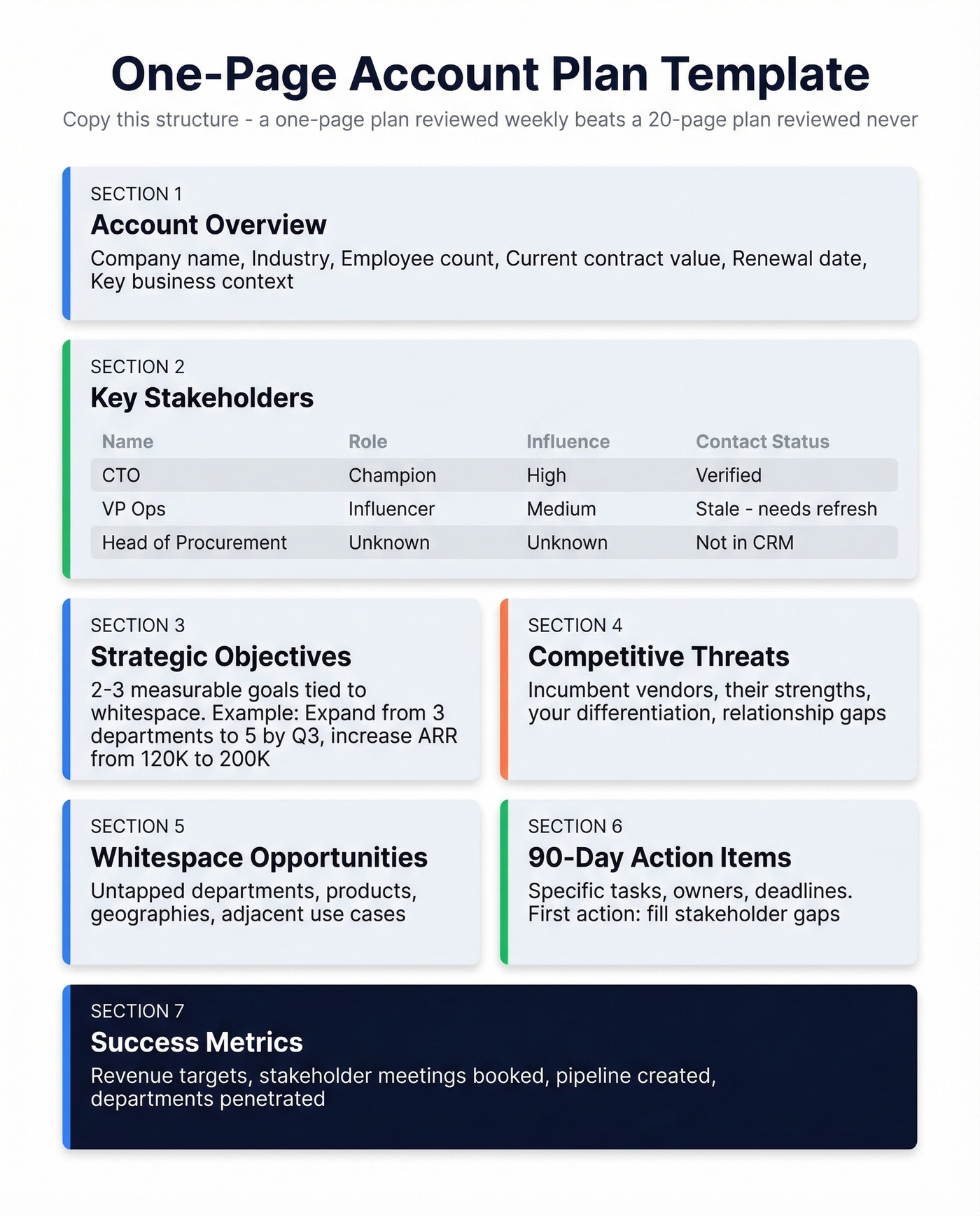
| Section | What to Include |
|---|---|
| Account overview | Company name, industry, size, current contract value, renewal date |
| Key stakeholders | Name, role, influence level, contact status (verified/stale/missing) |
| Strategic objectives | 2-3 measurable goals tied to whitespace |
| Competitive threats | Incumbent vendors, their strengths, your differentiation |
| Whitespace opportunities | Untapped departments, products, geographies |
| 90-day action items | Specific tasks, owners, deadlines |
| Success metrics | Revenue targets, stakeholder meetings booked, pipeline created |
Filled Example: TechSolutions to GlobalCorp
Account overview: GlobalCorp, manufacturing, 5,000 employees, current contract $85K/year (analytics module only), renews in Q3.
Key stakeholders: CTO (champion, verified), VP Operations (influencer, email stale - needs refresh), new Head of Procurement (unknown - not in CRM), CFO (decision-maker, no direct dial).
Strategic objectives: Expand from analytics to AI-driven operations suite by Q3, increasing ARR to $180K. Secure executive sponsorship from VP Operations.
Competitive threats: Legacy BI vendor entrenched in finance department with strong CFO relationship.
Whitespace: Operations department running manual processes aligned with our automation product. Supply chain team evaluating new tools per recent job postings.
90-day actions: Enrich all stakeholder contacts (Week 1). Schedule intro with Head of Procurement (Week 2). Deliver ROI analysis for operations automation (Week 4). Executive alignment meeting with VP Operations (Week 6).
Success metrics: $180K pipeline created, 3 new stakeholder relationships established, operations pilot agreed by end of Q2.
Quick glossary: Whitespace = untapped revenue opportunity within an existing account. Stakeholder mapping = identifying every person involved in the buying decision and their role. Account health score = composite metric tracking engagement, usage, and relationship strength. Executive sponsorship = senior leader on your side who advocates internally.
Mistakes That Kill Account Plans
1. No alignment with the sales plan. If the account plan lives in a separate doc from your pipeline and forecast, it's decorative. Tie plan goals directly to quota targets.
2. Not understanding the customer's business. You can't plan strategically for an account you don't understand. Read their 10-K, follow their news, know their competitive pressures.
3. No clear purpose statement. "Because leadership asked for it" isn't a purpose. "To expand from $85K to $180K by Q3" is.
4. Too many goals. Three goals, max. Five means nothing gets done.
5. Insufficient stakeholder collaboration. A plan built by one AE in isolation misses CS insights, product feedback, and executive relationships. Make it cross-functional.
6. No measurable targets. "Deepen the relationship" isn't measurable. "Book meetings with 3 new stakeholders by end of month" is.
7. No accountability or review cadence. In our experience, this is the most common mistake - and the hardest to fix. Leadership asks for plans without defining what "good" looks like, then wonders why nobody opens them after Q1. Build in monthly reviews with specific check-in questions, and assign someone to own the follow-up. Otherwise the plan is just a prettier version of the spreadsheet it replaced.
AI-Powered Account Planning in 2026
McKinsey estimates AI-driven sales productivity improvements of 3-5%, with personalization driving 5-8% revenue lifts. Those numbers compound when applied to your highest-value accounts.
Here's what the practical components of an AI-powered plan look like:
- Unified signal layer: CRM data + product usage + support tickets + billing, all in one view
- Propensity models: Which accounts are most likely to expand, churn, or respond to a specific offer?
- Next-best-action playbooks: AI recommends the right outreach at the right time based on account signals
- AI-assisted mutual action plans: Auto-generated MAPs based on deal stage and stakeholder engagement
- Pricing guardrails: CPQ-integrated rules that prevent over-discounting during expansion conversations
- Stakeholder graphs: Automated multi-threading recommendations based on org chart changes and engagement gaps
Intent data adds another dimension. Tracking topics your accounts are actively researching lets you prioritize accounts showing real buying behavior - not just the ones with the biggest logos. Tools like Prospeo surface Bombora-powered intent signals across 15,000 topics, so you can layer buying intent on top of your tiering model and catch accounts moving into market before competitors do.
Let's be honest about where we are: in 2026, account plans aren't documents you write once. They're living systems that update as signals change, flag risks before they become churn, and surface opportunities before competitors see them.
Tools & Software for Account Planning
You don't need a dedicated platform to start - a well-structured template in your existing CRM works for most teams. But as you scale, purpose-built tools add real value.
| Tool | Best For | Starting Price |
|---|---|---|
| Salesforce | CRM foundation | ~$25/user/mo |
| Prospeo | Contact data accuracy | Free tier; ~$0.01/email |
| DemandFarm | Dedicated KAM | Custom (typically $1,000-5,000+/mo) |
| Altify | Enterprise KAM | Custom (typically $1,000-5,000+/mo) |
| Kapta | Mid-market KAM | Custom (typically $1,000-3,000+/mo) |
| Apollo | Outbound prospecting | ~$49/user/mo |
| Pipedrive | Lightweight CRM | ~$14/user/mo |
Salesforce is the default CRM for most mid-market and enterprise teams. It doesn't have native account planning features, but it's the data backbone. Layer a KAM tool on top for visual org charts, whitespace maps, and plan tracking.
DemandFarm and Altify are dedicated key account management platforms. DemandFarm integrates with Salesforce and offers visual account maps and plan templates. Altify (now part of Upland) focuses on enterprise deal management inside Salesforce. Both require annual contracts - expect to talk to sales.
Kapta targets mid-market teams that want KAM functionality without enterprise complexity. It's lighter than DemandFarm but covers the essentials: account mapping and plan templates.
Apollo combines a prospecting database with outbound workflows. At $49/user/mo, it's a solid option for teams that want outbound prospecting and basic account coverage in one tool, though it lacks the deep KAM features of DemandFarm or Altify.
Pipedrive works for smaller teams that need a CRM with enough structure to support basic planning. At $14/user/mo, it's the budget option - pair it with a solid template and you're functional.
The recommendation is simple. Enterprise teams on Salesforce should layer in DemandFarm or Altify for dedicated KAM. Mid-market teams do well with Kapta or Pipedrive plus a structured template. Regardless of your CRM, pair it with a data enrichment tool so your stakeholder maps actually reflect reality - stale contact data is the single fastest way to kill an otherwise good plan. If you're evaluating providers, start with a shortlist of data enrichment tool options.
You just scored and tiered your top accounts. Now you need verified contact data for every stakeholder in the buying committee. Upload your CSV to Prospeo and get 50+ data points per contact at $0.01/email - no contracts, no sales calls.
Multi-thread every key account with contacts that actually connect.
FAQ
What's the difference between account planning and account management?
Account management handles the day-to-day relationship - support, delivery, renewals, issue resolution. Account planning is the strategic layer on top: analyzing growth opportunities, mapping stakeholders, setting expansion targets, and building a roadmap to increase account value. One maintains revenue; the other grows it.
How often should you update an account plan?
Tier 1 accounts need monthly reviews - organizations with frequently updated plans are 3x more likely to build customer decision confidence. Tier 2 accounts warrant quarterly check-ins. An annual plan reviewed once is just a filing exercise that adds zero pipeline value.
What should a good account plan include?
At minimum: a stakeholder map with verified contact data, competitive landscape analysis, whitespace opportunities, 2-3 measurable goals, 90-day action items with owners and deadlines, and a defined review cadence. Skip anything that doesn't drive a specific action.
How do you keep stakeholder data accurate?
Use a B2B data platform with a short refresh cycle. A 7-day refresh - compared to the 6-week industry average - keeps emails and direct dials current. Enrich your account lists monthly at minimum; stale data is one of the biggest execution killers in account planning.
Do small teams need account plans?
Yes, but lighter ones. A 5-rep team needs Tier 1 plans for 3-5 top accounts, not 20-page documents for every customer. Use the ICP scoring model to identify which accounts warrant the investment, build one-page plans for those, and review them monthly. The discipline matters more than the document length.