

Account Planning Examples That Aren't Just Blank Templates
Every "account planning template" article hands you a pretty PDF with empty boxes. You download it, stare at it, and realize you still don't know what a good account plan actually looks like when it's filled in. Fewer than 20% of companies have fully embedded account planning into their operations - and we think the biggest reason is simple: nobody shows real examples with real data. Teams with structured plans close 28% faster, but you can't get there with a blank SWOT grid and good intentions.
Here are three complete account plans you can steal, adapt, and use this week.
Three Plans You Can Steal Today
Example 1: Full Strategic Account Plan
You're an AE at CloudOps, a $40M ARR infrastructure monitoring platform, pursuing a strategic expansion inside Meridian Financial Group. You've got a $180K footprint in DevOps and a $600K expansion target across IT, Security, and Compliance.
Account Snapshot
| Field | Detail |
|---|---|
| Account | Meridian Financial Group |
| Industry | Financial services ($8.2B rev) |
| Current ARR | $180K (DevOps) |
| Expansion target | $600K (12 months) |
| Champion | Priya Sharma, VP DevOps |
Rather than cramming this into a 2x2 table that's unreadable on mobile, here's how a real SWOT looks when it has dates and evidence behind it:
Strengths: Strong ROI proof in DevOps - 42% incident reduction since deployment. Champion (Priya) actively advocates internally. Product roadmap aligns with their compliance needs.
Weaknesses: No relationship outside DevOps. Pricing perceived as high vs. incumbent. Implementation team stretched thin through Q2.
Opportunities: Meridian is under regulatory pressure to modernize their observability stack. CTO publicly committed to "platform consolidation" in the Q4 2025 earnings call - that's your opening.
Threats: Datadog has an enterprise agreement in place. New CISO starts Q2 with an unknown stance. Budget freeze possible if Q1 earnings miss.
Here's the thing: share this SWOT with your champion and ask, "Does this look right? What are we missing?" We've seen that single conversation surface more intelligence than a month of desk research. Stakeholder Map
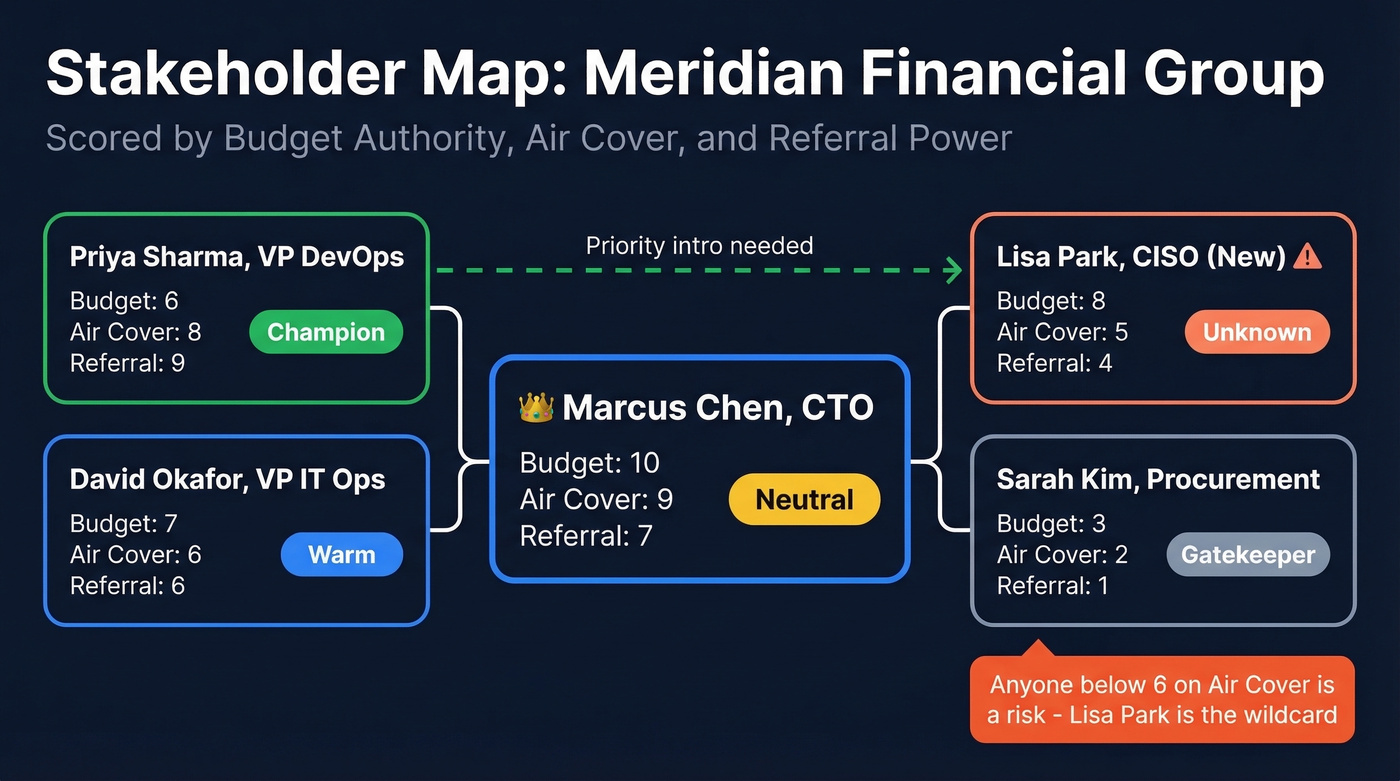
B2B deals now involve an average of 11 stakeholders. Score each one so you know where to invest time. The "Three Handshakes Rule" applies: if you can't reach a stakeholder within three introductions from your champion, you need a different path in.
| Stakeholder & Title | Budget Authority (0-10) | Air Cover (0-10) | Referral Power (0-10) | Status |
|---|---|---|---|---|
| Priya Sharma, VP DevOps | 6 | 8 | 9 | Champion |
| Marcus Chen, CTO | 10 | 9 | 7 | Neutral |
| Lisa Park, CISO (new) | 8 | 5 | 4 | Unknown |
| David Okafor, VP IT Ops | 7 | 6 | 6 | Warm |
| Sarah Kim, Procurement | 3 | 2 | 1 | Gatekeeper |
Anyone scoring below 6 on air cover is a risk. Lisa Park is the wildcard - getting Priya to make an introduction before Lisa forms her own vendor opinions is the single highest-priority action on this entire plan.
Action Plan
| Action | Owner | Due | Status |
|---|---|---|---|
| Priya to Lisa intro meeting | AE + Priya | Apr 15 | Pending |
| ROI case study for CTO | SE team | Apr 30 | In progress |
| Security compliance demo | Solutions eng | May 10 | Not started |
| Executive sponsor alignment | VP Sales | May 15 | Not started |
| Procurement pre-negotiation | AE | Jun 1 | Not started |
Track the value you're creating as you go - revenue gained, cost avoided, risk reduced. This "evidence ledger" becomes your ammunition when procurement pushes back on price.
Example 2: Lightweight Account Plan
A common complaint on r/CustomerSuccess about account planning? It's "incredibly time-consuming" and requires constant updates. If you're a solo CSM at a startup, you don't need a 40-slide deck. You need five fields in a Google Sheet.
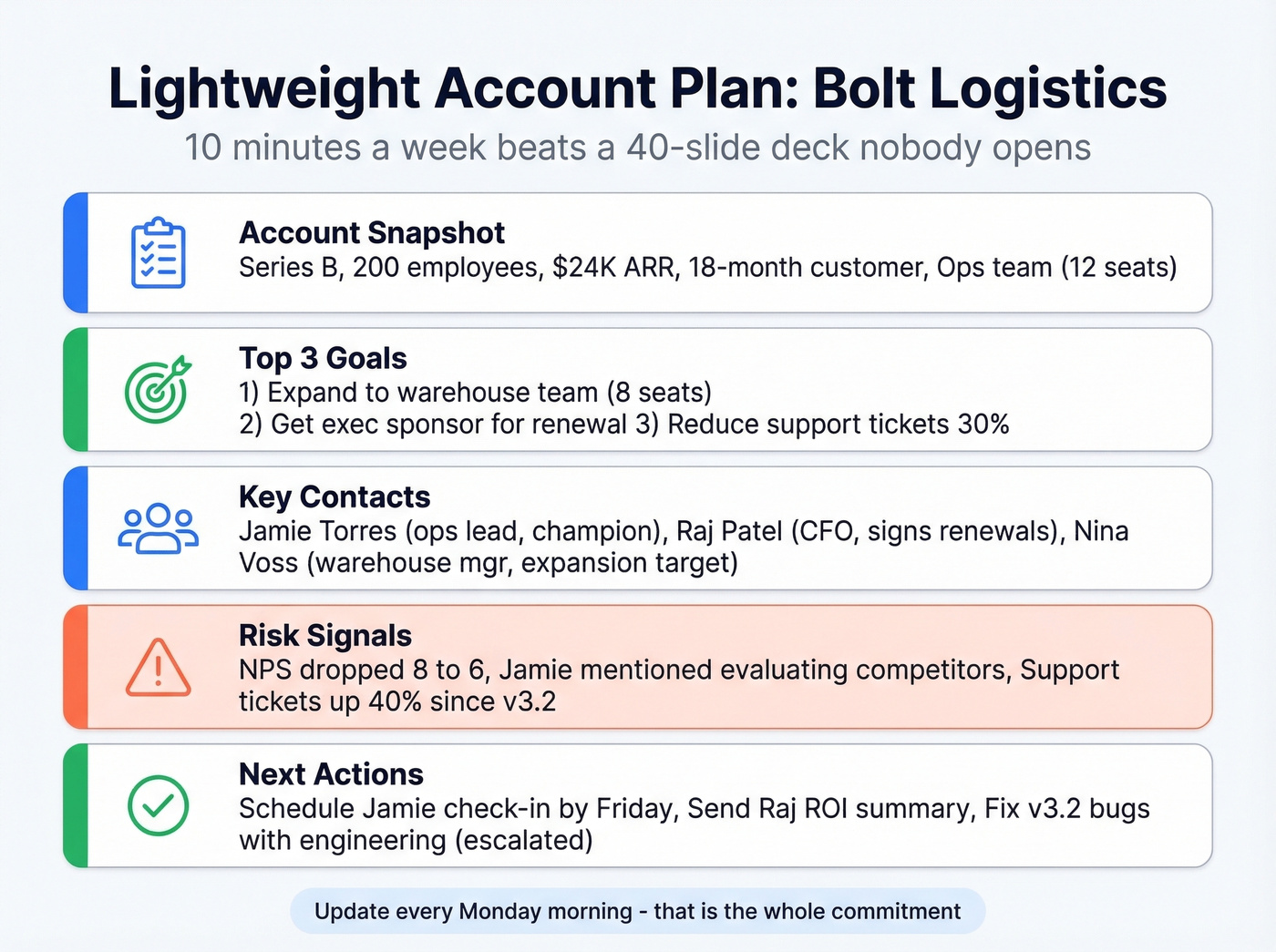
| Field | Example (Filled In) |
|---|---|
| Account Snapshot | Bolt Logistics, Series B, 200 employees. $24K ARR, 18-month customer. Primary user: ops team (12 seats). |
| Top 3 Goals | 1) Expand to warehouse team (8 seats). 2) Get exec sponsor for renewal. 3) Reduce support tickets 30%. |
| Key Contacts | Jamie Torres (ops lead, champion). Raj Patel (CFO, signs renewals). Nina Voss (warehouse mgr, expansion target). |
| Risk Signals | NPS dropped from 8 to 6. Jamie mentioned evaluating competitors. Support tickets up 40% since v3.2 release. |
| Next Actions | Schedule Jamie check-in by Friday. Send Raj ROI summary. Fix v3.2 bugs with engineering (escalated). |
A messy Google Sheet updated every Monday morning beats a beautiful 40-slide deck nobody opens after QBR. Ten minutes a week keeps this current. That's the whole commitment.
Example 3: Signal-Led Account Plan
Static account plans die the moment they're finished. The modern approach, outlined well by OrbitShift, builds your plan around real-time signals instead of stale company data. Only 5% of B2B accounts are actively in-market at any given time. Signals help you find that 5%.
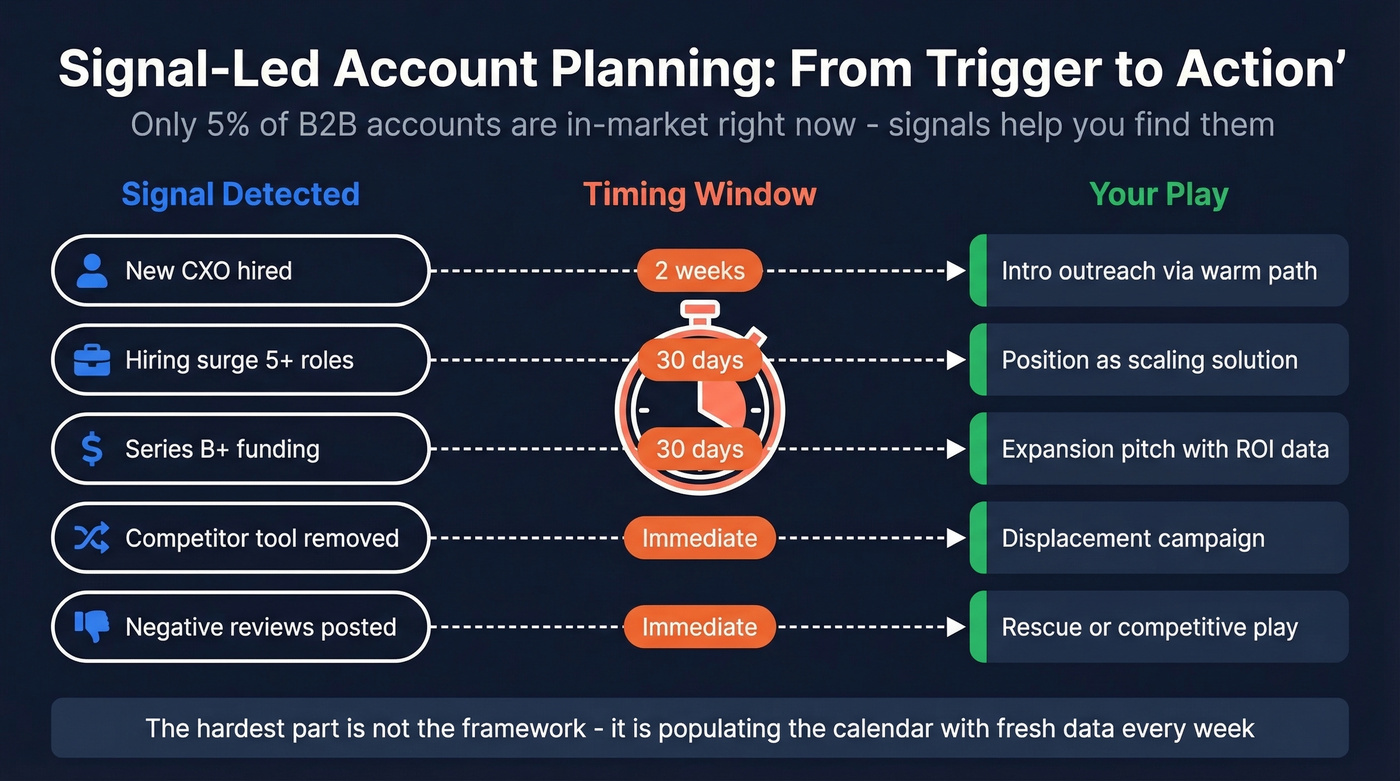
Trigger & Signal Calendar
| Signal Type | What to Track | Action If Triggered |
|---|---|---|
| Leadership change | New CXO in target dept | Intro outreach within 2 weeks |
| Hiring surge | 5+ open roles in target function | Position as scaling solution |
| Funding round | Series B+ or debt raise | Expansion pitch within 30 days |
| Tech stack change | Competitor tool removed | Displacement campaign |
| Dissatisfaction | Negative reviews, support complaints | Rescue/competitive play |
The hardest part of signal-led planning isn't the framework - it's populating the calendar with fresh data. Tools like Prospeo track 15,000 intent topics and refresh data every 7 days, so your signal calendar reflects what's happening now, not last quarter. When a signal fires and you need to reach the right stakeholder fast, verified emails and direct dials mean you're not wasting the timing advantage on bounced messages.
7 Elements Every Account Plan Needs
Whether you use the full strategic version or the lightweight one, Smartsheet's framework nails the essentials. Here's what each element looks like when it's done right versus when it's phoned in:
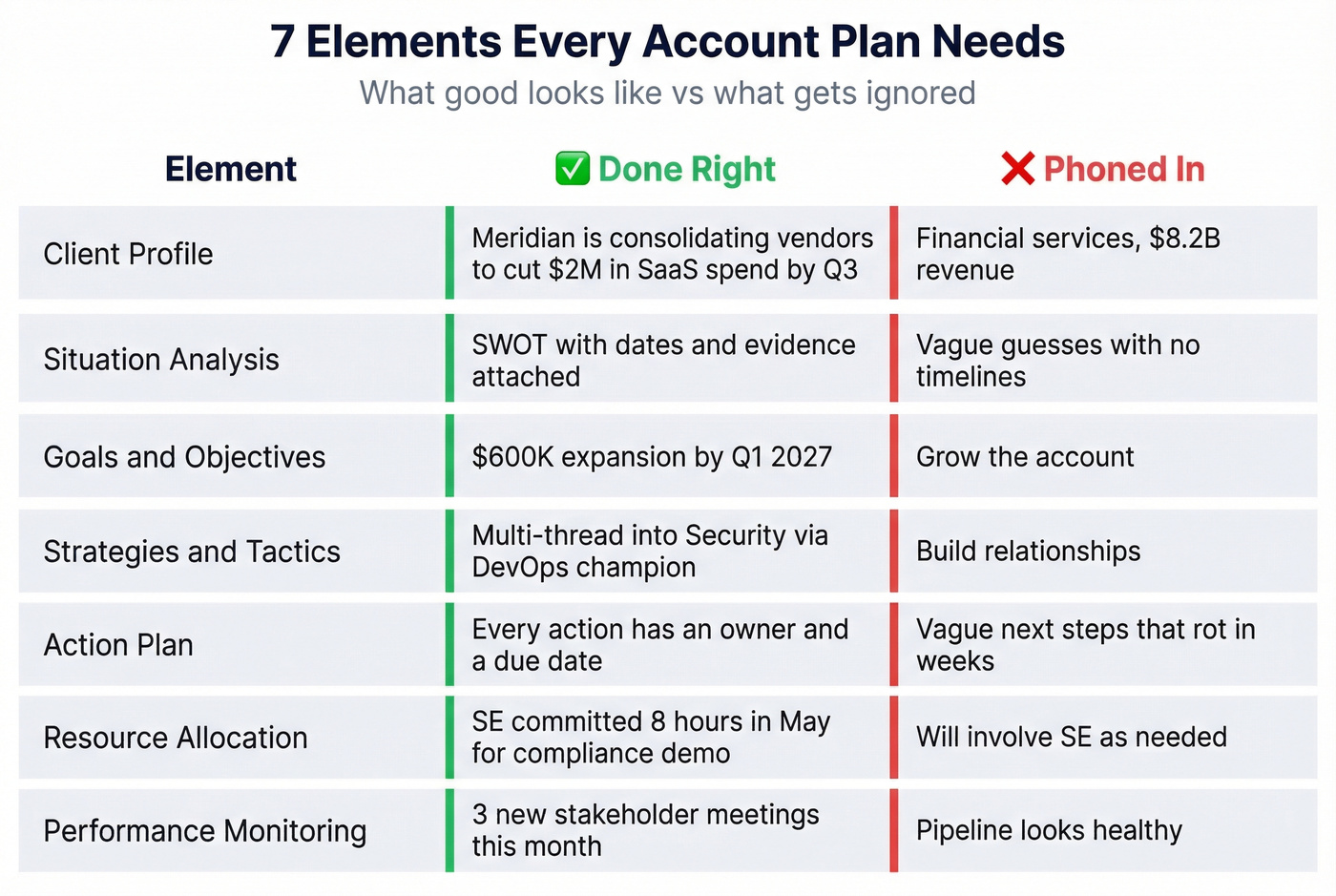
- Client Profile - Their strategic priorities, not just their revenue. Good: "Meridian is consolidating vendors to cut $2M in SaaS spend by Q3." Bad: "Financial services, $8.2B revenue."
- Situation Analysis - SWOT with dates and evidence, not vague guesses. If your threats don't have timelines, they're wishes.
- Goals & Objectives - "$600K expansion by Q1 2027" beats "grow the account."
- Strategies & Tactics - Multi-thread into Security via the DevOps champion, not "build relationships." For a tighter approach, borrow a few account-based strategies.
- Action Plan - Every action has an owner and a due date. No exceptions.
- Resource Allocation - Who's involved from your side? Good: "SE committed 8 hours in May for compliance demo." Bad: "Will involve SE as needed."
- Performance Monitoring - Gartner research shows intelligent information drives purchase ease by 3.0x. Track leading indicators like meetings booked and stakeholders mapped, not just lagging ones like revenue. Good: "3 new stakeholder meetings this month." Bad: "Pipeline looks healthy." If you want a clean way to operationalize this, start with pipeline health.

Your stakeholder map is useless if you can't actually reach the people on it. Prospeo gives you 98% accurate emails and 125M+ verified mobile numbers - so when your signal fires or your champion makes that intro, you connect on the first attempt, not the fifth.
Stop mapping stakeholders you can't reach.
How to Pick Which Accounts Deserve Plans
Not every account deserves a plan. Reps who try to plan 20 accounts end up with 20 bad plans instead of 5 good ones. Up to 77% of revenue growth comes from account-based strategies - but only when those strategies are focused.
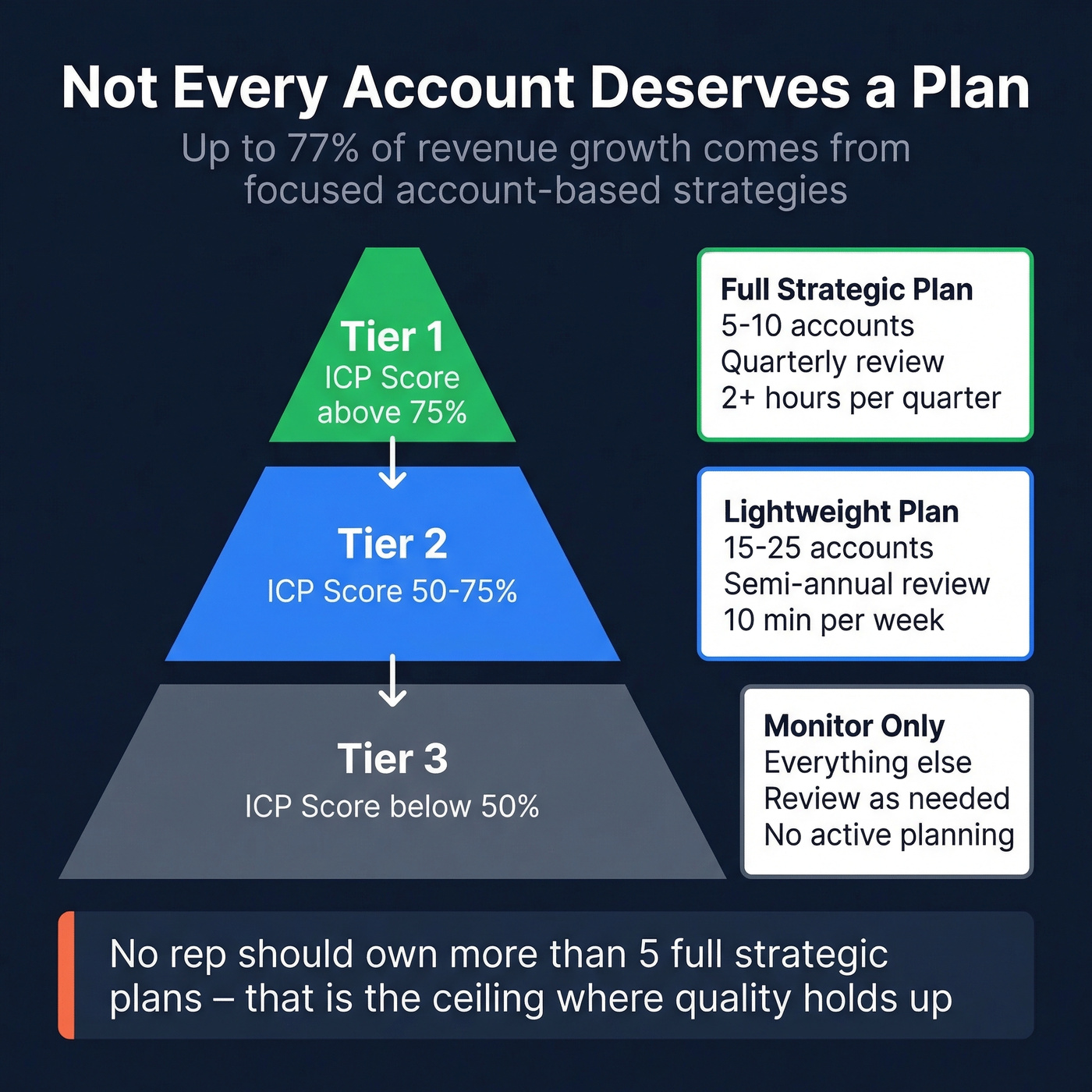
Let's be honest: if your average deal size is under $25K, you probably don't need the full strategic plan at all. The lightweight version will outperform a half-baked strategic plan every time. Save the full treatment for accounts where the expansion potential justifies 2+ hours of planning per quarter. If you need a quick way to decide which accounts qualify, use an ICP Score.
| ICP Score | Plan Type | Review Cadence |
|---|---|---|
| >75% | Full strategic plan | Quarterly |
| 50-75% | Lightweight plan | Semi-annually |
| <50% | Monitor only | As needed |
Aim for 5-10 Tier 1 accounts with full plans, 15-25 Tier 2 with lightweight plans, and everything else on a watch list. No rep should own more than 5 full strategic plans. That's the ceiling where quality holds up.
Mistakes That Kill Account Plans
In our experience, these are the patterns that separate plans driving revenue from plans collecting dust:
- Make it a living conversation - not a mandated check-the-box exercise. The moment it feels like homework, reps stop updating it.
- Plan 5 accounts well - not 25 accounts poorly. Don't boil the ocean.
- Focus on the client's world - not your org chart and product features. Your champion doesn't care about your internal team structure. This is also where discovery questions keep plans grounded in reality.
- Update weekly in a shared doc - not a polished deck refreshed once a quarter. We've watched teams lose six-figure deals because their "current" plan was three months stale.
- Assign owners and due dates - not vague "next steps" that rot within weeks. If you need a simple system for consistent execution, borrow a few sales activities.
Skip the full strategic plan if you're managing more than 10 accounts solo. You'll spend all your time planning and none of it executing. Start with the lightweight version, prove the habit, then graduate your top accounts to the full framework.
Signal-led account plans die without fresh data. Prospeo refreshes every 7 days - not every 6 weeks - and tracks 15,000 intent topics so your trigger calendar reflects reality. Layer buyer intent with job changes, funding rounds, and tech stack signals to find the 5% of accounts actually in-market.
Turn your account plan from a static doc into a live pipeline engine.
FAQ
How often should you update an account plan?
Use the 3-4x rule: your plan period should be 3-4 times your typical sales cycle. Three-month deals mean quarterly reviews. Tier 1 accounts get quarterly reviews minimum; Tier 2 accounts can go semi-annually.
What's the difference between an account plan and a success plan?
An account plan is your internal playbook for what you want to achieve with the account. A success plan is customer-facing, focused on helping them hit their goals with your product. Don't combine them - internal strategy and customer-facing deliverables serve different audiences.
Should account plans be living documents or snapshots?
Living documents win every time. A messy shared Google Sheet updated weekly captures real-time intelligence that a polished quarterly deck never will. Plans that don't evolve with the account become fiction within 30 days.
Do I need a different template for existing customers?
Yes. Post-sale plans emphasize retention, expansion, and health scores rather than initial discovery and competitive positioning. The lightweight example above works well as a starting point - swap "Risk Signals" for a health-score tracker and add renewal dates.
How do you find verified contact data for stakeholders in your plan?
Use a B2B data platform with verified emails and direct dials. Prospeo covers 300M+ profiles with 98% email accuracy and refreshes data every 7 days, so your stakeholder map stays current. Layer in intent signals to prioritize outreach to contacts actively researching relevant solutions.