

The Account Planning Template That Actually Gets Used (2026)
It's Q2 and you just realized your biggest account's VP of Engineering left two months ago. Nobody updated the plan. The org chart in your "strategic account plan" still shows a champion who now works at a competitor.
Sound familiar?
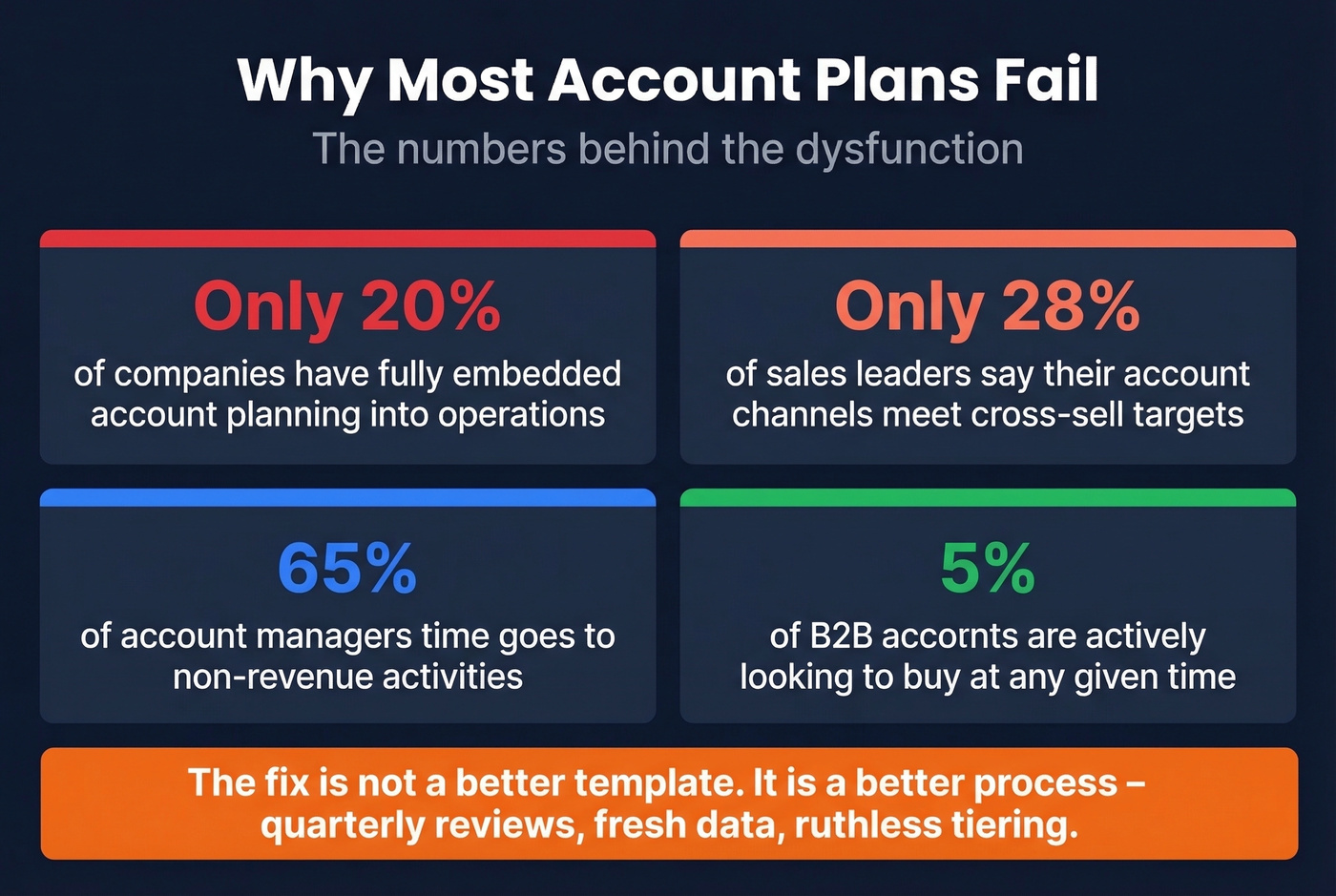
This is how most account planning templates die - not with a bang, but with stale data and good intentions. Fewer than 20% of companies have fully embedded account planning into their business operations. The other 80% build plans that collect dust or, worse, actively mislead the reps who reference them.
The core problem isn't the template itself. It's that plans get treated as admin busywork instead of living strategy documents. Over on r/CustomerSuccess, practitioners describe the process as a "scavenger hunt for minute details that could be found in our CRM" rather than actual strategic thinking. That tracks with what we've seen across dozens of sales orgs.
You don't need 12 templates. You need one good one and the discipline to update it. Here's the template, a filled-in example, and the process to keep it alive past March.
The Quick Version
If you've got 30 seconds, here's what a working account plan requires:
- 7 sections: Client profile, situation analysis, goals, strategies, action plan, resources, performance monitoring
- A tiering system: Full plans only for accounts above ~$30K ACV
- A quarterly review cadence: Monthly 15-minute check-ins, quarterly 60-minute deep dives
- A stakeholder map that's actually current - not the org chart from your onboarding deck
- A whitespace grid: Business units x your products, with honest labels
- A way to keep stakeholder data fresh (we run contacts through Prospeo's enrichment before each review)
- Ownership: One person per account plan, not a committee
Account Planning vs. Account Management
These terms get used interchangeably, and that's a problem - they're different jobs entirely.
| Account Planning | Account Management | |
|---|---|---|
| Focus | Strategic roadmap | Day-to-day relationship |
| Cadence | Periodic (quarterly) | Continuous |
| Output | Growth strategy document | Satisfaction + retention |
| Timeframe | 12-18 months forward | This week, this month |
Account planning is the strategic layer that sits on top of account management. It's where you decide how to grow the relationship, not just maintain it. The economics justify the effort: in the financial sector, a [5% increase in customer retention](https://hbr.org/2014/10/the-value-of-keeping-the-right-customers) drives a 25% increase in profit, and existing customers are 50% more likely to try new products and spend 31% more than new customers. Companies with structured planning also see 28% faster sales cycles and 35% higher close rates.
Don't make the mistake of treating strategic account planning as a heavier version of account management. It's a different activity entirely.
Which Accounts Deserve a Full Plan
Not every account needs a 10-page strategic plan. Most don't.
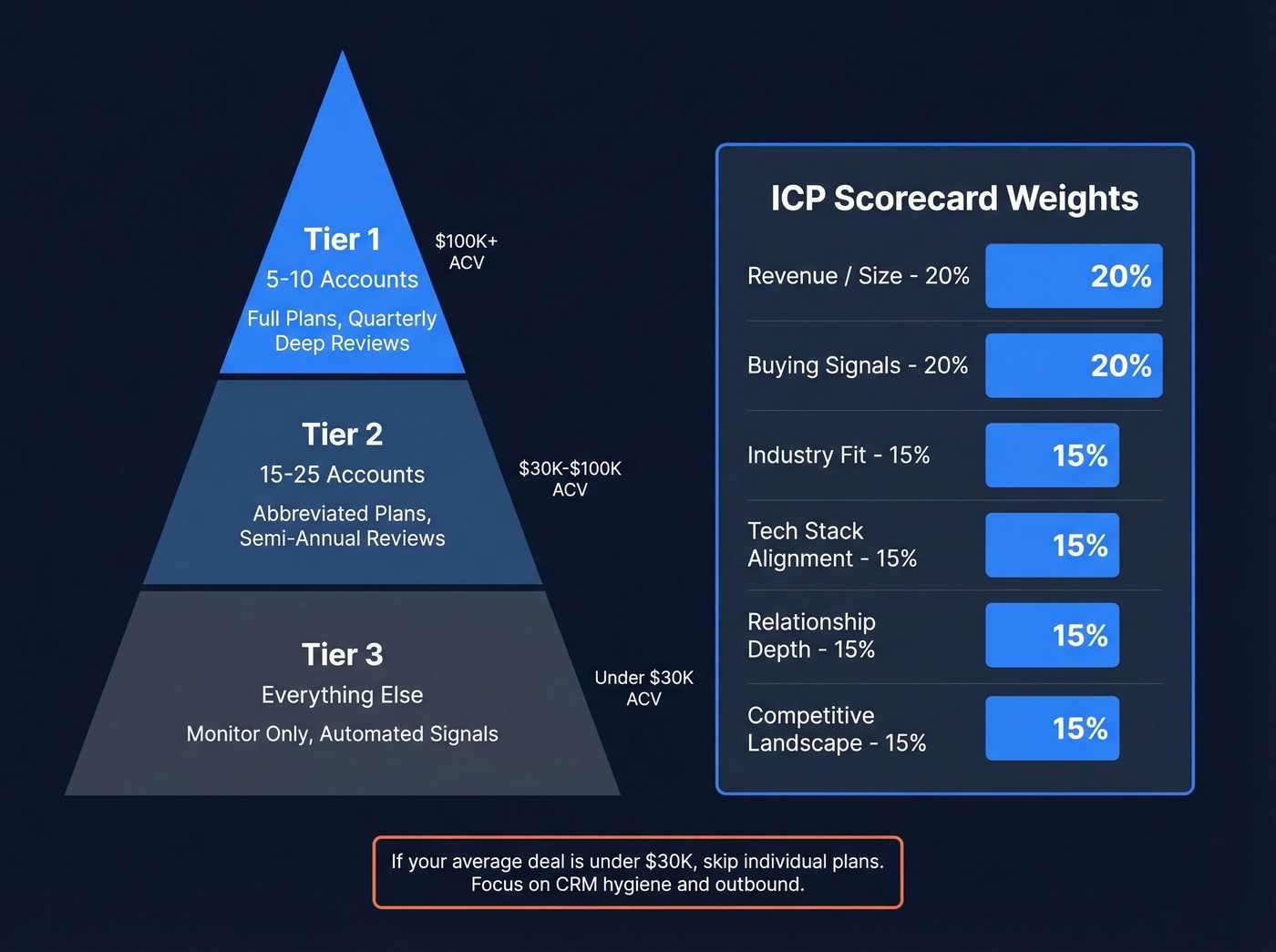
Start with an ICP scorecard. Weight it like this: revenue/size (20%), buying signals (20%), industry fit (15%), tech stack alignment (15%), relationship depth (15%), competitive landscape (15%). Score every account, then tier them.
Tier 1 (5-10 accounts): Full account plans with quarterly deep reviews. These are your biggest expansion opportunities - the accounts where a single deal can move your number.
Tier 2 (15-25 accounts): Abbreviated plans with semi-annual reviews. Cover the stakeholder map, whitespace, and top three initiatives. Skip the detailed SWOT.
Tier 3 (everything else): Monitor only. No individual plans. Use automated signals - job changes, funding rounds, intent spikes - to flag when a Tier 3 account should move up.
Here's the thing: if your average deal is under $30K, you probably don't need individual account plans at all. You need better CRM hygiene and a solid outbound motion. Account planning produces positive ROI when the deal size justifies the hours. For four-figure deals, it doesn't. Only 5% of B2B accounts are actively looking to buy at any given time, so your tiering system should focus your energy on the ones that matter most.
Your Template: 7 Sections
The backbone comes from Smartsheet's framework, adapted based on what we've seen actually get used versus what gets skipped.
Client Profile & Stakeholder Map
The client profile is straightforward: company overview, industry, revenue, headcount, tech stack, current products, contract renewal dates.
The stakeholder map is where plans shine or fall apart. Map every person involved in buying decisions: champion, economic buyer, technical evaluator, blocker, end user. An average B2B deal involves 11 stakeholders - sometimes up to 20. If your plan lists three names, you're flying blind. Before each quarterly review, run your contact list through an enrichment tool to catch job changes and get verified emails. Stale org charts are the number one plan killer, and we've watched teams lose six-figure renewals because nobody noticed a champion had quietly moved on three months earlier.
Situation Analysis
Run a SWOT for the account - not for your company, for theirs. What are their strengths, weaknesses, opportunities, and threats? Layer in your competitive position: who else is selling to them, what's the incumbent stack, when do competitor contracts renew?
The best plans include competitor renewal dates. That's your timing signal.
Goals & Objectives
Be specific. "Grow the account" isn't a goal. "$220K in new ACV by Q4 through expanding into the engineering org" is. Make every goal measurable and time-bound, tied to specific whitespace. Set goals in three categories: solving a client pain point, capturing whitespace, and deepening relationships.
Strategies & Tactics
This is where the whitespace grid lives. Build a simple matrix: business units across the top, your products down the side. Label each cell:
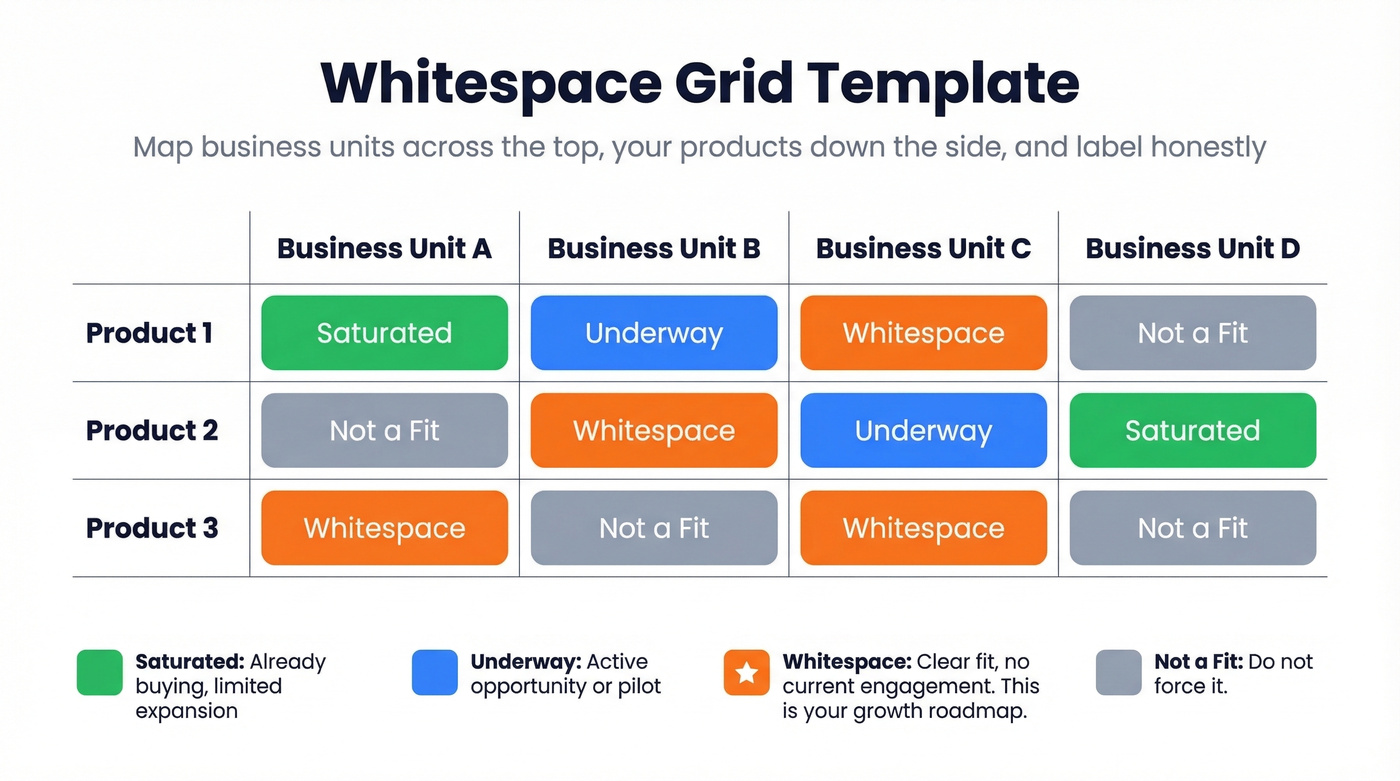
- Saturated - already buying, limited expansion
- Underway - active opportunity or pilot
- Whitespace - clear fit, no current engagement
- Not a Fit - don't force it
The whitespace cells are your growth roadmap. For teams running account-based marketing alongside their plan, the whitespace grid tells marketing exactly where to focus air cover - which business units need awareness campaigns and which need bottom-funnel content.
Action Plan
Actions need owners, due dates, and milestones. "Schedule QBR with VP of Ops" isn't an action plan - "Sarah schedules QBR with VP of Ops by March 15; agenda includes infrastructure expansion proposal" is.
65% of account managers' time goes to non-revenue activities, so cap your plan at 5-8 actions per quarter. Prioritize ruthlessly.
Resource Allocation
Who's working this account and what budget do you have? List the team (AE, CSM, SE, executive sponsor) and any ABM spend allocated. If your organization uses a go-to-market strategy template - whether it's a McKinsey-style framework or something homegrown - align your account-level resource allocation with the broader GTM priorities so you're not pulling budget from higher-priority motions.
Performance Monitoring
Define 3-5 KPIs using the ITSMA "3R" framework: Reputation (brand perception within the account), Relationships (stakeholder engagement depth), and Revenue (pipeline, closed-won, expansion). Review monthly for 15 minutes. Go deep quarterly for 60 minutes.

Stale org charts kill account plans. Prospeo's enrichment returns 50+ data points per contact at a 92% match rate - job changes, verified emails, direct dials - so your stakeholder map reflects reality, not last quarter's onboarding deck.
Run your account contacts through Prospeo before every quarterly review.
Worked Example: GlobalCorp
Let's walk through a completed plan so you can see what this looks like with real values filled in.
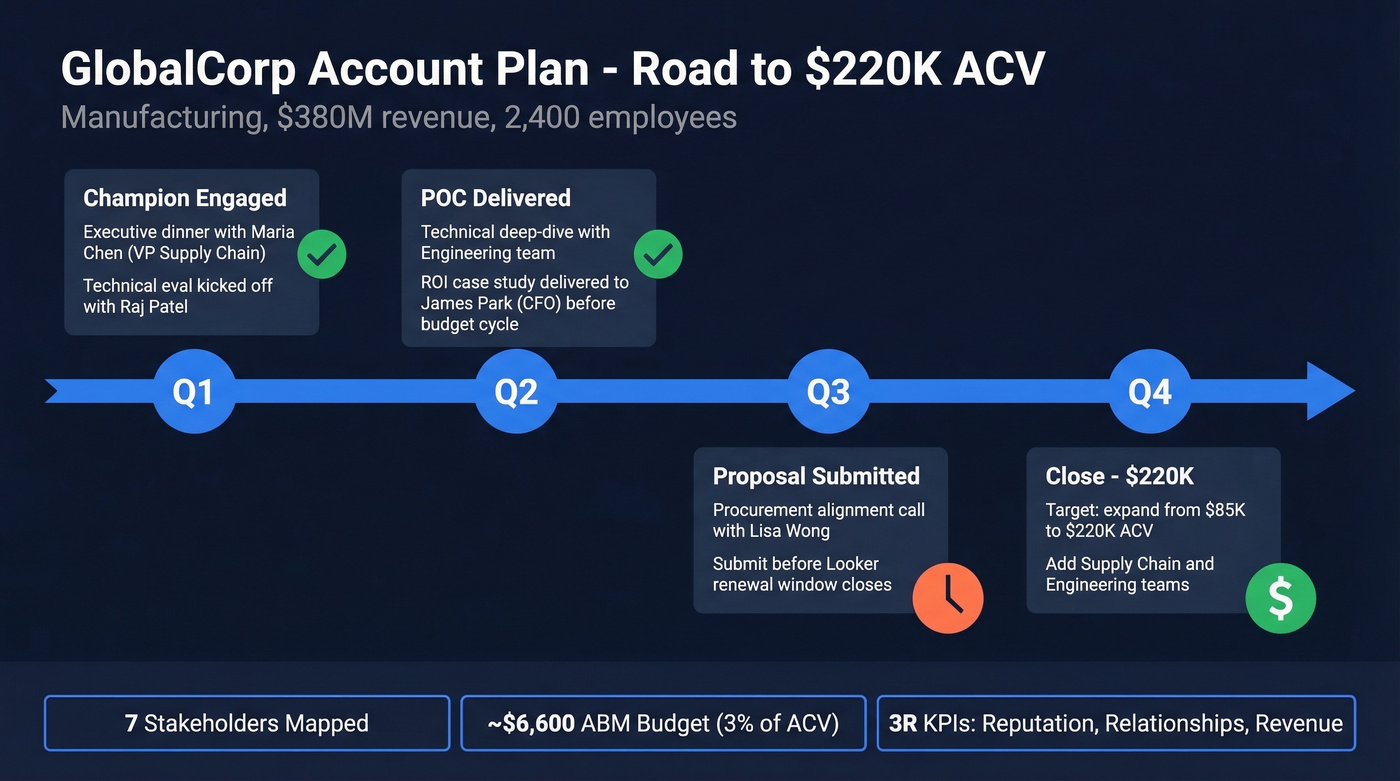
Account overview: GlobalCorp, $380M revenue, 2,400 employees, manufacturing sector. Currently buying your analytics platform ($85K/year). Goal: expand to $220K ACV by adding supply chain and engineering teams.
Buying committee: Maria Chen (VP Supply Chain, champion), James Park (CFO, economic buyer), Raj Patel (Director of Engineering, technical evaluator), Lisa Wong (Procurement Lead, potential blocker), plus three end users in operations. That's seven people - and in our experience, there are usually two or three more lurking in the background who'll surface during procurement.
Competitive landscape: Incumbent BI tool (Looker) renews in Q3. Competitor (Tableau) pitched in Q1 but didn't advance. Renewal timing is your window.
Whitespace grid:
| Analytics (Current) | Supply Chain | Engineering | Finance | Marketing | |
|---|---|---|---|---|---|
| Status | Saturated | Whitespace | Underway | Saturated | Not a Fit |
Plays by stakeholder: Executive dinner with Maria (Q1). Technical deep-dive with Raj's team (Q2). ROI case study delivered to James before budget cycle (Q2). Procurement alignment call with Lisa (Q3, pre-renewal).
Quarterly milestones: Q1 - champion engaged, technical eval started. Q2 - POC delivered, ROI case built. Q3 - proposal submitted before Looker renewal. Q4 - close.
KPIs (3R framework): Reputation - NPS from 3 key stakeholders. Relationships - monthly meetings with champion + economic buyer. Revenue - $220K closed by Q4.
ABM budget: For deals between $50K-$150K ACV, allocate ~1% in ABM spend. For $150K-$300K, allocate ~3%. For $300K+, allocate ~5%. GlobalCorp's $220K target falls in the 3% tier, so budget roughly $6,600 across events, content, and direct mail.
Mistakes That Kill Account Plans
Only 28% of sales leaders believe their account management channels meet cross-sell targets. Here's why most plans fail.
Treating it as admin busywork. If reps see the process as a checkbox for their manager, the plan will be garbage. The fix: make account plans the agenda for pipeline reviews, not a prerequisite for them.
Too many plans per rep. A rep managing 25 "strategic" accounts has zero strategic accounts. Cap Tier 1 plans at 5-10 per rep. Full stop.
Inside-out thinking. Plans built around "how do we sell more?" instead of "what does this customer actually need?" get ignored by buyers. Start with their pain, their initiatives, their budget cycle.
Ignoring whitespace. Most reps focus on renewing what they've already sold. The growth lives in the whitespace grid cells labeled "clear fit, no engagement." If your plan doesn't have a whitespace analysis, it's a retention plan, not a growth plan.
Set it and forget it. A plan built in January is fiction by March. No monthly review cadence means no accountability, no course correction, and no early warning when champions leave or budgets get cut. I've seen a team lose a $400K renewal because their "strategic plan" still listed a champion who'd been gone for five months.
Using Vertical Playbooks to Sharpen Plans
One of the fastest ways to improve plan quality is to layer in vertical go-to-market playbooks. Instead of writing every plan from scratch, build reusable playbooks for each industry vertical you sell into - manufacturing, financial services, healthcare, SaaS - and use them as the starting template for individual accounts.
A vertical playbook pre-loads the SWOT with industry-specific trends, maps common buying committee structures, and identifies the whitespace opportunities that repeat across accounts in that segment. Your reps spend less time on research and more time on strategy. The account planning template becomes the account-specific layer on top of the vertical playbook, not a blank page.
Keeping Your Plan Alive
Account plans need two operating rhythms running in parallel.
Calendar-based cadence: Monthly 15-minute check-ins to update stakeholder status, pipeline movement, and action items. Quarterly 60-minute deep reviews to reassess strategy, refresh the SWOT, and realign goals.
Signal-based triggers: Don't wait for the quarterly review when something changes. Job changes, funding rounds, intent spikes, competitor moves, and org restructures should all trigger an immediate plan update. The dual-playbook concept - time-based touchpoints plus signal-based reactions - is how enterprise teams manage 12-18 month sales cycles without losing the thread.
Before each quarterly review, re-enrich your stakeholder list. Prospeo's CSV enrichment returns data on 83% of contacts with updated titles, verified emails, and direct dials - so you stop building strategy on stale org charts.
You just built a whitespace grid and a buying committee map with 11 stakeholders. Now half those emails will bounce if you pulled them from your CRM six months ago. Prospeo verifies emails at 98% accuracy on a 7-day refresh cycle - for roughly $0.01 per contact.
Stop losing six-figure renewals to outdated contact data.
Spreadsheet vs. Software
Spreadsheets are fine for your first 10 account plans. After that, you'll want CRM-native plans or dedicated software. Skip this section if you already have a KAM platform you're happy with - and don't let tool vendors convince you to buy $50K platforms when you have 8 key accounts.
| Tool | Best For | Starting Price |
|---|---|---|
| Google Sheets / Excel | Getting started | Free |
| Smartsheet | Structured templates | ~$10/user/mo |
| Notion | Flexible docs + databases | Free / ~$10-$20/user/mo |
| Salesforce | CRM-native plans | ~$25/user/mo (billed annually) |
| HubSpot | Marketing + sales alignment | Free CRM; paid from ~$20/user/mo |
| Pipedrive | Small sales teams | ~$14/user/mo (billed annually) |
| DemandFarm | Dedicated KAM platform | ~$20K-$80K+/yr |
| Gainsight | CS-led account planning | ~$50K-$250K+/yr |
We've seen teams on Google Sheets outperform teams on $50K platforms because they actually reviewed their plans monthly. Pick the tool that matches your team size and budget, then invest your energy in the cadence.
FAQ
What's the difference between an account plan and a business plan?
An account plan is a strategy for growing a specific customer relationship - one account, one roadmap. A business plan covers the company as a whole. Different scope, different audience, different update cadence.
How often should I update my account plan?
Monthly light check-ins (15 minutes) and quarterly deep reviews (60 minutes), plus immediate updates when signals fire - job changes, funding announcements, competitor moves, or org restructures. The plan should never be more than 30 days stale.
What's the best free account planning template?
Smartsheet's simple account plan template (Word/Excel, ungated) or HubSpot's ABM template (lightly gated) both cover the essentials. For stakeholder data, pair either with Prospeo's free tier - 75 email credits per month - to keep your contact lists verified without spending a dime.
How many plans should one rep manage?
Five to ten Tier 1 plans, maximum. Beyond that, quality drops and plans become checkbox exercises. Use abbreviated plans for Tier 2 and signal-based monitoring for everything else.
Should my account plan align with our GTM strategy?
Absolutely. Your account plan should be a downstream artifact of your broader go-to-market strategy. Whether your team follows a McKinsey-style framework or a custom model, the plan translates company-level priorities - target verticals, ideal customer profiles, positioning - into specific plays for a single account. Without that alignment, reps chase opportunities that don't map to where the business is headed.