

Account Plans That Don't Become Shelfware
It's 4:47 PM on a Thursday. Your VP just dropped a Slack message: "Need account plans for our top 20 accounts by end of next week." Three reps immediately ask what format to use. Two ask what an account plan even is. One sends back a two-page Google Doc with a SWOT analysis from 2023.
This is how most planning initiatives start - and die. Fewer than 20% of companies have fully embedded account planning into their operations. The rest produce documents that sit in a shared drive collecting digital dust, never opened again after the initial deadline passes.
The gap isn't effort. It's clarity. Let's fix that.
What You Need (Quick Version)
An account plan is a strategic roadmap for growing revenue inside a single high-value account. Not every account deserves one. Here's the cheat sheet:
- Who gets a plan: Accounts with $30K+ deal potential. Max 5 plans per rep.
- Tiering: Tier 1 (full plans, quarterly reviews), Tier 2 (abbreviated, semi-annual), Tier 3 (monitor only).
- Review cadence: Cover 3-4x your typical sales cycle. Three-month cycle? Build a 12-month plan.
- Two biggest reasons plans fail: Bad data and no review cadence. A plan nobody revisits is just a writing exercise.
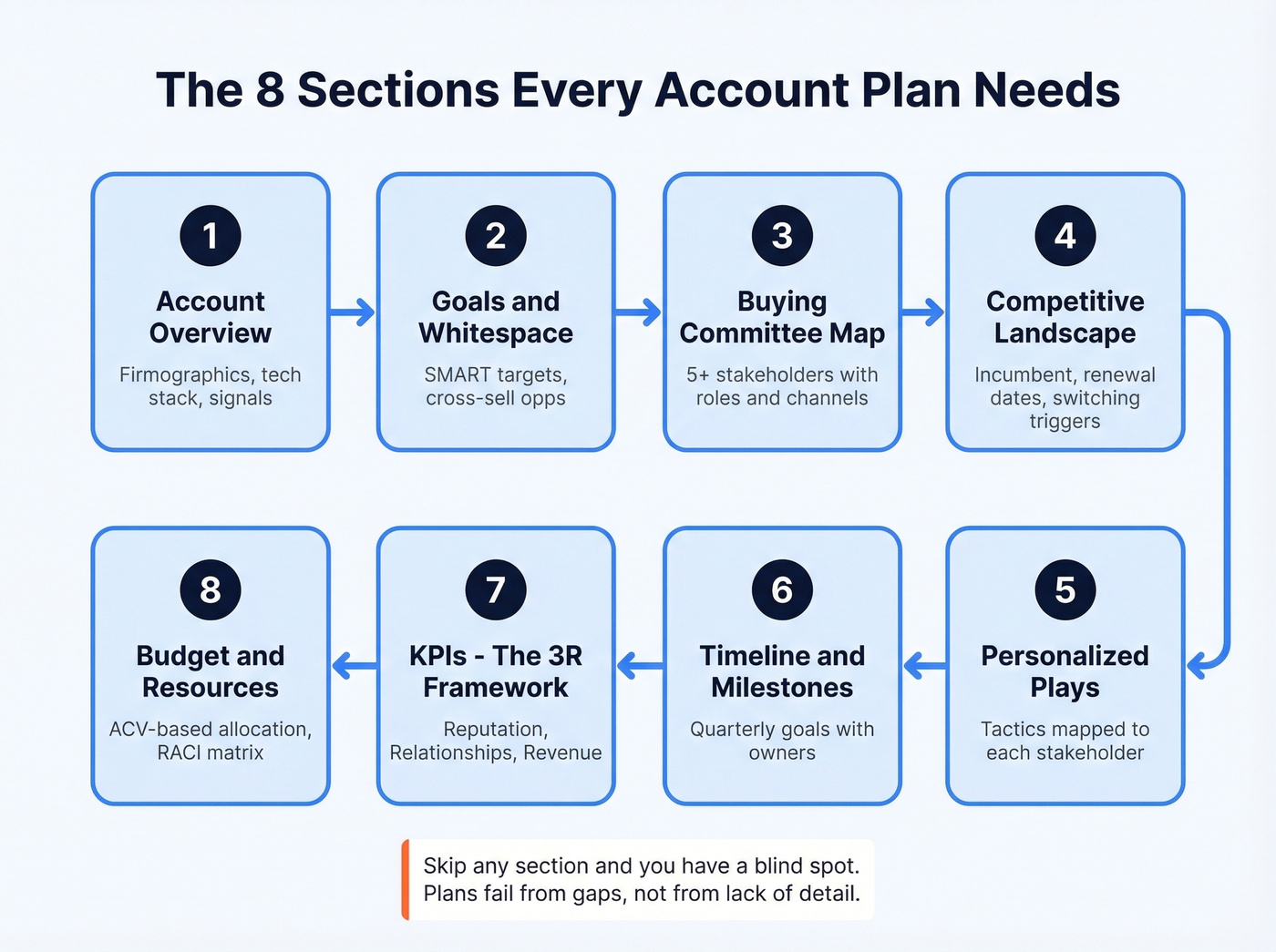
The 8 sections every plan needs:
- Account overview
- Goals and whitespace
- Buying committee map
- Competitive landscape
- Personalized plays and channels
- Timeline and milestones
- KPIs (Reputation, Relationships, Revenue)
- Budget and resources
What Is an Account Plan?
An account plan is a documented strategy for how you'll grow revenue, deepen relationships, and expand your footprint inside a specific account over the next 6-18 months. It's the difference between "I should probably call someone there" and "Here's exactly who we're targeting, what they care about, and how we'll win."
Don't confuse it with account management - the day-to-day relationship maintenance of handling support tickets, running QBRs, and making sure renewals happen. Account planning is the strategic layer on top: analyzing the account's future needs, mapping stakeholders, identifying whitespace, and coordinating cross-functional plays. One is reactive maintenance, the other is proactive growth.
It's also not a territory plan. A territory plan segments your entire book of business and decides where to invest time. An account plan zooms into one specific account with stakeholder-level detail. You need the territory plan first to decide which accounts deserve the deeper treatment.
Why Strategic Planning Matters
The numbers make the case better than any methodology deck. Organizations with mature account-based strategies report 72% higher ROI than any other marketing approach. Structured planning drives 28% faster sales cycles and 35% higher close rates.
Here's the thing: the average B2B deal now involves 11 stakeholders. Eleven people who need to agree before a PO gets signed. Without a plan, you're relying on your champion to navigate internal politics for you. That works until it doesn't - usually right around the time procurement gets involved and starts asking questions nobody prepped for.
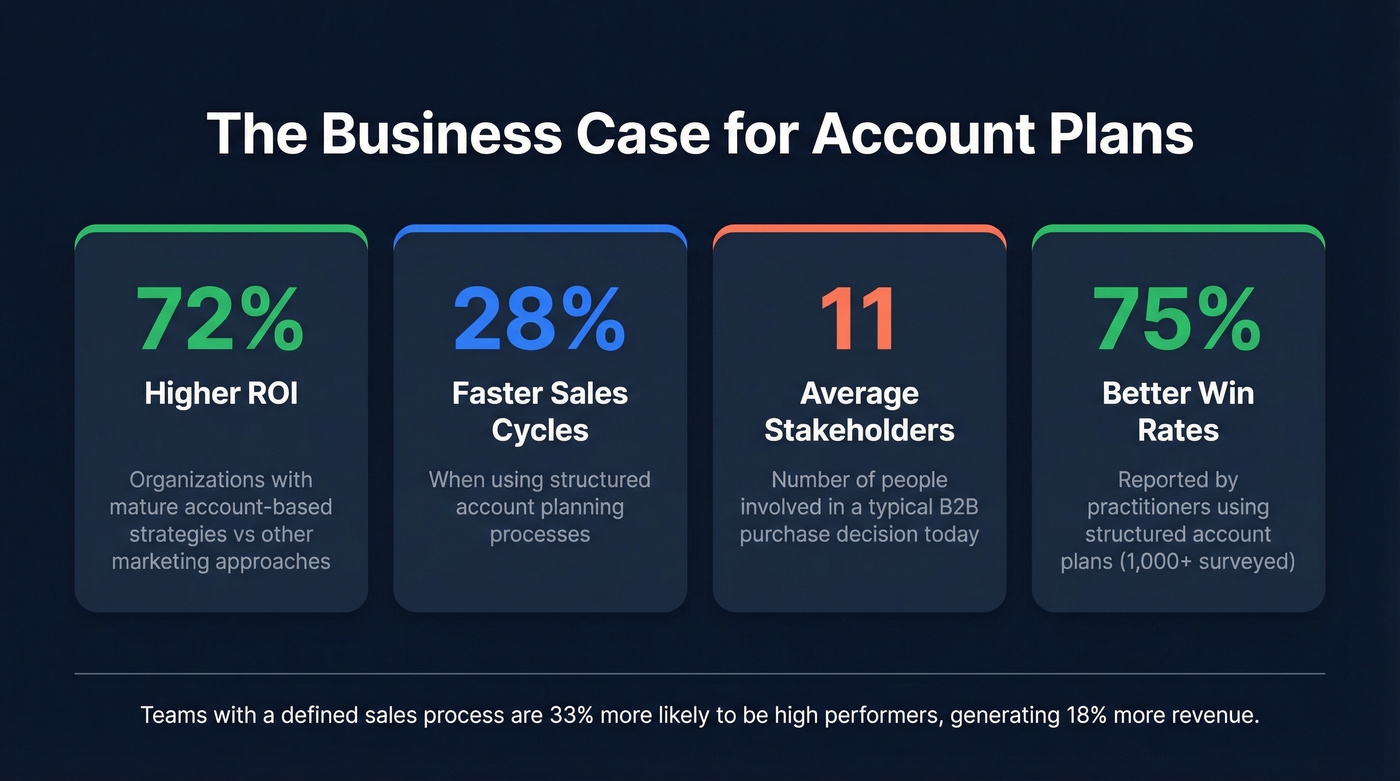
Across a study of over 1,000 practitioners, 75% report better win rates when using structured account plans. Teams with a defined sales process are 33% more likely to be high performers, generating 18% more revenue. The plan isn't bureaucracy. It's the operating system for complex deals.
Which Accounts Deserve a Plan?
Not all of them. That's the first mistake most teams make - trying to build plans for 50 accounts and ending up with 50 mediocre documents.
Account Tiering Framework
| Tier | # of Accounts | Plan Depth | Review Cadence |
|---|---|---|---|
| Tier 1 | 5-10 | Full plan | Quarterly |
| Tier 2 | 15-25 | Abbreviated | Semi-annual |
| Tier 3 | Rest | Monitor only | Signal-driven |
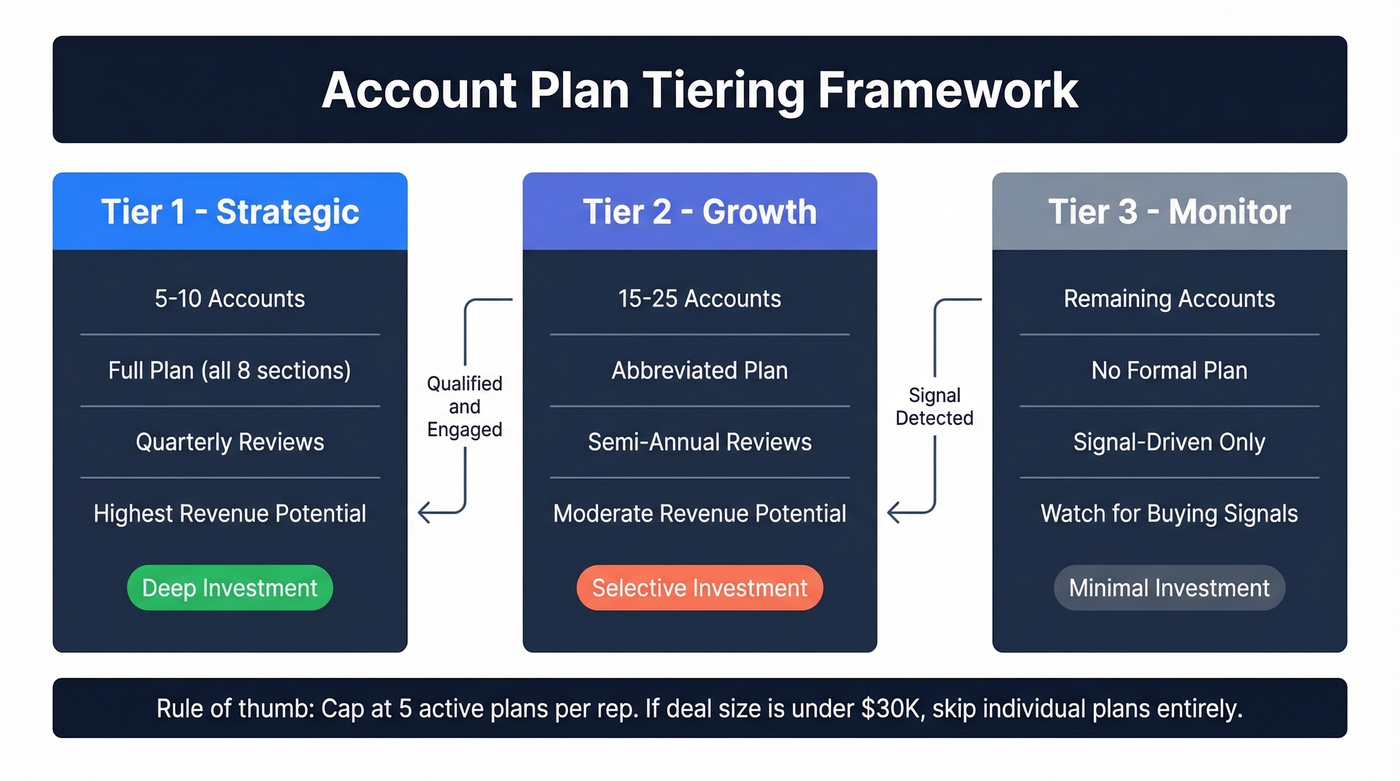
To decide which tier an account belongs in, score them against weighted criteria: revenue potential, industry fit, tech stack alignment, active buying signals, existing relationship depth, and competitive landscape. Only 5% of B2B accounts are actively looking to buy at any given time, so signal-based prioritization isn't optional - it's the only way to avoid wasting cycles on accounts that aren't ready.
The $30K Rule
If your average deal size is under $30K, skip individual planning entirely. The time investment doesn't pay off at that price point. Use territory-level plays and programmatic outreach instead.
For accounts that do clear the threshold, cap each rep at five active plans. We've seen teams assign 15-20 plans per rep and wonder why none of them get updated past week two. Five is the ceiling where quality stays high and plans actually get executed. Beyond that, you're just generating shelfware with extra steps.
Most companies don't have a planning problem. They have a prioritization problem. Building 20 mediocre documents feels productive. Building 5 excellent ones and ignoring the rest actually is productive. The discipline to say "this account doesn't get a plan" matters more than any template.
How to Create a Sales Account Plan
Each section below maps to a specific strategic question. Skip one, and you've got a blind spot.
Account Overview
Start with the basics, but go deeper than firmographics. You need company size, revenue, industry, and headquarters - but also their tech stack, your current relationship status (new prospect, existing customer, or expansion target), and the source signal that put them on your radar.
Layer in macro context: what are the top 3-5 industry trends affecting this company? What are their publicly stated strategic priorities? A rep on r/sales shared their account plan structure and included "known challenges," "shocking industry statistics," and "angles your company could take." That's the kind of specificity that turns a plan from a data sheet into a strategy document.
Goals and Whitespace
Define what winning looks like. What's your expansion target in dollar terms? Where are the cross-sell and upsell opportunities? Are there displacement opportunities where you can unseat an incumbent?
Use the SMART framework here - specific, measurable, achievable, relevant, time-bound. "Grow the account" isn't a goal. "$220K ACV by Q4 through displacing Tableau in the analytics division and expanding into the marketing team" is a goal. Every goal needs a measurable outcome and a deadline. Anything less is wishful thinking.
Buying Committee Map
This is where most plans either shine or fall apart.
Map at least five stakeholders with defined roles: champion, economic buyer, technical evaluator, blocker, and end user. For each person, capture whether they prefer email, phone, or in-person meetings, and note their current engagement status - cold, warm, or active.
Competitive Landscape
Identify the incumbent vendor, their contract renewal date, and the switching triggers that could open a window. What would make this account consider a change? A price increase? A product gap? A champion who's frustrated with support response times?
For deeper analysis, Porter's Five Forces can help you understand the competitive dynamics at play. But for most plans, knowing who you're displacing and when their contract is up covers 80% of the value.
Personalized Plays and Channels
This is where strategy becomes action. Map specific tactics to specific stakeholders - not generic "send emails to the buying committee." Your champion might respond best to a co-authored business case. The economic buyer needs a peer reference from their industry. The technical evaluator wants a sandbox environment.
Multi-channel matters here. A sequence that's email-only will underperform one that combines email, phone, direct mail, and event invitations. Match the channel to the person, not the other way around.
Timeline and Milestones
Break the plan into quarterly milestones. Q1 might be "secure technical evaluation with the analytics team." Q2 might be "present ROI analysis to CFO." Each milestone should have an owner and a clear deliverable.
Build in trigger-based updates between scheduled reviews. If your champion changes roles, that's an immediate plan revision. If a competitor makes a major product announcement, reassess your positioning. If intent data shows the account researching your category, accelerate your timeline. Static plans are dead plans.
KPIs: The 3R Framework
Measure three dimensions:
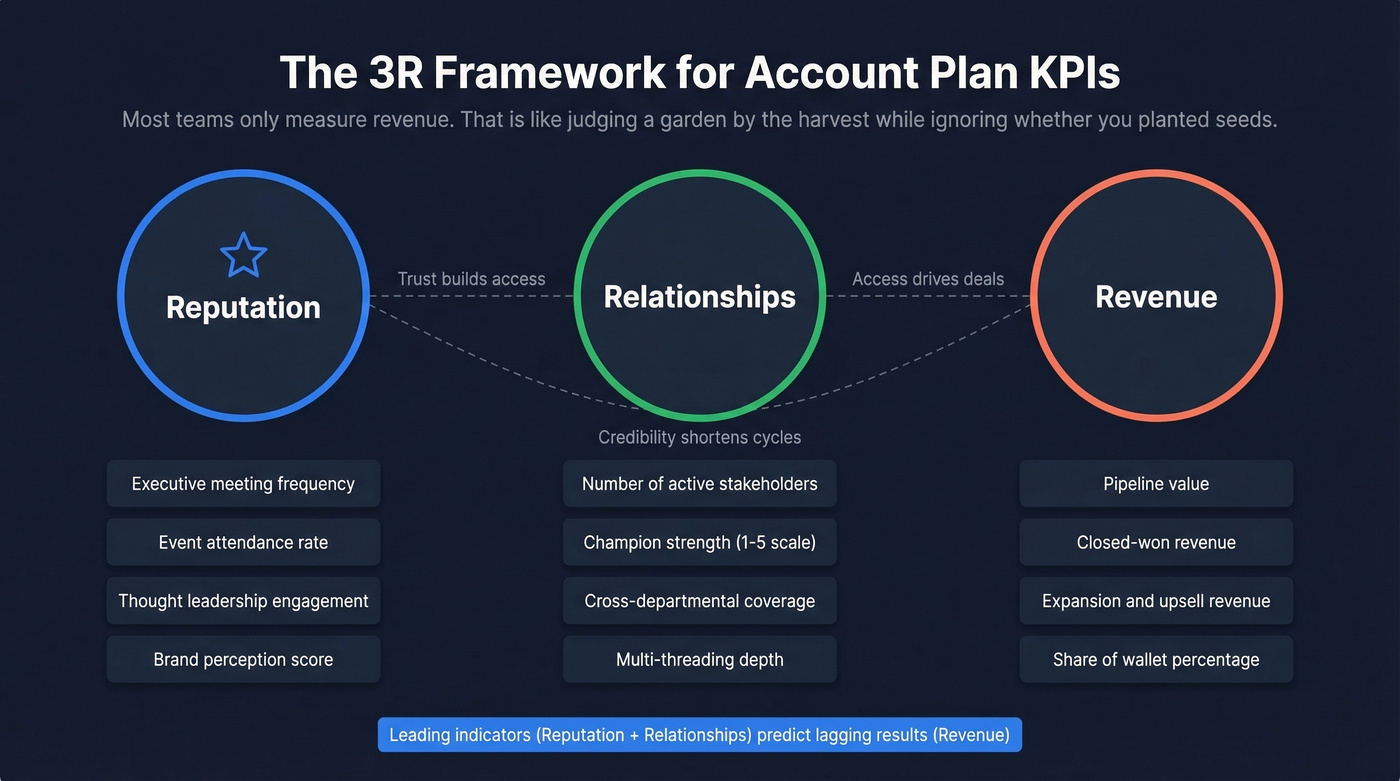
- Reputation: Are you seen as a strategic partner or just another vendor? Track executive meeting frequency, event attendance, and thought leadership engagement.
- Relationships: How deep is your multi-threading? Track the number of active stakeholder relationships, champion strength, and cross-departmental coverage.
- Revenue: The obvious one. Track pipeline value, closed revenue, expansion revenue, and share of wallet.
Most teams only measure revenue. That's like judging a garden by the harvest while ignoring whether you planted seeds.
Budget and Resources
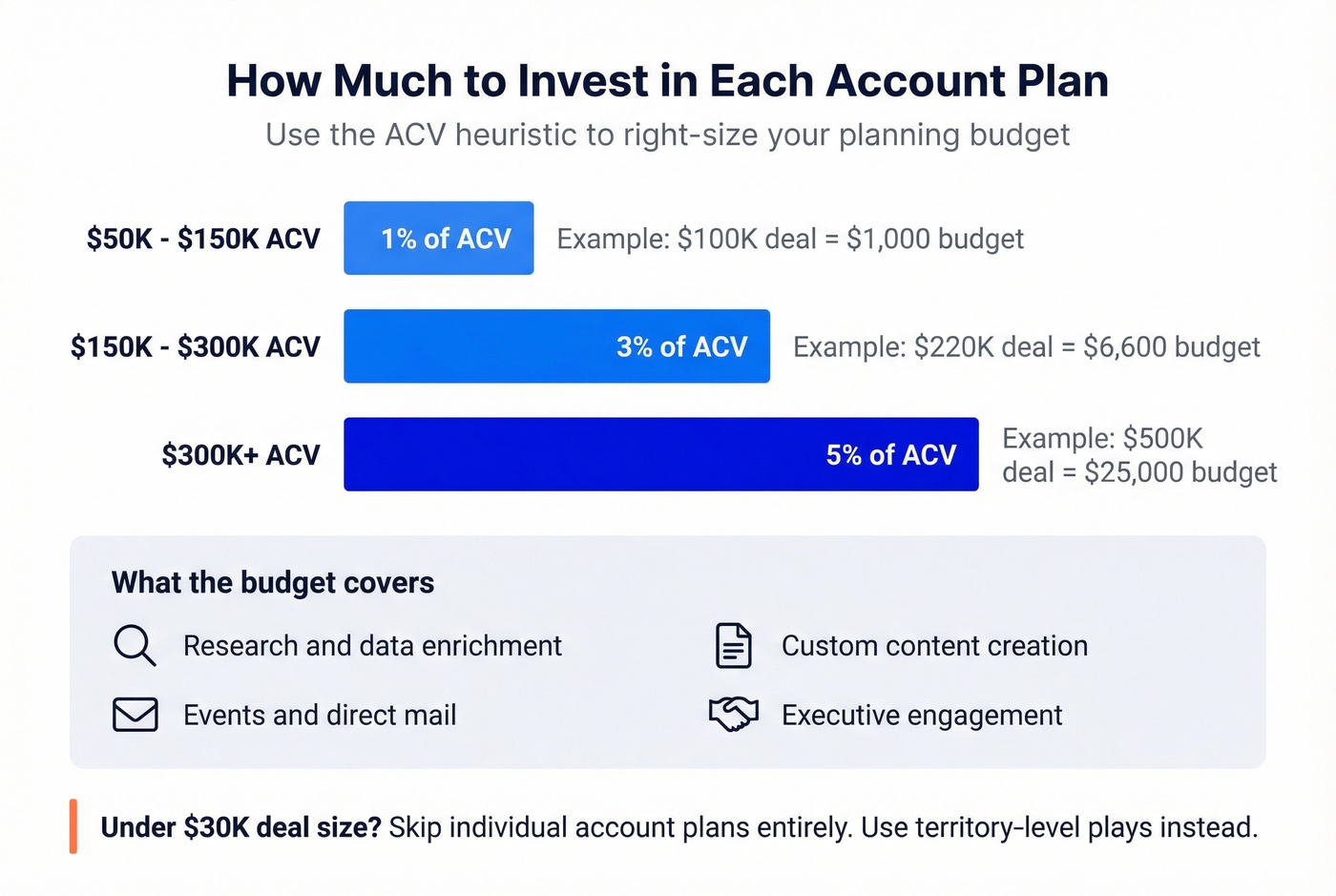
Use the ACV heuristic to right-size your investment: allocate roughly 1% of expected ACV for deals in the $50K-$150K range, 3% for $150K-$300K, and 5% for $300K+. A $220K target deal gets about $6,600 in dedicated planning resources - covering research, content creation, events, and direct mail.
Identify the cross-functional team with a simple RACI matrix. Who from marketing, product, customer success, and executive leadership needs to be involved? Gartner found that teams with high collaboration drag are 37% less likely to exceed revenue and profit targets. The plan should name names, not just departments.

You just read that the average B2B deal involves 11 stakeholders. Mapping them is strategy. Reaching them is execution. Prospeo gives you 98% accurate emails and 125M+ verified mobile numbers so every stakeholder on your buying committee map has real, working contact data - not a guess.
Stop planning accounts you can't actually reach.
Filled Example: GlobalCorp Plan
Here's what a completed plan looks like for a fictional $220K target account:
| Field | Entry |
|---|---|
| Account | GlobalCorp (Manufacturing, 2,500 employees, $400M revenue) |
| Goal | $220K ACV by Q4 - displace Tableau in analytics division, expand to marketing |
| Incumbent | Tableau (contract renews Q3) |
| Whitespace | Marketing team uses no analytics platform; operations team evaluating BI tools |
Buying Committee:
| Role | Name | Status | Channel |
|---|---|---|---|
| Champion | Sarah Chen, Dir. Analytics | Warm | Email + phone |
| Economic Buyer | James Park, VP Finance | Cold | Executive briefing |
| Technical Eval | Raj Patel, Sr. Data Eng | Active | Sandbox + Slack |
| Blocker | Lisa Wong, IT Security | Unknown | Compliance docs |
| End User | Team of 15 analysts | Neutral | Webinar + training |
Quarterly Milestones:
- Q1: Secure technical evaluation; deliver sandbox to Raj's team
- Q2: Present ROI analysis to James; get Sarah to champion internally
- Q3: Align with Tableau renewal timeline; submit proposal
- Q4: Close; begin onboarding
KPIs: 2 executive meetings/quarter (Reputation), 4+ active stakeholder relationships (Relationships), $220K closed by Q4 (Revenue)
Budget: 3% of $220K = $6,600 - covers executive dinner, custom demo build, industry report co-creation, and direct mail to blocker
Frameworks That Sharpen Your Plans
MEDDPICC to Plan Field Mapping
We built this mapping because it doesn't exist anywhere else - print it out and tape it to your monitor. If your team already uses MEDDPICC, each letter maps directly to a plan section:
- Metrics -> KPIs section (what does success look like for the customer?)
- Economic Buyer -> Buying committee map (who signs the check?)
- Decision Criteria -> Competitive landscape (what are they evaluating against?)
- Decision Process -> Timeline and milestones (what's their internal approval flow?)
- Paper Process -> Timeline (procurement, legal, security reviews)
- Identify Pain -> Goals and whitespace (what problem are you solving?)
- Champion -> Buying committee map (who's selling internally for you?)
- Competition -> Competitive landscape (who else is in the deal?)
MEDDPICC gives you the qualification rigor. The plan gives you the execution roadmap.
SPIN for Discovery
Where MEDDPICC qualifies, SPIN discovers. Use Situation, Problem, Implication, and Need-Payoff questions to feed the "known challenges" and "strategic priorities" fields in your account overview. SPIN is the conversation framework that turns a cold stakeholder into someone who articulates their own pain - which you then document in the plan and use to build your business case.
The two frameworks aren't competing. MEDDPICC tells you whether the deal is real. SPIN helps you uncover why it should be.
How Often to Update
A plan that gets reviewed once a year is wrong 11 months out of 12. The rule of thumb: your plan should cover 3-4x your typical sales cycle. Three-month average deal? Build a 12-month plan with quarterly review checkpoints.
Between scheduled reviews, let signals drive updates. A champion leaving the company, a competitor making a major move, or an intent spike in your category - any of these should trigger an immediate revision.
One more thing: use account plans as coaching artifacts in your 1:1s. When a manager reviews a plan with a rep every two weeks, the plan stays alive. When it only surfaces during QBRs, it's already stale. The review cadence is the plan's heartbeat.
Mistakes That Kill Account Plans
Five pitfalls we see over and over:
Treating it as a checkbox exercise. If leadership demands plans but never reviews them, reps will spend 30 minutes filling in blanks and never look at them again. Plans need ongoing strategic conversations, not just a completed template.
Planning too many accounts. Five plans per rep is the ceiling. If you have 20 strategic accounts, tier them - not every account needs the full treatment.
Being internally focused. Plans that read like "here's what we want to sell them" instead of "here's what they're trying to achieve and how we fit" miss the point entirely. The consensus on r/sales is that companies "have a really bad idea of what goes into" a good plan. Customer-centricity is the fix.
No follow-up cadence. Every action item needs an owner, a due date, and a status. Review progress every few weeks for Tier 1 accounts. A plan without accountability is just creative writing.
Building on bad data. This one's the silent killer, and it deserves its own section.
The Data Quality Foundation
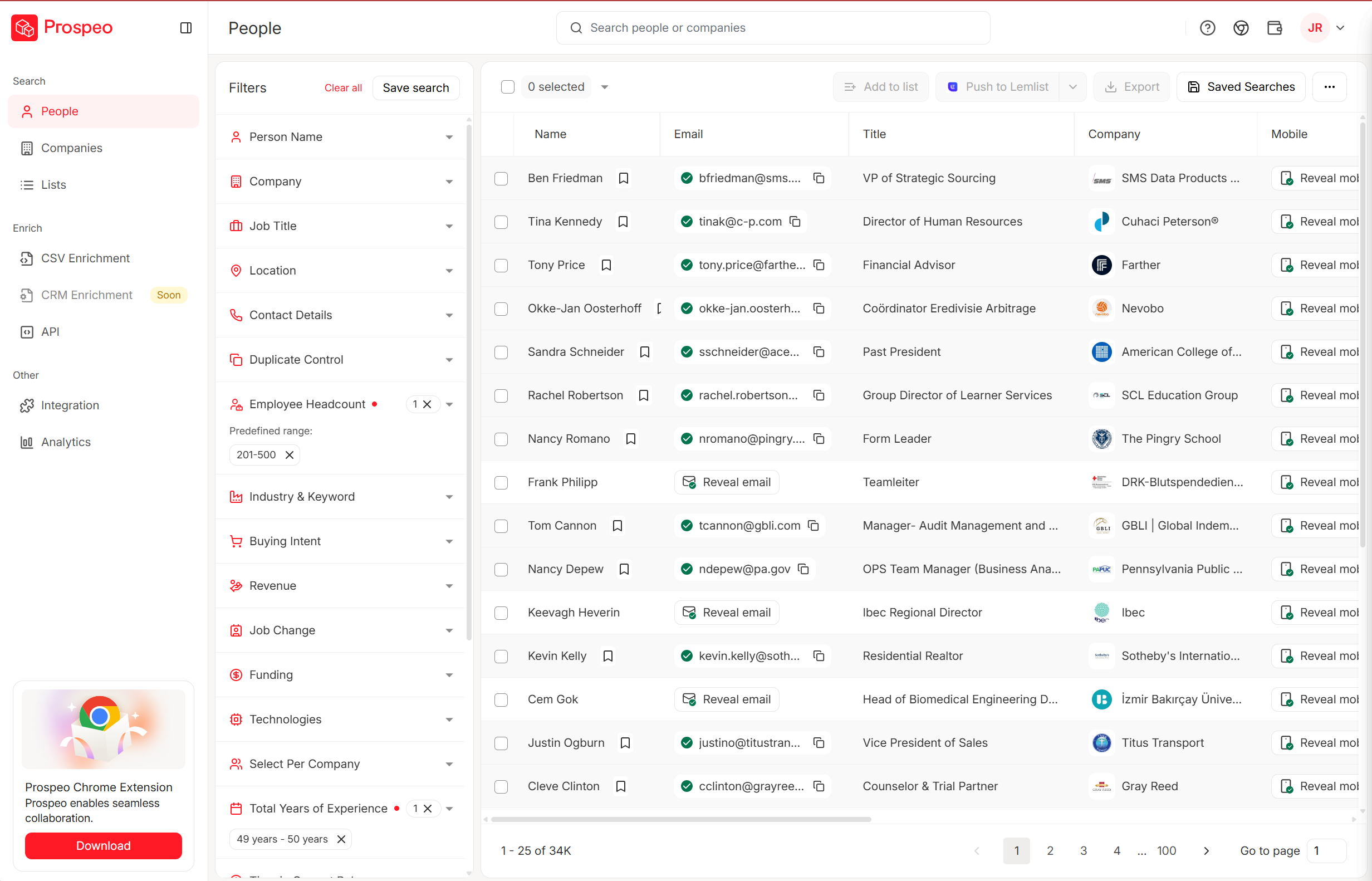
Look, you can build the most elegant account plan in the world, and it won't matter if your buying committee map is full of bounced emails and disconnected phone numbers. We've watched teams spend weeks on strategic planning only to discover that three of their five mapped stakeholders changed roles and two email addresses bounce.
Tools for Account Planning
The right tool depends on where your biggest gap is - planning structure, collaboration, or data. AI is starting to automate pieces of the process, from stakeholder mapping suggestions to intent signal aggregation, but no single tool does everything yet.
| Tool | Best For | Pricing |
|---|---|---|
| Prospeo | Data layer for all plans | Free tier (75 emails/mo); ~$0.01/email |
| Salesforce Account Plans | Existing SF orgs | Included with Enterprise+ |
| DemandFarm | Whitespace + org charts | Custom pricing |
| Kapta | Dedicated KAM teams | Custom pricing |
| Mural | Visual collaboration | Free tier; ~$10-20/user/mo |
| GSP Account Plan | SF-native structured plans | $450/mo flat |
Most planning tools solve the template and visualization problem well. Most don't solve the data problem. You still need verified emails, direct dials, and intent signals across your stakeholder map - that's the gap between a plan that looks good in a slide deck and one that generates pipeline.
Skip Kapta and DemandFarm if you're a team under 10 reps. The overhead isn't worth it at that scale. A well-structured spreadsheet paired with good contact data will outperform an expensive platform that nobody logs into.
Account plans fail when the data goes stale. Prospeo refreshes every 7 days - not the 6-week industry average - so your buying committee maps, tech stack intel, and contact details stay current between quarterly reviews. Layer in intent data across 15,000 topics to know which Tier 1 accounts are actually in-market right now.
Build account plans on data that's never more than a week old.
FAQ
How many account plans should each rep manage?
No more than five at a time. Quality collapses beyond that threshold - plans stop getting updated past week two. Tier your strategic accounts so only the highest-potential ones get the full treatment.
What's the difference between an account plan and a territory plan?
A territory plan segments your entire book of business and allocates time across it. An account plan zooms into one specific account with stakeholder maps, competitive intel, and quarterly milestones. Build the territory plan first, then create account plans for top-tier accounts only.
When is an account plan not worth building?
When your average deal size is under $30K. The time investment in stakeholder mapping, competitive analysis, and quarterly reviews doesn't generate enough return at that price point. Use territory-level plays and programmatic outreach instead.
How do I keep account plans from becoming shelfware?
Set a review cadence - every two weeks for Tier 1 accounts in manager 1:1s. Assign owners to every action item with due dates. Use signal-driven triggers like job changes or intent spikes to prompt updates between scheduled reviews. In our experience, the single biggest predictor of whether plans survive past month one is whether managers actively use them in coaching conversations.
What's the best free tool for account plan data?
Prospeo's free tier gives you 75 verified emails and 100 Chrome extension credits per month - enough to build and validate buying committee maps for your first few plans. For planning structure, pair it with Mural's free tier or a simple spreadsheet template.