

5 Sales Meeting Agenda Templates You Can Copy-Paste Right Now
It's Monday morning. You've got a team sync in 45 minutes, a pipeline review after lunch, and a discovery call at 3pm. The calendar invites all say the same thing: "Sales Meeting." No agenda, no time blocks, no stated purpose. Everyone shows up, talks in circles for an hour, and leaves without action items.
Meetings are ineffective 72% of the time, according to a survey of 5,000 knowledge workers. The fix isn't fewer meetings - it's setting an agenda for every sales meeting that forces focus. Below are five time-boxed templates. Copy them into your next calendar invite.
Quick Reference
| Meeting Type | Duration | Best For |
|---|---|---|
| Weekly Team Sync | 25 min | Full team alignment |
| 1:1 Coaching | 30 min | Manager + rep development |
| Pipeline Review | 45 min | Forecast accuracy, deal strategy |
| Discovery Call | 30 min | Prospect qualification |
| QBR | 45-60 min | Customer retention, expansion |
Why Every Sales Meeting Needs a Structured Agenda
The data is brutal. 62% of workers regularly attend meetings with no goal stated in the invite. More than half leave without clear next steps. And 79% say a simple agenda would make their meetings more productive - yet most organizers still don't include one.
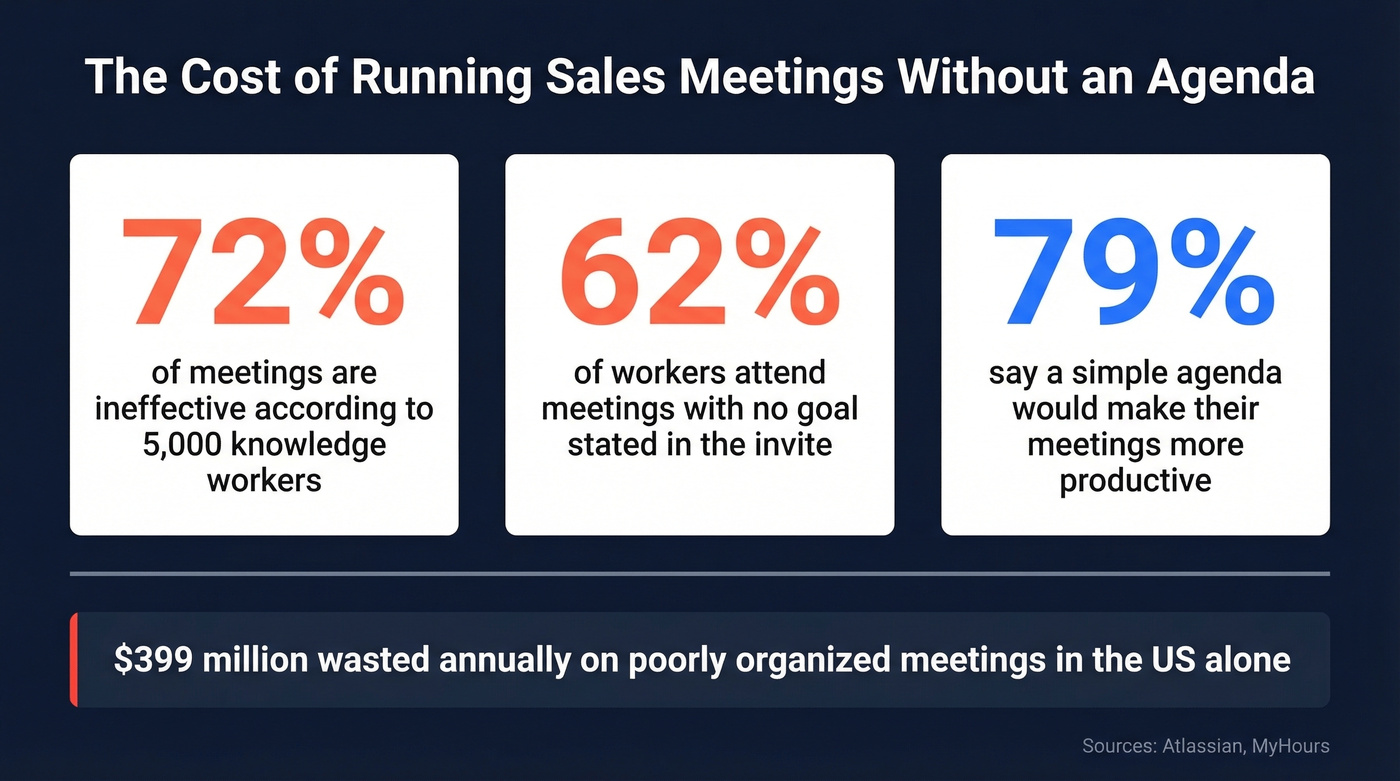
The cost isn't abstract. Poorly organized meetings waste an estimated $399 million annually in the US alone. For a sales team, the math is simpler: every 60-minute meeting without structure is an hour your reps aren't prospecting, following up, or closing.
A strong agenda needs three things: a purpose, time blocks, and owners. That's it.
5 Copy-Paste Templates
| Meeting Type | Duration | Cadence | Key Focus |
|---|---|---|---|
| Weekly Team Sync | 25 min | Weekly | Wins, metrics, blockers |
| 1:1 Coaching | 30 min | Weekly | Skills, pipeline, check-in |
| Pipeline Review | 45 min | Biweekly/Monthly | At-risk deals, forecast |
| Discovery Call | 30 min | Per opportunity | Prospect pain, next steps |
| QBR | 45-60 min | Quarterly | Value, goals, action plan |
Weekly Team Sync (25 Minutes)
Copy-paste this:
Wins & shoutouts - 3 min Metrics snapshot - 5 min Pipeline focus: 3-5 deals that need team input - 10 min Obstacles & asks - 5 min Action items with owners - 2 min
If your weekly sync runs longer than 30 minutes, you're doing it wrong. This meeting exists to align the team, surface blockers, and celebrate momentum. It's not a pipeline review - that's a separate meeting with a separate agenda.
Start with wins. It takes 3 minutes and sets the tone. Then hit the numbers fast; everyone should've already seen the dashboard before walking in. Spend the bulk of time on 3-5 specific deals where someone needs help, a warm intro, or a strategy gut-check. Every action item gets an owner and a deadline, or it doesn't get written down.
This format works because it's tight enough to prevent tangents but flexible enough to address what actually matters that week.
1:1 Sales Coaching (30 Minutes)
Here's a hot take: most 1:1s are broken because managers treat them as pipeline interrogations. Reps on r/sales say the same thing - they dread the weekly "walk me through every deal" grilling, so they give surface-level answers and check out. The 10/10/10 framework fixes it by forcing 20% inspection and 80% coaching.
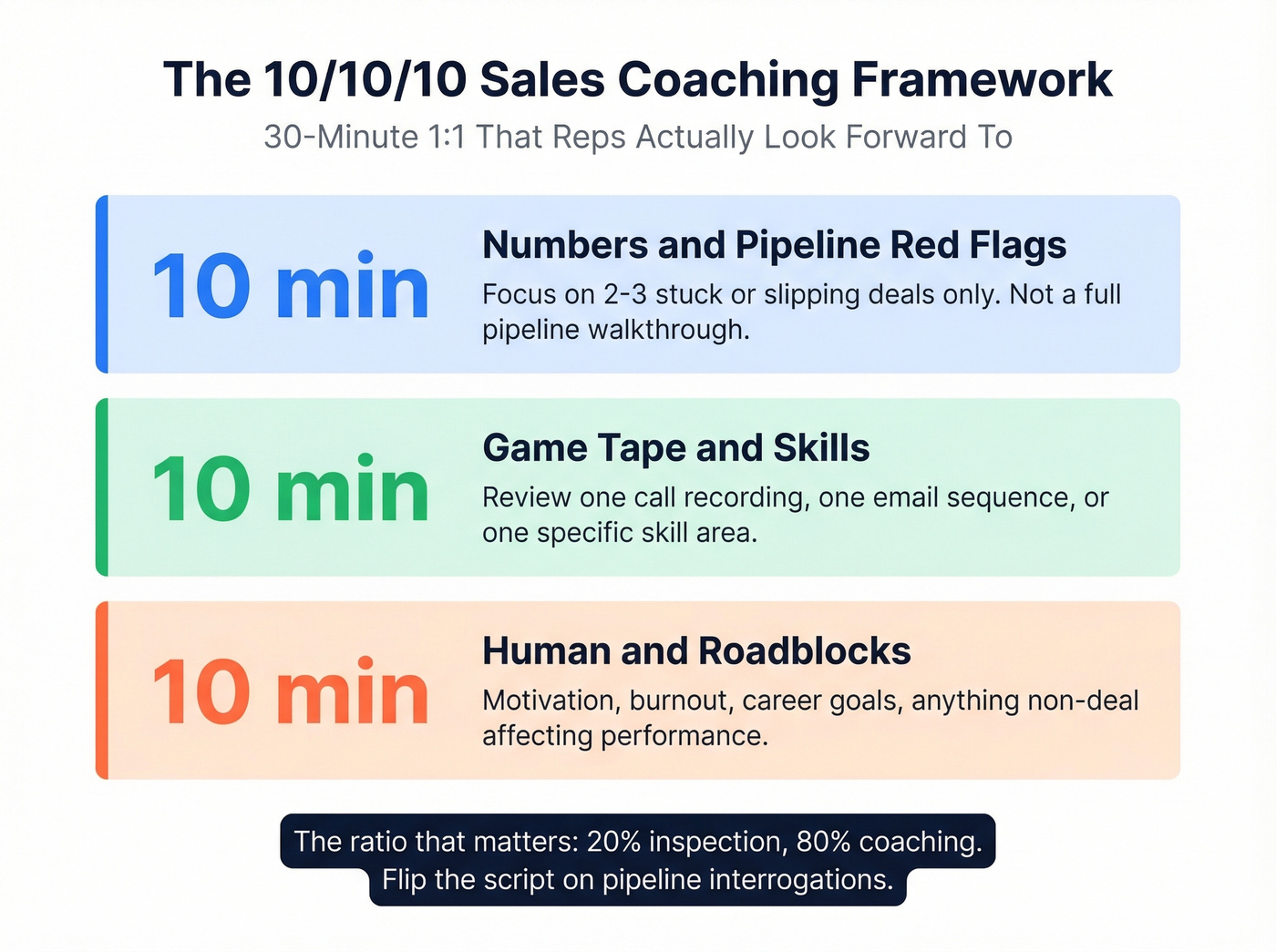
The 10/10/10 split:
Numbers & pipeline red flags - 10 min Focus on 2-3 deals that are stuck or slipping. Not a full pipeline walkthrough.
Game tape & skills - 10 min Review one call recording, one email sequence, or one specific skill area.
Human & roadblocks - 10 min Motivation, burnout, career goals, anything non-deal that's affecting performance.
Use this if you're a frontline manager running weekly check-ins and you want reps to actually look forward to the meeting. Skip this if you only meet monthly - at that cadence, you need a longer format that covers more ground.
I've seen managers spend 25 minutes grilling on pipeline and 5 minutes asking "anything else?" Flip that ratio. The pipeline section should zero in on red flags only - deals where the next step is unclear, the champion went dark, or the timeline slipped. Everything else waits for the pipeline review.
Pipeline Review (45 Minutes)
This is the meeting that makes or breaks your forecast. It's also the one most teams run poorly, because they try to cover every deal instead of the ones that actually need attention.
Pre-meeting prep checklist (do this before the meeting starts):
- Pull CRM dashboards: stage distribution, aging deals, forecast vs. actual
- Flag at-risk deals - no activity in 14+ days, pushed close dates, missing contacts
- Refresh your contact and account data so the deal intel you're reviewing reflects reality, not last quarter's org chart
- Each AE prepares 2-minute summaries for their flagged deals Copy-paste this:
Forecast snapshot - 5 min At-risk deals deep dive (3-5 deals, 4 min each) - 20 min Upside deals - 10 min Resource asks - 5 min Action items with owners and deadlines - 5 min
Stop reviewing every deal. A 45-minute meeting that covers 20 deals covers none of them well. A 45-minute meeting that goes deep on 5 deals moves the needle.
The pre-meeting prep is non-negotiable. Send the checklist 24 hours before. Anyone who hasn't done it doesn't get airtime - they get a follow-up task. We've seen pipeline reviews go from 60-minute slogs to 45-minute decision engines just by enforcing that prep step.
Here's the thing: pipeline reviews are only as good as the data underneath them. If your CRM says the VP of Engineering is still your champion but she left the company three months ago, your forecast is fiction. Build data hygiene into the prep step, not as an afterthought. Tools like Prospeo refresh contact records every 7 days with 50+ data points per enrichment, which means the stakeholder info your reps pull up is current - not a snapshot from six months ago.
Discovery Call (30 Minutes)
Before you look at the template, read this script out loud:
"Would it be alright if I ran through a quick agenda for our time today? I'd love to share a bit about what we do, then spend most of the time learning about your world - what's working, what's not. And at the end, we'll figure out together whether it makes sense to keep talking. Sound fair?"
That permission-based opener is the highest-leverage move in this entire article. It signals professionalism and creates a verbal contract - the prospect agreed to the structure, so they're less likely to derail it. Sending a shared agenda before the meeting also lets the prospect add their own priorities, which increases buy-in and reduces no-shows.
Copy-paste this:
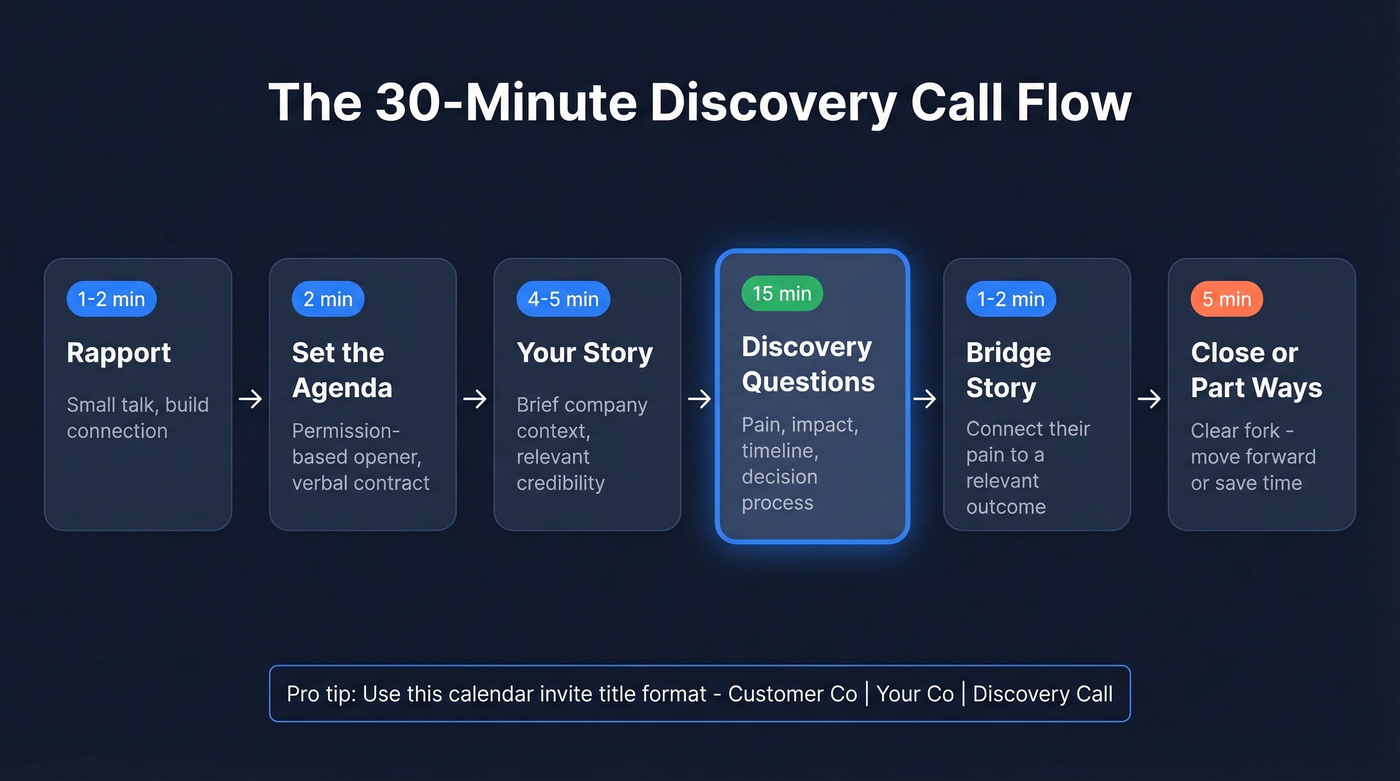
Small talk / rapport - 1-2 min Agenda setting (the script above) - 2 min Your story - 4-5 min Discovery questions (pain, impact, timeline, decision process) - 15 min Bridge story (connect their pain to a relevant outcome) - 1-2 min Closing / next steps - 5 min
For the calendar invite, use this title format: <Customer Co> | <Your Co> | Discovery Call. Meetings get forwarded. New attendees join without context. A clear title prevents the "what is this and why am I here" problem that kills discovery calls before they start.
End with a clear fork: either we move forward, or we agree to part ways. Don't end with "so, what do you think?" Both outcomes are wins - one moves the deal, the other saves everyone's time.
Quarterly Business Review (45-60 Minutes)
Not every account gets the same QBR. Tier your approach first:
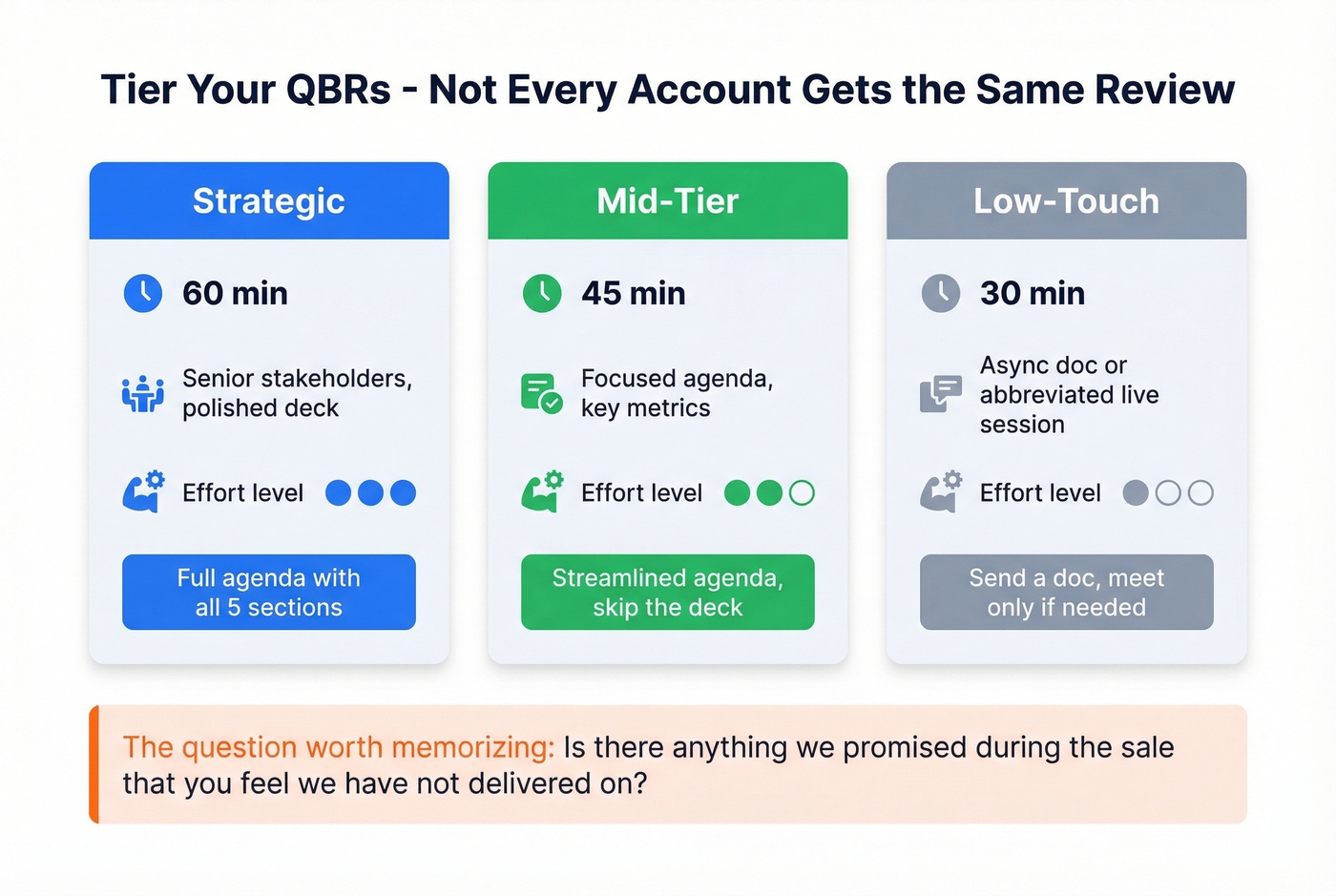
| Tier | Duration | Format |
|---|---|---|
| Strategic | 60 min | Senior stakeholders, polished deck |
| Mid-tier | 45 min | Focused agenda, key metrics |
| Low-touch | 30 min | Async doc or abbreviated live session |
Copy-paste this (for strategic and mid-tier accounts):
Partnership recap - 5 min Performance & value delivered (their metrics, not your features) - 15 min What's been hard (proactively name friction points) - 10 min Customer goals for next quarter - 10 min Joint action plan & next steps - 10 min Send the action plan within 24 hours.
The "What's been hard" section is where most QBRs fall apart - because most teams skip it entirely. They show 40 slides of metrics the customer didn't ask for and call it a review. Your customer already knows what's broken. Acknowledging it builds trust; ignoring it builds resentment.
One question worth memorizing: "Is there anything we promised during the sale that you feel we haven't delivered on?" It's uncomfortable to ask. It's more uncomfortable to lose the renewal because you never did.

Pipeline reviews fall apart when your CRM shows contacts who left the company months ago. Prospeo enriches every record with 50+ data points on a 7-day refresh cycle - so the stakeholder intel your reps present is current, not fiction.
Stop reviewing deals built on stale data. Start with contacts you can trust.
Facilitation Tips That Actually Matter
An agenda gets you 60% of the way. Facilitation gets you the rest.
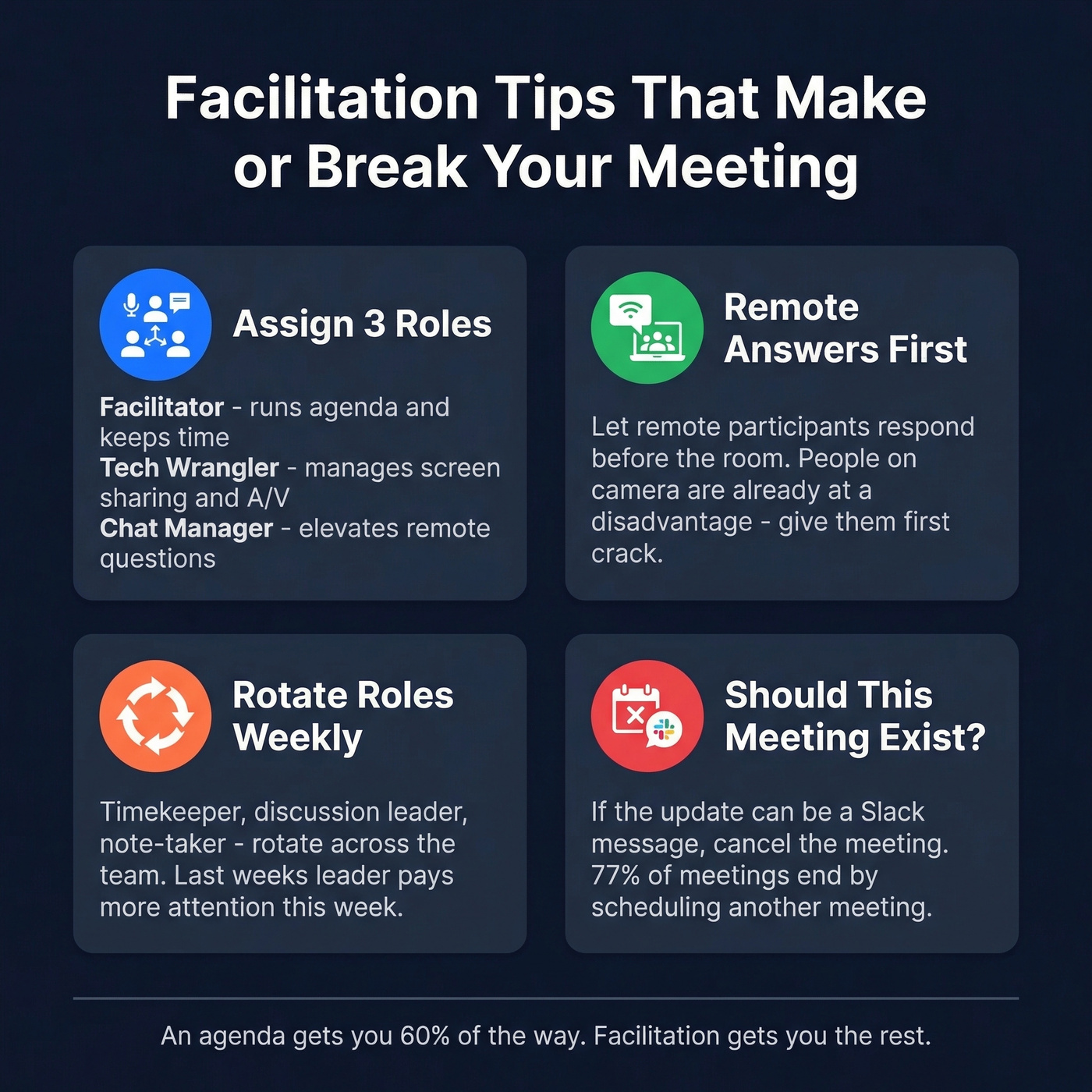
Assign roles, especially for hybrid meetings. You need a Facilitator who runs the agenda and keeps time, a Tech Wrangler who manages screen sharing and A/V, and a Chat Manager who monitors the chat window and elevates remote questions. Without these roles, remote participants become spectators.
Remote answers first. When you ask a question, let remote participants respond before the room. People on camera are already at a disadvantage - giving them first crack balances participation and prevents the loudest voice in the room from dominating.
Use live polling for larger team meetings. Tools like Mentimeter or Slido let you pulse-check the team in real time. "What's your biggest blocker this week?" as a word cloud takes 90 seconds and surfaces issues nobody would've raised out loud.
Rotate roles weekly. Timekeeper, discussion leader, note-taker - rotate them across the team. It forces engagement and distributes ownership. In our experience, the person who ran last week's meeting pays noticeably more attention to this week's agenda.
Apply the "should this meeting exist?" filter. If the update can be a Slack message, cancel the meeting. 77% of meetings end by scheduling another meeting. Break the cycle.
Mistakes That Kill Sales Meetings
No purpose in the invite. Remember that 62% figure from earlier? That's what happens when you skip the purpose line. If you can't write the meeting's goal in one sentence, the meeting shouldn't exist.
No time blocks. An agenda without time allocations is just a topic list. Time blocks create accountability and prevent any single topic from eating the whole meeting.
Dominant voices go unchecked. 43% of workers say a few people dominate meetings. If your top closer talks for 30 of 45 minutes, you've got a monologue, not a review. Call on people by name. Use round-robins.
No action items at the end. Every meeting should end with a written list: what's happening, who owns it, and by when. Skip this step and the meeting might as well not have happened.
Meetings that should've been emails. Look, if you're sharing a dashboard update that requires zero discussion, send a Loom. Save the synchronous time for decisions, strategy, and problem-solving.
Tools That Improve Meeting Quality
CRM prep. Salesforce or HubSpot dashboards should be your pre-meeting homework. Pull stage distribution, deal aging, and activity metrics before you walk in - not during the meeting.
Engagement. Mentimeter or Slido for live polling. Miro for collaborative whiteboarding during strategy sessions. These aren't gimmicks - they're how you get input from the people who won't speak up unprompted.
Data quality. Your pipeline review is only as good as your CRM data. Prospeo enriches contact records with 98% email accuracy and a 7-day refresh cycle, so when a rep pulls up a deal in the review, the stakeholder info is current. With an 83% enrichment match rate and 50+ data points per record, it fills the gaps that make forecasts unreliable. If you're evaluating vendors, start with a shortlist of data enrichment services.
FAQ
How long should a sales meeting be?
Twenty-five to thirty minutes for weekly team syncs, 30 minutes for 1:1 coaching, 45 minutes for pipeline reviews, and 45-60 minutes for QBRs. 55% of US meetings run 30-60 minutes, but shorter meetings with tighter agendas consistently produce better outcomes and higher rep satisfaction.
What topics should a weekly sales meeting cover?
Weekly syncs should cover wins, 2-3 key metrics, 3-5 deals needing team input, and blockers - all in under 30 minutes. Save deep pipeline analysis for a dedicated biweekly review. Every topic needs a time block and every action item needs an owner, or it gets cut.
When should I send the agenda?
Send it at least 24 hours before the meeting. For pipeline reviews, this gives reps time to prep deal summaries and refresh CRM data. For discovery calls, sharing the agenda early lets the prospect add their own priorities - which reduces cancellations and builds trust before you even get on the call.
What's the best way to keep CRM data fresh for pipeline reviews?
Use a data enrichment tool with automatic refresh cycles. Stale contact data is the single fastest way to turn a pipeline review into a fiction-reading exercise. We've found that weekly refreshes catch job changes, promotions, and departures that quarterly refreshes miss entirely - and those gaps are exactly what causes forecasts to blow up.
That pre-meeting prep checklist only works if your contact data is real. Prospeo delivers 98% email accuracy and 125M+ verified mobiles - so when your team flags at-risk deals, they're working with live org charts, not last quarter's guesses.
Refresh every contact in your CRM before your next pipeline review.