

How to Build an Agile Sales Organization That Actually Works
It's mid-quarter. Leadership just pivoted your ICP from mid-market fintech to enterprise healthcare. Reps are still working last quarter's account list, running sequences against contacts who changed jobs six weeks ago. Nearly two-thirds of sales organizations revise strategy two or more times per year, according to Gartner research cited by Forbes. The problem isn't the pivot - it's that your org hasn't been built for agility, so you can't translate strategy into seller behavior fast enough.
Here's the early warning system we watch for: late-stage deals start stalling, "no decision" creeps up, and objections shift from price to risk. That's agility debt coming due.
What You Need (Quick Version)
- Cross-functional pods of 4-8 people aligned to customer segments, not geography.
- Quarterly comp periods instead of annual plans, so incentives match the pace of change.
- A 90-day pilot with one pod before you scale the model.
Hot take: if your GTM motion can't change in 30 days, your "strategy" is just a slide deck.
What "Agile" Actually Means for Sales Teams
Most teams hear "agile sales" and copy the ceremonies - standups, boards, sprint names. That's the easy part, and it's the least important.
A truly agile sales organization rests on three non-negotiables:
- Structure that shortens feedback loops - pods, not silos.
- Incentives that reward the behavior you want this quarter, not last year.
- Data freshness that matches your operating cadence, so you're not iterating on fiction.
The cleanest definition we've landed on: the unit of progress is validated movement along the buying journey. Not "activity," not "busywork," and definitely not "we held the meetings."
This is why traditional sales enablement keeps missing. In a survey of 242 sales professionals, only about a third rated their training programs as very or extremely effective. Static training can't keep up with a moving market. Don't confuse adopting an agile sales framework with actually becoming agile - the framework is scaffolding, not the building.
Three Org Models (and Why Pods Win)
| Model | Structure | Agile Fit | Best For |
|---|---|---|---|
| Island | End-to-end reps | Low | Early-stage startups |
| Assembly Line | Specialized roles | Medium | High-volume sales |
| Pod | Cross-functional squad | High | Complex B2B |
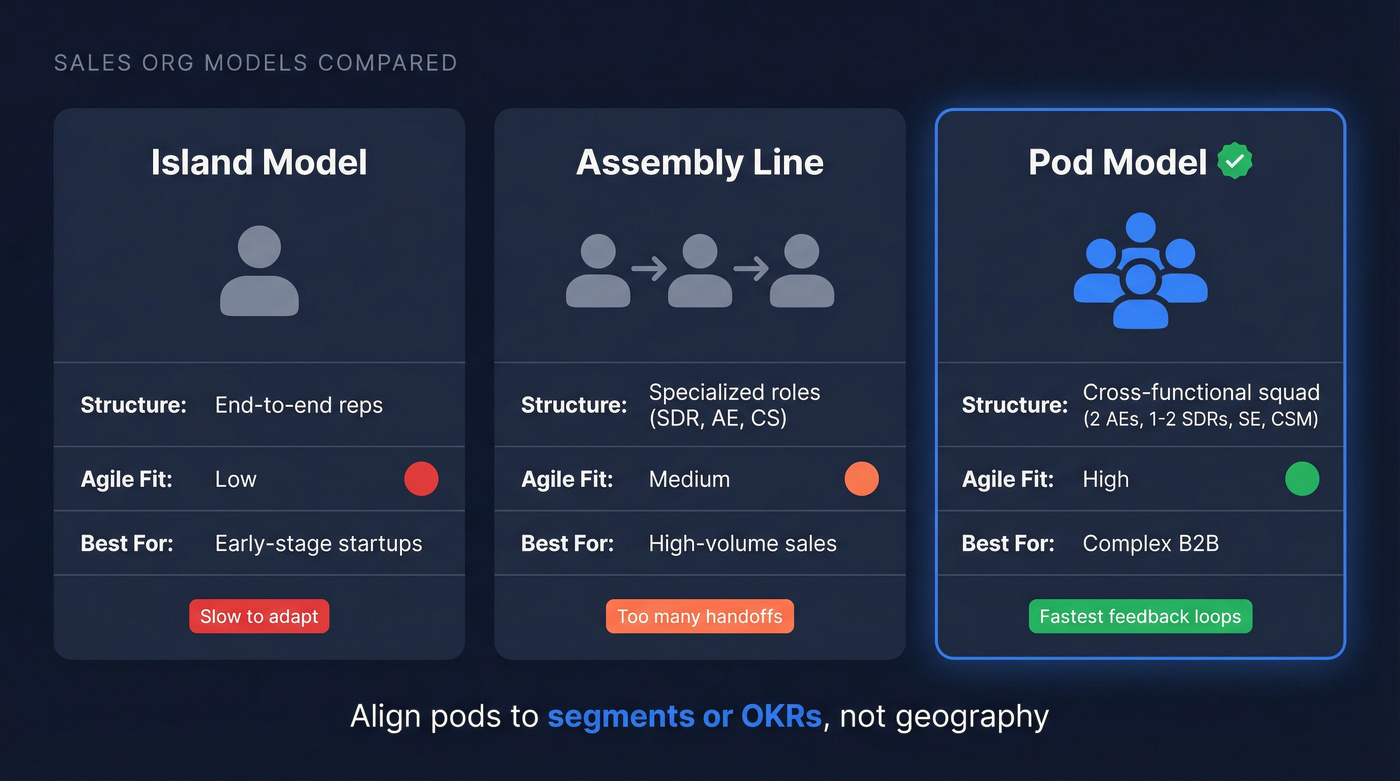
Pods win because they behave like a mini business unit aligned to a segment. A typical configuration: two AEs, one or two SDRs, a solutions engineer, a CSM, plus shared RevOps support. Fewer handoffs means faster learning, cleaner accountability, and better forecast accuracy because the same team sees the whole buyer journey from first touch to renewal.
One rule: align pods to segments or OKRs, not geography. Geography-based pods bake rigidity into the org chart. Segment-based pods can pivot when the market shifts because they're organized around buyer problems, not zip codes.
The Operating Rhythm That Drives Sprint-Based Selling
Structure without cadence is just a reorg. Here's the rhythm that makes pods actually move:
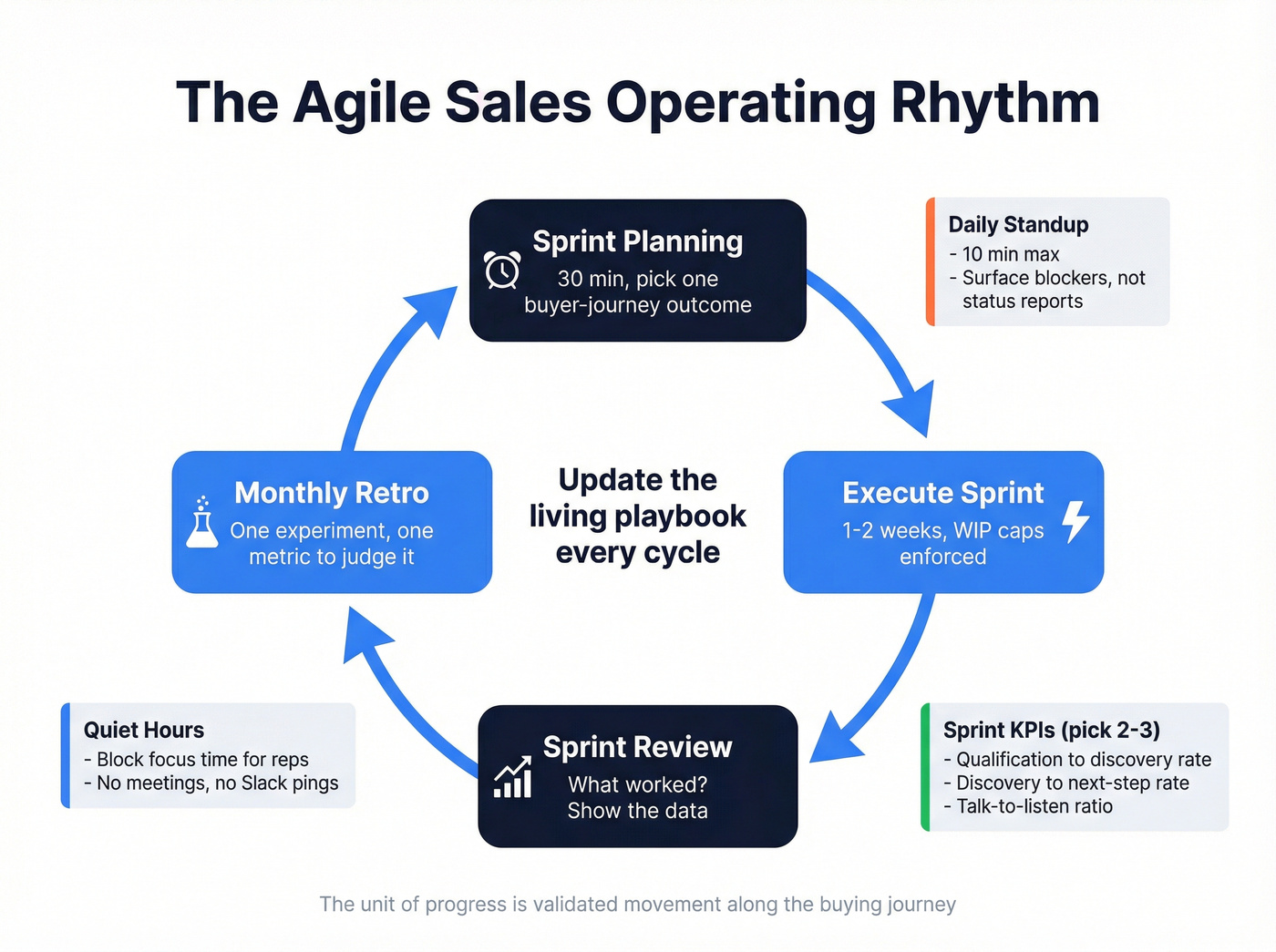
1-2 week sprints with one outcome that maps to the buyer journey - "increase discovery-to-demo conversion," not "do more calls." Each sprint starts with a 30-minute planning session and ends with a quick review of what worked.
Daily standup, 10 minutes max. Surface blockers and re-allocate help inside the pod. Salespeople hate standups when they turn into surveillance. Keep it tight and useful or kill it.
Monthly retro with one experiment you'll run next sprint and a metric you'll judge it by. No experiment, no retro - otherwise it's just a gripe session.
A living playbook that updates every sprint. If it's a static PDF, it's dead. And WIP caps plus quiet hours so reps stop context-switching themselves into mediocrity. In our experience, teams that skip WIP caps burn out fast and blame the methodology instead of the workload design.
For sprint KPIs, pick 2-3 that are hard to game: qualification-to-discovery conversion rate, discovery-to-next-step rate, and talk-to-listen ratio per call. A widely cited benchmark in agile sales guidance is that the chance of connecting with a lead is 100 times greater if contact happens within five minutes. Sprint cadence isn't a vibe - it's how you stop good leads from going cold.

Two-week sprints collapse when your contact data is six weeks old. Prospeo refreshes 300M+ profiles every 7 days - not the 6-week industry average - so your pods iterate on real buyer signals, not fiction. 98% email accuracy means reps spend sprint time selling, not chasing bounces.
Give your pods the data freshness their sprint cadence demands.
Redesigning Comp for Agility
You can't run quarterly sprints on annual comp plans. That's organizational schizophrenia.
ZS benchmarking shows annual performance periods dropped from 71% to 47% between 2008 and 2021, while quarterly cycles rose from 15% to 42%. The trend is clear: shorter periods force alignment. If this quarter's strategy is "win regulated healthcare," your wallet should reward regulated healthcare behavior now - not in December.
A few comp rules that actually work in pods:
Keep SDR pay-at-risk low enough that they don't game lead quality. Pay solutions engineers on team outcomes, because individual SE quotas create terrible internal competition that poisons the pod dynamic. For long cycles, use crediting rules that reward clean handoffs so reps don't sandbag deals to protect their number.
Why Agile Sales Transformations Fail
We've watched these rollouts die the same four deaths:
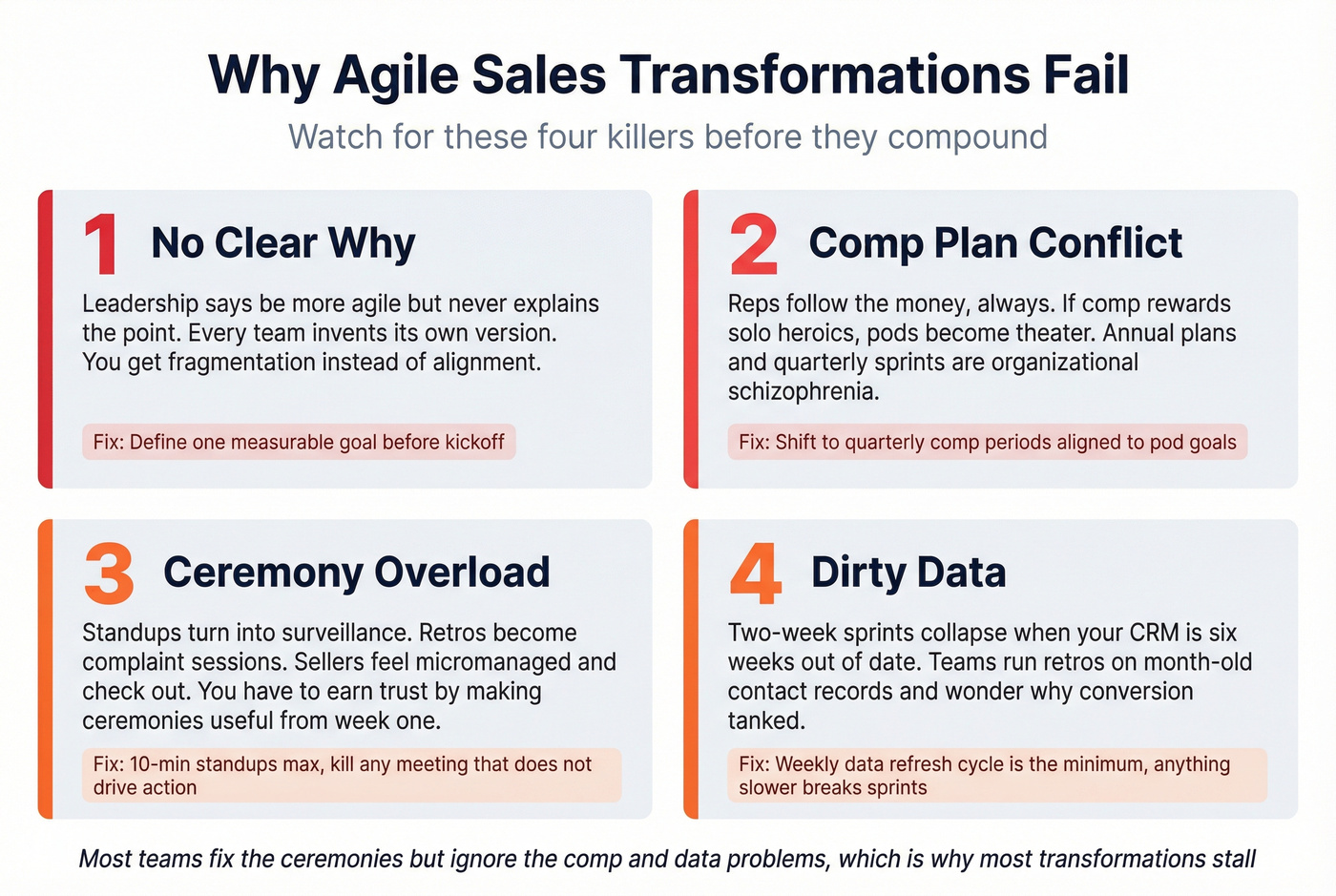
No clear why. If leadership can't explain the point beyond "be more agile," every team invents its own version and you get fragmentation instead of alignment.
Comp plan conflict. Reps follow the money. Always. If comp rewards solo heroics, pods become theater.
Ceremony overload. Standups turn into status reports, retros become complaint sessions, and sellers feel micromanaged. Let's be honest - most reps have been burned by a "new process" that just added meetings. You have to earn their trust by making the ceremonies genuinely useful from week one.
Dirty data. Two-week sprints collapse when your CRM is six weeks out of date. We've watched teams run retros on month-old contact records and then wonder why conversion tanked. A weekly data refresh cycle is the minimum - anything slower and your sprint decisions are built on fiction.
The 90-Day Pilot
Don't transform the whole org at once. Prove the model with one pod and one segment.
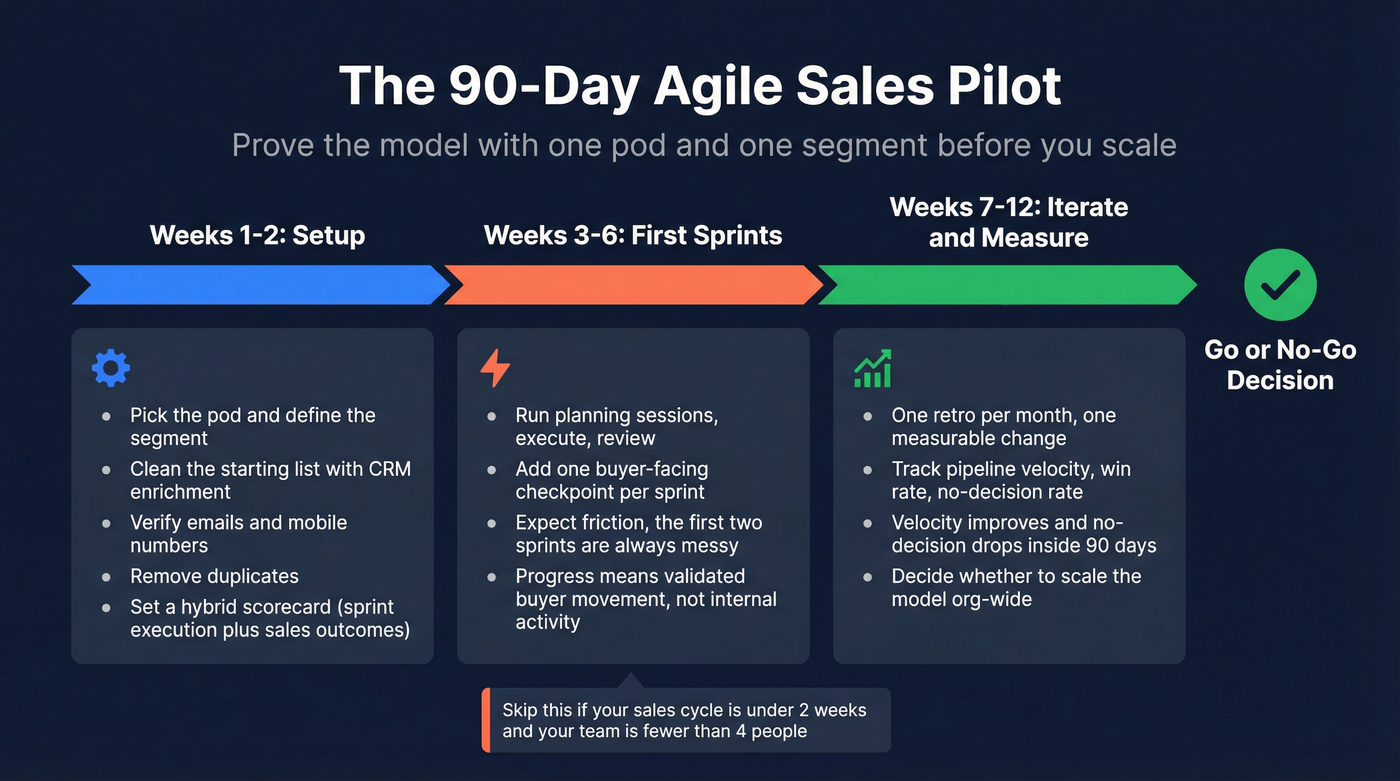
Weeks 1-2 (Setup): Pick the pod, define the segment, and clean the starting list. Use CRM enrichment to update contacts, verify emails and mobile numbers, and remove duplicates before sprint one. Set a hybrid scorecard that tracks sprint execution plus sales outcomes.
Weeks 3-6 (First sprints): Run your planning sessions, execute, review. Add one buyer-facing checkpoint per sprint so "progress" means validated movement in the buying journey, not internal activity. This is where you'll feel the friction - lean into it. The first two sprints are always messy.
Weeks 7-12 (Iterate): Hold one retro per month and commit to one measurable change. Track pipeline velocity, win rate, and "no decision" rate. When pods run this pilot cleanly, velocity improves and "no decision" drops inside 90 days. By the end, you'll know whether the model works for your market before committing the entire team.
Skip this approach if your sales cycle is under two weeks and your team is fewer than four people. At that size, the overhead of formal sprints and retros outweighs the benefit - just talk to each other.
The Data Layer Most Teams Skip
Here's the thing: CRMs don't fail because they're bad software. They fail because data decays faster than your GTM can adapt.
If your refresh cycle is the industry-average six weeks and your sprint cadence is two weeks, your team is three sprints behind reality - job changes, new decision-makers, disconnected numbers, bounced emails. That's not a small ops issue. It's a compounding forecast accuracy problem that gets worse every sprint you ignore it.

Prospeo addresses this directly with a 7-day refresh cycle across 300M+ professional profiles, 98% email accuracy, and native Salesforce and HubSpot integrations. It also verifies 125M+ mobile numbers and supports enrichment workflows via API, so RevOps can keep pods supplied without manual list babysitting. GreyScout cut rep ramp time from 8-10 weeks down to 4 after switching - exactly the kind of speed you need when you're spinning up new pods and can't afford a long learning curve.
Your 90-day pilot starts with clean data. Prospeo's CRM enrichment returns 50+ data points per contact at a 92% match rate - verified emails, direct dials, job changes, and intent signals across 15,000 topics. One enrichment run before sprint one eliminates the dirty-data failure mode entirely.
Clean your pilot list in minutes, not days. Starting at $0.01 per email.
FAQ
Is agile sales the same as Scrum for sales teams?
No. Scrum is one toolkit you can borrow from. An agile sales organization is broader: it combines pod structure, quarterly incentives, weekly data freshness, and a buyer-journey definition of progress - not just standups and sprint boards.
How long does a pilot take to show results?
Expect 90 days. Run one pod against one segment and measure pipeline velocity, win rate, and "no decision" rate. Trying to change five teams simultaneously slows learning and muddies attribution.
What tools does an agile sales team need?
At minimum: a CRM like Salesforce or HubSpot, a sprint board (Notion, Jira, or Trello), and a data platform that refreshes weekly. The sprint board is the cheapest piece - the data quality is what makes or breaks execution.
Can small teams under 10 reps run this model?
Yes - small teams are actually ideal for a first pilot. Start with a single pod of 4-6 people, one segment, and two-week sprints. Fewer stakeholders means faster iteration and cleaner feedback loops. You'll learn more in one quarter with a tight pod than in a year of org-wide "transformation."