

The Best AI Sales Bots in 2026 (Honest Buyer's Guide)
Your VP of Sales just forwarded a LinkedIn post about an AI sales bot that "books 50 meetings a week on autopilot." Now the whole team wants one. The problem? That term covers website chatbots, DM automation tools, outbound AI agents, and data verification layers - lumping sedans, forklifts, helicopters, and skateboards into one category. Sellers spend roughly 25% of their time actually selling, and AI can reclaim a chunk of the rest. But only if you pick the right type of tool.
There are four distinct categories, and buying from the wrong one is the most expensive mistake in this market.
Our Picks
| Pick | Best For | Starting Price | Why |
|---|---|---|---|
| Intercom + Fin AI | Mid-market AI chat | $29/seat/mo + $0.99/outcome | Best autonomous resolution rate |
| Prospeo | Clean data under your bot | Free (75 emails/mo) | 98% email accuracy, 7-day refresh |
| HubSpot | Free starting point | $0/mo (5 users) | CRM-native bot, zero friction |
| Tidio + Lyro AI | SMBs on a budget | $25/mo | Lyro AI handles 50 convos from $39/mo |
Intercom's Fin is the most mature AI agent for mid-market teams. Prospeo isn't a chatbot - it's the data layer that makes every other tool on this list actually work. 300M+ profiles, 143M+ verified emails, and 125M+ verified mobile numbers mean the leads your bot captures are reachable. HubSpot is the obvious free entry point. And Tidio gives budget-conscious SMBs a surprisingly capable AI assistant.
Which Type Do You Need?
Most "best AI sales bot" lists throw twelve tools into a single ranking without acknowledging they solve completely different problems. We've broken the market into four categories so you can skip straight to the one that matters.
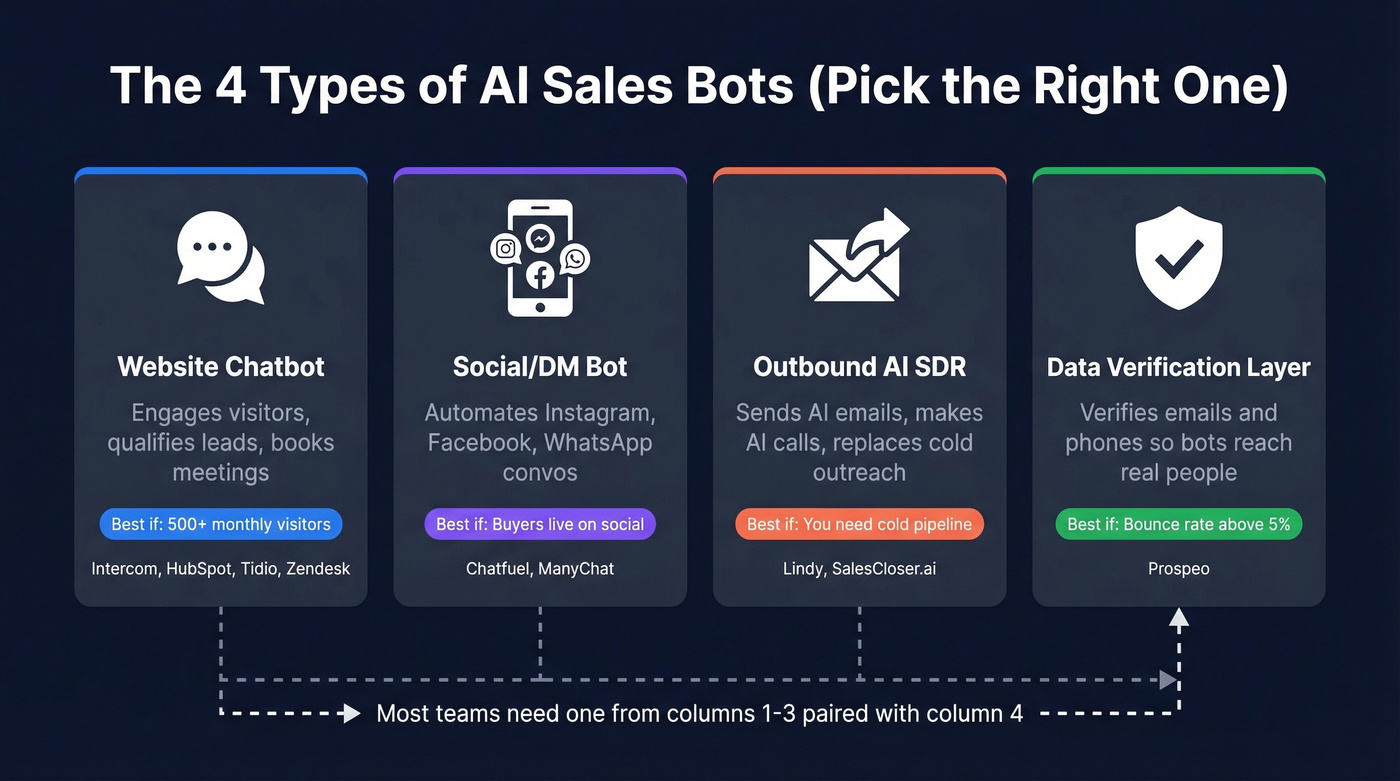
| Category | What It Does | Pick This If... | Example Tools |
|---|---|---|---|
| Website chatbot | Engages visitors, qualifies, books meetings | You get 500+ monthly site visitors and need to convert inbound traffic | Intercom, HubSpot, Tidio, Zendesk |
| Social/DM bot | Automates Instagram, Facebook, WhatsApp convos | Your buyers engage on social channels, not your website | Chatfuel, ManyChat |
| Outbound AI SDR | Sends AI-written emails, makes AI calls | You want to replace or augment SDRs for cold outreach | Lindy, SalesCloser.ai |
| Data verification layer | Verifies emails/phones so bots reach real people | Your bounce rate is above 5% or your CRM data is older than 30 days | Prospeo |
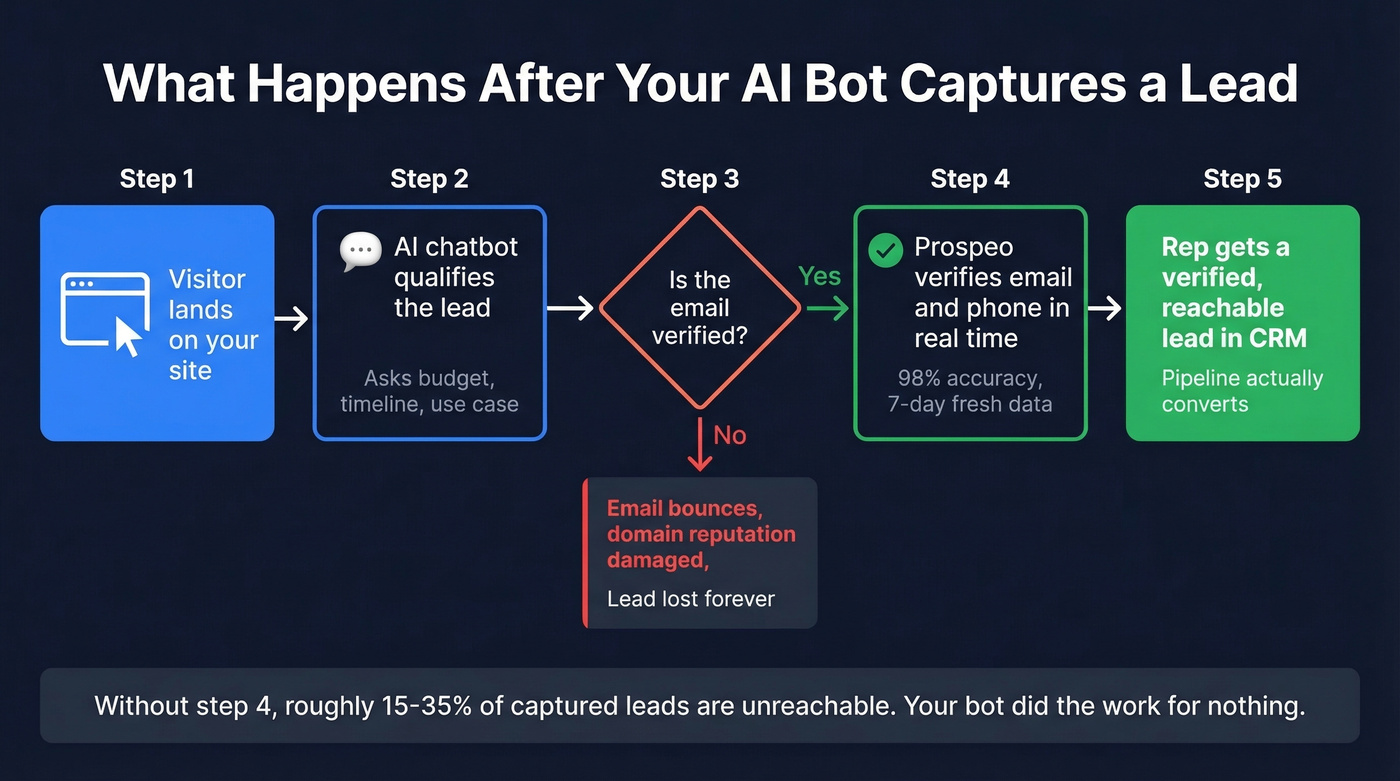
The first three categories handle the conversation. The data verification layer handles everything underneath. If your contact database is stale or unverified, it doesn't matter how good your chatbot's AI is - you're qualifying leads into a dead pipeline.
Here's the thing: most teams need one tool from categories 1-3 paired with category 4. A website chatbot that captures a lead with a bad email is just generating busywork for your reps. And the teams that pick the wrong category entirely - say, buying an outbound AI SDR when their real problem is converting existing website traffic - waste months before course-correcting.
The 12 Best AI Sales Bots
Intercom + Fin AI
Use this if you're a mid-market or growth-stage company with real support volume and want an AI agent that resolves conversations autonomously.
Skip this if you're pre-revenue with under 100 monthly conversations - the per-outcome pricing won't make sense yet.
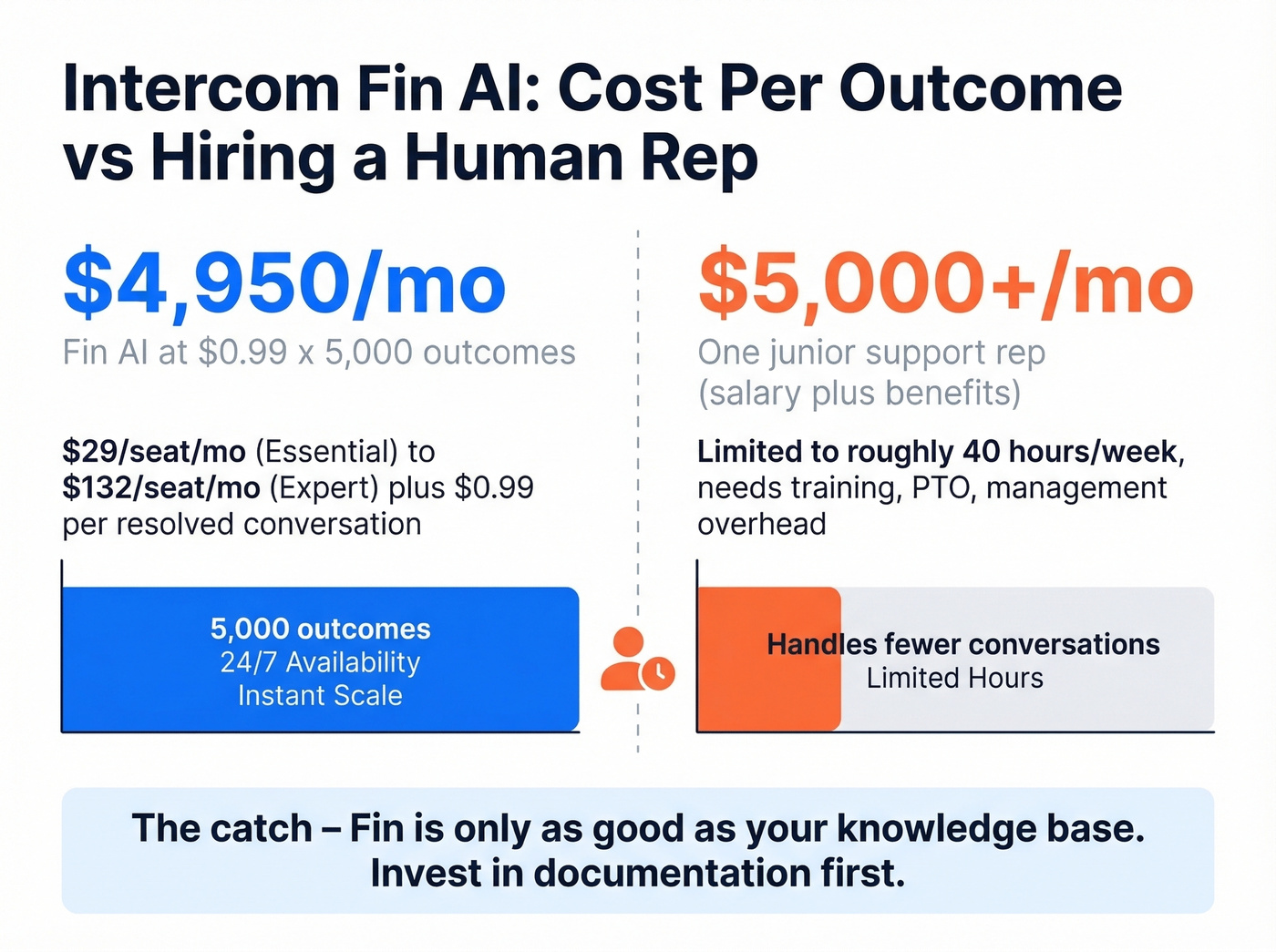
Intercom's Fin AI agent is the most mature autonomous chat agent on the market right now. It charges [$0.99 per outcome](https://www.intercom.com/help/en/articles/8205718-fin-ai-agent-outcomes), which sounds expensive until you do the math: 5,000 monthly outcomes cost $4,950 - roughly what one junior support rep costs after benefits. Seat pricing starts at $29/mo (Essential) and scales to $132/mo (Expert). The 14-day free trial is generous enough to test Fin on real traffic.
Reddit sentiment is generally positive, with users praising Fin's resolution quality but noting it works best when you've invested in your knowledge base. Garbage in, garbage out applies to AI agents too. The main limitation is exactly that: Fin reflects the quality of your documentation.
Prospeo
Use this if your outbound bounce rate is above 5%, your CRM data is older than 30 days, or you're feeding any AI sales tool with contact data that hasn't been verified recently.
Skip this if your bounce rate is already under 2% and your CRM data was verified in the last 7 days - but audit first, because most teams overestimate their data quality.
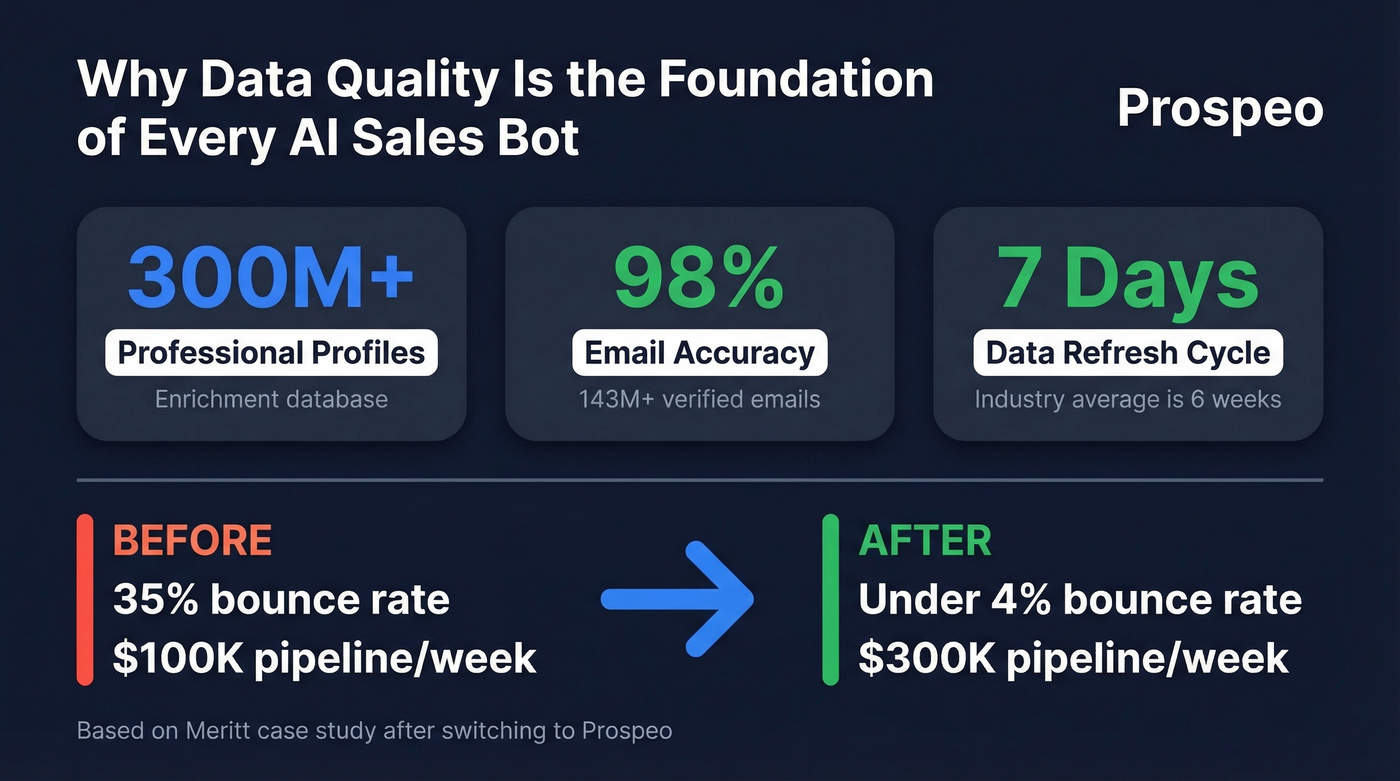
Prospeo is the data infrastructure that makes every other tool on this list work. It's not a chatbot - it's the verification and enrichment layer that ensures the leads your bot captures are reachable. The numbers: 300M+ professional profiles, 143M+ verified emails at 98% accuracy, 125M+ verified mobile numbers with a 30% pickup rate across all regions.

The 7-day data refresh cycle is the real differentiator. The industry average is six weeks, which means most databases are serving you contacts who've already changed jobs. At ~$0.01 per email with a free tier of 75 emails per month, the cost is negligible compared to the domain reputation damage from sending to bad addresses. Meritt tripled their pipeline from $100K to $300K per week after switching, with bounce rates dropping from 35% to under 4%. Native integrations with Salesforce, HubSpot, Lemlist, Instantly, and Clay mean it slots into whatever stack you're already running.
HubSpot
Use this if you're already on HubSpot CRM and want a chatbot that works without any integration headaches.
Skip this if you need sophisticated AI resolution - HubSpot's bot builder is rule-based at its core, and the AI features are still catching up to Intercom and Tidio.
HubSpot's chatbot is free for up to 5 users, which makes it the obvious starting point for early-stage teams. It lives inside the CRM, so every conversation automatically creates or updates a contact record. The bot builder uses a visual flow editor - no code required, but also no true AI autonomy. You're building decision trees, not deploying an agent.
For teams that just need to qualify visitors and route them to the right rep, that's often enough. We've seen multiple seed-stage startups run HubSpot's free bot for 6+ months before needing anything more sophisticated. G2 rating: 4.4/5.
Tidio + Lyro AI
I watched a team of three SDRs at a D2C SaaS company deploy Tidio's Lyro AI in about two hours. Within a week, Lyro was handling 40% of their inbound chat volume - mostly FAQ-style questions that were eating rep time. The pricing made it possible: Tidio starts at $25/mo, and Lyro AI adds on from $39/mo for 50 conversations.
The Growth plan at $59/mo is the sweet spot for most SMBs. If you need enterprise-grade features, Plus runs $749/mo and Premium hits $2,999/mo - but at that point, you should be evaluating Intercom instead. Tidio's 7-day free trial is enough to test Lyro on real traffic.
Drift (Now SalesLoft)
Salesloft acquired Drift in early 2024, and the product is being folded into Salesloft's platform. The sticker price is $2,500/mo (Premium tier, billed annually), but real-world costs run much higher. Advanced plans land at $48K-$60K/year. Enterprise? $72K-$120K/year. Add $3K-$5K for onboarding, seat fees around $80/seat/month, and an implementation timeline of 4-8 weeks (up to 12 for enterprise), and you're looking at a total investment of $150K-$300K/year depending on coverage hours.
G2: 4.4/5 across 1,200+ reviews. Best for enterprise teams already in the Salesloft ecosystem. Skip it if you're under 50 employees.
Zendesk
Zendesk's AI chatbot for sales starts at $55/agent/month billed annually, with a 14-day trial. It's a solid choice if you're already running Zendesk for support and want to extend the same platform to sales conversations. The AI capabilities are improving but still trail Intercom's Fin in autonomous resolution. Where Zendesk shines is the unified support-and-sales experience - one platform, one knowledge base, one reporting dashboard. G2: 4.3/5.
Chatfuel
Chatfuel is one of the best-known tools for Facebook, Instagram, and WhatsApp bots starting at $12.04/mo for the Starter tier, scaling to $23.99/mo for Business (FB/IG) and $34.49/mo for WhatsApp. Enterprise plans hit $300/mo. If your buyers engage through social DMs rather than your website, Chatfuel is a cost-effective option. The visual flow builder is intuitive enough that non-technical marketers can ship a working bot in an afternoon. It's not a website chatbot, though - don't buy it for that. 7-day free trial available.
Lindy
Lindy positions itself as an AI agent platform, not just a chatbot. The free tier gives you 400 credits/month, Pro runs $49.99/mo, and Business is $299.99/mo. It handles email, chat, and voice workflows with a no-code builder that lets you chain together multi-step automations. Best for teams that want to experiment with multi-channel AI agents without committing to enterprise pricing. The product is still maturing - expect to spend time configuring workflows, and start with a single channel before trying to automate everything at once. Community feedback suggests the email agent is the strongest module.
Crisp
Crisp starts at $95/mo with a generous 30-day trial - the longest on this list. It's a solid mid-range option for teams that want live chat, chatbot, and a shared inbox in one tool. The AI features are competent but not best-in-class. Best for small teams that want an all-in-one messaging platform without Intercom's per-outcome pricing model.
SalesCloser.ai
An AI voice agent for outbound calls. G2 rating: 2.7/5 from 3 reviews - one reviewer said the AI calls sounded like "Google Translate" and felt "confused and unnatural." Pricing isn't public; expect $200-$500/mo based on the voice agent market. Too early to recommend.
Rep AI
An ecommerce-focused AI sales assistant starting at $12/mo for 1,000 website visitors. Scales with traffic. Best for Shopify stores that want a conversational product recommendation engine, not B2B sales teams.
ManyChat
The other social DM bot alongside Chatfuel, focused on Instagram and Facebook Messenger automation. Free tier available, paid plans from ~$15/mo. If you're running influencer-driven sales funnels on Instagram, ManyChat is a common choice. Not relevant for B2B website sales.
Tools we evaluated but excluded: Ada, ChatLab, and MirrorFly all appeared in our research. Ada's pricing puts it firmly in enterprise-only territory with limited public information. ChatLab and MirrorFly lack the review volume and market traction to recommend confidently alongside the tools above.

Every AI sales bot on this list has the same weakness: bad data. If the emails your bot captures bounce or the phone numbers are disconnected, you're automating failure. Prospeo's 7-day data refresh and 98% email accuracy ensure every lead your bot qualifies actually reaches a real person.
Stop feeding your AI bot dead leads. Start with verified data.
Pricing Comparison
The AI chatbot market breaks into three tiers: entry-level ($50-$200/mo), mid-tier ($500-$2,000/mo), and enterprise ($5,000-$50,000+/mo). Usage-based models often add $0.01-$0.50 per conversation, with premium agents reaching $0.99 per outcome. Budget for integration work, LLM API credits, and data storage too. Implementation costs range from $1,000 for simple deployments to $100,000+ for enterprise rollouts, and average implementation cost has dropped about 35% since 2023.
| Tool | Category | Starting Price | Model | Free Tier/Trial |
|---|---|---|---|---|
| Intercom | Website chat | $29/seat/mo | Seat + $0.99/outcome | 14-day trial |
| HubSpot | Website chat | $0/mo (5 users) | Seat-based | Free tier + 14-day trial |
| Tidio | Website chat | $25/mo | Seat + AI add-on | 7-day trial |
| Drift | Website chat | $2,500/mo | Annual contract | Demo only |
| Zendesk | Website chat | $55/agent/mo | Seat-based | 14-day trial |
| Chatfuel | Social/DM | $12.04/mo | Tier-based | 7-day trial |
| Lindy | Outbound agent | Free (400 credits) | Credit-based | Free tier |
| Crisp | Website chat | $95/mo | Tier-based | 30-day trial |
| SalesCloser.ai | Outbound agent | ~$200-$500/mo | Custom | Demo only |
| Rep AI | Website chat | $12/mo | Traffic-based | 30-day trial |
| ManyChat | Social/DM | ~$15/mo | Tier-based | Free tier |
Let's be honest about the real cost equation. The biggest expense isn't the bot - it's the SDR staffing to cover escalations. Intercom's $0.99/outcome model looks expensive at first, but 5,000 monthly outcomes at $4,950 is cheaper than one junior rep. If your average deal size is under $10K, you probably don't need Drift-level infrastructure. A $25/mo Tidio plan with clean data underneath will outperform a $2,500/mo Drift deployment running on a stale CRM.
Why Most AI Sales Bots Fail
We've seen three failure modes repeatedly, and they have nothing to do with which tool you pick.
"Confidently irrelevant" personalization. The consensus on r/AI_Agents is brutal: AI SDR outreach is "more volume, less signal... still spam - just with creepier intros." The bot scrapes your job title, references a recent post, then pivots to a pitch that has nothing to do with your actual problems. More personalization tokens don't fix bad targeting.
Bad data underneath. If your bounce rate is above 5%, your automated sales agent is qualifying leads into a dead pipeline. It doesn't matter how sophisticated your conversation flows are if the contact data is stale. Snyk cut their bounce rate from 35-40% to under 5% after implementing verification and enrichment - and AE-sourced pipeline jumped 180%. A weekly data refresh cycle is the standard to aim for; anything closer to the six-week industry norm means you're working with contacts who've already moved on.

Plug-and-play expectations. Bain's research is clear: AI gains require process redesign, not just bolting a bot onto existing workflows. Otherwise you get "micro-productivity" - slightly faster versions of broken processes. Only about 5% of companies achieve substantial AI ROI, and the average payoff runs ~1.7x. The teams that win redesign their sales process, routing rules, and follow-up sequences around the bot - not the other way around.
How to Choose the Right Tool
Before you sign an annual contract, think through these decisions in order.
Start with your traffic. If you're getting under 500 unique monthly visitors, a website chatbot is a waste of money - focus on outbound or social channels instead. Once you know your volume, match the channel to where your buyers actually engage. Website visitors need Intercom or Tidio. Social DM buyers need Chatfuel or ManyChat. Outbound-heavy teams should look at an AI SDR agent like Lindy.
CRM integration matters more than most teams realize. Native Salesforce or HubSpot connections save weeks of implementation time. If your tool only connects via Zapier, expect data sync issues and lag that erode the automation gains you're paying for.
Think about pricing model fit. Seat-based pricing from HubSpot or Zendesk is predictable. Usage-based models like Intercom's $0.99/outcome scale with volume - great if you're growing, painful if traffic spikes unexpectedly. Credit-based models give you granular control over spend.
Before buying any bot, audit your data quality. Check your bounce rate. If it's above 5%, fix your data first - every dollar spent on a conversational agent is wasted if the leads it captures can't be reached.
A few implementation best practices that separate successful deployments from abandoned ones: set up QA monitoring from day one so you catch bad AI responses before your prospects do, always disclose bot identity to users (hiding it erodes trust), and establish clear escalation paths so conversations that exceed the bot's capability route to a human within seconds, not minutes.
Most tools offer 7-30 day trials. Use them. Deploy on a single page or segment, measure resolution rate and lead quality, then decide. Never commit to an annual contract based on a demo.
Realistic ROI Expectations
Bain's data shows 30%+ improvement in win rates is achievable - but only with process redesign, not just tool deployment. The difference is almost always implementation quality, not tool selection.
Expect initial returns in 6-18 months. Meaningful impact takes 18-36 months. Enterprise-level transformation? Three to five years. The average payoff across companies that stick with it runs about 1.7x, which is solid but not the 10x that vendor marketing implies.
Only about 5% of companies achieve substantial ROI from AI sales tools. Another 35% see partial returns. The rest either abandon the tool or never implement it properly. If you're going in expecting a magic button, you'll join the 60% that gets nothing. If you're willing to redesign workflows around the tool, the upside is real.
Meritt tripled their pipeline from $100K to $300K/week and cut bounce rates from 35% to under 4%. The difference wasn't a better chatbot - it was cleaner data underneath. At $0.01 per verified email, Prospeo costs less than a single wasted AI sales bot conversation.
Your bot handles the conversation. Prospeo makes sure someone's on the other end.
FAQ
What's the difference between a chatbot and an AI SDR?
A chatbot engages visitors on your website in real time - think Intercom or Tidio. An AI SDR automates outbound email and call sequences - think Lindy or SalesCloser.ai. Different tools, different budgets. Most teams need one or the other, not both.
How much does an AI sales bot cost?
Entry-level tools run $15-$200/mo (Tidio, Chatfuel, HubSpot free). Mid-tier platforms cost $500-$2,000/mo (Intercom at scale). Enterprise deployments hit $5,000-$50,000+/mo (Drift with staffing and onboarding). Usage-based models add $0.01-$0.99 per conversation or outcome.
Do these tools actually increase revenue?
Bain data shows 30%+ win rate improvement is possible when teams redesign their sales process around the tool - not just bolt it on. Expect 6-18 months for initial returns and an average payoff of ~1.7x investment. Only about 5% of companies hit substantial ROI.
How do I keep my bot's contact data accurate?
Audit your bounce rate first. If it's above 5%, verify your database before deploying any bot. A data verification layer with a 7-day refresh cycle ensures the contacts your bot engages are reachable - compared to the six-week industry average that leaves you messaging people who've already changed jobs.