

The AI Sales Process Is a Workflow Problem - Here's the Blueprint
Your SDR team is "using AI." They've got three tools, a Slack channel full of prompt tips, and reply rates that haven't moved in two quarters. Half the emails bounce. The "personalized" opening lines reference funding rounds from 18 months ago. And 88% of organizations report regular AI use, but roughly two-thirds haven't scaled beyond pilots.
The gap isn't tools. It's designing an AI sales process that actually connects workflows to revenue.
What You Need (Quick Version)
You don't need 12 AI use cases. You need two workflows that move revenue - prospecting inputs and qualification decisions. Three things to implement first:
- Verified contact data + enrichment. AI personalization is worthless when inputs are stale. Weekly refresh is the baseline for high-volume outbound. (If you’re evaluating providers, start with a verified contact database.)
- AI-assisted research + call/meeting summaries feeding CRM. This is where reps reclaim 5-10 hours a week, and it's the best way to use AI for sales without overhauling your entire stack. (If you need the systems layer, look at CRM automation.)
- Next-best-action automation with human approval gates. Not full autonomy - just intelligent nudges a rep can accept or override.
Everything else is optimization on top of these three.
What "AI" Actually Means in Sales
The term gets thrown around loosely. In practice, you're dealing with machine learning for lead scoring and pattern recognition, NLP that parses emails and transcribes calls, conversational AI powering chatbots and qualification flows, generative AI writing sequences and research summaries, predictive models for forecasting and propensity scoring, and the newest entrant - agentic AI, where systems chain multiple steps together autonomously.
What matters isn't the taxonomy. Gartner predicts that by 2027, 95% of seller research workflows will begin with AI, up from less than 20% in 2024. That's not a gradual shift. It's a wholesale replacement of how reps prepare for conversations.
Stage-by-Stage AI Sales Blueprint
Here's the thing - most content on this topic gives you a list of tools. What you actually need is a map of inputs, actions, outputs, and metrics per stage.
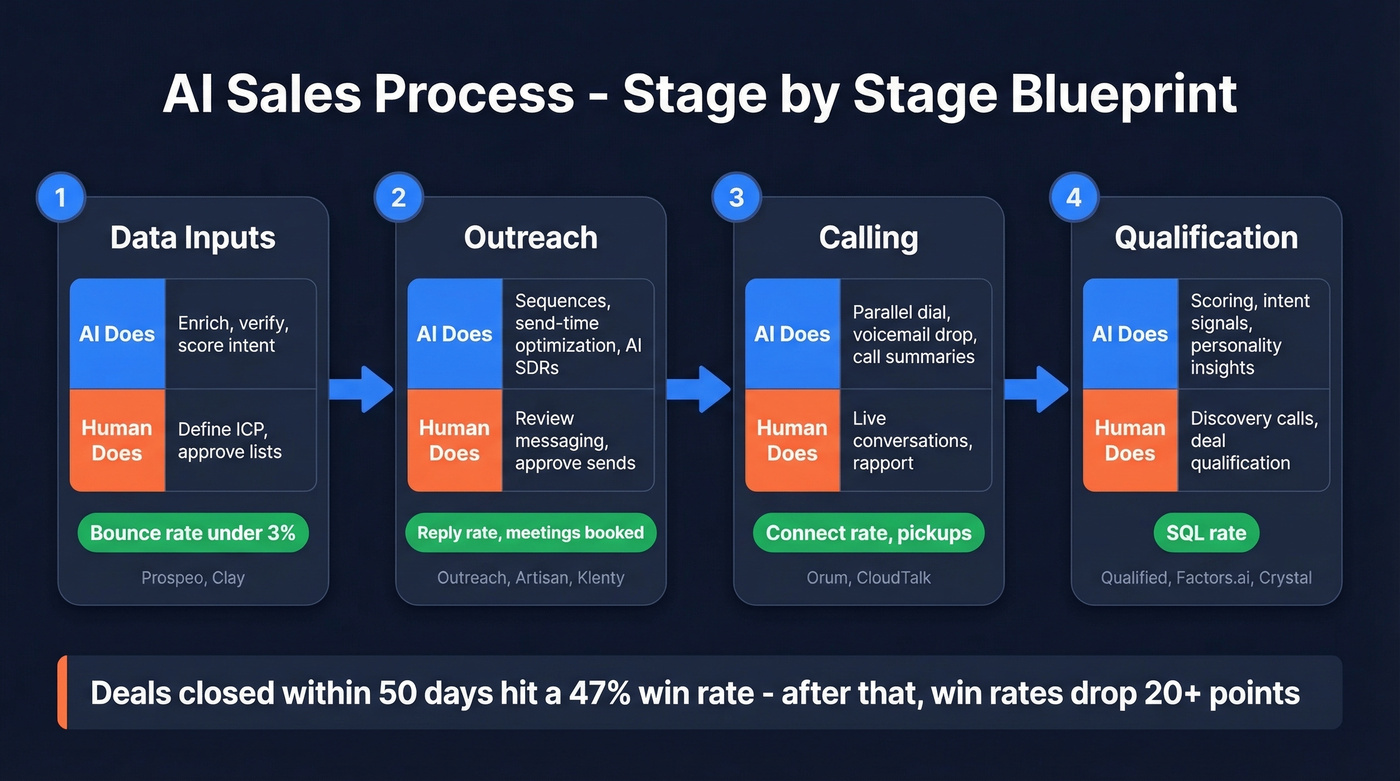
| Stage | AI Does | Human Does | Key Metric | Tools |
|---|---|---|---|---|
| Data Inputs | Enrich, verify, score intent | Define ICP, approve lists | Bounce <3%, fresh data | Prospeo, Clay |
| Outreach | Sequences, send-time, AI SDRs | Review messaging, approve | Reply rate, meetings | Outreach, Artisan, Klenty |
| Calling | Parallel dial, voicemail, summaries | Live conversations | Connect rate, pickups | Orum, CloudTalk |
| Qualification | Scoring, intent, personality | Discovery, deal qualification | SQL rate | Qualified, Factors.ai, Crystal |
Cycle time matters more than most teams realize. Outreach's data shows opportunities closed within 50 days hit a 47% win rate - after that threshold, win rates drop 20+ percentage points.
The data inputs row is where most implementations quietly fail. AI outreach breaks when inputs are stale. Prospeo refreshes 300M+ professional profiles every 7 days versus a typical 4-6 week refresh cycle, with 98% email accuracy at roughly $0.01 per lead. Intent data across 15,000 topics means your AI sequences target accounts actually in-market, not accounts that matched a firmographic filter last quarter. We've seen teams cut bounce rates from 35% to under 4% just by fixing this one layer before touching anything else. (If you’re comparing options, see the best B2B database rankings.)

The blueprint above is clear: AI outreach breaks when inputs are stale. Prospeo refreshes 300M+ profiles every 7 days with 98% email accuracy - at $0.01 per lead. Teams using Prospeo cut bounce rates from 35% to under 4% before touching a single AI tool.
Fix the data layer first. Everything else compounds from there.
Where AI Agents Break
Single-step tasks with clear inputs work well. Call summarization, email drafting, lead scoring, CRM field updates - these are reliable, measurable, and save real time. (For outbound-specific tooling, see outbound email automation.)
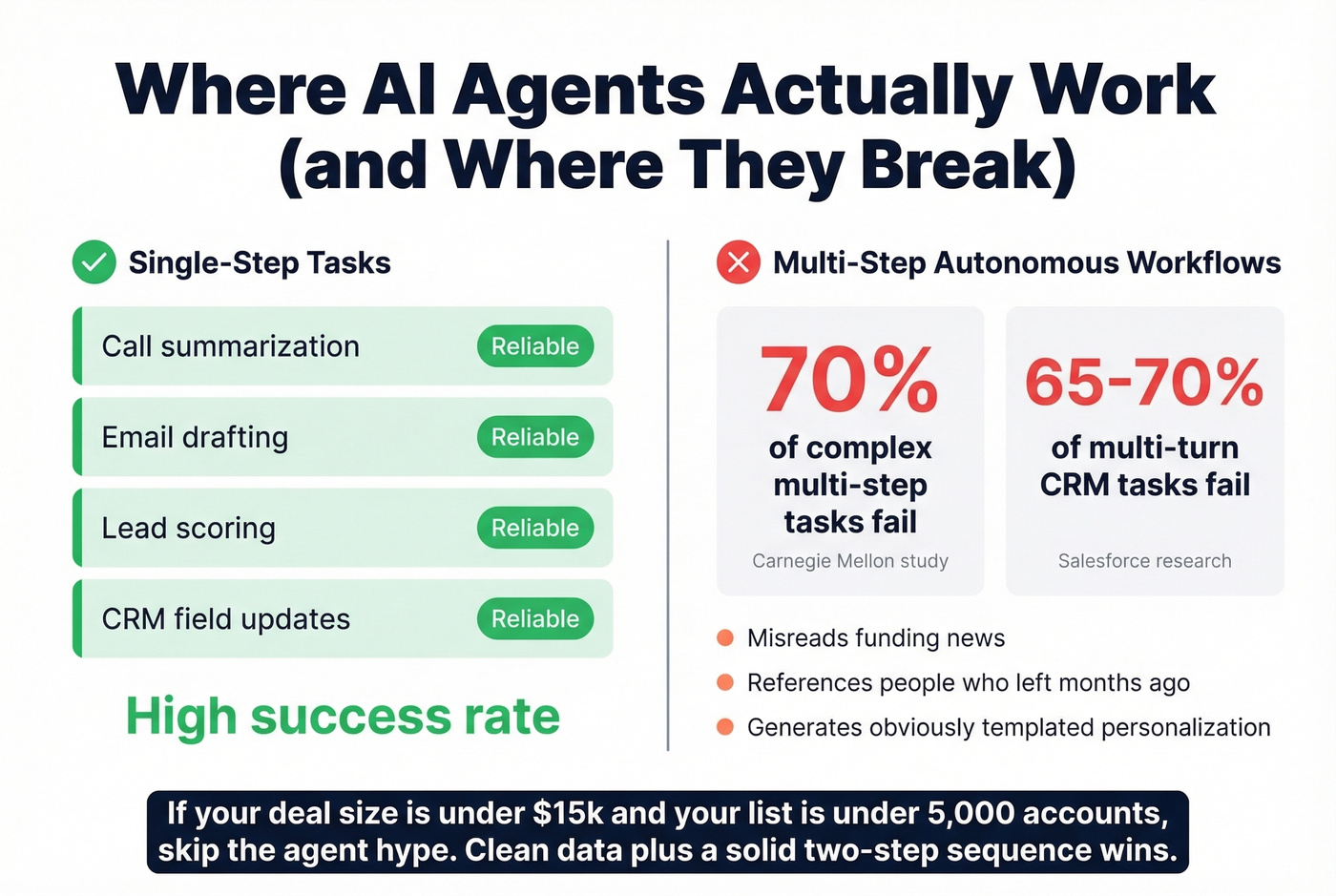
Multi-step autonomous workflows are a different story. A Carnegie Mellon study found AI agents fail 70% of complex multi-step office tasks. Salesforce research puts multi-turn CRM task success at just 30-35%. The failure patterns are predictable: AI misreads funding news, references personnel who left six months ago, generates "personalization" so obviously templated it erodes trust faster than a generic email would. Salesforce calls this "workslop" - low-quality AI output that creates more auditing work than it saves.
In our experience, the fix isn't better models. It's better inputs and tighter human approval gates.
If your average deal size is under $15k and your list is under 5,000 accounts, you probably don't need agentic AI at all. You need clean data and a solid two-step sequence. Skip the agent hype and spend that budget on verification. (If deliverability is the pain, start with an email verifier.)
Governance - The Part Vendor Blogs Skip
Sales intelligence stacks process three sensitive data categories: contact/firmographic data, behavioral/intent signals, and CRM integration records. Your governance non-negotiables:
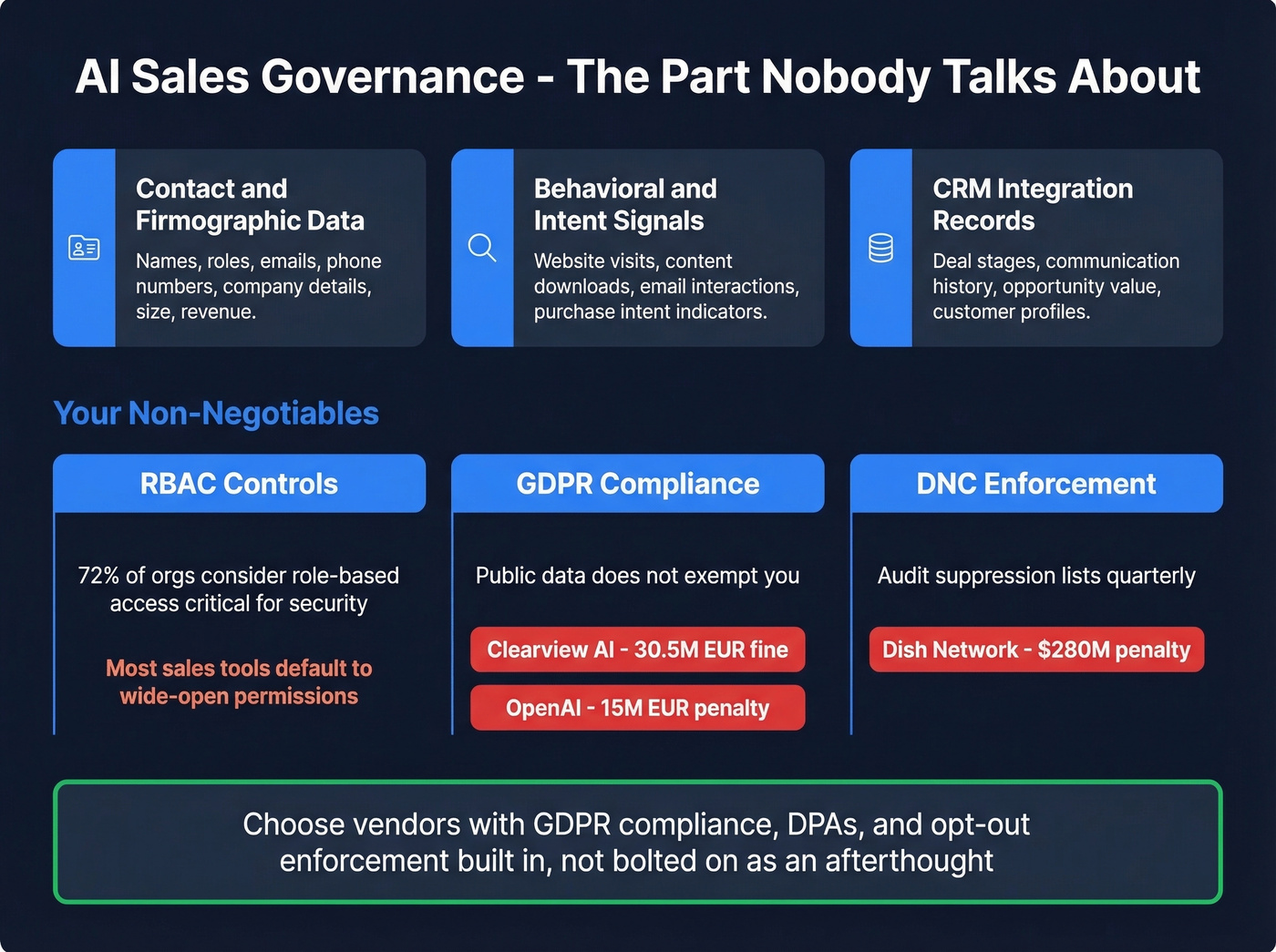
- RBAC controls - 72% of organizations consider role-based access critical for security, yet most sales tools default to wide-open permissions.
- GDPR compliance - Clearview AI's EUR30.5M fine and OpenAI's EUR15M penalty prove "public data" doesn't exempt you.
- DNC enforcement - Dish Network's $280M penalty should make every outbound team audit suppression lists quarterly.
Choose vendors with GDPR compliance, DPAs, and opt-out enforcement built in - not bolted on as an afterthought. (Use a GDPR compliant database checklist when you audit vendors.)
The 90-Day Rollout Plan
McKinsey's research is clear: workflow redesign separates companies that capture value from those stuck in pilot purgatory. We've seen the pattern repeatedly - leadership buys an AI tool, nobody changes the underlying process, and it becomes another tab nobody opens.
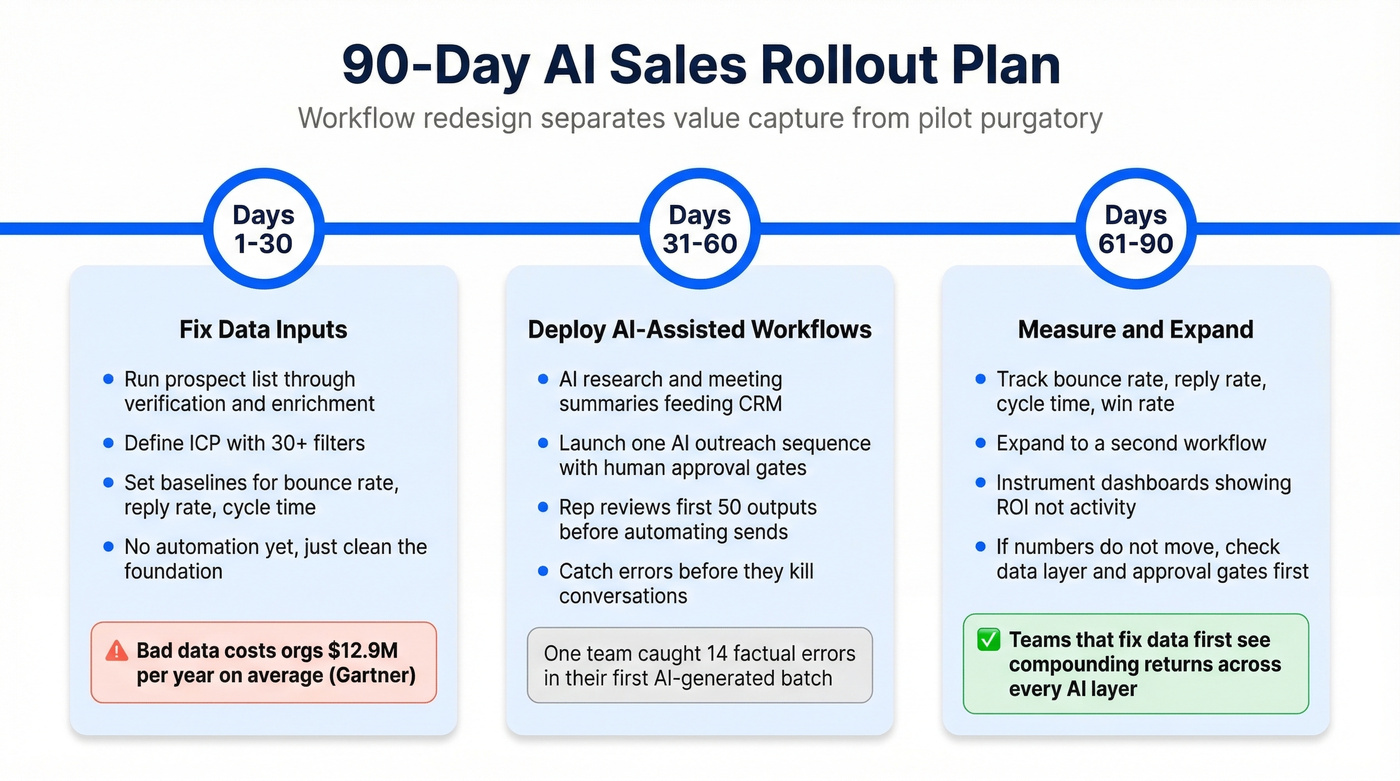
Days 1-30: Fix data inputs. Run your prospect list through verification and enrichment before automating anything. Define your ICP with 30+ filters. Set baselines for bounce rate, reply rate, and cycle time. This isn't glamorous work, but bad data quality costs organizations $12.9M annually on average, and no amount of AI sophistication downstream fixes garbage going in. (If you need a framework, start with an ideal customer profile.)
Days 31-60: Deploy AI-assisted research and meeting summaries feeding your CRM. Launch one AI outreach sequence with human approval gates - don't automate sending until a rep has reviewed the first 50 outputs. This is where sales efficiency with AI becomes measurable, not theoretical. One team we worked with caught 14 factual errors in their first batch of AI-generated openers, any one of which would've killed a deal conversation before it started. (For messaging, see AI email personalization.)
Days 61-90: Measure and expand. Track bounce rate, reply rate, cycle time, win rate. Expand to a second workflow. Instrument dashboards so leadership sees ROI, not activity metrics. If the numbers don't move, the problem is almost always in the data layer or the approval gates - not the AI model. (If you’re standardizing metrics, use account executive KPIs.)
Let's be honest: building an effective AI sales process isn't about finding the right tool. It starts with clean inputs, adds intelligence in layers, and keeps humans in the loop until you trust the outputs. The teams that get this right aren't the ones with the biggest tech budgets. They're the ones who fixed their data first.
Day 1 of your 90-day rollout starts with verification and enrichment. Prospeo gives you 30+ ICP filters, intent data across 15,000 topics, and 125M+ verified mobiles - so your AI sequences target in-market buyers, not stale firmographic matches.
Stop feeding garbage into your AI stack. Build on data that's 7 days fresh.
FAQ
How long does it take to implement AI in a sales workflow?
A focused pilot takes 30-90 days. Most teams stall because they skip workflow redesign and data cleanup - the two prerequisites that determine whether AI scales or dies in pilot. Start with data verification in week one, not tool selection.
What's the biggest reason AI sales pilots fail?
Bad data. If your contact records are stale or incomplete, every AI action downstream - scoring, personalization, routing - runs on wrong assumptions. Fixing the data layer with weekly-refresh verification eliminates the most common failure point before automation begins.
What email accuracy should I expect from a B2B data provider?
Aim for 95%+ email verification accuracy with weekly refresh cycles. Most providers refresh every four to six weeks, and that gap compounds fast when you're running AI-generated sequences at scale. Top-tier providers hit 98% with a 7-day refresh.