

AI SDR in 2026: What Works, What Fails, and What Nobody Tells You
A RevOps lead we know ran a head-to-head test last quarter - fully autonomous AI SDR against a mid-level human rep. The AI booked meetings at 54x lower cost. The human generated nearly 3x the revenue. That tension defines everything about this category right now.
What You Actually Need
Most teams don't need a $40K/year platform. They need an AI-assisted outbound workflow with clean data, a sequencer, and human oversight. The rest of this piece shows you why - and how to build it without torching your domain reputation or your pipeline.
The $15B Bet That Mostly Doesn't Work
The AI SDR market is projected to reach $15B by 2030. VCs have poured $400M+ into startups in the last two years alone. Rox AI hit a $1.2B valuation on roughly $8M in ARR - a 150x multiple that tells you more about investor enthusiasm than product-market fit. A UserGems survey of 100+ B2B revenue leaders found that 97% plan to increase AI spend, but only 7% report measurable ROI.
The tools are getting funded, buyers are signing checks, and the results aren't showing up. In practice, 50-70% of users quit within 3 months. The category has a credibility problem, and it's not because the technology is bad - it's because the implementation is almost always wrong.
These tools can work. But only if you understand what they're actually good at, where they break, and what infrastructure you need underneath them.
What Is an AI SDR?
An AI SDR is software that automates some or all of the tasks a human sales development representative handles: prospecting, outreach, qualification, follow-up, meeting scheduling, and CRM updates. The definition has evolved fast - early tools were glorified email sequencers, while today's platforms aim to replicate the full SDR role with artificial intelligence. Sales reps spend only 28-30% of their time actually selling. The rest disappears into CRM entry, internal meetings, email admin, and scheduling.
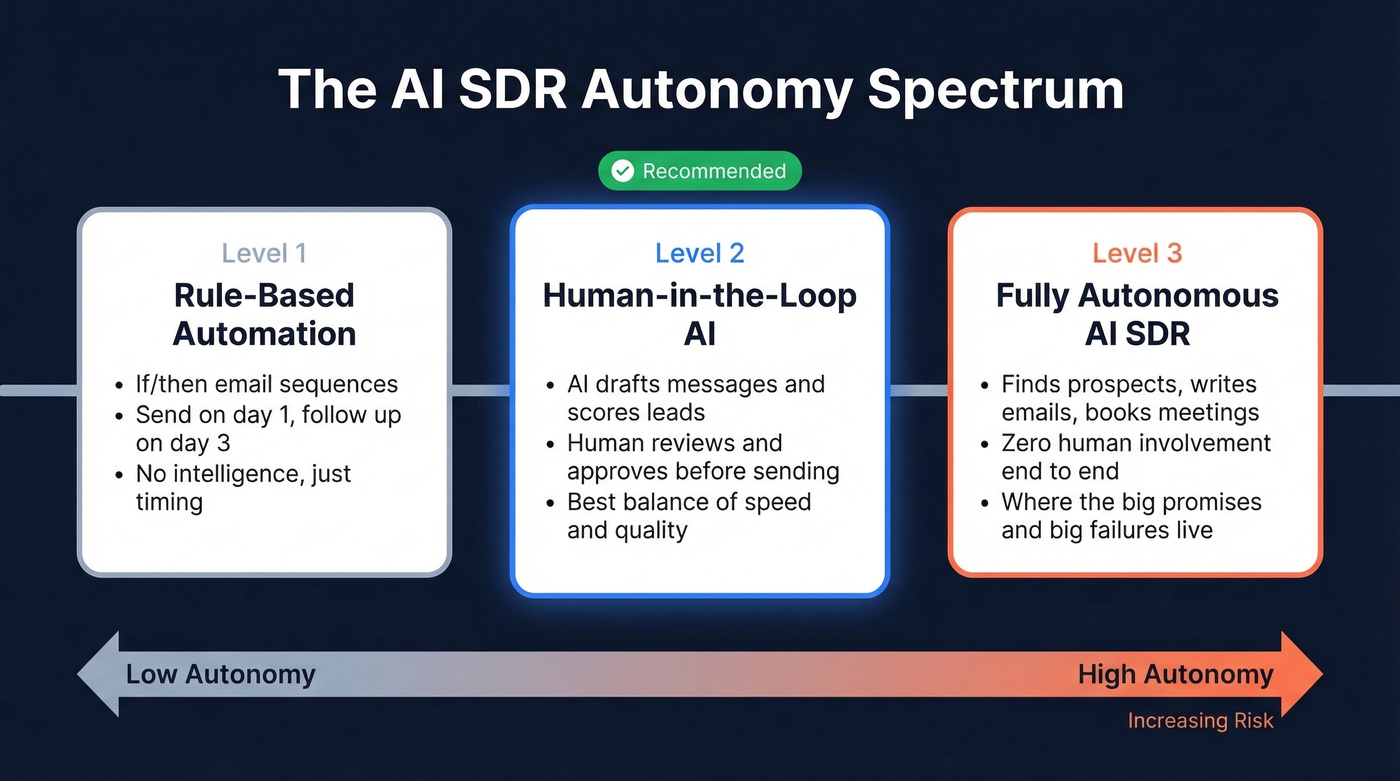
Think of these tools on an autonomy spectrum with three levels. Rule-based automation handles simple if/then sequences - send email on day 1, follow up on day 3. Human-in-the-loop AI drafts messages, suggests next steps, and prioritizes leads, but a human reviews and approves before anything ships. Fully autonomous platforms run the entire workflow end-to-end: they find prospects, write personalized emails, handle replies, book meetings, and update your CRM without anyone touching it.
Most tools sit somewhere between levels two and three. The fully autonomous ones are where the big promises live - and the big failures.
AI vs. Human SDR - The Real Numbers
| Metric | AI SDR | Human SDR |
|---|---|---|
| Response speed | <1 minute | 2-42 hours |
| Daily capacity | 200-500+ touches | 30-50 touches |
| Follow-up consistency | 98-100% | 65-75% |
| Cost per qualified lead | ~$39 | ~$262 |
| Meeting show rate | 52% | 71% |
| Meeting-to-opportunity rate | ~15% | ~25% |
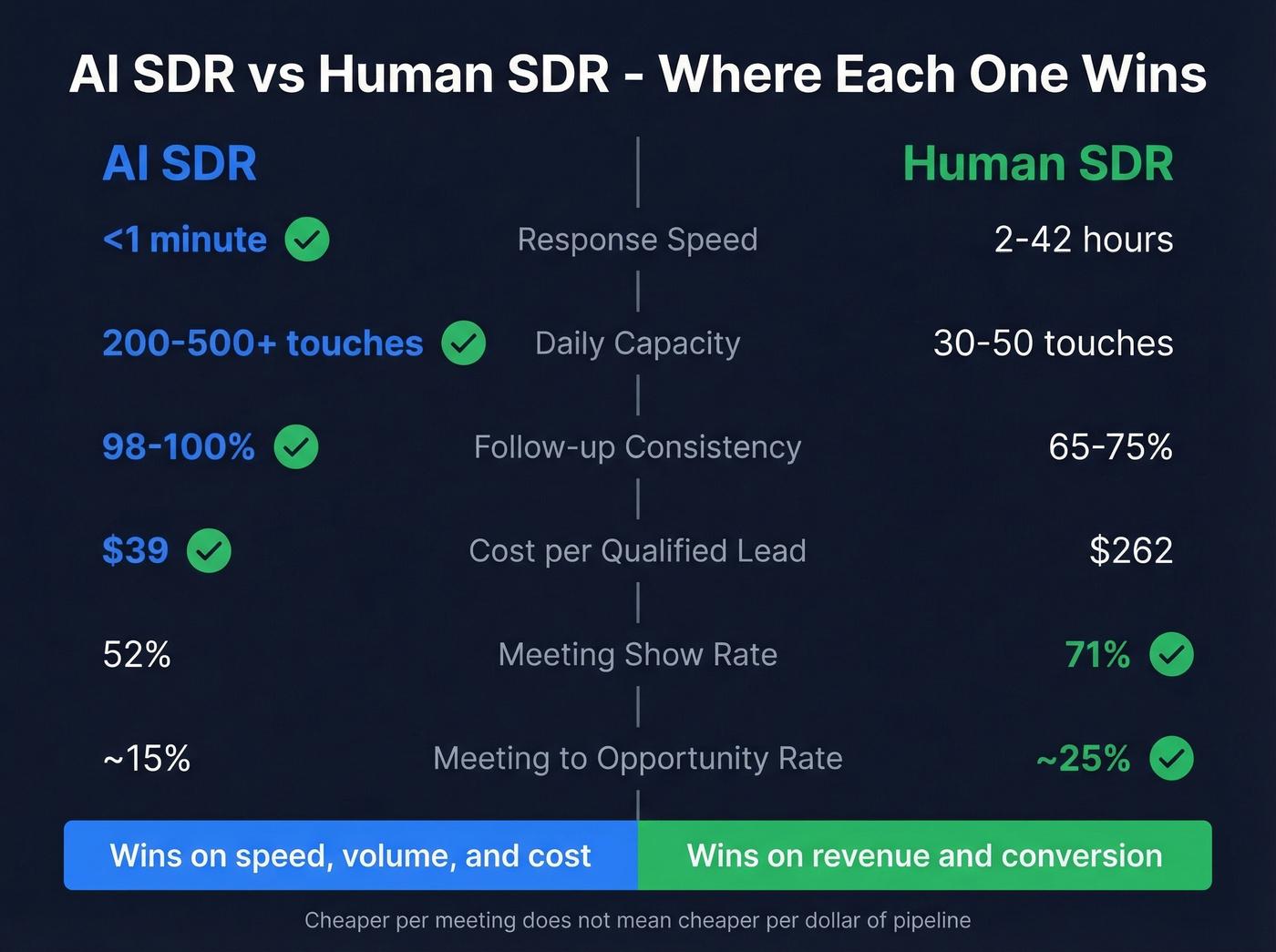
AI wins on speed, volume, consistency, and cost per lead. Humans win on the metrics that actually drive revenue - show rates and opportunity conversion. Responding within the first minute can boost conversions by 391%, which is the AI's superpower. But human-booked meetings convert to pipeline at nearly double the rate.
A fully loaded human SDR costs roughly $75K-$139K/year. AI platforms run $12K-$60K/year. The math looks obvious until you factor in that the human generates $147,000 in revenue where the AI generates $56,000 over the same period. Cheaper per meeting doesn't mean cheaper per dollar of pipeline.
Here's the thing: if your average deal size is under $10K, a well-configured outbound workflow might actually be the smarter play - the volume advantage outweighs the conversion gap at lower deal sizes. Above $25K ACV, the human's relationship-building pays for itself many times over.
Why 70% of Deployments Fail
The UserGems survey identified three barriers that kill most implementations before they generate meaningful pipeline.
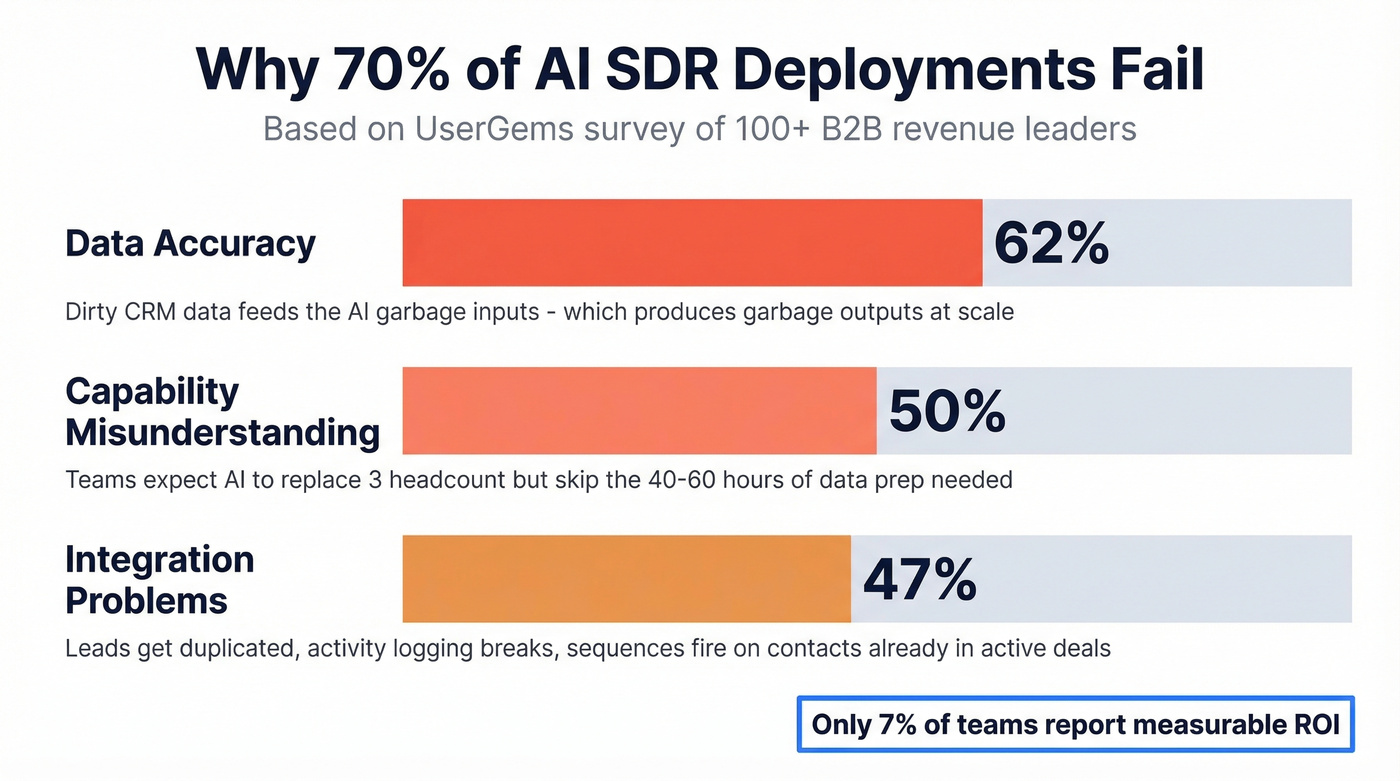
Data Accuracy (62% Cite This)
This is the big one. Dirty CRM data feeds the AI garbage inputs, which produces garbage outputs at scale. A tool with bad data doesn't just send wrong emails - it sends confidently wrong emails to the wrong people. The AI doesn't know the prospect changed jobs six months ago. It doesn't know the email bounces. It just sends, and sends, and sends.
Capability Misunderstanding (50%)
Half of revenue leaders don't actually understand what these platforms can and can't do. They buy a tool expecting it to replace three headcount, then discover it needs 40-60 hours of data prep, constant prompt tuning, and human oversight to produce anything usable. Teams that skip this prep phase fail almost universally - a pattern monday.com's implementation data confirms.
Integration Problems (47%)
The platform doesn't talk to the CRM cleanly. Leads get duplicated. Activity logging breaks. Sequences fire on contacts already in active deals. We've seen teams create thousands of duplicate contacts in Salesforce within the first week of turning on a new tool.
The practitioner complaints on r/gtmengineering are even more visceral: generic AI-generated messages that prospects instantly recognize, hallucinations that produce embarrassing personalization errors, and what one user called the "confidently irrelevant" problem. The AI nails the prospect's name and recent funding round, then pitches them a product they'd never buy.

62% of AI SDR failures trace back to data accuracy. Prospeo refreshes every record on a 7-day cycle - not the 6-week industry average that feeds your AI garbage inputs. 98% verified email accuracy, 300M+ profiles, and 5-step verification so your autonomous workflows send to real people at real companies.
Stop scaling bad data. Start scaling pipeline.
The Data Quality Problem Nobody Talks About
Here's the cause-and-effect chain that kills most AI outbound: stale data leads to hallucinated personalization, which triggers spam complaints, which burns your domain. Every link in that chain is preventable, but most teams don't prevent any of them.

The industry-average data refresh cycle is six weeks. People change jobs, get promoted, switch email providers. A 6-week-old list isn't slightly outdated - it's actively dangerous when you're sending at AI scale.
Deliverability - The Silent Killer
You can have the best AI copy engine in the world. If your emails land in spam, none of it matters.
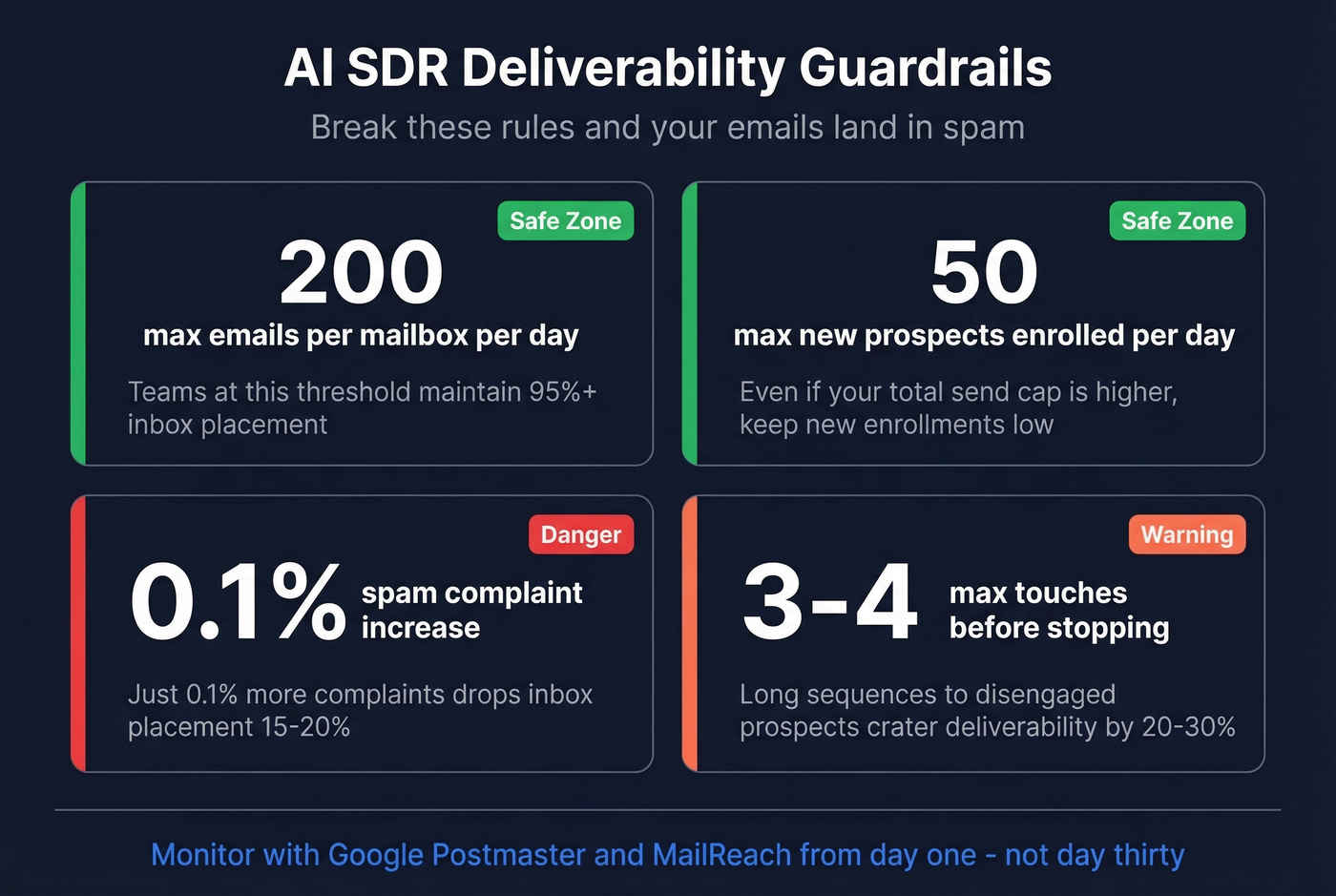
UserGems' deliverability testing produced specific guardrails every deployment should follow:
- Cap at 200 emails per mailbox per day. Teams at or under this threshold maintain 95%+ inbox placement.
- Enroll no more than ~50 new prospects per day into AI sequences, even if your total send cap is higher.
- A 0.1% increase in spam complaints can drop inbox placement 15-20%. Razor-thin margin.
- Long sequences to disengaged prospects crater deliverability by 20-30% over time. If they're not engaging after 3-4 touches, stop.
- Monitor with Google Postmaster and MailReach from day one. Not day thirty.
One user on r/b2bmarketing reported that even with solid email infrastructure, their Apollo + Smartlead setup kept landing in spam. The tools weren't broken - the volume and targeting were. AI makes it trivially easy to send more emails than your domain can handle, and that's a feature that becomes a bug fast.
What AI SDR Platforms Actually Cost
Platform Pricing
| Tool | Starting Price | Model |
|---|---|---|
| Apollo | $49/user/mo (free tier) | Published |
| Reply (Jason AI) | $59/user/mo; AI SDR $500/mo | Published |
| AiSDR | $900-$2,500/mo | Published |
| Agent Frank (Salesforge) | ~$416/mo | Published |
| Conversica | $1,500/mo | Demo only |
| Artisan | ~$30K-$60K/yr | Annual, not public |
| 11x | ~$40K-$60K/yr | Annual, not public |
| Regie.ai | ~$35K/yr | Not public |
| Salesforce Einstein | $50/mo | Quote-based |
| Human SDR (benchmark) | $75K-$139K/yr loaded | - |
11x and Artisan don't publish pricing, which is frustrating if you're trying to build a business case. You're looking at $40K-$60K/year commitments with annual contracts, and you can't see a number before talking to sales. For context, that's roughly what you'd pay a junior human rep - except the human converts meetings to opportunities at nearly double the rate.
The Modular DIY Stack (~$1,800/mo)
A practitioner breakdown on r/SaaS mapped out what a self-built AI outbound stack actually costs:
| Component | Monthly Cost |
|---|---|
| Domains + inboxes (~2,500 sends/day) | ~$550 |
| Sequencer (Instantly/Smartlead) | ~$100 |
| Clay enrichment | ~$350 |
| Enrichment/verification/data providers | ~$500 |
| Scraping tools | ~$50-100 |
| AI API costs | ~$100-200 |
| Campaign monitoring | ~$120-150 |
At ~$1,800/month, this stack produced roughly 20K prospects/month, 14 meetings booked, and 3 new customers - about $130/meeting and $600/customer acquired.
Prospeo covers the email finding and verification layer at ~$0.01/email with a 92% API match rate, and it integrates natively with Instantly, Smartlead, Clay, and HubSpot - no manual CSV shuffling required.
The budget tier ($500-$2K/mo) works for teams running focused outbound to a narrow ICP. Mid-market ($2K-$5K/mo) gets you a proper multi-channel stack. Enterprise ($30K-$60K+/year) is where the all-in-one platforms live, and where the ROI math gets hardest to justify.
The Hybrid Model That Works
The consensus from practitioners - including one on r/SaaS who put it bluntly: "THE ACTUAL OUTREACH HAS TO BE DONE BY HUMAN" - is that the hybrid model wins.
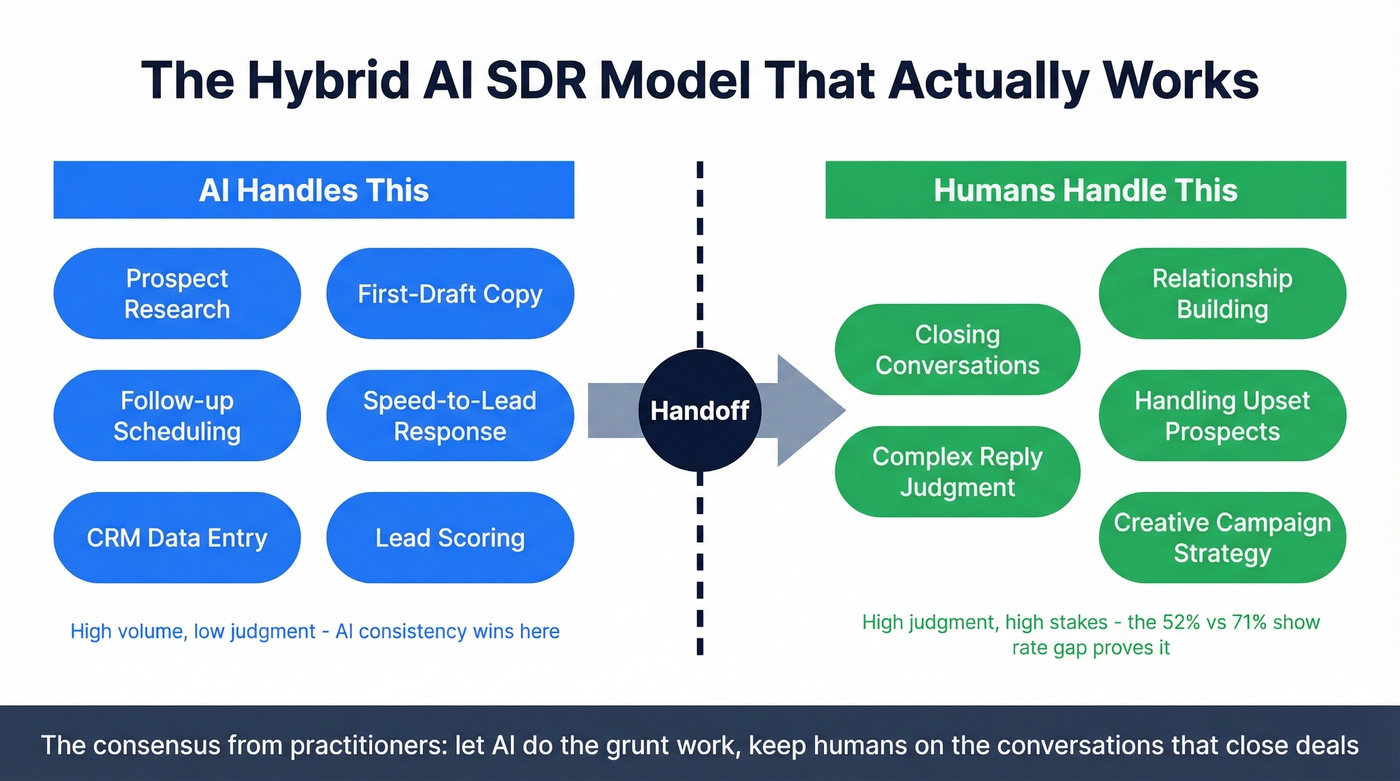
Let AI handle prospect research, first-draft copy, follow-up scheduling, speed-to-lead response, CRM data entry, lead scoring, and repetitive operational tasks. These are high-volume, low-judgment activities where AI's consistency and speed genuinely outperform humans.
Keep humans on closing conversations, relationship-building, judgment calls on complex replies, handling angry or confused prospects, and creative campaign strategy. The 52% vs. 71% show rate gap tells you everything - prospects can feel the difference between a human who cares and an algorithm that doesn't.
Worth noting: several practitioners on Reddit report that outreach on professional networks now outperforms cold email because prospects can verify your credibility through your profile before responding. If your AI tool only does email, you're leaving the highest-trust channel on the table.
Let's be honest about what we've seen across our own customer base and the broader community: the teams getting the best results aren't choosing between AI and human reps. They're using AI to make their human reps 3-5x more productive by eliminating the 70% of non-selling time that buries them.
How the SDR Role Is Changing
The traditional SDR role isn't disappearing. It's splitting into two tracks. One track is the "AI orchestrator" - someone who configures tools, monitors sequences, and steps in when the automation hits its limits. The other is the "strategic closer" who handles the high-value conversations that AI can't. The reps who thrive aren't the ones sending the most emails. They're the ones who know when to let automation run and when to pick up the phone.
Skip the all-in-one AI SDR platform if your team has fewer than 3 reps or your ACV is above $50K. You'll get better ROI from a modular stack with human oversight than from a $40K/year autonomous tool that books meetings nobody shows up to.
Launching Without Burning Pipeline
Step 1. Start small. Monday.com's research recommends beginning with 100-200 test accounts and scaling only after you've proven the workflow converts. Don't blast 10,000 contacts on day one.
Step 2. Budget 40-60 hours for data prep before you turn anything on. Clean your CRM. Deduplicate contacts. Verify emails. Segment your ICP. This is the difference between a 3-6 month ROI timeline and a 6-9 month slog that ends in churn.
Step 3. Human-review AI drafts for the first 30 days. Every email, every reply. You're training your own judgment about where the AI gets it right and where it hallucinates. After 30 days, you'll know which sequences can run autonomously and which need a human eye.
Step 4. Monitor deliverability from day one. Set up Google Postmaster. Subscribe to MailReach. Watch bounce rates, spam complaints, and inbox placement daily for the first month, weekly after that.
Step 5. Set a kill switch. If bounce rates exceed 5% or spam complaints hit 0.1%, pause everything. Fix the data. Fix the targeting. Then restart.
Your AI SDR is only as good as what you feed it. Prospeo delivers 98% email accuracy at $0.01/email with catch-all handling, spam-trap removal, and honeypot filtering built in. Teams using Prospeo keep bounce rates under 4% - exactly the deliverability foundation AI outbound demands.
Feed your AI SDR data that won't torch your domain.
FAQ
How much does an AI SDR cost?
Platforms range from $49/month for basic tools like Apollo to $40K-$60K/year for enterprise solutions like 11x and Artisan. A modular DIY stack runs ~$1,800/month. A fully loaded human SDR costs $75K-$139K/year for comparison.
Can an AI SDR fully replace a human rep?
Not yet. AI excels at speed and volume but converts meetings to opportunities at roughly 15% versus 25% for humans. The hybrid model - AI handles research and follow-up, humans handle closing - consistently outperforms either approach alone.
What's the biggest risk of using one?
Bad data at scale. A tool with stale contact data sends confidently wrong emails to the wrong people, burning your domain reputation. Verifying data before feeding it to any AI system is the single highest-leverage step you can take.
How long before an AI SDR shows ROI?
Expect 3-6 months with clean data and proper implementation, or 6-9 months starting from scratch. Teams that skip the 40-60 hours of data prep typically churn before seeing any return.
How do I prevent AI outreach from landing in spam?
Cap sends at 200 per mailbox per day, enroll no more than 50 new prospects daily, cut sequences to disengaged prospects after 3-4 touches, and monitor with Google Postmaster and MailReach from day one.