

How to Confirm an Email Address Is Valid Before You Hit Send
You sent 5,000 emails last quarter and 1,150 bounced. Your domain reputation tanked, your sequences stalled, and ops spent a week on cleanup. That's what happens when you skip verification. Here's how to make sure it doesn't happen again.
Why Valid Email Data Matters
Email lists decay by at least 23% per year. People change jobs, companies kill domains, IT teams reconfigure mail servers. A quarter of your "verified" list from last January? Dead weight today.
A bounce rate above 2% flags your domain with ISPs. Push past 5%, and you're looking at throttled delivery, spam folder placement, or outright blocks. Gmail and Yahoo now require SPF, DKIM, and DMARC for bulk senders and enforce a 0.3% spam complaint threshold. Clean data isn't optional - it's infrastructure.
What You Need (Quick Version)
- Cleaning an existing list? Use a bulk verifier like ZeroBounce or NeverBounce, roughly $8 per 1,000 emails at entry pay-as-you-go rates.
- Checking a single address? Run a manual SMTP check or use a free-tier verifier - Hunter and ZeroBounce both offer 100 free verifications per month.
- Building a new outbound list? Start with pre-verified data and skip the cleanup entirely.
Validation vs. Verification
These terms get swapped constantly, but they're different steps. Validation checks syntax - does the address follow name@domain.tld structure? That's it. Verification goes deeper: DNS lookups, MX record checks, SMTP handshakes, mailbox existence probes. You need both. Validation catches typos at the front door, while verification catches the dead mailboxes that syntax checks miss entirely.
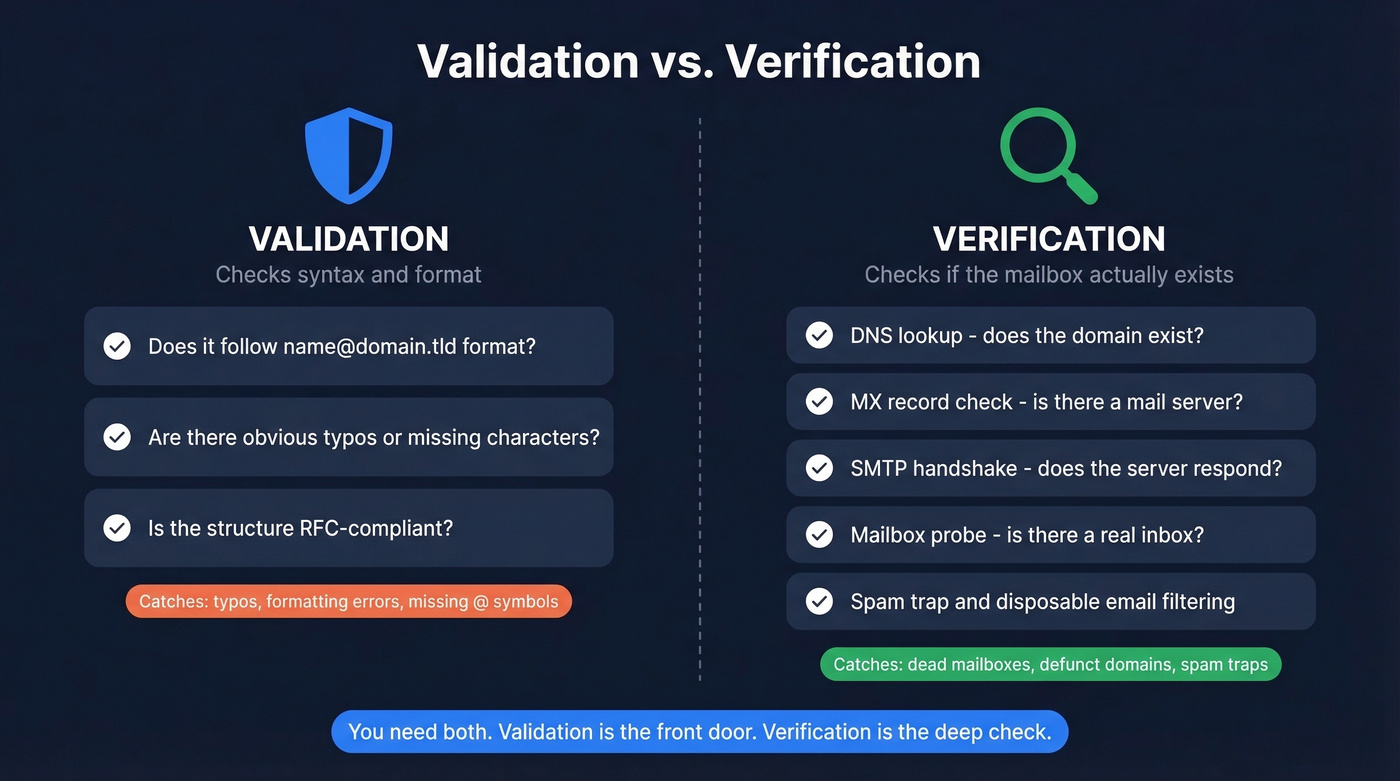

Validation catches typos. Verification catches dead mailboxes. Prospeo eliminates both problems before they start. With 5-step verification, catch-all handling, and a 7-day data refresh cycle, you get 98% email accuracy on every export - no third-party verifier required.
Skip the cleanup. Start with emails that actually work.
Four Methods to Verify an Email Address
1. Send a Test Email
Send an email and wait. If it bounces, the address is bad.
The problem is obvious - this doesn't scale, and blasting unverified addresses in bulk is exactly how you destroy sender reputation. Fine for one-off checks. Useless for anything systematic.
2. Manual SMTP Check
This is worth understanding even if you never use it in production. You're mimicking what verification tools do under the hood, and learning how email validation works at the protocol level is genuinely useful for debugging deliverability issues down the road.
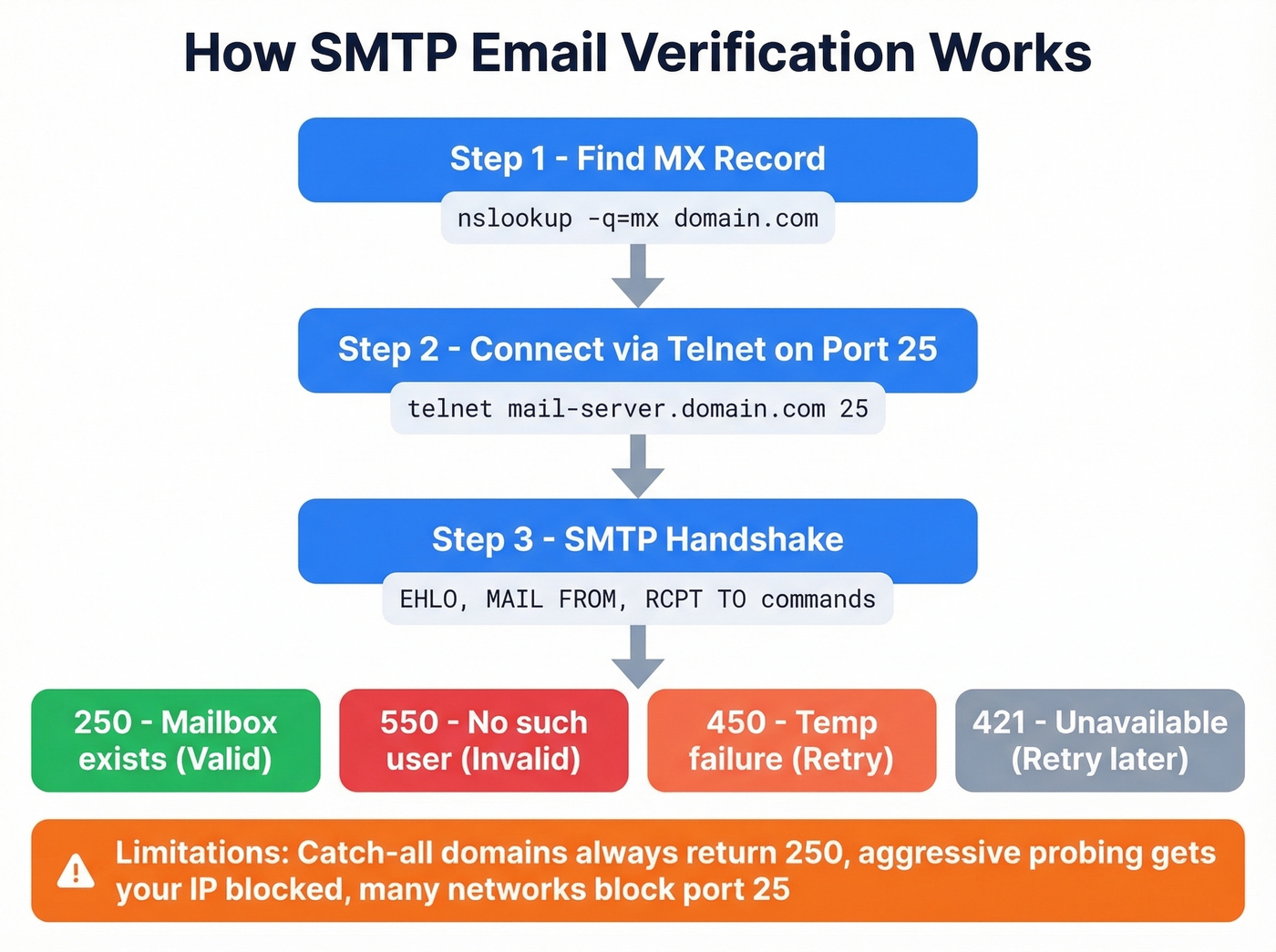
Step 1 - Find the MX record:
nslookup -q=mx gmail.com
Step 2 - Connect via telnet:
telnet alt1.gmail-smtp-in.l.google.com 25
Step 3 - Run the SMTP handshake:
EHLO verify.test
MAIL FROM:<test@yourdomain.com>
RCPT TO:<target@gmail.com>
| Code | Meaning | Action |
|---|---|---|
| 250 | Mailbox exists | Valid |
| 550 | No such user | Invalid |
| 450 | Temporary failure | Retry in 15-30 min |
| 421 | Service unavailable | Retry later |
Here's the thing: this fails on catch-all domains (they return 250 for everything), aggressive probing gets your IP blocklisted, and many corporate networks block port 25 entirely. The developer consensus on Stack Overflow is clear - SMTP callback verification is possible but never guaranteed. It's educational. It's not production-ready.
3. Use a Verification Tool
This is the practical answer for most teams wanting to validate addresses at scale. Verification tools combine syntax checks, DNS/MX lookups, SMTP probes, and filters for disposable, role-based, and spam-trap addresses into a single API call or bulk upload. They also catch disposable and throwaway addresses at sign-up, preventing free trial abuse - not just an outbound concern.
The results are probabilistic, not absolute. Some vendors claim 30+ verification steps, but benchmarks tell a different story. A Hunter benchmark testing 3,000 real emails across 15 verifiers found the top tool scored just 70% accuracy - far below the 98%+ numbers on marketing pages. Catch-all domains still return "unknown" for 30-40% of B2B addresses. We've seen this firsthand: the gap between what's promised and what's delivered is wider than most teams expect.
If you're comparing vendors, start with a shortlist of Bouncer alternatives and sanity-check results against your own bounce data.
4. Start With Pre-Verified Data
Let's be honest - if you're building an outbound list from scratch, verifying after the fact is solving the wrong problem. Prevention beats cure, and we've watched teams lose weeks of pipeline momentum from a single dirty list.
Prospeo's 5-step verification process - including catch-all handling, spam-trap removal, and honeypot filtering - delivers 98% email accuracy before you export a single contact. Data refreshes every 7 days, so the decay problem barely applies. Meritt's bounce rate dropped from 35% to under 4% after switching, and their pipeline tripled from $100K to $300K per week.

Use this if you're running outbound at any real scale. Skip this if you already have a list and just need to clean it - grab ZeroBounce or NeverBounce instead.
Tool Comparison
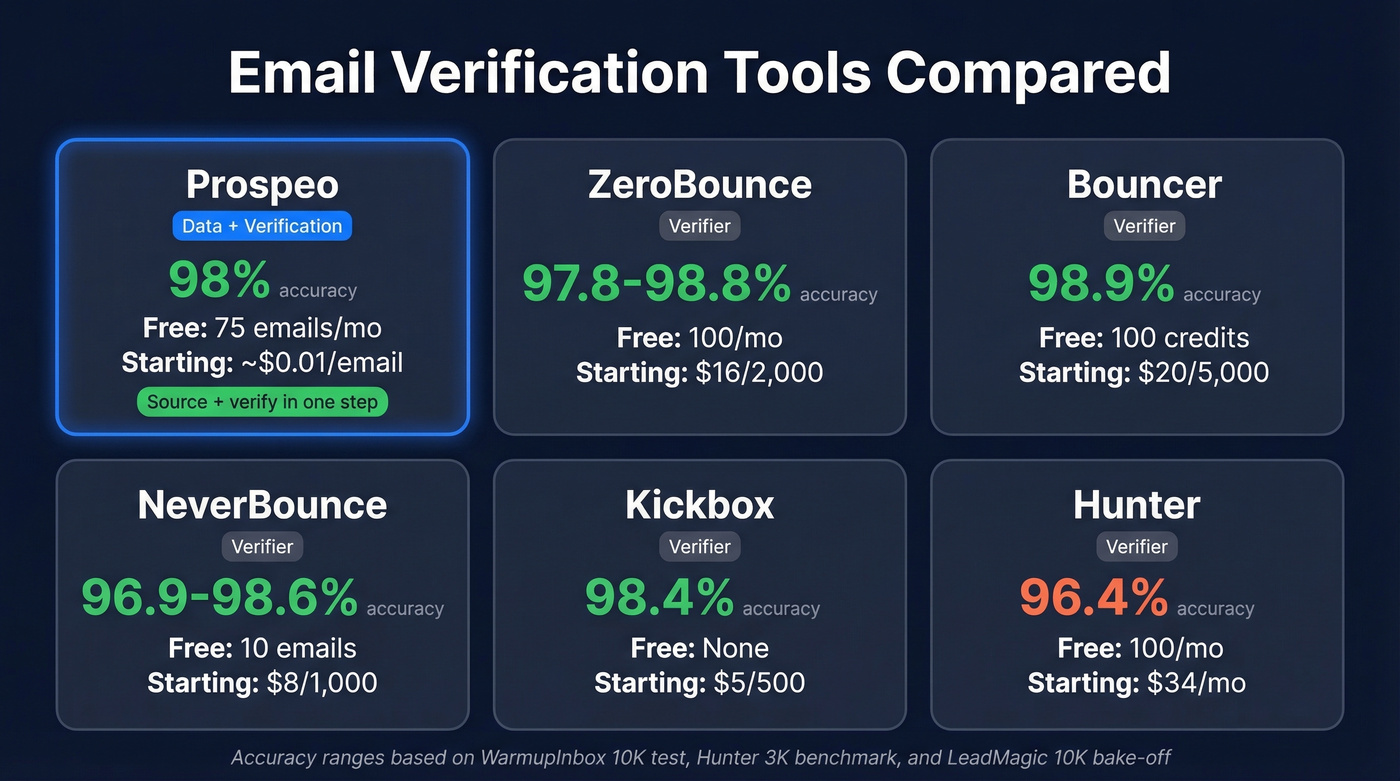
Here's how the major options stack up based on published tests - a WarmupInbox 10K-email test, Hunter's 3K-email benchmark, and a LeadMagic 10K-email bake-off:
| Tool | Type | Accuracy | Free Tier | Starting Price |
|---|---|---|---|---|
| Prospeo | Data + verification | 98% | 75 emails/mo | ~$0.01/email |
| ZeroBounce | Verifier | 97.8-98.8% | 100/mo | $16/2,000 |
| Bouncer | Verifier | 98.9% | 100 credits | $20/5,000 |
| NeverBounce | Verifier | 96.9-98.6% | 10 free | $8/1,000 |
| Kickbox | Verifier | 98.4% | None | $5/500 |
| Hunter | Verifier | 96.4% | 100/mo | $34/mo |
Accuracy ranges reflect different test methodologies and datasets. The key distinction: most tools on this list are verifiers only. Prospeo is a data platform with verification baked in, so you're sourcing and verifying in one step rather than stitching together two separate tools.
If you're sending at scale, also watch your email velocity and keep an eye on email bounce rate trends as you test tools.
Why No Method Is 100% Accurate
Catch-all domains cover 30-40% of B2B addresses and return 250 OK for any recipient, real or fake. In a 10,000-email test, ZeroBounce resolved only 12% of catch-all addresses while NeverBounce resolved 8% - the vast majority remain unverifiable. That's not a bug in the tools. It's a limitation of the protocol itself.
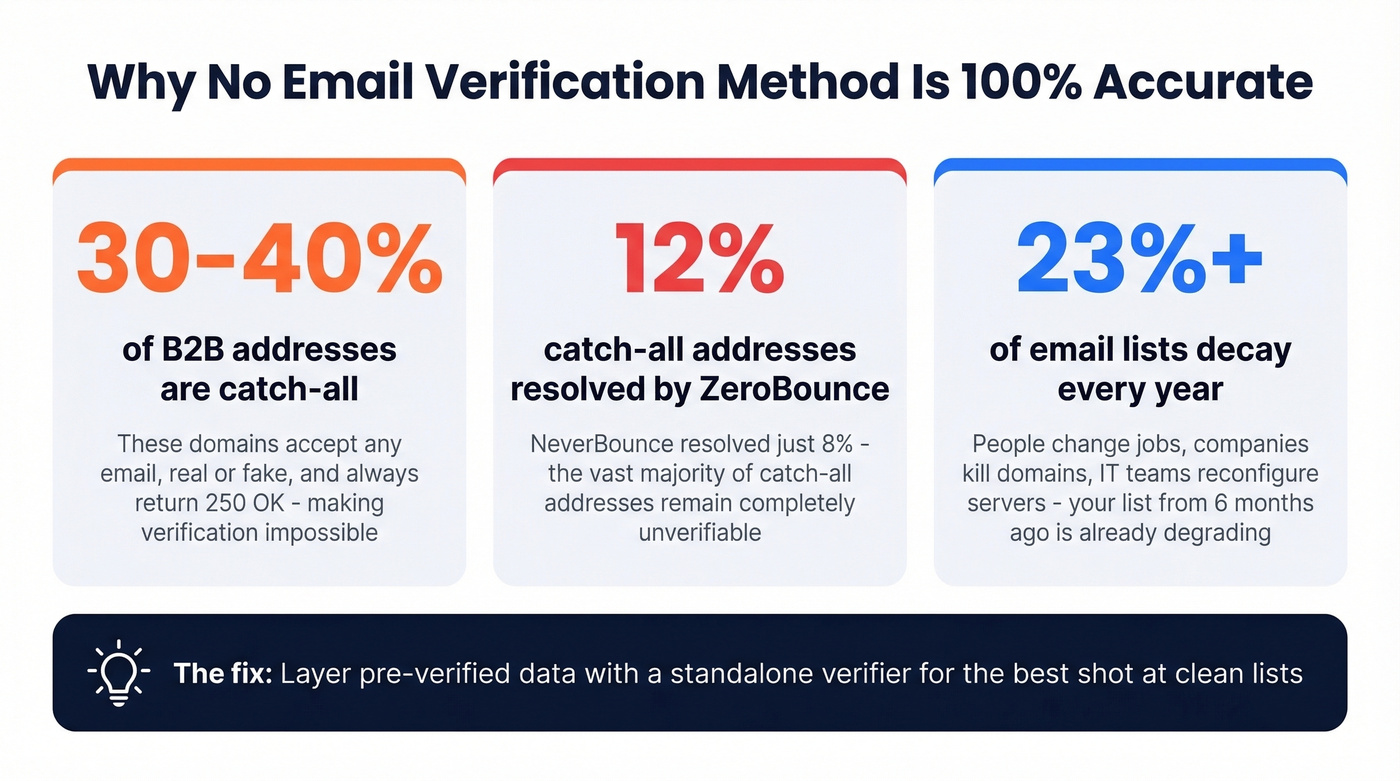
Enterprise gateways make it worse. Proofpoint, Mimecast, and Barracuda greylist, rate-limit, and sometimes reject verification probes entirely. A valid mailbox can return "unknown" simply because the gateway blocked the check. This is why relying on a single verification method is risky - layering pre-verified data with a standalone verifier gives you the best shot at clean lists.
If you're dealing with recurring list quality issues, a dedicated spam trap removal process can prevent silent reputation damage.
Deliverability Best Practices
Re-verify lists quarterly at minimum - monthly if you're sending weekly campaigns. Stay under 2% bounce rate; that's the threshold where ISPs start paying attention.
Use double opt-in for inbound to maximize consent quality and reduce bad sign-ups. For outbound, source pre-verified data instead of building lists and cleaning them after the fact. And make sure SPF, DKIM, and DMARC are configured - Gmail and Yahoo enforce them for bulk senders, no exceptions. The Reddit threads on r/coldemail are full of people who learned this the hard way after getting their domains blacklisted.
If you need a tighter setup, follow a checklist for improve sender reputation and confirm authentication with How to Verify DKIM Is Working.
Meritt's bounce rate dropped from 35% to under 4% after switching to pre-verified data. Their pipeline tripled. When your emails are verified at the source - with spam-trap removal, honeypot filtering, and weekly refreshes - you stop paying twice: once for the data and again to clean it.
Pre-verified emails at $0.01 each beat cleaning bad lists every time.
FAQ
How can I confirm an email address is valid for free?
ZeroBounce and Hunter each offer 100 free verifications per month, and Bouncer gives 100 free credits. For low-volume checks, any of these work without spending a dollar.
What does "catch-all" mean in email verification?
A catch-all domain accepts email sent to any address, whether the mailbox exists or not. This affects 30-40% of B2B addresses and is the primary reason verifiers return "unknown" results. It's the single biggest obstacle to accurate verification for outbound campaigns.
How often should I re-verify my list?
At least quarterly. Lists decay by 23%+ per year, and weekly campaigns warrant monthly verification to stay under the 2% bounce threshold. Teams using data sources with a 7-day refresh cycle can extend re-verification intervals significantly.
Can I verify an email without sending a message?
Verification tools that combine MX lookups with SMTP handshakes come closest, but no method is foolproof. Catch-all domains and enterprise gateways limit what any tool can detect, so pairing verification with pre-verified data sources gives you the best results.