

The Best AI SDR Agents in 2026: What Works, What Doesn't, and What to Buy
A RevOps lead we know ran a 90-day pilot with an AI SDR agent last quarter. The tool blasted outbound at scale, booked almost nothing, and racked up enough bounces to torch their sender reputation. The pilot was dead by week six.
That story isn't unusual. Practitioners on r/gtmengineering report 50-70% churn within three months for AI SDR agents - compared to the 5-10% churn a healthy SaaS product expects. Fortune Business Insights projects this market will hit $18B+ by 2032, but most deployments still fail within a single quarter.
These tools don't fail because the AI is bad. They fail because teams deploy them on stale data with no operating cadence and expect magic. We've spent months testing, pricing, and talking to teams running these agents in production. Here's what actually works.
Our Picks (TL;DR)
Reply.io (Jason AI) - Best transparent-pricing outbound agent. Copilot and autopilot modes, unlimited mailboxes, published pricing.
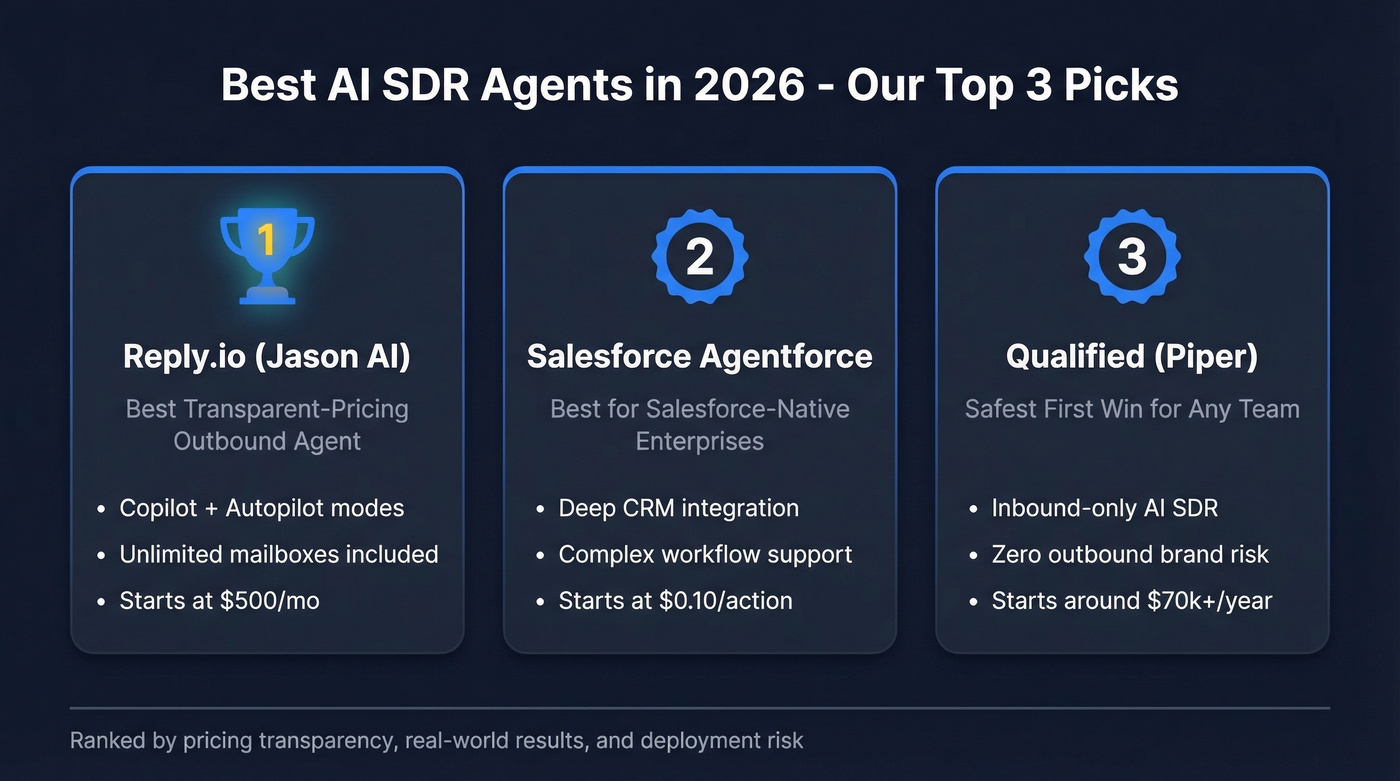
Salesforce Agentforce - Best for Salesforce-native enterprises. Deep CRM integration for complex workflows.
Qualified (Piper) - Safest first win. Inbound AI SDRs carry almost zero brand risk compared to autonomous outbound.
Top AI SDR Agents Ranked for 2026
We cover outbound agents (Reply.io, 11x.ai, AiSDR, Salesforge), inbound agents (Qualified), CRM-native options (Agentforce, monday), and the data layer that makes all of them work.
Reply.io (Jason AI)
Reply.io's Jason AI is the outbound agent with the most transparent pricing in the category. In a market where most vendors hide behind "contact sales," Reply.io publishes exact tier pricing on their website. That alone earns it the top spot for most teams.
Two operating modes make this flexible: copilot (AI drafts, you review and send) and autopilot (AI runs autonomously). The copilot-first approach lets you train the model on your voice before handing over the keys, which is exactly how we recommend deploying any agent. Unlimited mailboxes and built-in warmup come included at every tier, eliminating the deliverability infrastructure you'd otherwise build separately.
The starter tier caps at 1,000 active contacts for $500/mo (annual), with sub-tiers scaling to $1,000/mo for 3,000 contacts. Teams running high-volume campaigns will jump to Growth ($1,500-$3,000/mo annual) quickly. Monthly billing runs about 50-65% higher depending on tier.
Salesforce Agentforce
Agentforce is the AI SDR play for teams already deep in the Salesforce ecosystem. It hit $540M ARR by Q3 FY2026 with 330% YoY growth - but only ~8% of Salesforce's 150,000+ customers have adopted it. That gap tells you something: powerful but not simple.
Native CRM integration means zero data sync headaches. The agent reads your Salesforce objects directly - accounts, opportunities, activity history - and acts on them. For enterprises with complex routing rules and approval workflows, nothing else comes close.
Three pricing models run simultaneously: $2/conversation, $0.10/action via Flex Credits, or per-user licenses starting at $125/user/month. That flexibility is great until your finance team tries to forecast costs. Token overages (anything above 10,000 tokens per action) get billed as multiple actions, spiking costs unpredictably.
Skip this if you're a 10-person startup. Agentforce requires Salesforce ops maturity and a dedicated admin.
11x.ai (Alice)
11x.ai's Alice is the enterprise-grade outbound agent that doesn't publish pricing - which tells you exactly who it's for. Vendr reports a median contract value of $40,125/year, and real-world deals typically land in the $50k-$60k/year range.
The product handles prospect research, personalized sequencing, and multi-touch follow-ups. But the complaints are consistent: annual commitments with inflexible contracts, no proprietary database (you're relying on third-party data), and hallucination risks that require human oversight. Here's the thing - if a vendor won't publish pricing, you're buying a sales process, not a product.
Use this if you're an enterprise team with budget for a premium agent and dedicated ops support. Skip this if you need flexibility or transparent billing.
Artisan (Ava)
Artisan's Ava bundles a 300M+ contact database with AI-driven outbound sequencing, deliverability tooling, and warmup. G2 reviewers give it 3.9/5 across 22 reviews, praising ease of setup and customer support. Recurring complaints center on data accuracy and limited functionality in edge cases.
Pricing isn't public but runs roughly $2k-$3k/mo for up to 1,000 leads/month, scaling to $7k-$10k+/mo for high-volume tiers. Annual contracts only.
AiSDR
AiSDR is the budget-conscious entry point, starting at $900/mo billed quarterly ($2,700 upfront). That gets you 1,200 lead search credits and 1,200 AI messages per month, with an expected ~3 meetings/month at the Explore tier.
Follow-ups count against your message quota, so 1,200 messages means maybe 400-600 new prospects after sequences eat into the budget. New mailboxes need a 30-60 day deliverability ramp, so don't expect results in month one. No free trial.
Salesforge (Agent Frank)
Salesforge has low-cost plans starting at $40/month (billed annually) for basic sending, and its "Agent Frank" package is $416/month. Agent Frank handles basic outbound sequencing with AI personalization - good for solo founders testing autonomous outbound without committing thousands. Limited in sophistication compared to Reply.io or Artisan.
Qualified (Piper)
Piper is an inbound-only AI SDR - it engages website visitors in real time, qualifies them, and routes to sales. Completely different use case from outbound agents, and that's exactly why it deserves attention.
Let's be honest: inbound AI SDRs are the safest first win for any team exploring this category. Outbound autonomy is where brand risk spikes - one hallucinated claim in a cold email can damage your reputation permanently. Piper operates on your turf, with your visitors, where the downside is capped. Pricing is enterprise-level and often starts around $70k+/year, but if your inbound volume justifies it, start here before going outbound.
monday CRM AI SDR
monday's AI SDR capabilities are CRM-native and best suited for teams already running their pipeline in monday. Early-stage feature set, competitive pricing, fast activation. Don't expect the depth of a dedicated platform.
Other Tools We Evaluated
Persana AI and Lindy both offer AI SDR workflows worth watching, and Coldreach.ai takes an interesting signal-first approach to outbound. None matched the depth, pricing transparency, or track record of the tools ranked above, but they're on our radar for future coverage.
Pricing Comparison
For context, lead gen agencies typically charge $1,000-$3,000 per campaign with less transparency than most of these tools. AI-generated outreach costs roughly $39 per qualified lead versus $262 for fully human-sourced leads - a gap that explains why this market keeps growing despite the high churn.
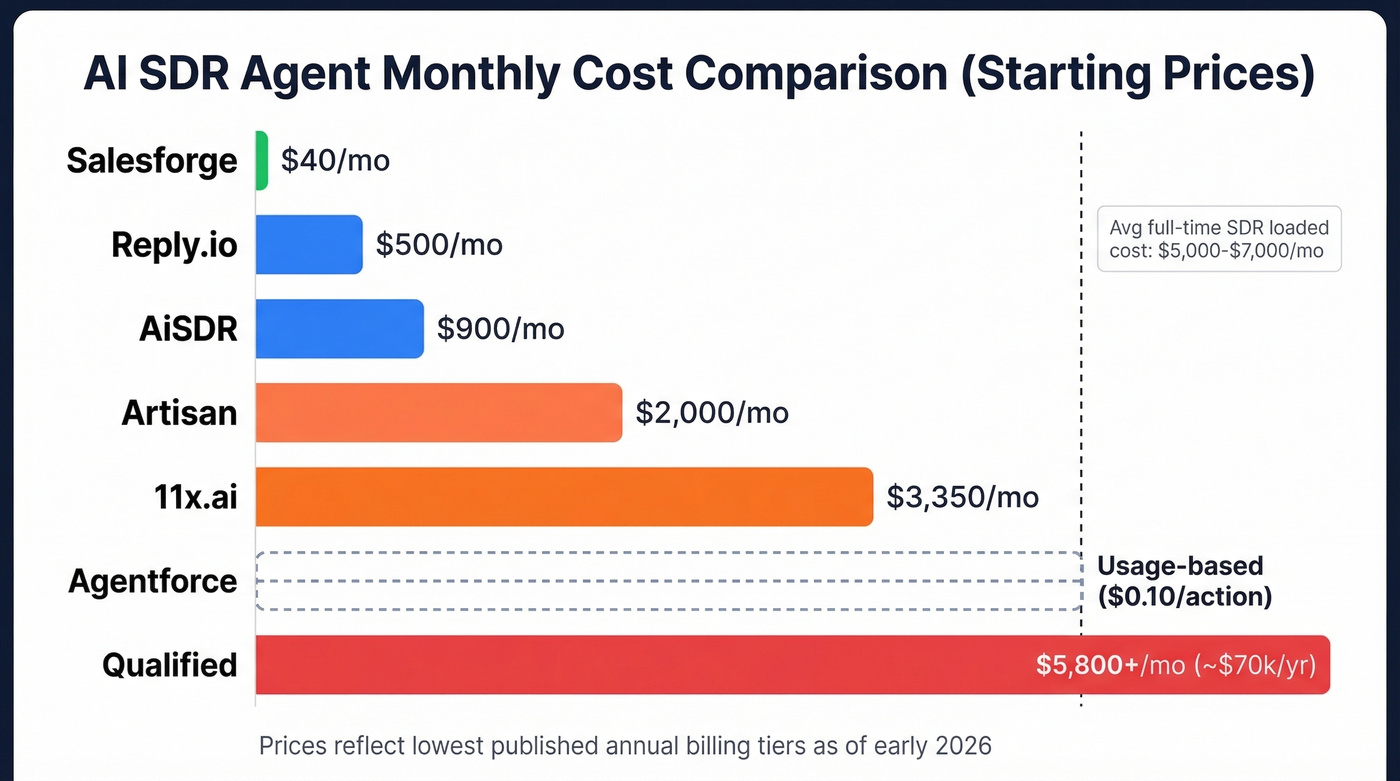
| Tool | Starting Price | Billing | Contacts/Credits | Best For |
|---|---|---|---|---|
| Reply.io | $500/mo (annual) | Monthly or annual | 1,000 active contacts | Transparent outbound |
| Agentforce | $0.10/action | Credits or per-user | Usage-based | Salesforce enterprises |
| 11x.ai | ~$3,350/mo (annual) | Annual contract | Usage-based | Enterprise outbound |
| Artisan | ~$2,000/mo | Annual tiers | ~1,000 leads/mo | All-in-one outbound |
| AiSDR | $900/mo | Quarterly ($2,700) | 1,200 messages/mo | Budget AI outbound |
| Salesforge | $40/mo (annual) | Monthly/annual | Plan-based | Lowest-cost entry |
| Qualified | ~$70k+/year | Annual | Usage-based | Inbound qualification |
| monday CRM | Not public | Monthly or annual | CRM-based | monday users |
Most platforms in this space land between $1,000 and $5,000 monthly - still less than a full-time SDR's loaded cost.

Every AI SDR agent on this list is only as good as the data you feed it. The 50-70% churn rate? It starts with stale contacts and bounced emails. Prospeo's 7-day refresh cycle and 98% email accuracy keep your agent sending to real inboxes - not torching your sender reputation.
Stop blaming the AI. Fix the data layer underneath it.
Why Most AI SDR Agent Pilots Fail
We've watched enough pilots crash to see the pattern. It's almost always the same three or four failure modes, and they compound each other fast.
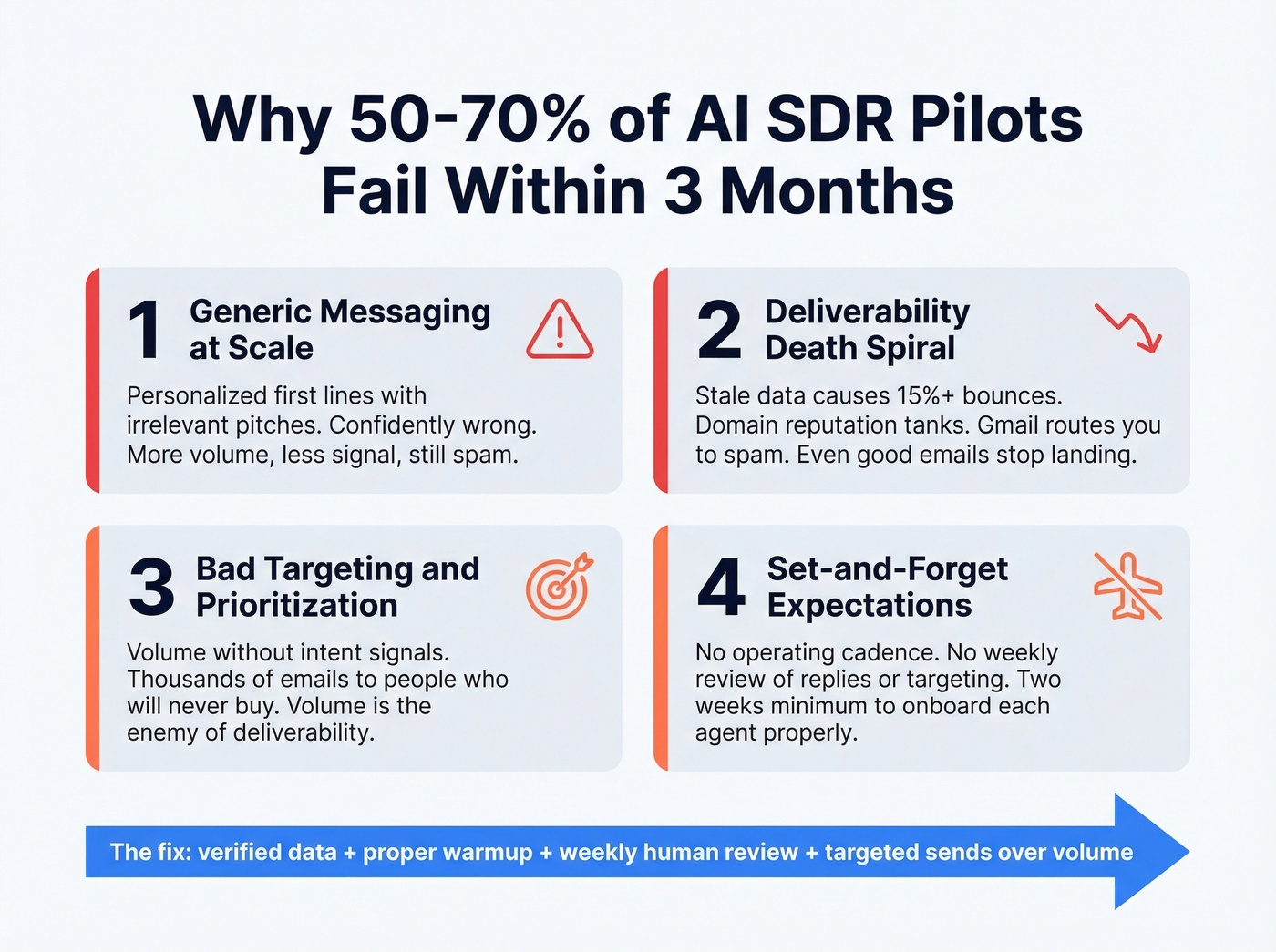
Generic messaging at scale. The agent sends "hyper-personalized" intros that pivot into completely irrelevant pitches. The consensus on r/AI_Agents nails this: AI SDR outreach is "confidently irrelevant - more volume, less signal, still spam, just with creepier intros." A personalized first line doesn't matter if the offer is irrelevant to the buyer's actual problem. Hallucinations compound this - agents inventing product features or citing fake case studies destroy trust instantly.
The deliverability death spiral. Your agent sends 5,000 emails. 15% bounce because the data is stale. Your domain reputation tanks. Gmail and Outlook start routing you to spam. Now even the good emails don't land. This is the #1 mechanical reason pilots fail, and it's entirely preventable with verified data and proper warmup.

Bad targeting and prioritization. Volume without intent signals means your agent emails thousands of people who'll never buy. The best-performing deployments we've seen send fewer emails to better targets. Volume is the enemy of deliverability.
Set-and-forget expectations. The promise is "autonomous outbound." The reality is that every agent needs an operating cadence - reviewing replies, tuning targeting, updating messaging weekly. SaaStr reports that each new agent costs at least two weeks to onboard properly, and during that period, existing workflows degrade because humans can't keep up with the inputs.
Some practitioners see better results with a research-first approach, using AI tools for prospect intelligence and draft messaging rather than fully autonomous email sends. Worth testing if cold email alone isn't converting.
How to Evaluate an AI Sales Agent
Before you sign anything, run every tool through these criteria.
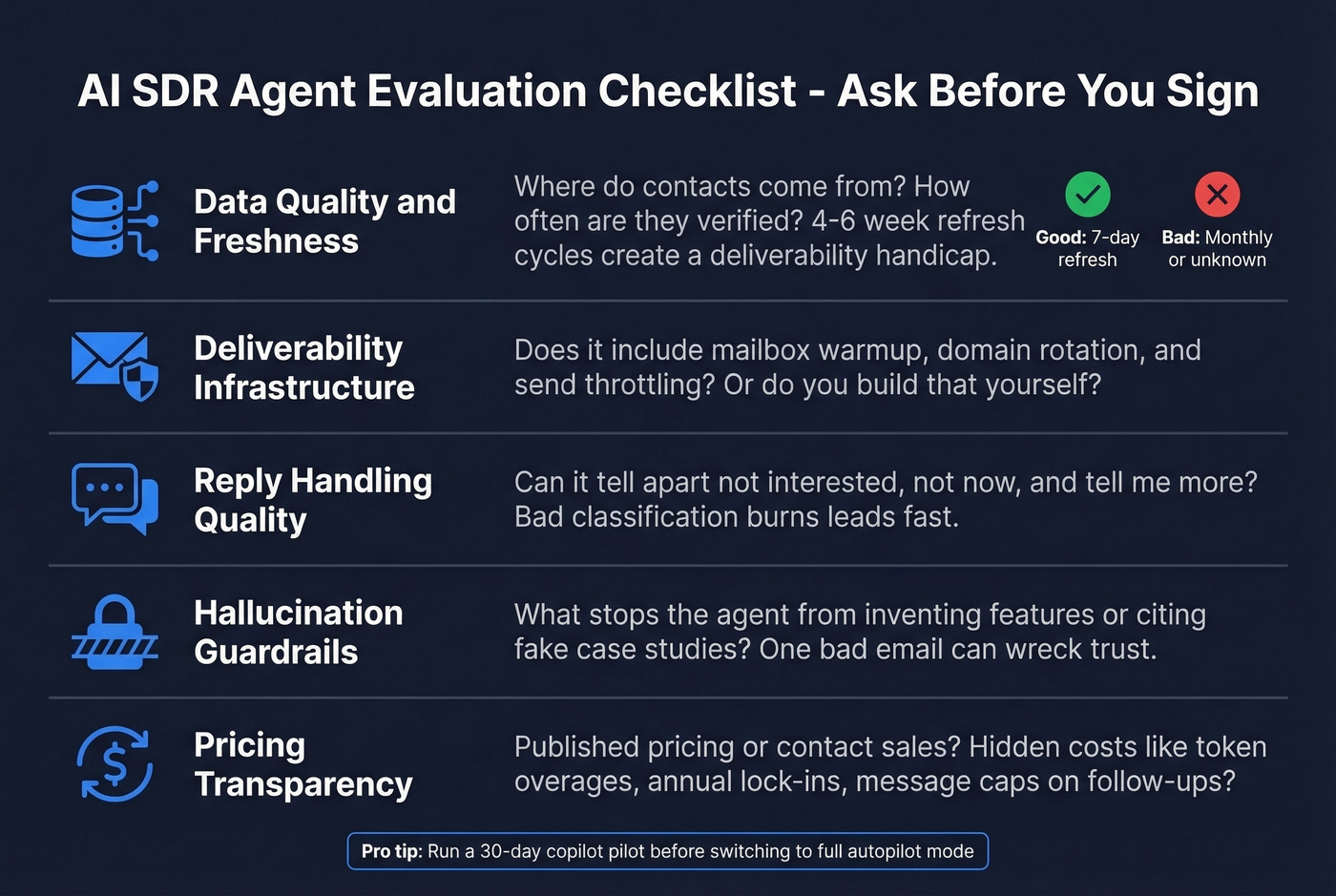
Start with data quality and freshness - where do the contacts come from, and how often are they verified? If your data refreshes every 4-6 weeks, you're starting with a deliverability handicap. Check whether the platform includes mailbox warmup, domain rotation, and send throttling. If not, you'll build that infrastructure yourself.
Reply handling quality matters more than most teams realize. Can the agent distinguish between "not interested," "not now," and "tell me more"? Bad reply classification burns leads and tanks your pipeline metrics. Ask about hallucination guardrails too - what prevents the agent from inventing features or misattributing the prospect's company?
Evaluate CRM integration depth (does it write back with full activity logging?), reporting and feedback loops (can you see which sequences drive meetings and feed that back into the model?), and pricing transparency. If you can't model costs before signing, expect surprises. Opaque pricing correlates strongly with inflexible contracts - we've seen this pattern over and over.
Your First 30 Days With an AI SDR
Stop trialing 10 tools. Pick one agent, one data layer, one deliverability stack.
Week 1-2: Foundation, not sending. Set up mailboxes and start warmup. Run your target list through real-time email verification before the agent sends anything. A platform like Prospeo - with 98% email accuracy and a 7-day data refresh cycle - eliminates the stale-data problem that kills most pilots before they start. Build ICP segments using intent signals and firmographic filters. Configure the agent in copilot mode so you're reviewing every message before it goes out.
Week 3-4: Controlled launch. Start sending at low volume (50-100 emails/day per mailbox). Review every reply. Tune messaging based on what's getting responses. Resist the urge to flip to autopilot - deliverability takes 30-60 days to ramp for new mailboxes, and the copilot phase is where you train the model on your voice and your buyers' objections.
By day 30, you should have enough data to decide whether to scale volume or adjust targeting. The teams that succeed treat the first month as calibration, not production.
Teams running AI SDR agents at scale burn credits fast on bad contacts. At $0.01 per verified email with 98% accuracy, Prospeo costs 90% less than ZoomInfo and delivers the clean data your agent needs to actually book meetings - not rack up bounces.
Feed your AI SDR 300M+ verified contacts starting today.
FAQ
Do AI SDR agents replace human SDRs?
No. AI sales agents handle research, list building, and draft messaging at scale, but hybrid teams report a 35% productivity boost and 2.5x revenue growth compared to either approach alone. Humans still own high-value sends and live conversations.
How much does an AI SDR cost per meeting?
Typical range is $200-$400 per meeting for SMB and midmarket teams. That number depends heavily on data quality - teams using verified contacts with sub-5% bounce rates consistently hit the low end.
Why do most pilots fail within 90 days?
Three reasons: generic messaging prospects instantly recognize as AI-generated, stale contact data causing bounce rates that destroy domain reputation, and no weekly operating cadence around the tool. Treat these agents like a new hire, not a SaaS login.
What's the best data layer to pair with an AI SDR agent?
You need verified, fresh contact data - that's non-negotiable. Prospeo offers 143M+ verified emails at 98% accuracy, 125M+ verified mobiles, and a 7-day refresh cycle versus the 4-6 week industry average. It integrates natively with Salesforce, HubSpot, Instantly, Smartlead, and Clay, so your agent always sends on fresh data.
What's the difference between copilot and autopilot mode?
Copilot drafts messages for human review before sending. Autopilot sends autonomously. Always start with copilot to train the model on your tone and your buyers' common objections - then graduate to autopilot only after you trust the output.