

Best AlphaSense Alternatives in 2026 (With Real Pricing)
Your AlphaSense renewal quote just landed higher than last year. You're not imagining things - the platform hit $500M ARR by October 2025, and after acquiring Tegus for $930M and absorbing Sentieo, the bundle has only gotten bigger. That usually means renewals get bigger too.
Here's the pricing reality: the median AlphaSense contract runs $18,375/year, with a $12K-$51K range, and per-seat pricing commonly falls in the $10K-$20K/seat/year band. Many teams don't use everything they're paying for.
You probably don't need one platform to replace AlphaSense. You need two or three tools that each do their specific job better.
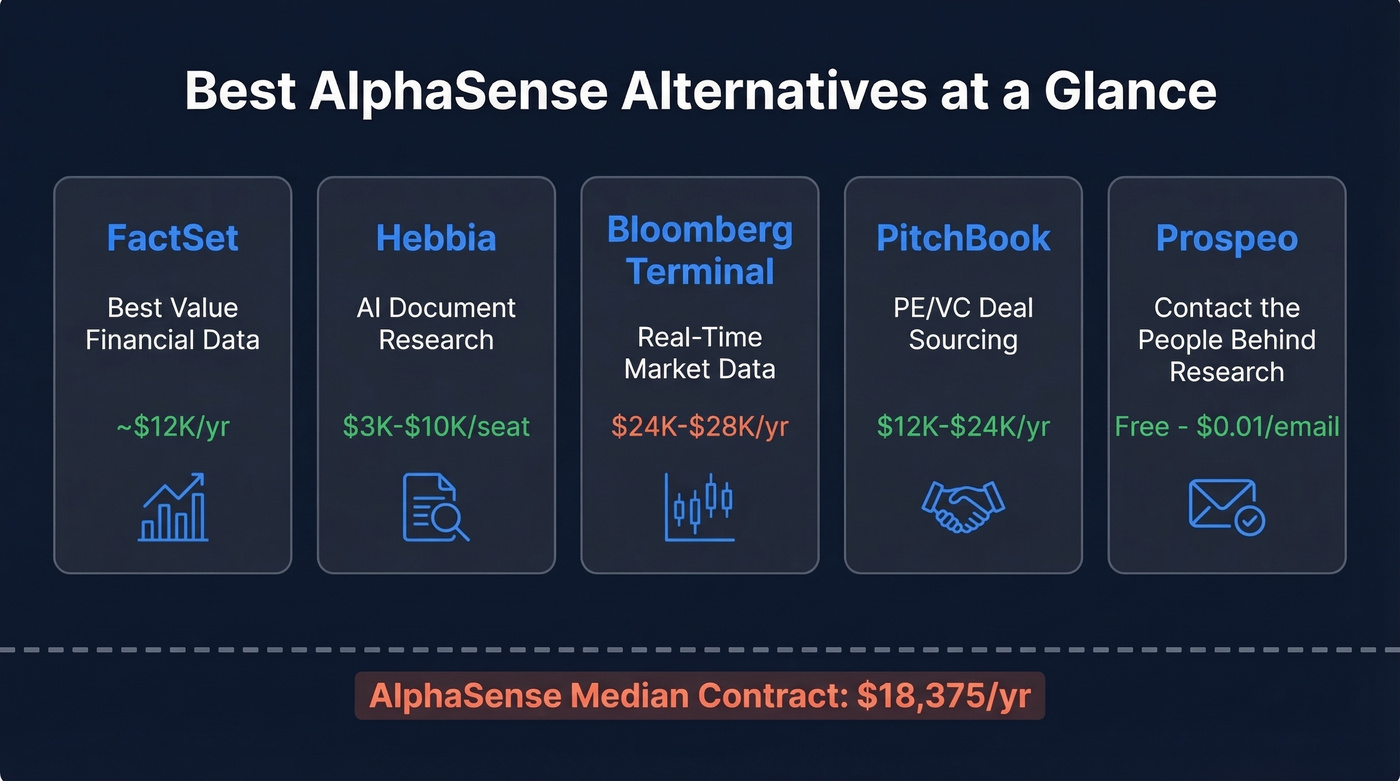
Our Picks (TL;DR)
| Use Case | Pick | Annual Cost |
|---|---|---|
| Best value for financial data | FactSet | ~$12K/yr |
| AI-native document research | Hebbia | $3K-$10K/seat |
| Real-time market data | Bloomberg Terminal | $24K-$28K/yr |
| PE/VC deal sourcing | PitchBook | $12K-$24K/yr |
| Reaching people behind the research | Prospeo | Free-~$0.01/email |
What Users Actually Say About AlphaSense
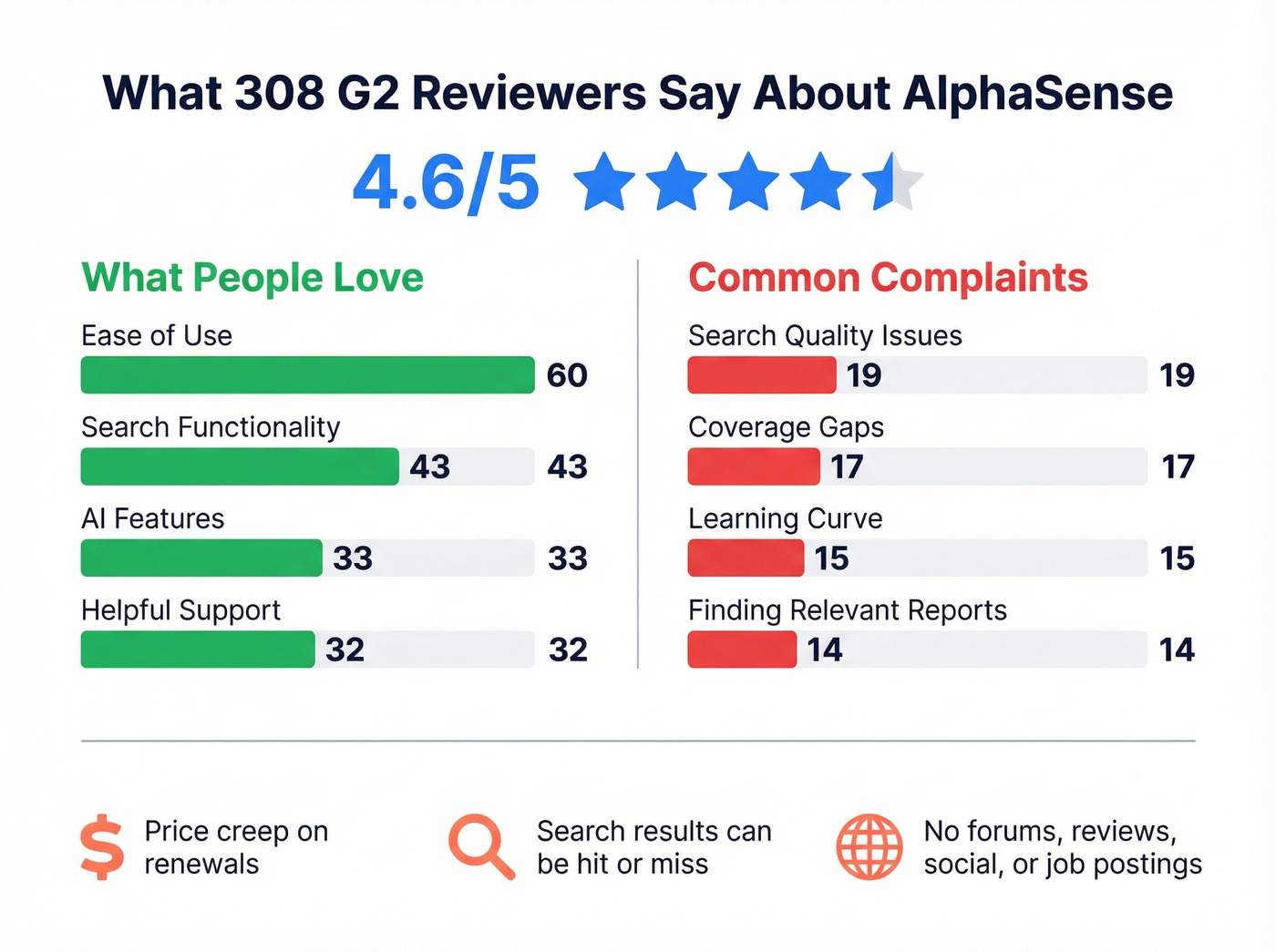
AlphaSense carries a 4.6/5 on G2 across 308 reviews - strong, but the complaint patterns tell a more interesting story than the star rating.
| Pros (G2 mentions) | Cons (G2 mentions) |
|---|---|
| Ease of use (60) | Search quality issues (19) |
| Search functionality (43) | Proprietary coverage gaps (17) |
| AI features (33) | Learning curve (15) |
| Helpful support (32) | Finding relevant reports (14) |
Three pain points drive most switching conversations.
Price escalation. Contracts creep up annually, and the Tegus add-on can make renewals steeper. The Tegus acquisition adds expert calls at roughly $300-$400 per call versus $800-$1,200 at legacy networks like GLG, but that cost often gets bundled into your renewal whether you use it or not.
Search inconsistency. 43 reviewers praise search, but 19 flag low-quality results. The engine is powerful but unpredictable - great when it surfaces the right document, maddening when it doesn't.
Real coverage blind spots. AlphaSense doesn't track forums, review sites, job postings, or social platforms. Custom source additions are RSS-only. Non-English content spans 37 languages but lacks translation. The expert transcript library is massive at 200K+ transcripts, but it skews investor-led - coverage clusters around U.S. public-market topics, and some transcripts are conducted by AI bots rather than human analysts, which reduces the depth and candor of expert responses. Sharing insights with non-subscribers is painful too; many teams end up exporting PDFs and emailing them around, which defeats the purpose of a centralized platform.

AlphaSense helps you find the companies. Prospeo helps you reach the people inside them. Turn any research target into a verified contact list - 300M+ profiles, 125M+ direct dials, 98% email accuracy. At $0.01/email, one Prospeo year costs less than a single AlphaSense seat.
Stop researching companies you can't actually contact.
Top AlphaSense Competitors Compared
Bloomberg Terminal
Use this if you need real-time market data, execution capabilities, and the deepest financial dataset on the planet. Bloomberg commands 33.4% market share in financial data - more than Refinitiv and Capital IQ combined.
Skip this if your primary need is document search, AI-powered summarization, or expert transcripts. Bloomberg doesn't compete with AlphaSense on unstructured content analysis. It competes on structured data and market access.
Pricing: $27,660/year for a single seat, dropping to $24,240/seat for multi-terminal leases. Two-year commitment required.
FactSet
FactSet is the best "traditional terminal" value play for teams that live in Excel. At ~$12,000/year for the full product, it's a strong option when you want structured financial data, screening, and modeling workflows without paying Bloomberg-level pricing. It holds a 4.3/5 on G2 with 35 reviews.
Where it falls short: real-time trading data and execution capabilities. FactSet's 4.5% market share reflects its positioning as a research-first tool, not a trading terminal. Modules and add-ons can push the real cost higher for enterprise deployments, but as a starting point, it's hard to beat.
Hebbia
This is the tool we'd bet on for the future of financial document research. Its "Matrix" interface lets you run multi-step research queries across hundreds of documents simultaneously, with full citation trails back to source material - every output is auditable, sentence by sentence. That's fundamentally different from AlphaSense's keyword search with a chatbot layer on top.
The catch: Hebbia is a reasoning engine, not a content aggregator. You bring your own documents or connect to data sources. It doesn't replace AlphaSense's large document library - it replaces the analyst hours you spend reading through it. For teams drowning in 10-Ks and earnings transcripts, that distinction matters enormously, because the bottleneck isn't finding documents; it's extracting structured answers from them at speed.
The numbers back the momentum: $13M ARR, $700M valuation, $161M in funding, and 33% of the top global asset managers by AUM already on the platform. Professional seats run $10,000/seat/year. Lite seats for consuming outputs come in at $3,000-$3,500/seat/year.
S&P Capital IQ Pro
Capital IQ is the tool people complain about paying for but can't quit because their models depend on it. The median S&P Global contract runs $53,344/year across 47 tracked purchases. A 4-seat PE firm typically pays ~$75K/year; a 400-seat enterprise can hit $600K/year. The UI feels dated compared to newer tools, and annual price increases are aggressive.
So why does it hold 6.2% market share? The deepest structured financial dataset for screening, comps, and modeling - especially for credit analysis and fixed income. If your team's Excel models pull from Capital IQ, switching costs are brutal. But if you're building from scratch, FactSet delivers comparable depth at a fraction of the price.
PitchBook
Use this if you're in PE, VC, or corporate development and need private market data - deal flow, fund performance, cap tables, and company profiles for pre-IPO companies. PitchBook owns this niche.
Skip this if you need public market financial data or document search. PitchBook and AlphaSense barely overlap.
Pricing runs $12K-$13.5K/year for a single seat, with 3-seat packages at $18K-$24K/year. Annual licenses only. We've seen teams push a $25K quote down to $20K for 3 seats with a 2-year commitment. Always negotiate - the first number they give you isn't the real number. Startup CFOs regularly flag PitchBook's $20K+ price tag as a dealbreaker, which is why lighter options like Crunchbase exist.
Rogo
Rogo is the newest entrant worth watching. Backed by a $50M Series B in May 2025 with total funding north of $75M, it's positioning as an AI-powered financial analyst that automates pitchbook drafting, financial modeling, and company research. Lazard, Nomura, and Moelis are already customers. The product integrates with external data sources like Capital IQ alongside proprietary datasets, meaning it sits on top of your existing terminal rather than replacing it. Enterprise custom pricing - expect ~$10K-$30K/user/year based on comparable AI finance platforms. We haven't tested Rogo deeply enough to recommend it over Hebbia yet, but it's on our radar for 2026.
Refinitiv Eikon (LSEG Workspace)
Now rebranded as LSEG Workspace, this is the budget Bloomberg alternative with 19.6% market share. Standard pricing runs ~$22,000/year; a stripped-down version starts as low as $3,600/year for teams that need basic market data without the full terminal experience.
Contify, Klue, and Crayon
These three serve competitive intelligence specifically - not financial research. If your AlphaSense frustration is about CI rather than financial analysis, they're worth evaluating.
Contify offers a 7-day free trial and tracks news, social signals, and competitor moves with automated newsletters and dashboards. It's the closest thing to AlphaSense's monitoring features, minus the financial data. Klue and Crayon both focus on battlecard creation and win/loss analysis for sales teams - custom pricing for both. They're sales enablement tools, not research platforms.
Crunchbase
Crunchbase is the lightweight option for private market data - free tier available, Pro at $49/month. Useful for quick company lookups and funding history, but it's not a serious replacement for deep financial research. Think of it as a starting point, not a destination.
Pricing Comparison
Almost none of these vendors publish pricing. Here's what real contracts and public benchmarks look like.
| Tool | Annual Price | Best For | Free Tier? |
|---|---|---|---|
| Crunchbase | $0-$588/yr | Quick company lookups | Yes |
| Hebbia Lite | $3K-$3.5K/seat | AI document analysis | No |
| FactSet | ~$12K/yr | Financial research + Excel | No |
| PitchBook | $12K-$24K/yr | PE/VC deal sourcing | No |
| AlphaSense | $12K-$51K/yr | AI search + transcripts | No |
| Refinitiv Eikon | $3.6K-$22K/yr | Budget market data | No |
| Bloomberg | $24K-$28K/yr | Real-time market data | No |
| S&P Capital IQ | $21K-$217K/yr | Structured financial data | No |
| Rogo | ~$10K-$30K/user | AI analyst automation | No |
| Contify | Custom | Competitive intelligence | 7-day trial |
| Klue / Crayon | Custom | Sales battlecards | No |
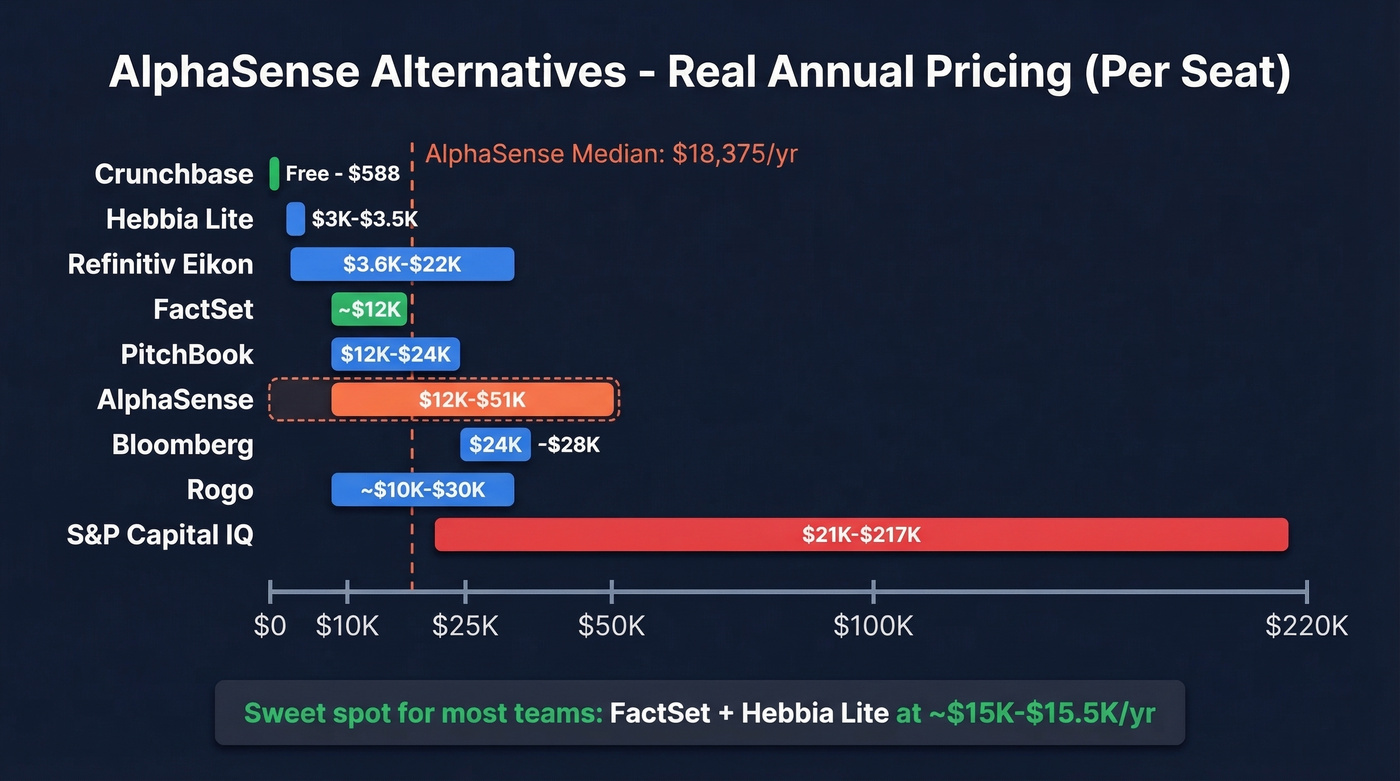
Let's be honest: if your annual contract value is under $50K and your team is under 10 people, you almost certainly don't need AlphaSense-level spend. A FactSet + Hebbia Lite stack at ~$15K-$15.5K/year gets you a huge chunk of the capability. The remaining gap - expert transcripts and broker research breadth - is real, but it isn't $18K/seat real for a lot of teams.
Build Your Stack
No single tool replaces AlphaSense for every use case. Here are three stacks based on your role.
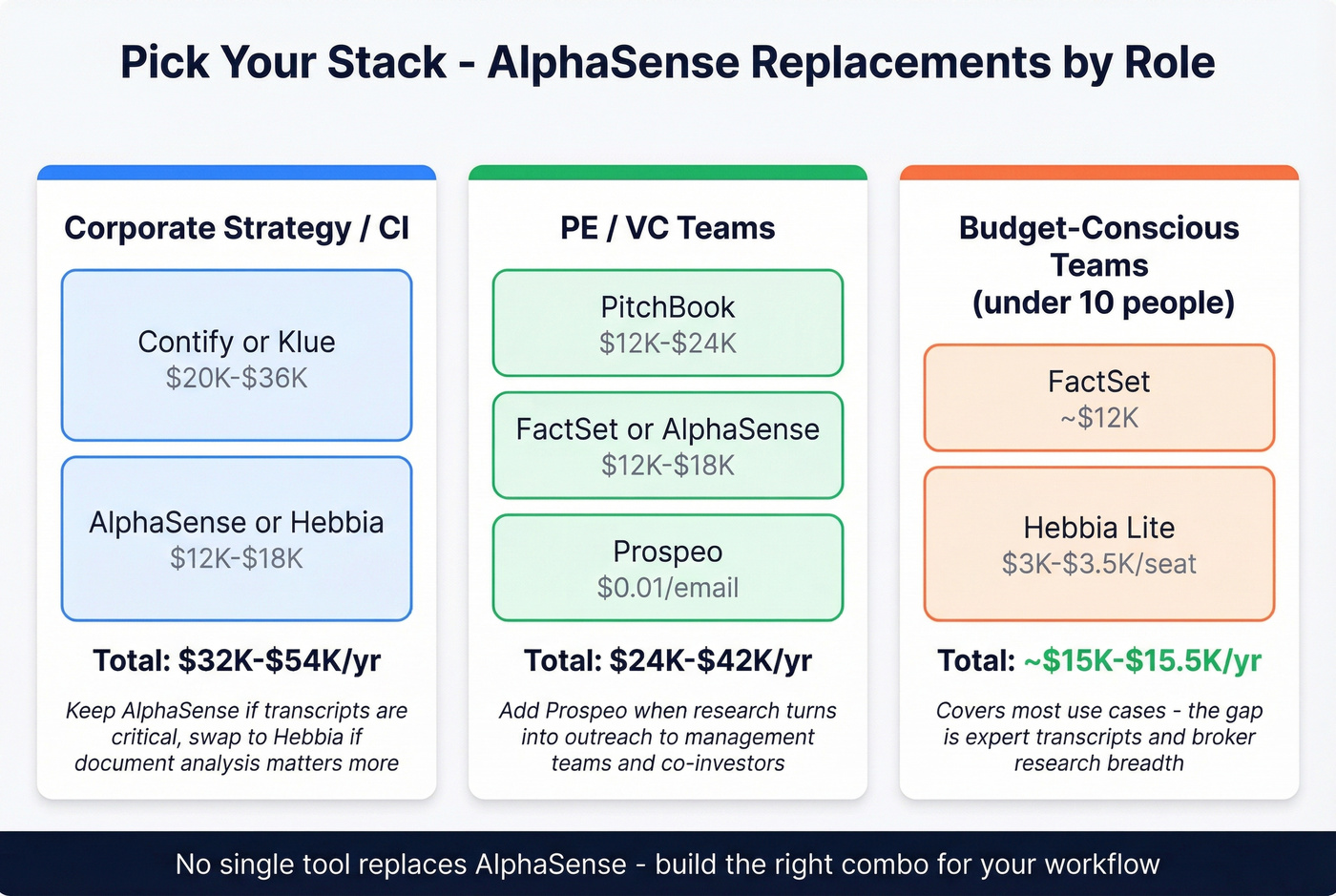
Corporate strategy / CI: Contify or Klue (~$20K-$36K) + AlphaSense or Hebbia (~$12K-$18K). Keep AlphaSense if the transcript library is critical; swap to Hebbia if document analysis matters more than content breadth.
PE/VC: PitchBook ($12K-$24K) + FactSet or AlphaSense ($12K-$18K). PitchBook handles deal flow and private market data. When research turns into outreach - management teams, co-investors, operating partners - layer in a contact data tool for verified emails and direct dials. In our experience, the research-to-outreach handoff is where most teams lose momentum, because the analyst who found the target company isn't the same person who has to track down the CFO's email.

Spending $12K-$50K/year on financial intelligence means nothing if your outreach bounces. Prospeo's 7-day data refresh and 5-step email verification keep bounce rates under 4% - the same results Snyk saw across 50 AEs. Layer intent data across 15,000 topics to know which prospects are actually in-market.
Turn expensive research into booked meetings for $0.01 per lead.
FAQ
What does AlphaSense actually cost?
The median contract lands at $18,375/year based on 34 tracked purchases, with per-seat pricing typically falling in the $10,000-$20,000 range. Total contract values span $12K to $51K depending on seats, modules, and whether Tegus expert calls are bundled.
Is there a free alternative to AlphaSense?
No free tool replicates AlphaSense's full capabilities. Crunchbase's free tier covers basic company data and funding history. For document analysis, Hebbia Lite starts at $3K/seat/year - the cheapest serious option.
What's the difference between AlphaSense and Bloomberg?
AlphaSense is an AI search engine for qualitative insights across documents and transcripts. Bloomberg is a real-time market data terminal for pricing, execution, and quantitative analysis. They solve fundamentally different problems with minimal overlap.
Are Hebbia and Rogo ready to replace AlphaSense?
For document reasoning with full citations, Hebbia's Matrix is genuinely competitive - 33% of top global asset managers already use it. For content breadth like broker research, expert transcripts, and regulatory filings, AlphaSense still has the larger library. Rogo is earlier-stage but gaining traction at top-tier banks like Lazard and Nomura.
How do I find contact data for companies I research?
Prospeo covers 300M+ professionals with 143M+ verified emails and 125M+ verified mobile numbers, searchable by company, role, or industry. Export directly to your CRM with 50+ data points per contact. The free tier includes 75 emails per month - no contract required.