

Competitive Intelligence Research: The Practitioner's Playbook for 2026
A RevOps lead we know lost three deals in a row to the same competitor last quarter. Nobody on the floor could explain why. The battlecards were eight months old, and the "competitive intel" lived in a Google Doc two people had bookmarked. That's not a CI program - that's a liability.
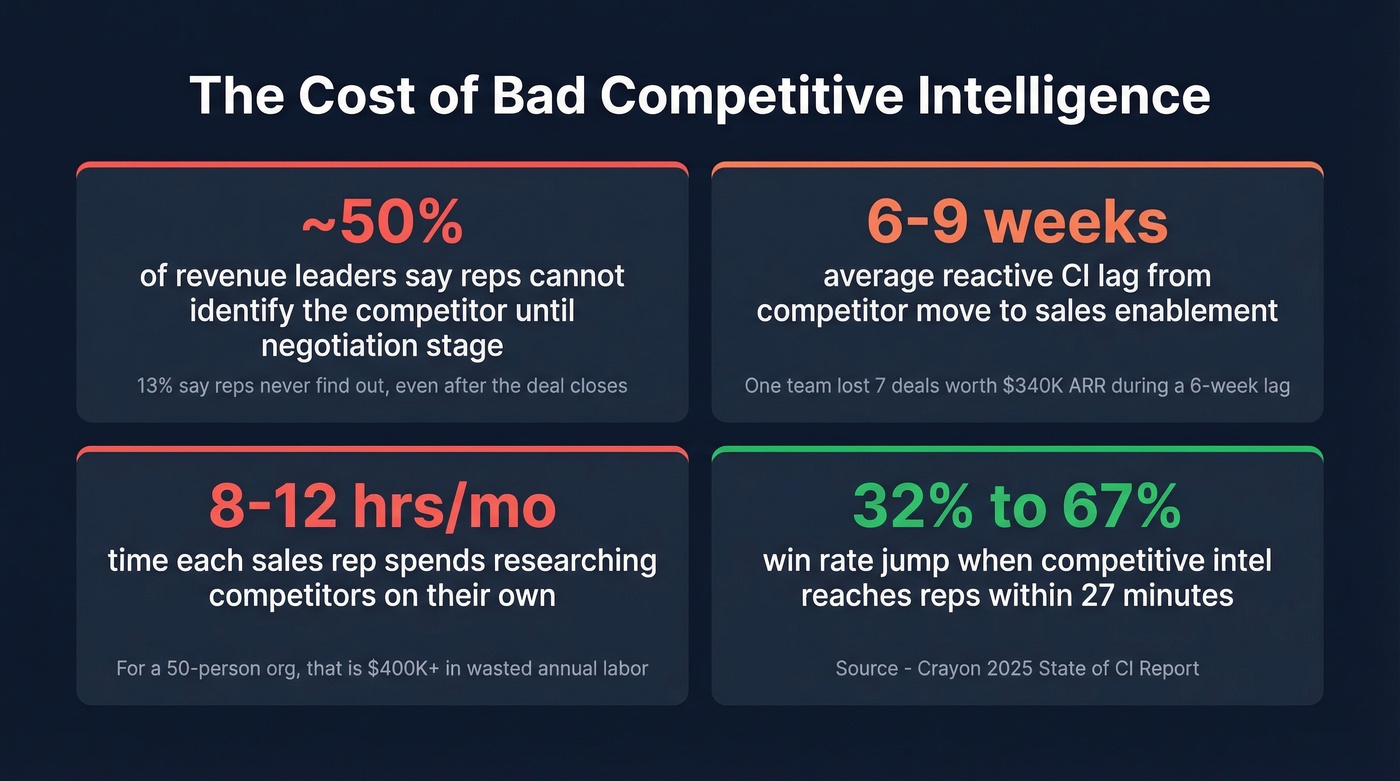
Here's the stat that should keep you up at night: 68% of B2B sales deals involve at least one direct competitor, per Crayon's 2025 State of CI report. The same report shows that when competitive intel reaches reps within 27 minutes, win rates can jump from 32% to 67%. The gap between those numbers is where your revenue goes to die. Effective competitive intelligence research closes that gap - systematically.
What Is Competitive Intelligence?
Competitive intelligence research is the systematic collection, analysis, and distribution of actionable information about specific competitors - their strategies, products, pricing, hiring patterns, and market moves. It's narrower than market research, which studies broader demand trends, and distinct from business intelligence, which focuses inward on your own operational data.
The distinction determines what you build. Market research tells you the TAM is growing. BI tells you your pipeline is slowing. CI tells you why - your competitor just launched a freemium tier and your reps don't have a counter-narrative.
One Reddit thread on r/sales makes the point bluntly: a lot of what gets labeled "competitive intelligence" is just Googling and monitoring public signals. At most companies, it is. The difference between desk research and a real CI program is the system behind it.
As of 2026, Gartner estimates 40% of tech and service providers now use commercial CI tools - up from roughly 10% a few years ago. The CI tools market is projected to hit $1.46B by 2030, growing at roughly 20% annually.
Building a CI Program: 30-60-90 Days
Most CI programs fail because they start with tools instead of people. The 30-60-90 day framework flips that.
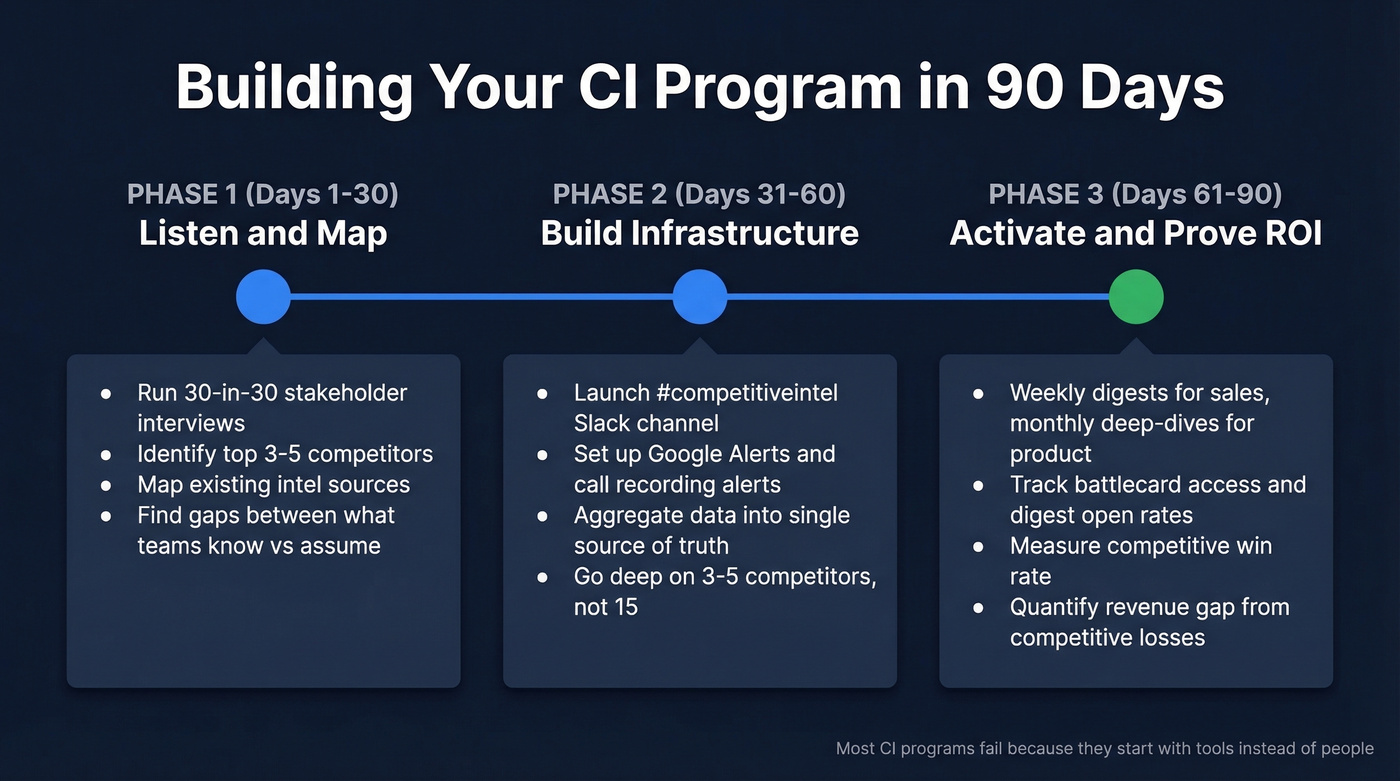
Days 1-30: Listen and Map
Your first month is about understanding what competitive intelligence already exists and where the gaps are. Run the 30-in-30: thirty stakeholder interviews, thirty minutes each, across sales, product, CS, and leadership. Ask one question in different ways: What do you wish you knew about our competitors that you don't?
These interviews surface patterns fast. You'll hear the same three or four competitors repeatedly. You'll discover that product knows things sales doesn't. You'll find that the intel reps actually use lives in Slack DMs, not your CRM. This early phase is essentially competitive landscape research - mapping who matters, where they show up, and what your team actually knows versus assumes. We've seen the 30-in-30 approach surface more actionable intel in a month than most teams collect in a year.
But you can't interview people you can't reach - especially competitor customers, ex-employees, and industry analysts. Prospeo returns verified emails with 98% accuracy across 300M+ professional profiles, and the free tier gives you 75 verified emails per month plus 100 Chrome extension credits. That's enough to run your entire 30-in-30 sprint without spending a dollar on contact data. (If you're evaluating providers, start with this list of B2B databases.)
Days 31-60: Build Infrastructure
Launch a #competitiveintel Slack channel for real-time field intelligence. Set up Google Alerts for competitor names, key executives, and product launches. Configure competitor-mention alerts in your call recording tool. Don't try to track fifteen competitors - pick three to five that show up most in your deals and go deep.
This is also when you should start aggregating competitive monitoring data from call recordings, CRM notes, and alert feeds into a single source of truth. If your CRM is messy, CRM automation can help keep competitor fields and loss reasons from rotting.
Days 61-90: Activate and Prove ROI
A CI program that collects intel nobody uses is just expensive journalism.
By day 61, establish a delivery cadence: weekly competitive digests for sales, monthly deep-dives for product, quarterly strategic briefings for leadership. Track adoption ruthlessly. How many reps open the digest? How often are battlecards accessed before calls? And the metric that matters most: competitive win rate. Klue's "competitive revenue gap" model - quantifying lost revenue attributable to competitive losses - is increasingly how CI teams justify budget to leadership. If you aren't moving win rate within 90 days, something in the system is broken. (If you need a battlecard baseline, use this sales battle cards guide.)
CI Sources: Internal vs. External
| Internal Sources | External Sources |
|---|---|
| CRM deal notes, competitor fields | SEC filings, earnings calls |
| Win-loss interviews | G2 and Capterra reviews |
| Call recordings (Gong, Chorus) | Glassdoor reviews, hiring signals |
| #competitiveintel Slack channel | Patent filings, press releases |
| Sales and CS anecdotes | Web traffic data (Similarweb) |
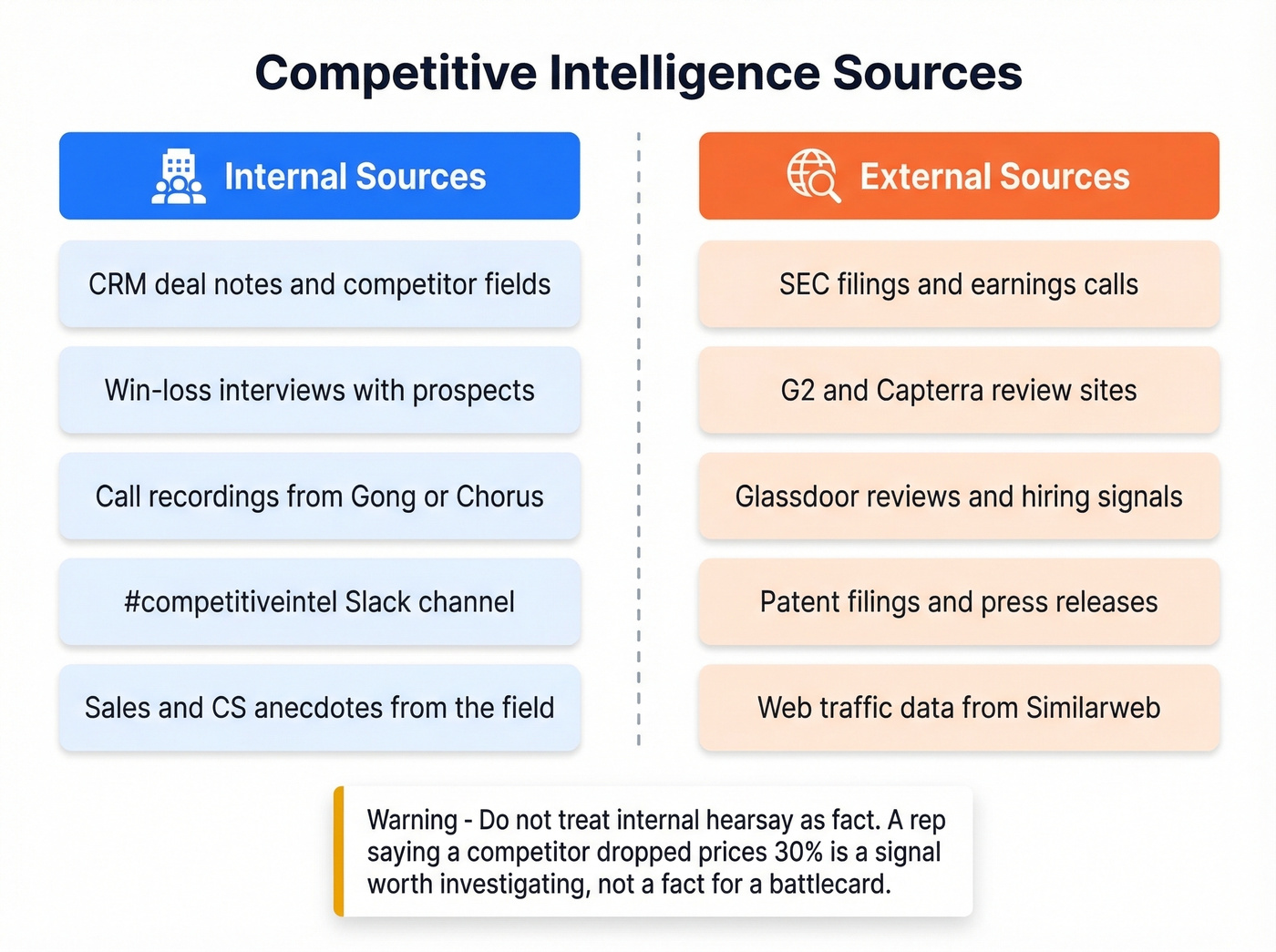
Don't treat internal hearsay as truth. When a rep says "the prospect told me Competitor X just dropped their price 30%," that's a signal worth investigating - not a fact for a battlecard. The Slack channel is a goldmine, but it needs a curator who separates signal from noise.
Frameworks That Actually Work
SWOT remains the workhorse because it's simple enough for a sales team to internalize. Strengths, weaknesses, opportunities, threats - mapped per competitor, updated quarterly. Not sophisticated, but actionable. A solid competitive landscape analysis example: run SWOT for your top three rivals, then overlay their positioning against your own to identify white space.
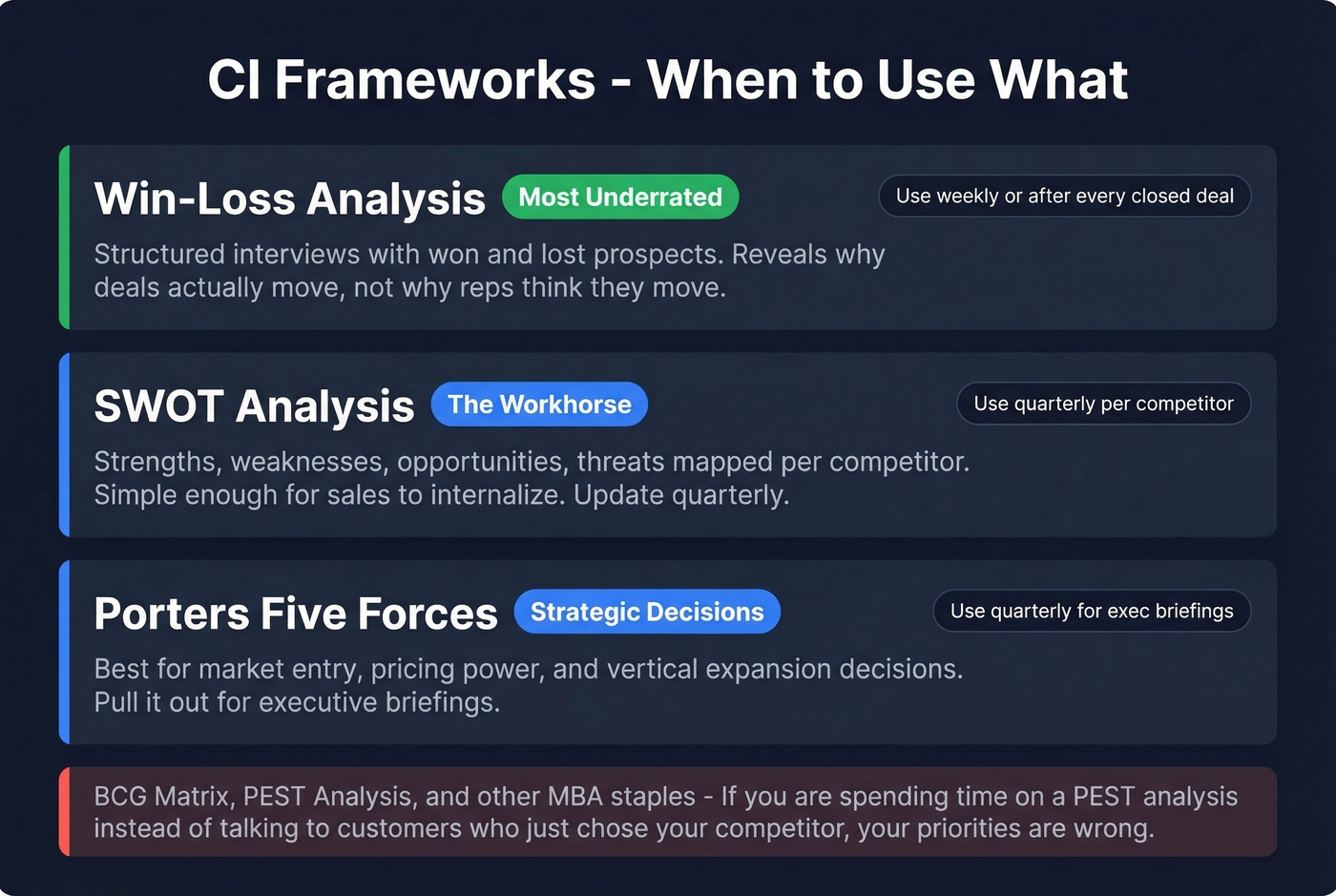
Porter's Five Forces earns its keep for strategic decisions about market entry, pricing power, or vertical expansion. Most CI teams pull it out quarterly for executive briefings. It's especially valuable when entering a new segment - understanding supplier power, buyer leverage, and substitute threats before committing resources.
Win-Loss Analysis is the most underrated framework in CI. Structured interviews with won and lost prospects reveal why deals actually move - not why reps think they move. The gap between those two things is usually enormous. (To operationalize this, align it with your account executive KPIs and competitive win-rate targets.)
The BCG matrix, PEST analysis, and other MBA staples? Look, if you're spending time on a PEST analysis instead of talking to customers who just chose your competitor, your priorities are wrong.

Your 30-in-30 CI sprint depends on reaching the right people - competitor customers, ex-employees, analysts. Prospeo gives you 98% accurate emails across 300M+ profiles, refreshed every 7 days so you're never working with stale contacts.
Run your entire competitive intelligence research sprint without a single bounce.
Competitive Landscape Analysis for Market Expansion
One of the highest-ROI applications of CI is analyzing the competitive landscape before expansion - whether you're entering a new vertical, geography, or product category. The B2B competitive landscape shifts dramatically across segments; a competitor that dominates mid-market SaaS may be invisible in enterprise healthcare.
Before expanding, answer three questions with data. What does the competitive landscape look like in the target segment? Who are the incumbents, and what switching costs do buyers face? Where are the gaps in their offerings that your product can exploit? Porter's Five Forces and win-loss data from adjacent segments give you the foundation. Layer in hiring signals, patent filings, and product launch timelines to build a forward-looking view rather than a static snapshot. (If you're defining who to target in the new segment, start with an ideal customer profile.)
Legal and Ethical Boundaries
CI is legal. Corporate espionage isn't. The line is clearer than most people think.
The Uniform Trade Secrets Act and the Economic Espionage Act of 1996 define the hard boundaries. Antitrust law adds another layer - any conversation with a competitor about pricing or market division is off-limits. Two practical tests keep you honest: the Front Page Test (would you be comfortable if your method appeared in the Wall Street Journal?) and the Reciprocity Test (would you consider it fair if a competitor did the same?).
SCIP is the global intelligence association, and modern CI ethics all converge on the same baseline: disclose your identity, comply with laws, respect confidentiality, and don't pressure competitor hires to violate their NDAs. (For a practical ethics checklist, see how to maintain ethics in sales.)
Mistakes That Kill CI Programs
Reps don't know who they're competing against. Nearly half of revenue leaders say their reps can't identify the competitor until negotiation. 13% say reps never find out, even after the deal closes.
Decentralized battlecards. Three versions of the "vs. Competitor X" doc in three different Google Drives isn't a battlecard - it's a liability. And they go stale within 30 days regardless.
Dirty CRM data. Your competitor field is blank on 60% of closed-lost deals? Your CI program is flying blind. (This is where data enrichment tools can help keep account and contact records usable.)
Reactive enablement. The average reactive CI lag is 6-9 weeks. One team we studied saw a 6-week lag lead to 7 lost deals totaling $340K ARR. Meanwhile, sales reps spend 8-12 hours per month researching competitors on their own - for a 50-person org, that's $400K+ in annual labor cost just in wasted rep time.
Collecting intel nobody uses. This is the most common CI failure mode. Not bad data - great data that never reaches the rep in the moment they need it.
CI Tools and Pricing in 2026
Here's the thing: if your average deal size is under $10K, you probably don't need a $30K CI platform. In our experience, teams that buy enterprise tools before proving the CI function with free tools waste both money and credibility. Start scrappy, prove ROI, then invest.
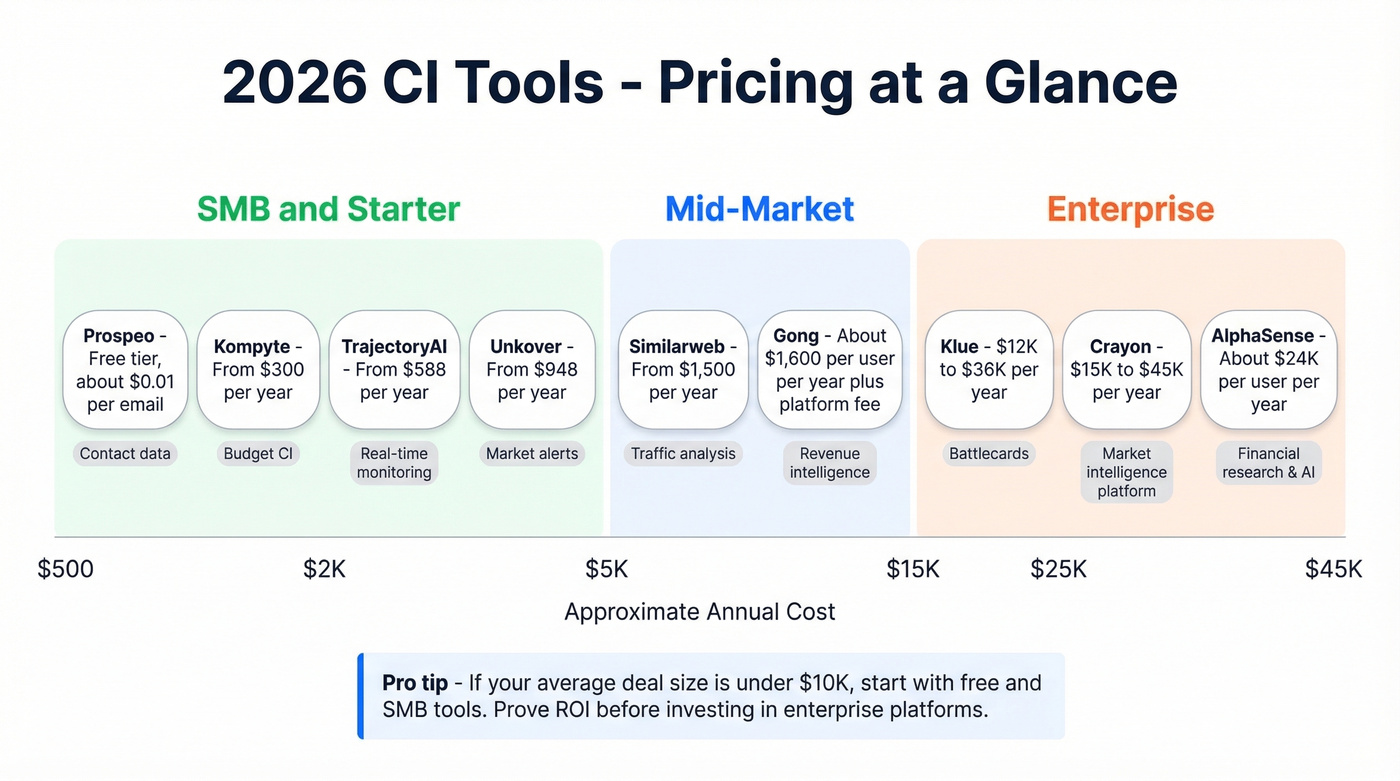
A common G2 reviewer complaint about enterprise CI platforms is that they're expensive and underused - teams buy Crayon or Klue, onboard half the sales floor, and watch adoption crater by month three. The tool isn't the problem. The system is.
| Tool | Category | Starting Price | Best For |
|---|---|---|---|
| Crayon | Enterprise CI | $15K-$45K/yr | Real-time monitoring, automated alerts |
| Klue | Enterprise CI | $12K-$36K/yr | Battlecard quality, sales enablement |
| AlphaSense | Strategic intel | ~$24K/yr per user | Earnings calls, SEC filings, expert transcripts |
| Kompyte | Budget CI | From $300/yr | SMBs launching their first CI program |
| TrajectoryAI | SMB CI | From $49/mo | Lightweight competitor tracking |
| Unkover | SMB CI | From $79/mo | Automated monitoring on a budget |
| Similarweb | Digital intel | From $125/mo | Web traffic benchmarks |
| Gong | Conversation intel | ~$1,600/user/yr + platform | Call-level competitive insights |
| Prospeo | Contact data | Free tier; ~$0.01/email | Reaching CI interview targets |

What to Spend by Company Stage
Under $1M ARR, keep CI tool spend under $5K/year. Google Alerts, a Slack channel, and a free contact data tier get you surprisingly far. At $1-10M ARR, budget $10-25K for a dedicated platform. Enterprise teams at $10M+ ARR should expect $50K+ annually across monitoring, enablement, and intent data.
The biggest cost isn't software - it's the headcount to run the program. Skip the enterprise CI platform if you don't have someone whose job it is to curate and distribute the intel. You'll just be paying for a dashboard nobody opens. (If you're building the broader stack, use this RevOps tech stack blueprint.)
Competitive landscape analysis before market expansion means reaching decision-makers in unfamiliar segments fast. Prospeo's 30+ search filters - including technographics, intent data, and headcount growth - let you map competitor customers and key buyers in any vertical.
Stop Googling. Start building CI lists with verified data at $0.01 per email.
AI-Powered CI in 2026
AI adoption within CI teams is up 76% year-over-year, with 60% of practitioners using AI daily. The shift isn't incremental - it's structural.
The current wave is agentic CI: LLM-powered workflows that continuously monitor competitor signals, generate intelligence briefs, and surface changes without human prompting. Teams running these systems report 85-95% reduction in manual research time. What used to take 6-9 weeks of reactive lag now takes days.
The technology works, but LLM-generated briefs hallucinate. A 4-6 week pilot is the right way to test any AI CI tool - long enough to see real output quality, short enough to kill it if the signal-to-noise ratio is bad. Human review stays in the loop for high-stakes competitive positioning. Let the AI handle monitoring and first-draft analysis; your CI lead handles the judgment calls. (If you're deciding what to automate, start with GTM AI.)
FAQ
What's the difference between competitive intelligence and market research?
CI targets specific competitors - their strategies, pricing, and moves. Market research studies broader demand trends and customer segments. You use market research to size an opportunity; you use CI to win the deal against a named rival.
Is competitive intelligence legal?
Yes, when conducted using publicly available information and transparent methods. The Uniform Trade Secrets Act and Economic Espionage Act define US boundaries. Stick to public sources, disclose your identity, and don't pressure anyone to violate NDAs.
How much does a CI program cost?
Under $1M ARR, keep tools under $5K/year - Google Alerts plus a free contact data tool covers the basics. At $1-10M ARR, budget $10-25K for a dedicated platform. Enterprise teams at $10M+ should expect $50K+. Headcount always outweighs software cost.
How long does it take to build a CI program?
A functional program takes 60-90 days. First 30 days: stakeholder interviews and source mapping. Days 31-60: infrastructure and tooling. By day 90, you need a delivery cadence and initial win-rate data to prove ROI.
What tools do I need to start?
At minimum: a monitoring tool (even Google Alerts), a #competitiveintel Slack channel, a CRM with a competitor field, and a contact data tool for primary research outreach. Don't buy a $30K platform before you've proven the function works with free tools.