

How to Maintain Ethics in Sales: Systems Beat Willpower
Your top rep just closed a deal you know will churn in 90 days. The product doesn't fit, the buyer's expectations are wrong, and the rep knew it - but quota closes in 48 hours. This isn't a character failure. It's a systems failure. Understanding how to maintain ethics in sales starts with accepting that truth. Gallup data confirms the damage: only 7% of people rate car salespeople as highly honest. The trust deficit is real, and it's structural.
What You Need (Quick Version)
Ethics breaks down because of systems, not bad people. Three priorities, in order:
- Fix your comp plan. It's the single biggest lever. If your incentive structure rewards short-term closes over long-term retention, no code of ethics will override it.
- Give reps a real decision framework. Not a poster on the wall - an actual process for navigating grey areas.
- Source clean data. If your first touchpoint is a bounce to an unverified address, you've already violated trust.
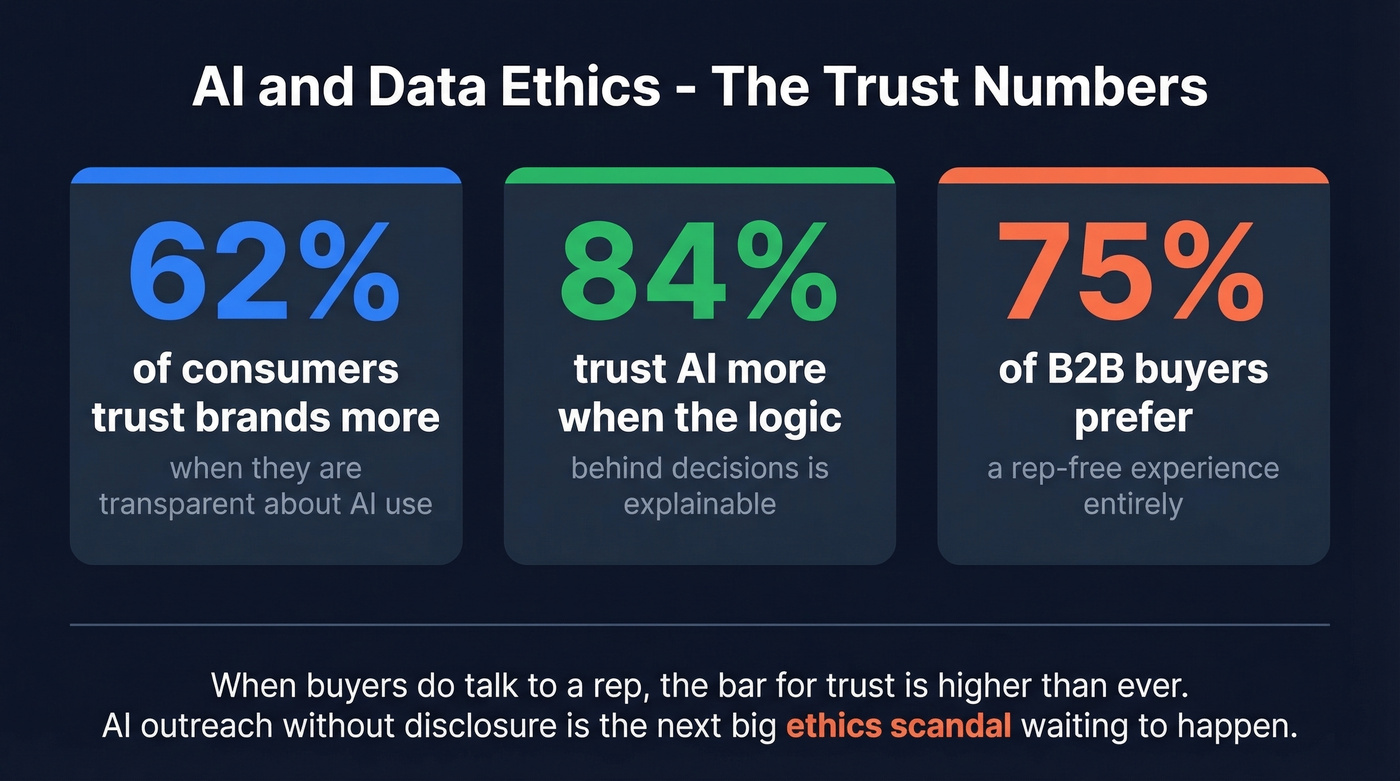
75% of B2B buyers prefer a rep-free experience. When they do talk to a rep, the bar for trust is higher than it's ever been.
Why Ethical Selling Breaks Down
The r/sales subreddit is full of posts describing the same pattern: quota pressure creates a pathway to misrepresentation. One thread captured it perfectly - the job requires you to "bend the truth," leave out warranty details, frame rate increases as "locked-in," and bury cancellation terms until after the signature. That's not one bad rep. That's a system producing predictable behavior.
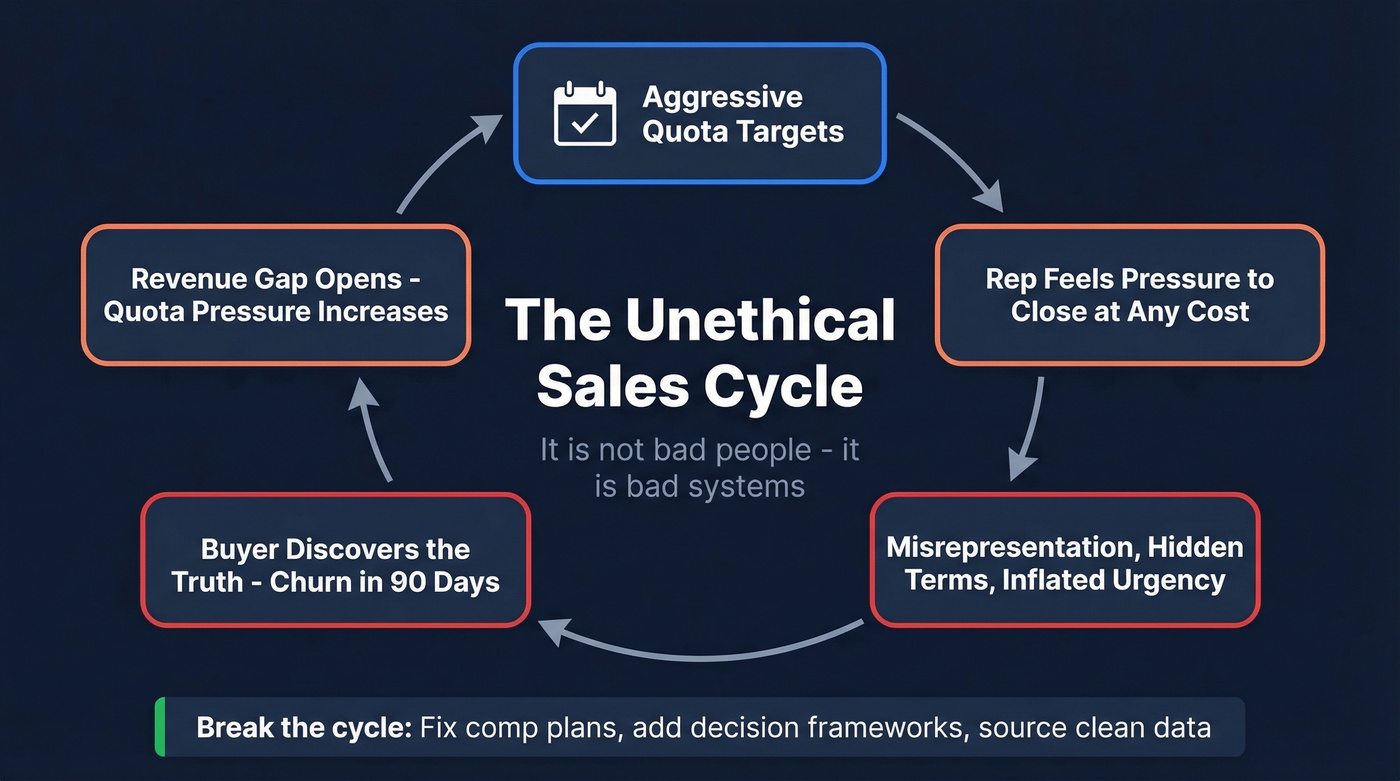
The Baylor Business Review nails the root cause: monthly quotas versus long-term relationships create fertile ground for unethical activity. Top management can't rely on individual integrity alone - they have to actively shape the ethical climate. Fear based selling - where reps manufacture urgency by exaggerating consequences of inaction - thrives in exactly this kind of environment because the system rewards closing at any cost.
A well-known pricing-governance failure looks like this: a rep sells full price from the 1st-15th of the month and half-price for the rest of the month to hit quota. When customers compare notes, the fallout is brutal. That's not a rogue rep problem. That's a pricing governance failure.
So is sales inherently unethical? No. But most sales environments are structurally designed to produce unethical behavior. There's a difference, and it matters.
The Cost of Getting It Wrong
If the moral argument doesn't land with your leadership team, the financial argument will.
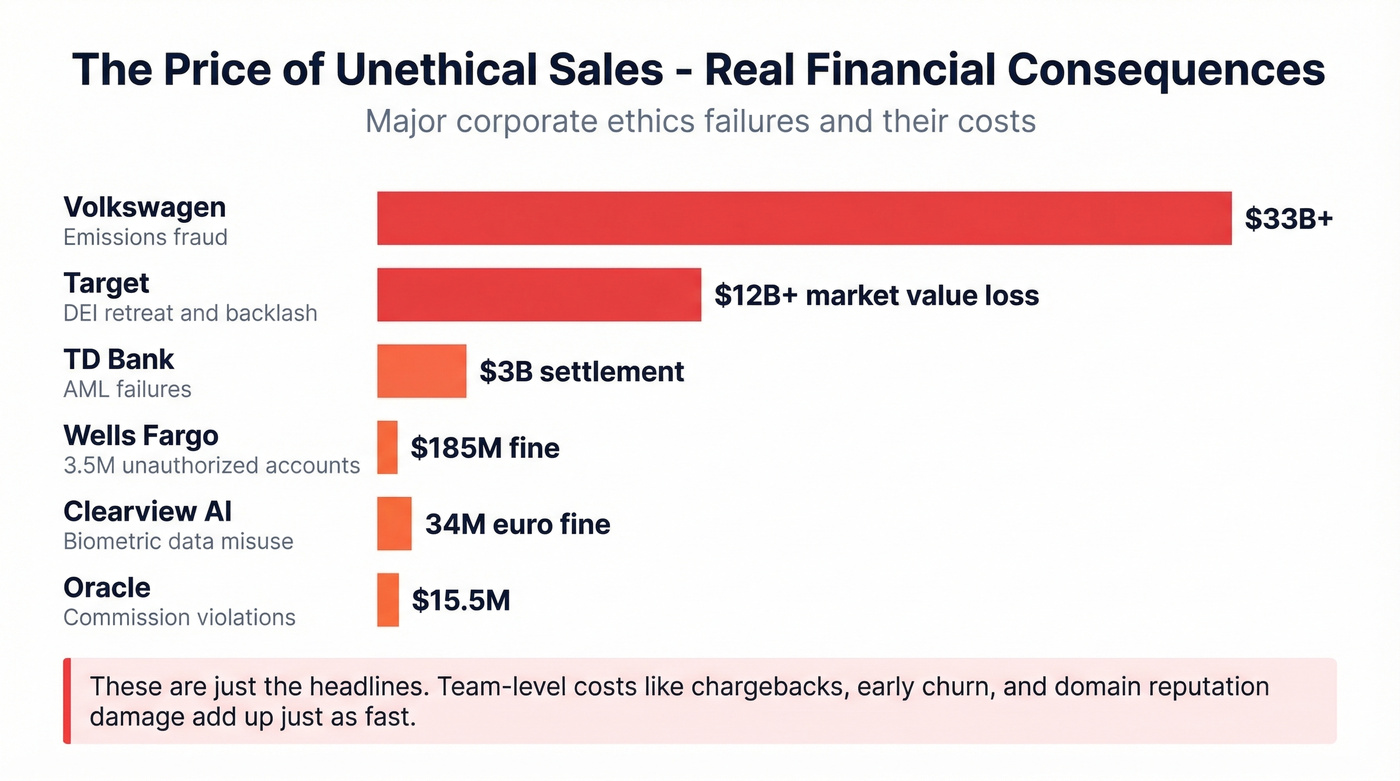
| Company | What Happened | Financial Cost |
|---|---|---|
| TD Bank | AML failures | $3B settlement |
| Wells Fargo | 3.5M unauthorized accounts | $185M fine |
| Oracle | Commission violations | $15.5M |
| Target | DEI retreat, backlash | $12B+ market value loss |
| Clearview AI | Biometric data misuse | €34M fine |
| Volkswagen | Emissions fraud | ~$33B total |
These are headline-level consequences. But team-level costs are just as real: chargebacks, early churn, and domain reputation damage that tanks your outbound for months. A single quarter of aggressive selling can create refund liability that wipes out the revenue it generated. It's also worth noting that some high-pressure tactics are illegal in many jurisdictions - bait-and-switch schemes, refusing to let a buyer leave, and misrepresenting contract terms can trigger regulatory action, not just lost trust.
Individual Ethics Framework
Stop hiring for ethics and start designing for it. The Markkula Center at Santa Clara University publishes a decision-making framework that adapts cleanly to sales. Here's a sales-friendly version reps can run fast:
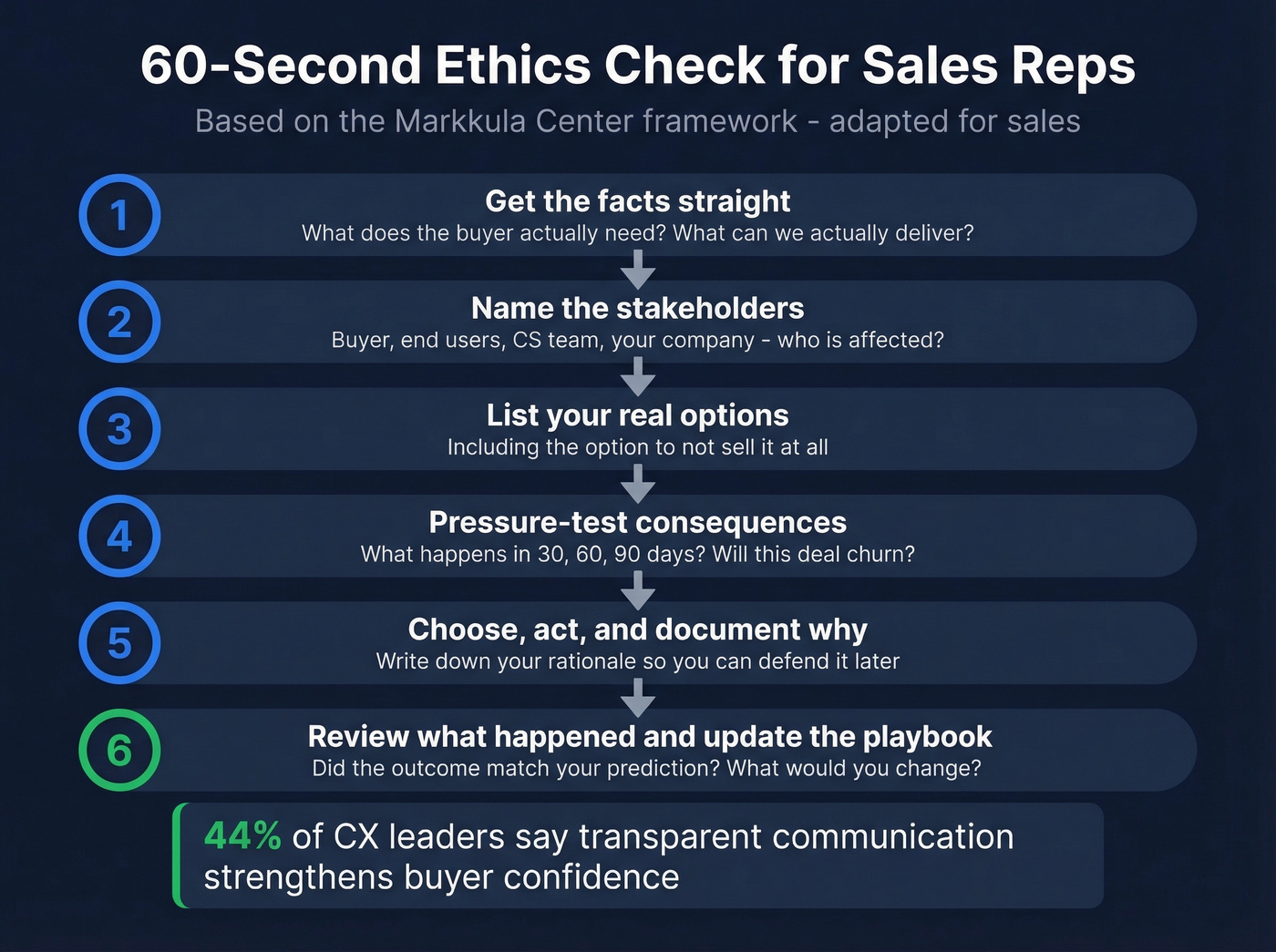
- Get the facts straight
- Name the stakeholders (buyer, end users, CS, your company)
- List your real options (including "don't sell it")
- Pressure-test consequences (especially the next 30-90 days)
- Choose, act, and document the rationale
- Review what happened and update the playbook
This isn't abstract philosophy. It's a checklist reps can run in 60 seconds before a pricing conversation where the fit is questionable. And the data backs it up: 44% of CX leaders say transparent communication definitively strengthens buyer confidence. Transparency isn't just ethical - it converts.

You can't build buyer trust on bad data. When 35% of your emails bounce, you're not just wasting credits - you're signaling to prospects that you don't care enough to get the basics right. Prospeo's 5-step verification delivers 98% email accuracy, so your first touchpoint is a real conversation, not a spam folder.
Ethical selling starts before the pitch - it starts with verified data.
Words and Phrases That Build Trust
The language your reps use matters as much as the process they follow. There are specific sales words to avoid because they trigger skepticism or feel manipulative - terms like "once-in-a-lifetime," "act now or lose out forever," and "I guarantee" when you can't actually guarantee anything. These phrases erode credibility faster than silence.
On the other end of the spectrum, a loss aversion sales pitch - framing the conversation around what a buyer stands to lose by not acting - can be used ethically or manipulatively. The ethical version presents real, documented risks the buyer faces. The manipulative version invents consequences to manufacture panic. The line between the two is whether the claim is verifiable.
Similarly, a fear of missing out sales strategy works when the scarcity is genuine (limited pilot slots, a real pricing deadline). It crosses into unethical territory when the urgency is fabricated. Reps should be trained to distinguish between legitimate urgency and manufactured pressure.
Even cursing in sales - which some reps use to build rapport or signal authenticity - carries ethical weight. It can land well in casual, peer-level conversations, but it can also alienate buyers or signal a lack of professionalism depending on context. The principle is the same as everything else: read the room, respect the buyer.
Fix the Comp Plan First
If your comp plan creates Wells Fargo behavior, your code of ethics is wallpaper.
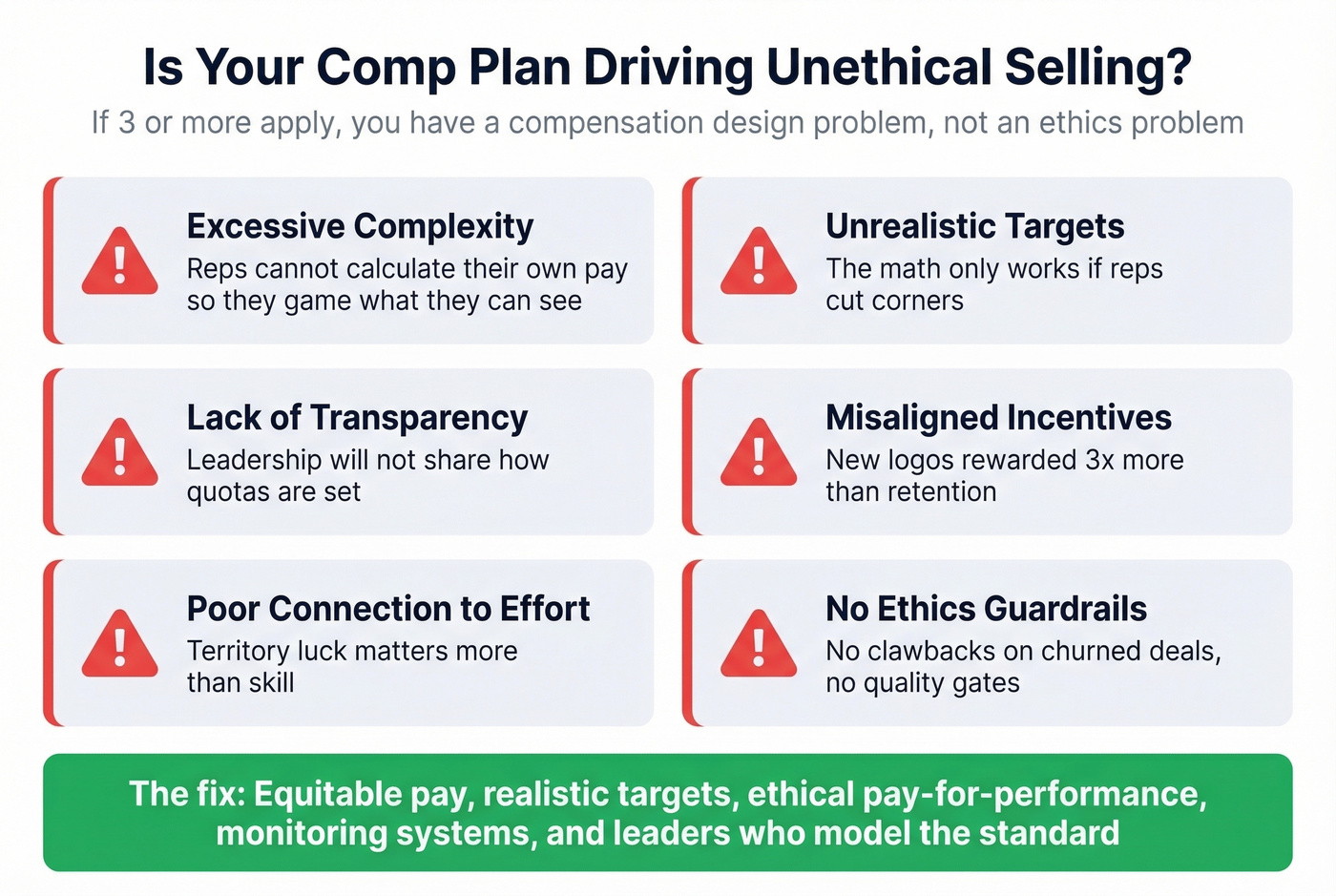
Here are six red flags that your comp plan is driving unethical selling. If three or more describe your current plan, you don't have an ethics problem - you have a compensation design problem.
- Excessive complexity - reps can't calculate their own pay, so they game what they can see
- Unrealistic targets - the math only works if reps cut corners
- Lack of transparency - leadership won't share how quotas are set
- Misaligned incentives - new logos rewarded 3x more than retention
- Poor connection to effort - territory luck matters more than skill
- No ethics guardrails - no clawbacks on churned deals, no quality gates
A Sage study of 19 call center sales managers across telecom, retail, banking, and healthcare confirmed what we've seen firsthand: compensation systems that foster ethical behavior consistently include equitable pay, realistic/attainable targets, ethically designed pay-for-performance, evaluation and monitoring systems, and leaders who model the standard. We've watched teams redesign comp plans and see ethical behavior improve within a single quarter - no training required.
Hot take: Most companies spend 10x more on ethics training than on comp plan redesign. That's backwards. Fix the incentives and you won't need to fix the people.
Burning Platform Tactics: When They Cross the Line
The burning platform sales approach - convincing a prospect that their current situation is unsustainable and demands immediate change - is one of the most effective persuasion frameworks in B2B. It's also one of the most abused. When the platform really is burning (legacy system losing support, regulatory deadline approaching, competitor eating market share), naming the urgency is a service to the buyer. When the "fire" is invented or exaggerated, it's manipulation.
The test is simple: could you defend your framing to the buyer's CFO six months after the deal closes? If the urgency you described turns out to be real, you've built trust. If it doesn't, you've burned it - and the churn will follow.
AI and Data Ethics in Outbound
62% of consumers trust brands more when they're transparent about AI use, and 84% trust AI more when the decision logic is explainable. Yet most outbound teams deploy AI-written sequences with zero disclosure. AI outreach without disclosure is the next big ethics scandal waiting to happen.
GDPR and modern privacy and AI rules push transparency around automated decision-making. But beyond compliance, there's a simpler principle: don't send outreach to people whose contact information you haven't verified.
This is where data sourcing becomes an ethics question. Prospeo runs every email through a 5-step verification process - catch-all handling, spam-trap removal, honeypot filtering - and refreshes all records on a 7-day cycle. That 98% email accuracy means your first touchpoint isn't a bounce or a message to someone who left the company six months ago. GDPR compliance is built in, with opt-out enforcement and DPAs available. In our experience, the outbound teams with the cleanest data also have the fewest compliance complaints.
If you're building a more reliable outbound engine, start with email deliverability and email bounce rate fundamentals before you scale volume.
One agency cut bounce rates from 35% to under 3% and scaled to $1M ARR without a single domain flag. That's what happens when your data provider refreshes records every 7 days instead of the 6-week industry average. Clean data isn't just an ethics play - it's a revenue play.
Stop burning domains and buyer trust with stale contact data.
Training That Actually Works
You've probably sat through a compliance training that consisted of clicking "Next" on 40 slides. That's liability theater. Research from the Network for Business Sustainability found that many ethics programs produce no measurable results. The ones that work share three traits.
First, they're built around discussion of real scenarios the team has faced - not lectures. Second, they run on an ongoing cadence: short microlearning sessions with role-play spread across the quarter beat a single annual marathon every time. Third, leadership shows up. If your VP of Sales skips the session, the entire org gets the message that ethics is optional.
The best ethics training doesn't feel like training. It feels like a pipeline review where someone asks, "Should we have closed that deal?" and the room actually discusses it. Knowing how to maintain ethics in sales is a skill that develops through practice and repetition, not a single workshop.
FAQ
What are the most common unethical sales practices?
Misrepresenting product capabilities, hiding cancellation terms, steering buyers to pricier options when cheaper solutions fit, and sending outreach to unverified lists. Most stem from incentive structures, not individual malice.
How do you create a sales code of ethics?
Start with your comp plan - it overrides any written code. Then document specific behaviors expected in discovery, pricing, and post-sale. Include guidance on words to avoid in outreach that overpromise or misrepresent capability. Review quarterly using real pipeline case studies.
How does bad prospect data relate to sales ethics?
Sending emails to unverified, scraped lists wastes people's time and violates consent norms. Prospeo verifies every email through a 5-step process and refreshes data on a 7-day cycle - keeping outreach ethical from the first touchpoint. Bounce rates under 4% are a realistic benchmark with verified data.
Is fear based selling ever appropriate?
Helping a buyer understand real, documented risks is responsible selling - inventing worst-case scenarios to pressure a signature is manipulation. The test: can the buyer independently verify the consequences you described? If yes, you're adding value. If not, you're destroying long-term trust.