

GTM AI: The Practitioner's Guide to What Actually Works in 2026
A RevOps lead we know spent $56,000 on 25 GTM tools last year. He canceled 20 of them. The five survivors were A-Leads, Strawberry, Sendpilot, Instantly.ai, and Loom. The industry calls this GTM bloat - and GTM AI is making it worse, not better, for teams that buy without a plan.
Meanwhile, 47% of GTM teams still have zero AI agents running in production. Most teams are either over-buying or under-deploying. This guide is about finding the middle.
What You Need (Quick Version)
Three things matter more than which tools you pick:
- Go deep on 1-2 workflows before going wide. A Default survey of 300+ RevOps leaders found that teams with focused implementations outperform those running 7+ scattered use cases.
- A composable stack at ~$500/mo beats a $30k+ enterprise platform for most teams under 100 reps. You don't need ZoomInfo, 6sense, and Gong on day one. You need verified data, a workflow tool, and a sending platform.
What Go-to-Market AI Actually Is
GTM AI isn't a product category. It's an operating model - a way of running your go-to-market motion where AI handles research, enrichment, routing, personalization, and increasingly, execution across sales, marketing, and customer success.
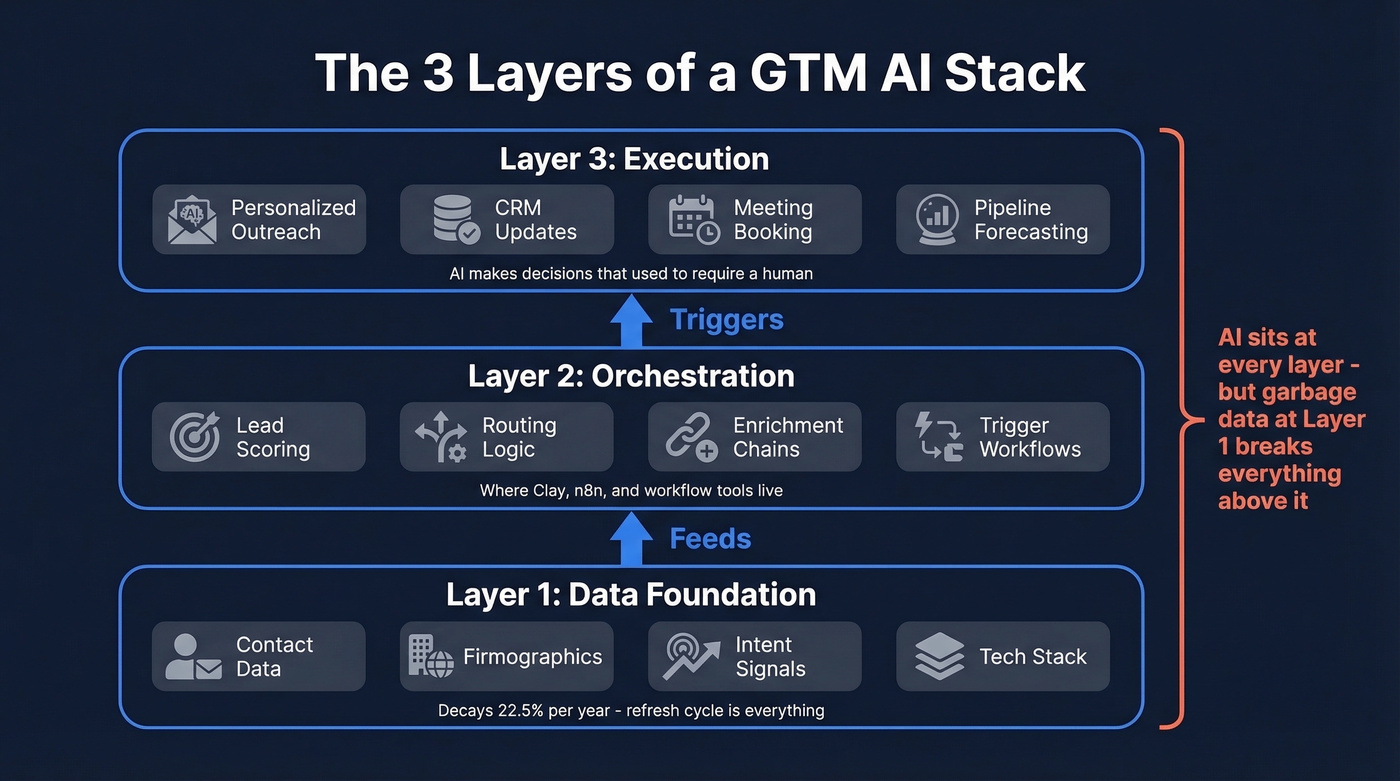
That distinction matters. The market is full of tools that slap "AI-powered" on a feature and call it go-to-market intelligence. A CRM chatbot that summarizes your pipeline isn't a real implementation. A ChatGPT wrapper that writes cold emails isn't either. Revenue intelligence platforms - the Gongs and Claris of the world - handle conversation analysis, pipeline analytics, and forecasting, but they're just one piece of a much larger architecture.
The model breaks into three layers: data foundation, orchestration, and execution. AI sits at each level making decisions that used to require a human. Evergrowth's research quantifies the upside - teams running this model properly reduce research time by 90-95%, saving reps 6+ hours per week, with lead quality improving up to 50%.
Gartner forecasts worldwide AI spending will top $2 trillion in 2026, up from $1.5T in 2025. AI agents and AI-ready data are the two fastest-advancing technologies on Gartner's Hype Cycle, both sitting at the Peak of Inflated Expectations. Massive potential, massive overpromising, and a correction coming for teams that buy the hype without building the foundation.
Where Most Teams Actually Are
The disconnect between confidence and results is striking. Default's survey found that 71% of RevOps leaders rate themselves 7+ in AI knowledge - but their ROI numbers don't follow.
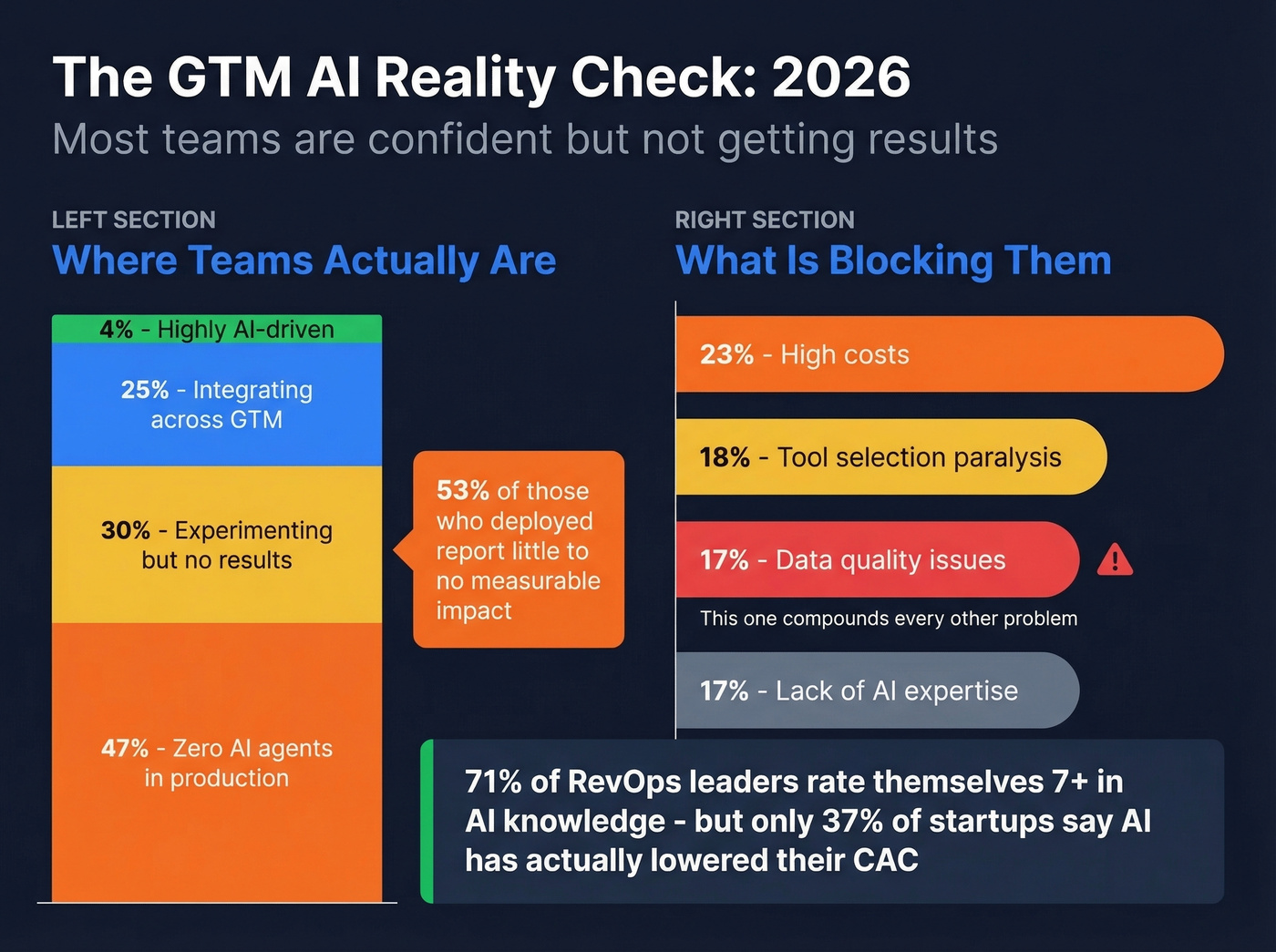
Here's the actual maturity breakdown:
- 30% are experimenting but not seeing desired results
- 25% are integrating AI across GTM functions
- 4% describe themselves as highly AI-driven organizations
- ~1 in 4 have no clear owner for AI initiatives
The GTM Strategist's 2026 data paints an even starker picture: 47% of teams have zero AI agents in production. Of those who've deployed, 53% report little to no measurable impact.
So where's the money going? HubSpot's survey of 500 founders and GTM leaders breaks down the challenges: 23% cite high costs, 18% struggle with tool selection, 17% flag data quality issues, and another 17% lack AI expertise. That data quality number should worry you most - every other problem compounds when your underlying contact data is wrong. And yet only 37% of startups report that AI has actually lowered their CAC.
Here's the thing: if your average deal size is under $10k and you have fewer than 50 reps, you probably don't need "GTM AI" as a category at all. You need three good tools and the discipline to use them well.
Where AI for GTM Actually Works
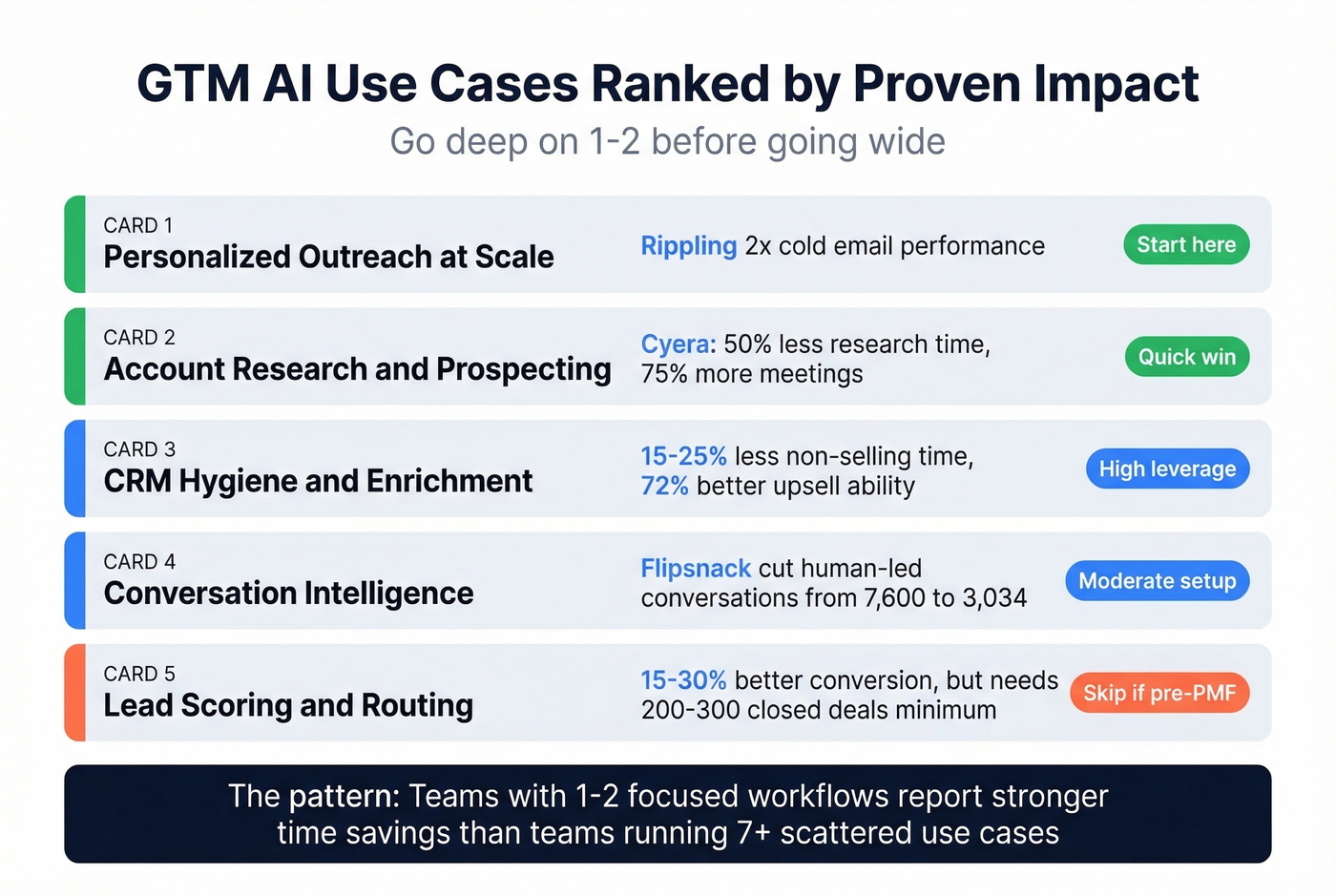
Not every use case delivers equally. Based on the data and what we've seen in production, these are the workflows worth prioritizing.
Lead Scoring and Routing
This can improve lead-to-opportunity conversion by 15-30%, but only with the right data foundation. You need a minimum of 200-300 closed deals to train routing models effectively. Skip this entirely if you're pre-product-market-fit.
Personalized Outreach at Scale
This is where most teams see the fastest wins. Back in 2023, Rippling doubled the year-over-year performance of their cold email channel using Clay for AI-driven personalization - and the tooling has only gotten better since. The key isn't writing more emails. It's writing emails that reference specific triggers, tech stacks, and pain points pulled from enrichment data.
If you want a deeper breakdown of what actually works (and what doesn't), see our guide to AI-driven personalization.
CRM Hygiene and Enrichment
The math is straightforward. CRM data decays roughly 22.5% annually, and revenue teams waste 20-30% of their time on data entry and research. Automated enrichment workflows cut non-selling time by 15-25% when done right. 72% of teams using AI report improved ability to upsell and cross-sell - a downstream benefit that only materializes when the CRM data is actually accurate.
If you're evaluating vendors, our roundup of the best data enrichment tools is a good starting point.
Conversation Intelligence
Real headcount leverage here. Flipsnack deployed HubSpot's Breeze customer agent and reduced human-led conversations from 7,600 to 3,034 - nearly half. That's not a demo trick.
Account Research and Prospecting
This is where the approach shines brightest for individual reps. Cyera's team spends 50% less time on manual research and books 75% more meetings using Apollo's AI features. The pattern is consistent across every case study we've reviewed: AI handles the grunt work, humans handle the strategy.
If you're rebuilding your outbound motion, use this B2B prospecting playbook as the baseline.
Default's survey confirms the meta-pattern - teams with 1-2 focused workflows report stronger time savings than teams running 7+ scattered use cases. Go deep before you go wide.

The article says it plainly: 22.5% of your CRM decays every year, and AI trained on bad data just automates bad decisions faster. Prospeo refreshes 300M+ profiles every 7 days - not every 6 weeks - with 98% email accuracy and 143M+ verified emails. That's the data foundation your GTM AI stack actually needs.
Stop feeding your AI stack stale data. Start with a foundation that holds.
The Data Foundation Problem
Here's where most implementations quietly die.
CRM data decays 22.5% annually. Roughly a quarter of your contact records are wrong, outdated, or bouncing by year's end. 95% of GTM leaders acknowledge that poor data hurts their go-to-market execution. The failure cascade looks like this: stale email addresses lead to bounced emails, which trigger spam traps, which tank your domain reputation, which kills your entire outbound channel. AI trained on that data doesn't fix the problem - it automates bad decisions faster and at greater scale.
If you're seeing deliverability issues, start with an email reputation check and a domain reputation audit before you scale volume.

We've tested a lot of data providers, and the refresh cycle is the metric that separates the useful ones from the dangerous ones. Prospeo runs a 7-day refresh cycle across 300M+ professional profiles with 143M+ verified emails and 125M+ verified mobile numbers. The industry average is six weeks, which means most databases are serving you contacts that changed jobs a month ago. A proprietary 5-step verification process includes catch-all handling, spam-trap removal, and honeypot filtering to keep your domain safe.
For a broader comparison, see our ranking of the best B2B databases and the shortlist of verified contact databases.
The proof is in the customer results. Meritt went from a 35% bounce rate to under 4% after switching, and their pipeline tripled from $100K to $300K per week. Snyk - running 50 AEs prospecting 4-6 hours per week - dropped bounce rates from 35-40% to under 5% and saw AE-sourced pipeline jump 180%.
A composable stack at ~$500/mo beats a $30K enterprise platform - but only if the data layer is right. Prospeo gives you 30+ search filters, intent data across 15,000 topics, and CRM enrichment returning 50+ data points per contact at $0.01/email. No contracts, no sales calls, no bloat.
Skip the GTM bloat. Get enterprise-grade data at startup-friendly pricing.
The Biggest GTM AI Mistakes
SaaStr deployed 20+ AI agents generating over $1M in revenue. But their AI SDR rollout? It "failed spectacularly" in the first 30 days. Emails were generic, targeting was off, and response rates cratered. The fix wasn't a better tool - it was treating the AI like a new hire. They manually reviewed the first 1,000 emails, built a 5-point scoring system, and ran ongoing audits. Now they're sending 3,000+ emails per month at 5-12% response rates versus the 2-4% industry average.
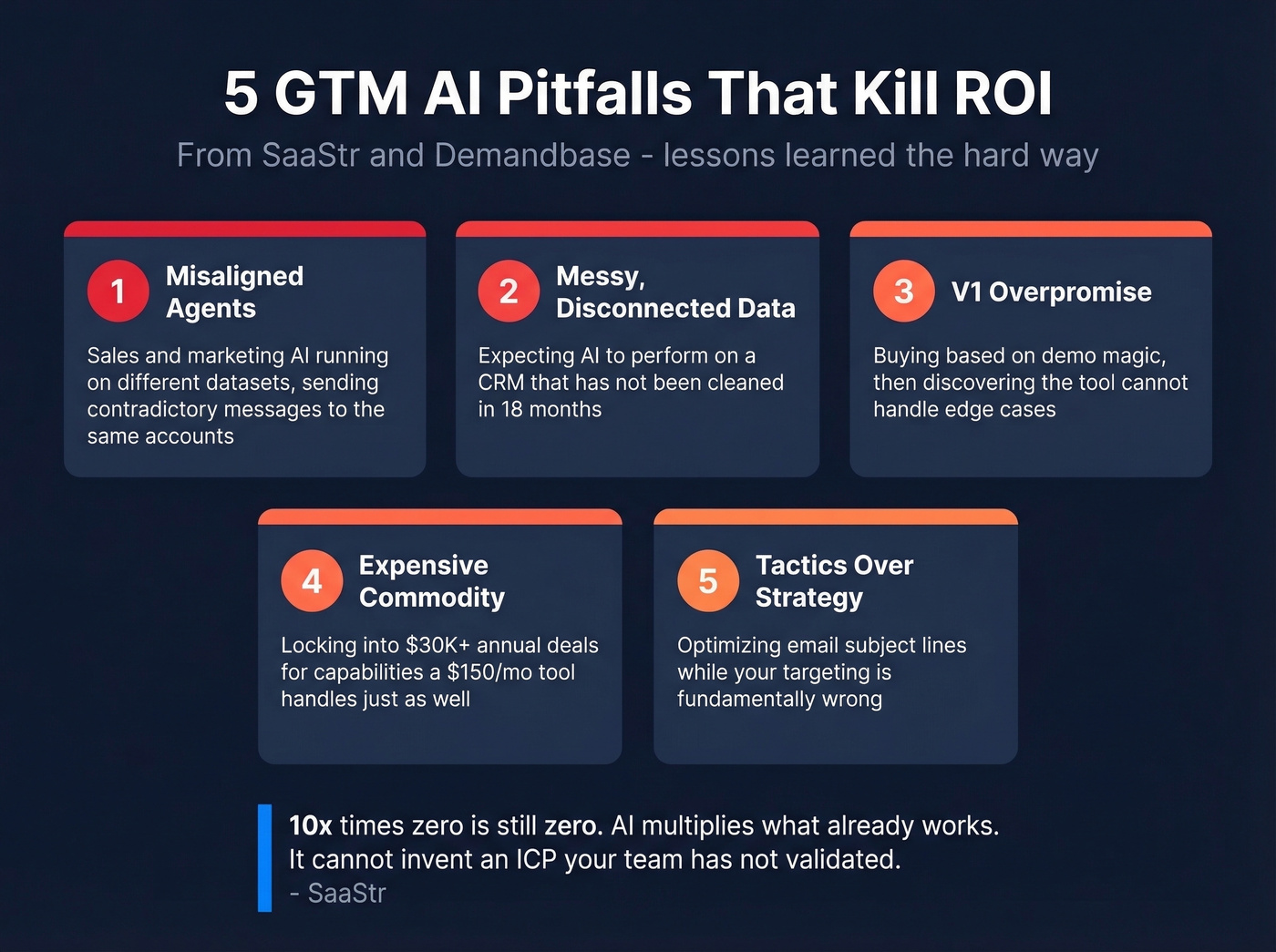
Their heuristic is worth memorizing: "10x times zero is still zero." AI multiplies what's already working. It can't invent an ICP your team hasn't validated or fix messaging that doesn't resonate.
Demandbase's CEO outlined five pitfalls that map to what we see repeatedly:
- Misaligned agents. Sales and marketing running AI on different datasets, producing contradictory messaging to the same accounts.
- Messy, disconnected data. Expecting agents to perform on a CRM that hasn't been cleaned in 18 months.
- V1 overpromise. Buying early-stage AI products based on demo magic, then discovering they can't handle edge cases.
- Expensive contracts for commoditized tools. Locking into $30k+ annual deals for capabilities a $150/mo tool handles just as well.
- Losing strategy amid tactics. Optimizing email subject lines while your targeting is fundamentally wrong.
A Reddit post captured it perfectly: "Execution velocity without strategic intelligence just means making mistakes faster." You can't personalize your way out of a targeting problem.
Building Your GTM AI Stack
The winning pattern from GTM Strategist's research is clear: general-purpose LLMs plus affordable, composable tools beat waiting for a single vendor to solve everything. ZoomInfo lays out an Automate, Predict, Generate framework. Here's how to actually execute it.
The $500/Month Starter Stack
This is where most teams under 50 reps should start. Four tools, clean architecture:
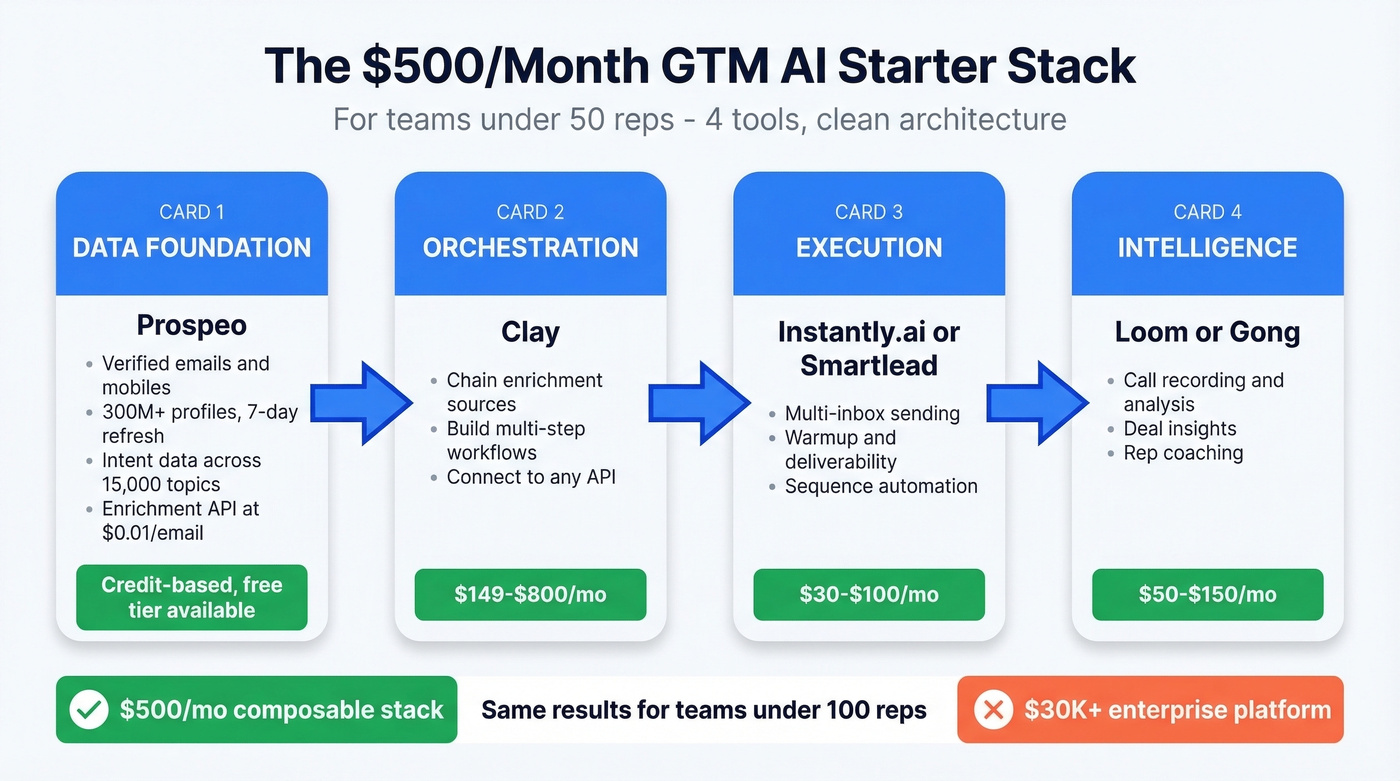
- Prospeo - your data foundation. Verified emails, mobiles, enrichment API, and intent data across 15,000 topics. Everything downstream depends on this being right. Credit-based, self-serve, with a free tier.
- Clay (~$149-$800/mo) - workflow orchestration. Chain enrichment sources, build automated research workflows, personalize at scale. Clay's Sculptor now lets non-experts build workflows in about 20 minutes.
- ChatGPT Plus or Claude Pro ($20/mo) - research, content drafting, ICP analysis. The Swiss Army knife.
- Instantly.ai (~$30-$100/mo) - cold email infrastructure with warmup. Handles the sending so your domain stays clean.
If you're choosing a sequencer, use this outbound email automation guide to avoid overbuying.
The $2k-$5k/Month Growth Stack
Add conversation intelligence and a CRM with native AI:
- Gong (~$1,200-$2,400/user/year) - call analytics, deal forecasting, coaching insights. Worth it once you've got enough call volume to train the models.
- HubSpot Sales Hub (~$90-$150/seat/month) - CRM with Breeze AI baked in. Solid for teams that don't want to stitch together five integrations.
If you're rethinking your CRM layer, start with how to choose a CRM (and avoid the usual migration traps).
Enterprise ($5,000+/Month)
ZoomInfo ($15-40k/year) and 6sense or Demandbase ($30-100k+/year) only make sense at 100+ reps where the data volume and ABM complexity justify the spend. For everyone else, you're paying for features you'll never activate.
Let's be honest - one Reddit practitioner's actual daily stack is ChatGPT Pro, Granola.ai for meeting notes, and Genspark for document creation. Total cost under $50/month. That's not a full stack, but it shows how far focused tool selection gets you before you need to spend real money.
| Tool | Category | Starting Price | Best For | Skip If |
|---|---|---|---|---|
| Prospeo | Data foundation | Free tier; ~$0.01/email | Verified emails, mobiles, intent | You have <100 prospects/mo |
| Clay | Orchestration | ~$149/mo | Enrichment chaining, workflows | You run <3 enrichment sources |
| ChatGPT Plus | Research/content | $20/mo | Drafting, ICP analysis | You already have a writing team |
| Instantly.ai | Cold email | ~$30/mo | Sending, warmup | You only do inbound |
| Granola.ai | Meeting intel | ~$10/mo | Call notes, patterns | You take <5 calls/week |
| Gong | Conversation intel | ~$1,200/user/yr | Call analytics, deals | You have <50 recorded calls |
| HubSpot | CRM + AI | Free; ~$90/mo/seat | Pipeline, native AI | You're already on Salesforce |
| ZoomInfo | Enterprise data | ~$15-40k/yr | Large teams, 100+ reps | You have <50 reps |
| 6sense / Demandbase | ABM + intent | ~$30-100k+/yr | Enterprise ABM | Your ACV is under $50k |
Implementation Playbook
Phase your rollout based on what your data and team can actually support.
Phase 1: Automate (Weeks 1-4). Start with CRM hygiene, contact enrichment, and account research. These are low-risk, high-impact workflows that clean your foundation. You need verified data before anything else works. In our experience, teams that skip this phase and jump straight to AI agents end up circling back within 60 days anyway.
Phase 2: Predict (Months 2-4). Once you've got clean data flowing, layer in lead scoring and pipeline forecasting. Remember the threshold: you need 200-300 closed deals minimum to train predictive models. If you're not there yet, skip this phase entirely and keep building volume.
If forecasting is a priority, pair this with a tighter B2B sales pipeline management system so the model has clean inputs.
Phase 3: Generate (Months 4-6+). AI SDRs, AI-generated content, autonomous agents. This is where the SaaStr QA framework becomes critical - treat every AI agent like a new hire. Manually review the first 1,000 outputs. Build scoring systems. Run ongoing audits. The teams that skip QA are the ones posting failure stories on Reddit six months later.
Two operational essentials worth calling out. First, assign a clear AI owner. Nearly 1 in 4 organizations don't have one, and 69% of founders now have a dedicated AI specialist or team - if you don't, you're already behind. Second, expect the GTM engineer role to evolve fast. Companies were paying $100-130k for GTM engineers to build Clay workflows in 2024. Now that Sculptor and similar tools have abstracted much of that complexity, the role is shifting toward revenue system design - people who understand both the technology and the revenue model, not just the workflow builder.
FAQ
Is GTM AI worth it for small teams?
Yes, but start composable at ~$500/month with enrichment and personalized outreach. They deliver the fastest ROI. You don't need agents or enterprise platforms; you need clean data and a good sequencer. Even a 10-person team sees results when scope is narrow and contacts are verified.
How long until it shows ROI?
Enrichment and hygiene workflows typically show measurable results in 30-90 days - reduced bounces, higher reply rates, cleaner pipeline. Predictive models need 6+ months and 200-300 closed deals to train properly. Anyone promising instant ROI from AI scoring is overselling.
What's a good free starting point?
Prospeo offers 75 free verified emails plus 100 Chrome extension credits per month - enough to test enrichment workflows before committing budget. Hunter gives 25 free searches monthly but caps enrichment depth. For orchestration, Clay's free tier lets you prototype workflows before scaling.
Can AI replace SDRs?
Not yet. SaaStr's AI SDR "failed spectacularly" without heavy QA, and the consensus on r/sales echoes this - most practitioners treat AI SDRs as research assistants, not closers. AI handles research and personalization well. Humans still own strategy and the judgment calls that close deals.
What's the biggest mistake teams make?
Deploying AI on bad data. If you're automating outreach on unverified contacts, you're scaling bounces and spam complaints. Fix the data foundation before automating anything. The most common failure isn't the technology - it's the data quality underneath it.