

Competitive Battlecards: Build, Scale, and Get Reps to Use Them
Your AE is mid-demo. The prospect says, "We're also evaluating [competitor]." Three seconds of silence. Then a rambling, half-confident response pulled from a blog post the rep skimmed six months ago. That moment - where a deal tilts toward or away from you - is exactly what competitive battlecards exist to prevent.
What You Need (Quick Version)
Build three cards first: a "Why We Win" card with talk tracks, an Objection Handler covering price, security, and switching risk, and a Replacement Pitch with a table-driven comparison. These cover 80% of competitive conversations.
Apply the 10-second rule. If a rep can't find the answer to "What do I say when the prospect mentions [competitor]?" in 10 seconds, the card's broken. Speed beats completeness every time.
Short on time? Jump to the AI workflow section - you can get a solid first draft in 15 minutes.
What Is a Competitive Battlecard?
A competitive battlecard is a one-page, call-side reference designed for a specific moment: when a buyer says "we're also looking at X" and your rep has roughly 15 seconds to respond with something credible.
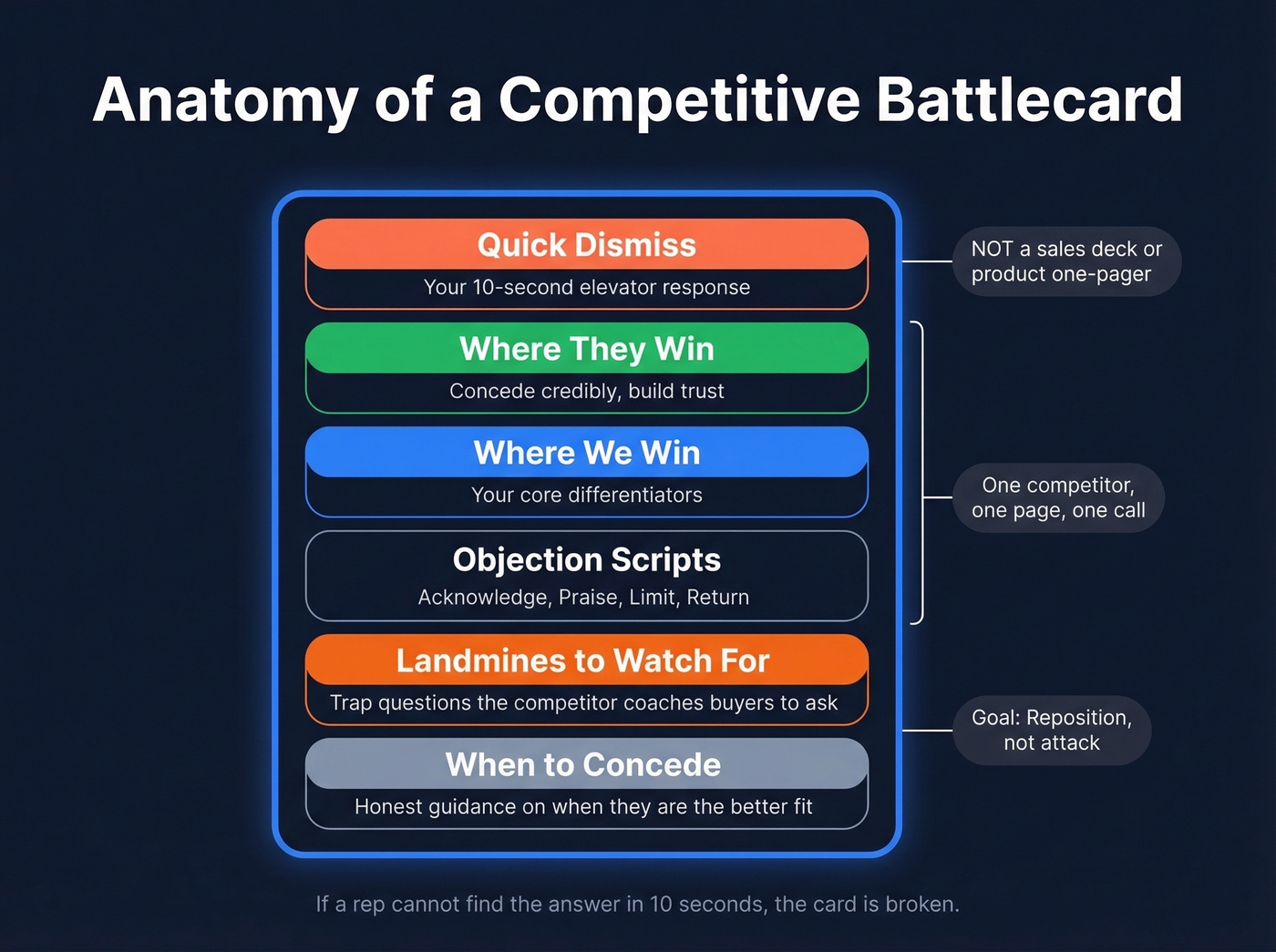
It's not a sales deck, a playbook, or a product one-pager. Those cover entire sales motions or product positioning. A battlecard is narrower - one competitor, one page, built for the moment a rep needs it most. Think of it as a repositioning tool, not an attack document. The goal isn't to trash the competitor; it's to shift the buyer's evaluation criteria toward your strengths.
The best ones read like cue cards, not encyclopedia entries. They answer three questions: What does the competitor do well? Where do we win? What should I say right now?
Why Battlecards Matter in 2026
The numbers are hard to argue with. Teams using structured battlecards win 23% more competitive deals, and among companies using them, 71% report improved win rates. But only 29% of reps feel they have adequate competitor information. That gap - between what reps need and what they actually have - is where deals die quietly.
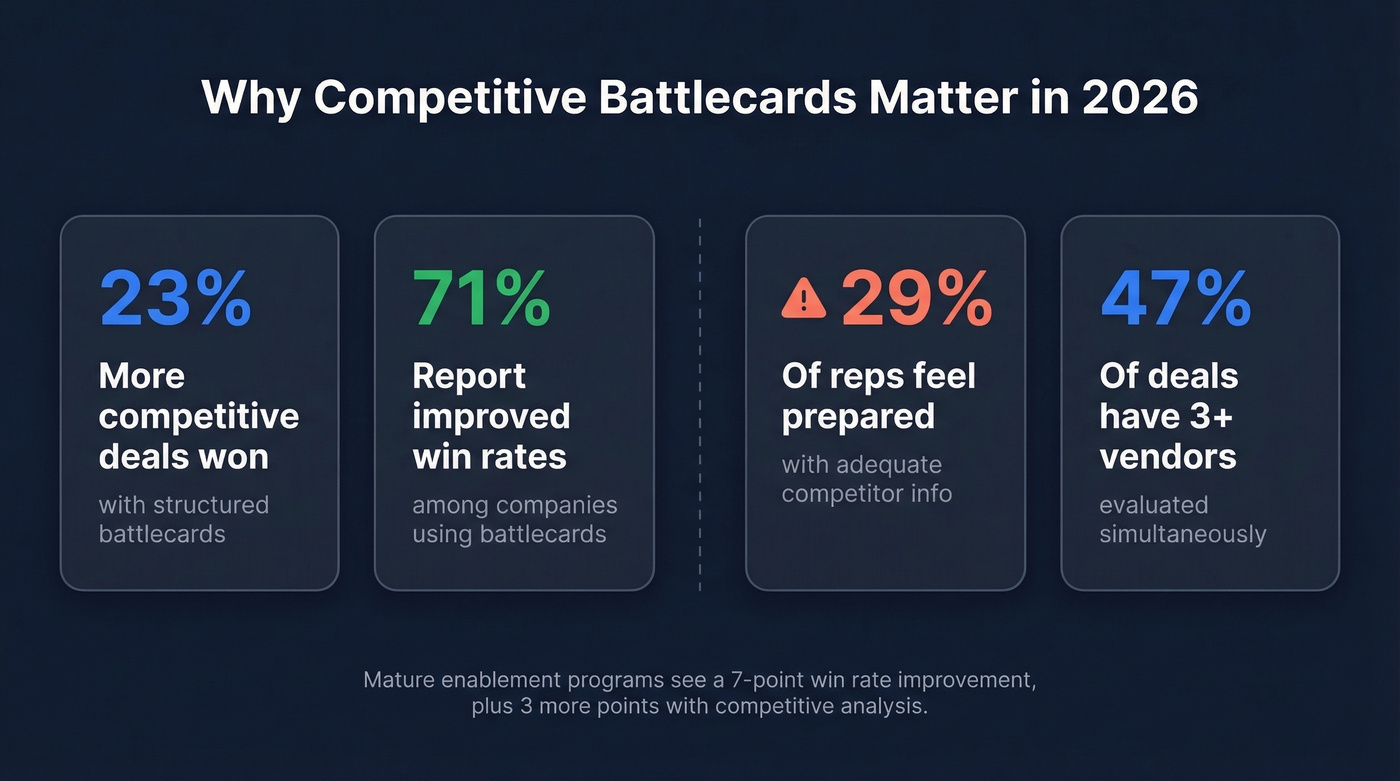
Multi-vendor evaluations are the norm now. 47% of deals involve three or more vendors evaluated simultaneously, which means your reps aren't just competing against one alternative; they're navigating evaluations where every conversation is a chance to differentiate or blend into the noise. Reps who can reposition confidently against two or three competitors in a single call close at significantly higher rates than those who wing it.
Mature enablement programs see a 7 percentage-point improvement in win rates, with an additional 3-point lift when enablement is involved specifically in competitive analysis. These aren't massive numbers in isolation, but compounded across hundreds of deals per quarter, they're worth millions in pipeline.
What to Include in Your Cards
The Product Marketing Alliance's canonical checklist covers the basics: competitor overview, pain points, key features, differentiators, objection scripts, discovery questions, pricing comparison, third-party validation, and customer wins. That's your foundation.
But the sections that separate useful cards from forgettable ones are the ones most teams skip:
- When to Concede. Every competitor does something well. Telling reps when to acknowledge a strength - and how to pivot - builds credibility with buyers. Pretending your product wins everywhere makes reps sound dishonest.
- Do Not Say. Specific phrases or claims that backfire. Your competitor just fixed a bug you've been using as a talking point? Reps need guardrails.
- Landmines. Trap-setting questions buyers ask that sound innocent but are designed to expose a weakness - questions the competitor's sales team coached the buyer to ask.
For objection handling, use the Acknowledge, Praise, Limit, Return framework (see more objection handling scripts). Acknowledge the competitor's strength, praise it briefly to disarm the buyer, limit its relevance to the buyer's specific situation, then return to your differentiator: "Yeah, [Competitor] has a solid integration with [tool]. It's well-built for teams that rely heavily on that workflow. Where most of our customers find it falls short is [specific gap]. What we've done instead is..."
Every section should be scannable - bullet points over paragraphs, bold headers over flowing prose. This gets read mid-call, not at a desk with coffee.
What Great Battlecards Look Like
Five Patterns From Real Cards
After reviewing Dock's curated library of 24 real battlecard examples, a few structural patterns stand out:
Persona anchoring. Cisco's battlecards frame every scenario around a single buyer persona. Instead of generic feature comparisons, the card reads like a conversation with a specific person - their priorities, their objections, their decision criteria. Reps can pattern-match to the person they're actually talking to (and tighten your B2B messaging around that persona).
Discovery coaching embedded. The best cards don't just tell reps what to say - they tell reps what to ask. Dell's ATTO 360 example includes explicit "Ask this / Listen for" sections that connect buyer answers to competitive positioning.
Buyer-question-led structure. Some cards organize entirely around the questions buyers ask, FAQ-style, which mirrors how reps think mid-call: "The prospect just asked about X - what do I say?"
Fear and risk openers. Leading with the buyer's anxiety rather than your features. "Your team is worried about migration downtime" hits harder than "Our migration tool is 3x faster."
Blunt comparison tables. Netskope's cards include micro case studies - short anonymized wins with company size, use case, and why they won - alongside checkmark-style comparison grids. Fast scanning, zero fluff.
A Filled Example
Here's what a completed "Why We Win" card looks like. Imagine you sell a project management tool and you're up against "TaskFlow."
Competitor: TaskFlow
Quick Dismiss (10 seconds): "TaskFlow is solid for small teams doing basic task tracking. Where customers come to us is when they need cross-department visibility and resource forecasting - TaskFlow doesn't do either natively."
Where They Win: Simple UI, fast onboarding, strong mobile app. Don't trash these - buyers like them.
Where We Win: Portfolio-level reporting, resource allocation, enterprise SSO, and API depth. TaskFlow requires third-party add-ons for all four.
Landmine: "Can your tool handle simple task boards?" - This is a setup. They're trying to make you sound over-engineered. Response: "Absolutely. We have a Kanban view that's just as clean. But we also scale to [use case they care about] without bolting on extra tools."
When to Concede: If the buyer has fewer than 15 users and no cross-team dependencies, TaskFlow is genuinely a good fit. Don't force it.
The whole thing takes about 8 seconds to scan. That's the standard.

Battlecards reposition deals - but only if the data behind your claims holds up. Prospeo gives your reps 98% email accuracy, 125M+ verified mobiles, and a 7-day refresh cycle so every stat on your card is current, not six weeks stale.
Arm your reps with data that survives the competitor call.
How to Create Competitive Battlecards
Prioritize Your Top 3-5 Competitors
Start with the competitors your reps actually encounter on calls, not the ones your CEO reads about in TechCrunch. Pull data from your CRM's "competitor mentioned" field, ask your AEs which names come up weekly, and check Gong or Chorus call recordings for frequency. We've seen teams waste weeks building cards for vendors reps never face - while ignoring the one that shows up in every other deal.
If you need a starting point, use a competitor battlecard template and customize from there.
Gather Field Intel
The best battlecard content comes from three sources: win/loss interviews with recent buyers, call recordings from competitive deals, and direct conversations with prospects who chose the competitor.
Here's the thing: your cards are only as good as the data feeding them. If win/loss interview emails bounce, you're building on secondhand intel. Upload a list of lost-deal contacts to Prospeo, get verified emails back, and start the conversations that produce real intel. With a 98% email accuracy rate and 7-day data refresh cycle, your outreach actually lands.
If you're running this as a repeatable motion, treat it like sales enablement: defined owners, distribution, and reinforcement.
Apply the Fact-Impact-Act Framework
For every competitive data point, run it through three filters. Fact: What does the competitor actually do? Impact: Why does that matter to the buyer? Act: What should the rep say or do? This framework, popularized by Klue's battlecard methodology, prevents the most common failure: cards full of facts that reps don't know how to use.
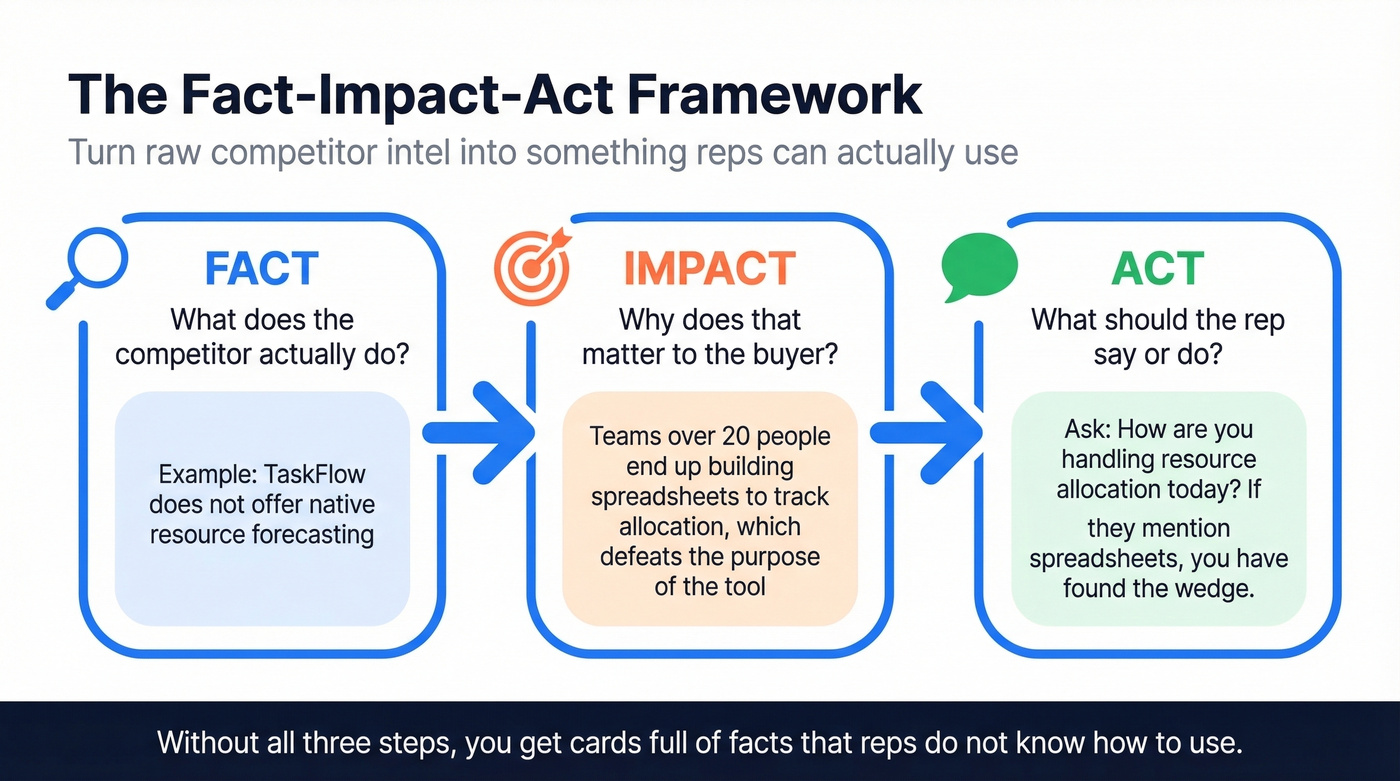
In practice, it looks like this. Fact: "TaskFlow doesn't offer native resource forecasting." Impact: "Teams over 20 people end up building spreadsheets to track allocation, which defeats the purpose of the tool." Act: "Ask: 'How are you handling resource allocation today?' If they mention spreadsheets, you've found the wedge."
Test the 10-Second Rule
Hand the draft to a rep. Ask them: "The prospect just mentioned [competitor]. Find what to say." If it takes more than 10 seconds, simplify. Cut paragraphs. Add bold headers. Move the talk track to the top.
This is also where a lightweight sales content library matters - if reps can’t find the card fast, they won’t use it.
Build a Battlecard in 15 Minutes with AI
A practitioner workflow shared on r/CustomerSuccess lays out a three-step process using Google Gemini:
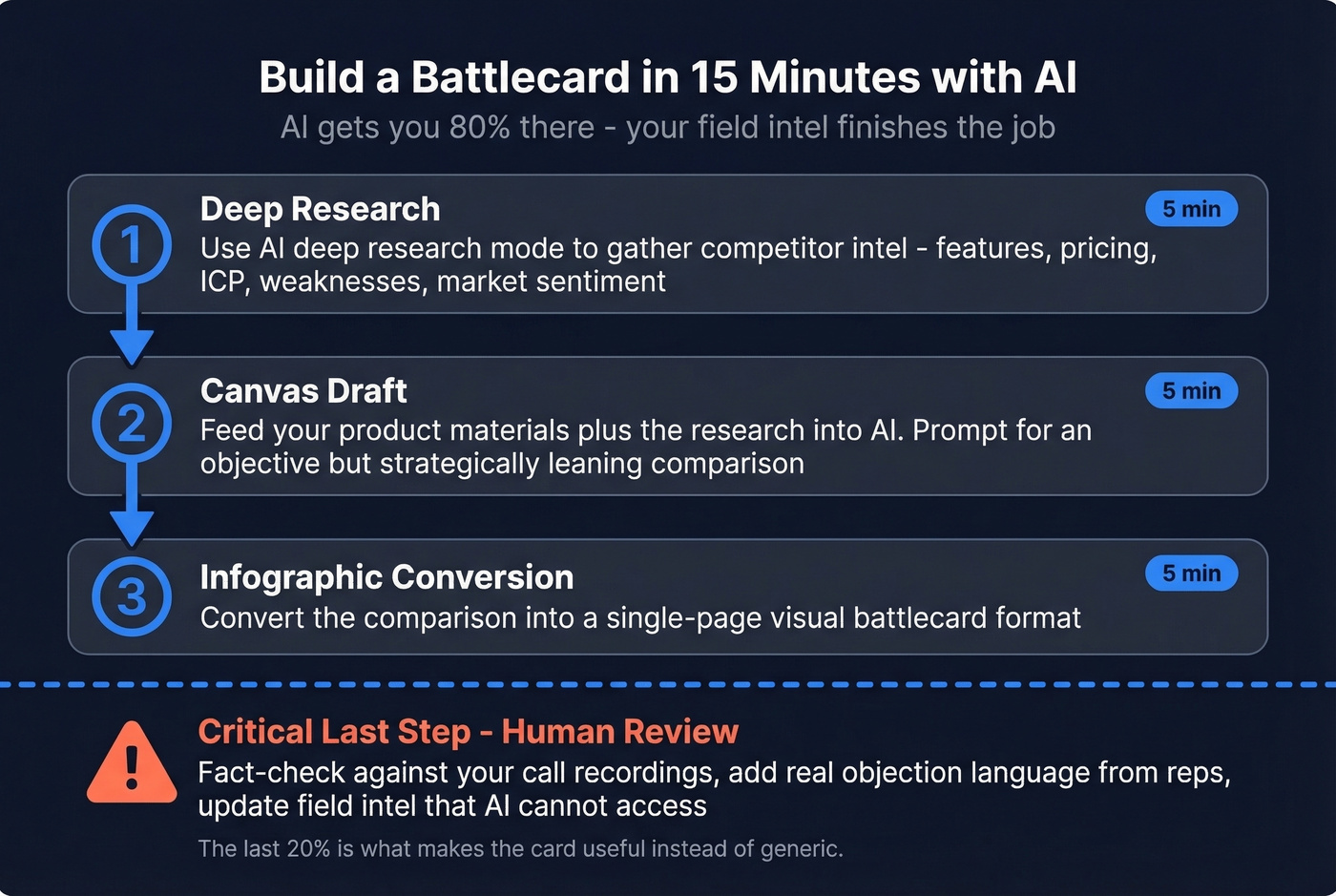
- Deep Research. Use Gemini's Deep Research mode to generate competitor intel across features, pricing, ideal customer profile, weaknesses, and market sentiment.
- Canvas draft. Feed your own product materials alongside the research into Gemini Canvas. Prompt it to produce an "objective but strategically leaning" comparison.
- Infographic conversion. Use Canvas's "Create Infographic" feature to turn the comparison into a single-page visual battlecard.
Here's a tool-agnostic prompt template you can use with any LLM (more how to use ChatGPT for sales workflows apply here too):
Compare [Your Product] vs [Competitor] across these dimensions: core features, pricing model, ideal customer, known weaknesses, and common objections. Format as a one-page battlecard with sections for Quick Dismiss, Objection Handling, Discovery Questions, and When to Concede.
Let's be honest: AI gets you 80% there. The last 20% - field intel from your reps, real objection language from call recordings, the nuances of how buyers actually phrase their concerns - is what makes the card useful instead of generic. Always fact-check AI output against your own call data before distributing.
Tools and Pricing for 2026
| Tool | Best For | Starting Price | Notes |
|---|---|---|---|
| Klue | Enterprise CI programs | ~$20K-$40K/yr | CRM/Slack distribution; acquired Ignition for AI win/loss analysis. G2: 4.7/5 |
| Crayon | Automated tracking | ~$15K-$47K/yr | AI + human analysts. G2: 4.6/5 |
| Playwise HQ | SMB/startup teams | Free (up to 5 users) / $250/mo | Battlecard-specific; fast setup |
| Kompyte | Mid-market CI | From $300/mo | Automated monitoring |
| Owler | Lightweight monitoring | Free / $35/mo Pro | News-focused supplement |
| Notion / Slides | DIY on a budget | Free | Manual updates; no automation |
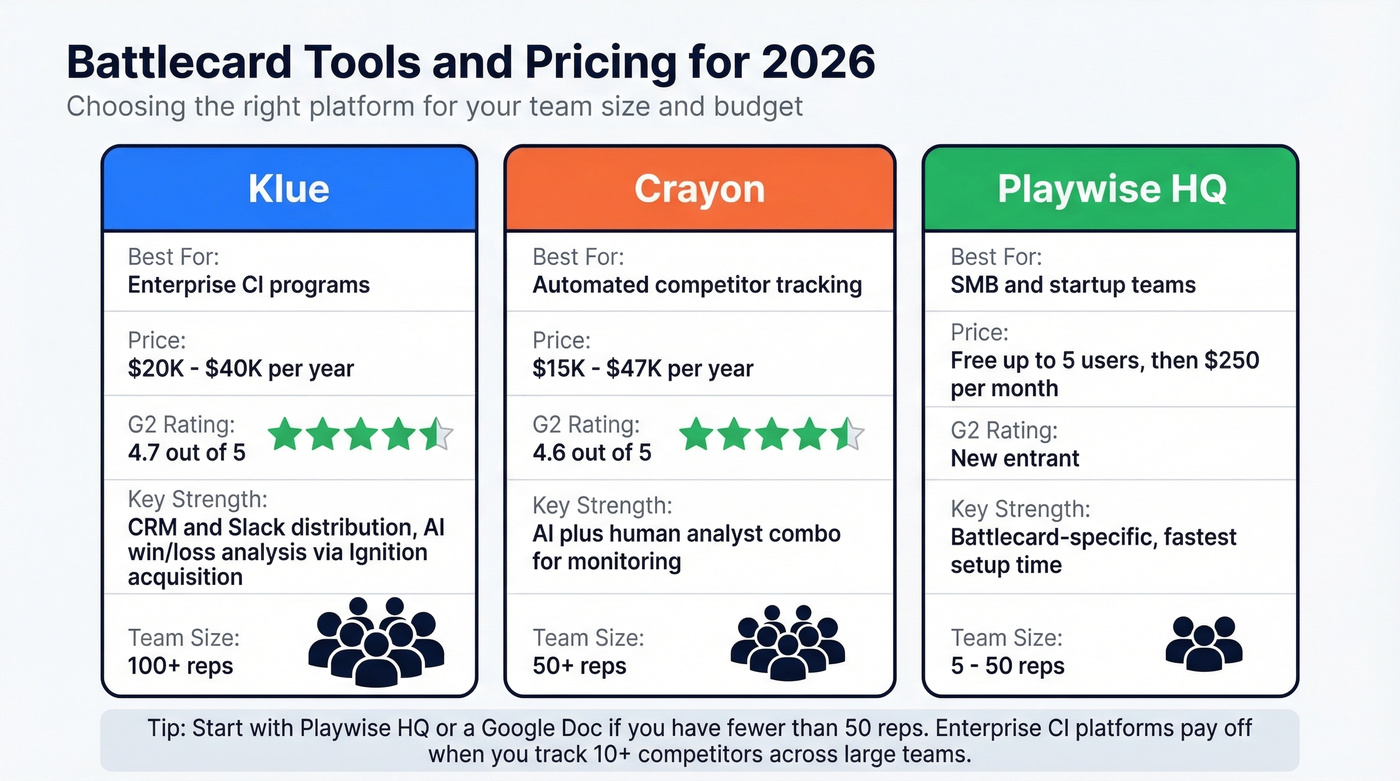
Klue and Crayon are excellent if you've got $20-40K/year and a dedicated competitive intelligence function. Most teams don't. Start with Playwise HQ's free tier or a Notion template - either gets you to a usable card fast. Graduate to enterprise CI when you have 5+ competitors and a full-time analyst.
If you’re evaluating options, compare against other competitive intelligence tools and sales readiness tools so you don’t buy overlap.
The frustrating part of this market? Klue and Crayon don't publish self-serve pricing. You'll talk to sales, sit through a demo, and get a quote that varies based on company size and scope.
I'll say it plainly: most teams overthink the tooling. A well-maintained Google Doc beats an abandoned $30K CI platform every time. The bottleneck is never software - it's whether someone owns the update cycle.
Your 'Why We Win' card is only as strong as the contacts it helps reps reach. With 300M+ profiles, 30+ filters including buyer intent and technographics, and $0.01/email, Prospeo turns competitive intel into booked meetings.
Win the battlecard moment and the deal that follows.
Why Most Battlecards Fail
They're Too Long and Buried
Only 30% of marketing-created content gets used by sales. Reps recreate existing content 40% of the time because they can't find it or don't trust it. If your card lives in a Google Drive folder three levels deep, it doesn't exist. One page max. Embed it in your CRM or push it to Slack where reps already work.
They Go Stale
A card with last quarter's pricing is worse than no card - it gives reps false confidence. Update your top 3 competitors every 30-60 days. Assign a named owner per competitor, not "the marketing team." Set trigger-based updates: competitor launches a feature, changes pricing, or you lose a deal you should've won.
No Training or Reinforcement
Teams spend dozens of hours building cards that almost nobody opens. Creation isn't the hard part - distribution and adoption are. Run role-play sessions where reps practice the talk tracks (use a sales coaching cadence, not a one-off). Have your top performer model how they use the card on a real call. Drip one insight per week in Slack. Make it impossible to ignore.
Scaling Your Program
Not every team needs the same card. Crayon's Modern Battlecard Blueprint lays out a four-stage maturity model:
- Universal. One card per competitor. Covers "why we win," objections, and landmines. Start here.
- Role-based. Separate cards for BDRs focused on quick dismiss, AEs with full objection handling, SEs with technical deep-dives, and CS for retention.
- Matrixed. Role + segment. An AE selling to mid-market healthcare gets a different card than one selling to enterprise fintech.
- Dynamic. Real-time updates delivered in Slack or embedded in Salesforce, updating automatically when competitor signals change.
At the role-based stage, you're building cards tailored to each function's needs - a BDR doesn't need the same depth on technical objections that an SE does. Skip straight to matrixed if you sell into wildly different verticals; for teams with a single ICP, role-based is plenty.
If you're planning to feed battlecards into AI copilots or internal LLMs, structure matters. Use consistent headers, write in clean modular sections, and use specific phrasing - "TaskFlow lacks native resource forecasting as of Q1 2026" parses better than "TaskFlow doesn't really do resource stuff well."
If you want a faster path to adoption, ship battlecards as part of a broader sales playbook instead of standalone docs.
Measuring Battlecard Impact
Track these five metrics (and align them to your broader sales operations KPIs):
- Usage rate. Target 30-60% of reps accessing cards monthly. Below 30%, you have an adoption problem, not a content problem.
- Win-rate delta. Compare competitive deal win rates before and after rollout. Healthy programs see a 3-10 percentage-point lift. Organizations using sales content tools rated "extremely effective" report a 9 percentage-point improvement.
- Rep NPS on competitive readiness. Survey quarterly. If reps still don't feel prepared, the cards aren't solving the right problems.
- Time-to-first-use. How quickly do reps open a new card after distribution? If it takes weeks, your distribution channel is wrong.
- Update freshness score. What percentage of your active cards were updated in the last 60 days?
The key variable isn't the tool - it's whether reps actually use what you build. A battlecard nobody opens is just a document; one they reference mid-call is a revenue lever.
FAQ
How long does it take to create a competitive battlecard?
A first-pass card takes 4-12 hours per competitor, with ongoing maintenance running 1-2 hours monthly. AI workflows can cut initial creation to under an hour, though you'll still need field validation from reps and recent call recordings.
How often should battlecards be updated?
Every 30-60 days for your top 3-5 competitors. Trigger immediate updates when a competitor changes pricing, launches a major feature, or you lose a deal you should've won. Stale cards erode rep trust fast.
What's the difference between a battlecard and a sales playbook?
A battlecard is a one-page, call-side reference for a single competitor. A playbook covers an entire sales motion across all scenarios - discovery, demo, negotiation. Battlecards live inside playbooks as modular components, not the other way around.
Do competitive battlecards actually improve win rates?
Yes - teams using structured battlecards win 23% more competitive deals, and 71% of companies report improved win rates after adoption. The key variable is whether reps actually open them; a card nobody uses has zero impact regardless of quality.
How do I get accurate contact data for win/loss interviews?
Use a verified data provider with high accuracy and fresh records. Prospeo offers 98% email accuracy on a 7-day refresh cycle with a free tier of 75 emails per month - enough to start win/loss outreach on deals closed in the last 90 days.