

B2B Messaging: How to Build a Strategy That Converts in 2026
The average B2B website converts 1.5% of visitors into leads. Top performers hit 8-15%. That's not a design gap or a traffic problem - it's a messaging problem. And it's costing your pipeline more than you think.
67% of B2B buyers now prefer a rep-free experience, according to Gartner's survey of 646 buyers conducted in August-September 2025. Even more telling: 45% of those buyers used AI tools during their most recent purchase to evaluate vendors, summarize options, and compare claims. Your messaging has to do the selling before a rep ever gets involved, and now it needs to be clear enough for both humans and AI summarization tools to parse. If it doesn't land in the first 30 seconds on a landing page, in the subject line of a cold email, or in the opening slide of a deck, you've already lost the deal to a competitor whose words were sharper.
Why Sales Messaging Is a Revenue Problem
Most teams treat messaging as a marketing exercise - something you workshop once, drop into a Google Doc, and forget. That's backwards.
Messaging is the single highest-leverage revenue input you have because it touches every conversion point in your funnel. Consider the math: if your visitor-to-lead conversion sits at the B2B SaaS median of 1.5-3.0% (see B2B SaaS median), and top-quartile companies hit 8-15%, the difference isn't better ads or more traffic. It's that top performers say something that makes prospects stop scrolling and start clicking. A 2x improvement in messaging clarity can compress sales cycles, lift demo request rates, and reduce the "let me think about it" stalls that kill pipeline velocity.
Gartner's research connects decision confidence to deal quality: confident buyers are twice as likely to report a high-quality deal compared with buyers who have low decision confidence. Clear B2B messaging creates confident buyers. Confused messaging creates stalled deals.
Buyers are doing more of the evaluation without you. They spend only 17% of their buying time meeting with potential suppliers. The rest? Reading your website, scanning your emails, comparing you against two or three alternatives - all based on what you wrote, not what your AE said on a call.
Short on Time? Here's the Framework
If you've got five minutes, here's what separates high-converting messaging from generic noise:
- Start with positioning, not copy. If your team can't agree on what makes you different and who you're for, no amount of wordsmithing fixes conversion rates. Align internally first (use an Ideal Customer Profile to force clarity).
- Build messaging from customer language. Run 8-12 VoC interviews, mine sales call recordings, and frequency-sort the phrases your buyers actually use. Then steal those phrases for your copy.
- Write for 11 stakeholders, not one. The average B2B buying committee has 10-11 people. Your messaging needs role-specific branches - the CFO doesn't care about the same things as the end user.
The sections below break each of these down with frameworks, templates, and the benchmarks top teams measure against.
What B2B Messaging Actually Is
Let's clear up a confusion that wastes a lot of internal meetings. Messaging, copywriting, branding, and positioning are four different things - and together they form your messaging architecture (and should ladder up to your B2B brand positioning).
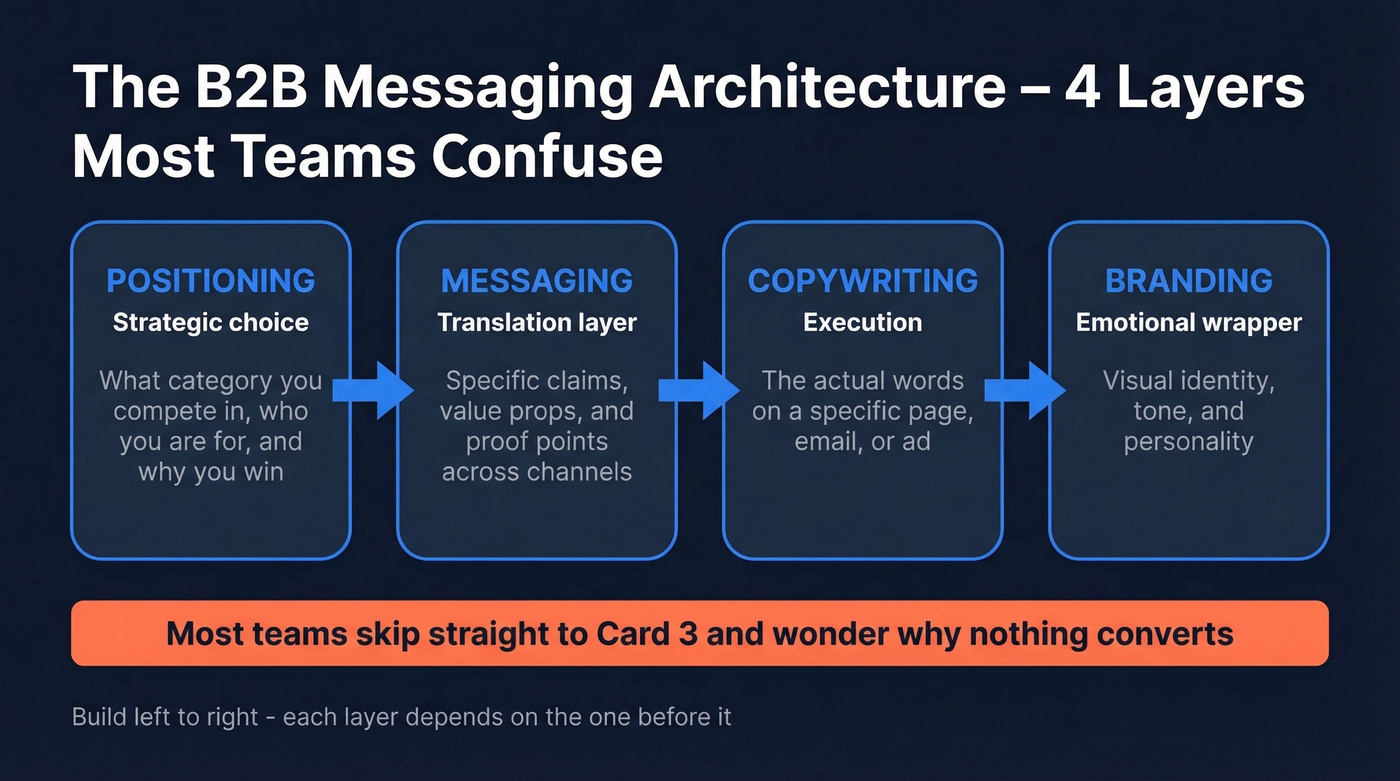
Positioning is the strategic choice: what category you compete in, who you're for, and why you win. Messaging is the translation layer - the specific claims, value props, and proof points you'll use across channels. Copywriting is the execution: the actual words on a specific page or email (see email copywriting for channel-specific examples). Branding is the emotional wrapper - visual identity, tone, personality.
Most teams skip straight to copywriting and wonder why nothing converts. They're writing headlines without knowing what the headline should say.
Here's the thing about B2B buyers: they aren't robots. The idea that business buyers make purely rational decisions is a myth that won't die. They're humans with careers on the line. Fear of making the wrong choice, desire for peer recognition, frustration with the status quo - these emotional forces drive purchases just as much as ROI calculators do. Your go-to-market messaging should acknowledge both.
Start with Positioning, Not Copy
Most messaging problems aren't messaging problems. They're positioning problems wearing a messaging costume.
We call it "positioning fog." The founder talks about the product in investor language - TAM, disruption, category creation. Sales talks in prospect pain - "you're wasting 10 hours a week on manual data entry." Marketing writes feature headlines - "AI-powered automation platform." Product describes capabilities. Four teams, four different stories, zero alignment. The prospect hears all four and gets confused.
A confused prospect never buys.
The fix is deceptively simple: get everyone in a room and align on positioning before anyone writes a single line of copy. The enemy isn't your competitor - it's the status quo. Your prospect's current way of doing things is the real obstacle, and your positioning should make the status quo feel unacceptable.
The 90-Minute Positioning Workshop
Block 90 minutes with founders, sales leads, and marketing. Walk out with a single doc that answers four questions:
- What are our real differentiators - not features, but things competitors can't easily copy?
- Why do those differentiators matter to the buyer?
- What customer value do they create, in the buyer's words, not yours?
- Which segments care most about this value?
This becomes your messaging foundation. Every headline, email, and deck should trace back to it.
If your team can't fill in those four boxes with confidence, you don't have a messaging problem. You have a strategy problem. Fix that first.
Three Frameworks That Produce Results
There's no shortage of messaging frameworks. Most are academic. These three actually produce usable output.
Wynter's Message Layers
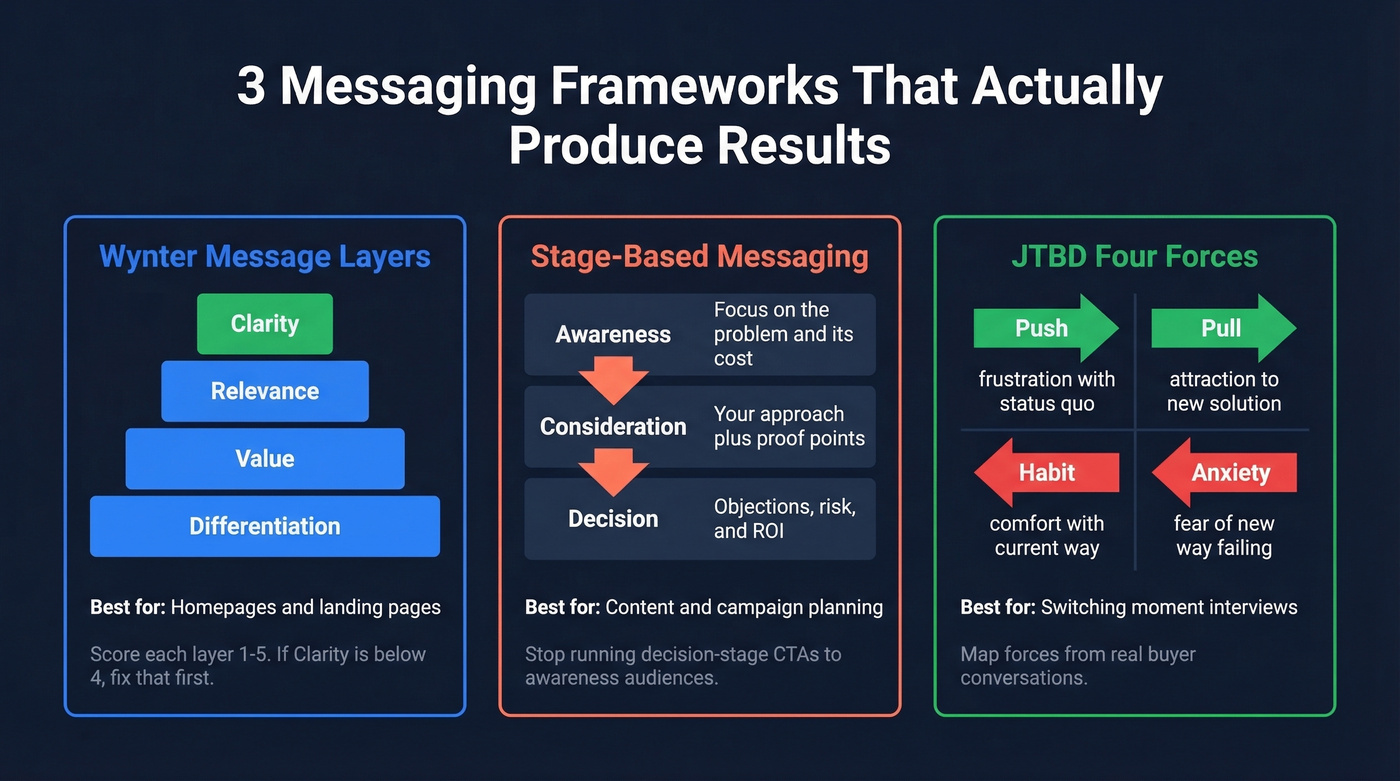
Wynter's framework breaks messaging into four sequential layers: Clarity, Relevance, Value, and Differentiation. You build them in order because each layer depends on the one before it. If prospects don't understand what you do, they'll never evaluate whether it's relevant to them.
The practical move: score each layer on a 1-5 scale during message testing. If Clarity scores below 4, don't bother optimizing your value prop - fix the basics first. This framework works best for homepage and landing page messaging where you need to convert cold traffic in seconds. The underlying principle is simple: strip away complexity until the core value is immediately obvious.
Stage-Based Messaging
Different funnel stages need different message weight. Awareness-stage messaging should focus on the problem and its cost - not your product. Consideration-stage messaging introduces your approach and proof points. Decision-stage messaging handles objections, risk, and ROI.
The mistake most teams make is running decision-stage messaging ("Book a demo! See pricing!") to awareness-stage audiences. Map each asset to a stage, and you'll stop wondering why your top-of-funnel content doesn't convert (this is easier when you have a defined B2B sales funnel).
JTBD Four Forces
Jobs-To-Be-Done captures the switching moment - the instant a buyer decides to move from their current solution to something new. Four forces are at play: Push (frustration with the status quo), Pull (attraction to the new solution), Habit (comfort with the current way), and Anxiety (fear of the new way failing).
A common practitioner critique is that traditional personas become "static" documents that collect dust. JTBD is the antidote. Interview buyers about their switching moment, map the four forces, and you'll know exactly which levers your messaging needs to pull.

You just learned that B2B buying committees average 11 stakeholders. Now you need verified contact data for every one of them. Prospeo gives you 300M+ profiles with 30+ filters - role, seniority, intent, technographics - so your perfectly crafted messaging actually reaches the right people at 98% email accuracy.
Great messaging deserves great data. Start finding decision-makers for free.
Your Messaging Has 11 Audiences
Most B2B messaging targets a fictional person called "the decision maker." That person doesn't exist.
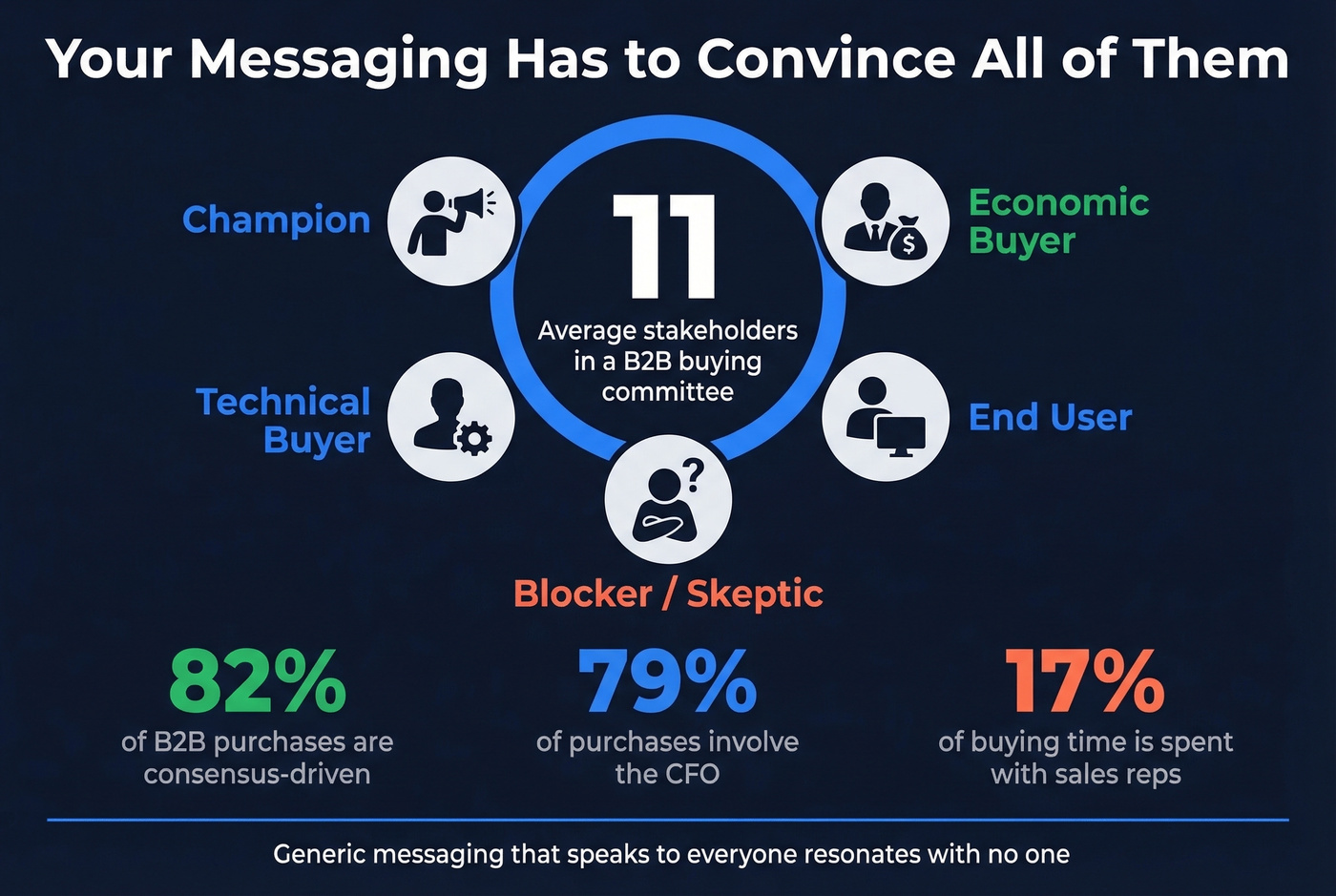
The average B2B buying committee includes 10-11 stakeholders. Enterprise deals can involve 15. CFOs participate in 79% of purchase decisions, and 82% of B2B purchases are consensus-driven. Your messaging can't just convince one person - it needs to arm your champion with the right ammunition for every other person in the room.
| Role | What They Care About | Content They Need |
|---|---|---|
| Champion | Peer validation, ease of adoption | Use cases, peer stories |
| Economic Buyer | ROI, total cost, payback | ROI calculators, TCO analysis |
| Technical Buyer | Security, integration, architecture | Tech docs, security papers |
| End User | Daily workflow, learning curve | Walkthroughs, before/after |
| Blocker/Skeptic | Risk, vendor stability | Third-party reviews, risk assessments |
Before any campaign, map the buying committee for your target accounts. Build role-specific messaging tracks - this is where personalization becomes essential (see personalized outreach), because a generic pitch that tries to speak to everyone ends up resonating with no one. Stagger outreach over 2-3 weeks so different stakeholders receive different proof points, and measure engagement at the account level, not the individual level. This is how ABM-focused teams approach buying committees, and it works because it mirrors how decisions actually get made.
Build Messaging from Customer Language
The best messaging doesn't come from brainstorms. It comes from your customers' mouths.
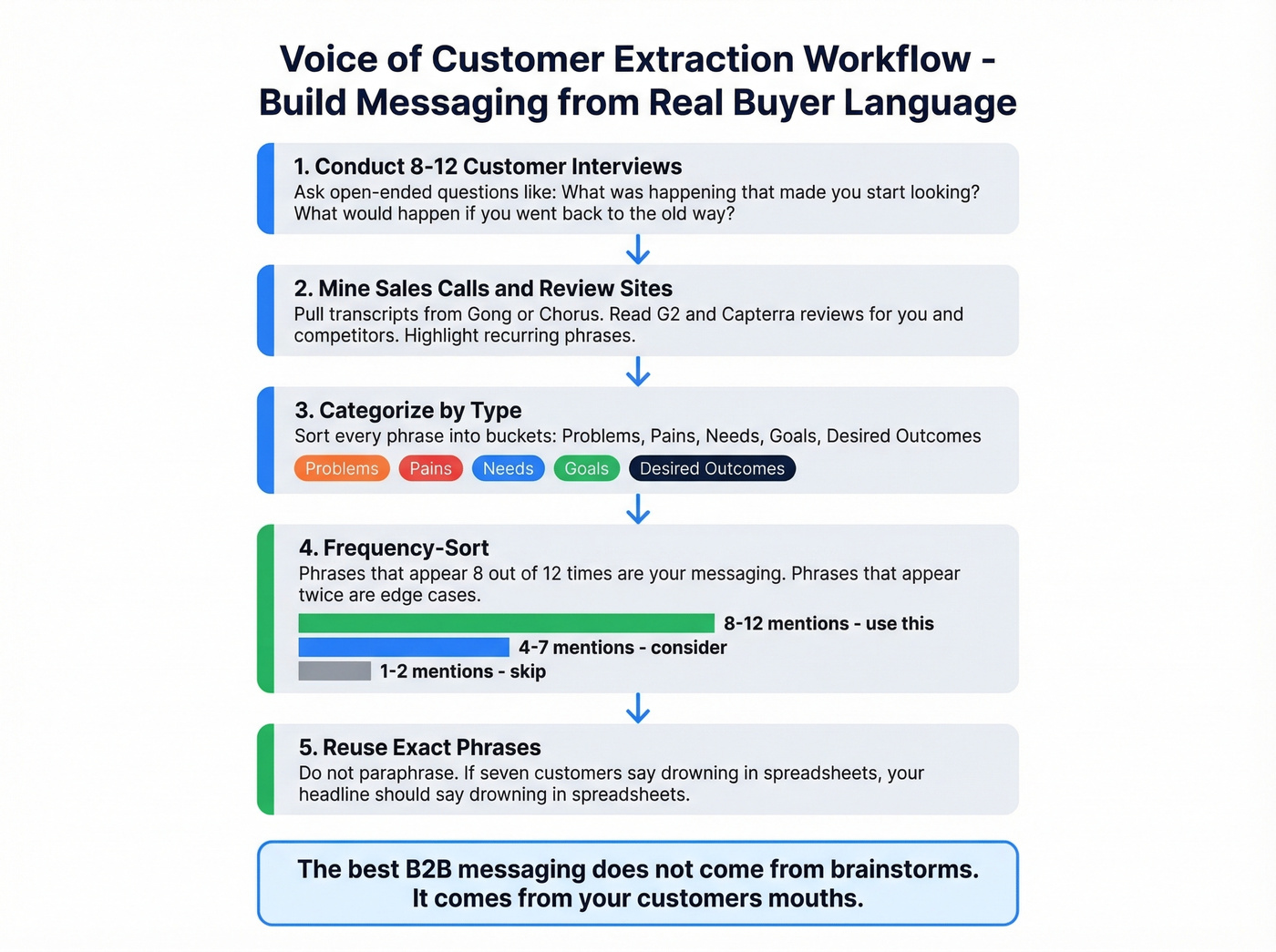
Here's the VoC extraction workflow that practitioners on r/b2bmarketing swear by:
- Conduct 8-12 customer interviews. Ask open-ended questions: "What was happening in your business that made you start looking for a solution?" and "What would happen if you went back to the old way?"
- Mine sales call recordings and review sites. Pull transcripts from Gong or Chorus. Read G2 and Capterra reviews - yours and your competitors'. Highlight recurring phrases.
- Categorize by type. Sort every phrase into buckets: problems, pains, needs, goals, desired outcomes.
- Frequency-sort. The phrases that show up 8 out of 12 times are your messaging. The ones that show up twice are edge cases.
- Reuse exact phrases. Don't paraphrase. If seven customers say "I was drowning in spreadsheets," your headline should reference drowning in spreadsheets - not "streamline your workflow."
This is where personas fail. A persona says "VP of Marketing, 35-45, cares about pipeline." That's a demographic sketch, not a messaging input. The VoC workflow gives you the actual words that make prospects think "this company gets me." That emotional recognition is what converts - and it's the foundation of crafting a sales message that feels authentic rather than manufactured.
Seven Mistakes That Kill Conversion
1. Leading with features, not outcomes. "AI-powered analytics dashboard" tells me what you built. "Cut reporting time from 4 hours to 15 minutes" tells me why I should care.
Before: "AI-powered analytics dashboard for modern teams." After: "Cut reporting time from 4 hours to 15 minutes - without writing a single formula."
The first version describes the product. The second describes the buyer's life after using it.
2. Generic buzzwords. "Innovative. Scalable. Customer-centric." These words mean nothing because every company uses them. Replace with specific, provable claims. "We process 2M records per second" beats "lightning-fast performance" every time.
3. Buyer journey mismatch. Running "Book a demo" ads to people who don't know they have a problem yet. Map every asset to a funnel stage.
4. Jargon overload. If your prospect needs a glossary to understand your homepage, you've failed the Clarity layer. Read your copy aloud. If it sounds like a press release, rewrite it. The goal is simplification until a new hire can explain your value prop after reading your homepage once.
5. Messaging not anchored in positioning. Copy that sounds good but doesn't connect to a strategic differentiator. Every claim should trace back to your positioning doc.
6. Inconsistent messaging across channels. Your website says one thing, your SDR emails say another, your sales deck says a third. This is messaging drift - silent, cumulative, and deadly to conversion rates. Single source of truth, reviewed quarterly.
7. Skipping testing entirely. You wouldn't ship code without QA. Don't ship messaging without testing it against real buyers. Even informal testing works - ask your AEs which phrases prospects repeat back on calls. Those phrases are your messaging winners.
How to Test and Measure
You can't improve what you don't measure. Here are three tools worth considering for message testing, plus the KPIs that actually matter.
| Tool | Best For | Speed | Approx. Pricing |
|---|---|---|---|
| Wynter | ICP-matched buyer panels | ~48 hours | ~$200-2,000+/mo |
| UserTesting | Video-based qualitative depth | 1-3 days | ~$10K+/yr enterprise |
| Maze | Rapid prototype validation | Hours | Free tier; ~$99+/mo |
If you're testing for the first time, start with Wynter - it's purpose-built for B2B and returns results in 48 hours. Write 3 variations of your homepage headline, recruit 15-20 ICP-matched panelists, and score each variation on Clarity, Relevance, and Differentiation using a 1-5 scale. The winner becomes your control; test again in 6 months.
Beyond testing tools, track these KPIs: conversion rate by page and channel, time-on-page for key landing pages, demo request volume, and sales cycle length (tie this back to your funnel metrics). Build a feedback loop where sales call recordings feed messaging updates, which get re-tested, which feed back into sales enablement. Without this loop, messaging drift is inevitable.
If you're running outbound email, the average B2B open rate sits around 21.3% - but a well-crafted welcome series can exceed 60%. If your cold outbound is below 15% open rate, the problem is likely your subject line or your data quality (use these cold email subject line examples to pressure-test yours).
The Data Quality Gap Nobody Talks About
Look, we've seen this play out dozens of times: most "messaging problems" in outbound aren't messaging problems at all. They're delivery problems.
Your SDR team just sent 2,000 cold emails with messaging your marketing team spent weeks perfecting. Open rate: 4%. Reply rate: 0.2%. The problem isn't the copy - 800 of those emails bounced and 500 went to people who left the company six months ago.
This is the messaging delivery gap that every strategy article ignores. You can nail your positioning, build role-specific messaging tracks, and test every headline - but if your contact data is stale, none of it matters. Even hyper-personalized outreach falls flat when it lands in a dead inbox (see email bounce rate benchmarks and fixes).

The numbers back this up. When Snyk's 50-person AE team was dealing with 35-40% bounce rates, they switched to Prospeo and dropped that to under 5% - AE-sourced pipeline jumped 180%, generating 200+ new opportunities per month. That's not a messaging improvement. That's the same messaging finally reaching real inboxes. With 98% email accuracy and a 7-day data refresh cycle, Prospeo ensures your carefully crafted outbound sequences actually land where they're supposed to (and it helps to follow a full email deliverability guide alongside verification).
Nail the positioning, build from customer language, write for the full buying committee, test relentlessly, and make sure your data is clean. That's the complete B2B messaging stack for 2026.
Buyers spend 83% of their journey without talking to your reps. That means your cold emails carry your entire messaging strategy. One bounce kills deliverability and credibility. Prospeo's 5-step verification and 7-day data refresh keep bounce rates under 4% - so every word you write actually lands.
Stop perfecting emails that bounce. Start with data that delivers.
FAQ
What's the difference between B2B messaging and copywriting?
Messaging is the strategic layer - what you say, to whom, and why it matters. Copywriting is the execution: the actual words on a specific page or email. Messaging comes first and acts as the brief; copy follows. Getting this order wrong is why most B2B websites sound generic.
How often should you update your messaging strategy?
Revisit messaging quarterly or whenever you enter a new market, launch a major feature, or see conversion rates drop by more than 15%. Run message tests with a tool like Wynter at least twice a year to catch drift before it compounds.
How do you make sure outbound messaging reaches verified contacts?
Start with a data provider that refreshes weekly - if your bounce rate exceeds 5%, even perfect copy is wasted. Prospeo's 98% email accuracy and 7-day refresh cycle keep deliverability above 95%, while many competitors refresh every 4-6 weeks. Pair clean data with role-specific messaging tracks for measurable reply-rate lifts.
What does hyper-targeted messaging look like in practice?
It means tailoring the value proposition, proof points, and problem statement to a specific role at a specific company. An email to a CFO at a 200-person SaaS company should reference payback period and cost per seat - not feature lists. This level of personalization requires clean contact data, buying committee mapping, and stage-appropriate content working together.
How do you simplify a sales message without losing nuance?
Focus on one outcome per touchpoint. Lead with the single biggest result your buyer cares about, support it with one proof point, and save the rest for follow-up. If your prospect can't repeat your value prop from memory after one read, it's too complex.