

How to Create a Sales Playbook Reps Will Actually Open
60% of employees never read their company handbook](https://www.waybook.com/blog/7-common-business-playbooks-mistakes-and-how-to-fix-them). That stat alone should make you rethink how you're building internal documentation. Meanwhile, 69% of reps missed quota last year, buying committees have ballooned to 25 stakeholders, and average deal cycles now stretch to 6.5 months. Reps who rate their sales training as highly effective win 11 percentage points more deals - but a playbook is the training that stays open after the workshop ends.
Here's how to build one your team will actually use.
The 5-Card Quick Start
Short on time? Ship these five cards and iterate later:
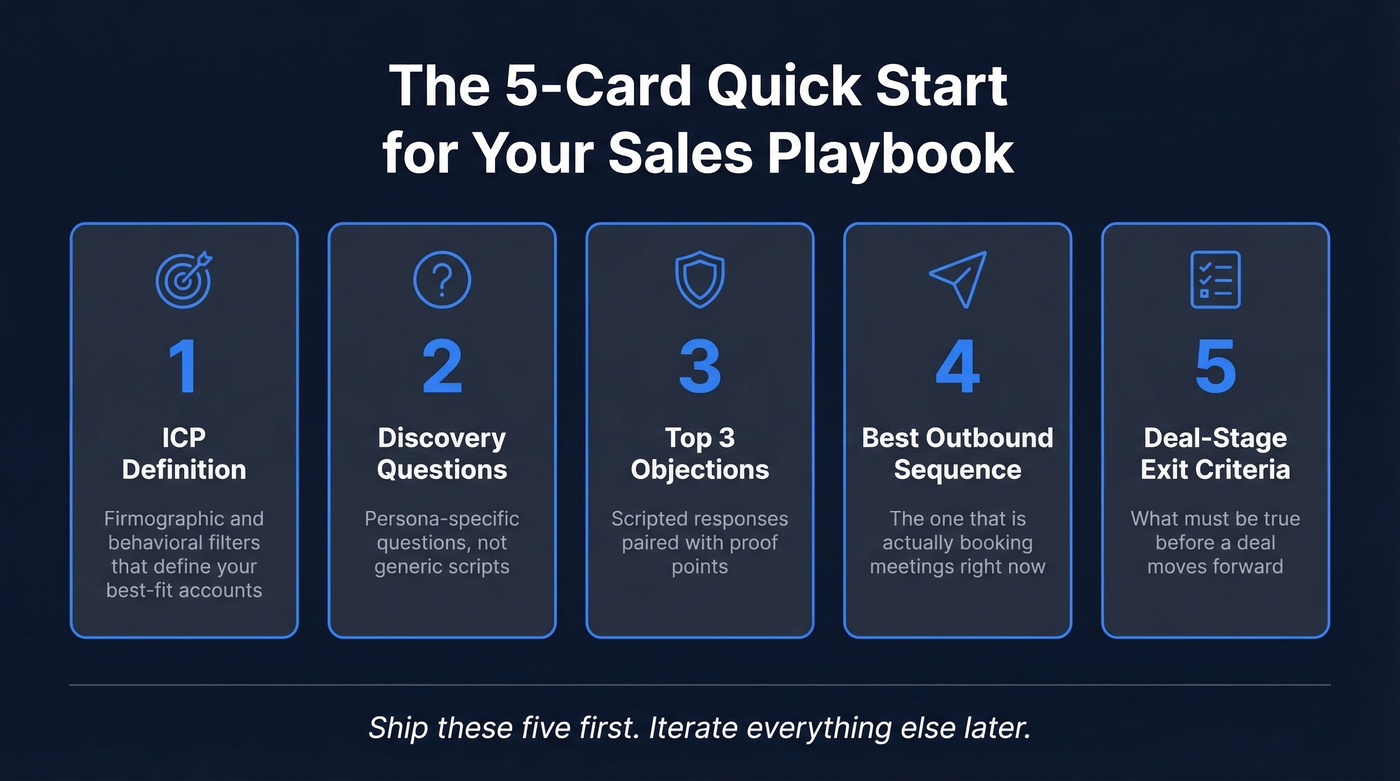
- ICP definition - firmographic and behavioral filters
- Discovery questions - by persona, not generic
- Top 3 objections - scripted responses with proof points
- Best outbound sequence - the one actually booking meetings
- Deal-stage exit criteria - what must be true before a deal advances
That's a playbook outline you can build on. Everything else is a nice-to-have until those five are solid. We've seen teams ship their first version in under a week using just these cards, and honestly, some never need much more than that.
What a Sales Playbook Actually Is
A sales team playbook is a collection of individual plays reps can pull up before a call. Some teams structure those plays as one-page reference cards so they're usable mid-deal.
Some guides recommend 50-80 pages. That's a compliance document, not a tool.
The goal is covering roughly 80% of your team's common sales motions. If a play doesn't map to something reps do weekly, it doesn't belong in v1.
Core Components
Build your playbook in modules. Each one stands alone. These are the components that separate a useful reference from shelfware.
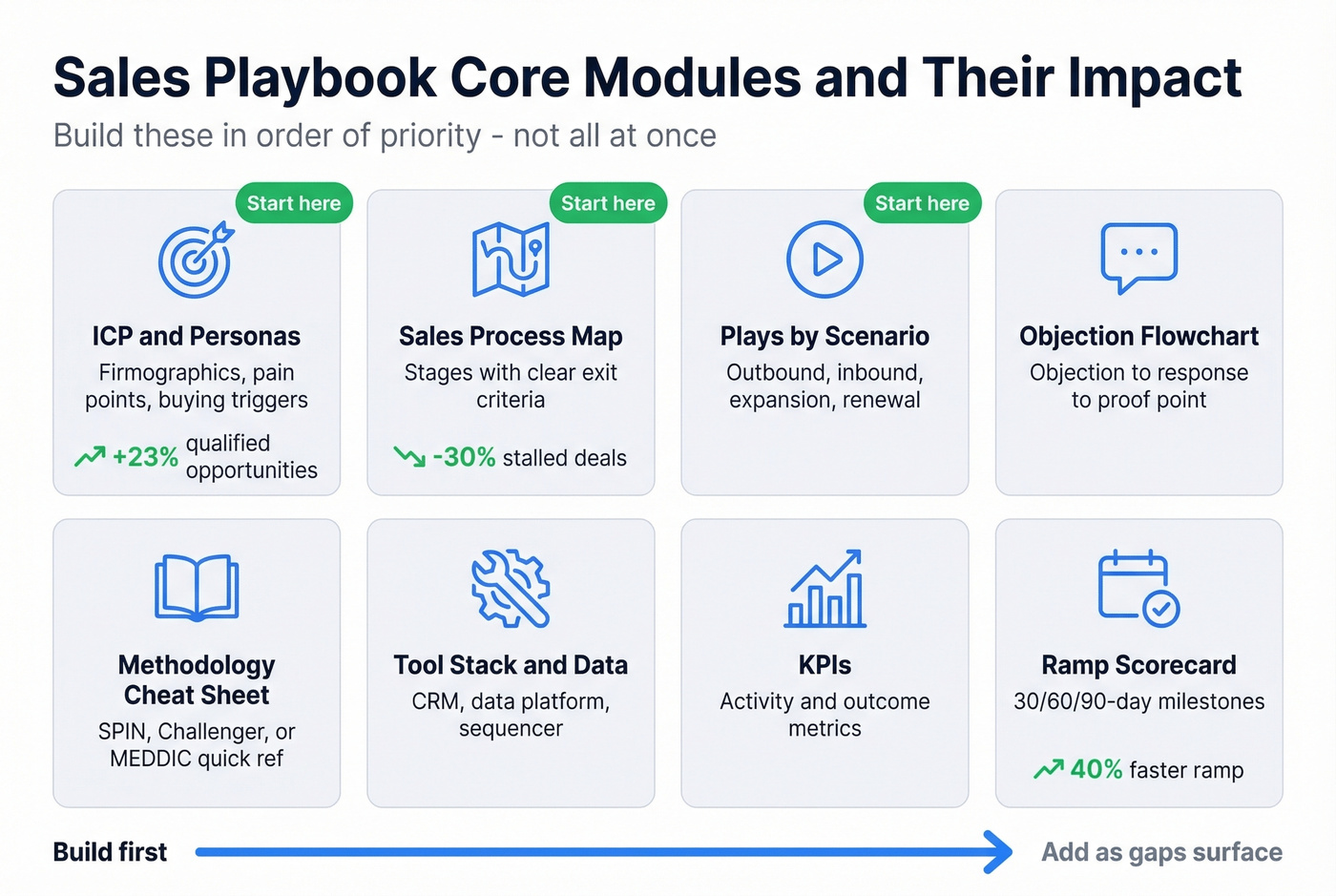
| Module | What It Contains | Why It Matters |
|---|---|---|
| ICP & Personas | Firmographics, pain points, buying triggers | A strong ICP section can drive a 23% increase in qualified opportunities |
| Sales Process Map | Stages with exit criteria | Stage checklists can cut stalled deals by 30% |
| Plays by Scenario | Outbound, inbound, expansion, renewal | Covers the 80% rule |
| Objection Flowchart | Objection → response → proof point | Reps stop freezing |
| Methodology Cheat Sheet | SPIN/Challenger/MEDDIC quick ref | Consistent language across the team |
| Tool Stack & Data Sources | CRM, data platform, sequencer | Reduces 10-tool chaos |
| KPIs | Activity and outcome metrics | Ties plays to pipeline |
| Ramp Scorecard | 30/60/90-day milestones | Can drive 40% faster time to first quote |
Don't build all eight at once. Start with ICP, process map, and two or three plays. Add modules as gaps surface in deal reviews.
How to Build It in 6 Steps
1. Assemble a cross-functional team. Sales, marketing, product, and CS. Playbooks built by one person reflect one person's blind spots. We learned this the hard way - our first internal playbook was written entirely by marketing, and the sales team ignored it for three months.
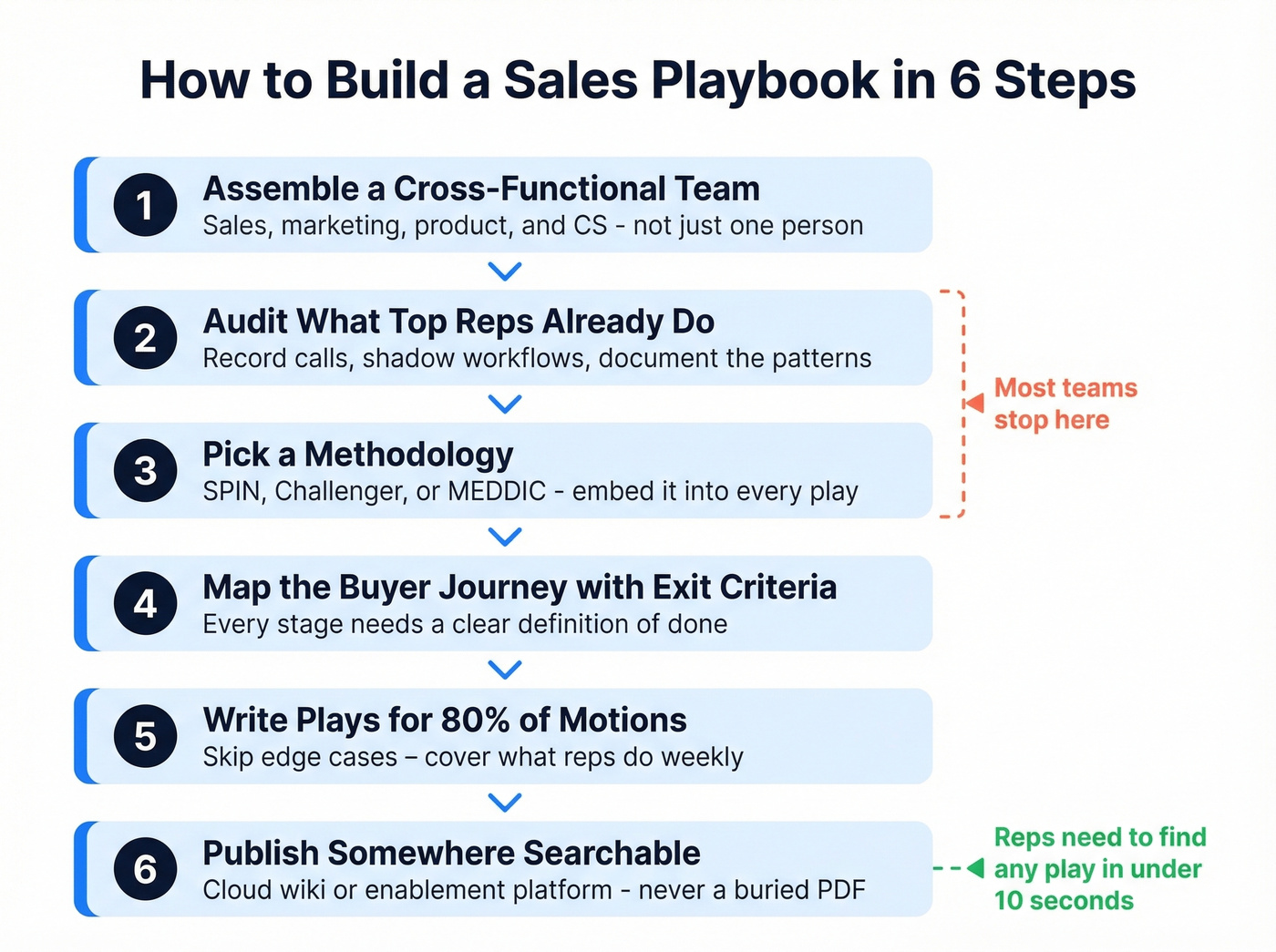
2. Audit what top reps already do. Your best reps have a playbook - it's just in their heads. Record their calls, shadow their workflows, document the patterns. This is the fastest shortcut to building something that reflects reality rather than theory, and it gives you credibility with the rest of the team because the content comes from peers, not management.
3. Pick a methodology. SPIN Selling was built from 35,000+ sales calls across 20+ countries over 12 years. Challenger is based on research with 6,000+ reps. MEDDIC works best for enterprise deals with complex buying committees. Pick one, embed it into your discovery and qualification plays, and stop letting reps freelance.
4. Map the buyer's journey with exit criteria. Every stage needs a clear definition of "done." If a rep can't articulate what changed between Stage 2 and Stage 3, the deal isn't aging - it's rotting.
5. Write plays for 80% of motions. The Alexander Group's research is clear: focused playbooks covering key motions improve productivity by up to 15%. Don't document every edge case. You'll never finish, and nobody will read it anyway.
6. Publish it somewhere searchable. A cloud-based wiki or enablement platform - not a PDF buried in Google Drive. If reps can't find the play in under 10 seconds, they won't use it.

Your outbound play is only as good as the data behind it. Prospeo gives reps 300M+ profiles with 30+ filters - intent signals, tech stack, job changes, headcount growth - so the target list in Step 1 is accurate on Monday morning and still accurate on Friday. 98% email accuracy means reps execute the play instead of bouncing into spam folders.
Stop writing plays your reps can't execute because the data is stale.
Example: A Filled-In Outbound Play
Here's what a real play looks like when it's complete enough to hand a rep on day one:
- Trigger: New VP of Sales hired at a target account (job change signal)
- Audience: Series A-C SaaS companies, 50-500 employees, using Outreach or Salesloft
- Goal: Book 10-15 qualified demos per month
- Step 1 - Build the target list: Pull accounts matching your ICP from a B2B database with filters for industry, headcount, tech stack, and intent signals. Refresh weekly so the list is current when reps open it Monday morning.
- Step 2 - Qualify before the call: Add two mandatory questions to your booking form. One practitioner reported this eliminated 90% of bad-fit calls.
- Step 3 - Run a 14-day multi-touch sequence: 3 emails, 2 calls, 1 video message. Lead with the outcome, not the product.
- Assets: 2 email templates, 1 case study PDF, 1 video testimonial link
- KPIs: Reply rate >8%, booking rate >3%, qualified demo rate >60% of bookings

Three Mistakes That Kill Playbooks
Too broad. The "boil the ocean" binder covering every scenario. Nobody reads it. Scope to the 80% of motions that drive revenue, and skip this approach if you're tempted to be thorough at the expense of usability.
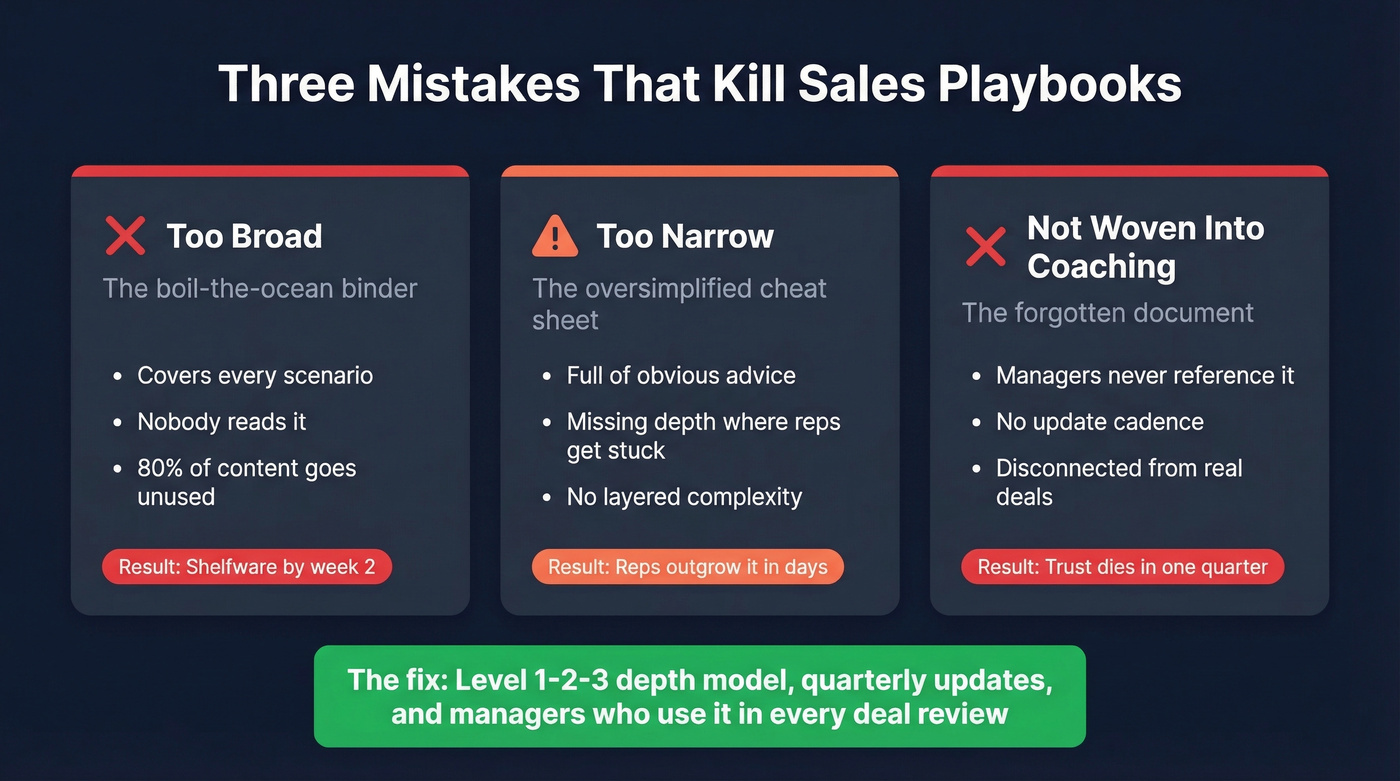
Too narrow. The oversimplified version full of "duh moments." Use a Level 1-2-3 depth model: Level 1 covers stages, Level 2 covers key activities, Level 3 goes deep on complex scenarios. Build Levels 1-2 broadly, reserve Level 3 for where reps actually get stuck.
Not woven into coaching. In our experience, this is where 80% of playbooks die. If managers don't reference the playbook during pre-call planning and post-call reviews, it becomes shelfware within a month. No update cadence makes it worse - a playbook that's accurate for one quarter and stale for three is a trust killer. The consensus on r/sales echoes this constantly: reps don't ignore playbooks because they're lazy, they ignore them because the content is outdated or disconnected from how deals actually close.
Rules of Engagement
Every sales team playbook needs a section on rules of engagement - the non-negotiables that prevent internal chaos. Territory ownership, lead routing, account overlap, when a rep must hand off or collaborate. Without clear rules, two reps chasing the same account erodes trust with the buyer and inside the team. Define them early, enforce them consistently, and revisit them when territories or segments change.
Choosing Your Tool Stack
Reps spend only 30% of their time actually selling and juggle an average of 10 tools. Teams using sales enablement tools are 19% more likely to see win-rate increases year over year. Here's the stack that matters:
| Category | Tool | Approx. Pricing |
|---|---|---|
| CRM | Salesforce / HubSpot | From ~$25/user/mo (Salesforce); free tier + paid from ~$20-$100+/user/mo (HubSpot) |
| Data Platform | Prospeo | Free tier; paid from ~$0.01/email |
| Call Recording | Gong | ~$100-$200/user/mo |
| Enablement | Highspot / Seismic | ~$50-$150/user/mo (annual contracts typical) |
Let's be honest: your outbound plays are only as good as the contact data behind them. Prospeo gives reps 300M+ profiles with 98% email accuracy on a 7-day refresh cycle, so the prospect list your playbook references stays current - not six weeks stale. Add 125M+ verified mobile numbers with a 30% pickup rate, and the "call" step in your sequence actually connects.

Here's the thing: if your average deal size is under $10k, you probably don't need a $15k-$40k/year data platform. A self-serve tool with transparent pricing and no contracts will get you 90% of the way there - and your playbook won't collect dust waiting for procurement to approve the vendor.
The best playbook in the world fails when reps spend 4-6 hours a week hunting for contact data. Prospeo's 7-day refresh cycle and 125M+ verified mobile numbers mean your "Tool Stack & Data Sources" module actually accelerates the play - not bottlenecks it. At $0.01 per email, even bootstrapped teams can operationalize every play they write.
Give your playbook the data layer it's missing.
FAQ
How long should a sales playbook be?
One page per play, with five to seven plays covering your core motions as a strong starting point. Add depth only where reps consistently ask for it. Focus on ICP, process map, and objection handling before expanding into edge-case scenarios.
How often should you update it?
Quarterly at minimum, with a designated owner who tracks win/loss patterns. Trigger immediate updates when pricing changes, new competitors emerge, or conversion metrics shift. A stale playbook is worse than no playbook - it erodes rep trust fast.
What's the fastest way to build one from scratch?
Start with the five cards from the Quick Start above: ICP, discovery questions, top objections, best outbound sequence, and deal-stage exit criteria. Capture what your top performers already do and make it repeatable. Publish the cards in a searchable wiki, pair with a reliable data platform so your targeting criteria stay accurate week to week, and iterate based on deal review feedback.
What data tools work best for playbook-driven outbound?
Look for a platform with verified contact data, intent signals, and CRM integrations so reps can execute plays without switching tabs. The key criteria are email accuracy above 95%, a fast data refresh cycle, and native syncs with whatever CRM and sequencer your team already uses.