Best Competitive Intelligence Tools for 2026 (With Real Pricing)
Your VP of Sales just asked why the team lost three deals to the same competitor last quarter. Nobody has a good answer because nobody's tracking what that competitor is doing. That CI gap costs companies $2M-$10M per year in winnable deals, and the average sales team rates its competitive preparedness at 3.8 out of 10.
Here's the thing: most "best competitive intelligence tools" lists are written by CI tool vendors. Half the tools they recommend are SEO platforms that got relabeled. We evaluated 20+ tools and narrowed to 10 that actually deliver for sales and strategy teams - excluding web scraping proxies, generic BI platforms, and tools with no public pricing or reviews. What follows is an honest breakdown with real pricing, actual ratings, and opinionated recommendations.
Our Picks (TL;DR)
| Use Case | Pick | Why |
|---|---|---|
| Sales enablement | Crayon | 3x PMA Pulse winner, deepest battlecards |
| SMBs and startups | Kompyte | $300/year starting - around 50x cheaper than enterprise CI |
| Turning CI into action | Prospeo | Verified emails + direct dials for flagged accounts |
| Strategic research | AlphaSense | Financial filings, expert transcripts, M&A-grade depth |
| Digital/SEO CI | Semrush | Keyword tracking, content gaps, backlink analysis |
| Best free option | Visualping + Feedly | Website monitoring + news feeds at zero cost |
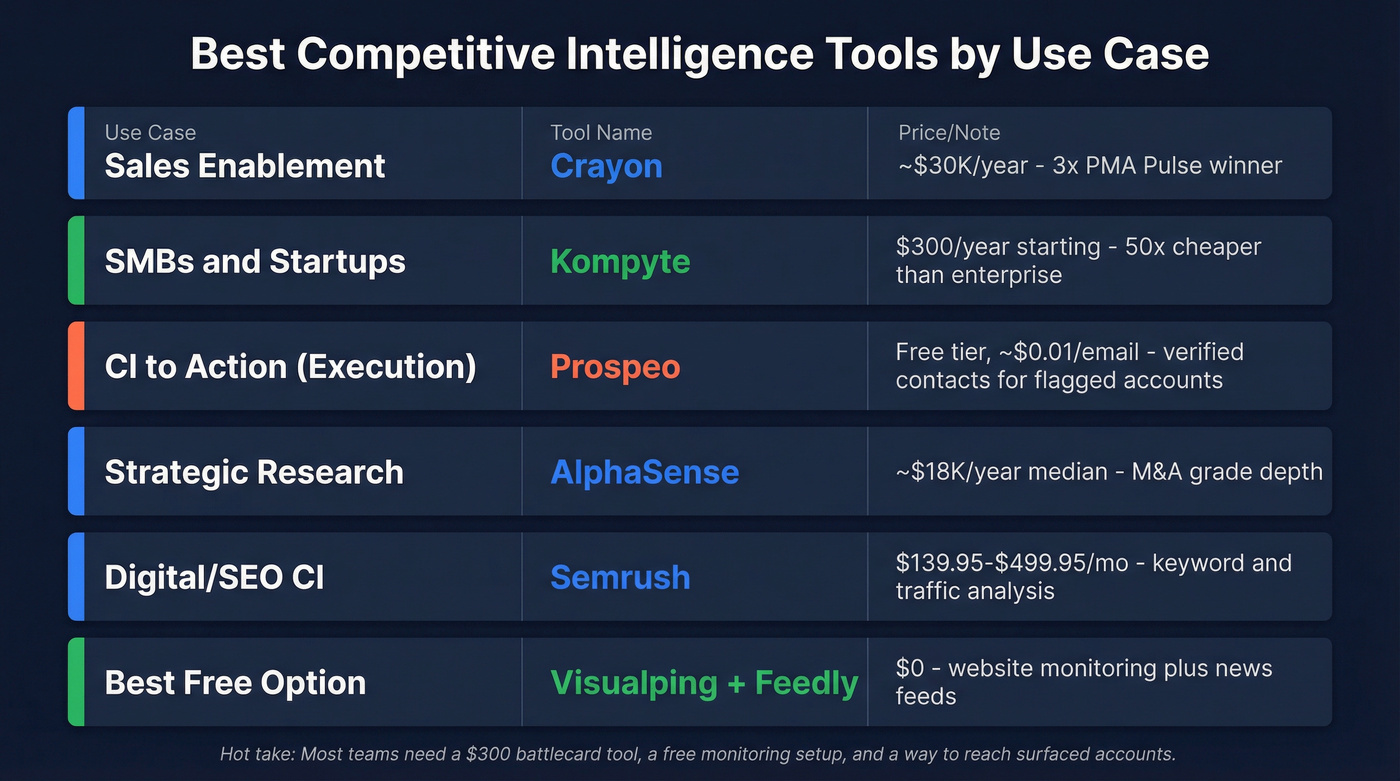
Hot take: Most teams don't need a $30K CI platform. They need a $300 battlecard tool, a free monitoring setup, and a way to actually reach the accounts their intelligence surfaces. The two-tool stack beats the bloated enterprise stack nine times out of ten.
CI Tool Categories
"Competitive intelligence" means wildly different things depending on who's buying. Let's break down how the categories actually work before getting into specific tools.
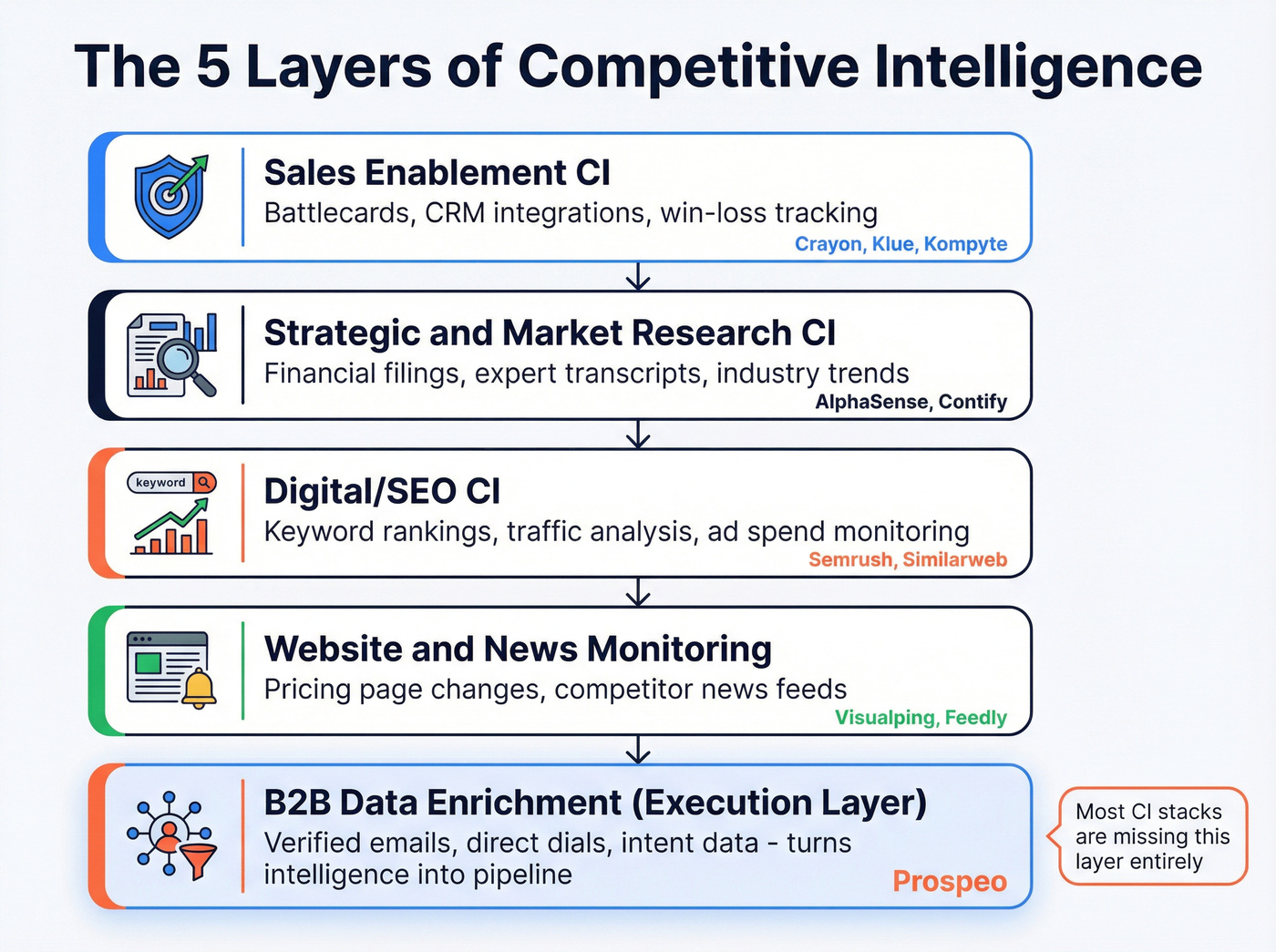
Sales enablement CI - Crayon, Klue, and Kompyte track competitor product changes, pricing moves, and messaging shifts, then package that intelligence into battlecards your reps can use mid-deal. Competitors show up in 68% of deals. Teams using battlecards report 71% improved win rates, with 93% of those seeing increases exceeding 20%.
Strategic and market research CI - AlphaSense and Contify go broader, covering industry trends, financial filings, expert transcripts, and regulatory shifts. These tools serve strategy teams and executives, not frontline sellers.
Digital/SEO CI - Semrush and Similarweb monitor competitor web traffic, keyword rankings, ad spend, and content strategies. Useful, but calling Semrush a "competitive intelligence tool" is like calling a hammer a construction company.
Website and news monitoring - Visualping and Feedly are lightweight, focused tools that handle one job well. They're complements, not replacements.
B2B data enrichment is the execution layer most CI stacks are missing entirely. Your CI platform tells you what competitors are doing and which accounts are in play - but without verified contact data, that intelligence just sits in a dashboard gathering dust.
The 10 Best CI Tools Reviewed
Crayon - Sales Enablement Leader
Crayon is one of the most established CI platforms on the market, and for good reason. It won three consecutive PMA Pulse awards (2021-23) for best competitive intelligence software, and its monitoring engine feeds directly into battlecards, CRM integrations, and sales enablement workflows.
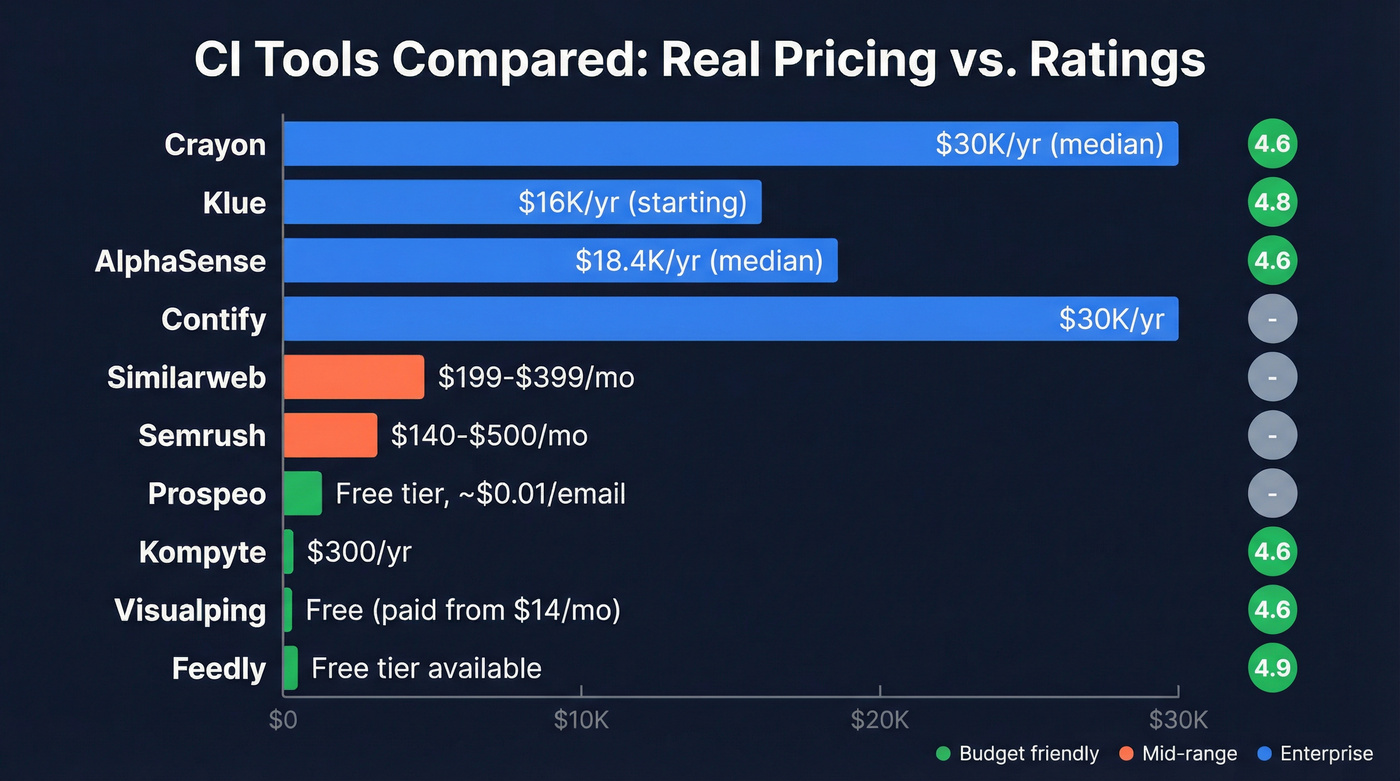
The platform's strength is turning raw competitive signals - pricing changes, product launches, messaging shifts, job postings - into actionable intelligence that reps can pull up inside Salesforce or HubSpot mid-call. In our experience, that CRM integration piece is what separates Crayon from tools that just dump alerts into an inbox and hope someone reads them.
Use this if: You've got a $30K+ CI budget and need enterprise-grade battlecards integrated into your CRM.
Skip this if: You're a startup or SMB. Median contracts run around $30K/year, and Crayon doesn't publish pricing. G2 rating: 4.6/5. Peer Insights: 4.5/5 across 10 ratings.
Verdict: The default choice for revenue teams with enterprise CI budgets.

Kompyte - Best for SMBs and Startups
At $300/year starting, Kompyte is around 50x cheaper than Klue or Crayon at the entry level. That's not a typo.
Acquired by Semrush in 2022, Kompyte checks competitors' digital footprints daily and uses AI to classify changes across 500M+ data points - websites, press releases, job boards, review sites, app stores, and more. It's trained on 8 years of tracking websites, filtering out noise like A/B test variations and widget changes that trigger false alerts on other platforms. You get unlimited battlecards, HubSpot and Salesforce integrations, and win-loss tracking.
The tradeoffs are real, though. Reviewers on SoftwareAdvice consistently praise the battlecard workflow but flag incomplete competitor coverage, limited social media monitoring, and occasional slow performance as the main pain points. The Peer Insights rating (3.3/5, 9 ratings) reflects those rough edges, though SoftwareAdvice's 4.6/5 across 37 reviews tells a more balanced story. For the price, we think it's hard to argue with the value.
Verdict: The no-brainer for startups that need battlecards without enterprise pricing.
Prospeo - Turning CI Into Action
Your CI platform identifies that a competitor just raised prices, or that three target accounts are evaluating alternatives. Now what?
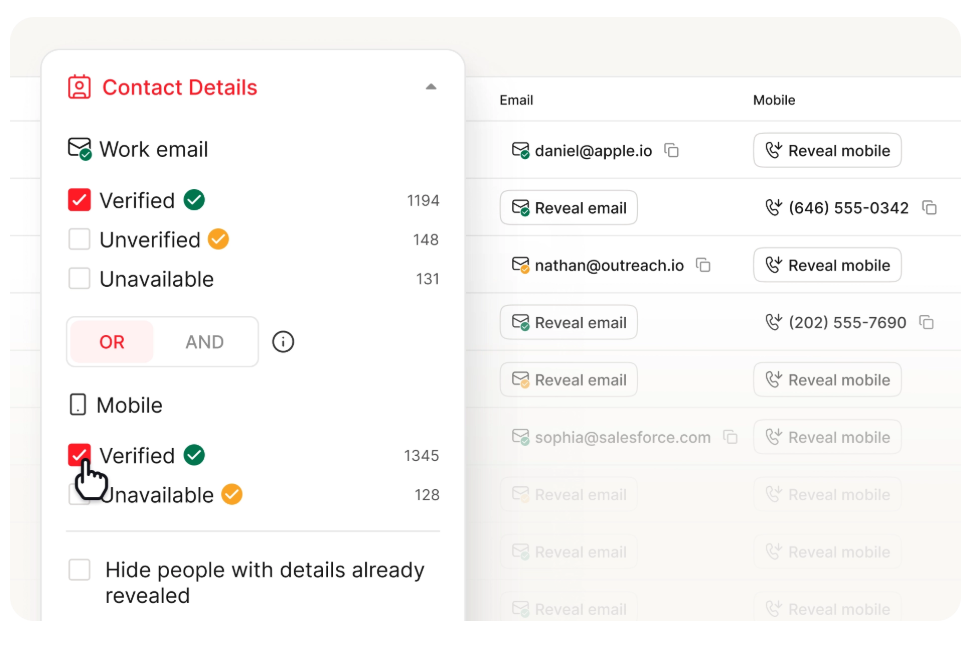
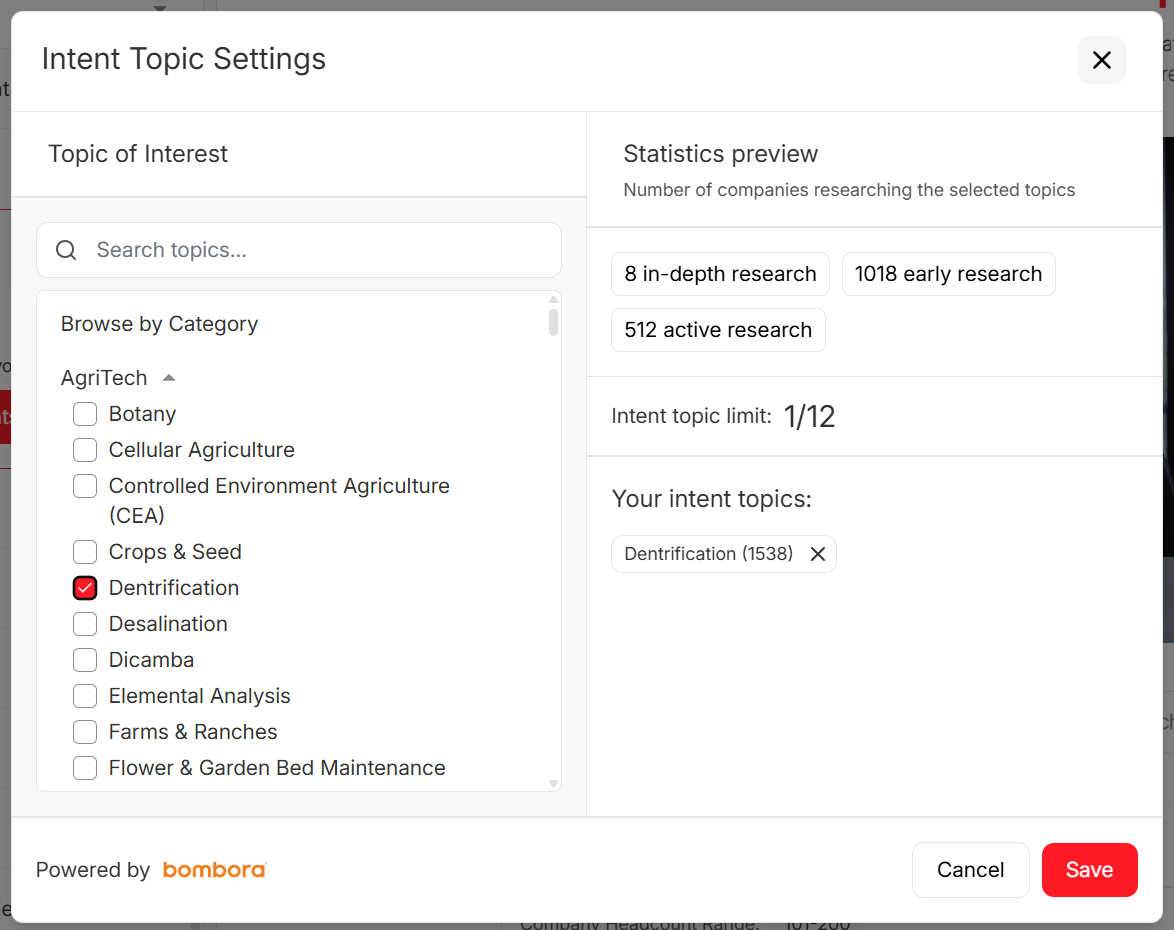
You need verified contact data to actually reach those accounts, and that's where most CI stacks fall apart. Prospeo's database covers 300M+ professional profiles with 98% email accuracy, 143M+ verified emails, and 125M+ verified mobile numbers that deliver a 30% pickup rate. The data refreshes every 7 days, compared to the B2B contact data decay reality most teams are stuck with. You can filter by 30+ criteria including buyer intent powered by Bombora, technographics, job changes, and headcount growth - so you're finding the right contacts at the right moment, not blasting a stale list.
Teams using Prospeo book 26% more meetings than ZoomInfo users and 35% more than Apollo users. At ~$0.01/email with a free tier of 75 emails/month and no contracts, it's the execution layer that makes the rest of your CI stack actually produce pipeline.
Verdict: Your CI platform identifies the opportunities. Prospeo gives you the emails and direct dials to close them.
Klue - Enterprise CI Programs
Klue is one of the highest-rated CI platforms on G2 at 4.8/5 across 428+ reviews, and its Peer Insights score of 4.7/5 across 20 ratings backs that up. The platform covers battlecards, win-loss analysis, and AI-powered competitive insights - all designed for large CI programs with dedicated headcount.
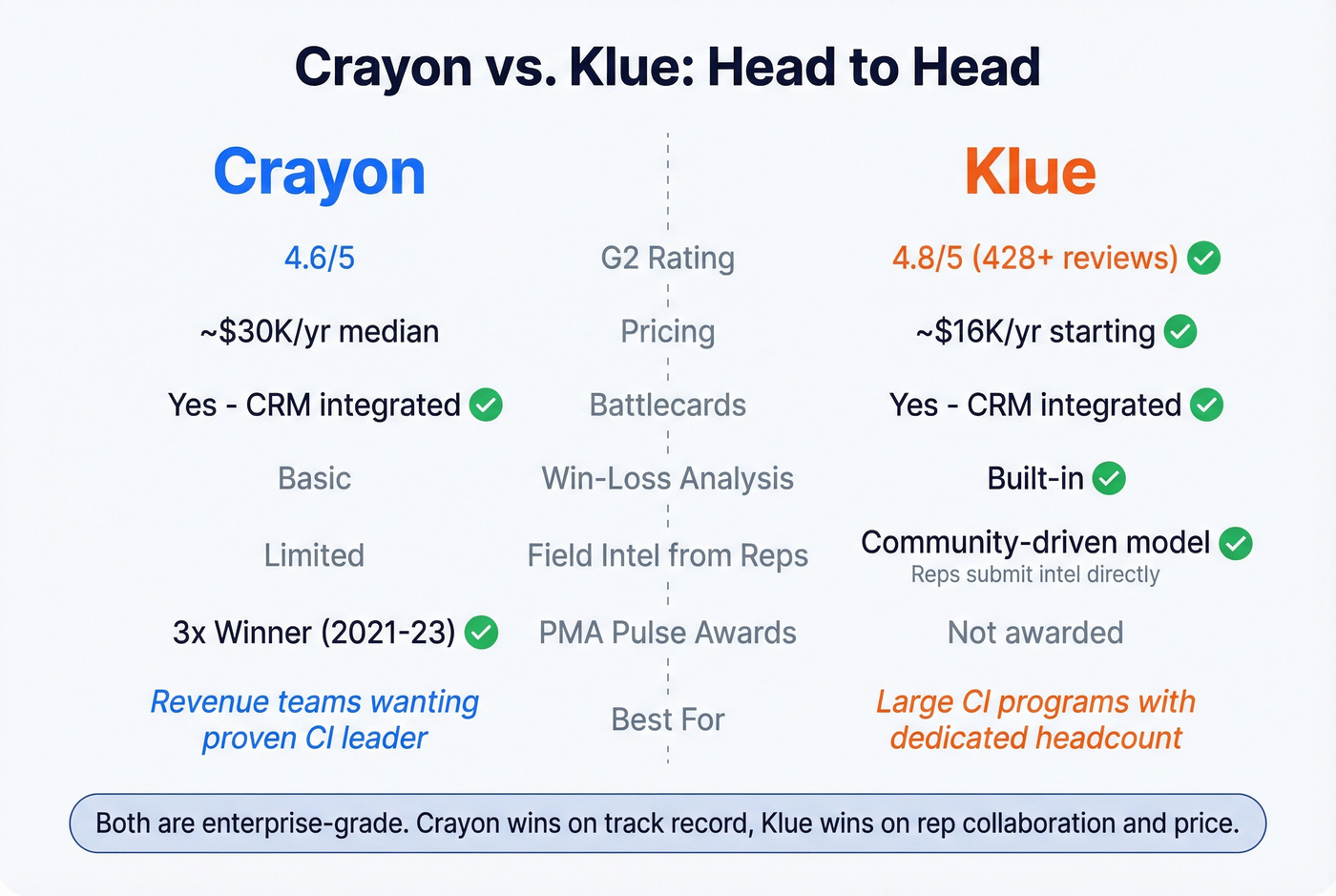
Where Klue separates from Crayon is in its community-driven intelligence model. Reps can submit field intel directly into the platform, which the CI team curates and redistributes. This bottom-up approach works well for organizations where competitive knowledge is scattered across dozens of sellers. The consensus on r/sales threads is that Klue's rep-submitted intel feature is genuinely useful - not just a checkbox.
Pricing starts around ~$16K/year and scales by users, competitors tracked, and modules. It's quote-based, which means enterprise-priced. If your CI program has executive sponsorship and budget to match, Klue is the premium pick. For scrappy teams, look at Kompyte first.
Verdict: The premium pick for teams with dedicated CI programs and budget to match.
AlphaSense - Strategic Research
Comparing AlphaSense to Crayon is like comparing a Bloomberg Terminal to a Google Alert. They're solving fundamentally different problems.
AlphaSense provides AI-driven search across earnings call transcripts, financial filings, news, research, and expert calls, with semantic search, smart alerts, document summarization, and collaboration features. The Tegus acquisition in July 2024 added even deeper expert network content. The median buyer pays $18,375/year based on 34 purchases tracked by Vendr, with a range of $12K-$51K depending on seats and content access. Peer Insights: 4.6/5 across 63 ratings.
Use this if: You're in corporate strategy, M&A, or investor relations and need research-grade intelligence.
Skip this if: You just need sales battlecards. This is overkill for SDR teams.
Semrush - Digital and SEO CI
Semrush isn't a CI platform. It's an SEO and digital marketing tool that happens to be excellent for competitive analysis. Organic and paid keyword tracking, backlink analysis, content gap identification, and ad spend monitoring give you a clear picture of what competitors are doing online. For market share benchmarking in content-heavy industries, nothing else comes close at this price point.
Pricing is transparent: Pro at $139.95/mo, Guru at $249.95/mo, Business at $499.95/mo, with a 7-day free trial. Semrush also owns Kompyte (acquired 2022), which means the two tools can work together if you need both digital CI and sales enablement.
Verdict: Essential for content-heavy markets. Pair it with a real CI platform for the full picture.
Contify - Market Intelligence Monitoring
Contify sits in the strategic intelligence lane, offering AI-curated news feeds, market intelligence monitoring, and custom taxonomies that organize competitor and industry signals by the categories that matter to your business. The AI taxonomy engine is the real differentiator - it classifies signals into your specific competitive framework rather than dumping raw alerts into a feed.
Contify integrates with Slack and Salesforce for real-time updates, and contracts often land around $30K/year. A free trial is available.
Verdict: The news intelligence layer for strategy teams who don't need battlecards.
Similarweb - Traffic and Market Share
Similarweb is the go-to for benchmarking competitor web traffic, audience overlap, and digital market share. When you need to know where a competitor's traffic comes from, which audiences you share, and how your digital presence stacks up, this is the tool. Marketing Intelligence pricing starts at $199/month for Starter and $399/month for Professional, with Enterprise custom-quoted.
Visualping - Free Website Monitoring
Free tier covers 150 checks/month across 5 pages. Paid plans start at $14/mo, with a 14-day free trial on paid tiers. Used by 85% of Fortune 500 companies and 2M+ users. Peer Insights: 4.6/5 across 71 ratings. Set-and-forget competitor website monitoring - the free tier is genuinely useful for tracking pricing page changes and product updates.
Feedly - Lightweight News Monitoring
Free tier available. Peer Insights: 4.9/5 across 39 ratings - the highest-rated tool in this list. Perfect for solo operators who need curated competitor news without a platform commitment.

Competitive intelligence without an execution layer is just a spectator sport. Prospeo turns CI signals into pipeline with 300M+ profiles, 98% email accuracy, and buyer intent data across 15,000 topics - all refreshed every 7 days. At $0.01/email, it costs less than the coffee your rep drinks while reading a battlecard.
Stop watching competitors win deals you should have closed.
Pricing Comparison
Enterprise CI vendors hide their pricing because they sell on perceived value, not cost. That works for them, not for you.
| Tool | Starting Price | Typical Annual | Free Trial | Model |
|---|---|---|---|---|
| Kompyte | $300/yr | $300-$2K/yr | Yes + free version | Transparent |
| Semrush | $139.95/mo | $1,680-$6,000/yr | 7-day trial | Transparent |
| Visualping | Free (150 checks/mo) | $0-$1,200+/yr | 14-day trial | Transparent |
| Feedly | Free | $0/yr | Free tier | Transparent |
| Similarweb | $199/mo | $1,500-$4,000/yr | Limited free | Transparent |
| Klue | ~$16K/yr | $16K-$50K/yr | No | Quote-based |
| Crayon | ~$15K/yr | $15K-$30K+/yr | No | Quote-based |
| AlphaSense | ~$12K/yr | $12K-$51K/yr | No | Quote-based |
| Contify | Custom | ~$30K/yr | Yes | Quote-based |
Ratings at a Glance
Ratings vary wildly by platform and sample size. Here's the snapshot across the three major review sites. All Gartner Peer Insights ratings are from their competitive and market intelligence tools category.
| Tool | Peer Insights (Rating/Reviews) | G2 | SoftwareAdvice |
|---|---|---|---|
| Feedly | 4.9/5 (39) | - | - |
| Klue | 4.7/5 (20) | 4.8/5 (428+) | - |
| Visualping | 4.6/5 (71) | - | - |
| AlphaSense | 4.6/5 (63) | - | - |
| Crayon | 4.5/5 (10) | 4.6/5 | - |
| Kompyte | 3.3/5 (9) | - | 4.6/5 (37) |
Feedly's 4.9 is the highest Peer Insights rating among the tools here. Klue leads G2 with 428+ reviews and a 4.8/5 score. Kompyte's low Peer Insights score reflects a tiny sample - its SoftwareAdvice rating tells a more balanced story. Contify and Similarweb lack sufficient public reviews for a reliable rating, which is worth factoring into your evaluation.
How to Build Your CI Stack
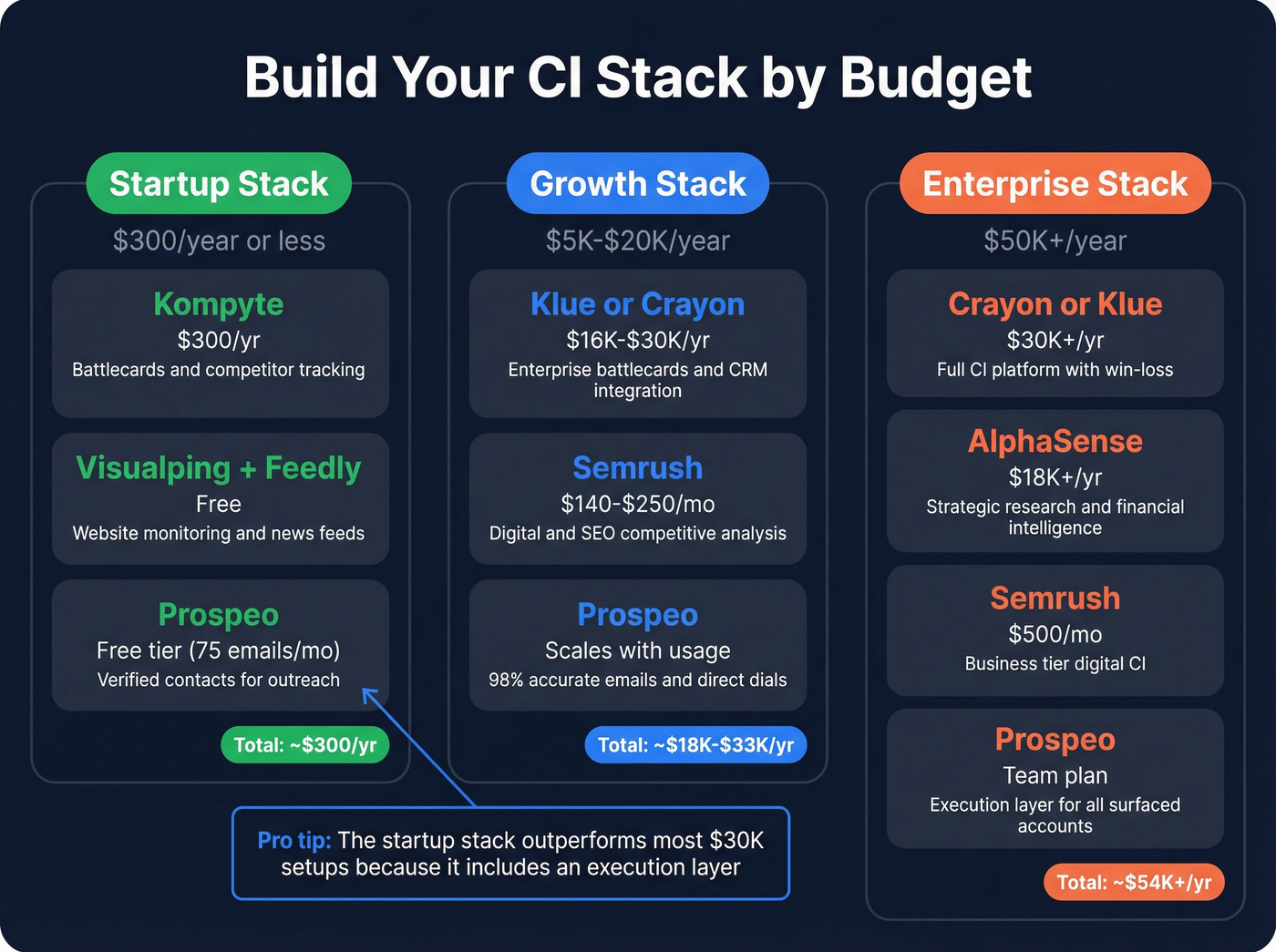
You don't need 10 tools. You need 2-3, max. One for monitoring and battlecards, one for contact data enrichment, and maybe one for digital CI if you're in a content-heavy market.
SMB stack (~$300-$1,000/year): Kompyte for battlecards and competitor tracking, Prospeo for verified contact data on flagged accounts, and Feedly for news monitoring. We've seen this combination get a 10-person sales team 80% of what enterprise CI programs deliver at a fraction of the cost.
Mid-market stack (~$20K-$60K/year): Crayon or Klue for full CI and sales enablement, a data enrichment layer for outreach execution, and Semrush for digital competitive analysis. This is the sweet spot for Series B-D companies with dedicated RevOps.
Enterprise stack (~$50K-$100K+/year): AlphaSense for strategic research, Crayon for sales enablement battlecards, and a data enrichment layer for verified contact data across all target accounts. Add Contify if your strategy team needs a separate market intelligence feed.
When evaluating any CI tool, five criteria actually matter: data sources and coverage breadth, AI quality (the signal-to-noise ratio on alerts), sales enablement features like battlecards and CRM integrations, pricing transparency, and data quality for outreach execution. That last one is where most stacks break down - even the best competitive intelligence tools are useless if your contact data bounces. Weekly data refreshes and verified emails are the difference between reaching a decision-maker and hitting a dead inbox (and why email verification for outreach belongs in the stack).
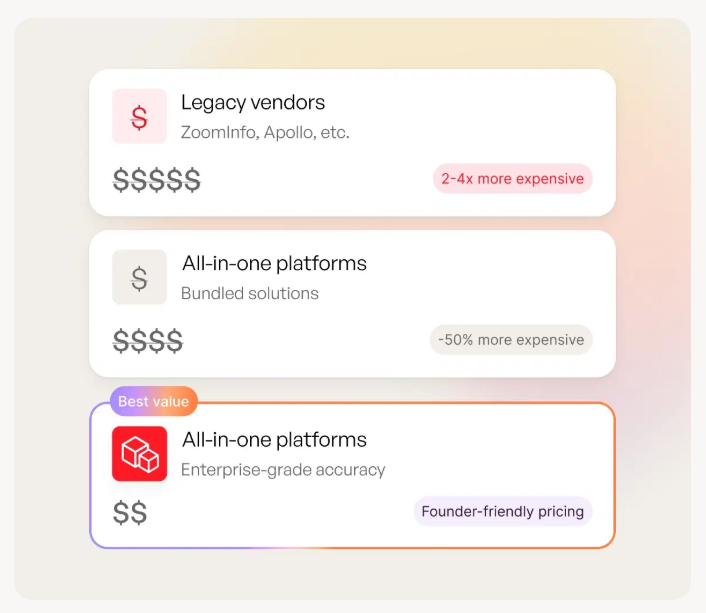
Your CI platform just flagged three accounts evaluating alternatives to your competitor. Now you need verified direct dials and emails - fast. Prospeo delivers 125M+ verified mobiles with a 30% pickup rate and 143M+ verified emails, filtered by intent signals, job changes, and technographics. Teams book 26% more meetings than ZoomInfo users.
Intelligence without action is just expensive news. Start reaching flagged accounts today.
FAQ
What's the difference between competitive intelligence and market intelligence?
Competitive intelligence focuses on specific rivals - their pricing changes, product launches, wins and losses, and positioning moves. Market intelligence covers broader industry trends, regulatory shifts, and market sizing. Tools like Crayon and Klue are CI-focused; AlphaSense and Contify lean toward market intelligence. Most teams need elements of both.
How much do CI platforms typically cost?
Pricing ranges from free (Visualping, Feedly) to $50K+/year for enterprise AlphaSense or Crayon contracts. Most mid-market teams spend $15K-$30K/year on a primary CI platform. Budget-conscious teams can start with Kompyte at $300/year and add tools as the program matures.
Do I need a data enrichment tool alongside my CI platform?
Almost always yes. CI platforms track competitor movements but don't provide verified contact data for outreach. That gap means intelligence stays trapped in dashboards instead of generating pipeline. A data enrichment tool turns "Competitor X raised prices" into "here are 50 verified decision-maker emails at accounts affected by that price hike."
What's the fastest way to start with competitive intelligence?
Set up free Visualping alerts on your top 3 competitors' pricing and product pages, then add a Feedly board for their press mentions and blog posts. That gives you 80% of the monitoring value while you evaluate paid platforms - and it costs nothing to start today.