

What Is a Sales Pitch? Structure, Tips & 2026 Data
You spent 45 minutes crafting the perfect cold email. Personalized opener, sharp value prop, clean CTA. It bounces. The contact left that company six months ago.
So what's a sales pitch worth if it never reaches a human being? Nothing.
Quick version:
- A sales pitch is a concise, buyer-focused argument - not a product monologue.
- Structure every pitch: Hook, Problem, Value, Proof, CTA.
- 96% of buyers research you before you pitch - add value beyond what's Googleable.
- The #1 pitch-killer isn't your script. It's pitching the wrong person with bad data.
What Is a Sales Pitch?
A sales pitch is a short, persuasive message designed to convince a specific buyer that your product or service solves a problem they care about. It can take the form of a cold call, an email, a 30-second elevator conversation, or a full demo presentation. The common thread: it's buyer-focused, not product-focused.
Buyers do a ton of research before they ever talk to sales. 96% of prospects research companies and products before engaging with a rep, and 71% prefer doing their own homework over talking to someone in sales. Your pitch can't just recite features. 87% of businesses expect reps to act as trusted advisors, not walking brochures.
A product pitch explains what something does. A great sales pitch explains why it matters to this buyer, right now.
Why Most Pitches Fail
Most pitch guides obsess over scripts. The real problem is upstream.
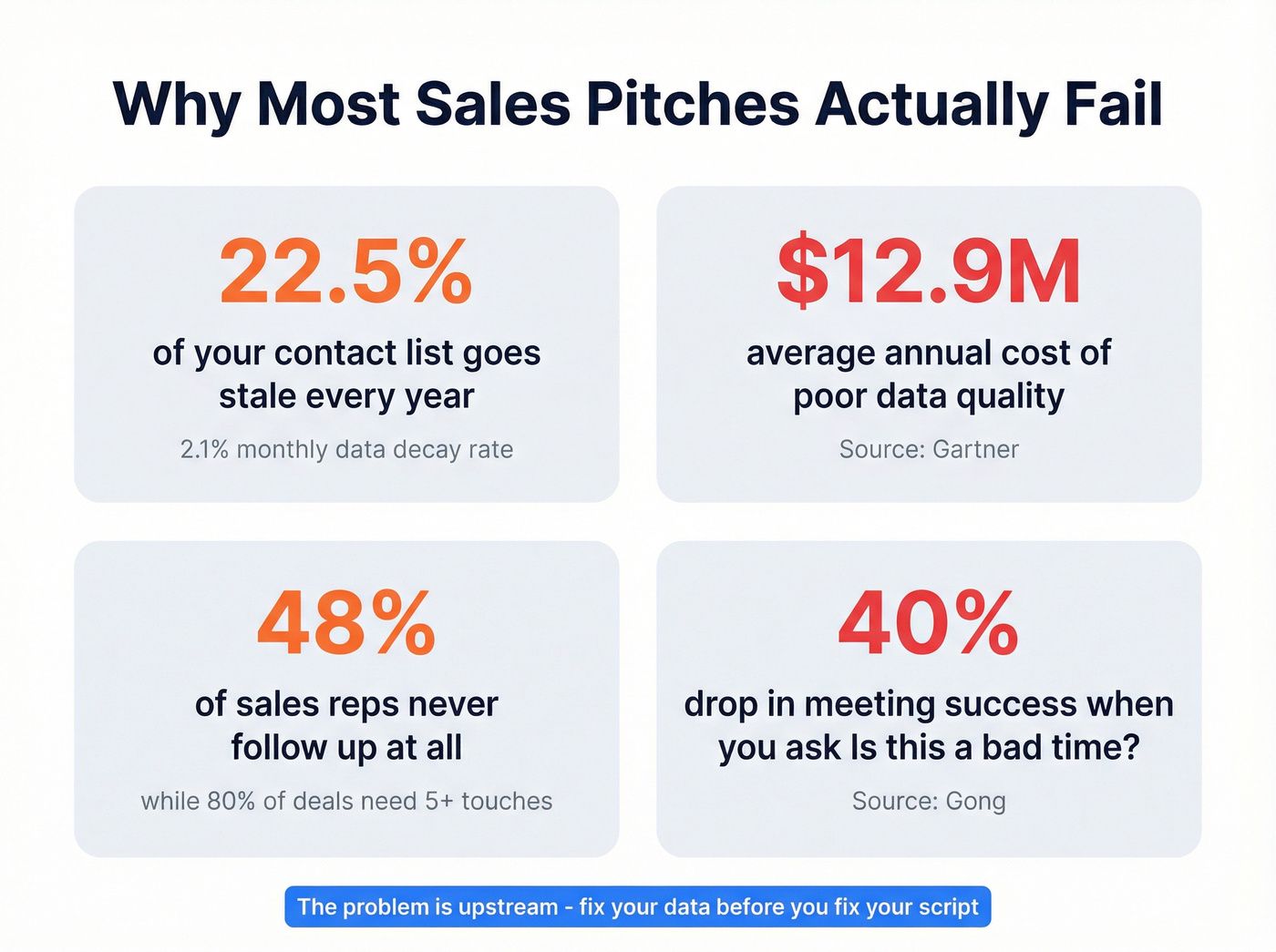
B2B contact data decays at roughly 2.1% per month - that's 22.5% annually. People change jobs, get promoted, switch companies. Poor data quality costs businesses an average of $12.9M per year. Your SDR team isn't underperforming because the talk track is weak. They're underperforming because a quarter of their contact list is dead.

Then there's the timing problem. Reps who pitch before diagnosing - sending a deck two minutes into a discovery call, leading with features instead of questions - kill deals before they start. Gong's data shows that asking "Is this a bad time?" decreases meeting chances by 40%.
Here's the thing: the biggest pitch-killers are simple. Talking too much, leading with features, and having no clear next step. The follow-up gap makes it worse - 48% of reps never follow up at all, while 80% of successful sales take five or more touches. Even a basic pitch with a clear CTA outperforms a polished deck that never gets a reply.
Stop obsessing over your script. Start obsessing over your prospect list.
The Five-Part Formula That Closes
Every effective pitch follows the same skeleton, whether it's 30 seconds or 30 minutes. Most pitch guides give you Mad Libs with [COMPANY NAME] placeholders. That's not a pitch - that's a fill-in-the-blank exercise.
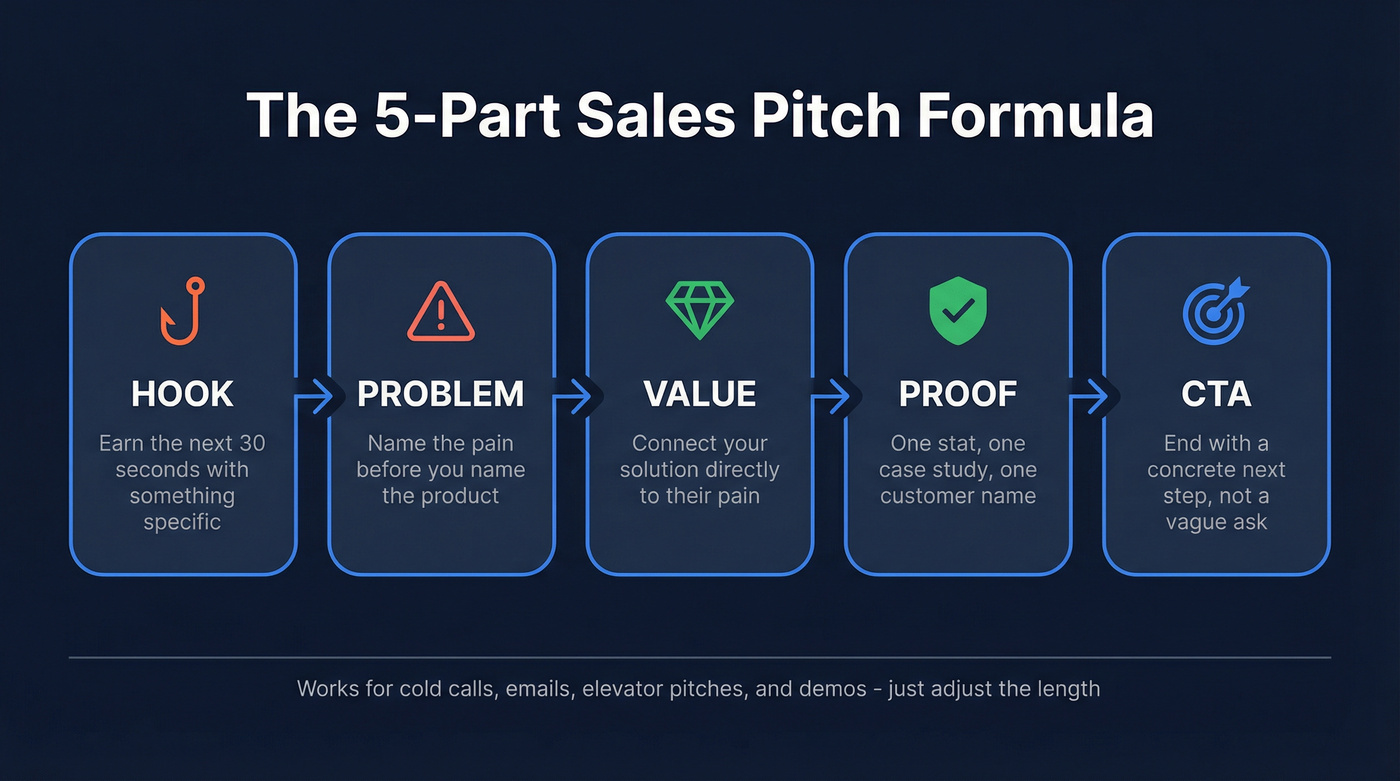
The real formula is simpler than you think: Hook, Problem, Value, Proof, CTA.
Hook
You've got about 30 seconds to earn the next 30. Open with something specific - a recent funding round, a job posting that signals a pain point, a mutual connection. Generic openers get generic responses.
Problem
Name the pain before you name the product. SPIN selling's Situation and Problem questions force the buyer to articulate what's broken. The Challenger model takes it further: teach the prospect something they didn't know about their own problem, then tailor the solution. If you're talking for more than 60 seconds without asking a question, you're presenting, not pitching.
Value
Connect your solution directly to the problem they just described. Not "we have AI-powered analytics." Instead: "That reporting gap you mentioned? We close it in two clicks."
Proof
One stat, one case study, one customer name. "We helped a 50-person SaaS team cut their sales cycle by 11 days" lands harder than a slide deck with six logos.
CTA
End with a concrete next step. "Can I send you a 3-minute walkthrough video?" beats "Let me know if you're interested" every single time.
These five components stay the same regardless of channel - what changes is the length and delivery.

You just learned the 5-part pitch formula. But even a perfect Hook-Problem-Value-Proof-CTA sequence is worthless if it lands in a dead inbox. With 22.5% annual data decay, your prospect list is rotting while you polish your script. Prospeo refreshes 300M+ profiles every 7 days - not every 6 weeks - so your pitch reaches real buyers, not former employees.
Fix the list first. The pitch will do the rest.
Pitching by Channel
Cold Call Pitch
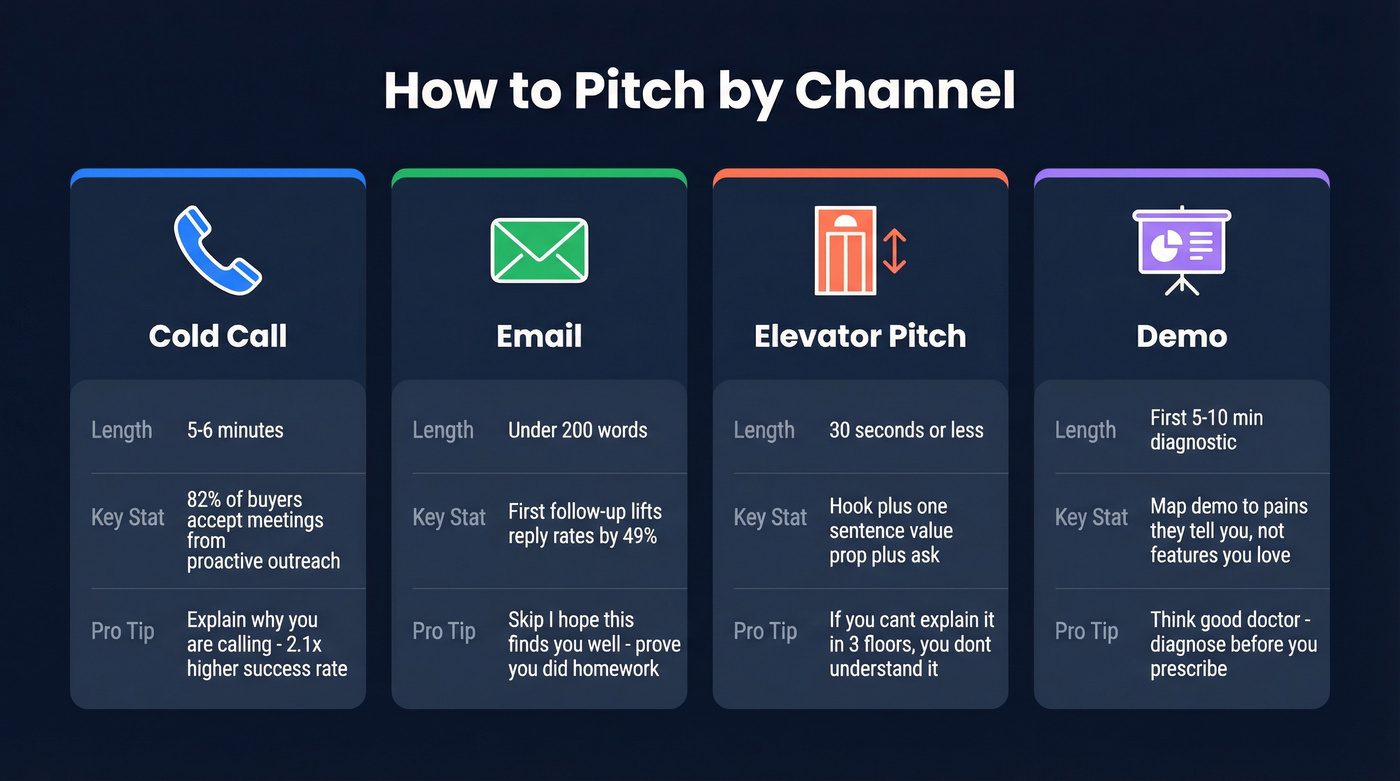
Explaining why you're calling produces a 2.1x higher success rate. Successful cold calls average 5:50 in duration versus 3:14 for failed ones - the goal is to earn a real conversation, not rush through a script. Despite what the "cold calling is dead" crowd says, 82% of buyers accept meetings from proactive outreach.
We've seen reps double their connect rates just by verifying phone numbers before dialing. Sounds obvious, but most teams skip it.
Email Pitch
Cold email is getting harder - 69% of senders report declining performance year over year. But follow-up still works: the first follow-up email lifts reply rates by 49%. Write like a human, not a template. The best email pitch reads like it was written for a single person, not batch-sent to a thousand.
Skip the "I hope this email finds you well" opener. Start with something that proves you did your homework.
Elevator Pitch
Thirty seconds or less. Hook, one-sentence value prop, ask. If you can't explain what you do and why it matters in the time it takes to ride three floors, you don't understand your own product well enough.
Demo or Presentation
The first 5-10 minutes should be diagnostic. Think "good doctor" - you wouldn't trust a physician who prescribed medication before asking about symptoms. Map your demo to the pains they tell you about, not the features you're proud of.
Fix Your Data Before You Pitch
Let's be honest about the math. Your SDR team made 200 calls today. Booked 2 meetings. Not because the script was bad - because about 45 of those phone numbers were outdated. That's what 22.5% annual data decay looks like in practice.
Before you rewrite a single talk track, verify your list. Prospeo runs 98% email accuracy across 300M+ profiles with a 7-day data refresh cycle, compared to the 6-week industry average. Upload a CSV, verify in bulk, and push clean contacts straight to your sequencer. The free tier gives you 75 emails per month to test it. In our experience, the reps who book the most meetings aren't the best talkers - they're the ones with the cleanest lists and the best questions.
If you want to go deeper on the root cause, start with B2B contact data decay and then tighten up CRM hygiene so your list stays clean.
The article says it plainly: reps who book the most meetings have the cleanest lists. Prospeo delivers 98% email accuracy and 125M+ verified mobile numbers with a 30% pickup rate - so your cold calls and emails actually connect. At ~$0.01 per verified email, you'll spend less fixing your data than you lost on last week's bounces.
Stop pitching ghosts. Start reaching real decision-makers today.
How AI Is Changing Pitches in 2026
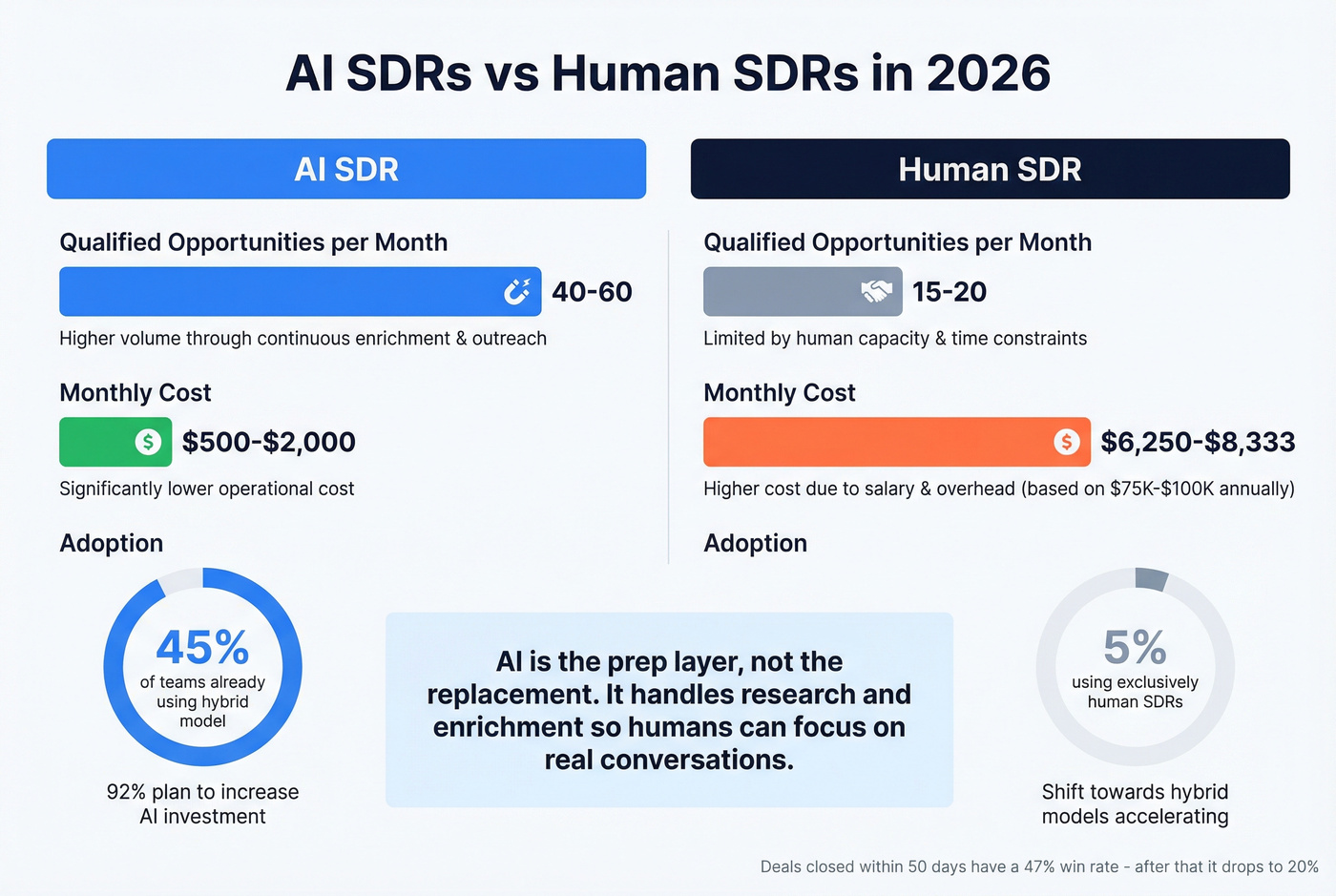
45% of sales teams already run a hybrid AI-SDR model, and 92% plan to increase AI investment over the next three years. AI SDRs generate 40-60 qualified opportunities per month versus 15-20 for a human rep - at $500-$2,000/month instead of $75K-$100K fully loaded.
But AI is the prep layer, not the replacement. It handles research, personalization hooks, and contact enrichment so you can focus on the actual conversation. Deals closed within 50 days carry a 47% win rate; after that, it drops to around 20%. Speed matters, and AI buys you speed.
A strong pitch still needs a human behind it - AI just makes sure that human is talking to the right person at the right time.
Hot take: If your deal size is under $10K, you probably don't need a polished 20-slide pitch deck. You need clean data, a sharp email, and fast follow-up. Most teams over-invest in pitch polish and under-invest in reaching the right person. The consensus on r/sales backs this up - thread after thread of reps saying their best months came from better lists, not better scripts.
FAQ
How long should a sales pitch be?
Thirty seconds for an elevator pitch, under 200 words for email, and 5-6 minutes for a cold call. Successful cold calls average 5:50 versus 3:14 for failed ones. If you're talking longer than your prospect, it's too long.
What's the difference between a sales pitch and an elevator pitch?
An elevator pitch is the shortest form of a sales pitch - always under 30 seconds, focused on a single value proposition. A full pitch can be a cold call, email, demo, or presentation that expands with proof, discovery questions, and a concrete CTA.
What makes the best sales pitch?
The best pitch nails all five structural elements - hook, problem, value, proof, and CTA - while staying focused on the buyer's specific situation. It's less about eloquence and more about relevance: right person, right pain point, right timing.
How do I pitch without sounding pushy?
Ask questions before making claims. Lead with the prospect's problem, not your product. End with a specific next step instead of pressure. Reaching the right person with verified contact data also helps - when the conversation is relevant, it doesn't feel intrusive.