Follow-Up Email Opening Lines That Actually Get Replies
You sent the proposal three days ago. Radio silence. You open Gmail, hit reply, and type "Just following up..." - then delete it because you know exactly how that email feels to receive. 70% of cold email chains die after the first message, and a single follow-up increases your reply chance by 25%. The problem isn't that you're following up. It's that your opening line is doing nothing.
Here's the quick version: your opening line doubles as inbox preview text, so treat it like a second subject line. Stop using "just following up" and five other dead phrases listed below. And match your opener to where you are in the sequence - follow-up #1 shouldn't sound anything like follow-up #4.
If you want the lines, scroll to the list. If you want the strategy behind them, keep reading.
Your Opening Line IS Preview Text
On mobile - where 47% of recipients check email - the first line of your body shows up as preview text, right next to the subject line. Most people waste it completely.
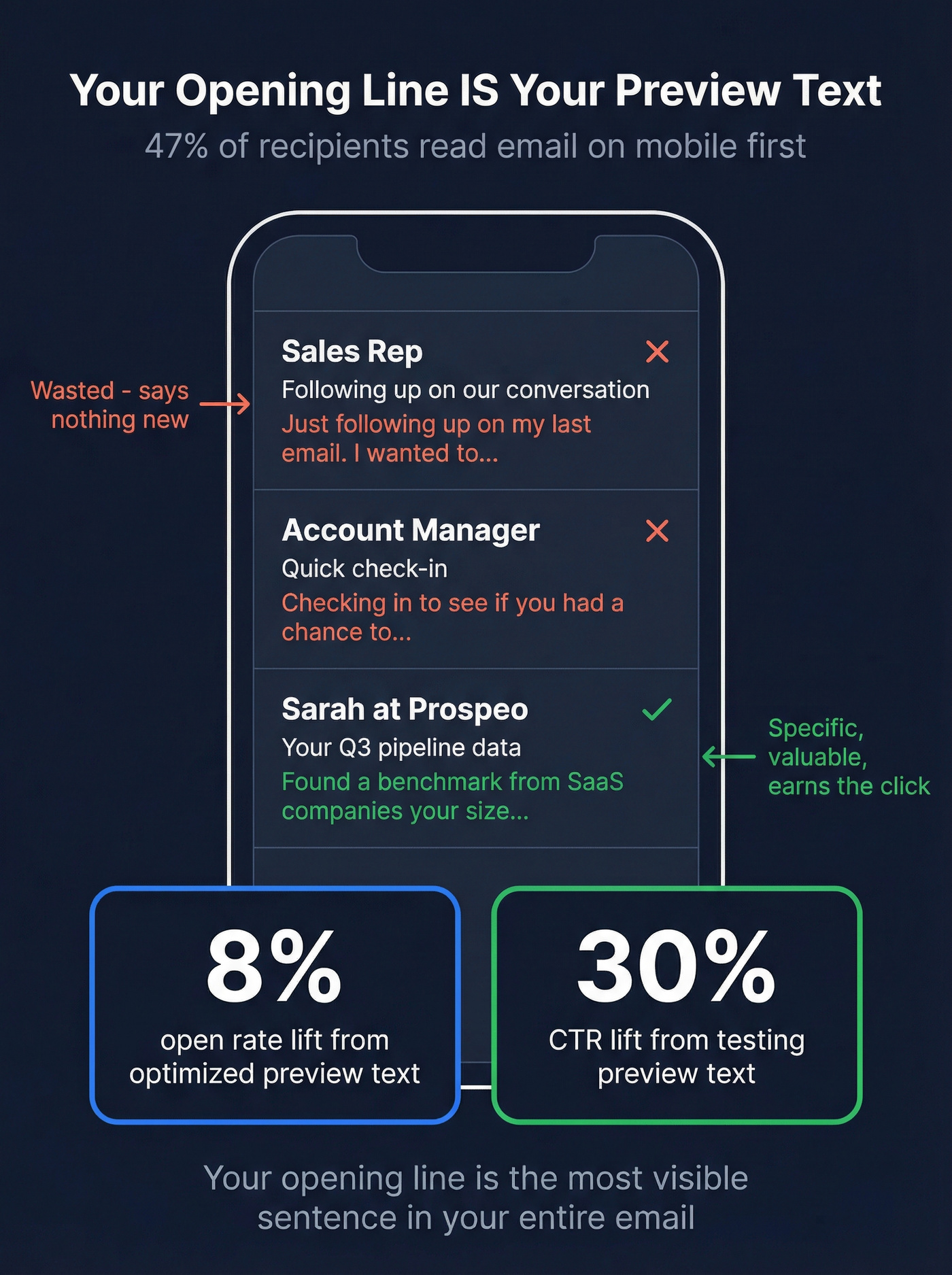
Autoplicity saw an 8% open-rate lift just from optimizing preview text. WeddingWire saw a 30% CTR lift from testing it. That's not a minor tweak. Your opening line is the most visible sentence in your entire email, and if it says "just following up," you've burned your best real estate on nothing.
Phrases to Stop Using Immediately
"Just following up" is the "regards" of email openers - technically fine, practically useless. We've reviewed hundreds of outbound sequences across sales teams, and the opener is almost always the weakest link. Kill these six:
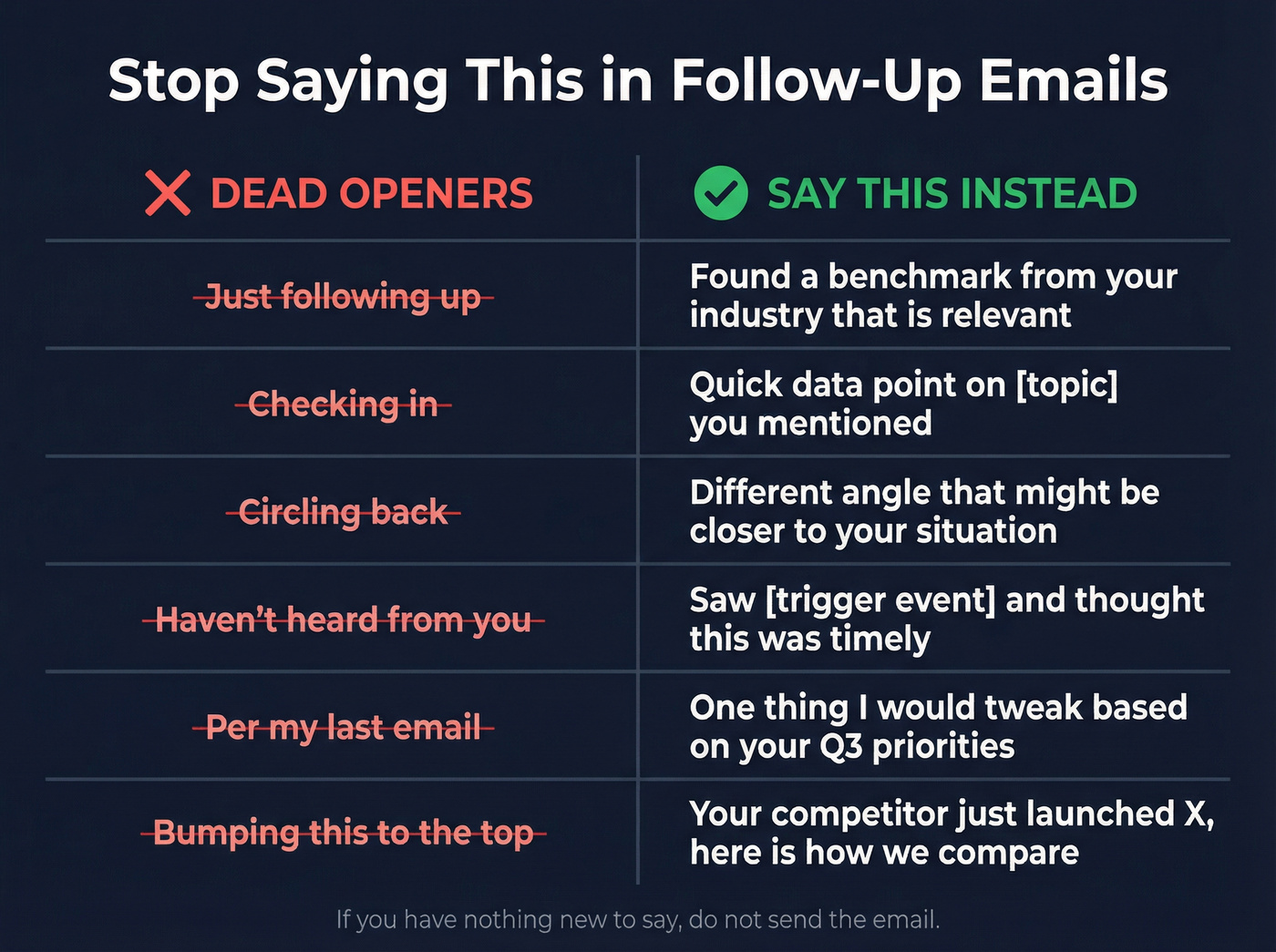
"Just following up"- adds zero value"Checking in"- the corporate equivalent of "hey, remember me?""Circling back"- you're not circling anything"Haven't heard from you"- guilt-tripping doesn't generate pipeline"Per my last email"- passive-aggressive in every context"Bumping this to the top"- their inbox isn't your priority queue
Every one of these tells the recipient you have nothing new to say. If you don't have something new, don't send the email.
30+ Follow-Up Email Opening Lines by Context
You don't need 50 templates. You need 4-5 strong openers and the judgment to pick the right one.
Sales Follow-Ups
Post-demo:
- "After our call, I dug into [specific thing they mentioned] - here's what I found."
- "Your question about [topic] stuck with me. Quick data point that might help."
Post-proposal:
- "Wanted to flag one thing in the proposal that usually gets questions - [section]."
- "Quick thought on the timeline we discussed - [new insight]."
Cold follow-up:
- "Saw [company] just [trigger event]. Thought this might be timely."
- "Different angle: [alternate pain point] might be closer to what you're dealing with."
Before/After rewrites you can steal:
❌ "Just checking in on my last email" ✅ "Found a benchmark from [their industry] that's relevant to what we discussed."
❌ "Wanted to follow up on the proposal" ✅ "One thing I'd tweak in the proposal based on your Q3 priorities."
❌ "Bumping this back up" ✅ "Saw [competitor] just launched [feature] - figured you'd want to know how we compare."
Job Search Follow-Ups
80% of hiring managers say thank-you notes affect their decisions, yet barely half of candidates send them. That gap is your advantage.
Post-interview:
- "Loved hearing about [specific project]. It reminded me of [relevant experience]."
- "Our conversation about [topic] got me thinking - here's a quick take."
Post-application (no interview yet):
- "Applied for [role] last week - wanted to share [relevant work/insight] that maps to [job requirement]."
Networking:
- "Great connecting at [event]. Your point about [topic] stuck with me - here's something related."
Internal and Client Follow-Ups
- "Quick update on [deliverable] - we're at [status], and here's what's next."
- "The invoice from [date] is still open - any blockers on your end?"
- "Recap from Thursday's call: [one-line summary]. Two items need your sign-off."
Breakup / Final Attempt
- "Totally get if the timing's off. Last note from me unless you say otherwise."
- "Three emails, no reply - I can take a hint. But if [pain point] resurfaces, [resource] might help."

Personalized opening lines need accurate contact data behind them. Prospeo's 300M+ profiles with 30+ filters - including job changes, intent signals, and tech stack - give you the context to write openers that feel relevant, not recycled. At $0.01 per email with 98% accuracy, your follow-ups actually land.
Stop crafting perfect openers for email addresses that don't exist.
Opening Lines by Sequence Position
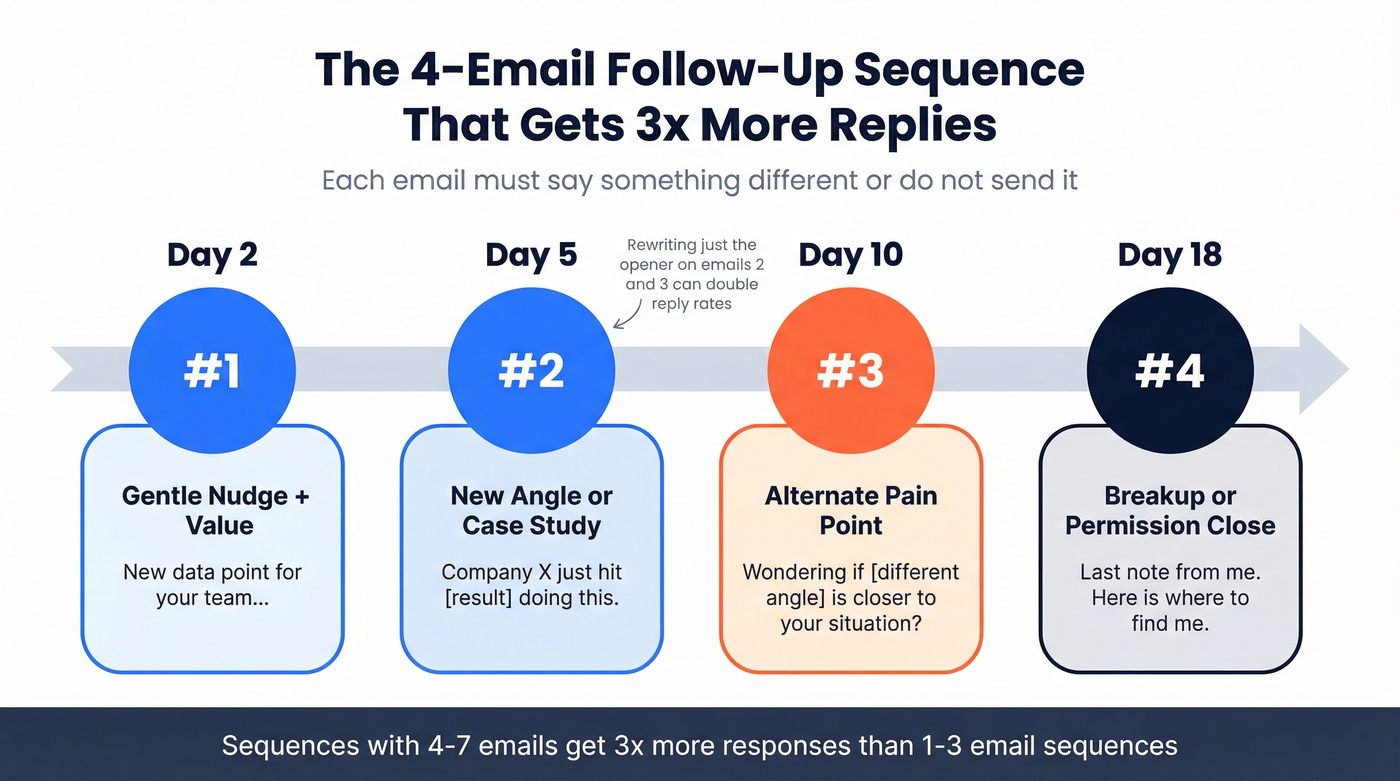
Your opener should evolve as the sequence progresses. Here's a cadence that works well: Day 2 nudge, Day 5 new angle (often a case study), Day 10 alternate angle, Day 18 breakup. Sequences with 4-7 emails get 3x more responses than 1-3 email sequences, but only if each email says something different.
| Follow-Up # | Timing | Opener Style | Example |
|---|---|---|---|
| #1 | Day 2 | Gentle nudge + value | "[New data point] for your team..." |
| #2 | Day 5 | New angle or case study | "[Company X] just hit [result]." |
| #3 | Day 10 | Alternate pain point | "Wondering if [different angle] is closer?" |
| #4 | Day 18 | Breakup / permission close | "Last note. Here's where to find me." |
Let's be honest: most teams obsess over subject lines and ignore the opener entirely. That's backwards. Your subject line gets the open; your opening line gets the reply. I've seen teams double reply rates by rewriting nothing but the first sentence of follow-ups #2 and #3.
The Personalization Ladder
Reply rates jump from 1-3% with no personalization to 25-40% with multi-signal personalization - a 142% lift. If you're only going to personalize one sentence, make it the first one.
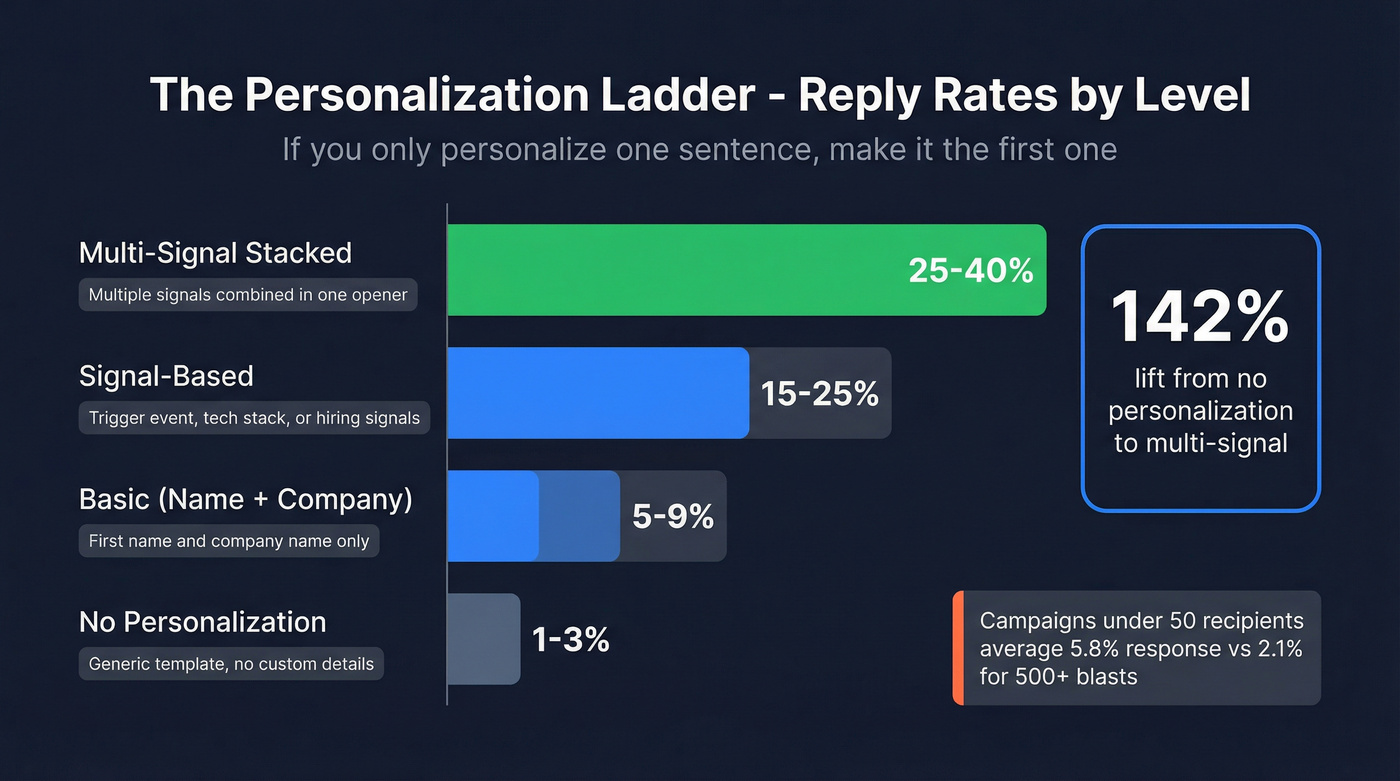
- No personalization: 1-3% reply rate
- Basic (first name, company): 5-9%
- Signal-based (trigger event, tech stack, hiring): 15-25%
- Multi-signal stacked: 25-40%
Batch size matters too. Campaigns targeting 50 or fewer recipients average 5.8% response versus 2.1% for 500+ recipient blasts. The most upvoted advice across r/sales and r/coldemail? Stop leading with what you want and start leading with what they need.
Verify Before You Follow Up
The best opening line in the world won't help if the email bounces. Average sequence bounce rates run around 2.8%, but poorly maintained lists spike much higher - and anything above 3% starts threatening your domain reputation. Stack Optimize built to $1M ARR while keeping client deliverability at 94%+ and bounce under 3%, and verification was a non-negotiable part of that.
Prospeo handles this with 98% email accuracy on a 7-day refresh cycle, so you're not emailing addresses that went stale three weeks ago. The free tier covers 75 emails per month plus 100 Chrome extension credits - enough to verify your next follow-up batch before you hit send. (If you're comparing options, start with an email checker tool or a full list of email ID validators.)
Your sequence cadence is only as strong as your data. Stale emails mean bounces, bounces kill domain reputation, and dead domains kill every follow-up after. Prospeo refreshes every record on a 7-day cycle - not the 6-week industry average - so follow-up #4 hits the same verified inbox as follow-up #1.
Protect your sender reputation before you send that next follow-up.
Quick Tips for Higher Reply Rates
Send on Tuesday through Thursday, 10 AM or 2 PM in the recipient's timezone - this consistently outperforms other windows. For your CTA, "Curious?" and "Open to learning more?" hit a 30% success rate, double other CTA types. Propose two specific time blocks instead of an open-ended "when works for you?" (If you want a deeper breakdown, see the best time to send prospecting emails.)
Personalized follow-ups pull roughly 18% response versus 9% for generic templates. Know when to stop, though: sending 4+ emails triples your spam complaint rate. The simplest "do this first" rule? One initial email plus one strong follow-up is a proven sweet spot, and then you can extend to a longer sequence when the deal size justifies it. When someone gives you a clear "no," or asks you to check back in Q2, respect that timeline. Following up before the window they gave you is a fast way to lose the deal permanently. (For more, use this prospect follow up cadence.)
FAQ
How do you start a follow-up email without saying "just following up"?
Reference a specific detail from the previous conversation, share a new resource, or lead with a result relevant to their problem. Even a one-line insight beats any generic nudge. Replace your default greeting with something that delivers immediate value - a data point, a relevant article, or a question that shows you've done your homework.
How many follow-up emails should you send?
One initial email plus one strong follow-up is a proven sweet spot for most situations. If you're running a true outbound sequence, 4-7 emails can triple response rates - but sending 4+ also triples spam complaint rate. After a few attempts, send a clean breakup email and move on.
Does the opening line really affect reply rates?
Yes - it doubles as your inbox preview text, which 47% of recipients see on mobile before deciding to open. Personalized openers lift reply rates by up to 142% compared to generic ones. Verifying that your email actually reaches a valid inbox matters just as much; a bounced email wastes even the best opener.
What's the best free tool to verify emails before following up?
Prospeo's free tier includes 75 email verifications per month plus 100 Chrome extension credits - enough for small-batch follow-up campaigns. Hunter offers 25 free searches per month but caps enrichment. For teams sending more than a handful of follow-ups, verifying every address first protects your domain reputation and keeps bounce rates under 3%.
Stop writing "just following up." Start writing something worth replying to.