

25 Objection Handling Examples With Full Scripts - Not One-Liners
Sales cycles are getting longer. 57% of sales professionals say so, and nearly 70% of the buyer's journey is done before a rep ever gets involved. That means when you finally get someone on the phone, the objection handling examples you've rehearsed matter more than ever - fumble the response, and there's no second chance.
Most content on this topic gives you one-liners. "Say this when they say that." Real conversations don't work that way. What follows are 25 full dialogue scripts organized by category, backed by data from 67,149 sales calls analyzed by Gong, and built around the behaviors that actually separate top closers from everyone else.
Here's the thing: before you memorize a single script, these five habits matter more.
- Pause 5X longer than feels comfortable after hearing an objection
- Assume the first objection isn't the real one - dig before you respond
- Match your response to the sales stage - a cold call isn't a closing call
- Ask before you answer - questions beat rebuttals every time
- Practice in low-stakes environments weekly - not just before QBRs
Objections vs. Obstructions
Not every pushback is an objection. Understanding the difference changes how you respond.
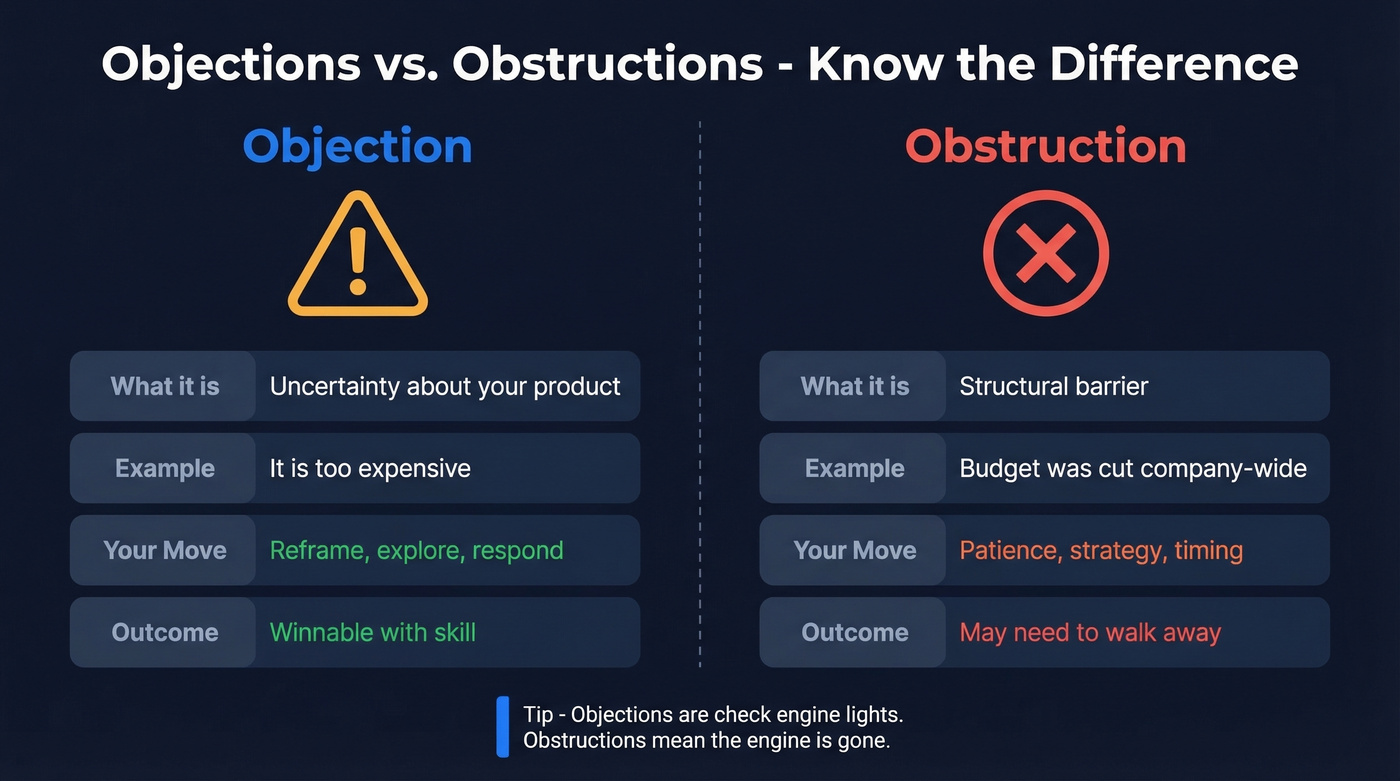
An objection is uncertainty about your product - price, fit, timing, value. The prospect is engaged but unconvinced. An obstruction is a structural barrier: no budget exists, no decision-maker is accessible, the market shifted. Think of objections like check engine lights. They don't mean the car is dead; they mean something specific needs attention. Obstructions mean the engine is actually gone.
| Objection | Obstruction | |
|---|---|---|
| What it is | Uncertainty about product | Structural barrier |
| Example | "It's too expensive" | "Budget was cut company-wide" |
| Your move | Reframe, explore, respond | Patience, strategy, timing |
| Outcome | Winnable with skill | May need to walk away |
One more distinction that trips people up: objection handling and negotiation are different stages. Objection handling happens while the prospect is deciding if they want your product. Negotiation happens after they've decided they want it. Mixing them up - negotiating price before the prospect even sees the value - is one of the fastest ways to lose a deal. (If you want to go deeper on pricing psychology, see anchor concepts.)
What 67,149 Sales Calls Reveal
Gong analyzed 67,149 sales calls using AI to identify what top sellers do differently when objections hit. The single biggest finding: successful reps pause for 5X longer than their less-successful peers immediately after hearing an objection.
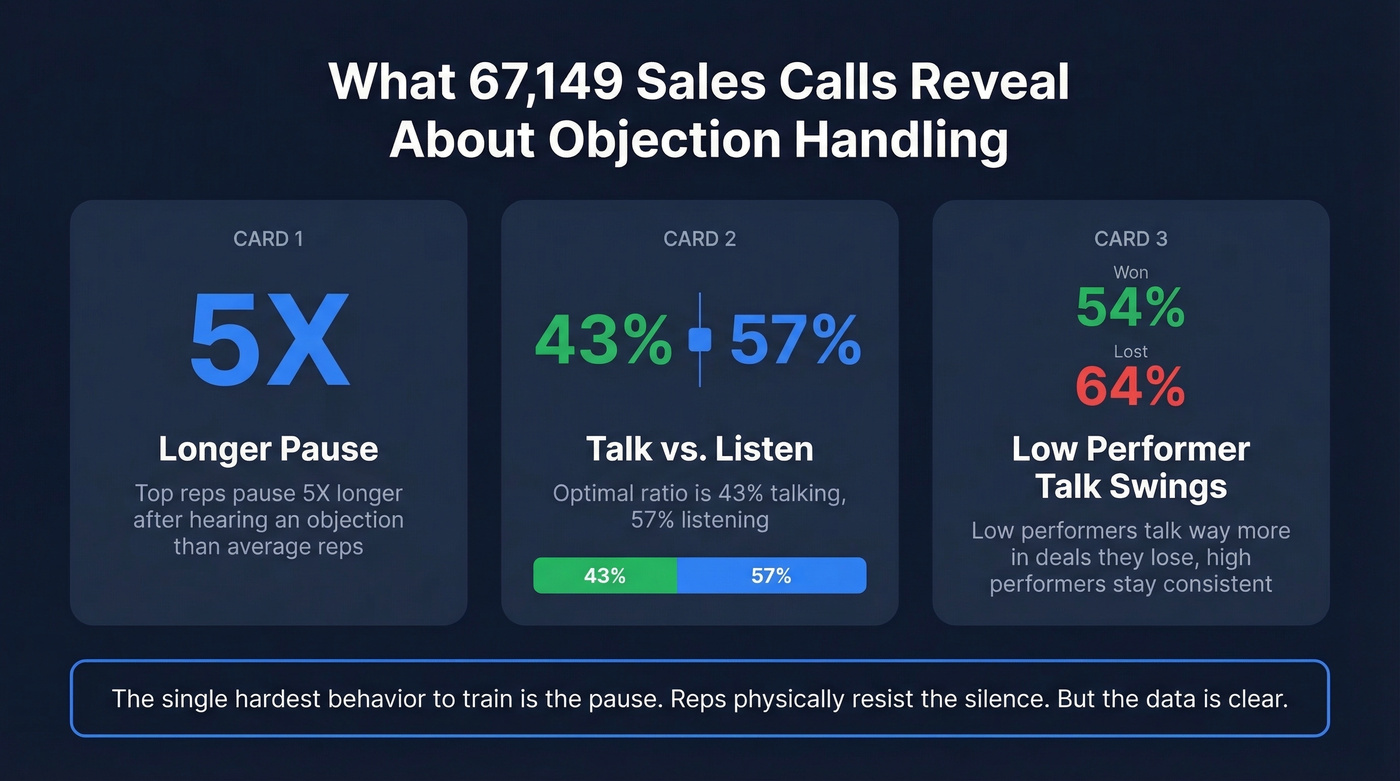
That pause does two things. It signals that you're actually listening, and it gives your brain time to formulate a response that isn't defensive. In our experience, the pause is the single hardest behavior to train - reps physically resist the silence. But the data is unambiguous.
The talk-to-listen ratio data reinforces this. Gong's benchmarks put the optimal ratio at 43% talk / 57% listen. But the real separator isn't the ratio itself - it's consistency. Low performers' talk time swings wildly: 54% in won deals versus 64% in lost deals. High performers keep their patterns steady regardless of outcome.
One more practical tip from the research: top performers sprinkle in micro-check questions like "Does that make sense?" throughout the conversation. It's not filler - it's a pressure-release valve that keeps the prospect engaged and surfaces hidden objections early.
The consensus on r/sales echoes this: the "secret" to handling objections isn't a magic line. It's asking one more question before you respond. The data backs them up.
25 Sales Objection Responses by Category
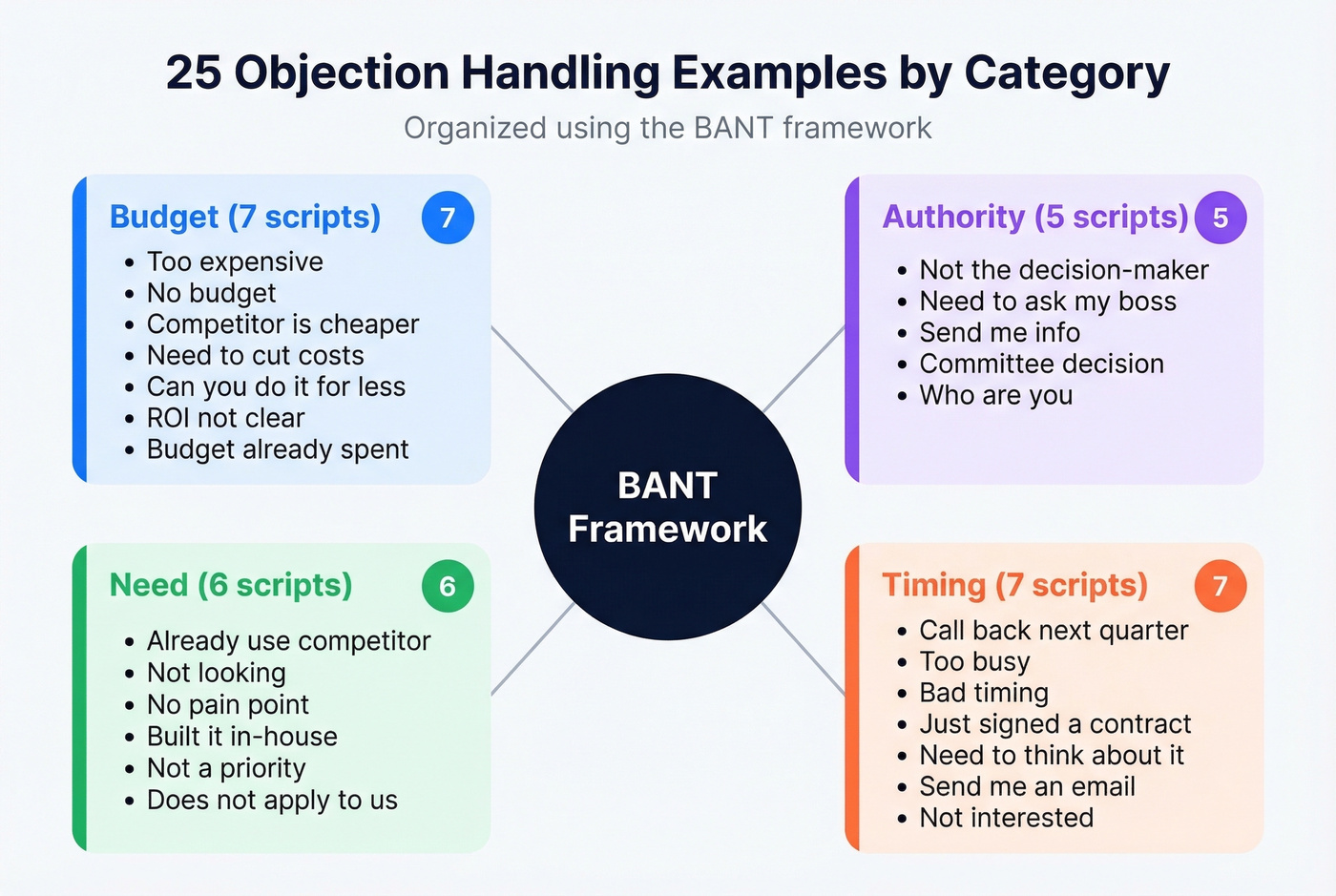
Most objections fall into four buckets: Budget, Authority, Need, and Timing - the classic BANT framework. Each example below includes the objection, a multi-turn exchange, and the principle behind it.
Budget Objections
1. "It's too expensive."
Prospect: "Honestly, this is more than we want to spend." Rep: [Pause] "Appreciate you being upfront. When you say too expensive - is that relative to your budget, or relative to what you expected a solution like this to cost?" Prospect: "Both, really. We had a number in mind and this is above it." Rep: "Got it. Let's talk about the outcomes that would make this feel worthwhile. If we could [specific result], would that change the math?"
Don't defend the price. Shift to outcomes.
2. "We don't have budget for this."
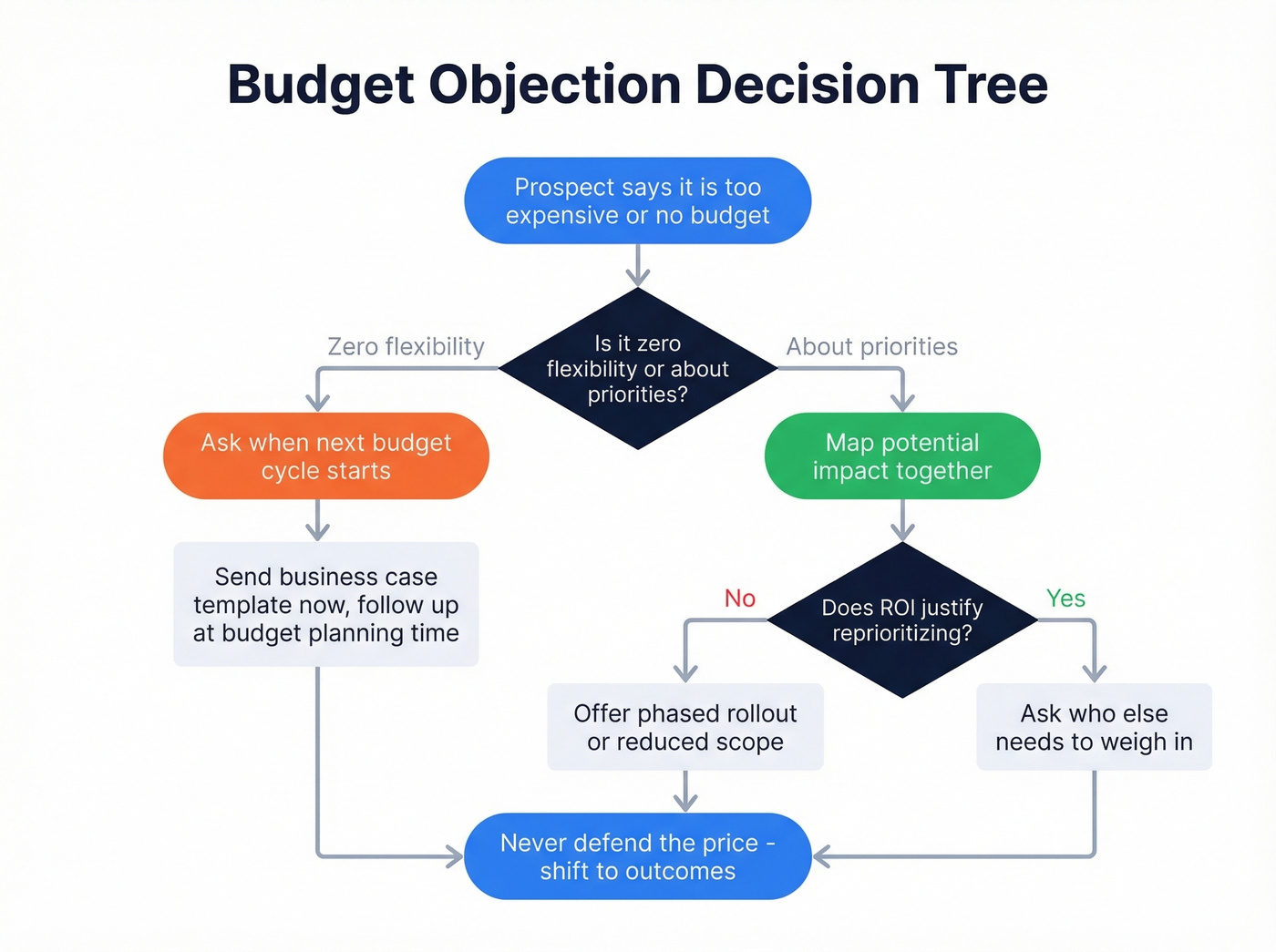
Prospect: "There's no budget allocated for this right now." Rep: "Understood. Is that zero flexibility, or is this more about where to prioritize spend?" Prospect: "It's more about priorities. We've already committed to other projects this quarter." Rep: "That makes sense. Can we map the potential impact together? If the ROI justifies reprioritizing, who else would need to weigh in on that decision?"
The dig question - "zero flexibility, or about where to prioritize?" - is one of the best budget probes in the playbook.
3. "Your competitor is cheaper."
Prospect: "We got a quote from [Competitor] that's 30% less." Rep: "That's worth looking at. Quick question - does their proposal include onboarding, dedicated support, and the analytics module? Or is that priced separately?" Prospect: "I'm not sure, actually." Rep: "Let's compare apples to apples. I'll send you a side-by-side of total cost of ownership. Most teams find the gap narrows - or flips - once you factor in implementation."
Sticker price almost never tells the full story.
4. "We need to cut costs right now."
Prospect: "Leadership is pushing cost reduction across the board." Rep: "I hear you - that's the reality for a lot of teams right now. What if this actually helps you cut costs? Our average customer reduces [specific cost] by [X%]. Would that be worth a 20-minute deep dive?" Prospect: "Maybe. What kind of cost reduction are we talking about?" Rep: "Let me pull a case study from a company your size. I'd rather show you real numbers than hypotheticals."
5. "Can you do it for less?"
Prospect: "We love the product, but we need a better price." Rep: "Before we talk numbers - what's driving the ask? Is it budget constraints, or are you comparing to another option?" Prospect: "A bit of both. We have a number we need to hit internally." Rep: "Got it. Let's figure out what scope gets you to that number without cutting the pieces that actually drive ROI. Sometimes a phased rollout solves this."
Discounting too early devalues everything you've built. Start with ROI. Always.
6. "The ROI isn't clear."
Prospect: "I can't justify this to my CFO without clear numbers." Rep: "That's reasonable. Let's build the business case together. What metrics does your CFO care about most - cost savings, revenue impact, or time-to-value?" Prospect: "Revenue impact, mainly." Rep: "Perfect. I'll pull the revenue data from three customers in your space and we'll build a projection your CFO can actually evaluate. Can we block 30 minutes this week?"
7. "We already spent our budget this year."
Prospect: "Our budget for this category is fully allocated through year-end." Rep: "When does the next planning cycle start?" Prospect: "We start budgeting in October for next year." Rep: "Let's do this - I'll send you a business case template now so you can include this in the next cycle. And if anything frees up before then, you'll have the numbers ready to move fast."
Timing the follow-up to their budget cycle is more effective than pushing against a wall.
Authority Objections
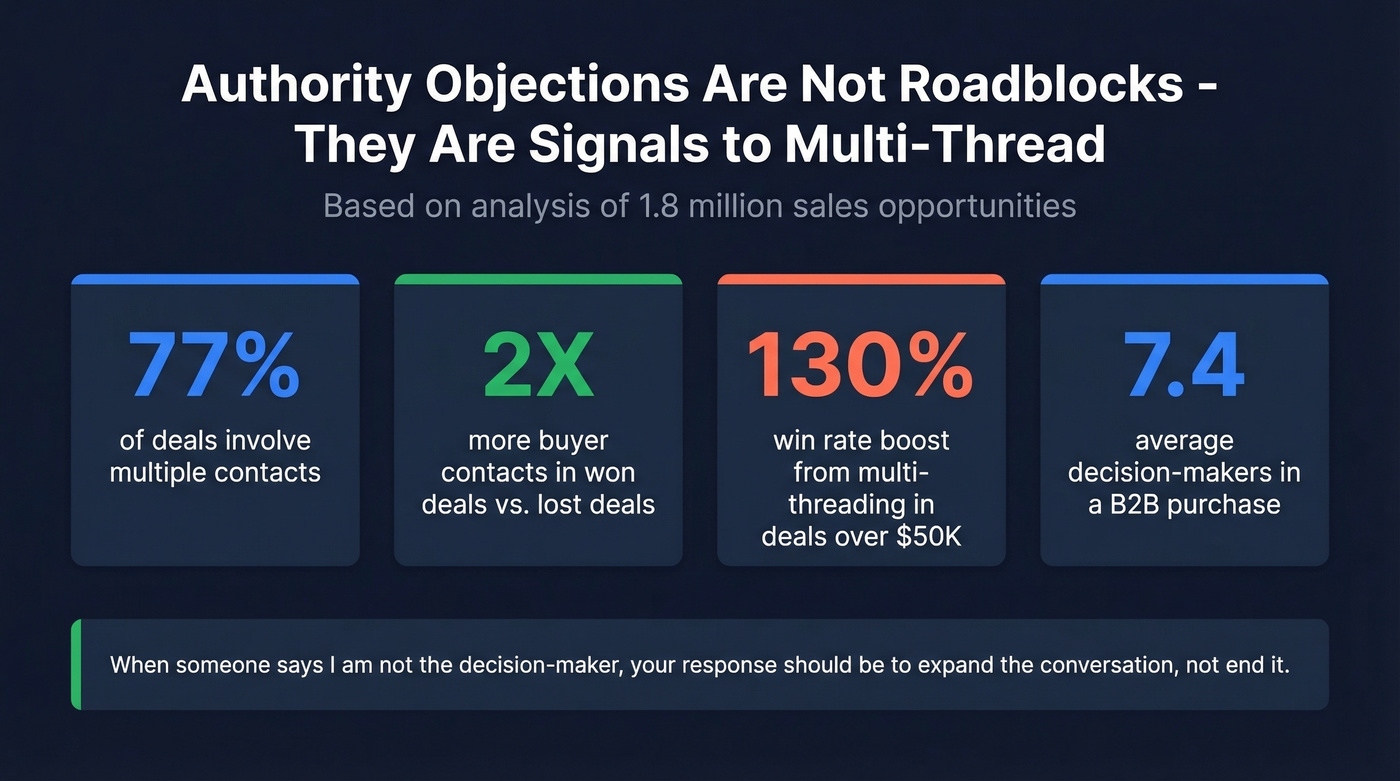
After analyzing 1.8 million opportunities, conversation intelligence research found that 77% of deals involve multiple contacts, and closed-won deals have roughly 2X as many buyer contacts as closed-lost. Multi-threading boosts win rates by 130% in deals over $50K. The average B2B purchase involves 7.4 decision-makers. Authority objections aren't roadblocks - they're signals to multi-thread.
8. "I'm not the decision-maker."
Prospect: "I appreciate the info, but I don't make this call." Rep: "No problem. Can you help me understand who does? And would it make sense for us to loop them into a quick conversation so you're not playing telephone?" Prospect: "That would be [Name], our VP of Ops." Rep: "Perfect. I'll reach out to them directly and reference our conversation. What's the best way to connect?"
9. "I need to run this by my boss."
Prospect: "This looks good, but I need to check with my manager." Rep: "Of course. What questions do you think they'll have? I want to make sure you've got everything you need to present this well." Prospect: "Probably budget and timeline." Rep: "Let me put together a one-pager that covers both. And would it help if I joined that conversation? Sometimes it's easier than relaying technical details secondhand."
10. "Send me some info and I'll share it internally."
Prospect: "Just send me a deck and I'll pass it along." Rep: "Happy to. But decks don't answer questions - and your team will have them. What if I send the materials and we schedule a 15-minute call with whoever's evaluating this? That way nothing gets lost."
11. "We have a committee for this."
Prospect: "Purchasing decisions go through a review committee." Rep: "Got it. How many people are on the committee, and what does each person care about most? I can tailor materials for each stakeholder so you're not doing all the heavy lifting." Prospect: "There are five of us. Finance, IT, operations, and two VPs." Rep: "Let me build five versions of the business case - each one speaking to what that person actually cares about. That's what gets committees to yes."
12. "Who are you? I don't know your company."
Prospect: "I've never heard of you guys." Rep: "Fair - we're not a household name yet. We work with [2-3 recognizable customers in their industry]. The reason I'm reaching out is [specific, relevant value prop]. Worth 5 minutes?"
A lot of "wrong person" and "who are you?" objections happen because the data was wrong in the first place. We've seen this firsthand - cleaning up contact data before the campaign launches means you're reaching verified decision-makers, not burning your best talk track on the wrong contact. Tools like Prospeo, with a 7-day data refresh cycle and 98% email accuracy, keep your outreach pointed at the right people. (If you're evaluating vendors, start with data enrichment and lead enrichment.)
Need Objections
13. "We already use [Competitor]."
Prospect: "We're locked into [Competitor] for another year." Rep: "Makes sense. How's it going? If everything's working perfectly, I'll leave you alone. But most teams I talk to have at least one gap they're working around." Prospect: "It's fine. Not perfect, but fine." Rep: "What's the 'not perfect' part? That's usually where we add the most value."
14. "We're not looking for anything new right now."
Prospect: "We're happy with our current process." Rep: "Glad to hear it. Out of curiosity - what could I have said about this topic that might have actually interested you?"
That meta-question - borrowed from EBQ's cold-call framework - is disarming because it's genuinely curious. It often unlocks the real objection hiding behind the polite brush-off.
15. "This isn't a priority."
Prospect: "We've got bigger fish to fry right now." Rep: "I get it. What's the biggest priority right now? Sometimes what we do actually supports that - and sometimes it doesn't. Either way, I'd rather know."
16. "I don't see how this applies to us."
Prospect: "This seems like it's for bigger companies." Rep: "I hear that a lot, actually. Our sweet spot is [their company size/type]. Let me give you a 60-second example of how [similar company] uses this. If it doesn't click, we'll part ways."
17. "We tried something like this before and it didn't work."
Prospect: "We had a bad experience with a similar tool." Rep: "That's important context. What went wrong? I want to make sure we're not repeating the same mistake - and honestly, if the issue was fundamental, I'll tell you." Prospect: "Implementation was a nightmare. Took six months and we never fully adopted it." Rep: "That's the number one failure mode in this category. Our implementation averages [X weeks] and we assign a dedicated onboarding lead. But let me ask - was the problem the tool itself, or the rollout?"
18. "I need to think about it."
Prospect: "Let me think it over." Rep: "Of course. What specifically do you want to think through? I ask because sometimes I can answer it right now and save you the back-and-forth."
19. "Our team won't adopt another tool."
Prospect: "We've got tool fatigue. My team barely uses what we have." Rep: "That's the most honest objection I hear, and it's valid. What if this replaced one of those tools instead of adding to the stack? Which tool gives your team the most headaches right now?" Prospect: "Probably our CRM enrichment workflow. It's all manual." Rep: "That's exactly what we automate. Let me show you a 3-minute demo of the integration - if it doesn't obviously save time, I'll stop pitching."
Timing Objections
Around 80% of sales require 5+ follow-ups, but roughly 92% of reps quit after 4 attempts. Timing objections aren't rejections - they're invitations to be persistent. (If you need sequences, use these sales follow-up templates.)
20. "Call me next quarter."
Prospect: "The timing isn't right. Reach out in Q3." Rep: "I'll absolutely follow up then. Quick question - what changes in Q3 that makes this a better conversation? I want to make sure I come back with the right information."
21. "We're too busy right now."
Prospect: "It's our busiest season. Can't even think about this." Rep: "Completely understand. Would it make sense to spend 10 minutes now scoping this out, so when things calm down we can move fast? That way you're not starting from scratch in Q3."
22. "We just signed a contract with someone else."
Prospect: "We literally just signed with [Competitor] last month." Rep: "Congrats on getting that sorted. When does the contract come up for renewal? I'd love to be in the conversation 90 days before that - even if it's just a benchmark."
23. "Now's not a good time - we're going through [change]."
Prospect: "We're in the middle of a reorg." Rep: "That's actually when most of our customers first evaluate us - new leadership wants to see what's working and what's not. Would it help to have a quick benchmark ready for whoever lands in the seat?"
24. "I don't have time for a demo."
Prospect: "I can't commit to a 45-minute demo right now." Rep: "Noted. What if I send you a 3-minute video walkthrough instead? If it clicks, we'll find 15 minutes. If not, no hard feelings."
25. "We're evaluating options later this year."
Prospect: "We're planning to look at solutions in Q4." Rep: "Smart to plan ahead. Most teams that wait until Q4 to start evaluating end up rushing the decision. What if we do a low-pressure intro now so you've got a baseline when the formal eval kicks off?" Prospect: "That could work, actually." Rep: "I'll send a 10-minute overview and a comparison framework you can use for any vendor. No strings - it just makes your Q4 process faster."

You can't handle objections if you never reach the decision-maker. Prospeo gives you 98% accurate emails and 125M+ verified mobile numbers - so your reps spend time overcoming real objections, not chasing bad data.
Stop rehearsing scripts for voicemails that never get returned.
Stage-Specific Scenarios
The same objection requires a completely different response depending on where you are in the sales cycle. On a cold call, your goal is curiosity and a next step, not a sale. Don't try to overcome objections - earn 30 more seconds. (For more cold outreach structure, see cold calling and a full cold calling system.)
| Stage | Your Goal | Response Style | Example |
|---|---|---|---|
| Cold call | Earn curiosity | Light, quick, pivot | "Fair point. 15 seconds - then you decide." |
| Discovery | Understand root cause | Exploratory, question-heavy | "Help me understand what's behind that." |
| Closing | Remove final barriers | LAER framework, specific | "What needs to change for you to feel confident?" |
Late-stage objections are psychologically different. Carew International identifies four drivers: decision anxiety, new stakeholders entering the conversation, analysis paralysis, and competitive dynamics shifting. These aren't the same as "I'm not interested" on a cold call. They require patience, specificity, and often bringing in additional resources.
Bringing in a sales engineer for enterprise demos can increase win rates by up to 30%. Most reps resist this because it feels like admitting they can't close alone. Get over it. Your ego is costing you deals. (If demos are a weak spot, use a product demo checklist.)
Frameworks Compared
Four frameworks dominate sales objection handling training. If you only learn one, make it LAER.
| Framework | Steps | Best Stage | Strength | Weakness |
|---|---|---|---|---|
| LAER | Listen, Acknowledge, Explore, Respond | All stages | Forces root-cause discovery | Takes practice to internalize |
| Feel-Felt-Found | Feel, Felt, Found | Transactional / early | Simple, easy to teach | Feels formulaic in complex deals |
| Boomerang | Redirect the objection back as a reason to buy | Mid-funnel | High impact when it lands | Risky if poorly executed |
| 4Ps | Pause, Probe, Provide, Prove | Discovery | Structured, data-friendly | Slower, less natural |
LAER wins because the "Explore" step forces you to ask questions like "What would need to change for you to feel confident moving forward?" and "Who else has input on this decision that we haven't connected with?" Those questions uncover the real objection - which is rarely the first thing the prospect says.
Feel-Felt-Found is fine for simpler sales cycles, but in complex B2B with 7+ decision-makers, it's too shallow. The Boomerang technique is powerful in the right hands but dangerous in the wrong ones - turning "it's too expensive" into "that's exactly why you need it" requires serious finesse. Skip it if you're not confident you can land it naturally.
Mistakes That Kill Deals
Believing the first objection is real. It's usually a smoke screen. "Too expensive" often means "I don't see the value yet" or "I'm scared of change." The real objection is rarely the first one you hear. Dig before you respond.
Rushing to answer. The conversation intelligence data is unambiguous - top performers pause 5X longer. That silence feels uncomfortable. Lean into it.
Arguing or getting defensive. The moment you argue, you've lost. Resistance increases, rapport evaporates, and the prospect mentally checks out. Stay empathetic even when the objection feels unfair.
Discounting too early. Dropping price before establishing value trains the prospect to push harder. If you discount before the prospect understands what they're buying, you've anchored the entire relationship to the wrong number. Start with ROI. Always.
Failing to prepare. Look - if you're hearing the same objections and getting surprised every time, that's a preparation problem. Use your CRM data and call recordings to build an objection playbook before you need one. We've found that teams who study real dialogue from their own recorded calls improve twice as fast as those working from generic scripts. (This pairs well with sales training tips and competitive sales training.)
How to Train Your Team
Knowing the scripts isn't enough. Your team needs to practice until responses feel automatic.
Rapid-fire drill (5-10 min): One person throws objections nonstop. The rep responds immediately. Speed and comfort over perfection - the goal is eliminating the freeze response. This is the warm-up, not the workout.
Structured role play: Pair up. One plays prospect, one plays rep. Run a full 5-minute scenario, then debrief what worked and what didn't. Switch roles. Record it if possible - reps are always surprised by how much they talk.
"Why behind the objection" exercise: The rep can only respond with clarifying questions - no statements, no rebuttals. This forces the habit of exploring before responding and is the single fastest way to internalize the LAER framework. I've watched reps go from average to top-quartile in weeks just from this one drill.
Competitor scenario practice: Start with a discovery call where the prospect mentions a specific competitor. The rep must transition from discovery to differentiation to value without bashing the competitor. Harder than it sounds.
Call review training: Pull a real recorded call. Pause at each objection. Ask the team: "How would you respond?" Compare to what actually happened. This is where the biggest breakthroughs happen - real calls expose patterns that role-play can't replicate. Reviewing objection handling examples from your own pipeline is far more effective than studying hypothetical scenarios.
Let's be honest: great objection handling starts before the call. Clean, verified contact data means fewer "who are you?" objections and more time spent on conversations that actually matter. (To tighten top-of-funnel inputs, use these sales prospecting techniques.)
Budget objections hit harder when your pipeline is thin. Teams using Prospeo book 35% more meetings than Apollo users - more at-bats means more chances to use these scripts on real prospects.
Fill your pipeline at $0.01 per verified email. No contracts.
FAQ
What's the difference between an objection and a rejection?
An objection means the prospect is still engaged but needs something resolved. A rejection is a firm no. Most apparent rejections are actually objections in disguise - dig deeper with one clarifying question before walking away.
How many objections should I expect per B2B deal?
Expect 3-5 distinct objections per complex B2B deal, with more surfacing near the decision point. The average purchase involves 7.4 decision-makers, and each brings their own concerns. Reviewing closed-won calls in your CRM reveals the most common patterns for your specific market.
What's the best framework for handling sales objections?
LAER (Listen, Acknowledge, Explore, Respond) works across all sales stages and forces you to uncover the real objection before responding. It outperforms simpler frameworks like Feel-Felt-Found in complex deals with multiple stakeholders.
How does better prospect data reduce objections?
Verified contact data eliminates "wrong person" and "who are you?" objections before they happen. When reps spend talk time on real buying concerns instead of data errors, they get more at-bats against objections that actually matter - and more practice handling them well.