

Sales Enablement Best Practices That Actually Move Revenue
Your team sends 5,000 emails. 1,200 bounce. The battlecard you spent three weeks building never reaches the prospect because the email address was dead before the sequence fired. That's not a content problem - it's a data problem, and it's the sales enablement best practice most teams skip entirely.
Revenue teams waste 440 hours per year searching for or recreating content. Reps spend only 30% of their time actually selling. Most enablement programs focus on the content and training layers while ignoring the foundation underneath - the quality of the contact data flowing through every tool in the stack. If you're trying to improve enablement at your org, start there.
The Short Version
Three things separate enablement programs that prove ROI from those that get cut at budget review:
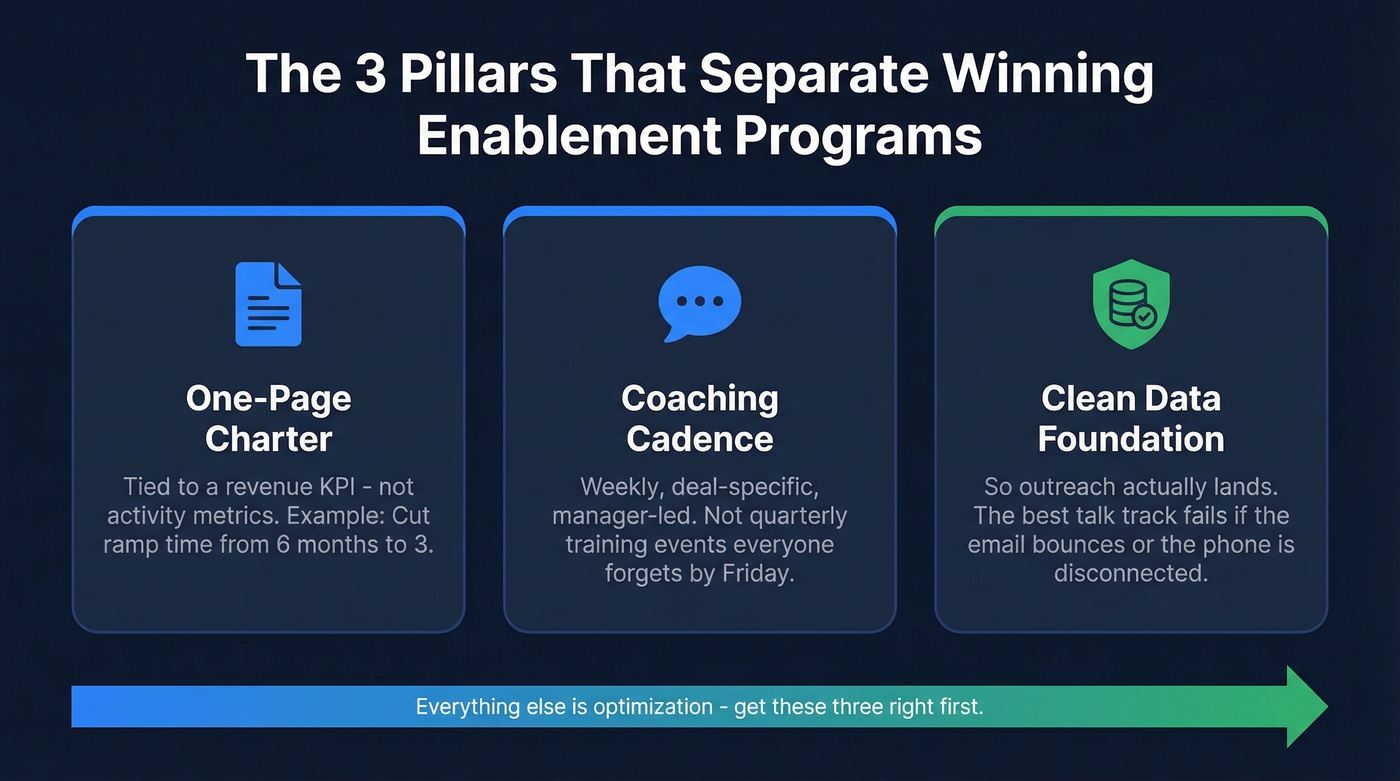
- A one-page charter tied to a revenue KPI - not "deliver 12 training sessions" but "cut ramp time from 6 months to 3." (If you need a ramp framework, use a 30-60-90 day plan.)
- A coaching cadence - weekly, deal-specific, manager-led. Not quarterly training events everyone forgets by Friday.
- A clean data foundation so outreach actually lands. The best talk track in the world doesn't help if the phone number is disconnected and the email bounces.
Everything else is optimization. Get these three right first.
What Sales Enablement Means in 2026
Sales enablement is the ongoing, cross-functional process of equipping revenue teams with the content, coaching, tools, and insights they need to engage buyers and close deals. That's Seismic's definition, and it holds up.
What it's not: sales ops (which owns process and systems) or sales training (which is a single activity within enablement, not the whole thing). Teams that treat enablement as "training + a content library" plateau fast.
The bigger shift is from sales enablement to revenue enablement. More than 50% of CSOs expect enablement to support marketing and customer success roles within the next three years, per Gartner. The function is expanding beyond sellers to cover the full customer lifecycle - onboarding, retention, expansion. If your enablement charter still says "sales training," you're scoping too narrowly.
Why It Matters Now
Here's the tension: 75% of B2B buyers prefer a rep-free experience, but 43% of buyers who go fully self-service report higher purchase regret. Buyers want independence until they don't - and when they re-engage with a rep, that rep needs to be sharp, relevant, and armed with the right content for that exact moment in the deal.

Companies with formal enablement programs see 49% higher win rates on forecasted deals. That's not a marginal improvement - it's the difference between a team that hits plan and one that restructures every Q3. Enablement adoption has surged from 32% to 76% of organizations in five years, and in 2026, an estimated 65% of B2B sales organizations are shifting from intuition-based to data-driven decision making. Despite all this momentum, only 22% of the average enablement budget goes to technology. The question isn't whether you need enablement - it's whether your program is delivering measurable revenue impact or just generating activity metrics nobody reads.
Who Should Own Enablement?
| Function | Ownership % |
|---|---|
| RevOps | 39.4% |
| Sales | 25.4% |
| C-Suite | 16.6% |
| Marketing | 5.2% |
| Product Marketing | 3.5% |
| HR | 2.6% |
| Other | 7.3% |
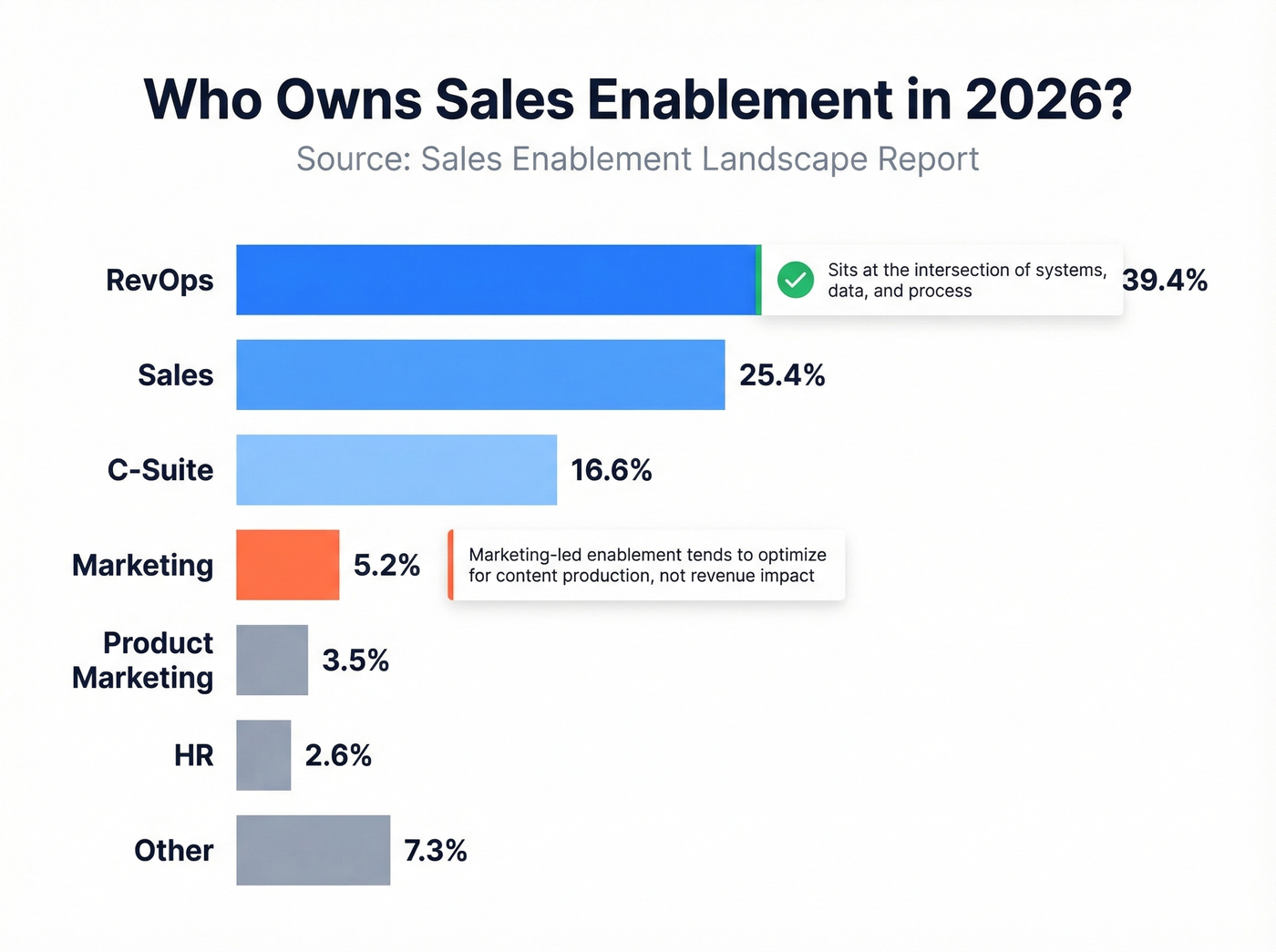
Data from the Sales Enablement Landscape Report tells a clear story: RevOps-led enablement dominates, and for good reason. RevOps sits at the intersection of systems, data, and process - exactly where enablement needs to live. (If you're hiring or scoping the role, see RevOps Manager.)
Here's the thing: marketing-led enablement (5.2%) tends to optimize for content production, not revenue impact. You get beautiful battlecards that nobody uses and webinar decks that don't map to deal stages. If your enablement function reports into marketing, it's probably measuring the wrong things.
10 Practices That Drive Revenue
1. Start With a One-Page Charter
Your charter is mission, scope, ownership, and one year-one success metric on a single page. Example: "Reduce ramp time from 6 months to 3 months while maintaining 85%+ quota attainment for the 2026 cohort."
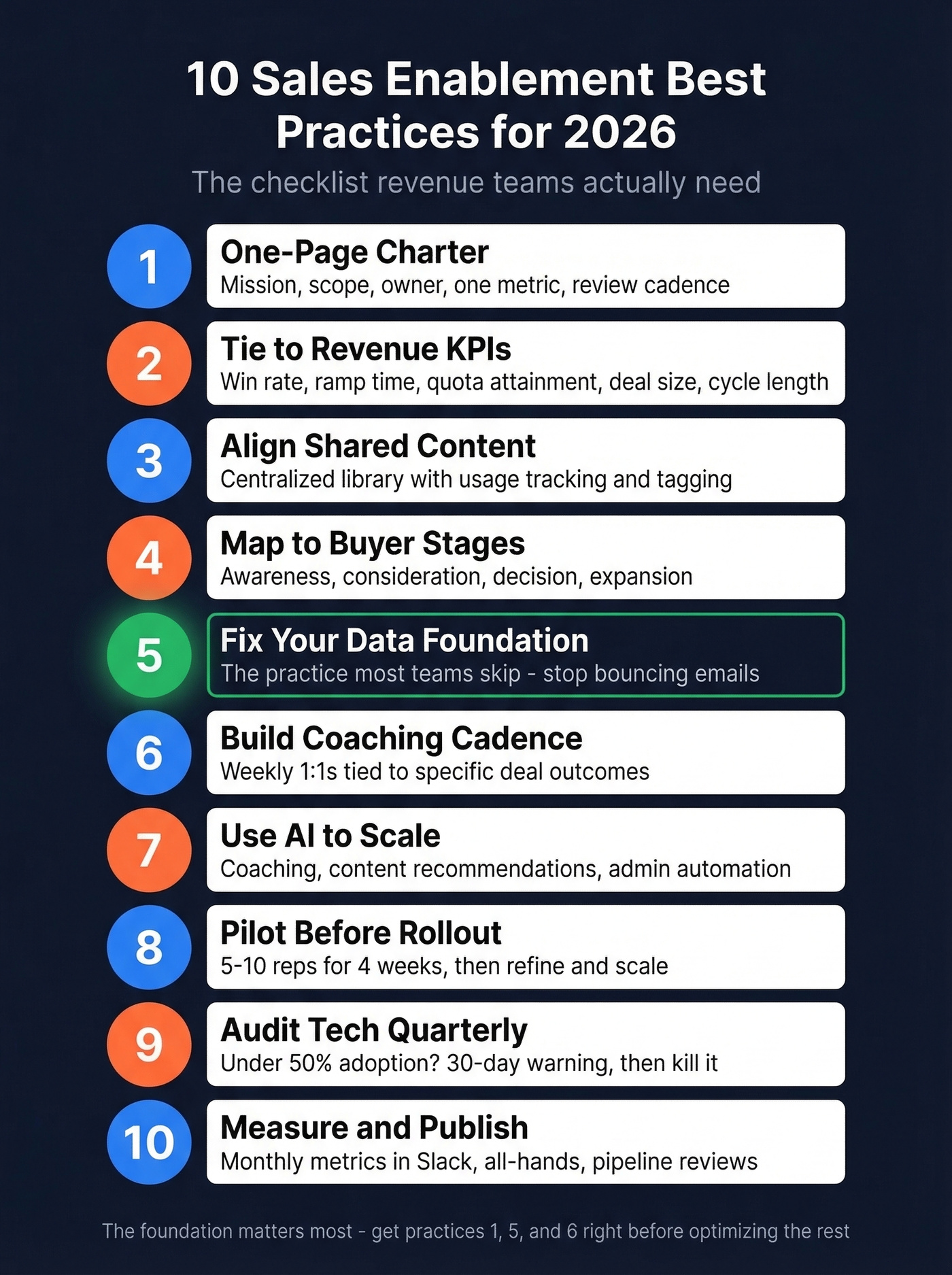
If your charter is longer than one page, it won't get read. If it doesn't have a number attached, it won't get funded.
Charter template fields: Mission, Scope, Owner, Year-1 Metric, Review Cadence. Fill those five boxes and you have a charter that actually gets read in leadership meetings.
2. Tie Every Initiative to a Revenue KPI
Activity metrics - sessions delivered, content pieces created, training hours logged - are vanity metrics for enablement. Every initiative should connect to a revenue-linked outcome: win rate, ramp time, quota attainment, deal size, or sales cycle length.
If you can't draw a line from the initiative to one of those numbers, question whether it belongs in the program. The KPI targets later in this article give you concrete benchmarks. This is one of the most overlooked enablement tips, and it's the one that keeps your budget alive.
3. Align Teams Around Shared Content
Only 30% of marketing-created content gets used by sales. Reps recreate existing content 40% of the time because they can't find it or don't trust it.
The fix is a centralized content library with usage tracking. Organizations with centralized libraries see 25% higher content usage rates. Tag everything by buyer stage, persona, and deal type. If a rep can't find the right case study in under 60 seconds, your system is broken.
4. Map Content to Buyer Stages
Every content asset should have a home in the buyer journey: awareness (thought leadership, industry reports), consideration (battlecards, comparison guides), decision (ROI calculators, case studies, talk tracks), and expansion (onboarding guides, upsell playbooks).
If you've got 50 case studies and zero ROI calculators, you know where the gap is.
5. Fix Your Data Foundation First
This is the practice most enablement guides skip entirely. You can build the perfect battlecard, run flawless coaching sessions, and arm reps with killer talk tracks - none of it matters if the email bounces or the phone number is disconnected.
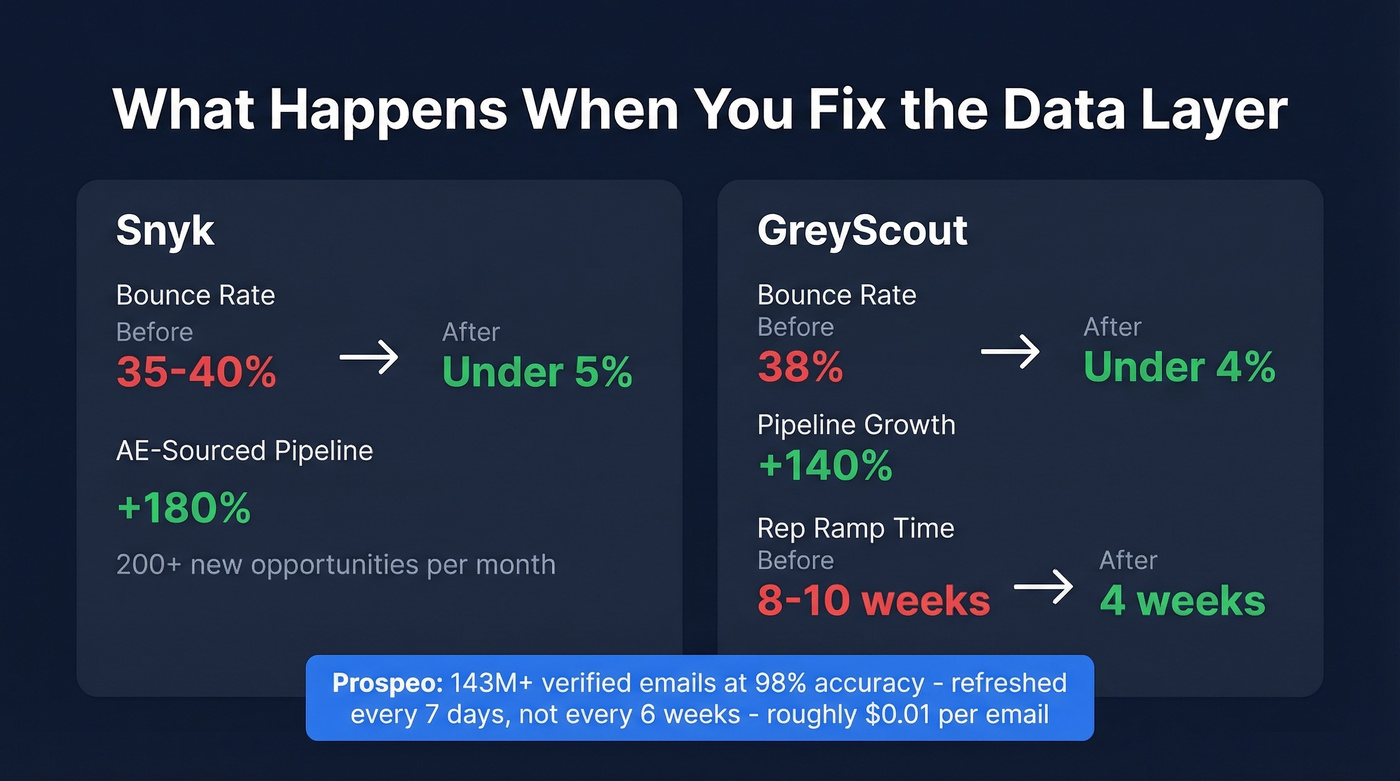
We've watched teams invest six figures in enablement platforms while their outbound sequences bounce at 35%+. Snyk went from 35-40% bounce rates to under 5% after fixing their data layer - AE-sourced pipeline jumped 180% and they generated 200+ new opportunities per month. GreyScout dropped from 38% to under 4%, pipeline grew 140%, and rep ramp time was cut from 8-10 weeks to 4. (If you're diagnosing bounces, start with email bounce rate benchmarks and fixes.)
Prospeo fits here at the foundation level: 143M+ verified emails at 98% accuracy, 125M+ verified mobile numbers, and a 7-day data refresh cycle where the industry average is six weeks. At roughly $0.01 per email with a free tier to start, it's the cheapest insurance policy your enablement stack can buy - with native integrations for Salesforce, HubSpot, Smartlead, Instantly, and Lemlist so it plugs into whatever you're already running. (For a broader view, compare data enrichment services.)

6. Build a Coaching Cadence
One-and-done training doesn't stick. The consensus on r/b2b_sales is that inconsistent rep behavior remains the #1 challenge for enablement leaders, and it's easy to see why - a quarterly SKO doesn't change daily habits. Meanwhile, 49% of sellers believe their current skills will be outdated within 2-3 years, which makes continuous coaching non-optional.
Weekly 1:1 coaching tied to specific deal outcomes beats generic skills training every time. Review a lost deal. Role-play a discovery call. Debrief a competitive situation. Make it specific, make it recurring, make it non-negotiable. (If you need a structure, use discovery questions.)
7. Use AI to Scale What Works
81% of sales teams already use AI in some form. Sales leaders using AI forecast 25% higher revenue growth on average. The question isn't adoption - it's where to deploy it first.
Three high-impact starting points: AI coaching (teams using it see 14% higher win rates), AI content recommendations (41% improvement in relevance, 28% less time searching), and admin automation that frees reps from digging through disconnected tools all day. (For outreach use cases, see AI cold email outreach.)
8. Pilot Before Full Rollout
Pilot 5-10 reps for 4 weeks. Gather structured feedback. Refine the program. Then scale.
This avoids the classic trap: you buy a platform, roll it out to 200 reps, and six months later discover 43% of your tools have under 50% adoption. Pilots are cheap. Failed rollouts aren't.
9. Audit Your Tech Stack Quarterly
91% of sales orgs use 3+ enablement tools. The average stack runs 10+ solutions. You don't need 10 tools. You need 3 that talk to each other.
Every quarter, pull adoption data. Anything under 50% usage gets a 30-day warning. If it doesn't recover, kill it. The money you save on shelfware funds the tools reps actually use. Regular audits are the backbone of enablement optimization - you can't improve what you don't measure. (If you're standardizing outreach, start with sequence management.)
10. Measure and Publish Results
Publish enablement metrics to the sales team monthly. Not in a buried Confluence page - in the team Slack channel, in the all-hands deck, in the weekly pipeline review.
Transparency drives adoption. When reps see that coached deals close 14% more often, they show up to coaching sessions. (If you want a clean set of leading/lagging indicators, use funnel metrics.)

The best enablement program in the world can't fix a 35% bounce rate. Prospeo gives your reps 143M+ verified emails at 98% accuracy and 125M+ verified mobiles - refreshed every 7 days, not every 6 weeks. That's the data foundation this article is telling you to build.
Stop enabling reps to send emails that bounce. Start here.
Snyk cut bounce rates from 35% to under 5% and saw AE-sourced pipeline jump 180%. GreyScout slashed rep ramp time in half. Both started by fixing the data layer underneath their enablement stack - with 98% email accuracy at $0.01 per lead.
Every sales enablement best practice starts with data that actually connects.
Enablement Maturity Model
Most teams are stuck between Stage 1 and Stage 2. Use this as a self-assessment to identify the one or two capabilities that would move you to the next level.
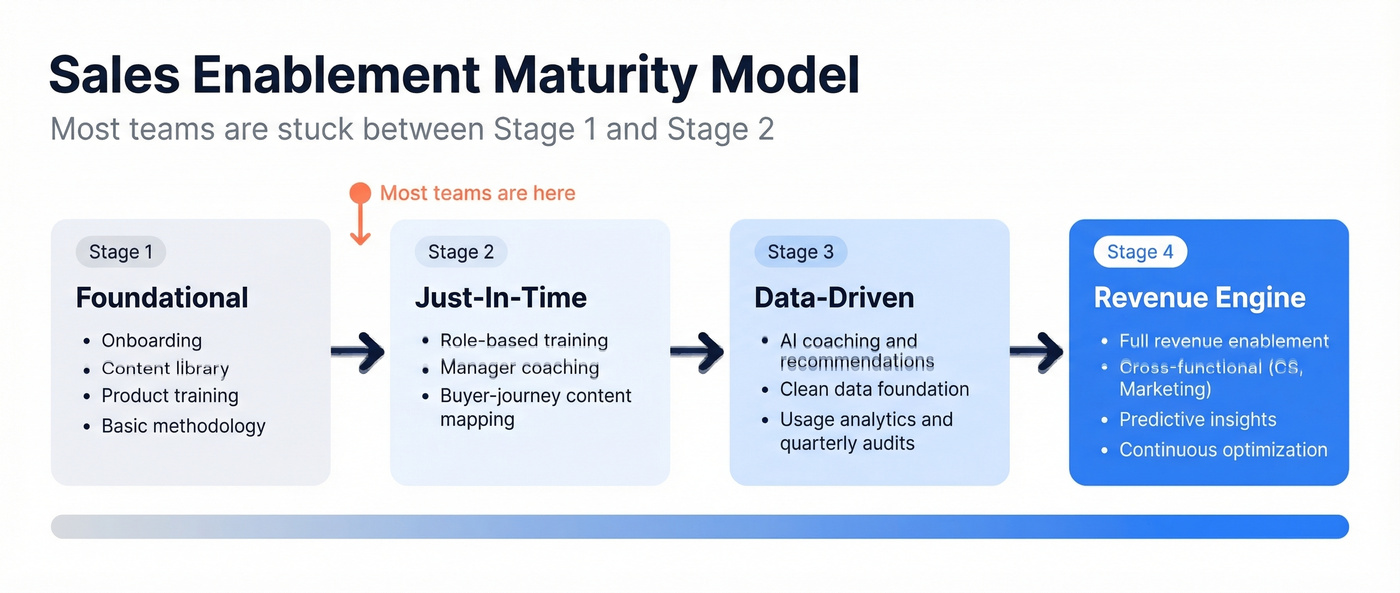
| Stage | Name | Key Capabilities |
|---|---|---|
| 1 | Foundational | Onboarding, content library, product training, basic methodology |
| 2 | Just-In-Time | Role-based training, manager coaching, buyer-journey content, guided selling |
| 3 | Optimized | Certifications, peer learning, AI content suggestions, digital sales rooms |
| 4 | Transformative | 1:1 AI coaching, AI content creation, forecasting insights, full-cycle analytics |
Unlike pillar-based frameworks that list capabilities without sequencing, this model tells you what to build first. The jump from Stage 1 to Stage 2 is where most programs stall - but the actions are concrete. Assign each content asset to a buyer stage. Schedule weekly 1:1 coaching. Verify your prospect data so outreach actually lands. That's it - you're Stage 2.
Stage 3 and 4 require real AI integration and cross-functional alignment, but you can't skip there from Stage 1 no matter how much you spend on platforms. The progression is sequential, not optional.
Why Enablement Programs Plateau
Let's be honest about the pattern we see over and over: half of enablement leaders cite inconsistent rep behavior as their biggest challenge, automation maturity sits at 5-6 out of 10 even with bigger tech stacks, and most teams span Sales and CS but lack a connected system between them.
Most enablement doesn't fail at the content layer. Teams have plenty of content - often too much. It fails at the data layer and the systems layer. Reps can't find what they need. The CRM is full of stale contacts. The sequencer fires emails to addresses that haven't been verified in months. The coaching program exists on paper but gets skipped when pipeline reviews run long.
The fix isn't more content or another platform. It's connecting the systems you already have, cleaning the data flowing through them, and building a coaching rhythm that survives a busy quarter.
Skip the enterprise enablement platform entirely if your average deal size is under $10K. A clean CRM, verified prospect data, and a weekly coaching cadence will outperform a six-figure enablement contract every single time. We've seen this play out with enough teams to say it with confidence.
KPI Targets - What Good Looks Like
| Metric | Baseline | Target | Frequency |
|---|---|---|---|
| Win rate | 22% | 28% | Monthly |
| Ramp time | 6 months | 3 months | Per cohort |
| Content usage | 30% | 80% | Monthly |
| Quota attainment | Team avg | +10-15% | Quarterly |
| Sales cycle length | Current | -15-20% | Quarterly |
| Avg deal size | Current | +10% | Quarterly |
The Landscape Report shows what practitioners actually measure: content adoption (50%), quota attainment (43.1%), and win rate (42.2%) lead the pack. Content adoption is the most tracked metric, but it's a leading indicator, not a revenue outcome. Make sure your dashboard includes at least two lagging revenue metrics alongside any adoption metrics.
Enablement Tools and Pricing
| Category | Tool | Price Range |
|---|---|---|
| Enterprise Enablement | Seismic | ~$100K-$250K/yr |
| Enterprise Enablement | Highspot | ~$50K-$200K/yr |
| Enterprise Enablement | Showpad | ~$30K-$150K/yr |
| Mid-Market | Dock | Free; paid from $350/mo |
| Sales Engagement | Salesloft | ~$75-$125/user/mo |
| Sales Engagement | Outreach | ~$100-$130/user/mo |
| CRM | Salesforce | $25-$300/user/mo |
| CRM | HubSpot | Free to ~$90+/user/mo (Professional) |
| Data Layer | Prospeo | Free to ~$0.01/email |
Enterprise enablement platforms are overpriced for teams under 200 reps. A Seismic contract in the $100K-$250K/year range for a 50-person sales team works out to thousands per rep per year for what's essentially a content management system. Only 22% of the average enablement budget goes to technology - so when you do spend on tools, every dollar needs to count. Don't waste it on platforms with sub-50% adoption.
Ideas You Can Steal This Week
Not every improvement requires a six-month rollout. Here are three things you can implement in days, not quarters:
- Deal debrief Slack channel. After every closed-won or closed-lost, the owning rep posts a 3-sentence debrief. Peer learning compounds fast.
- 60-second content audit. Time how long it takes a new rep to find a competitive battlecard. If it's over 60 seconds, reorganize your library by deal stage and competitor.
- Data hygiene sprint. Run your top 200 target accounts through a verification tool and purge stale contacts before your next outbound push. In our experience, this single action improves reply rates more than any new talk track or training session.
FAQ
What's the difference between sales enablement and revenue enablement?
Sales enablement equips sellers with content, coaching, and tools to close deals. Revenue enablement extends that discipline to marketing, CS, and partner teams across the full customer lifecycle. Over 50% of CSOs expect this expansion within three years.
How long does it take to see ROI from enablement?
Most teams see measurable impact within one to two quarters if they tie initiatives to revenue KPIs and run a structured pilot first. Programs without clear metrics or executive sponsorship can drift for 6-12 months before anyone notices.
Why do most enablement programs fail?
Disconnected systems and inconsistent rep behavior are the top causes. Teams invest in content and training but skip the data foundation and coaching cadence - the two pillars that actually change daily rep behavior and outreach outcomes.
How much does an enablement platform cost?
Enterprise platforms like Seismic and Highspot run $50K-$250K per year. Mid-market options like Dock start at $350/month. For the data layer - verified prospect emails and direct dials - tools like Prospeo start free and scale at roughly $0.01 per email.
Should enablement report to sales or marketing?
RevOps ownership (39.4% of organizations) correlates with the strongest outcomes because RevOps sits at the intersection of systems, data, and process. Marketing-led enablement tends to optimize for content volume rather than revenue impact.
The best enablement programs aren't the ones with the most content or the fanciest platform. They're the ones where reps can find the right asset in 60 seconds, reach a verified contact on the first try, and get coached on a real deal every week. Nail those three things and the rest follows.