

The Only Competitor Battlecard Template You'll Actually Use
Your AE just lost a deal to a competitor they'd never heard of. The prospect asked about integrations, your rep froze, and a winnable deal walked. That's not a product problem - it's a missing 90-second reference doc.
Here's the gap: 79% of CI teams produce battlecards, but only 26% say reps actually use them enough. Meanwhile, 33% of deals are lost directly to a competitor, and nearly half of those losses were considered winnable. This template is ungated, filled with real examples, and built around the framework that separates cards reps use from cards that collect dust.
What You Need (Quick Version)
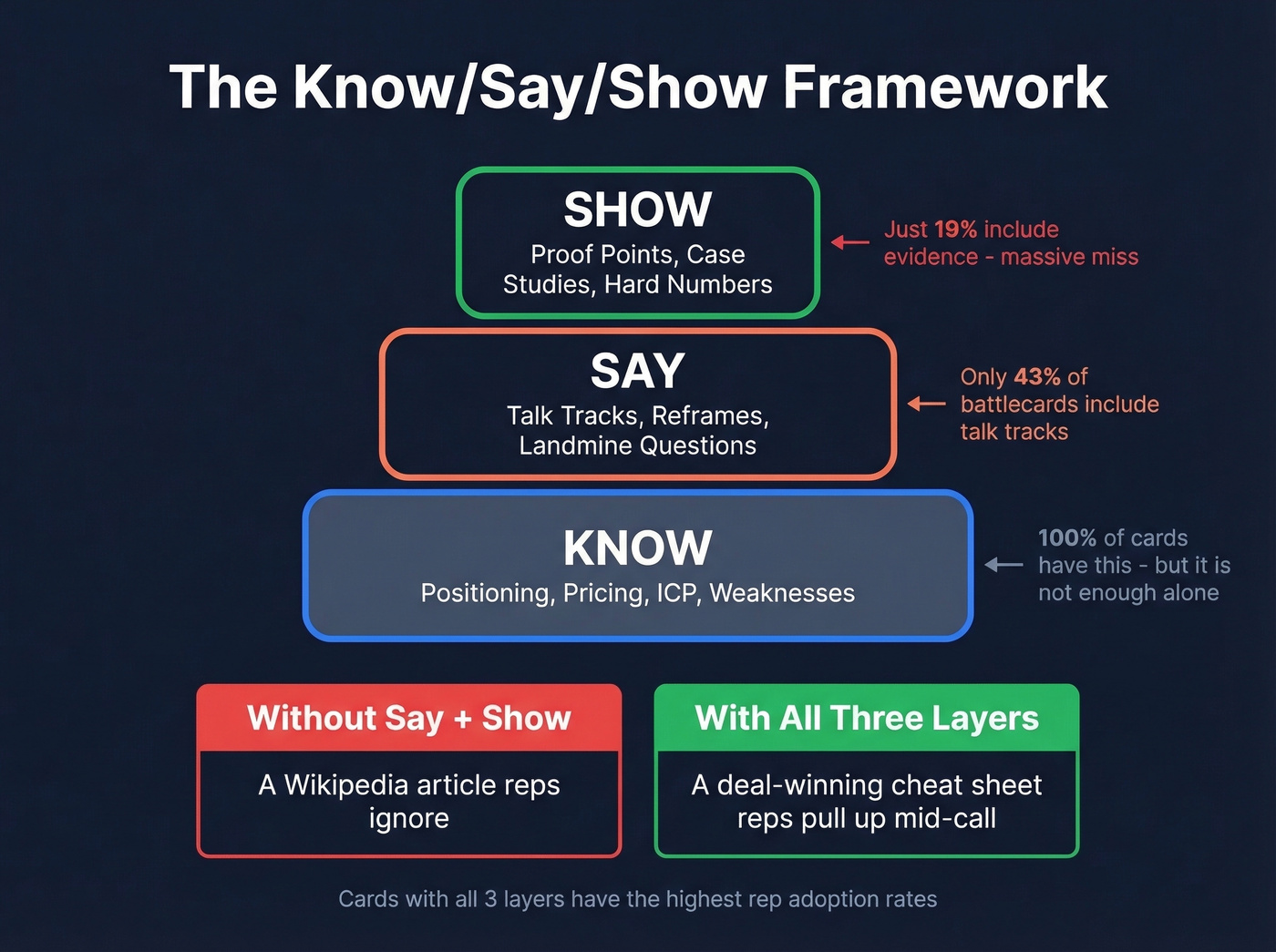
Every competitive battlecard that drives rep adoption contains three layers:
- Know - competitor positioning, pricing, target market, weaknesses
- Say - talk tracks, reframes, and landmine questions reps can use live on a call
- Show - proof points, customer stories, and specific numbers that back up your claims
If your card only has "Know," it's a Wikipedia article, not a sales tool. Jump to the full template or the intel-gathering plan if you already know the framework.
What a Battlecard Is (and Isn't)
A competitor battlecard is a concise, one-to-two-page reference designed to be scanned mid-call. It's not a brochure. It's not a 15-slide competitive report your PMM spent three weeks on. It's the cheat sheet your rep pulls up when a prospect says "We're also looking at [Competitor X]."
Sellers encounter competitors in 68% of deals. Two-thirds of your pipeline involves a moment where your rep either has the right words or doesn't. Feature comparison grids are where competitive deals go to die - they invite apples-to-apples comparisons on your competitor's turf. Great battlecards reframe the conversation instead.
Per commonly cited Crayon benchmarks, 71% of companies using battlecards report increased win rates, with 93% of those saying the increase exceeds 20%. The ROI isn't theoretical.
The Know/Say/Show Framework
100% of the highest-retention battlecards in a major audit contained all three layers. Yet only 43% of cards include talk tracks, just 19% include evidence, and cards are 1.5x less likely to include guidance on when and how to use the intel they contain. That gap is why reps ignore your cards.
| Layer | What It Contains | Why It Matters |
|---|---|---|
| Know | Positioning, pricing, ICP, weaknesses | Background context |
| Say | Talk tracks, reframes, landmines | Words reps use live |
| Show | Proof points, case studies, stats | Credibility on the spot |
Most PMMs stop at "Know" because it's the easiest to research. But reps don't need another fact sheet - they need ammunition. The "Say" and "Show" layers turn a reference doc into a deal-winning tool.
The Complete Competitor Battlecard Template
Copy this template, adapt it, and don't overthink the formatting - a Google Doc that gets used beats a beautiful Notion page that doesn't. On r/ProductMarketing, the same question comes up constantly: "What do battlecards actually look like at your company?" The answer is almost always "a Google Doc nobody updates." This template fixes that.
Competitor Overview
Four to six fields, table-driven, scannable in under 10 seconds. Dock's curated Parallels RAS example nails this format - two pages, table-driven, checkmarks, short labels.
| Field | Example Fill |
|---|---|
| Competitor | Acme Analytics |
| Positioning | "All-in-one BI for mid-market" |
| Target market | 200-2,000 employees, NA |
| Funding / size | Series C, ~$180M raised, ~400 FTEs |
| Key customers | Shopify, Brex, Notion |
Decision Framework
Buyers in 2026 aren't just comparing vendors. They're weighing a five-way decision: buy vs. build vs. hire vs. use AI tools vs. wait-and-see. "What headcount does this replace?" came up in 60% of enterprise deals last year, and "What roles change when we implement this?" surfaced in 40%. Your battlecard needs reframes for each alternative, not just the named competitor.
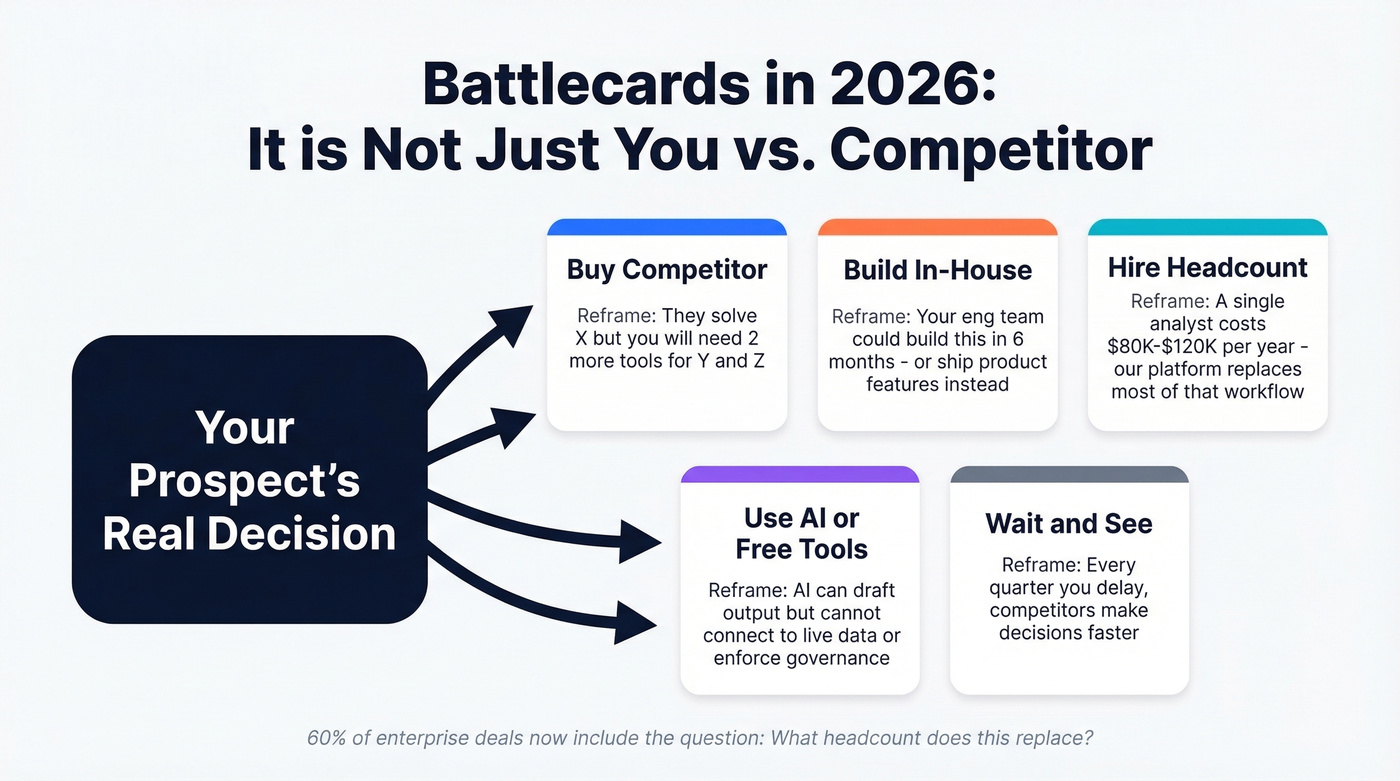
- Buy (competitor): "They solve X, but you'll need two more tools for Y and Z. We're one platform."
- Build in-house: "Your eng team could build this in 6 months - or ship product features instead."
- Hire headcount: "A single analyst costs $80K-$120K/yr. Our platform replaces most of that workflow."
- Use AI/free tools: "AI can draft the output, but it can't connect to your live data or enforce governance."
- Wait and see: "Every quarter you delay, your competitors are making decisions faster because they can actually trust their data."
Key Differentiators + Reframes
Don't list features. List reframes. Dock's Cisco Webex example does this well - instead of trying to out-Zoom Zoom on features, they reframe the conversation toward end-to-end security and control.
| Their Strength | Your Reframe |
|---|---|
| "More integrations" | "We integrate deeply with 5 tools you use daily. They integrate shallowly with 200 you don't." |
| "Lower sticker price" | "Ask about implementation costs. Their 'cheaper' plan often requires paid professional services." |
| "Bigger brand" | "Brand doesn't close deals - results do. Here's what [Customer X] achieved in 90 days." |
Talk Tracks + Landmine Questions
Talk tracks are the single most underused battlecard section. We've reviewed dozens of cards across our customer base, and the pattern is always the same: the "Know" section is polished, the "Say" section is either empty or filled with marketing-speak no human would say out loud. If your rep can't say the words naturally, the card failed.
Integration trap (modeled on Gong's template structure):
"That's a great tool. Quick question - have you confirmed it integrates natively with [your CRM]? We've seen teams spend months on custom middleware after signing."
Buyer fear:
"I hear this a lot: 'I don't know if my team will actually adopt another tool.' That's exactly why we built onboarding into the first 48 hours - not a 6-week implementation."
Landmine questions force the competitor into a weak answer:
- "Ask them how they handle [specific edge case]. If it's not supported today, get them to commit to a date in writing."
- "Ask for a reference customer in your industry with more than 500 users. They'll struggle."
Evidence / Proof Points
Only 19% of battlecards include supporting evidence. That's a staggering miss.
Strong proof points pair your number against theirs, then spell out the business impact. For example: "Our email accuracy is 98% vs. Competitor X's 79%. Data refreshes every 7 days vs. their 6-week cycle. That's the difference between a sequence that books meetings and one that tanks your domain reputation."
Whatever product you're selling, structure your proof points the same way: your number vs. their number, with the business impact in plain English. Bad proof point: "We're faster and more reliable." Good proof point: "We process transactions 50% faster, cutting wait time from 10 seconds to under 5 seconds - which means fewer drop-offs in the workflow."
Pricing Snapshot + Customer Story
Side-by-side pricing removes ambiguity. Name the company size, the use case, and why you won.
| You | Competitor | |
|---|---|---|
| Entry price | $500/mo (5 seats) | $800/mo (5 seats) |
| Enterprise | ~$2K/mo, no platform fee | ~$1.5K/mo + platform fee |
| Contract | Monthly, cancel anytime | Annual, auto-renews |
Micro case study: "Fintech startup, 120 employees, evaluated both platforms for 30 days. Chose us because their team was productive in 48 hours vs. 3 weeks of onboarding with [Competitor]. Pipeline sourced from our platform: $1.2M in Q1."

Great battlecards need real numbers - not marketing fluff. Prospeo gives you 98% email accuracy vs. competitors' 79%, a 7-day data refresh vs. their 6-week cycle, and 30% mobile pickup rates. Those are proof points your reps can drop into any competitive deal.
Fill your battlecard's "Show" layer with numbers that actually close deals.
What Great Battlecards Look Like
Most articles describe what battlecards should contain. Let's look at what the good ones actually look like.
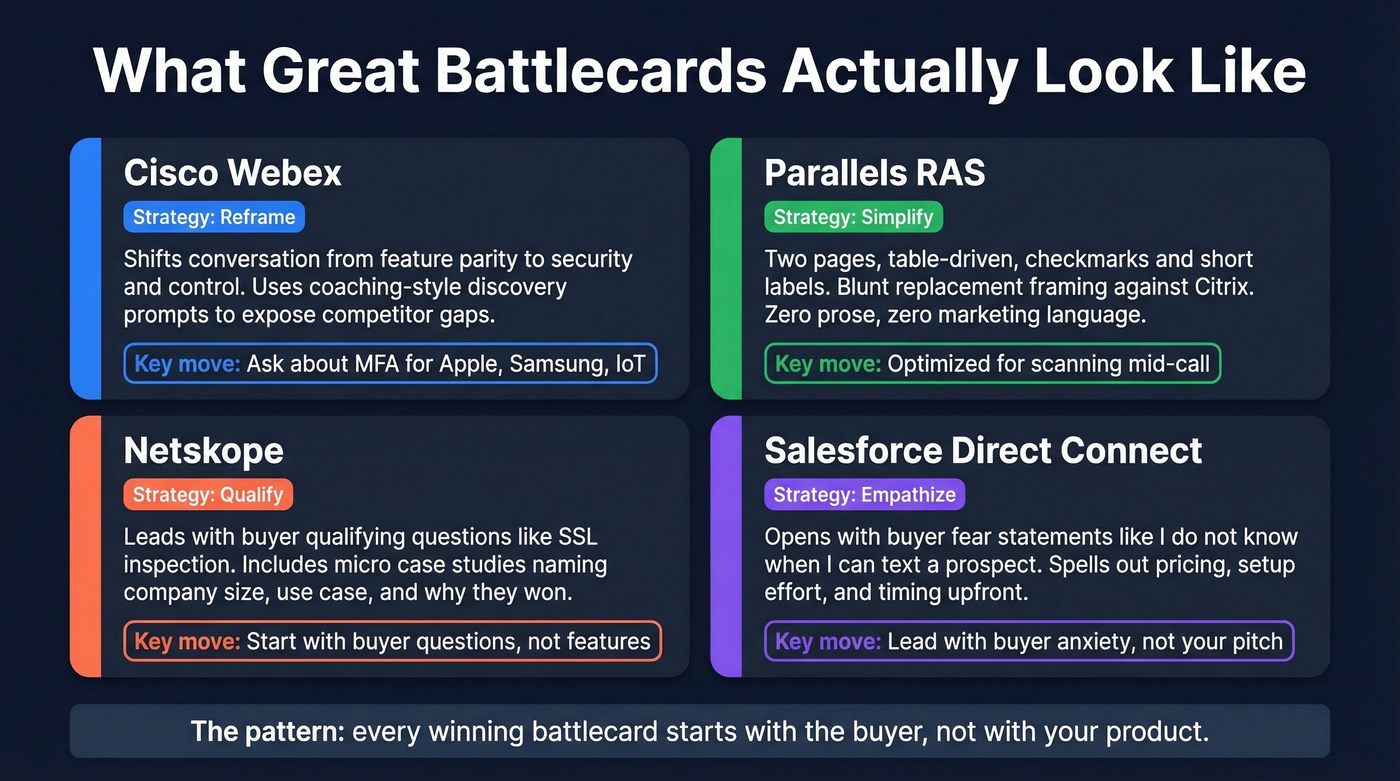
Cisco Webex reframes the entire competitive conversation away from feature parity with Zoom/Microsoft toward end-to-end security and control. Their card includes coaching-style discovery prompts - asking prospects about MFA for Apple Macs, Samsung devices, and IoT - to expose gaps competitors can't answer. Less "why we're better," more "what questions make them better."
Parallels RAS keeps it brutally simple: two pages, table-driven, blunt "replacement" framing against Citrix. Optimized for scanning mid-call. No prose, no marketing language, just checkmarks and short labels. If your reps hate reading, steal this format.
Netskope's partner battlecard leads with buyer qualifying questions like SSL inspection capabilities and includes micro case studies naming company size, use case, and why they won. Salesforce Direct Connect opens with buyer fear statements - "I don't know when I can text a prospect" - and spells out pricing, setup effort, and timing. Both prove that starting with the buyer's anxiety beats starting with your features.
Where to Gather Competitor Intel
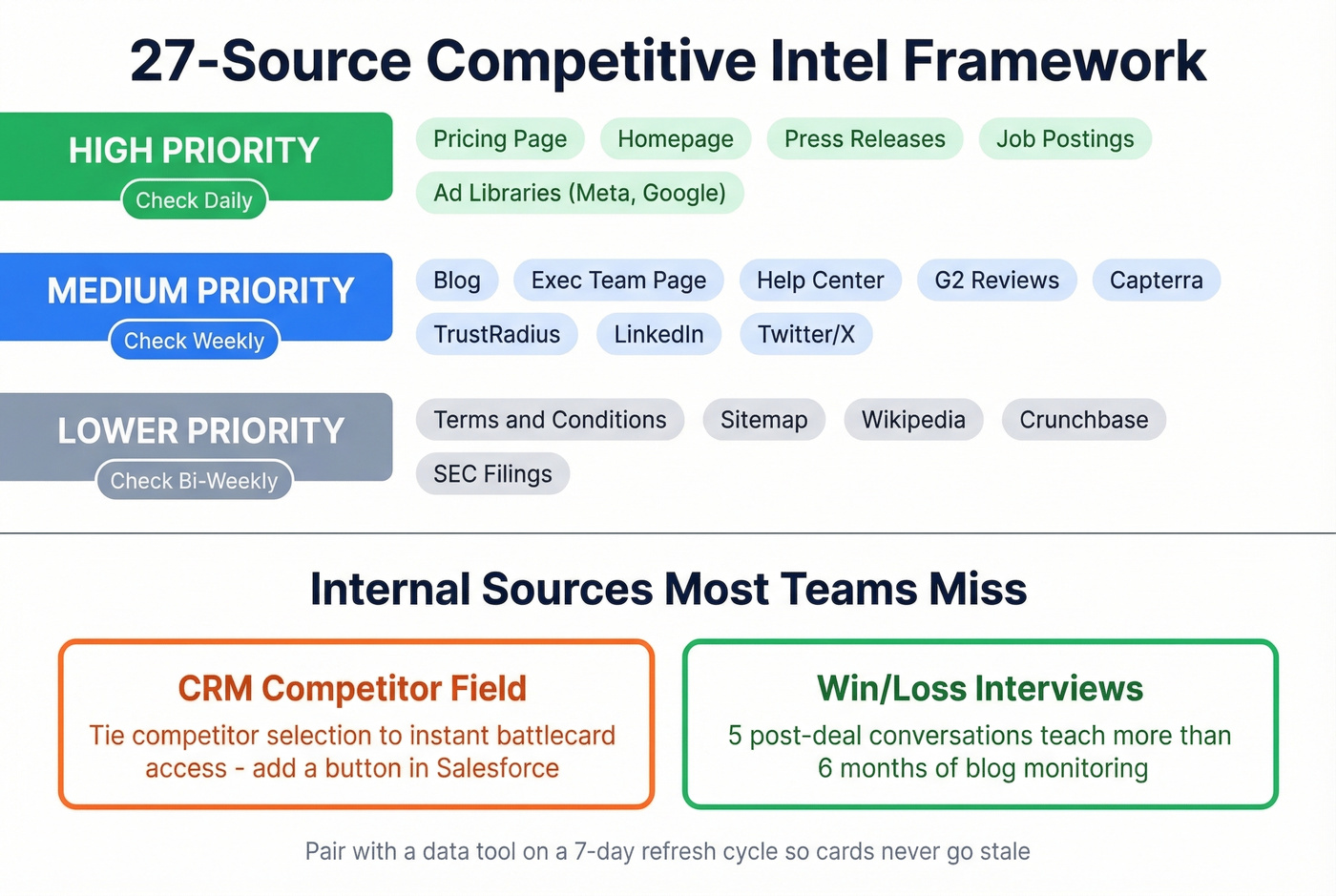
A competitive battlecard is only as good as the intel feeding it. Here's a 27-source monitoring framework organized by priority:
| Priority | Sources | Cadence |
|---|---|---|
| High | Pricing page, homepage, press releases, job postings, ad libraries | Daily |
| Medium | Blog, exec team page, help center, G2/Capterra/TrustRadius, social | Weekly |
| Lower | Terms & conditions, sitemap, Wikipedia, Crunchbase | Bi-weekly |
Internally, your CRM's competitor field is an underused goldmine. Tie competitor selection to immediate battlecard access - a button in Salesforce that surfaces the right card when a rep logs a competitor. Win/loss interviews are the other source most teams skip. Five post-deal conversations will teach you more about a competitor's pitch than six months of monitoring their blog.
To keep your battlecard's contact data and competitor profiles current, pair your CI workflow with a tool like Prospeo - 300M+ profiles on a 7-day refresh cycle means your cards don't go stale the week after you publish them.
If you want a broader system beyond a single card, build a lightweight competitive intelligence strategy that defines sources, owners, and update cadence.
Your reps need landmine questions backed by data they can trust. Prospeo's 300M+ verified profiles, 125M+ mobile numbers, and $0.01/email pricing give your team ammunition no competitor can match. Teams using Prospeo book 35% more meetings than Apollo users.
Stop losing winnable deals - arm your reps with data competitors can't touch.
Distribution + Keeping Cards Updated
Here's the thing: the biggest battlecard mistake isn't bad content - it's bad distribution. A perfect card buried in a Google Drive folder nobody opens is worthless. Put your cards where reps already work:
- CRM button - Salesforce or HubSpot, surfaced when a competitor is logged on an opportunity
- Slack pin - in your #competitive-intel or #deal-support channel
- Notion/Confluence - searchable, version-controlled, linked from your sales playbook
- CI platform - Klue, Crayon, or Playwise if you've got the budget
PMM owns creation and updates. Sales contributes real-deal language and flags when intel is stale. Set a monthly calendar reminder with a single owner per competitor. If nobody's name is on the card, nobody updates it.
To make distribution stick, tie battlecards into your sales enablement workflow (where content lives, how reps find it, and what gets updated).
Battlecard Tools + Pricing
For teams under 50 reps, a well-maintained Google Doc beats a dusty $50K platform every time. I've seen this play out repeatedly - the honest question isn't "which CI tool is best?" but "will your team actually log into a dedicated CI platform, or will they just Slack the PMM anyway?" Start with the workflow your reps already use, then upgrade if adoption proves it's needed.
| Tool | Pricing | Best For |
|---|---|---|
| Playwise HQ | $0-$450/mo | SMBs, free tier |
| Crayon | ~$15K-$47K/yr | Mid-market CI teams |
| Klue | ~$16K+/yr | Enterprise CI programs |
| Kompyte | Custom | Automated tracking |
| Contify | Custom | Enterprise, media CI |
| Seismic | Custom | Enterprise enablement |
Skip the enterprise platforms if you're a team of 10. You'll spend more time configuring the tool than writing the cards.
If you're evaluating tools that feed the "Show" layer, compare options across data enrichment services and sales prospecting databases before you commit.
FAQ
How many competitors should a battlecard cover?
One card per competitor, focused on your top three - the ones showing up in 80% of competitive deals. Deep cards for three beat shallow cards for fifteen. Check your CRM's competitor field to find which three actually matter.
How long does it take to build one from scratch?
Four to eight hours for the first card with CI sources ready; subsequent cards take two to three hours. The research is the bottleneck, not the writing. Using enrichment tools to pre-populate competitor profiles and contact data cuts that step significantly.
Who should own battlecard updates?
Product marketing owns creation and quarterly refreshes. Sales contributes real-deal language and flags stale intel. The worst battlecards are written entirely by marketers who've never run a competitive deal - and in our experience, the best ones get a red-pen pass from at least two reps before they ship.
How often should you refresh competitive intel?
Monthly at minimum, with a single named owner per competitor. If a competitor launches a major feature or changes pricing, update immediately. Stale cards erode rep trust faster than having no card at all.
Copy the template above, fill in your top competitor, and get it in front of a rep this week. A mediocre card that's used beats a perfect card that isn't.
If you want to turn the card into a repeatable rep habit, add a one-page sales battle cards SOP and a short library of talk tracks your team can practice.