

The Best Database Contacts Tools in 2026 - With Pricing Nobody Else Publishes
Your database contacts are rotting right now. B2B contact data decays at 2.1% per month - roughly 22.5% of your records going stale every year. Emails bounce, phone numbers disconnect, people change jobs, and your reps waste an estimated 500 hours annually cleaning bad data. Poor data quality costs organizations $12.9M annually, and companies lose roughly 15% of revenue due to inaccurate contact information. Most of that damage is invisible until your bounce rates spike and your domain reputation tanks.
The fix isn't buying a bigger database. It's buying a fresher one.
Our Picks (TL;DR)
| Tool | Best For | Starting Price |
|---|---|---|
| Prospeo | Email accuracy & data freshness | Free (75 emails/mo) |
| Apollo.io | Free starting point | $0 (free tier) |
| Cognism | European prospecting | ~$22.5K/yr (5 seats) |
What Are Database Contacts?
Database contacts are structured records - names, emails, phone numbers, job titles, company data. A lookup tool. A CRM, by contrast, manages relationships: activity timelines, deal pipelines, task automation, and reporting.
Most small teams start with a spreadsheet as a makeshift business contact database. That works until you miss follow-ups, lose visibility across the team, or watch leads slip through cracks because nobody updated the sheet. Those are the classic triggers for upgrading.
You need both. A contact database to source prospects, a CRM to manage them. The tools in this article are B2B contact databases - they find and verify contact information. They don't replace your HubSpot or Salesforce. They feed it.
Why Data Quality Beats Size
Every vendor brags about database size. "275M contacts!" "300M profiles!" The number that actually matters is accuracy - and most providers average around 50% across their full database.
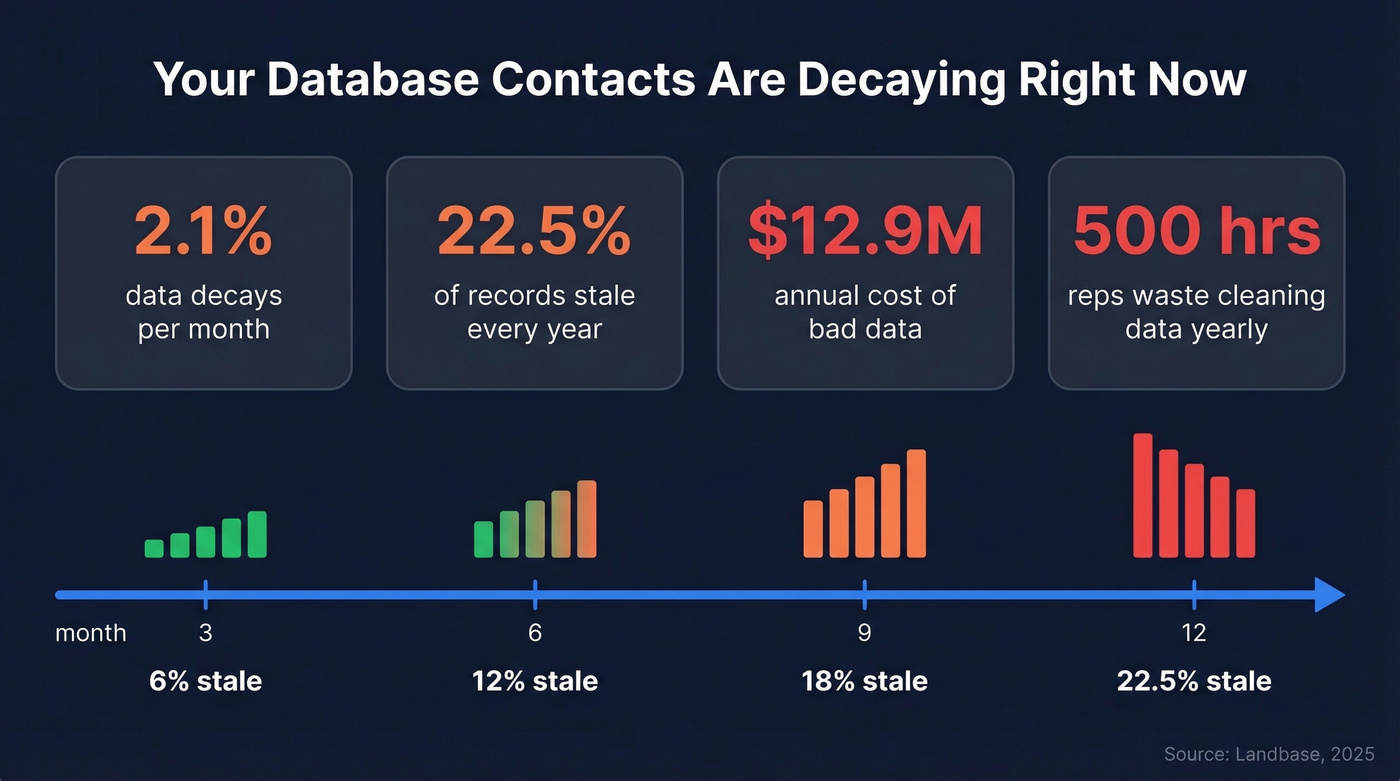
About 30% of your customer information goes stale every year. One Reddit practitioner put it bluntly: "70% of phone numbers are wrong" in the big databases, and the contacts that aren't wrong are overused - every SDR in your market already has them.

A common take in r/b2bmarketing is that static lists from Apollo and ZoomInfo lead to declining reply rates and deliverability issues. That's the key distinction: don't buy static contact lists. A pre-built list is stale the moment it's exported. You need a B2B contacts database with real-time verification that confirms data at the point of use, not one that hands you a CSV and wishes you luck.
Refresh frequency is the buying criterion nobody talks about. Most providers refresh data around every 4-6 weeks. A 7-day refresh cycle should be your benchmark. If a vendor won't disclose their refresh cadence, assume it's bad.
Here's the thing: if your average deal size sits below five figures, you almost certainly don't need ZoomInfo-level data. A smaller, verified contact database will outperform a massive, decaying one every time. We've seen teams with 50,000 records outperform teams with 500,000 - because the smaller list was verified and current. Volume is a vanity metric. Accuracy is a pipeline metric.
Best Contact Database Tools in 2026
Prospeo
Prospeo's database covers 300M+ professional profiles, 143M+ verified emails, and 125M+ verified mobile numbers. The 98% email accuracy rate is backed by a proprietary 5-step verification process with catch-all handling, spam-trap removal, and honeypot filtering - all on a 7-day refresh cycle.

Search filters include buyer intent across 15,000 topics via Bombora, technographics, job changes, headcount growth, and funding rounds. The Chrome extension has 40K+ users. CRM enrichment returns 50+ data points per contact, and the API delivers a 92% match rate. Real results: Meritt tripled their pipeline from $100K to $300K per week, and their bounce rate dropped from 35% to under 4%.
Free tier gives you 75 emails and 100 Chrome extension credits per month. Paid plans scale at ~$0.01 per email. No contracts, no sales calls.

You just read that 22.5% of B2B contact data goes stale every year. Prospeo's 7-day refresh cycle means your database contacts never rot. 300M+ profiles, 98% verified email accuracy, 125M+ mobile numbers - at $0.01 per email.
Stop prospecting from a decaying database. Start with data refreshed weekly.
Pricing Comparison
These are real ranges, not the sanitized figures vendors put on their websites.
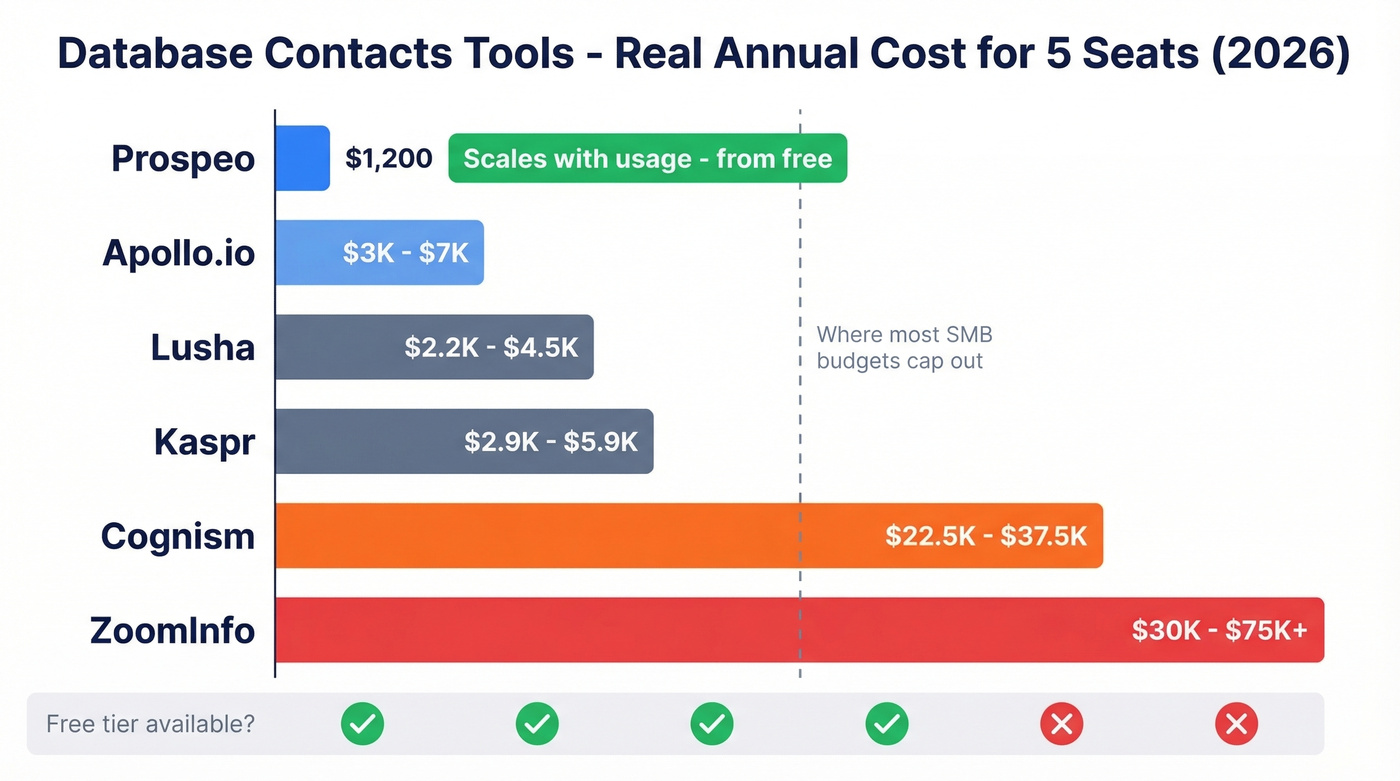
| Tool | Starting Price | Typical Annual (5 seats) | Credit Model | Free Tier |
|---|---|---|---|---|
| Prospeo | Free / ~$0.01/email | Scales with usage | Pay-per-use, no expiry | 75 emails + 100 ext/mo |
| ZoomInfo | ~$15K/yr | $30K-$75K+ | $0.20-$0.60/credit, annual | No |
| Apollo.io | Free / $49/user/mo | ~$3K-$7K | Monthly, expires | Yes (generous) |
| Cognism | ~$22.5K/yr | $22.5K-$37.5K+ | Fair-use capped, annual | 25 leads (guided) |
| Lusha | Free / $37/user/mo | ~$2.2K-$4.5K | Monthly credits | Yes (limited) |
| Kaspr | Free / ~$49/user/mo | ~$2.9K-$5.9K | Unlimited email on paid | Yes (limited) |
| RocketReach | Free / $39/mo | ~$2.3K-$4.7K | Monthly credits | 5 searches/mo |
How to Evaluate a Contact Data Provider
Don't just compare feature lists. Here's what actually separates good providers from expensive disappointments:
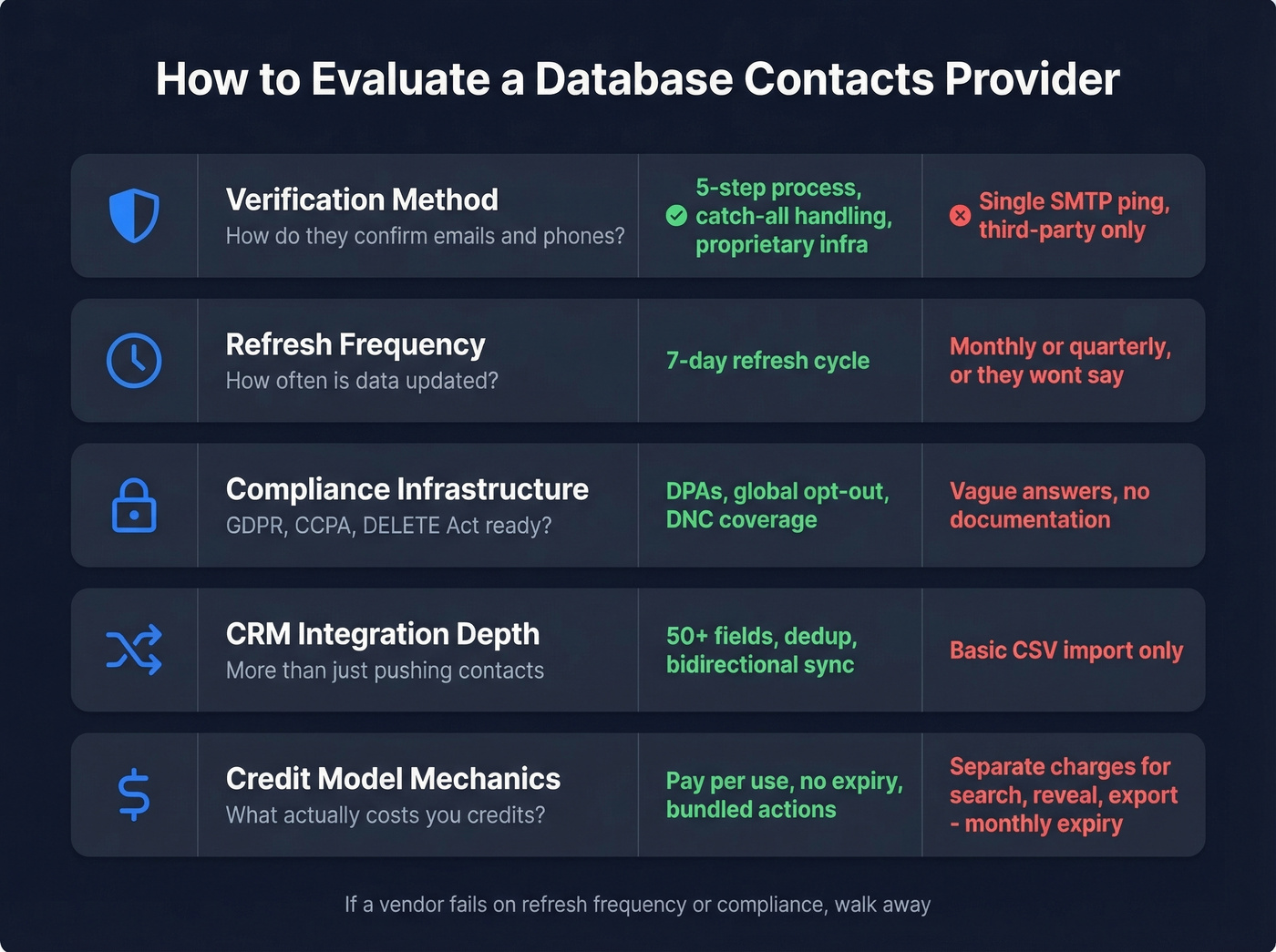
Verification method. A 5-step process with catch-all handling is fundamentally different from a single SMTP ping. Ask specifically how the provider verifies emails and phone numbers - and whether they use proprietary infrastructure or rely on third-party verification services. If you need a deeper breakdown, start with an email verifier benchmark.
Refresh frequency. A database refreshing weekly gives you fundamentally different data than one refreshing monthly or quarterly. If the vendor won't disclose their cadence, walk away.
Compliance infrastructure. GDPR and CCPA aren't optional. Look for DPAs, global opt-out enforcement, compliant data sourcing, and DNC list coverage across your target markets. If you're building in Europe, use a GDPR compliant database checklist.
CRM integration depth. Pushing contacts into Salesforce is table stakes. You want enrichment that fills 50+ fields, deduplicates automatically, and syncs bidirectionally. Compare options in our guide to data enrichment tools.
Credit model mechanics. Understand what consumes credits. Some tools charge for searches, reveals, exports, and enrichment separately. Others bundle. The difference can be 3x in effective cost, and credits that expire monthly create artificial urgency and overage charges. If you want flexibility, look at pay-as-you-go B2B data.
Building and Maintaining Your Database Contacts
1. Define your ICP tightly. Firmographic criteria plus behavioral signals - hiring patterns, tech stack, funding stage. The tighter your ICP, the less data you waste money on. Use an ideal customer profile framework to keep it consistent across teams.
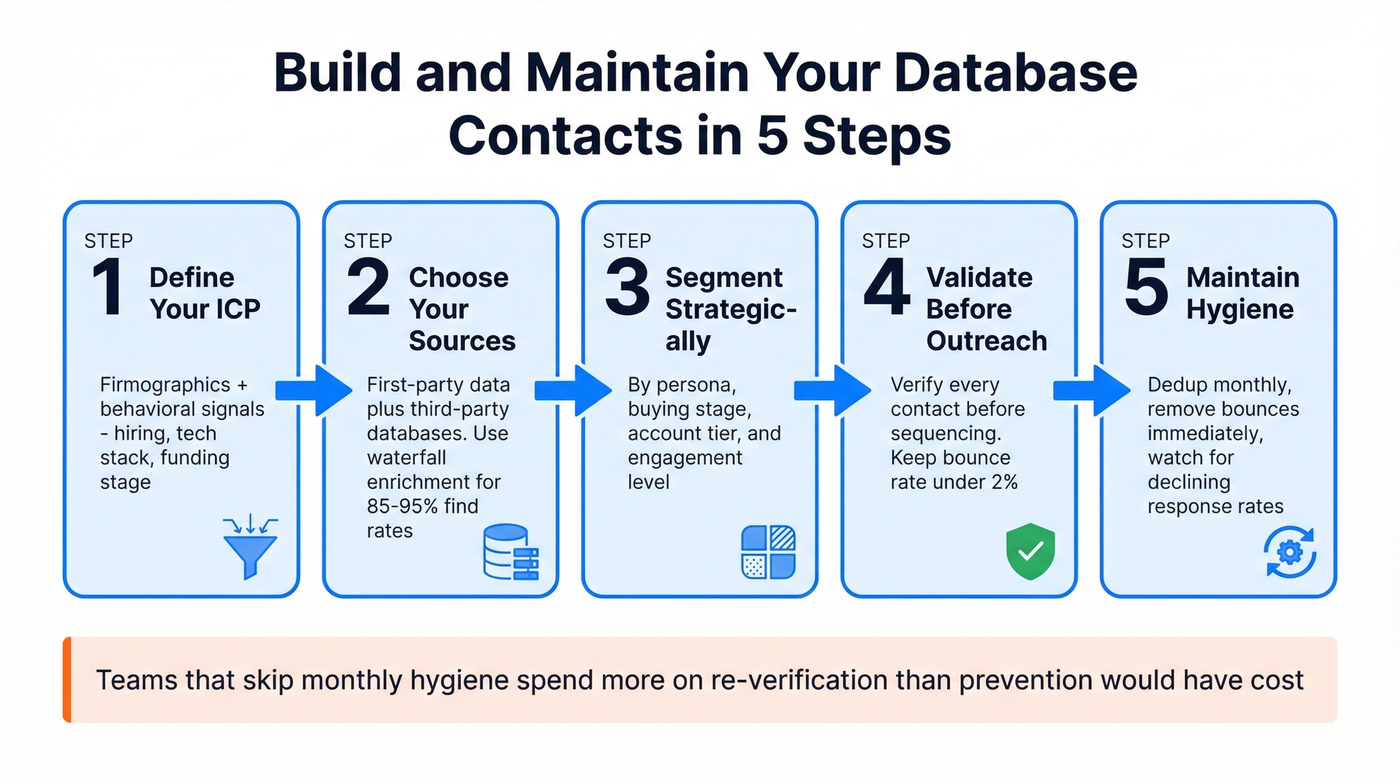
2. Choose your sources. First-party data (website visitors, event attendees, inbound leads) is the most accurate but limited in volume. Third-party databases fill the gap. Waterfall enrichment - querying multiple sources sequentially - typically hits 85-95% find rates versus 50-60% from a single source.
3. Segment strategically. Don't dump everything into one list. Segment by persona, buying stage, account tier, and engagement level.
4. Validate before outreach. Every contact should be verified before it enters a sequence. If your bounce rate creeps above 2%, your database needs attention now, not next quarter. If deliverability is slipping, run a quick email reputation check.
5. Maintain hygiene relentlessly. Deduplicate monthly. Remove bounced emails immediately. Watch for rising bounce rates, declining response rates, and increasing unsubscribes. In our experience, teams that skip monthly hygiene end up spending more on re-verification than they would've spent on prevention.
Compliance Essentials
GDPR applies to any EU resident's data, regardless of where your company is based. Violations carry fines up to €20M or 4% of global annual turnover.
CCPA/CPRA thresholds for 2026 are inflation-adjusted: $26.625M revenue or processing personal information of 100,000+ California residents annually. Global Privacy Control compliance is now mandatory - your systems must detect and honor opt-out signals automatically.
The DELETE Act is the big 2026 change. California's DROP platform went live January 1, 2026, giving consumers a single portal to request deletion from all registered data brokers. Starting August 1, 2026, data brokers must check the platform every 45 days and process deletions. If your database provider is classified as a data broker, this directly affects your data supply chain.
This isn't legal advice. But if your database vendor can't clearly explain their compliance posture, that's a red flag you shouldn't ignore.
FAQ
What's the difference between database contacts and a CRM?
Database contacts are structured records - names, emails, phone numbers, job titles, and company data used for prospecting. A CRM manages relationships by adding activity timelines, deal pipelines, and team collaboration. Most B2B teams need both: a contact database to source prospects and a CRM like Salesforce or HubSpot to manage them through the sales cycle.
How fast do database contacts go stale?
Contact data decays about 2.1% per month - roughly 22-25% per year. Emails decay at 23-30% annually, and phone numbers change at about 18% per year. If you aren't refreshing at least monthly, a quarter of your records is already outdated.
Which contact database has the best email accuracy?
Prospeo delivers 98% email accuracy with a 7-day refresh cycle and a proprietary 5-step verification process. Most providers average around 50% accuracy across their full database. Always test with a sample of your target ICP before committing to a full contract.
How much does a B2B contact database cost?
The range is enormous. Apollo starts at $49/user/month. ZoomInfo typically costs $30K-$75K+ per year. Cognism runs $22K-$37K+ for a 5-person team. Prospeo scales from free (75 emails/month) at ~$0.01 per email with no contracts. Always factor in credit overages, renewal increases, and hidden onboarding or API charges when comparing.