

How to Build an Annual Sales Meeting Agenda That Isn't Expensive Theater
You just got budget approval for the annual sales kickoff. Flights, hotel blocks, AV rentals, maybe a keynote speaker. Now you're staring at a blank agenda, terrified the whole thing turns into a two-day VP slide parade that reps forget by Wednesday.
Here's the thing: 70% of meetings are unproductive. Annual kickoffs, with their five-figure price tags, are the easiest ones to waste. Let's build one that actually changes rep behavior.
Lock Your Constraints First
Before you write a single slide, nail these down:
- Territories and quotas finalized. Don't hold your kickoff before reps know their numbers. They need time to digest assignments and come with real questions - not sit through two days wondering what their patch looks like.
- Schedule 2-4 weeks after year-end. Reps need to close out Q4 without the distraction of travel logistics. January's third or fourth week is the sweet spot for calendar-year companies.
- Headcount drives everything. Who's attending - just AEs, or also SEs, CSMs, marketing, leadership? The answer shapes venue size, breakout needs, and session design.
- Budget per head. Travel alone often runs $500-$2,000 per person. Add production, F&B, and venue costs, and a 50-person SKO commonly lands around $75k-$200k all-in.
Agenda Design Rules for 2026
The best annual kickoffs follow an Inspiration → Education → Celebration arc. Day one opens with energy and strategic vision, transitions into skill-building, and closes with recognition. Every session should fit one of those three buckets. If it doesn't, cut it.
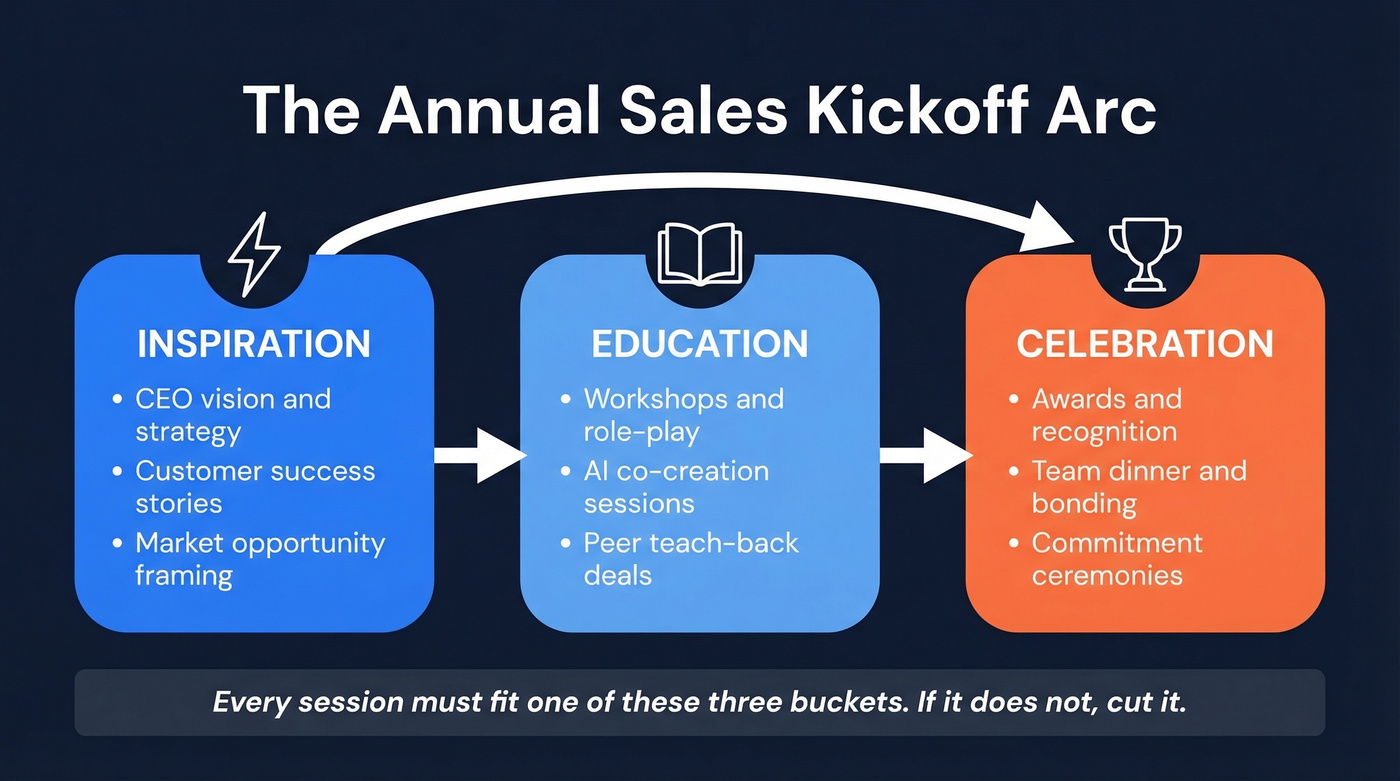
Cap any lecture-style block at 20-30 minutes. Use a flipped classroom model: send pre-reads, product updates, and competitive intel as async pre-work before the event, then use live time for practice, role-play, and discussion. Consistent sales coaching drives 32% higher win rates - but only if reps actually practice, not just listen. For 2026, build at least one AI co-creation session into the education block where reps practice with AI-generated talk tracks or AI-supported role-play scenarios, then refine in pairs.
And protect networking time. Ask any rep what they remember from last year's SKO, and it's rarely the CEO keynote - it's the hallway conversation with a peer who shared a deal strategy. Unstructured time isn't filler. It's the point.
Templates for Every Team Size
Small Team (18 or Fewer Reps) - Full Day
| Time | Session | Owner | Output |
|---|---|---|---|
| 8:30-9:00 | Breakfast + networking | - | Energy, connection |
| 9:00-9:45 | Year in review (metrics) | Sales leader | TCV, win rates, deal size |
| 9:45-10:30 | CEO/founder vision | CEO | Strategic direction |
| 10:30-10:45 | Break | - | - |
| 10:45-12:00 | Rep annual plans | Each rep (8 min) | Individual commitments |
| 12:00-1:00 | Lunch | - | - |
| 1:00-1:45 | Cross-functional updates | Product, marketing | Roadmap, lead gen plans |
| 1:45-2:30 | New process/territory walk | RevOps | Clarity on changes |
| 2:30-2:45 | Break | - | - |
| 2:45-3:45 | Workshop: objection handling | Enablement | Practice, not slides |
| 3:45-4:15 | Awards + celebration | Sales leader | Recognition |
| 4:15-4:30 | Wrap-up + 30-day action items | Sales leader | Written commitments |
| 6:00+ | Team dinner | - | Bonding |
With a small team, every rep should present their annual plan. Eight minutes each, no slides required - just "here's my territory, here's my top-10 target list, here's where I need help." We've seen this single session generate more accountability than any keynote.
Mid-Size Team (20-80) - Two Days
Larger teams need breakout rooms, role-play blocks, and quiet spaces for reps who need to take prospect calls. Sales don't stop for internal meetings.
Day 1: Inspire + Align
| Time | Session | Owner | Output |
|---|---|---|---|
| 8:30-9:00 | Breakfast | - | - |
| 9:00-10:00 | State of the business | CRO/CEO | Vision + metrics |
| 10:00-10:15 | Break | - | - |
| 10:15-11:15 | Keynote or customer panel | External/customer | Inspiration |
| 11:15-12:15 | Breakout: segment strategy | Segment leads | Territory plans |
| 12:15-1:15 | Lunch | - | - |
| 1:15-2:15 | Product roadmap + demo | Product | What's coming |
| 2:15-3:15 | Competitive deep dive | Enablement | Battlecards updated |
| 3:15-3:30 | Break | - | - |
| 3:30-4:30 | Peer teach-back sessions | Top reps | Peer learning |
| 6:30+ | Awards dinner | Sales leader | Celebration |
Day 2: Educate + Execute
| Time | Session | Owner | Output |
|---|---|---|---|
| 8:30-9:00 | Breakfast | - | - |
| 9:00-10:30 | Workshop rotations (3x30 min) | Enablement | Skills practice |
| 10:30-10:45 | Break | - | - |
| 10:45-12:00 | Role-play certification | Managers | Reps certified on pitch |
| 12:00-1:00 | Lunch | - | - |
| 1:00-2:00 | 30-day execution planning | Managers + reps | Written action plans |
| 2:00-2:30 | Wrap-up + commitments | CRO | Alignment |
The peer teach-back sessions on Day 1 deserve special attention. Pick your top three to five reps and give each 15 minutes to walk through a real deal they closed - what worked, what almost killed it, what they'd do differently. In our experience, these sessions consistently get the highest post-event ratings. Reps trust peers more than executives, and the stories stick longer than any framework slide.
Virtual or Hybrid - Two-Track
Virtual attendees need a shorter, denser schedule. Don't mirror the in-person agenda - give them the highest-value sessions live and everything else on-demand.
| Time | In-Person Track | Virtual Track |
|---|---|---|
| 9:00-10:00 | State of the business | Live stream + chat Q&A |
| 10:00-10:15 | Break | Break |
| 10:15-11:15 | Keynote/panel | Live stream + polls |
| 11:15-12:00 | Breakout workshops | Virtual breakout rooms |
| 12:00-1:00 | Lunch | Virtual ends (core block) |
| 1:00-3:00 | Workshops + role-play | On-demand recordings |
| 3:00-4:00 | Networking + 1:1s | Async Slack channels |
Plan around your most restrictive time zone. Use gamification - leaderboards, live polls, sales Jeopardy - to keep virtual engagement from cratering after hour two. If your remote reps are an afterthought, skip the hybrid setup entirely and just record the in-person event. A bad hybrid experience is worse than no hybrid experience.

Your kickoff's 30-day execution plans are only as good as the data reps prospect with afterward. Prospeo gives every rep access to 300M+ profiles with 98% email accuracy and 125M+ verified mobiles - so the momentum from your SKO actually converts into pipeline.
Don't let bad data kill your post-kickoff momentum.
What Ruins Annual Kickoffs
Do: Highlight top-performing reps as session leaders. Peer learning beats executive lectures every time.
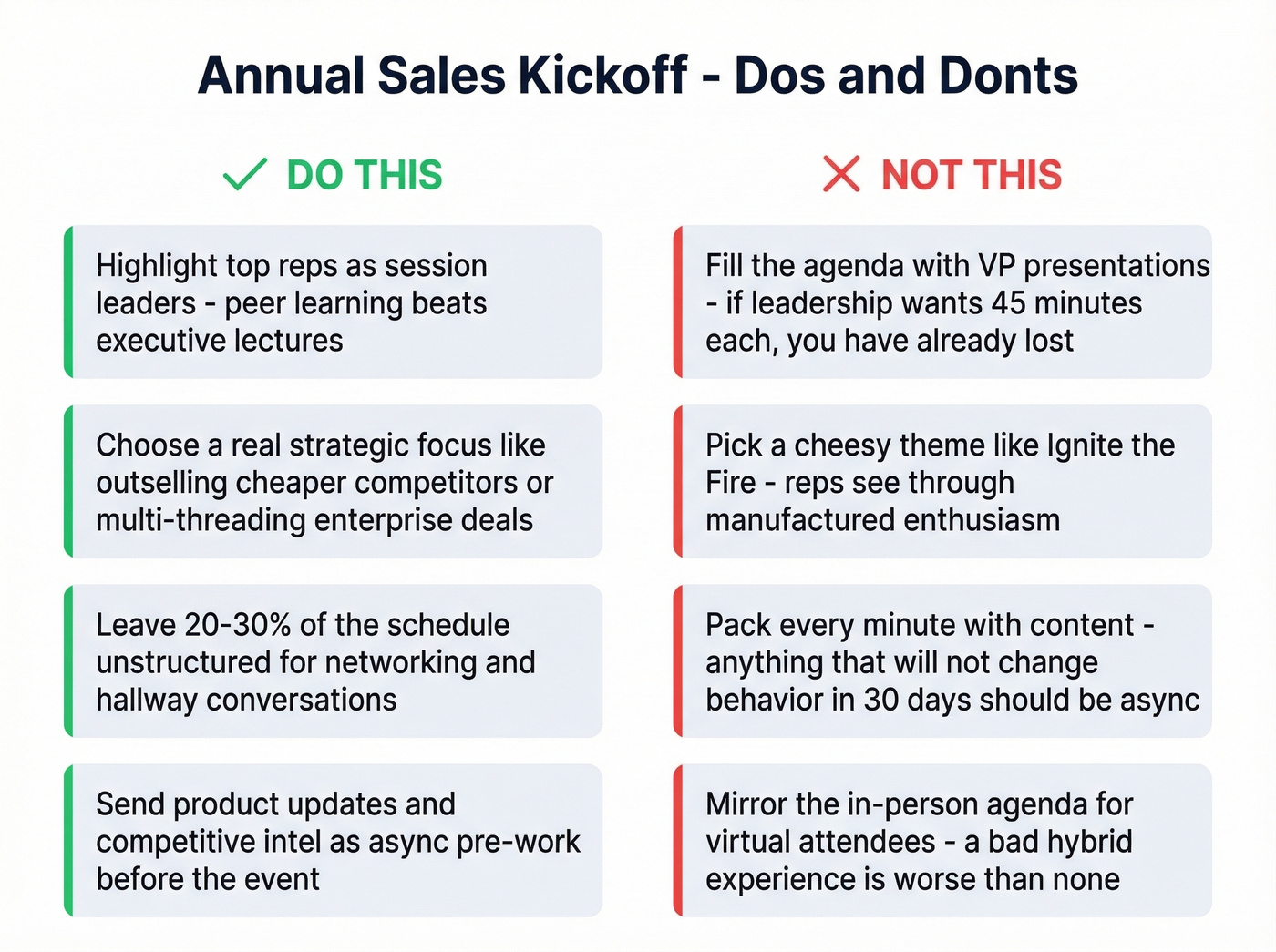
Don't: Fill the agenda with VP presentations. If leadership wants 45 minutes each, you've already lost.
Do: Choose a real strategic focus - "outselling lower-priced competition" or "multi-threading enterprise deals."
Don't: Pick a cheesy theme. "Ignite the Fire" isn't a strategy. The consensus on r/sales is pretty clear: reps see right through manufactured enthusiasm, and it actively erodes trust in the event.
Do: Leave 20-30% of the schedule unstructured. Salespeople consistently rank networking and collaboration as the most valuable part of kickoff-type events.
Don't: Pack every minute with content. Anything that won't change rep behavior in 30 days should be async pre-work.
Planning Timeline
4-6 months out: Lock objectives, secure budget, send venue RFPs, identify speakers, draft your preliminary agenda. This is also when you should be fighting for the budget line items that matter - breakout room AV, workshop facilitators, and post-event reinforcement tools.
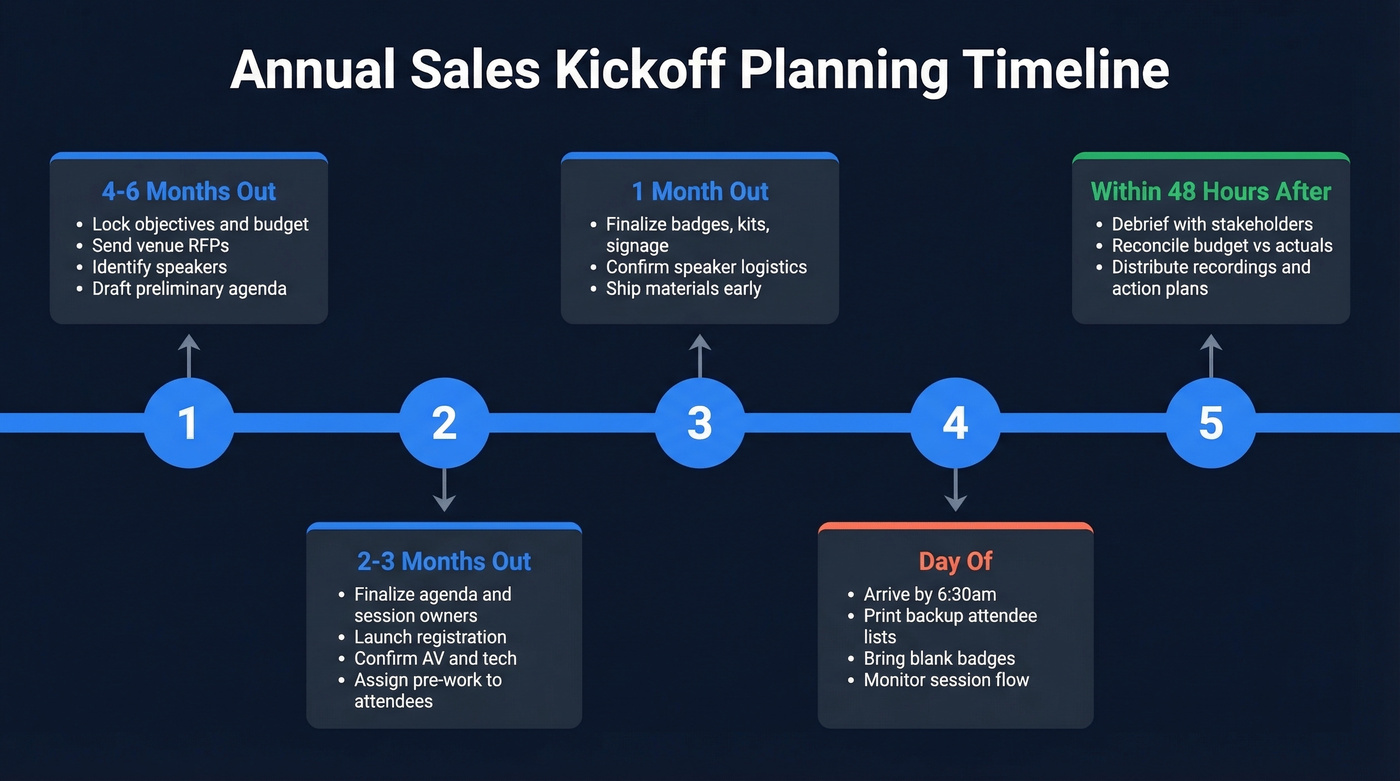
2-3 months out: Finalize the agenda and session owners, launch registration, confirm AV/tech, book F&B. Start assigning pre-work to attendees.
1 month out: Finalize collateral like badges, kits, and signage. Confirm speaker logistics. Ship materials early.
Day-of: Arrive by 6:30am. Print backup attendee lists. Bring blank badges. Monitor session flow like a hawk.
After: Debrief within 48 hours. Reconcile budget vs. actuals. Distribute session recordings and written action plans to every attendee and their manager.
Make It Stick Post-SKO
The typical AE takes 4.7 months to ramp and stays 2.7 years. That means you get maybe four or five kickoffs to shape their performance. The single biggest predictor of SKO ROI is whether reps leave with written 30-day action plans - and then actually execute them.
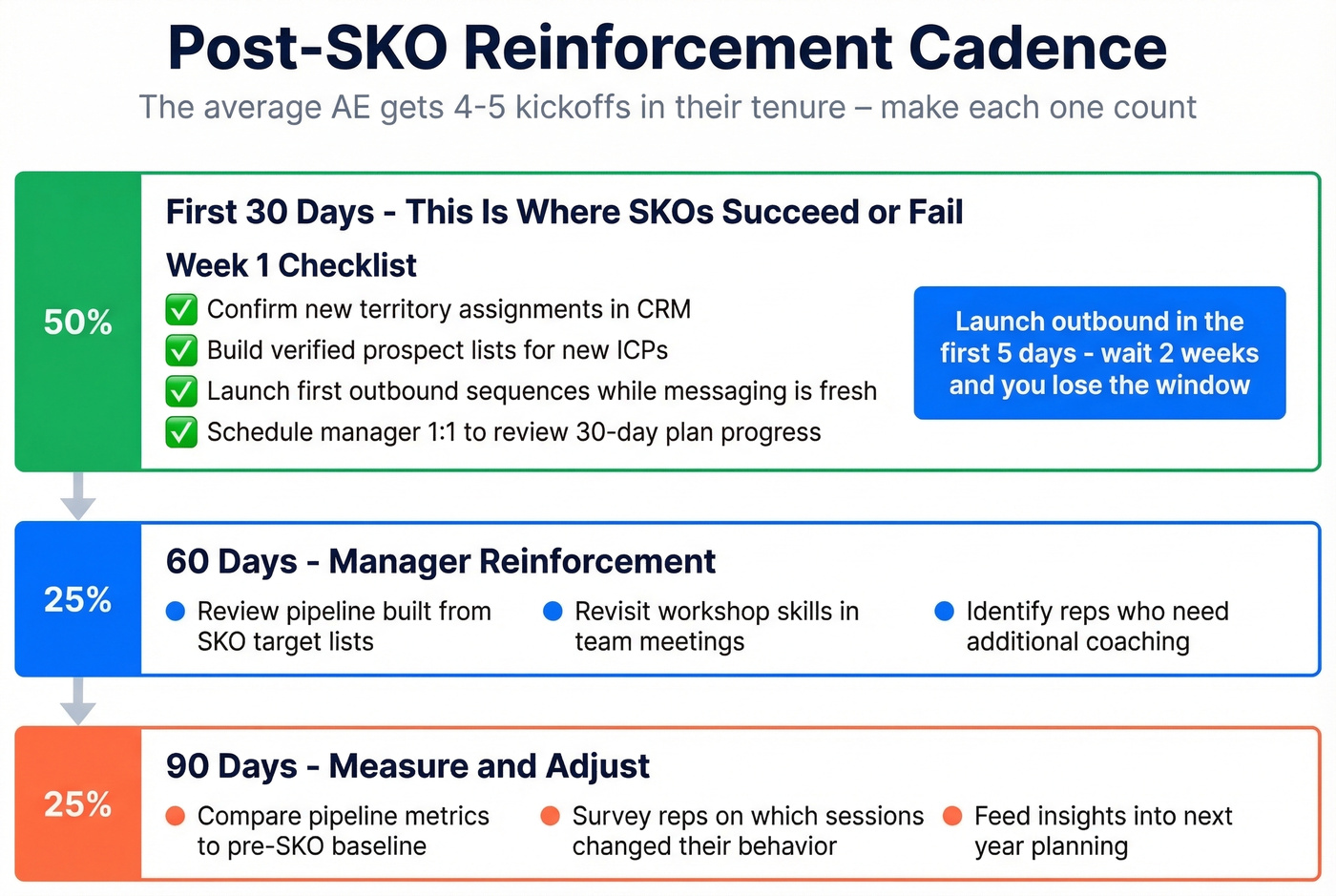
Build a 30/60/90-day reinforcement cadence. The week-one checklist matters most:
- New territory assignments confirmed in CRM
- Build verified prospect lists for new ICPs using a tool like Prospeo - a 7-day data refresh cycle keeps that first outbound push clean instead of bouncing off stale records
- Launch first outbound sequences while SKO momentum is hot
- Schedule manager 1:1s to review 30-day plan progress
A great annual sales meeting agenda only matters if you turn it into week-one execution. Launch outbound in the first five days, while messaging is fresh and managers are still reinforcing the plan. Wait two weeks and you've lost the window.
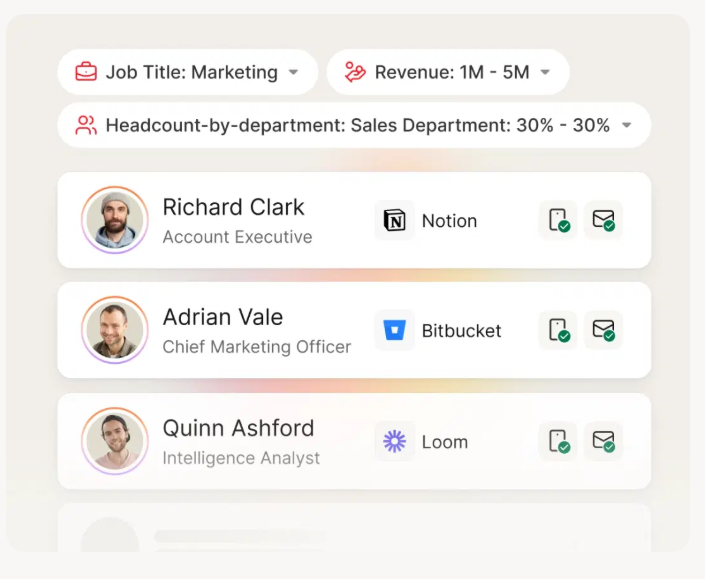
Those rep annual plans and top-10 target lists need verified contact data behind them. Prospeo's 30+ search filters - including buyer intent, technographics, and headcount growth - let reps build territory plans with contacts they can actually reach. At $0.01 per email, it costs less than one SKO coffee break.
Turn every rep's territory plan into a loaded pipeline in minutes.
FAQ
How long should an annual sales meeting be?
One day for teams under 20 reps; two days for 20-80+ with breakouts and workshops. Virtual kickoffs should cap live content at 3-4 hours per day to prevent screen fatigue. Anything longer needs an on-demand track.
When's the best time to hold a sales kickoff?
Two to four weeks after fiscal year-end, once territories and quotas are finalized. Holding SKO before numbers are set is the most common planning mistake - reps can't build credible action plans without knowing their patch and target.
How do I build prospect lists for new territories after SKO?
Use a B2B data platform with ICP-level filters - industry, title, headcount, intent signals - to pull verified contacts immediately. The goal is outbound in week one, not week four. Look for platforms with high email accuracy and fresh data so your reps aren't burning domain reputation on their first sends.