

The 10 Best AI Sales Assistants - And the One Thing They All Need to Work
Your reps spend roughly [25% of their time actually selling](https://www.bain.com/insights/ai-transforming-productivity-sales-remains-new-frontier-technology-report-2025/). The rest vanishes into CRM updates, research, and email drafting. The right artificial intelligence sales assistant can claw back those hours. The wrong one becomes an expensive tool nobody logs into after month two.
Here's the thing: the tool you pick matters less than the data you feed it. Every AI assistant on this list falls apart when it's working with stale contacts and invalid emails. That's the thread running through this entire guide.
Our Top Picks
| Tool | Best For | Starting Price | Free Tier? |
|---|---|---|---|
| Prospeo | Verified contact data for AI workflows | ~$0.01/email | Yes (75 emails/mo) |
| Clay | Multi-source enrichment workflows | $149/mo | Yes (100 credits/mo) |
| Lavender | Real-time email coaching | $29/mo | Yes |
For the enterprise stack with budget to match: Salesforce Agentforce + Gong + a verified data layer with a 7-day refresh cycle. That combination covers CRM-native AI, conversation intelligence, and the accuracy foundation underneath everything.
What Is an AI Sales Assistant?
The category spans GenAI applications that streamline sales workflows - follow-ups, scheduling, data entry - and deliver insights through CRM and data analysis integrations.
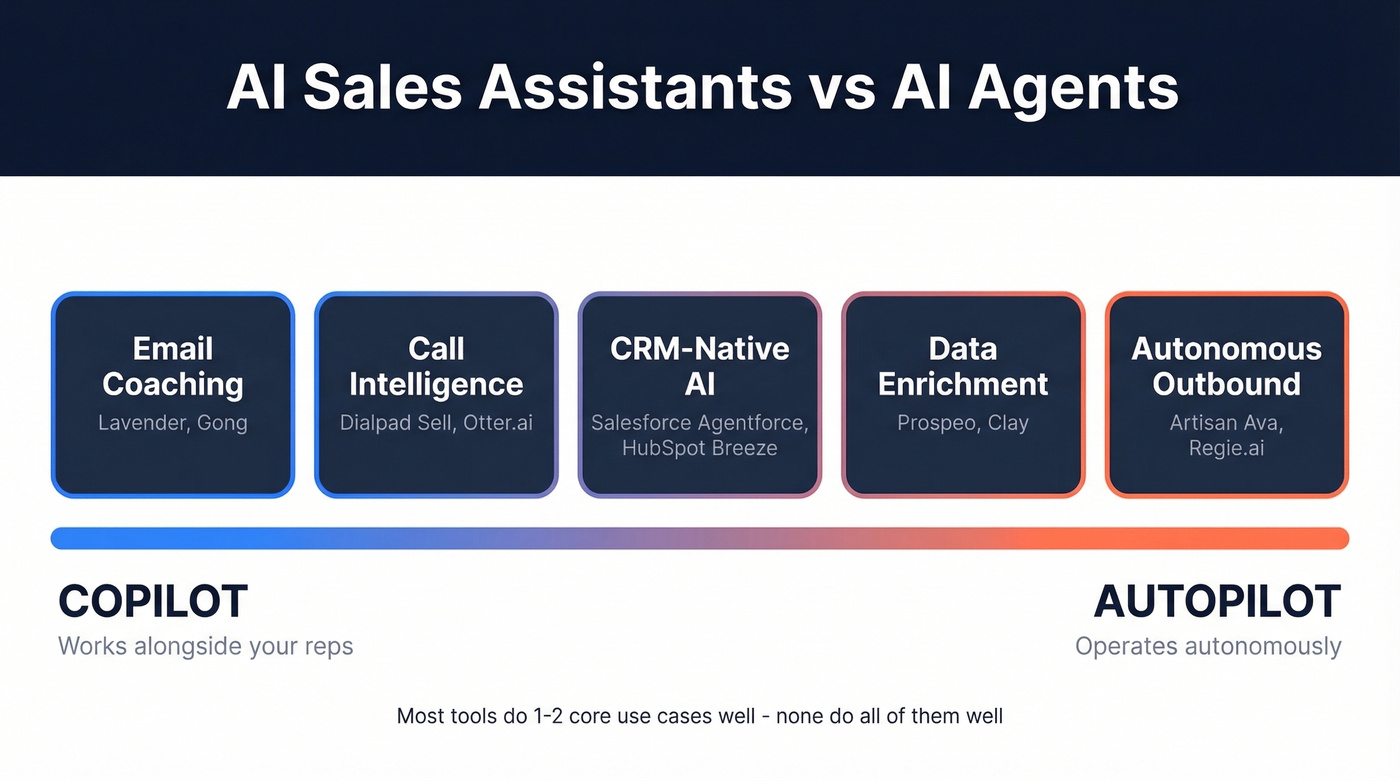
In practice, there's a meaningful split. AI assistants work alongside reps: coaching emails, summarizing calls, surfacing deal risks. Think copilot. AI agents operate autonomously: sourcing leads, writing sequences, sending emails, even booking meetings without a human in the loop. Think autopilot.
Most tools do one or two core use cases well - email drafting, lead scoring, CRM hygiene, call coaching, or pipeline forecasting. None do all of them well, despite what their marketing pages suggest. Bain's research found that teams using AI effectively see 30%+ win-rate improvements, but only when the underlying data and processes are sound.
Best Sales AI Tools by Use Case
Data Enrichment & Prospecting
Prospeo
The most accurate email data on this list. If you're loading contacts into any AI outreach tool without verifying them first, you're burning your domain reputation.
The database covers 300M+ professional profiles with 143M+ verified emails and 125M+ verified mobile numbers. The 98% email accuracy rate comes from a proprietary 5-step verification process with catch-all handling, spam-trap removal, and honeypot filtering. The 7-day data refresh cycle is genuinely unusual - the industry average sits around six weeks, which means most providers are serving you contacts that have already changed jobs by the time you hit send.
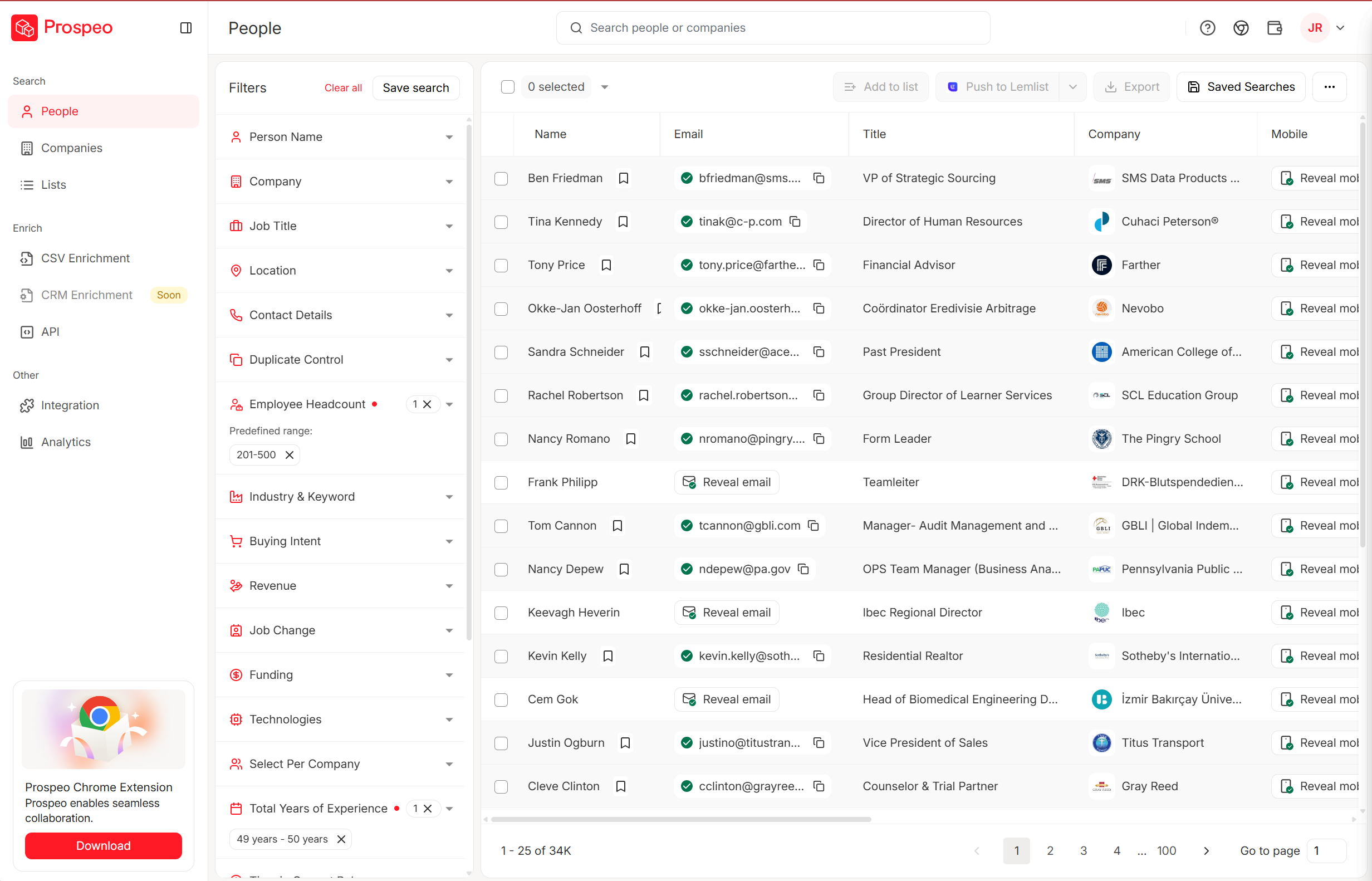
Beyond raw contact data, 30+ search filters include buyer intent data tracking 15,000 Bombora topics, technographics, job changes, and headcount growth signals. You're not just finding contacts - you're finding contacts who are actively in-market. The Chrome extension, used by 40K+ users, lets you pull verified contacts from any website in one click. Native integrations with Salesforce, HubSpot, Clay, Instantly, and Lemlist mean the data flows directly into whatever sequencing or enrichment tool you're running.
The proof point that sticks with us: Snyk's team of 50 AEs dropped their bounce rate from 35-40% to under 5% and generated 200+ new opportunities per month after switching. Pricing is transparent - free tier with 75 emails/month, paid plans at roughly $0.01/email, no annual contracts required.
Clay
Clay is the enrichment and research automation platform that's become the darling of RevOps teams who love building workflows. It lets you chain enrichment steps together and use AI to research accounts at scale.
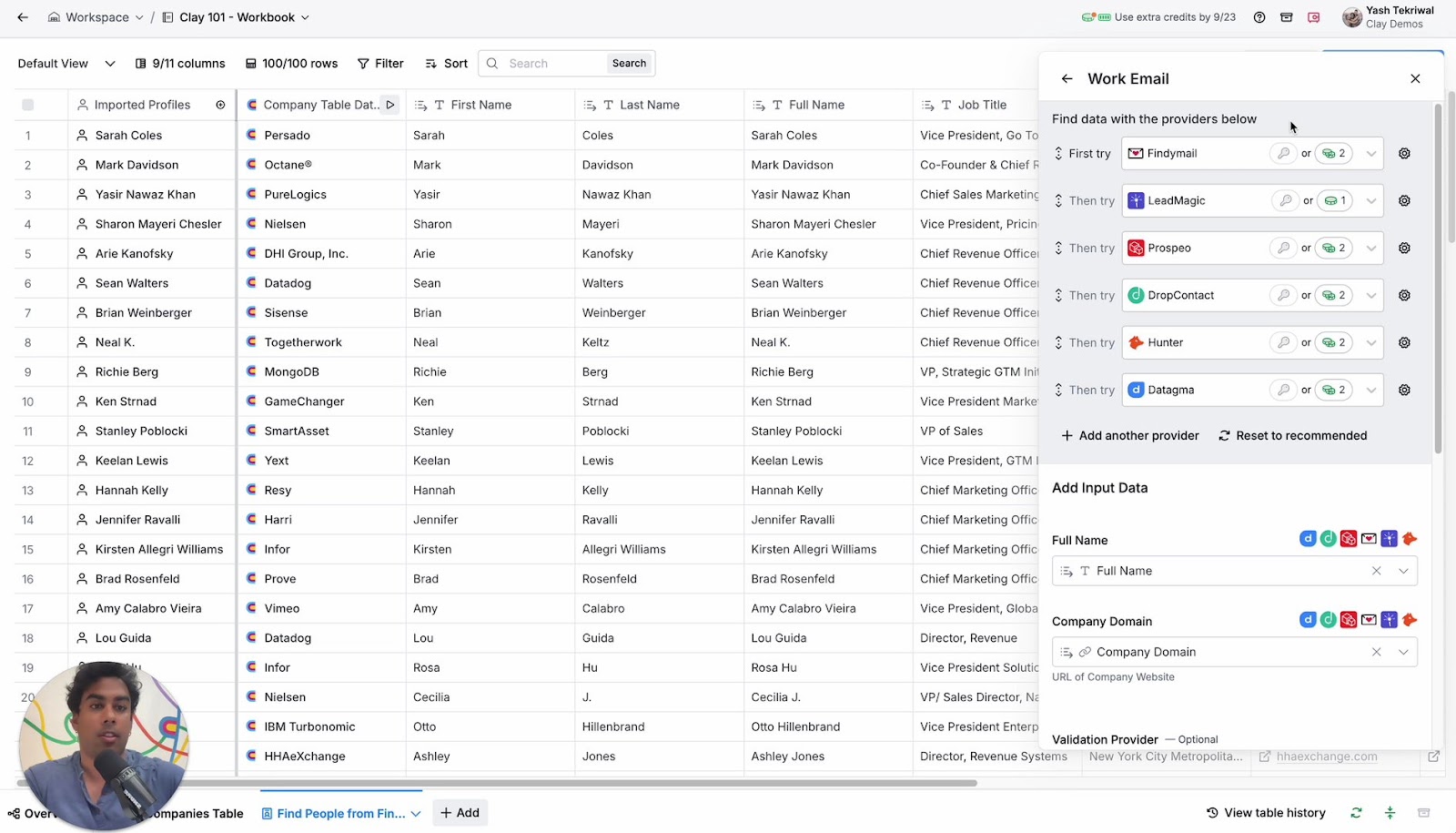
The free tier gives you 100 credits/month. Paid plans start at $149/mo with 2,000 credits, step up to $349/mo with 10,000 credits, and scale to $800/mo with 50,000 credits. The credit economics shift dramatically as you scale - roughly $75 per 1,000 credits at Starter drops to ~$16 per 1,000 at Pro. CRM sync isn't available on Starter, which means you're exporting CSVs until you hit Pro. Reviewers consistently flag the learning curve, but for teams with the technical appetite, nothing else offers this level of flexibility.
Outbound Automation
Regie.ai
The AI Agents package starts at $35,000/year and includes lead sourcing, enrichment, signal-based prioritization, and integration with Outreach or Salesloft. Add the AI Dialer for parallel dialing, AI call scripts, and voicemail drops. Regie says teams can reach 3-5x more accounts without adding headcount.
If you're under 20 reps, you're overpaying. If you're running 50+ reps on Outreach and need to scale without scaling headcount, it's worth a conversation.
Artisan (Ava)
The most polarizing tool on this list. One user reported booking 8-10 meetings in their first two months. Another reported sending roughly 1,400 emails with zero responses.
Artisan's AI SDR "Ava" sources leads from a 300M+ contact database, writes personalized sequences, and books meetings autonomously. The pitch is compelling. The reality is inconsistent. Analysis of 100+ reviews surfaces a clear pattern: early excitement fades within 30-60 days, and the "hyper-personalization" often feels like generic GPT output. At $2,000+/month with request-only pricing, you need serious confidence in your ICP and messaging before committing.
Use this if you've already proven your outbound motion with human SDRs. Skip this if you're still figuring out product-market fit - Ava can't fix a positioning problem.
Instantly
High-volume cold email at low cost - email sending from $30/mo, lead discovery from $39.90/mo. It's the go-to for agencies and founders running multi-domain outbound. Pair it with a verification tool before loading contacts, because deliverability lives and dies on data quality.
Email Coaching
Lavender
$29/mo to make your reps better at the one thing that matters most in outbound: getting replies. That's the entire pitch.

Lavender's real-time scoring engine analyzes drafts as reps write, flagging readability issues, personalization gaps, and patterns that correlate with lower reply rates. The free tier is genuinely useful for individual reps testing the concept. Individual Pro runs $49/mo, and Team plans at $99/seat/mo add manager dashboards and team-wide analytics.
For teams running a hybrid model - AI handling volume, humans handling quality - Lavender keeps the human side sharp.
Call & Meeting Intelligence
Dialpad Sell
One of the highest-rated options in this category at 4.5/5 across 24 peer reviews. Plans commonly start around $60/user/mo and run around $95/user/mo for real-time call assistance. Real-time AI coaching during live calls - sentiment analysis, keyword tracking, suggested responses - differentiates it from pure transcription tools. If call coaching is your primary need and you don't want enterprise pricing, start here.
Gong
Expect enterprise pricing - typically $30-50K+/year depending on seats and modules. That's the first thing you should know about Gong, because the price tag shapes every decision around it.
The platform captures calls, emails, and web conferences, then surfaces deal risks, coaching opportunities, and revenue insights across your entire pipeline. Reviewers love the insight density but consistently cite the price as a barrier for SMBs. For mid-market and enterprise teams where deal sizes justify the investment, the intelligence is hard to match. Outreach's competing Kaia feature claims to close deals 11 days faster and lift win rates by 10+ points on deals above $50K - so this category delivers real ROI if you're in the right ACV range.
Otter.ai
Skip this if you need revenue intelligence. Grab this if you just need reliable transcription and searchable meeting notes. Rated 4.2/5 across 38 peer reviews, Otter.ai offers a free tier with 300 minutes/month and paid plans from $8.33/user/mo. It won't replace Gong, but it covers the basics at a fraction of the cost.
CRM-Native AI
Salesforce Agentforce
The most-reviewed AI assistant in the category - 4.4/5 across 61 peer reviews. Sales Cloud often runs $50-150/user/mo plus AI add-ons. The advantage is deep CRM integration: lead scoring, opportunity insights, and automated follow-ups that live natively where your reps already work.
If you're already a Salesforce shop, Agentforce is the natural choice. If you're not, switching CRMs to get AI features is almost never worth the migration pain.
HubSpot Breeze
Skip this if you're not already on HubSpot. Sales Hub runs $90/seat/mo at Pro and $150/seat/mo at Enterprise. The AI features - email drafting, meeting prep, deal summaries - are integrated but not as deep as Salesforce's offering. Good enough for most HubSpot-native teams, not a reason to switch platforms.

Your AI sales assistant can draft perfect emails, score every lead, and automate your entire workflow. None of it matters if 35% of your contacts bounce. Prospeo's 98% email accuracy and 7-day data refresh give your AI stack the foundation it actually needs to perform.
Feed your AI assistant verified data - not stale contacts that kill your domain.
Pricing at a Glance
The fact that Artisan, Regie.ai, and Gong hide their pricing behind "request a demo" tells you everything about how they view small teams.
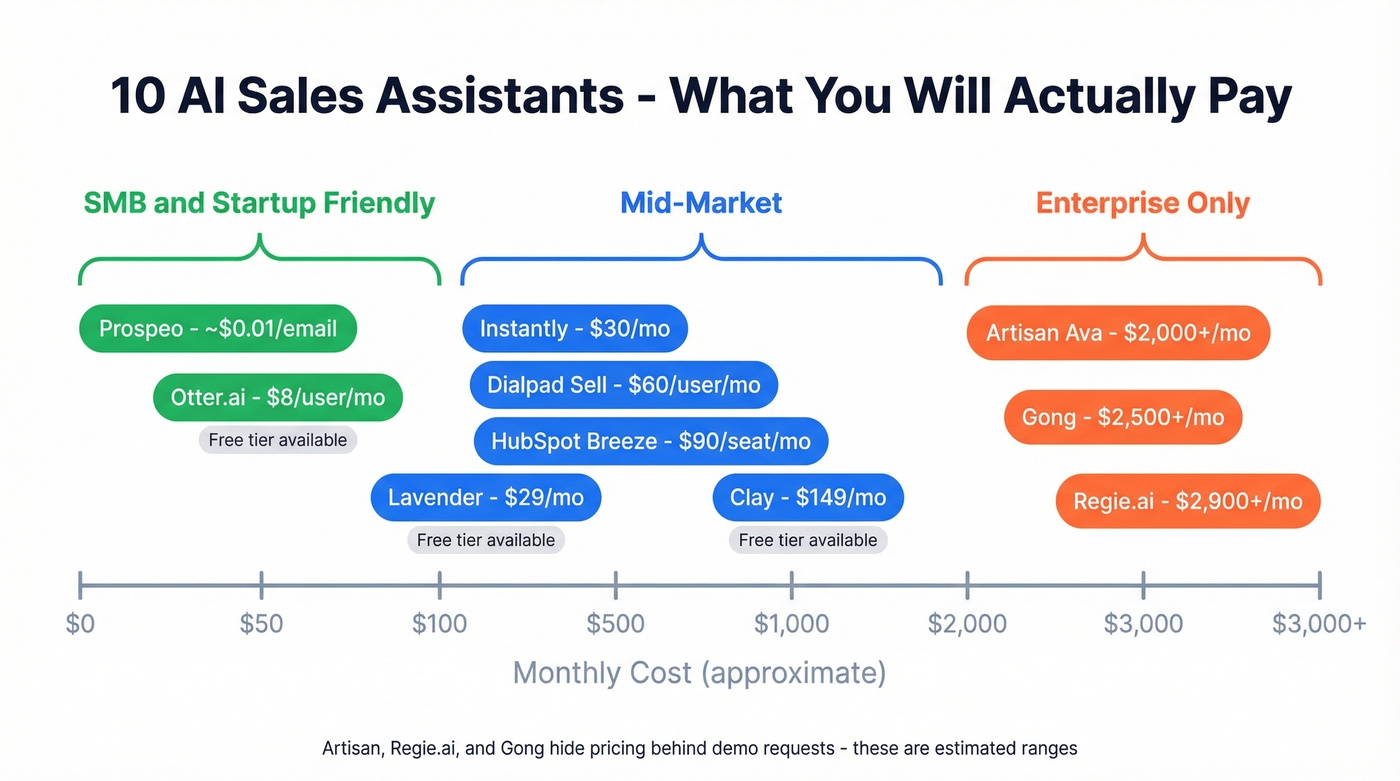
| Tool | Best For | Starting Price | Free Tier? | Model |
|---|---|---|---|---|
| Prospeo | Verified contact data | ~$0.01/email | Yes | Credits |
| Clay | Multi-source enrichment | $149/mo | Yes | Credits |
| Lavender | Rep email coaching | $29/mo | Yes | Per seat |
| Instantly | High-volume cold email | $30/mo | No | Per seat |
| Otter.ai | Meeting transcription | $8.33/user/mo | Yes | Per seat |
| Dialpad Sell | Live call coaching | $60/user/mo | No | Per seat |
| HubSpot Breeze | CRM-native AI (HubSpot) | $90/seat/mo | No | Per seat |
| Gong | Revenue intelligence | $30-50K+/yr | No | Annual contract |
| Artisan (Ava) | Autonomous AI SDR | ~$2,000+/mo | No | Custom |
| Regie.ai | Enterprise outbound at scale | $35,000/yr | No | Custom |
AI SDR vs. Human SDR
The "AI will replace SDRs" narrative misses the math that matters:
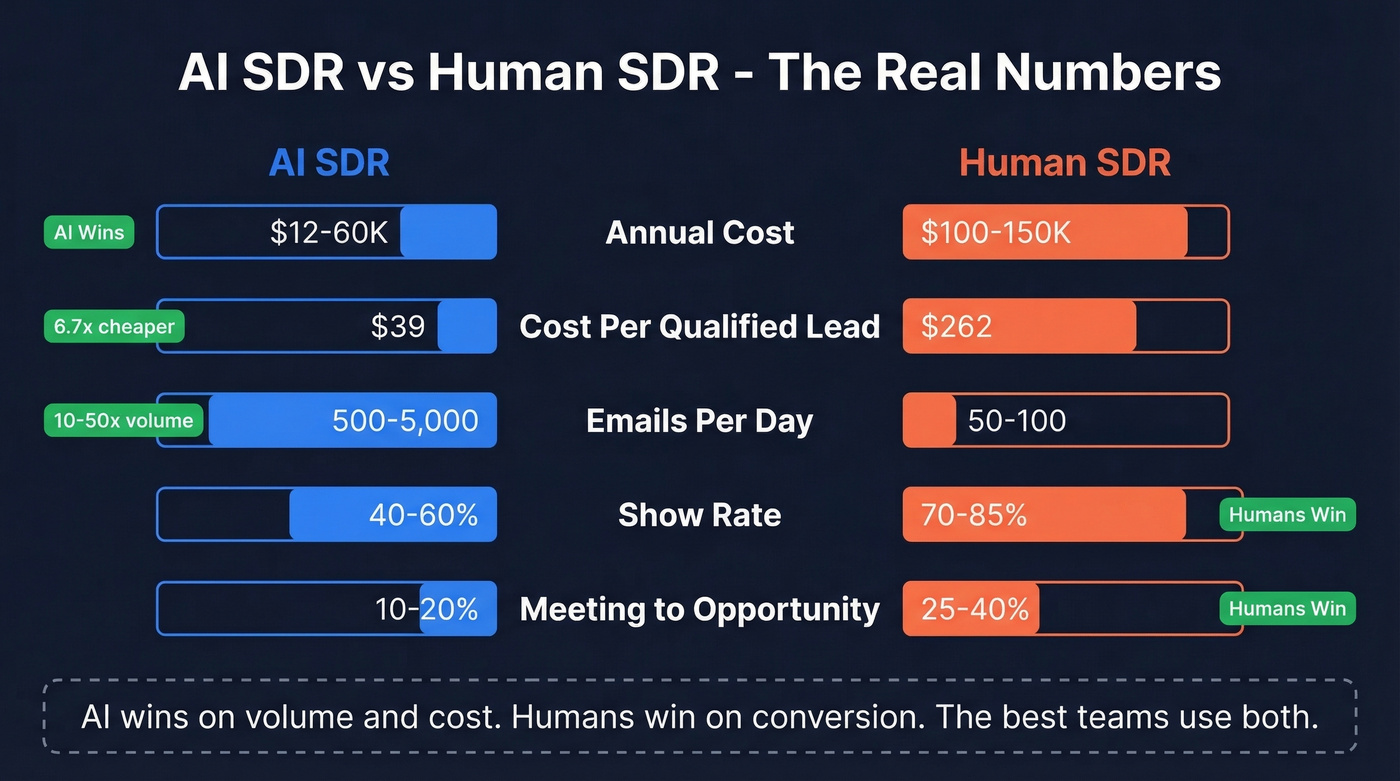
| Metric | Human SDR | AI SDR |
|---|---|---|
| Annual cost | $100-150K | $12-60K |
| Cost per qualified lead | ~$262 | ~$39 |
| Emails per day | 50-100 | 500-5,000 |
| Show rate | 70-85% | 40-60% |
| Meeting to opportunity | 25-40% | 10-20% |
AI wins on volume and cost - dramatically so on cost-per-lead. Humans win on conversion quality and relationship building. Speed-to-lead data shows a 391% conversion boost when leads are contacted quickly, which is where AI's always-on nature shines. But that conversion advantage evaporates if the AI is emailing dead addresses.
45% of teams already run a hybrid model, and that number is climbing. AI handles the research, personalization at scale, and initial outreach cadence. Humans handle judgment calls, relationship building, and complex deal navigation. The hybrid model only works when the data layer is clean - we've seen teams blame their AI SDR for poor results when the real culprit was a 30% bounce rate from stale contact lists.
Why Most AI Sales Pilots Fail
~95% of GenAI pilots fail to achieve measurable profitability impact, despite organizations investing an average of $6.5M annually in AI initiatives. In our experience working with sales teams, the failures cluster around five patterns:
Broken data foundations. Roughly 80% of enterprise data is unstructured - scattered across emails, docs, call transcripts, and half-maintained CRMs. Modern AI sales assistants increasingly use RAG architectures that pull from your company's knowledge base in real time. If that knowledge base is garbage, the AI's output is garbage.
No process redesign. Teams automate existing broken workflows instead of rethinking them. Fragmented workflows and piecemeal pilots are the norm.
Inadequate training. Only 17% of employees report receiving adequate GenAI training. You can't hand a rep an AI tool and expect adoption without investment in showing them how it fits their day.
Domain reputation damage. You loaded 5,000 contacts from a stale database, hit "go" on your AI SDR, and watched your bounce rate hit 15%. Your sender reputation tanked. Your sequences got throttled. Now you're spending weeks recovering deliverability instead of booking meetings. This is the failure mode that frustrates us most, because it's entirely preventable.
Expectation mismatch. Teams expect autonomous AI to perform like a trained human SDR from day one. It won't. Early results require tuning, feedback loops, and patience.
How to Choose the Right Stack
| Profile | Recommended Stack | Monthly Cost |
|---|---|---|
| Solo founder / 1-5 reps | Prospeo + Lavender + Instantly | Under $150/mo |
| Mid-market / 10-50 reps | Clay + Dialpad Sell + CRM-native AI | $500-2,000/mo |
| Enterprise / 50+ reps | Salesforce Agentforce + Gong + verified data layer | $4,000-8,000+/mo |
The solo stack gives you verified contacts, email coaching, and a sending platform - a complete outbound motion without enterprise overhead. The mid-market stack invests in enrichment workflows, call coaching, and CRM automation. Enterprise gets full conversation intelligence and CRM-native AI.
When your average deal size doesn't justify Gong-level tooling, invest in data quality and email coaching instead. The ROI per dollar is dramatically higher at lower ACVs.
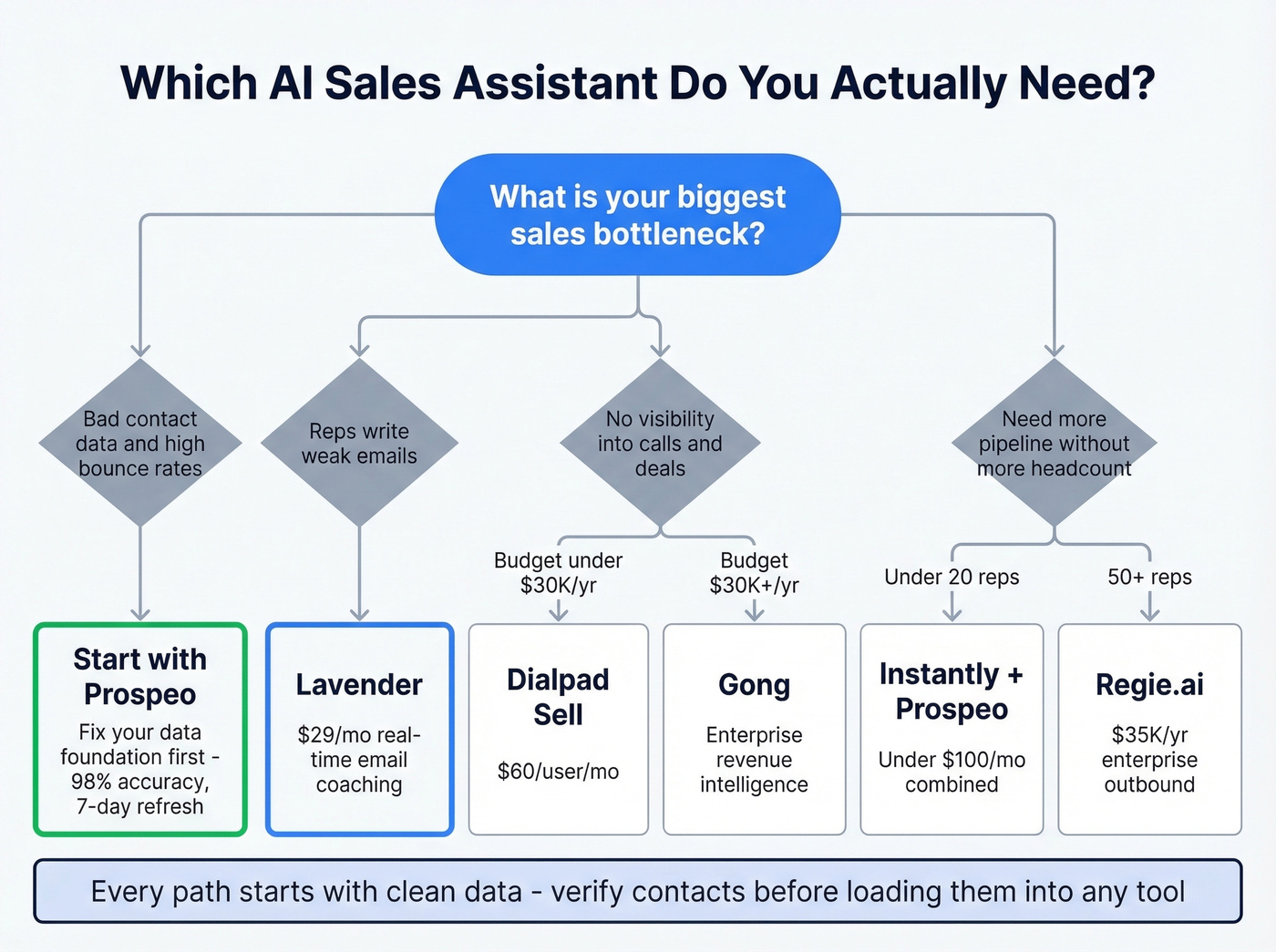
Let's be honest about the universal first step across all three profiles: get the data layer right. Every artificial intelligence sales assistant on this list performs better with verified, fresh contact data underneath it.
Snyk's 50 AEs dropped bounce rates from 35-40% to under 5% and generated 200+ new opportunities per month. The difference wasn't a better AI tool - it was better data underneath. At $0.01/email with no contracts, Prospeo is the cheapest upgrade that makes every other tool in your stack work harder.
Stop letting bad data sabotage your AI sales stack.
FAQ
What does an AI sales assistant actually do?
It automates admin work that eats rep time - CRM updates, email drafting, call transcription, lead scoring - and surfaces deal insights so reps focus on high-value conversations. Most teams reclaim 10-15 hours per rep per week by offloading research and data entry.
Are AI SDRs better than human SDRs?
Neither alone outperforms the combination. AI handles volume at ~$39/qualified lead vs. ~$262 for humans, but show rates drop to 40-60%. 45% of teams already use a hybrid model - AI for scale, humans for conversion.
How much do AI sales tools cost?
From free to $35,000+/year. Email coaching tools like Lavender start at $29/mo. Credit-based platforms run ~$0.01/email with a free tier. Enterprise platforms like Gong and Regie.ai require annual contracts north of $30K.
Why do most AI sales tool pilots fail?
Bad data is the top cause - ~95% of GenAI pilots fail to hit profitability targets. Teams layer AI on stale CRM records, bounce rates spike, and domain reputation tanks. Fix the data foundation first, then deploy the AI layer.
What's a good free option to start with?
Prospeo's free tier gives you 75 verified emails/month for the data foundation. Layer Lavender's free plan for email coaching and Otter.ai with 300 free minutes/month for meeting transcription. That trio covers prospecting, writing, and call capture at zero cost.