

Artisan vs Apollo.io: Honest Comparison (2026)
Your VP forwarded an Artisan demo and asked if you should switch from Apollo. The "never hire another SDR" pitch sounded compelling, and the demo was slick. But this Artisan vs Apollo.io comparison is harder than it looks - Artisan doesn't publish pricing, has only 22 G2 reviews to Apollo's 9,500+, and the entire "AI SDR" category runs on more hype than proof.
We've dug through the contracts, the Reddit threads, and the actual performance data so you can make the call with confidence.
30-Second Verdict
Pick Apollo if you're budget-conscious, want a free tier to test before committing, and you're comfortable assembling your own outbound stack. At $49-$119/user/month on annual billing, it's accessible for teams of any size.
Pick Artisan if you've got $25K+/year to spend, want a managed AI BDR experience, and you're willing to bet on maturing software with dedicated support.
Pricing Breakdown
This is where the comparison gets stark. Apollo is transparent and self-serve. Artisan makes you talk to sales.
Apollo.io Pricing
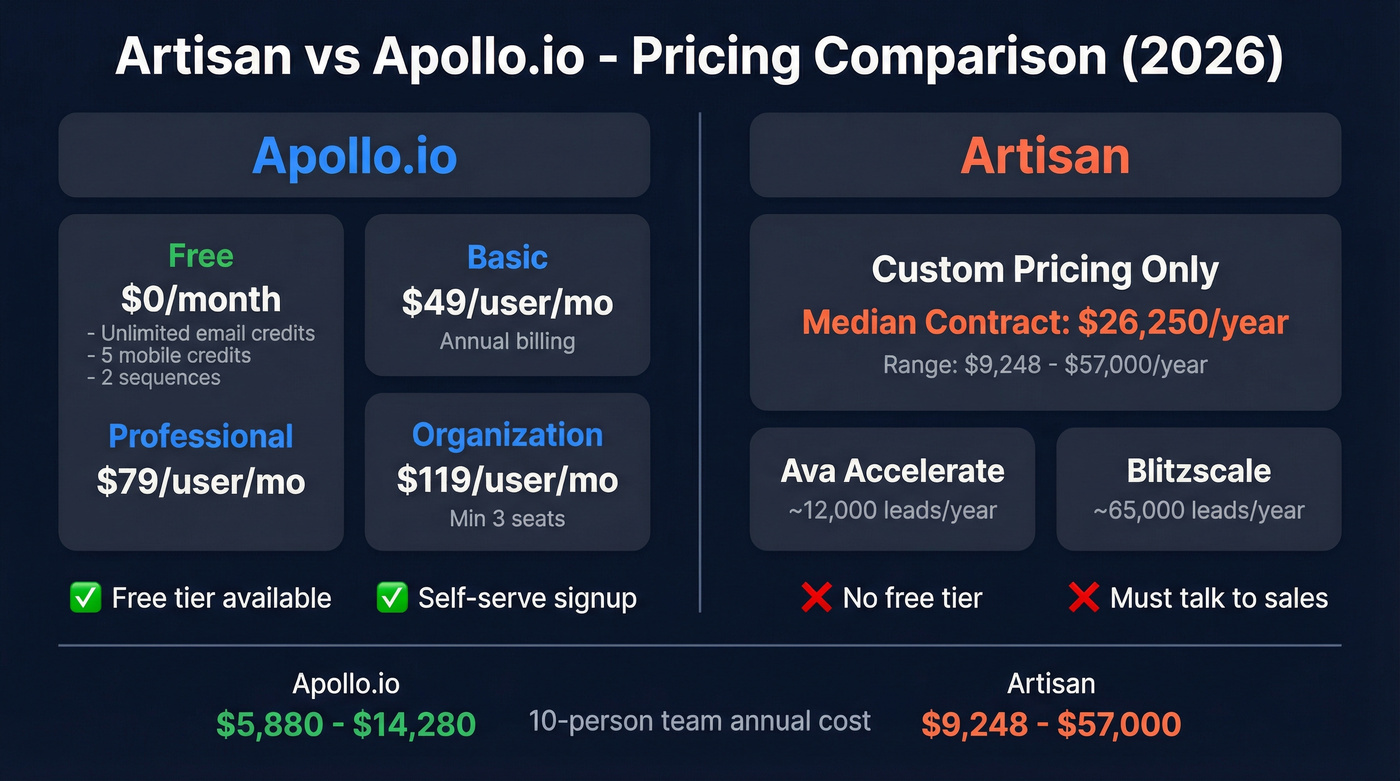
Apollo runs four tiers: Free ($0), Basic ($49/user/month), Professional ($79/user/month), and Organization ($119/user/month, minimum 3 seats). All paid prices assume annual billing.
The free plan gives you unlimited email credits/month, 5 mobile credits, 10 export credits, and 2 active sequences. Limited, but genuinely useful for evaluating the platform. Credits don't roll over - unused credits expire each billing cycle, and overages cost $0.20/credit with a 250-credit minimum. Apollo also migrated to a new credit system in late 2025, so legacy accounts may see different limits, and enrichment steps can consume credits at variable rates depending on which data source returns results. For a 10-person team, expect $490-$1,190/month depending on tier.
Artisan Pricing
Artisan doesn't publish pricing. You'll request a quote, and pricing scales based on lead volume. Per Vendr's benchmark data, the median contract lands at $26,250/year, with a range of $9,248-$57,000. Packages hint at volume tiers - Ava Accelerate covers roughly 12,000 leads/year, Blitzscale handles around 65,000. Annual billing is standard. No free tier, no public free trial. If you're negotiating, December and January tend to be your best months.
Cost-Per-Meeting Math
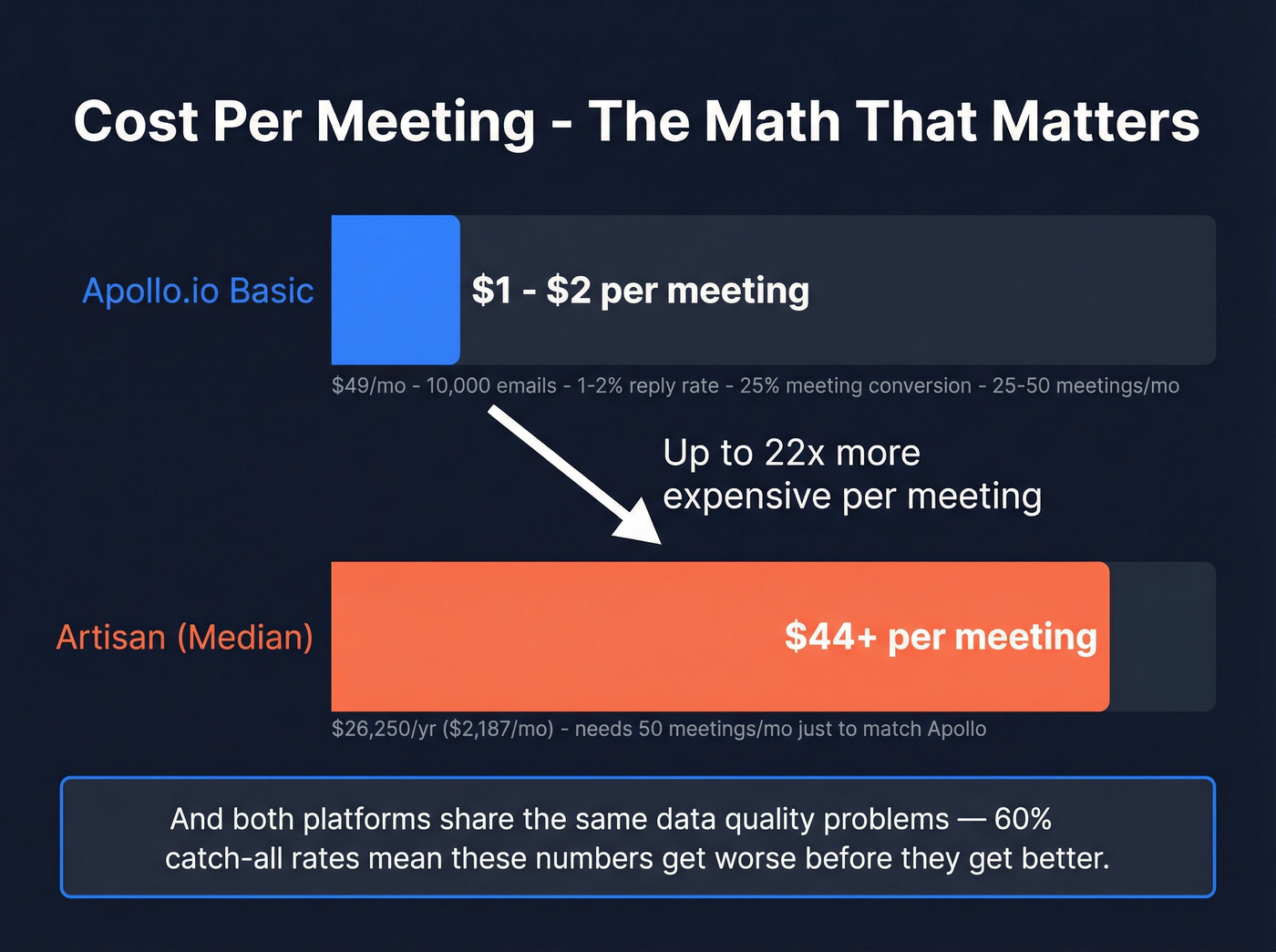
Here's where the numbers get uncomfortable for Artisan. At Apollo's $49/month Basic tier, assume you send 10,000 emails and land a 1-2% reply rate with a 25% meeting conversion on replies. That's roughly 25-50 meetings/month at $1-$2 per meeting. Artisan's $26K/year median needs to generate about 50 meetings per month just to match Apollo's unit economics - and that's before you factor in the data quality issues both platforms share.
| Apollo.io | Artisan | |
|---|---|---|
| Starting price | Free ($0) | ~$9,248/year |
| Paid plans | $49-$119/user/mo | $9K-$57K/year |
| Free tier | Yes | No |
| Free trial | Yes | Not publicly listed |
| Billing | Annual pricing shown | Annual only |
| Credits roll over? | No | N/A (lead-volume based) |
Data Quality Reality Check
Apollo covers 275M+ B2B contacts, and Artisan markets 300M+ contacts. But database size means nothing if the emails bounce.
A Reddit user ran a telling experiment. They exported roughly 900 Apollo leads marked "Verified" and checked them through a third-party verifier. The results: ~19% valid, ~21% invalid, and ~60% risky/catch-all. That "Verified" badge didn't mean what they thought.
Artisan isn't immune either. G2 reviewers consistently tag "Inaccuracy" and "Data Inaccuracy" as recurring themes, and the same GTM engineer who tested Artisan's AI BDR reported features that "worked very poorly," suggesting the data layer has its own gaps.
Neither tool solves your real data quality problem. They're prospecting engines, not verification platforms.

This is exactly where a dedicated verification step matters. Prospeo's 5-step verification process - with catch-all handling, spam-trap removal, and honeypot filtering - delivers 98% email accuracy compared to Apollo's 79%. That gap is massive in practice: teams using Prospeo's verification layer book 35% more meetings than those relying on Apollo's native data alone. At $0.01/lead on a 7-day refresh cycle, you're spending pennies to protect your domain reputation. We've seen teams go from 35-40% bounce rates to under 5% just by adding this step. Run every list through verification before it touches your sequencer, regardless of which tool generated it.

Both Artisan and Apollo struggle with email accuracy - 60% catch-all rates and bounces that torch your domain. Prospeo's 5-step verification delivers 98% accuracy on a 7-day refresh cycle, so every list you send is clean. Teams switching from Apollo book 35% more meetings.
Stop debating tools that share the same data quality problem. Fix the data.
Feature Comparison
| Feature | Apollo.io | Artisan | Winner |
|---|---|---|---|
| Database size | 275M+ contacts | 300M+ contacts | Tie |
| AI email writing | Yes (Pro+) | Yes (Ava AI BDR) | Artisan (more autonomous) |
| Sequences | Yes, with A/B testing | Yes, AI-managed | Apollo (more control) |
| Dialer | Yes (Pro+) | Not a core focus | Apollo |
| Inbox rotation | Not native | Included | Artisan |
| Email warmup | Typically third-party | Built-in | Artisan |
| CRM integrations | HubSpot, Salesforce | HubSpot, Salesforce | Tie |
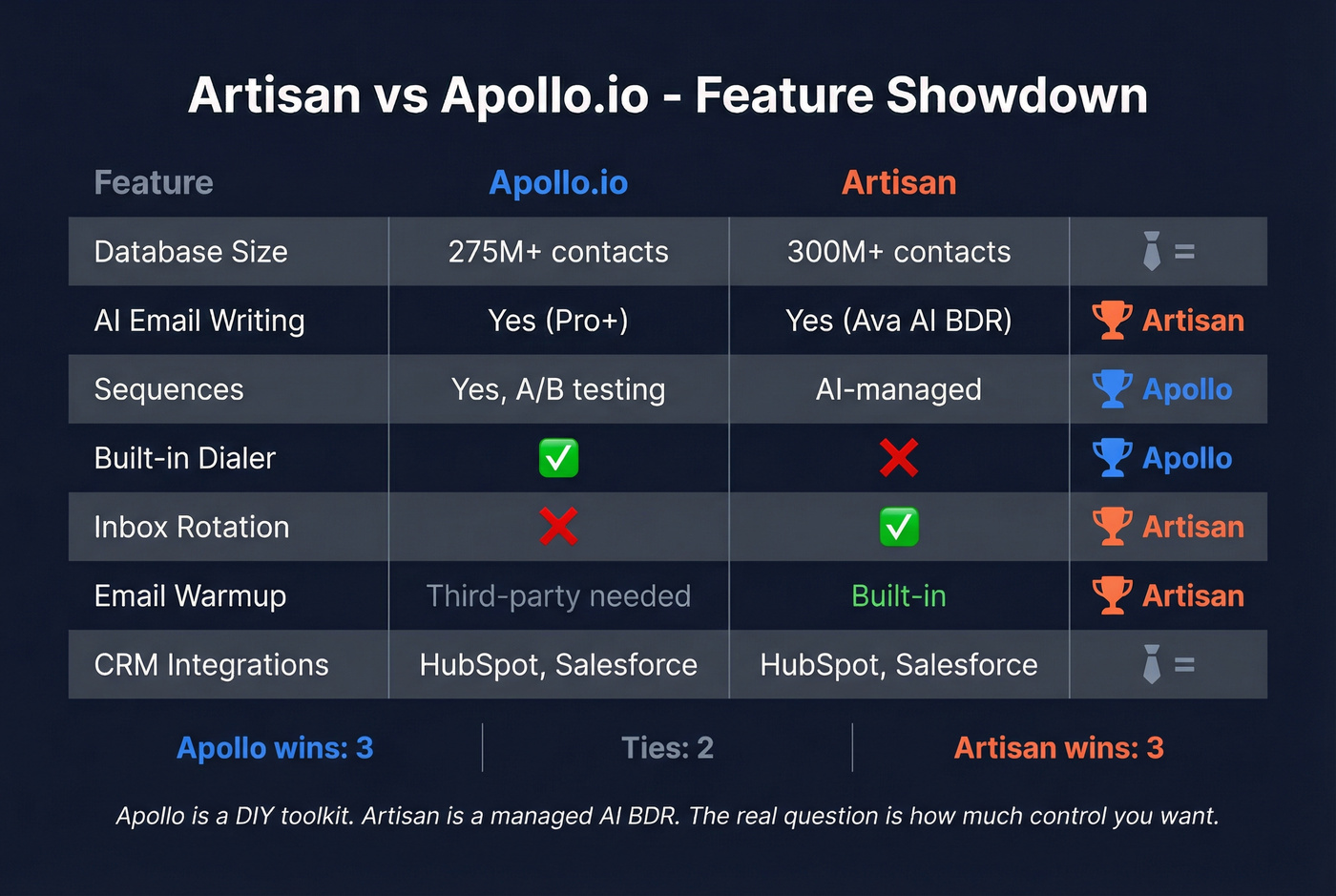
Apollo wins on 3 rows, Artisan wins on 3, and 2 are ties. Apollo is a DIY toolkit - you build your own workflows, configure your own sequences, and plug in third-party tools for warmup and inbox rotation. Artisan is a managed AI BDR where you set parameters and Ava handles execution.
Let's be honest: the "AI SDR" category is mostly marketing at this stage. Apollo quietly does 80% of what Artisan brands as a breakthrough. In our experience, Apollo's AI email writing feels more template-fill than genuine personalization - but Artisan's Ava isn't dramatically better, just more automated. The real difference is whether you want to drive the car yourself or hand the keys to an AI that's still learning to parallel park.
What Real Users Say
Apollo: Massive Validation, Known Gaps
Apollo carries a 4.7/5 on G2 across 9,510 reviews - that's massive market validation. Users consistently praise the search and prospecting capabilities. The complaints center on data quality (see above), outreach features, and AI writing quality.
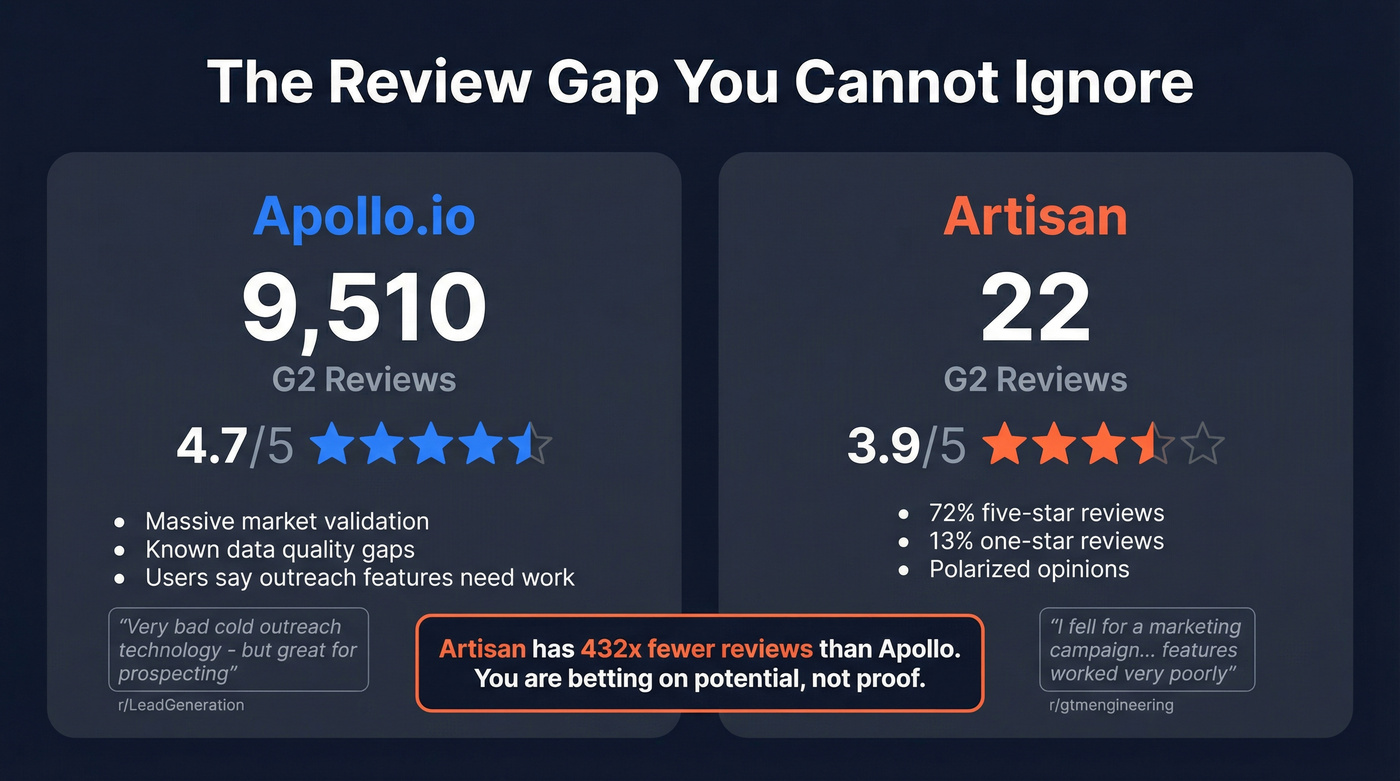
Reddit users on r/LeadGeneration call it "very bad cold outreach technology", specifically flagging the lack of inbox rotation. Multiple users note that Apollo's AI email output "looks obviously AI" and reads more like template-fill than genuine personalization. Most teams use Apollo for prospecting and pair it with a dedicated sending tool - which is probably the right move anyway.
Artisan: Polarized and Thin
The review-volume gap here is one of the most extreme we've seen in any tool comparison. Artisan sits at 3.9/5 on G2 with only 22 reviews, and the distribution is polarized: 72% five-star, 13% one-star. Users praise the dedicated account manager and ease of setup.
But the criticism cuts deep. A GTM engineer on Reddit put it bluntly: "I fell for a marketing campaign." Features "worked very poorly," and promised capabilities were always "coming very soon." That same poster noted Apollo is "low-key an AI SDR... better than half the stuff on the market." With 22 reviews against Apollo's 9,500+, you're placing a bet on potential rather than proven results.
Who Should Pick Which
Pick Apollo if you're a team of 1-10 SDRs, want to start free and scale into paid plans, and you're comfortable building your own stack. Apollo's prospecting database is proven at scale, and the $49/month entry point is hard to argue with.
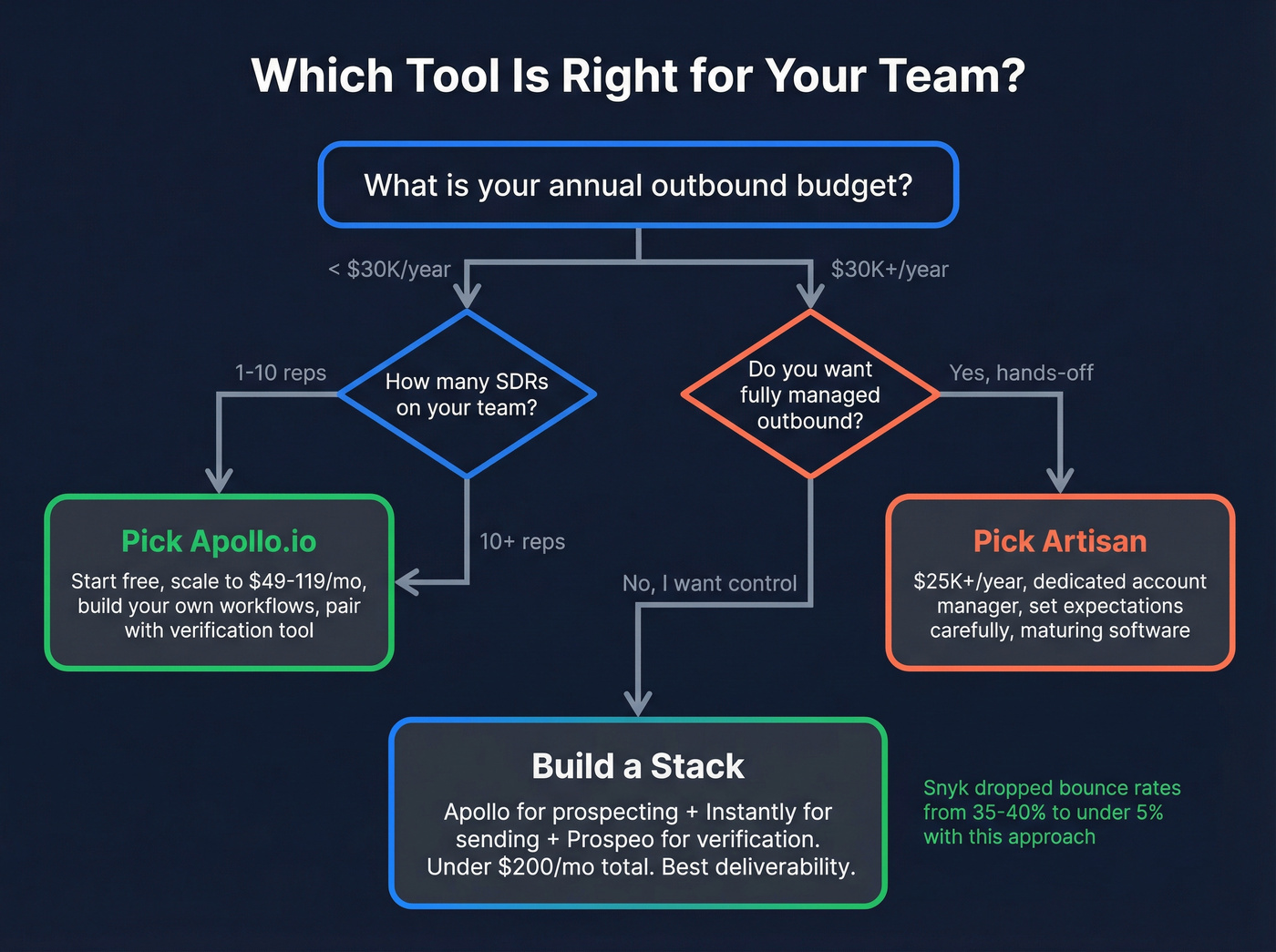
Pick Artisan if you've got $25K+/year in budget, want fully managed outbound, and have a dedicated ops person to work with Artisan's account manager. Go in with realistic expectations - this is maturing software, not a finished product. Skip it if your team is under 5 reps or your annual outbound budget is below $30K.
Build a stack if you want maximum control at minimum cost. Use Apollo for prospecting, a dedicated sending tool like Instantly for outreach, and Prospeo for verification. One customer, Snyk, added Prospeo's verification layer to their outbound stack and dropped bounce rates from 35-40% to under 5%, generating 200+ new opportunities per month. That kind of stack outperforms most all-in-ones on deliverability because each tool does one thing well - and the total cost stays under $200/month.
Artisan charges $26K/year. Apollo's data bounces at 21%+. Neither solves the core issue: you need verified contacts that actually connect. Prospeo gives you 300M+ profiles at 98% email accuracy for $0.01/lead - no annual contracts, no sales calls.
Get enterprise-grade data without the enterprise pricing or the bounces.
FAQ
Is Artisan worth the price compared to Apollo?
Artisan's median contract is $26,250/year - often 10x+ what Apollo costs for small teams. Unless you specifically need a fully managed AI BDR and have budget to match, Apollo delivers 80% of the same functionality at a fraction of the cost. Most teams under 10 SDRs get better ROI from Apollo plus a dedicated verification tool.
Does Apollo.io have a free plan?
Yes. Apollo's free tier includes unlimited email credits/month, 5 mobile credits/month, 10 export credits/month, and 2 active sequences. It's enough to evaluate the database and basic workflows before committing to paid.
How do I improve data quality from either tool?
Run every list through a third-party verification layer before sending. Apollo labels leads as "verified" that still come back invalid or catch-all at high rates under independent testing. A dedicated verification step with catch-all handling and spam-trap removal keeps your bounce rate under 5% and protects your domain.