

Automated Lead Response: The Practitioner's Field Guide
A prospect fills out your demo form at 9:47 PM on a Friday. By Saturday morning, your competitor has already booked the call. By Monday, when your SDR finally sees the notification, that lead is gone.
That's the cost of not having automated lead response. A 60-day split test on r/AskMarketing quantified the damage: teams with sub-minute response saw a +127% conversion lift over manual follow-up averaging 4.2 hours, and the SDR running the test saved roughly 8 hours per week. We've seen similar patterns across our own outbound workflows - speed isn't a nice-to-have, it's the single biggest variable in whether a lead converts or ghosts.
Most Companies Are Failing
Workato tested 114 B2B companies by submitting demo requests and timing responses. Over 99% failed to respond within 5 minutes. Zero called within 5 minutes. The average personalized email took 11 hours and 54 minutes. One in five companies never responded by email at all.
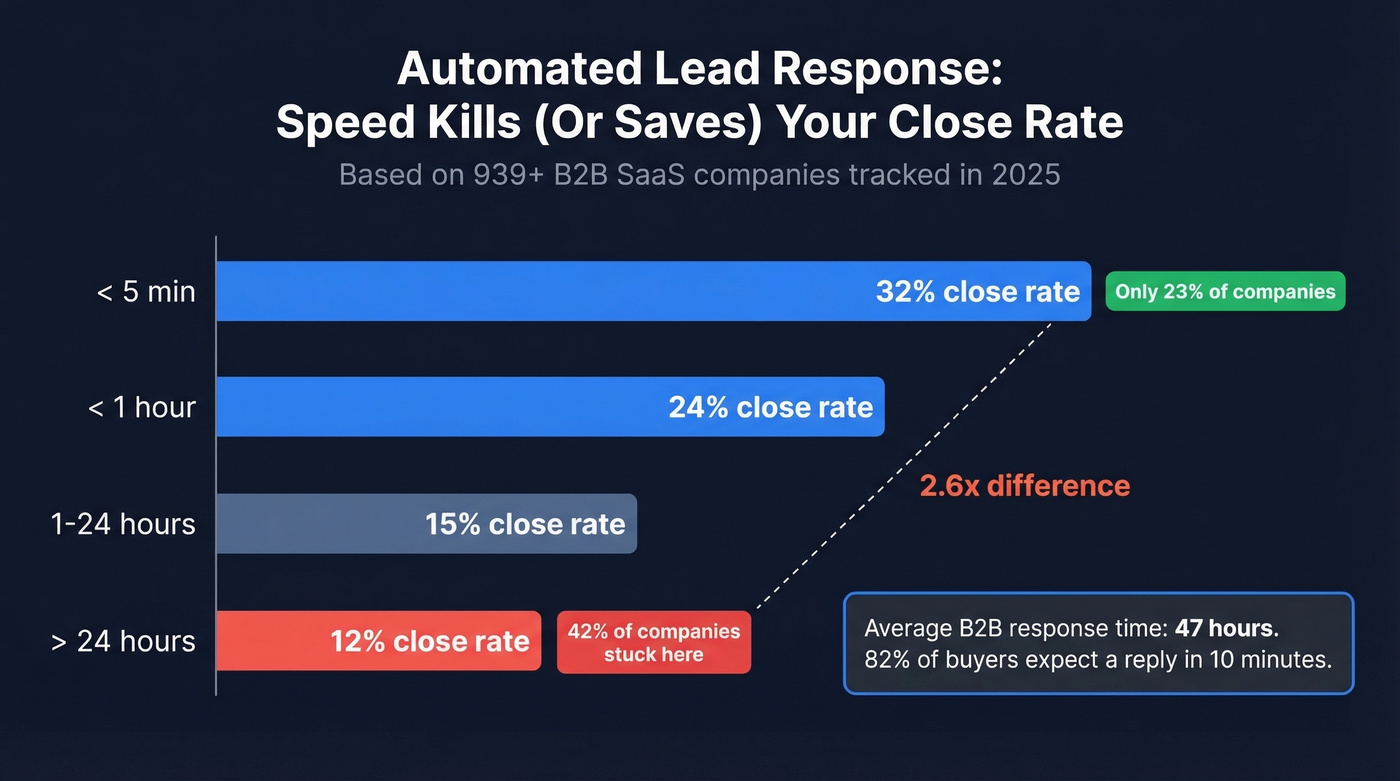
47 hours. That's the average response time across 939 B2B SaaS companies tracked in Q1-Q3 2025. Even companies using routing tools averaged 3 hours 32 minutes - better, but nowhere near the 5-minute threshold that actually moves close rates. Meanwhile, 82% of consumers expect a response within 10 minutes, and 80% of inbound leads never close.
| Response Time | Close Rate | % of Companies |
|---|---|---|
| < 5 min | 32% | 23% |
| < 1 hour | 24% | - |
| 1-24 hours | 15% | - |
| > 24 hours | 12% | 42% |
Companies responding in under 5 minutes close at 2.6x the rate of those taking over 24 hours. And 42% of companies are still stuck in that slowest bucket, basically handing revenue to whoever picks up the phone first.
How the System Works
Stop obsessing over AI chatbots. The Reddit split test didn't use a sophisticated bot - it used sub-minute response with qualification and booking. That's what drove the lift. An email autoresponder is a band-aid, not a system.
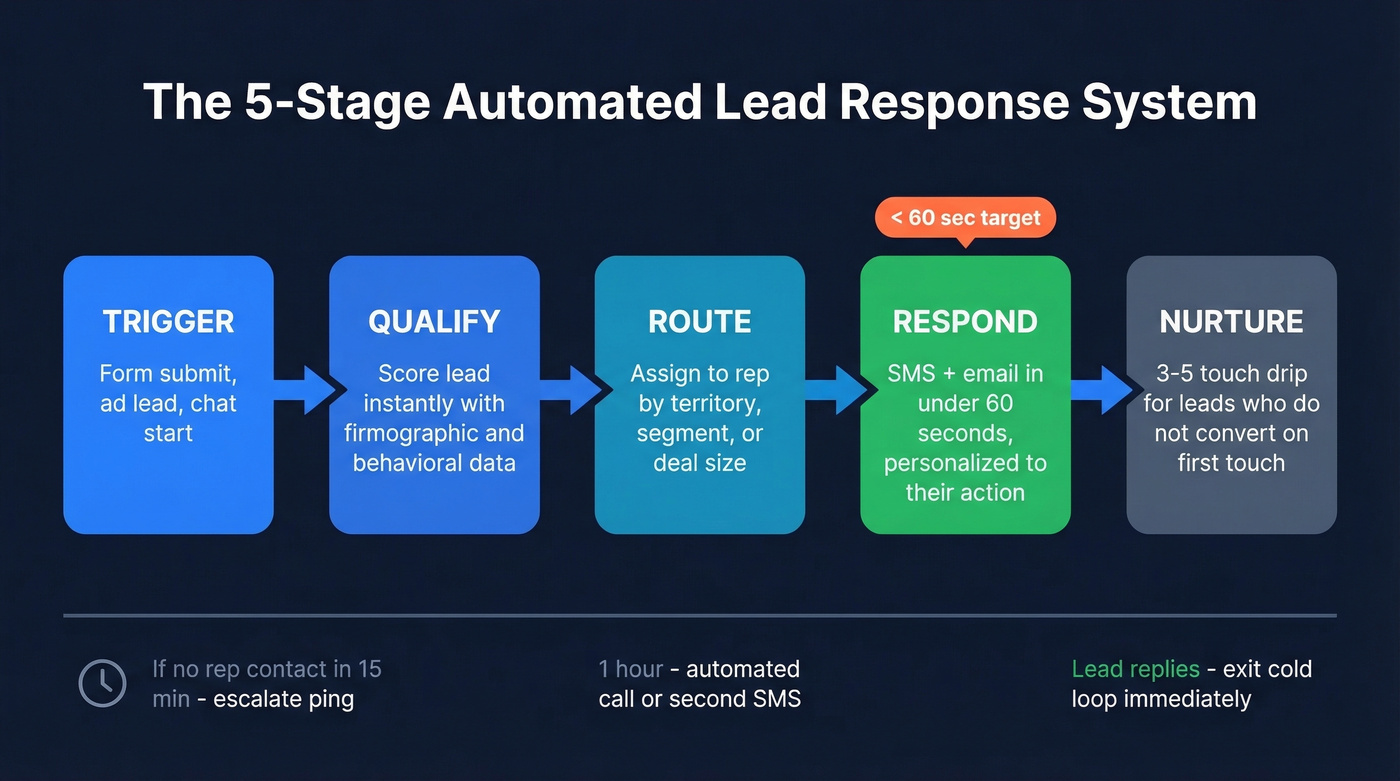
A real automated lead response system follows five stages: Trigger -> Qualify -> Route -> Respond -> Nurture. The trigger catches the inbound signal. Qualification scores the lead instantly. Routing assigns it to the right rep. Response fires across SMS and email within 60 seconds. Nurture handles leads who don't convert on first touch. Let's walk through how to actually build this.
Build Your Workflow
Here's the workflow template adapted from real implementations. It's tool-agnostic - HubSpot, Salesforce, or any CRM with automation capabilities will work.
1. Trigger: Form submitted, ad lead captured, or chat started.
3. Respond (< 60 seconds): Automated SMS + email referencing the specific action the lead took - the form, the page, the product they asked about. Not a generic "thanks for reaching out." Channel matters: 95% of texts are opened within 3 minutes, while about 70% of emails go unopened.
4. Route: Assign to a rep based on territory, segment, or deal size. Notify via Slack.
5. Escalate (15 min): If the rep hasn't made contact, fire a reminder ping. This is where most systems collapse - they trigger the response but don't enforce the human handoff.
6. Follow-up (1 hour): Automated call attempt or second SMS.
7. Nurture (24 hours): Enter a drip sequence. Three to five touches maximum - more than five drives unsubscribe requests.
8. Exit logic: Lead replies -> remove from cold loop immediately. Lead books -> shift to confirmation + reminder sequence.
Your minimum stack: CRM (HubSpot or Salesforce) + router (Chili Piper or Calendly) + SMS trigger (Twilio-based) + verified contact data. Budget $200-$500/mo for the non-CRM pieces.

Your sub-minute response means nothing if the email bounces or the phone number is dead. Prospeo's 5-step verification delivers 98% email accuracy and 125M+ verified mobiles - so every automated touchpoint in your workflow actually reaches a real person.
Stop automating bad data at scale. Verify before you trigger.
Mistakes That Kill Your System
Responding too fast with robotic copy. Sub-10-second responses with zero personalization trigger "are you a bot?" suspicion. One Reddit practitioner learned this firsthand - their initial system "responded too fast and sounded robotic." Add a 30-60 second delay and use personalization tokens referencing the lead's specific action.
Here's the thing about data quality: "but I already have clean data" is something we hear constantly, and it's almost never true. Run a seed-list QA test on your current database. If you can't hit a 95%+ pass rate, your automation is amplifying bad data at scale. Every bounced email chips away at deliverability, dead phone numbers waste call sequences, and duplicate records mean multiple reps chasing the same lead. Verify before you automate - always.

Over-following-up. One practitioner tracked 832 leads over six months and landed on the ceiling: 3-5 follow-ups. Start with three, test up to five, watch your opt-out rates. Beyond five, you're generating complaints, not pipeline. If you need copy that doesn't sound automated, pull from proven follow-up templates.
Stitching together six tools without testing the handoffs. Your trigger fires, but the router doesn't pick it up for 12 minutes because of a webhook delay. Test the full chain end-to-end before going live. The integration seams are where speed dies.
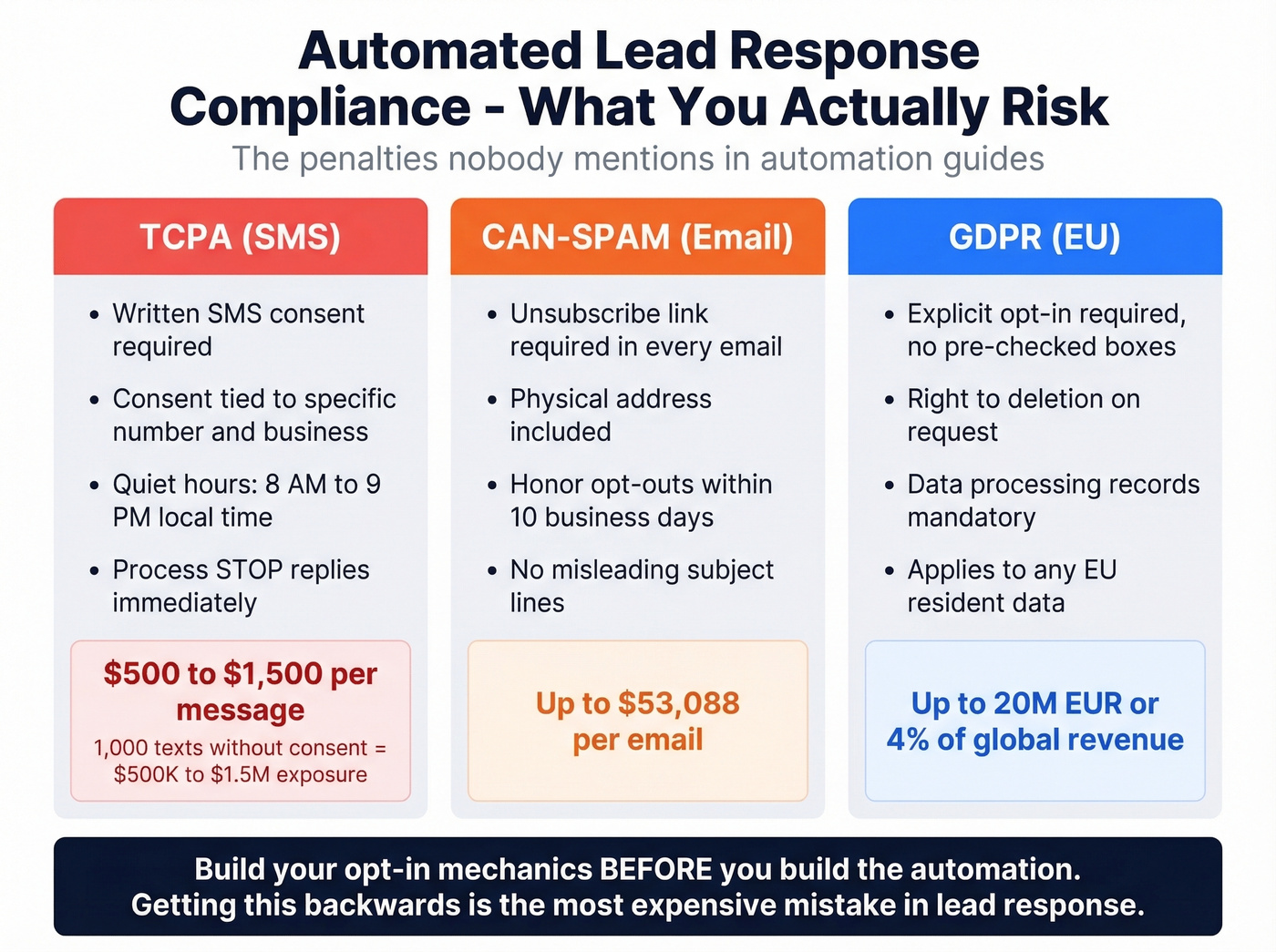
Ignoring compliance. Every guide tells you to respond in under 5 minutes. Almost nobody tells you what happens when your automated text violates TCPA. That's $500-$1,500 per message. If you're doing any outbound-style texting, read up on cold texting before you scale.
Compliance: The Part Nobody Covers
Automated SMS without proper consent isn't just risky - it's expensive. State-level "mini-TCPAs" are adding regulation layers that most automation guides skip entirely, and the penalties are brutal.
| Regulation | Requirement | Penalty |
|---|---|---|
| TCPA | Written SMS consent; quiet hours 8AM-9PM | $500-$1,500/msg |
| CAN-SPAM | Unsubscribe link + address; opt-out in 10 days | Up to $53,088/email |
| GDPR | Explicit opt-in; right to deletion | Up to EUR 20M or 4% revenue |
Every marketing SMS needs prior express written consent - not a pre-checked box, not a buried clause. Consent must be tied to a specific number and business. Process "STOP" replies immediately. Don't send before 8 AM or after 9 PM in the recipient's local time.
If you're sending 1,000 automated texts without proper consent, your exposure is $500K-$1.5M under TCPA alone. Most teams should build the opt-in mechanics before they build the automation. Getting this backwards is the most expensive mistake in lead response, and the one nobody talks about because it's not as exciting as shaving seconds off response time. Skip the SMS channel entirely until your consent flow is airtight.
Realistic Benchmarks for 2026
Don't expect overnight results. Expect visible improvements in 30-45 days and meaningful data at 60-90 days. If you want to sanity-check your targets, compare against average B2B lead conversion rate benchmarks.
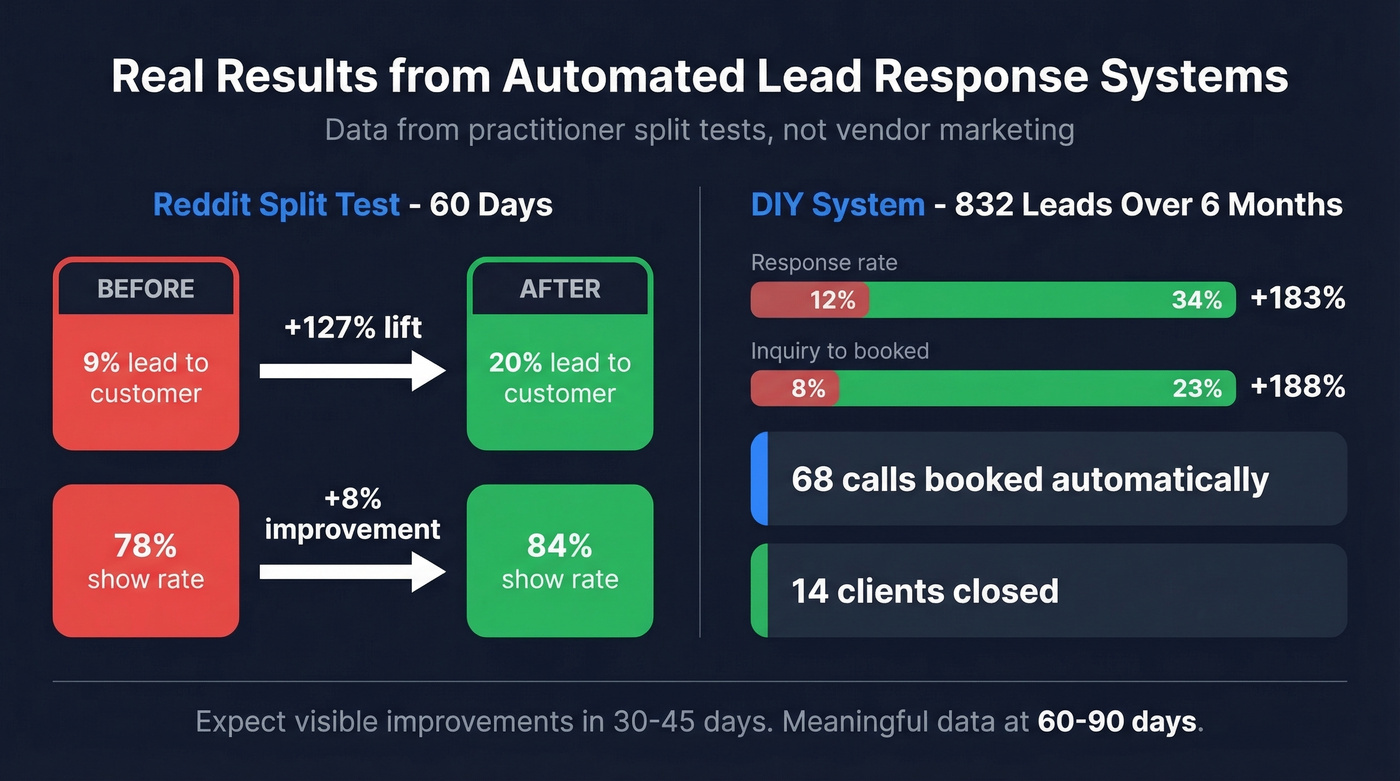
The Reddit split test showed lead-to-customer jumping from 9% to 20% - that +127% lift - with show rates improving from 78% to 84%. A separate practitioner running a DIY system over six months tracked 832 leads: response rates climbed from 12% to 34%, inquiry-to-booked jumped from 8% to 23%, 68 calls booked automatically, and 14 clients closed. These aren't enterprise numbers with massive budgets. They're small teams running lean systems with good data.
Automated lead response isn't a competitive advantage anymore - it's table stakes. The 42% of companies still responding after 24 hours are handing deals to whoever builds this system first. If you're rebuilding your process end-to-end, map it to a clean lead generation workflow so nothing falls through the cracks.
The article says it clearly: if your database can't hit a 95%+ pass rate, your automation is amplifying bad data. Prospeo refreshes every 7 days - not 6 weeks - with spam-trap removal and catch-all handling built in. At $0.01 per email, cleaning your pipeline costs less than one bounced sequence.
Run your seed-list QA test against Prospeo's 300M+ verified profiles.
FAQ
What's the ideal response time?
Under 5 minutes. Companies hitting that threshold close at 32% - 2.6x higher than those taking over 24 hours. Over 99% of B2B companies fail to reach it, so getting there puts you ahead of virtually everyone.
What tools do I need?
A CRM (HubSpot or Salesforce), a routing tool (Chili Piper or Calendly), an SMS trigger (Twilio-based), and a data verification layer for email and phone accuracy. Budget $200-$500/mo for the non-CRM pieces. The goal is trigger-to-booking without manual bottlenecks.
How many follow-ups should an automated sequence include?
Three to five. Practitioners consistently find that more than five touches drives unsubscribes and complaints. Start with three, test up to five, and monitor opt-out rates - if they spike above 2%, scale back.
Do I need SMS consent before automating responses?
Yes. TCPA requires prior express written consent for every marketing SMS. Without it, penalties run $500-$1,500 per message. Build your opt-in mechanics before you build the automation, or a 1,000-text campaign could carry $500K+ in liability.