

B2B Buying Signals: Which Ones Actually Matter in 2026
Your SDR gets a Bombora alert - a target account is surging on "CRM migration." She pulls up the contact in Salesforce. Last verified eight months ago. She fires off an email anyway. It bounces. The signal dies in a dead inbox.
That's the real problem with B2B buying signals. Detection is easy - a dozen tools will flood your Slack with alerts. Activation is where everyone fails. Only ~5% of B2B buyers are in-market at any given time, buying cycles have compressed from 11.3 months to 10.1 months per the most recent 6sense Buyer Experience Report, and the window is shrinking while most teams fumble with stale data when it opens.
Not All Signals Are Equal
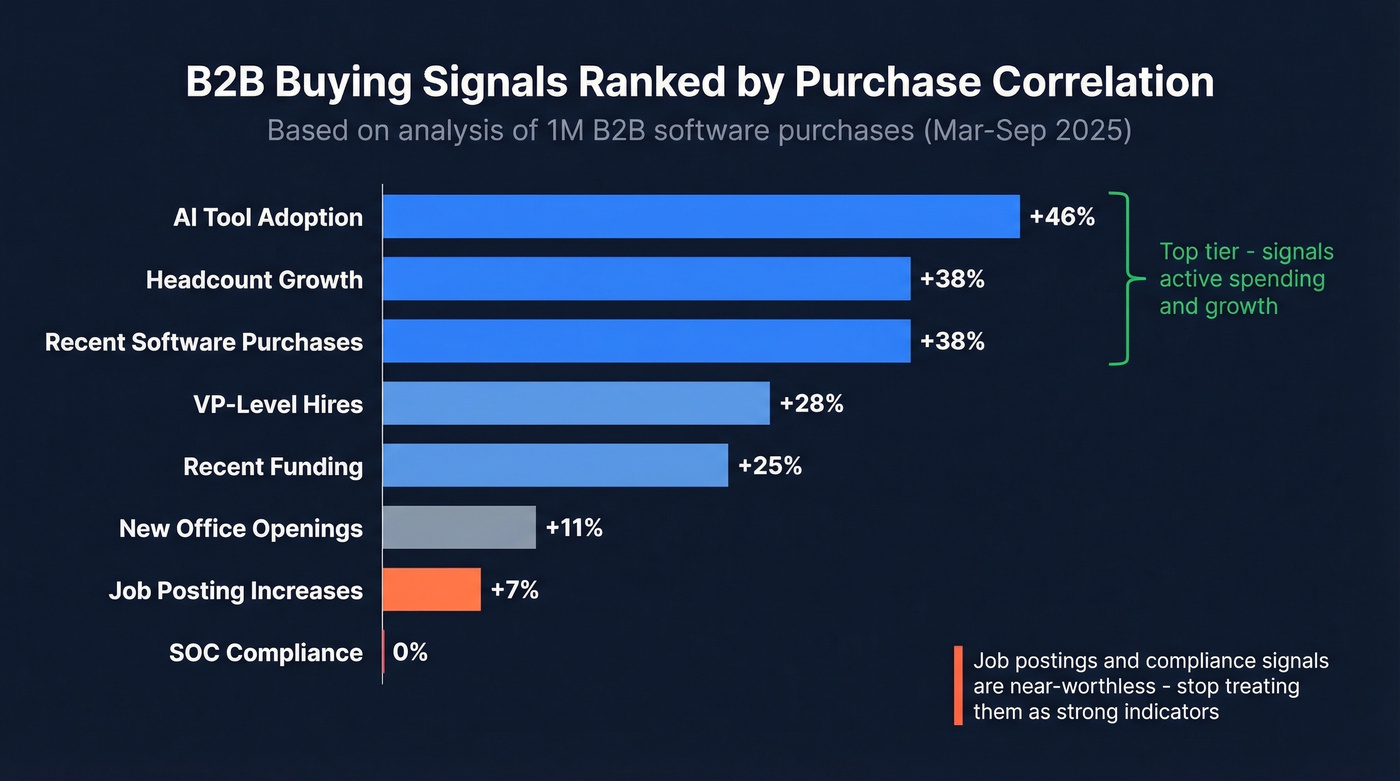
An analysis of 1 million B2B software purchases found that AI tool adoption (+46%), headcount growth (+38%), and recent purchases (+38%) are the strongest correlates with buying activity. Job postings? A measly +7%. Nearly worthless.
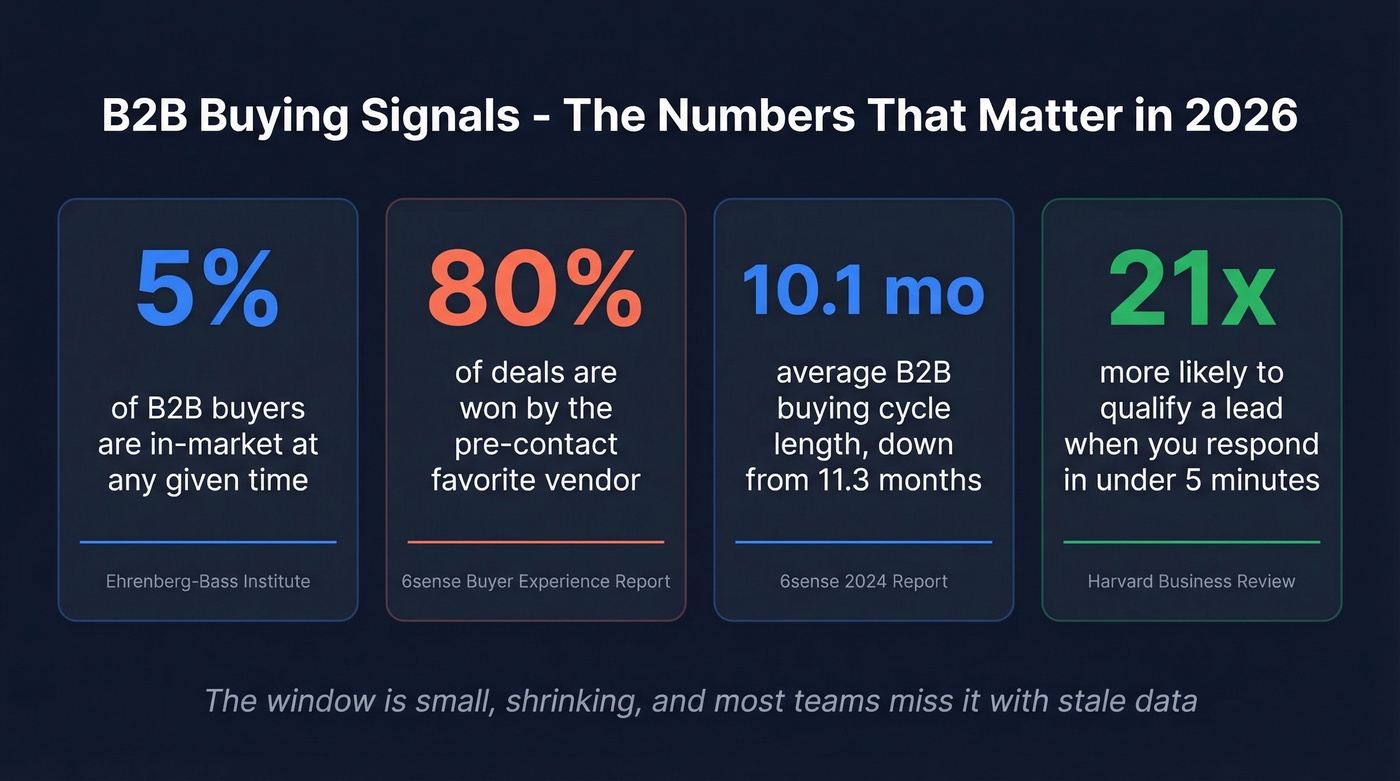
Here's the uncomfortable truth: 95% of winning vendors are already on the buyer's Day One shortlist, and the pre-contact favorite wins roughly 80% of deals. If you're not on that shortlist before the signal fires, you're fighting for scraps.
What Are B2B Buying Signals?
Any observable action or event that indicates an account is entering a buying window - that's a buying signal. The useful distinction is between first-party and third-party. First-party signals happen on your turf: a prospect visits your pricing page, downloads a whitepaper, or requests a demo. You own this data. Third-party signals come from external sources - intent data providers tracking topic research across the web, job posting monitors, funding databases, technographic changes.
There's also the explicit vs. implicit split. A demo request is explicit - the buyer is telling you they're interested. A pricing page visit is implicit - you're inferring interest from behavior. Both matter, but they demand different responses.
Which Signals Actually Predict Purchases?
A practitioner on r/b2bmarketing analyzed 1 million B2B software purchases from March-September 2025, focusing on team-level purchases at companies with 200-1,000 employees. The signal hierarchy that emerged is striking:
| Signal | Correlation with More Purchases |
|---|---|
| AI tool adoption | +46% |
| Headcount growth | +38% |
| Recent software purchases | +38% |
| VP-level hires | +28% |
| Recent funding | +25% |
| New office openings | +11% |
| Job posting increases | +7% |
| SOC compliance | 0% |
If your team is treating job postings as a strong indicator, you're chasing noise. SOC compliance announcements are even worse - lagging indicators that show up after the buying already happened.
The top three signals share a common thread: they indicate a company that's actively spending and growing. AI tool adoption at +46% makes intuitive sense - companies adopting AI tools are in transformation mode, evaluating their entire stack. Headcount growth and recent purchases both signal budget availability and organizational momentum. The methodology is self-reported, but it's the most concrete ranking of purchase-intent indicators published to date, and it aligns with what we've seen across dozens of outbound campaigns.
Hot take: If your average deal size is under $15K, you probably don't need a $40K intent platform. Layer free first-party signals with a verified contact database and you'll outperform teams drowning in expensive, unactivated alerts.
The Complete Signal List
Behavioral Signals (First-Party)
Pricing page visits are the closest thing to a hand-raise without being one. Route to an SDR within hours. Demo requests remain the single strongest first-party signal - respond in minutes, not hours. Bottom-of-funnel content downloads like case studies, ROI calculators, and comparison guides signal active evaluation; blog post downloads don't. And return visits - three or more in seven days - indicate sustained interest worth flagging for SDR review if the account matches your ICP.
Engagement Signals
Email replies are strong. Any reply - even a "not now" - indicates awareness, so tag for nurture. Email opens are weak on their own due to tracking pixel unreliability, but a cluster of opens across multiple contacts at the same account is worth flagging. Webinar attendance is moderate - registrations are weak, but actual live attendance signals real interest. Social engagement is mostly noise. Likes are vanity. Comments on product-related posts are the only ones worth tracking.
Company Change Signals (Third-Party)
These are the signals that separate good outbound teams from great ones.
Recent funding means new capital and new spending - time your outreach 2-4 weeks post-announcement. Headcount growth of 10%+ in 90 days is one of the top three purchase correlates; growing teams need tools. Technology adoption in your ecosystem signals stack investment and active evaluation. Executive changes - especially new VPs - create a 30-90 day window where new vendors get considered. In our experience, the funding + new VP combo is the highest-converting signal pair in B2B.
Intent Data Signals (Third-Party)
Topic surges are moderate - useful when layered with ICP fit and first-party engagement, but noisy alone. Review site activity is strong; a prospect reading your G2 reviews is further along than one reading blog posts. Competitor research is also strong - if they're evaluating your competitor, they should be evaluating you.
The Dark Funnel Problem
Around 73% of the B2B buying journey happens anonymously - research your CRM and attribution can't see. Per the 6sense Buyer Experience Report, 83% of buyers define requirements before speaking with sales, and 92% start with at least one vendor already in mind. By the time you see a signal, the buyer likely already has preferences.
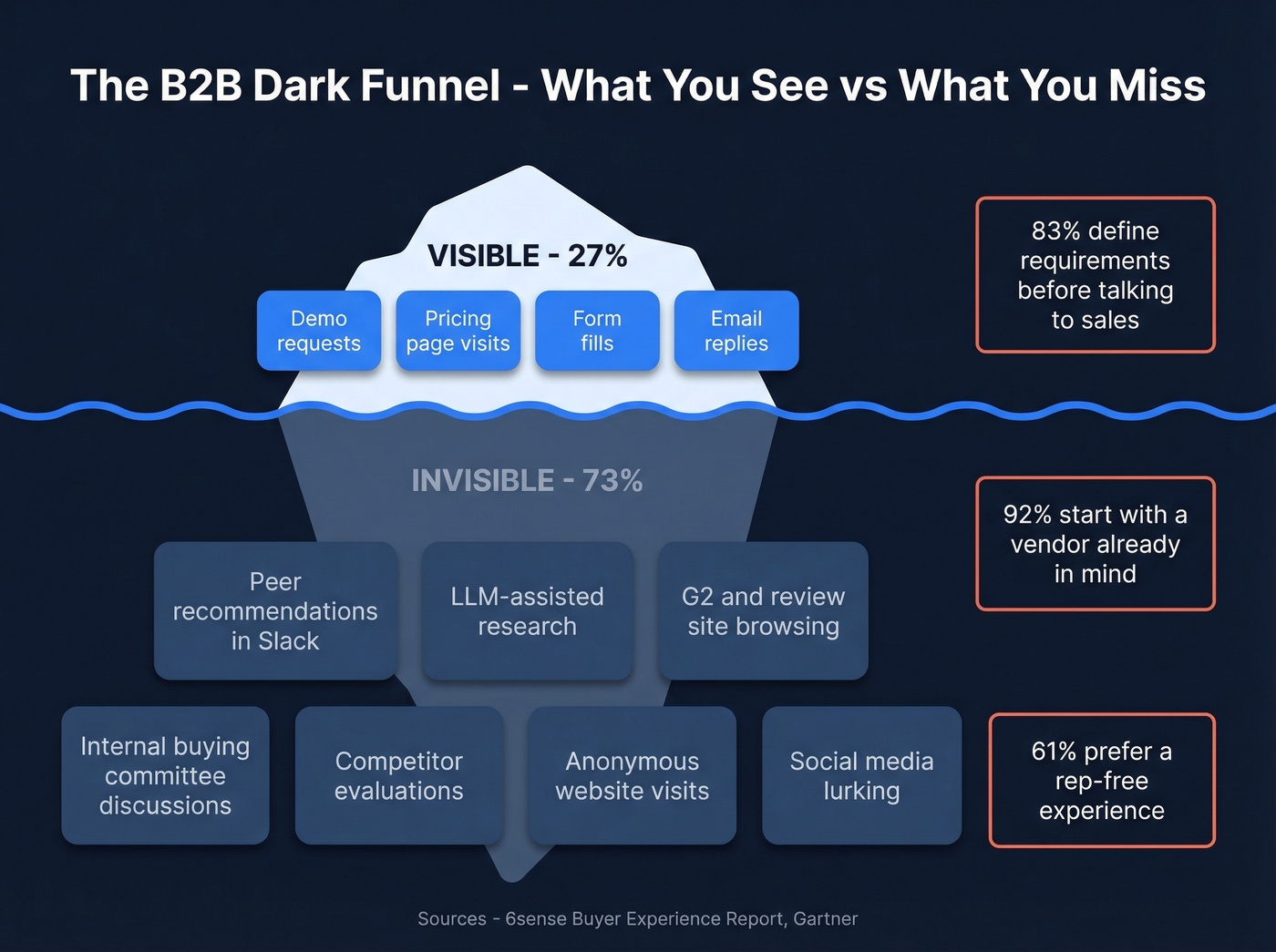
The shift is accelerating. Gartner research shows 61% of buyers prefer a rep-free buying experience, and buyers are increasingly using LLMs during their research. Even more of the journey is happening in channels you'll never track.
The dark funnel isn't a problem you solve. It's a reality you design around.
Two tactics work. First, account-level identification - connect anonymous sessions to companies using reverse-IP and behavioral fingerprinting. Tools like 6sense, Demandbase, and Clearbit do this at scale. Second, intent cluster detection. A single anonymous visit means nothing. But when three people from the same company hit your pricing page, download a case study, and click a newsletter link within 48 hours - that's a cluster. That's signal.

Detecting buying signals is the easy part. Activating them before competitors requires verified contact data - not emails last checked eight months ago. Prospeo tracks 15,000 intent topics via Bombora, layers them with 30+ filters like headcount growth and funding, and delivers 98% accurate emails refreshed every 7 days.
Stop letting buying signals die in bounced inboxes.
How to Score Buying Signals
A signal without a score is just an alert. Here's a concrete 0-100 model you can implement this week.
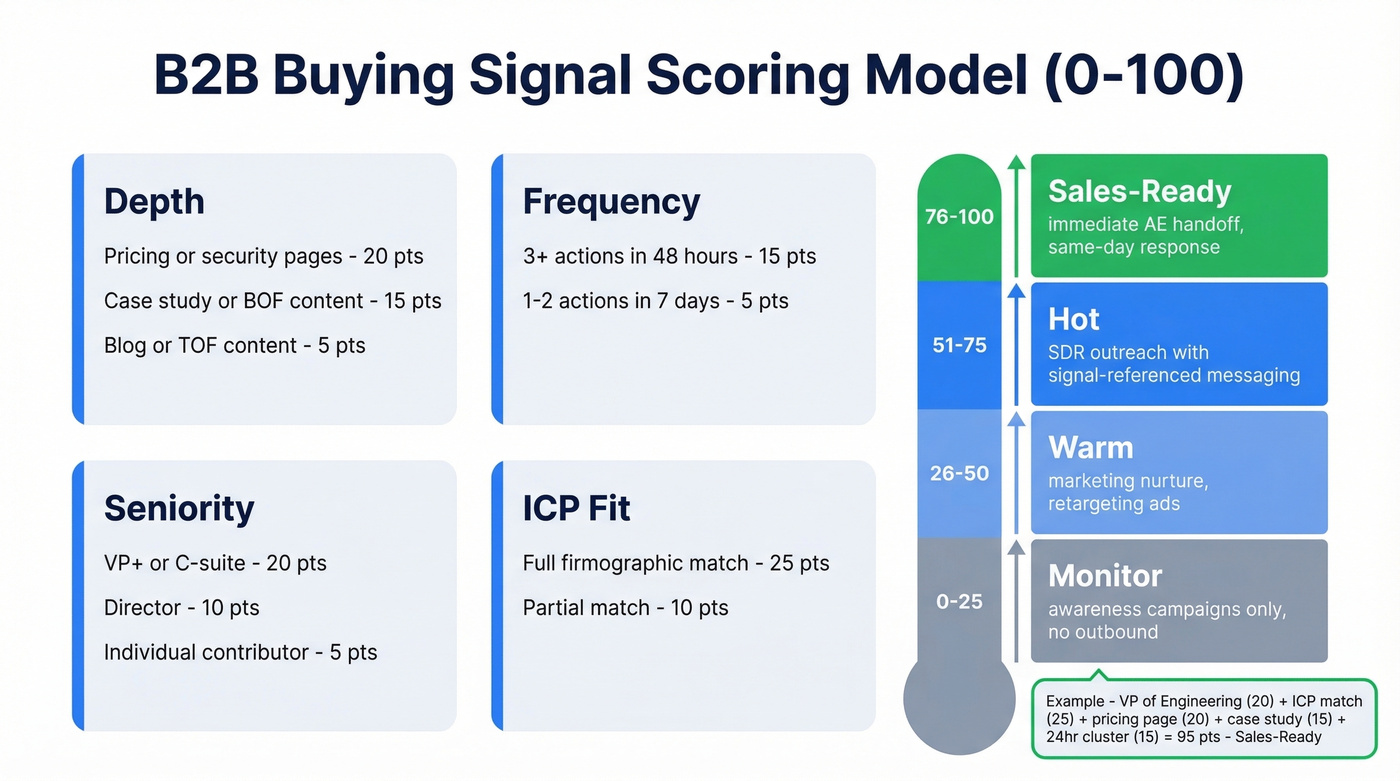
| Dimension | Criteria | Points |
|---|---|---|
| Depth | Pricing/security pages | 20 |
| Depth | Case study / bottom-of-funnel content | 15 |
| Depth | Blog / top-of-funnel content | 5 |
| Frequency | 3+ actions in 48 hours | 15 |
| Frequency | 1-2 actions in 7 days | 5 |
| Seniority | VP+ or C-suite | 20 |
| Seniority | Director | 10 |
| Seniority | Individual contributor | 5 |
| ICP Fit | Full firmographic match | 25 |
| ICP Fit | Partial match | 10 |
Tiers and actions:
| Score | Tier | Action |
|---|---|---|
| 0-25 | Monitor | Add to awareness campaigns. No outbound. |
| 26-50 | Warm | Marketing nurture - targeted content, retargeting ads. |
| 51-75 | Hot | SDR outreach. Personalized, signal-referenced messaging. |
| 76-100 | Sales-Ready | Immediate handoff to AE. Same-day response. |
Let's run an example. A VP of Engineering (20 pts) at a company that matches your ICP (25 pts) visits your pricing page (20 pts) and downloads a case study (15 pts) within 24 hours (15 pts). That's 95 - Sales-Ready. Your AE should be calling today.
Start with point-based scoring. Graduate to ML when you have enough closed-won data to train on. Recalibrate quarterly and watch for score decay - a signal from 90 days ago isn't worth what it was on day one.
Activating Signals in Your Outbound
Here's a 7-touch, 10-day cadence that works as a baseline:
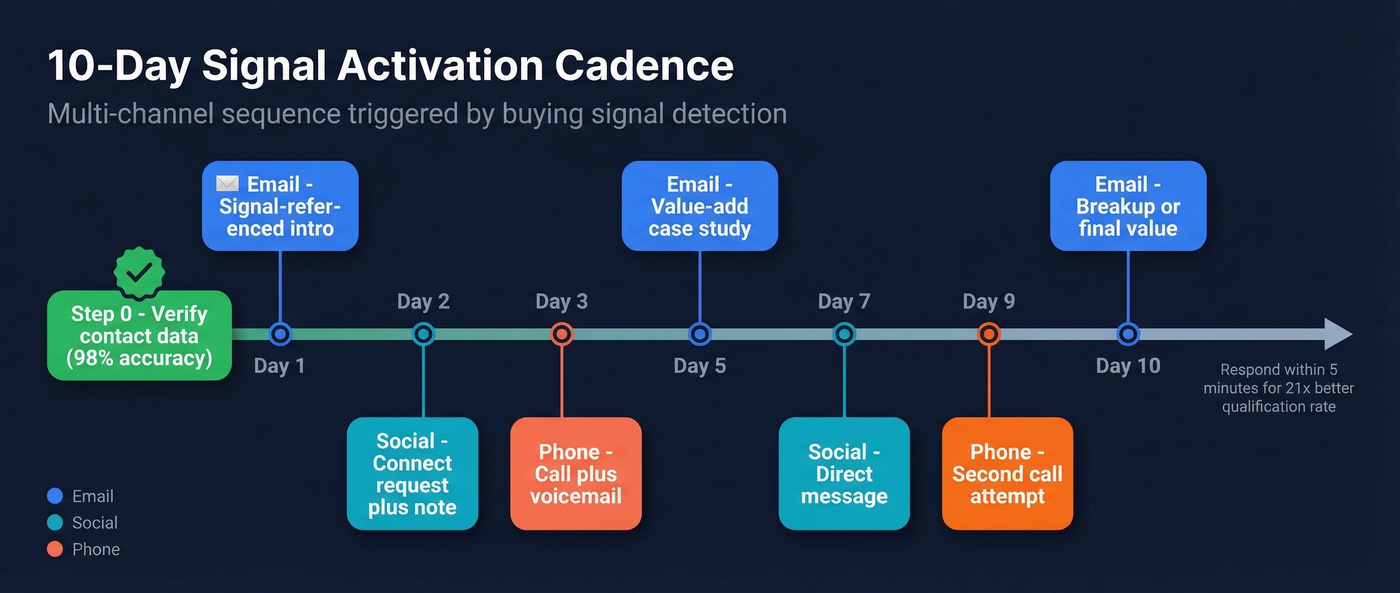
| Day | Channel | Action |
|---|---|---|
| 1 | Signal-referenced intro | |
| 2 | Social | Connect request + note |
| 3 | Phone | Call + voicemail |
| 5 | Value-add (case study) | |
| 7 | Social | Direct message |
| 9 | Phone | Second call attempt |
| 10 | Breakup / final value |
Modify based on the signal type. If someone hit your pricing page, lead with pricing context - "I noticed you're evaluating [category]. Here's how our pricing compares to X." For a funding round, lead with congratulations and a relevant use case. For a technology adoption signal, reference the specific tool and how you integrate.
Before you trigger that sequence, verify the contact. A signal that fires on a bounced email is a signal wasted. Prospeo's real-time email verification runs at 98% accuracy, and the mobile finder delivers a 30% pickup rate, so your cadence doesn't die at step one.
Speed matters too. Responding within five minutes makes you 21 times more likely to qualify a lead than waiting 30 minutes.
Industry-Specific Signals
Not every signal carries the same weight across verticals. Purchase intent indicators in manufacturing look different from those in SaaS - equipment lifecycle data, supply chain disruptions, and regulatory compliance deadlines often matter more than topic surges. Intent signals in banking tend to center on regulatory changes, core system contract expirations, and digital transformation mandates rather than headcount growth. Skip the one-size-fits-all scoring model if you're selling into a specific vertical; tailor the weights to what actually drives purchasing behavior in that industry.
Intent Data Tools - What They Cost
Most intent providers won't publish pricing because they're selling to procurement, not practitioners. Here's what you'll actually pay:
| Tool | Annual Cost | Contract | What You Get | Best For |
|---|---|---|---|---|
| Prospeo | Free-~$0.01/lead | No contract | Intent (15K topics) + verified emails/mobiles + database | Budget-conscious teams who want intent + contacts in one platform |
| ZoomInfo Intent | ~$7K-$36K/yr | Annual | Streaming intent signals | Mid-market teams with existing CRM workflows |
| Bombora | ~$25K/yr | Annual | Co-op intent data | Enterprise teams needing raw intent at scale |
| 6sense | ~$35K/yr | Annual | ABM + intent platform | Full ABM orchestration with predictive analytics |
| G2 Buyer Intent | ~$10K-$87K+/yr | Annual | Review-site intent | Companies with strong G2 presence wanting bottom-funnel signals |
| Demandbase | ~$40K/yr | Annual | ABM + intent + ads | Enterprise ABM with integrated advertising |
Budget 15-25% above the license cost for implementation, training, and the inevitable "we need another module" conversation. Market consolidation is accelerating - HG Insights acquired TrustRadius in June 2025, collapsing review-site intent into the technographic data layer.
Most of these platforms give you intent signals but leave you to find the actual contacts yourself. That's the gap. Prospeo closes it by combining 15,000 Bombora-powered intent topics with 300M+ professional profiles, 143M+ verified emails, and 125M+ verified mobile numbers - all on a 7-day refresh cycle versus the 6-week industry average. The free tier gives you 75 emails per month to test, and paid plans run roughly $0.01 per lead with no annual contracts.
That funding + new VP combo you just identified? Worthless without a direct line to the decision-maker. Prospeo gives you 125M+ verified mobile numbers with a 30% pickup rate and emails at $0.01 each - so when the signal fires, you reach a real person in minutes, not days.
Turn every buying signal into a conversation that actually happens.
Operationalize Signals at Scale
Knowing which signals matter and having a scoring model is half the battle. The other half is making sure your team actually acts on them consistently.
Look - here's the narrative that plays out in every growing org: Finance asks why you're spending $40K/year on intent data when your team barely acts on the alerts. The answer is usually that nobody built the routing rules, SLAs, or CRM integration to make the data actionable. Signals need to flow automatically into rep workflows - assigned by territory, scored by priority, with SLAs that trigger escalation if nobody responds within two hours. We've seen teams double their signal-to-meeting conversion rate just by adding a two-hour SLA and Slack alerts for Sales-Ready scores.
Revenue orchestration platforms from Outreach and Salesloft (typically ~$100-150/user/month) converge sales engagement, conversation intelligence, and revenue operations into a single system. They handle multi-channel execution, auto-capture interactions, run buyer signal algorithms, and serve prioritized next actions. Without that plumbing, you're paying for expensive dashboards nobody checks.
FAQ
What's the strongest B2B buying signal?
AI tool adoption (+46%), headcount growth (+38%), and recent software purchases (+38%) are the strongest third-party correlates based on an analysis of 1 million B2B software purchases. For first-party signals, demo requests remain the single strongest indicator. Layer both for the most reliable scoring.
What is the dark funnel in B2B?
The roughly 73% of the buying journey that happens anonymously - research, peer conversations, LLM queries, and evaluation your CRM can't track. Account-level identification and intent cluster detection (multiple people from the same company hitting high-intent pages) are the primary methods for gaining visibility.
How quickly should you act on a buying signal?
Within minutes, not hours. Responding within five minutes makes you 21x more likely to qualify a lead than waiting 30 minutes. Build routing rules and SLAs that ensure high-scoring signals get immediate attention - not next-morning review.
What's a budget-friendly way to act on intent data?
Prospeo combines 15,000 Bombora-powered intent topics with verified emails and mobile numbers starting on a free tier (75 emails/month). Paid plans run ~$0.01 per lead with no annual contract - roughly 90% cheaper than ZoomInfo while delivering 98% email accuracy and a 7-day data refresh cycle.