

B2B Growth Hacking Strategy: Build a System, Not a Tactics List
It's Monday morning. Pipeline is flat. Your CEO just Slacked you asking for "growth hacks." You open a browser, find 10 articles listing 20 tactics each, bookmark three, implement zero. The quarter ends the same way it started.
A real B2B growth hacking strategy requires something different entirely. Bain surveyed 1,263 senior commercial executives and found that top B2B companies delivered roughly 2x the average revenue growth of their industries. The gap wasn't tactics - it was systems. 82% of companies say they run sales plays, but only 21% realize full value from them.
Here's the thing: most B2B teams don't have a growth problem. They have an execution infrastructure problem dressed up as a growth problem.
What Doesn't Work Anymore
Before building anything, clear the dead weight.
Spray-and-pray outbound from AI SDRs with zero personalization signals low quality - enterprise buyers ignore it. Paid acquisition as a core strategy is equally dead: average Google Ads CPC hit $5.26 in 2025, up 13% year-over-year, and a Series A company competing on branded keywords against incumbents with 50x the budget is lighting money on fire.
Tool sprawl is the quieter killer. The average early-stage company runs 12-15 marketing tools at roughly $2,400/month with utilization hovering around 33%. You don't need more tools. You need fewer tools doing more work. And selling to everyone - a weak ICP - means every experiment is noisy, because you can't measure what's working if you're targeting three different buyer personas with the same message.
The teams that win aren't the ones collecting stunts. They're the ones building systems that make execution repeatable.
Weekly Experiments: The Core Growth Loop
The core of any B2B growth hacking approach isn't a tactic - it's a cadence. One structured experiment per week, reviewed with sales every Friday. Not five half-baked A/B tests running simultaneously.
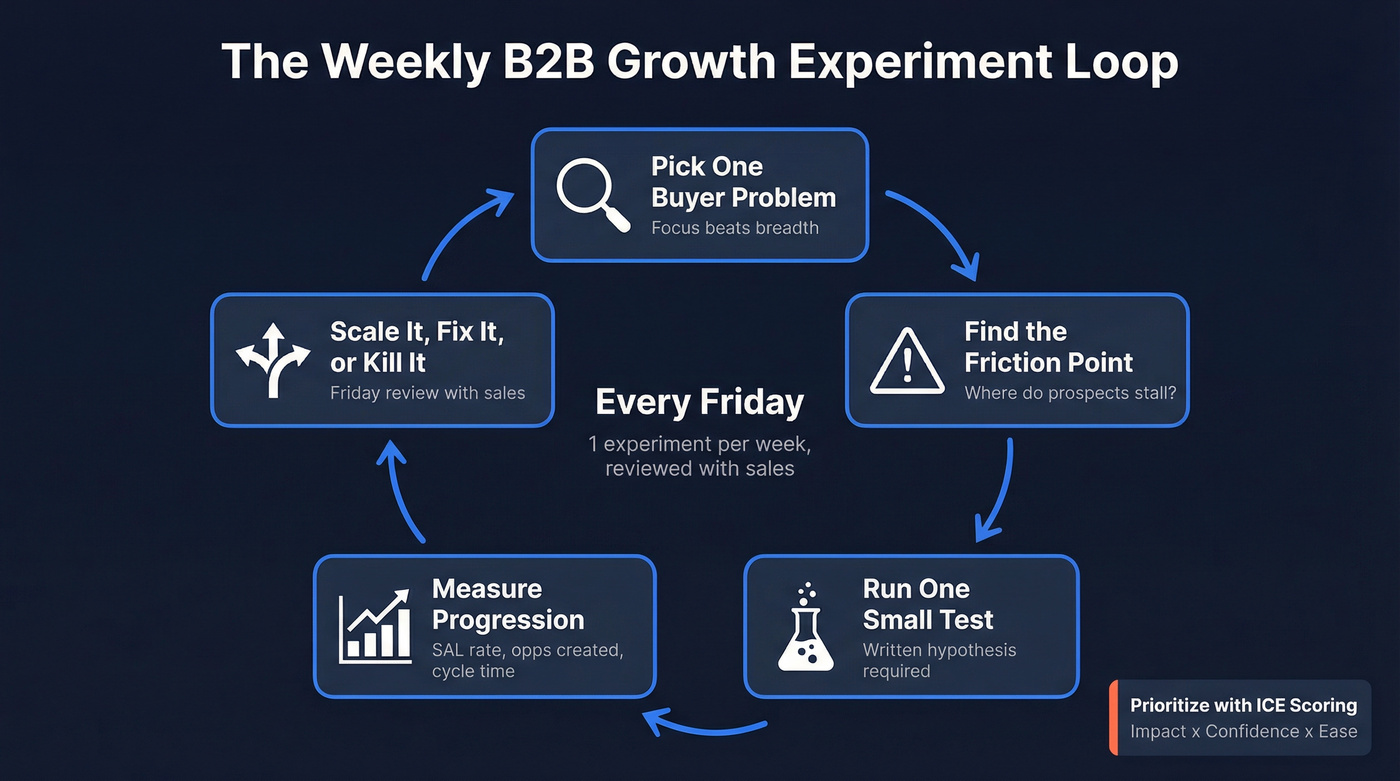
The critical difference from B2C growth hacking: B2B involves buying groups, longer cycles, and higher risk tolerance per experiment. You're optimizing for pipeline progression, not viral coefficients. The loop looks like this:
- Pick one buyer problem
- Identify one friction point where prospects stall
- Run one small test to move them forward
- Measure progression - SAL rate, opportunity creation, cycle time
- Scale it, fix it, or kill it
Prioritize with ICE scoring: rate each idea on Impact, Confidence, and Ease (1-10 scale), multiply them, run the highest score first. Every experiment needs a written hypothesis before launch:
If we [change X], then [metric Y] improves by [Z%] within [T time].
No hypothesis, no experiment. This kills the "we tried a bunch of stuff and nothing worked" quarterly review.

Every growth experiment in your weekly loop depends on reaching real people at real companies. Bad data doesn't just waste credits - it poisons your metrics and kills experiments before they start. Prospeo delivers 300M+ profiles with 98% email accuracy on a 7-day refresh cycle, so every test runs on clean data.
Run your first growth experiment this week with 75 free verified emails.
Five Growth Plays for 2026
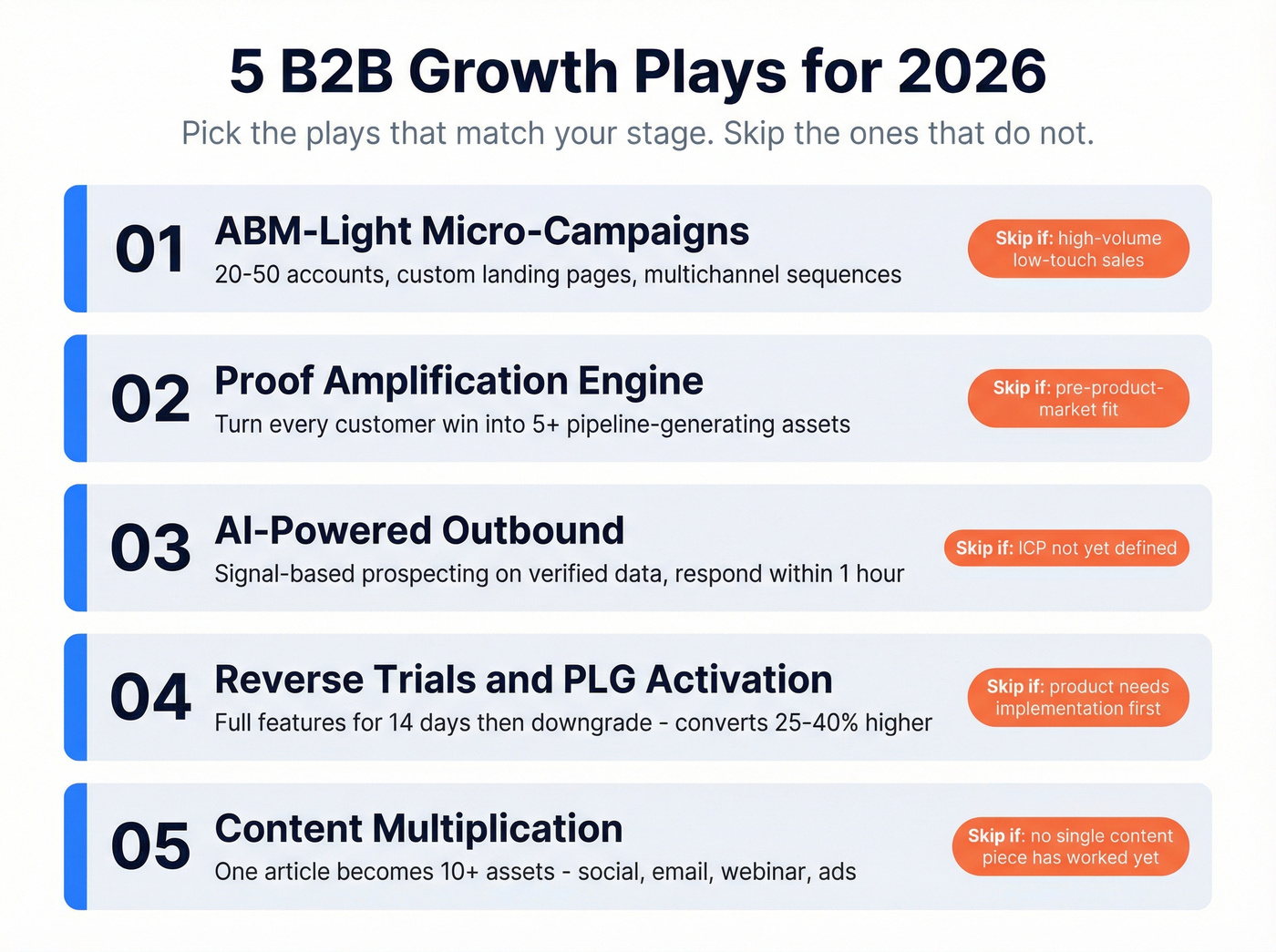
1. ABM-Light Micro-Campaigns
Pick 20-50 target accounts. Map three stakeholders at each. Build custom landing pages per vertical, then run multichannel sequences - email, ads, direct mail - against that tight list.
This is the highest-leverage play we've seen for deals above five figures with multiple decision-makers. One team we worked with ran a 30-account ABM sprint and generated more qualified pipeline in six weeks than their previous quarter of broad outbound. The key was specificity: each account got a landing page referencing their tech stack, recent funding, and a relevant case study.
Skip this if you're running high-volume, low-touch sales where per-account research doesn't pay off.
2. Proof Amplification Engine
How many customer wins are buried in your Slack threads right now? One case study becomes an ad, a cold email proof point, a landing page testimonial, and a webinar slide. Most teams have great customer stories that never make it into pipeline-generating assets.
Build a results capture system that turns every win into 5+ derivative assets. We've found that the simplest version is a shared doc where AEs paste customer quotes and metrics the same week a deal closes, before the details fade. A content person turns each entry into assets on a two-week cycle.
Skip this if you're pre-product-market-fit with no repeatable wins yet.
3. AI-Powered Outbound
88% of B2B companies already use AI for prospecting, and AI prospecting tools reclaim 4-7 hours per rep per week. But most teams automate on top of bad data. Responding to buying signals within an hour is 7x more likely to qualify the lead - speed and accuracy aren't nice-to-haves, they're the whole game.
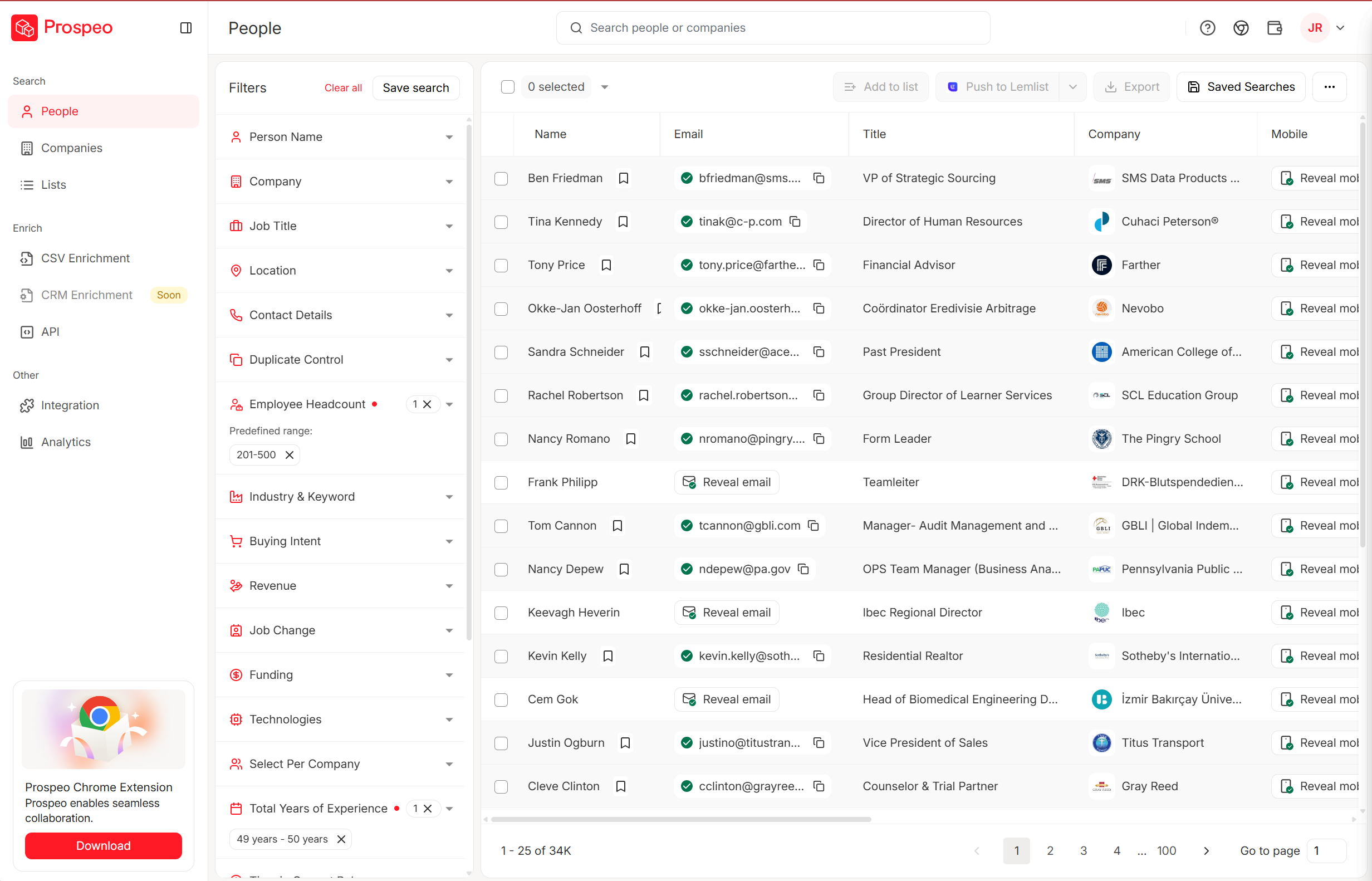
The first step in any outbound experiment is verified contact data. Prospeo covers 300M+ professional profiles with 98% email accuracy and a 7-day refresh cycle, compared to the 6-week industry average. The free tier gives you 75 verified emails per month, enough to run your first experiment this week.
Skip this if you haven't defined your ICP yet. Automating outreach to the wrong people just accelerates failure.
4. Reverse Trials and PLG Activation
PLG companies grow 1.9x faster and burn 50% less cash than sales-led peers. The reverse trial model - full paid functionality for 14 days, then downgrade - converts 25-40% higher than traditional freemium. Engineer an "aha moment" in under two minutes.
Skip this if your product requires implementation before value is visible.
5. Content Multiplication
One well-researched article ($500-$2,000 to produce) generates 10+ derivative assets: social posts, email sequences, a webinar, sales enablement snippets, ad copy. The economics are obvious, but most teams publish once and move on.
Skip this if no single piece of content has performed well yet. Multiply zero and you still get zero.
Benchmarks That Matter
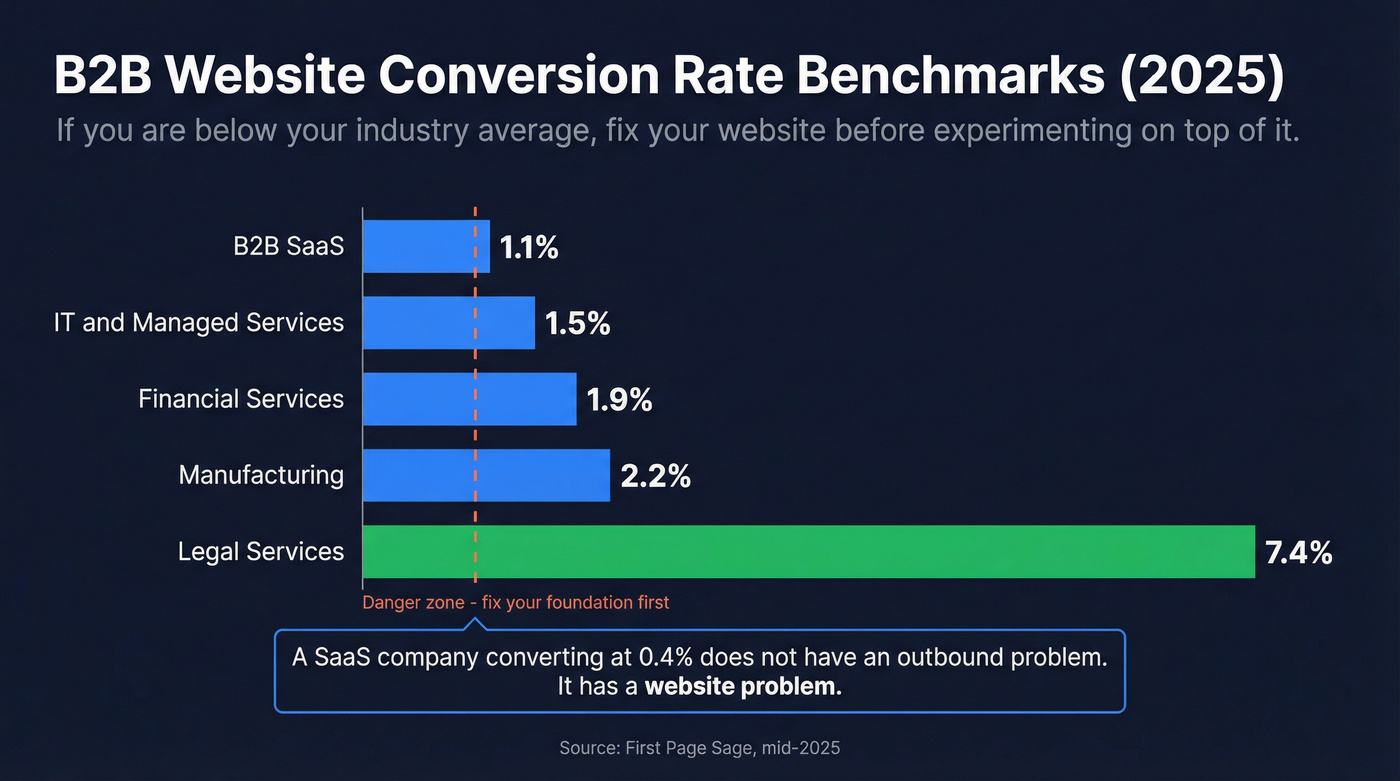
If your website conversion rate is below industry average, fix that first - no amount of clever outbound compensates for a landing page that leaks. These benchmarks come from First Page Sage's data through mid-2025:
| Industry | Avg Conversion Rate |
|---|---|
| B2B SaaS | 1.1% |
| IT & Managed Services | 1.5% |
| Financial Services | 1.9% |
| Manufacturing | 2.2% |
| Legal Services | 7.4% |
A B2B SaaS company converting at 0.4% doesn't have an outbound problem. It has a website problem. Fix the foundation before you experiment on top of it.
The Lean Growth Stack
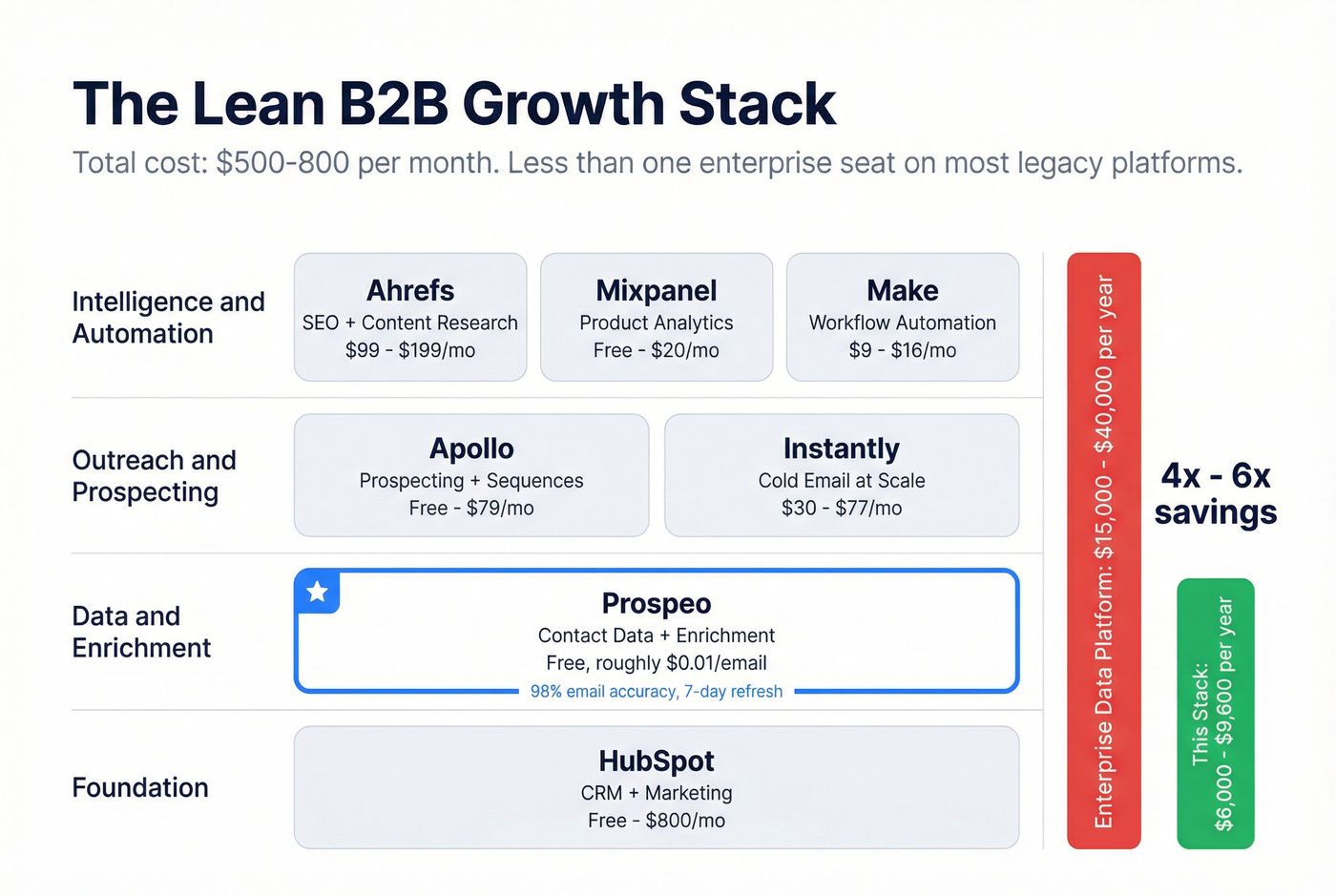
There are 15,384 martech solutions on the market. The average company utilizes 33% of what it buys. Here's what a complete lean stack actually costs:
| Tool | Role | Price |
|---|---|---|
| HubSpot | CRM + marketing | Free-$800/mo |
| Prospeo | Data + enrichment | Free; ~$0.01/email |
| Apollo | Prospecting + sequences | Free-$79/mo |
| Instantly | Cold email at scale | $30-$77/mo |
| Ahrefs | SEO + content research | $99-$199/mo |
| Mixpanel | Product analytics | Free-$20/mo |
| Make | Workflow automation | $9-$16/mo |
Notice what's missing: a $15-40K/year enterprise data platform. Most teams overpay for their data layer by an order of magnitude. In our experience, the combination of Prospeo's enrichment API (92% match rate, 50+ data points per contact) with a lightweight sequencing tool handles 90% of what those enterprise contracts promise - at a fraction of the cost.
Let's be honest about the total: $500-800/month covers CRM, data, outreach, SEO, analytics, and automation. That's less than one enterprise seat on most legacy platforms.
You don't need a $40K/year data platform to run ABM sprints, AI-powered outbound, or any of the plays above. Prospeo gives you 30+ search filters - buyer intent, technographics, funding, headcount growth - at roughly $0.01 per email. That's the lean growth stack in action.
Stop overpaying for your data layer by 10x. Start building pipeline instead.
FAQ
What makes a B2B growth hacking strategy different from growth marketing?
Growth hacking prioritizes rapid experimentation and unconventional tactics to find scalable levers fast. Growth marketing covers brand, content, and demand gen on longer timelines. The best B2B teams blend both: a systematic experiment loop with weekly ICE-scored tests inside a sustainable marketing engine.
How many experiments should a team run per week?
Start with one well-designed experiment per week using clear ICE scoring and a written hypothesis. Most teams fail because they run five half-baked tests simultaneously. One focused test teaches you more than a dozen unfocused A/B tests - and compounds faster over a quarter.
Does B2B growth hacking work for enterprise sales cycles?
Yes, but the experiment unit changes. Instead of optimizing sign-ups, you're optimizing pipeline progression - meeting-to-opportunity rate, multi-threading depth, and cycle time reduction. ABM micro-campaigns targeting 20-50 accounts with personalized sequences are the highest-leverage play for deals above $25K.