B2B Lead Generation for Small Business: The 2026 Playbook (With Real Numbers)
A RevOps lead we know bought a "verified" list of 5,000 contacts last year. Bounce rate hit 27% on the first sequence, the sending domain got flagged, and three weeks of pipeline work evaporated overnight. That's the reality for most small businesses running B2B lead generation - 51% of sales pros say it's their biggest challenge, and the generic "15 tactics" listicles don't help because they're written for companies with 10-person marketing departments.
You don't need 15 tactics. You need three channels, real numbers, and a stack that costs less than your team lunch budget.
The Quick Version
- Define your ICP by testing 3 segments, not guessing one
- Build clean lists - bad data is the #1 outbound killer, so verify every email before it enters a sequence
- Run outbound expecting 1-5% reply rates; 200-500 emails books roughly 5-10 meetings
- Layer inbound only after outbound works - average B2B CPL is $84 across paid channels
- Measure with AQO - 100 prospects, 15 reached, 5 qualified, 2-3 deals
The 5-Step Playbook
1. Define Your ICP and Test 3 Segments
Pull up your last six months of closed-won deals and look for patterns across geography and time zone overlap, headcount bands (10-50? 50-200?), funding stage or revenue, and tech stack signals like what tools they already run.
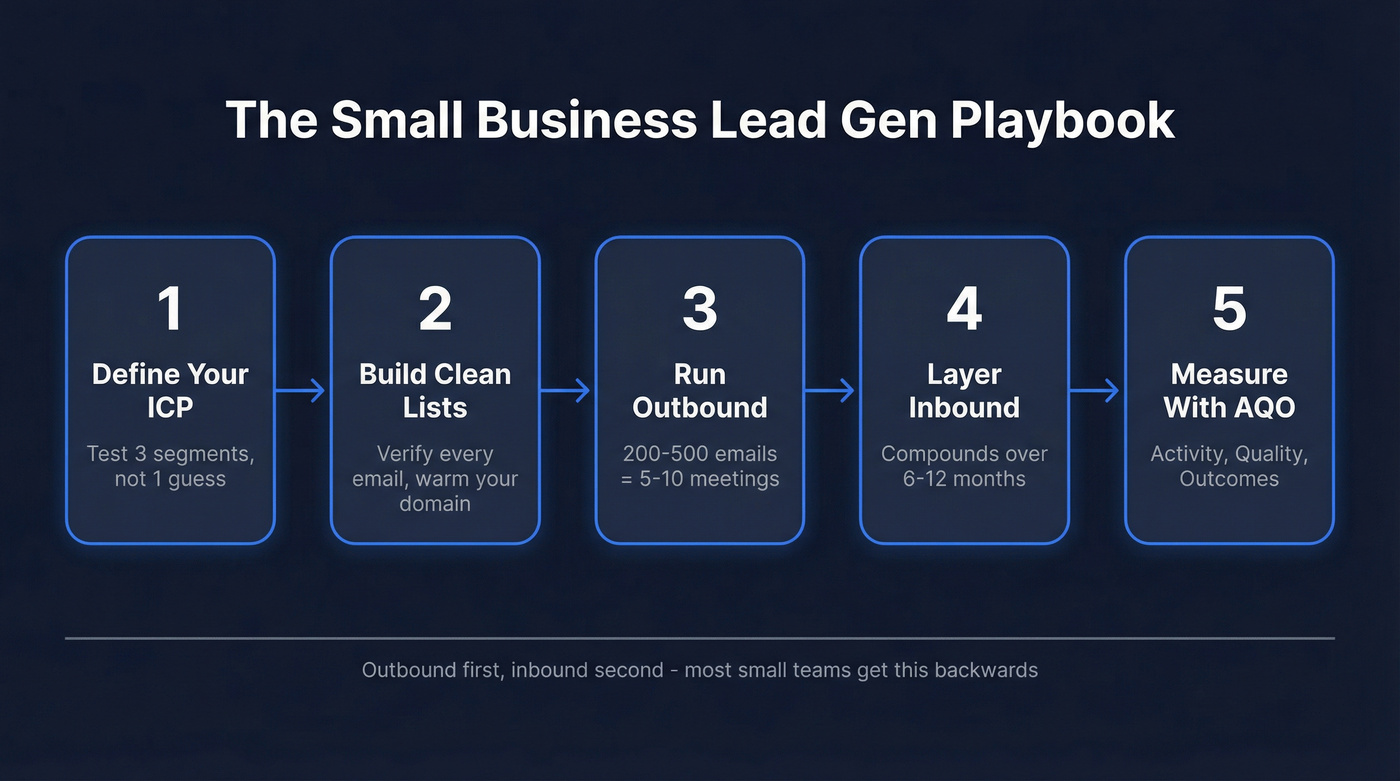
If you don't have enough deals yet, study your best conversations - the ones where the prospect said "this is exactly what we need" inside five minutes. Now build three distinct segments from those patterns and test all three simultaneously. One partnership-heavy vertical, one cold-outbound play, one referral-adjacent niche. Putting all your eggs in one segment is how small teams burn an entire quarter with nothing to show for it.
Let's talk about partnerships for a second, because they're criminally underused by small teams. A single channel partner or integration partnership can generate more pipeline than months of cold outbound. 45% of B2B marketers allocate 10-20% of their budget to testing new channels - partnerships should be one of those tests.
2. Build Your List Without Burning Your Domain
Do this: Find contacts through a verified database, confirm emails before sending, and warm your domain for 2-3 weeks with SPF/DKIM/DMARC configured. This is non-negotiable plumbing.
Skip this if you value your domain: Buying a bulk list from a broker or scraping contacts without verification. Apollo bounce rates often exceed 30% in head-to-head tool comparisons. A 30% bounce rate doesn't just waste sends - it torches your sender reputation, and recovering takes months.
We've seen the difference firsthand. Meritt switched to verified data and saw bounce rates drop from 35% to under 4%, with pipeline tripling from $100K to $300K per week. The fix wasn't better copy or a new sending tool. It was clean data.

3. Run Outbound That Gets Replies
Cold email reply rates run 1-5% for most B2B outbound. Highly personalized campaigns targeting high-ticket buyers can push 8-12%, but plan for the lower end. At 200-500 emails, you're looking at 5-10 qualified meetings - a realistic month for a solo founder or small sales team.
Social selling adds a parallel channel. Spending 15-20 minutes a day engaging with target prospects' content before connecting yields 30-40% connection acceptance rates. The tradeoff: social selling converts better per touch but caps your daily volume.
Here's the thing about small business lead generation that most advice ignores: personalization beats volume every single time at this scale. You can't outspend a 50-person SDR team, but you can out-research them on 20 accounts a week. That asymmetry is the core advantage of SMB prospecting - you trade headcount for depth, and depth wins deals.
4. Layer Inbound for Compounding Returns
Outbound gets you pipeline this quarter. Inbound compounds over 6-12 months.
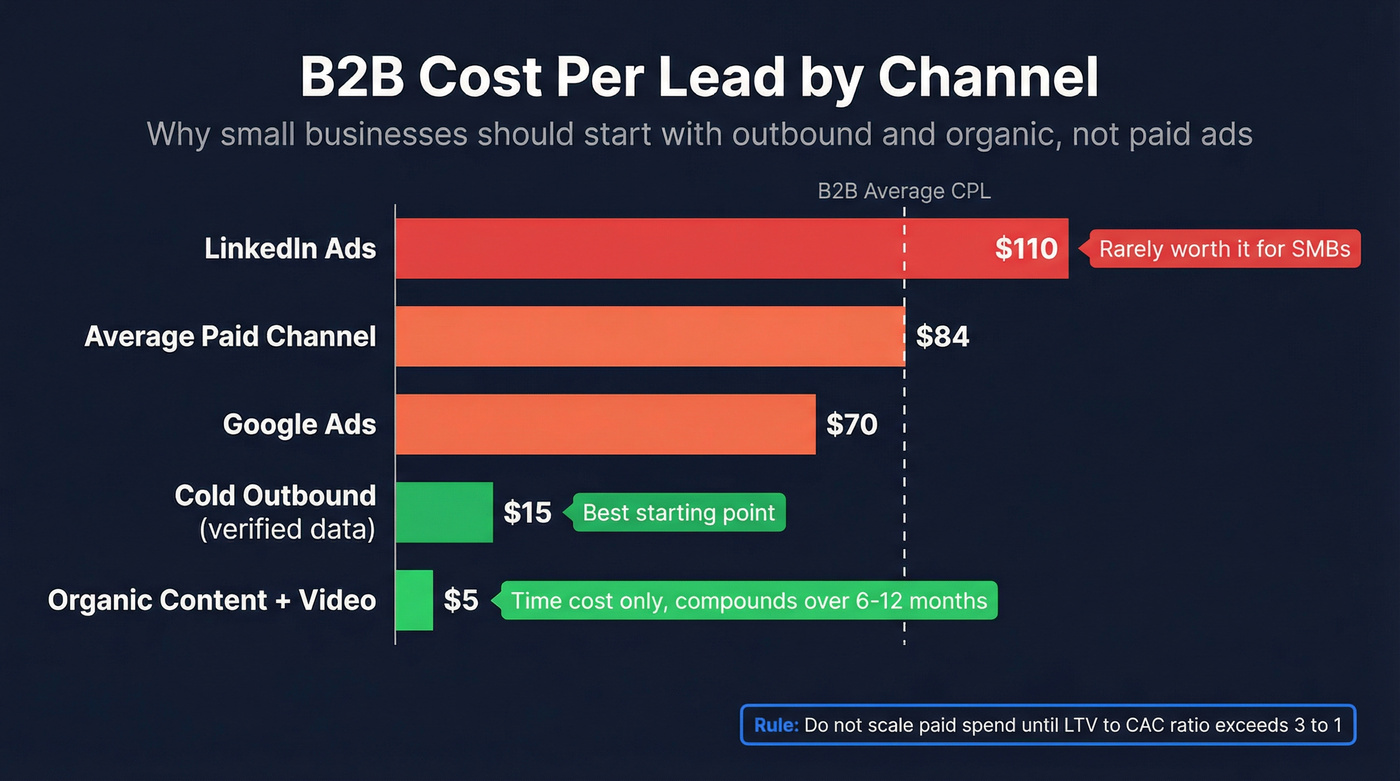
Paid channels average $84 per lead. Google Ads sits around $70/lead. LinkedIn Ads run $110+ - almost never the right first move for a small business because at that CPL, you need large deal sizes just to break even.
Organic channels cost time instead of money. 78% of B2B marketers now use video, and it's one of the few inbound plays where a small team competes on quality rather than budget. A founder explaining a problem on camera builds more trust than a $5,000 whitepaper. And with 49% of marketers reporting declining traditional search traffic due to AI answers, video and direct-audience channels are becoming essential, not optional.
Guard every paid channel with a simple rule: don't scale spend until your LTV:CAC ratio exceeds 3:1.
5. Qualify and Measure With AQO
The AQO framework keeps small teams honest. Activity: are you doing enough outreach? Quality: do meetings match your ICP? Outcomes: does every good meeting produce a next step within 7 days?
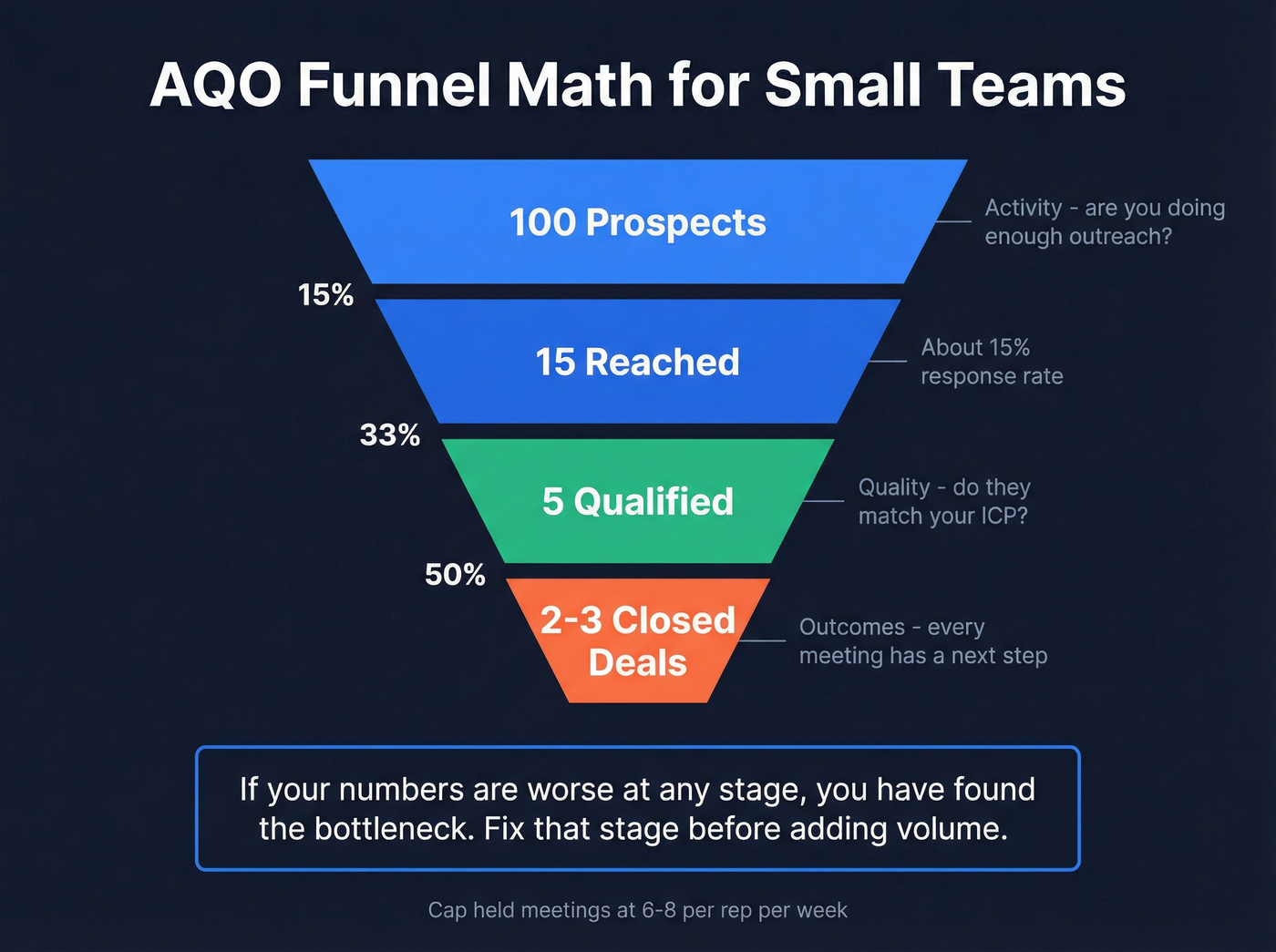
A meeting only "counts" if it holds, passes a quality check, and generates a concrete next step. Cap held meetings at 6-8 per rep per week - more than that and prep quality collapses. Full funnel math: 100 prospects, reach 15, qualify 5, close 2-3. If your numbers are worse at any stage, you've found the bottleneck. Fix that stage before adding volume.

Bad data torched that RevOps lead's domain - and it happens to small teams every day. Prospeo's 5-step verification delivers 98% email accuracy with a 7-day refresh cycle, so every contact in your sequence is real. At $0.01 per email with a free tier of 75 lookups/month, it fits the sub-$120 stack this playbook recommends.
Stop burning your domain. Start sending to verified contacts today.
The Small Business Lead Gen Stack (Under $120/Month)
| Tool | Role | Price | Verdict |
|---|---|---|---|
| Prospeo | Email finding + verification | Free tier (75/mo), ~$0.01/email | 98% email accuracy, 7-day data refresh |
| Instantly | Cold email sending | From $37/mo | Top pick for solo founders |
| HubSpot CRM | Pipeline management | Free tier | Strong free CRM to start |
| Apollo.io | Prospecting database | From $59/user/mo | Large database, but data quality issues at scale |
| Hunter | Email finder | Free (25/mo), from ~$49/mo | Basic lookup, less depth |
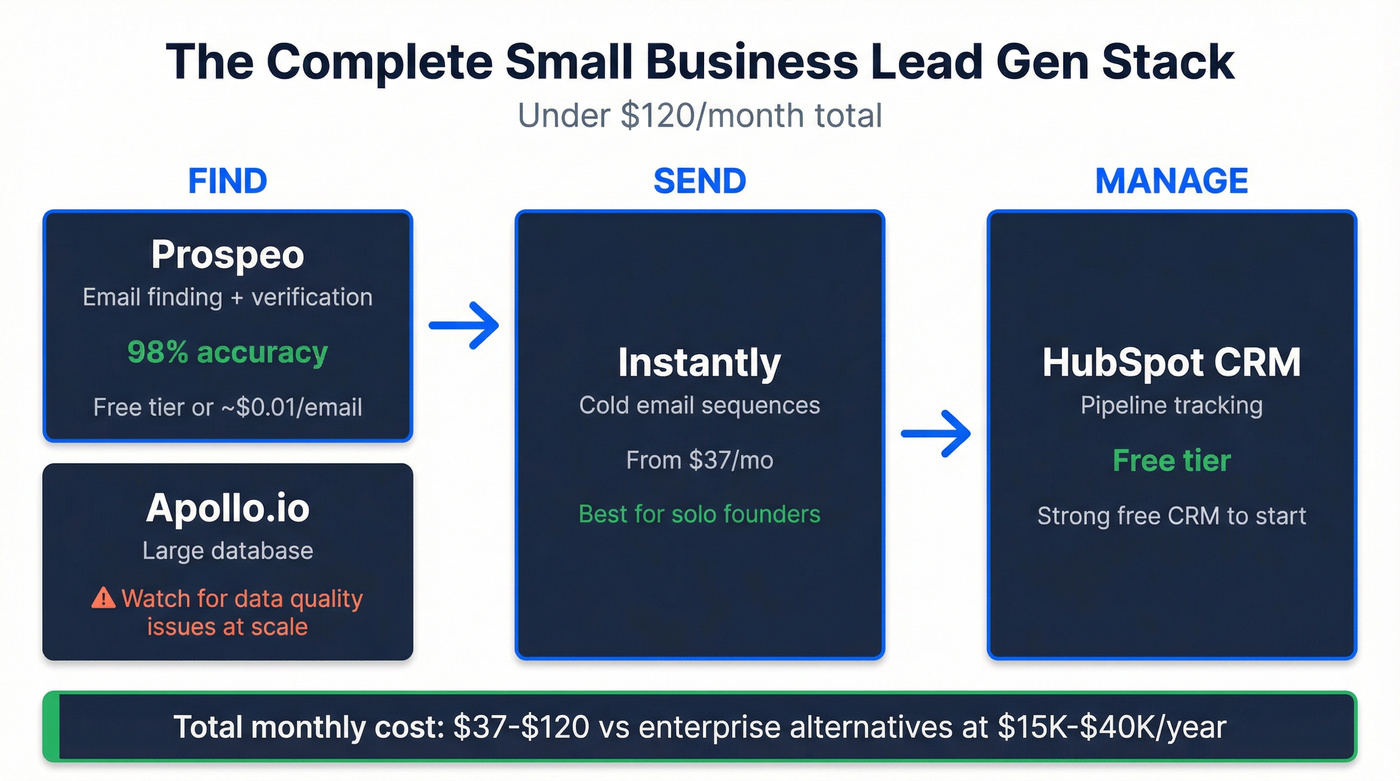
Look - most small businesses don't need a $15-40K/year ZoomInfo contract. A self-serve stack with verified data, a solid sending tool, and a free CRM outperforms enterprise platforms for small business lead generation because you actually use every feature instead of paying for a bloated platform you'll never fully adopt. The consensus on r/sales backs this up: founders consistently report better ROI from lightweight stacks than from enterprise tools they barely touch.

Mistakes That Kill Your Pipeline
No ICP definition. Going broad means going broke. Test 3 segments and kill the losers fast.
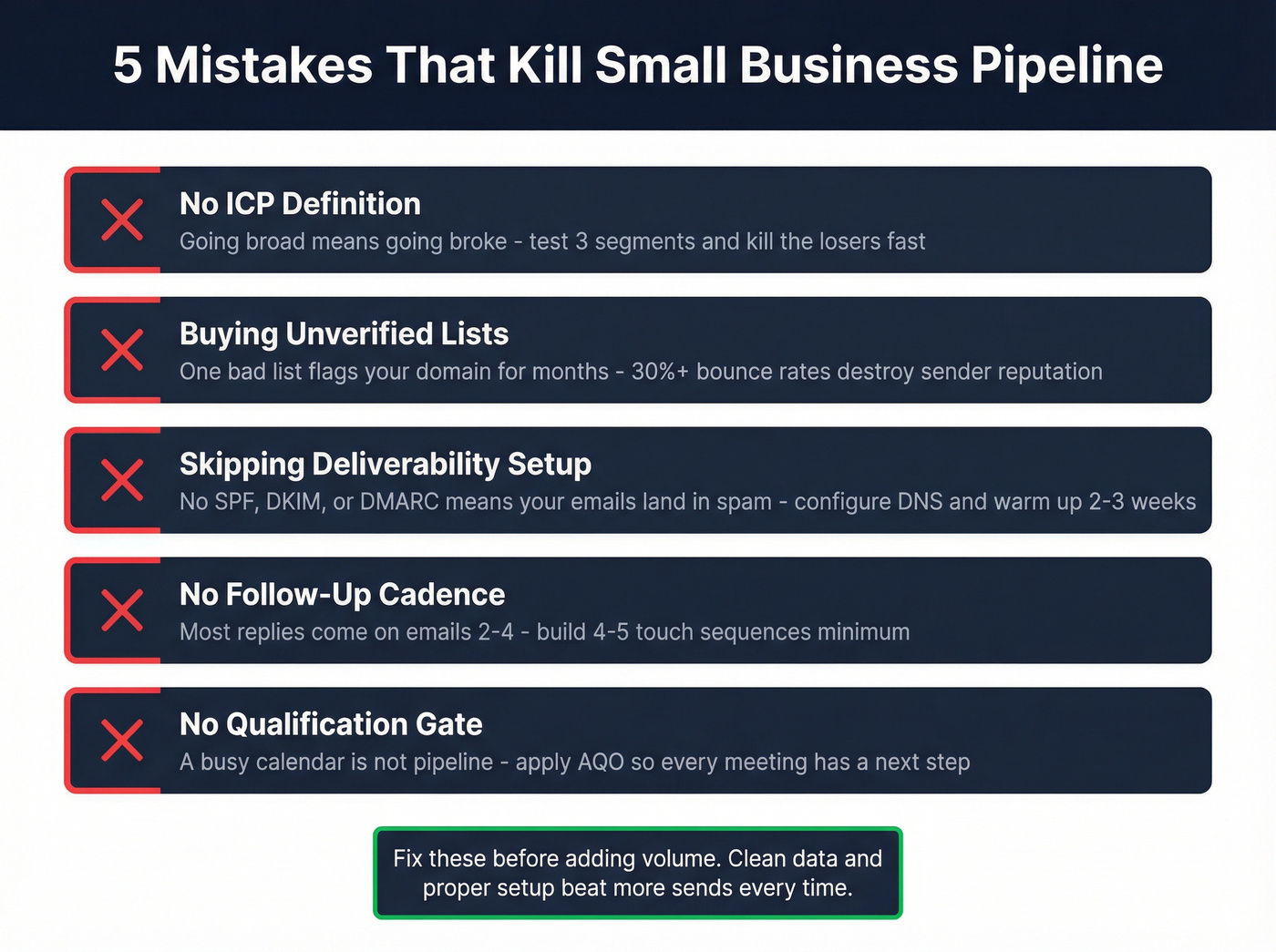
Buying unverified lists. One bad list can flag your domain for months. We can't stress this enough - verify every email before it enters a sequence. Stack Optimize built to $1M ARR while maintaining under 3% bounce rates and zero domain flags across all their clients, purely by insisting on verified data from day one.
Skipping deliverability setup. No SPF/DKIM/DMARC means your emails land in spam. Configure DNS records and warm up for 2-3 weeks before sending a single cold email.
No follow-up cadence. Most replies come on emails 2-4, not email 1. Build 4-5 touch sequences minimum. If you're sending one email and moving on, you're leaving meetings on the table.
No qualification gate. A busy calendar isn't pipeline. Apply the AQO framework so every meeting has a next step.
You don't need a $15K ZoomInfo contract to run enterprise-grade outbound. Prospeo gives small teams 300M+ profiles, 30+ search filters including intent data and technographics, and verified emails at 90% less cost. Meritt tripled pipeline to $300K/week after switching - with the same team size.
Enterprise data, small business pricing. No sales calls required.
FAQ
How much should a small business spend on lead generation?
A functional outbound stack runs under $120/month on entry plans. Paid ads average $84 per lead. Start with outbound and organic content, then add paid channels only when your LTV:CAC ratio exceeds 3:1. For most small teams, that means outbound carries the load for the first 6-12 months.
What's a realistic timeline for B2B lead gen results?
Expect 60-90 days for consistent pipeline from cold outbound, assuming deliverability is configured and your ICP is defined. Inbound compounds over 6-12 months. Most small teams quit at week four - don't.
Which prospecting tool is best for small teams on a budget?
Pair Prospeo's free tier with Instantly for sending and HubSpot's free CRM. That complete stack runs under $120/month with no contracts, and teams using verified data report bounce rates under 4% versus 30%+ on unverified lists. The difference in deliverability alone pays for the stack many times over.
Can a solo founder run B2B lead generation effectively?
Yes. A solo founder sending 200-500 personalized emails per month can realistically book 5-10 qualified meetings. The key is verified data to protect your domain, a 4-5 touch sequence, and 15-20 minutes of daily social selling to warm prospects before the first email lands. It's not glamorous work, but it's the work that fills pipeline.