How to Find a Domain Email Address in 2026 (4 Ways)
You've got a list of target accounts and zero email addresses. The company website has a generic "info@" and a contact form that goes nowhere. You need actual people, actual inboxes - fast.
Here's how to find domain email addresses using four methods, ranked by speed and reliability.
The Short Answer
Use a domain email finder tool - paste the domain, get verified emails in seconds. For free manual methods, try email permutation with verification, Google dorking, or checking company pages directly. All four are below, step by step.
Four Ways to Find Emails From a Domain
1. Domain Email Finder Tool
This is the method that scales. Paste a company domain, the tool searches its database, and you get back verified email addresses tied to that company. If you need a full contact list without manual research, this is the fastest path by a wide margin.
For context, Dropcontact's benchmark testing 15 email finders found Hunter had an 11.2% hard bounce rate. That's catastrophic for B2B prospecting deliverability - one bad campaign and your domain is in remediation for weeks.
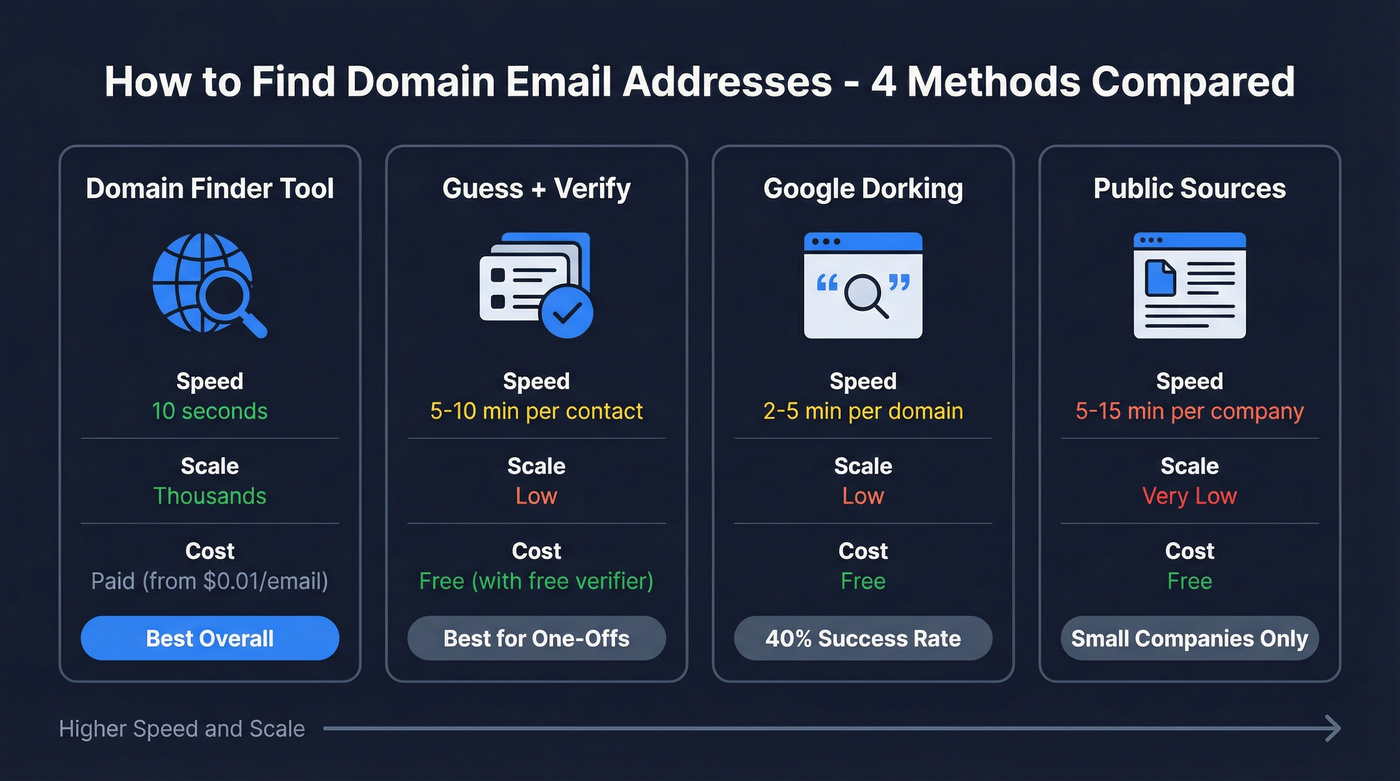
Use this if: you need verified emails at volume without a separate verification step.
Skip this if: you literally need one email once a year and don't mind spending 20 minutes on it.
2. Guess the Pattern + Verify
Most companies follow a predictable email format. Roughly 60% use first.last@domain.com, about 20% use first@ or firstlast@, and the rest are variations like f.last@ or flast@.
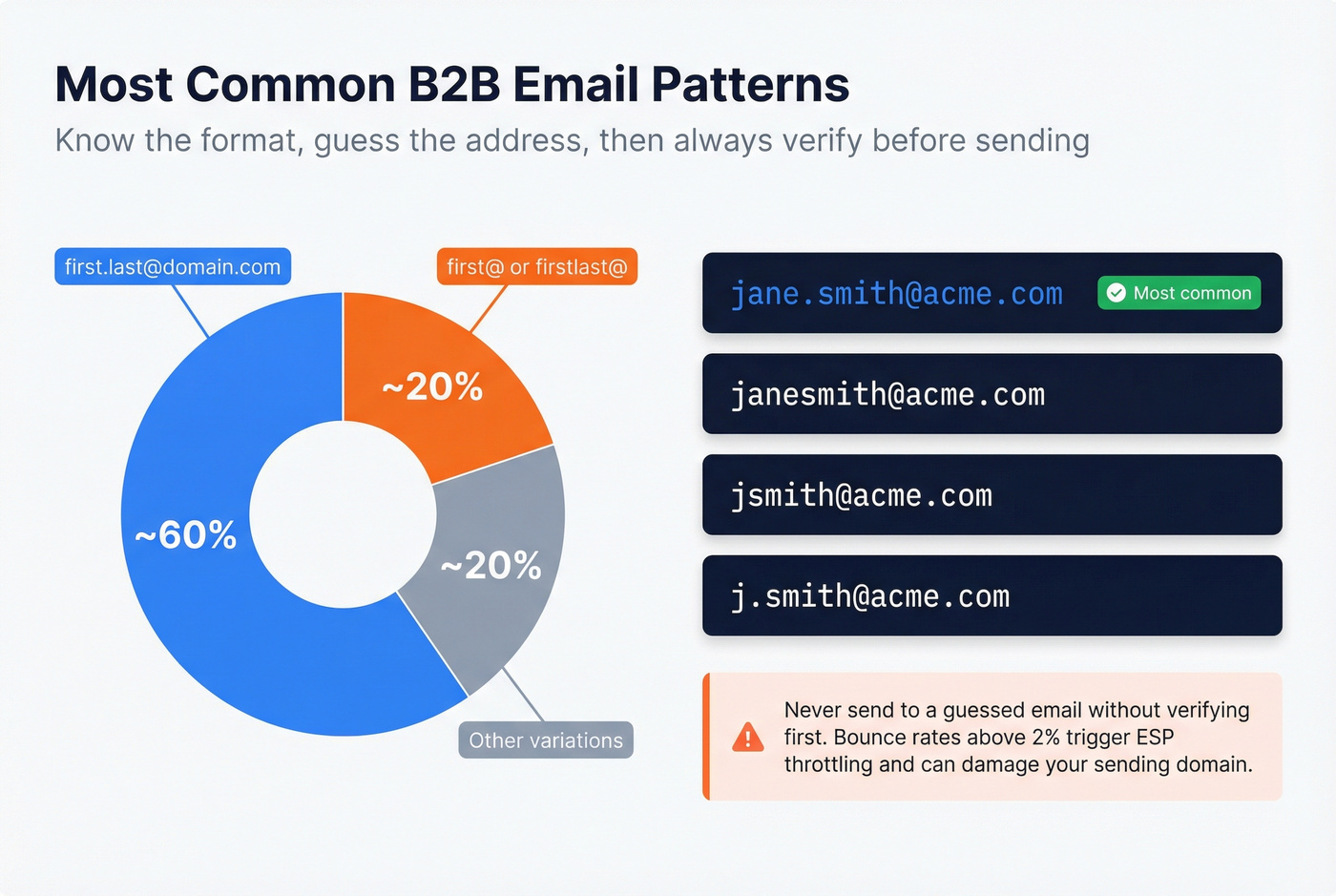
If you know someone's name and company domain, generate permutations:
jane.smith@acme.comjanesmith@acme.comjsmith@acme.comj.smith@acme.com
Here's the thing: never send to a guessed email without verifying it first. If your bounce rate crosses the 2% threshold, ESPs start throttling your domain. Across cold email communities on Reddit, the consensus is unanimous - trust but verify, even if your tool claims 99% accuracy. We've seen teams nuke perfectly good sending domains because they skipped this step on a batch of 500 guessed addresses. (If you want the safe workflow, see email permutation best practices.)
3. Google and DuckDuckGo Dorking
Search engines index more email addresses than you'd expect. Copy-paste these queries:
"@acme.com" site:acme.com- emails on the company's own site"john smith" "@acme.com"- narrows to a specific personsite:acme.com filetype:pdf intext:"email"- catches emails in PDFs and press kits"@acme.com" site:twitter.com OR site:github.com- emails on public profiles
DuckDuckGo doesn't strip email addresses from search snippets the way Google does. Run "@acme.com" there and you'll often see full addresses right in the results. In our testing, this surfaces usable addresses about 40% of the time - a solid free option when you need a handful of contacts without paying for anything. (More workflows: search engines for email discovery.)
4. Company Pages and Public Sources
Sometimes the simplest approach works. Check about/team pages (smaller companies often list direct emails), press releases (media contacts are almost always real inboxes), and blog author bios. SEC filings and patent documents are another goldmine that people overlook - they're public record and frequently contain direct professional emails.
These methods don't scale past a handful of lookups. But they're free and immediate. (If you’re building lists, use a prospecting workflow so this doesn’t turn into busywork.)

You just read four ways to find domain email addresses. One of them gives you verified contacts in seconds - no permutation guessing, no Google dorking, no manual page scraping. Prospeo's domain search returns 98% accurate emails with catch-all handling built in, at roughly $0.01 per email.
Stop guessing email patterns. Paste the domain and get verified addresses.
Why Verification Is Non-Negotiable
Email lists decay roughly 22.5% per year as people change jobs and inboxes get deactivated. The guardrails are tight: keep bounces at or below 2%, and Gmail spam complaints under 0.3%. Cross either line and you're in remediation mode for weeks. (If you’re troubleshooting, start with an email deliverability checklist.)

Verification runs through four layers: syntax validation, MX/domain check, SMTP mailbox probe, and risk screening for role accounts and spam traps. Catch-all domains - which account for 15-28% of B2B domains - are the trickiest, because they accept mail to any address whether the recipient exists or not. Cold email practitioners consistently warn that catch-all domains are the silent killer of sender reputation: your emails deliver, but nobody reads them, and engagement metrics crater. (Deep dive: AI email verification and what actually works.)
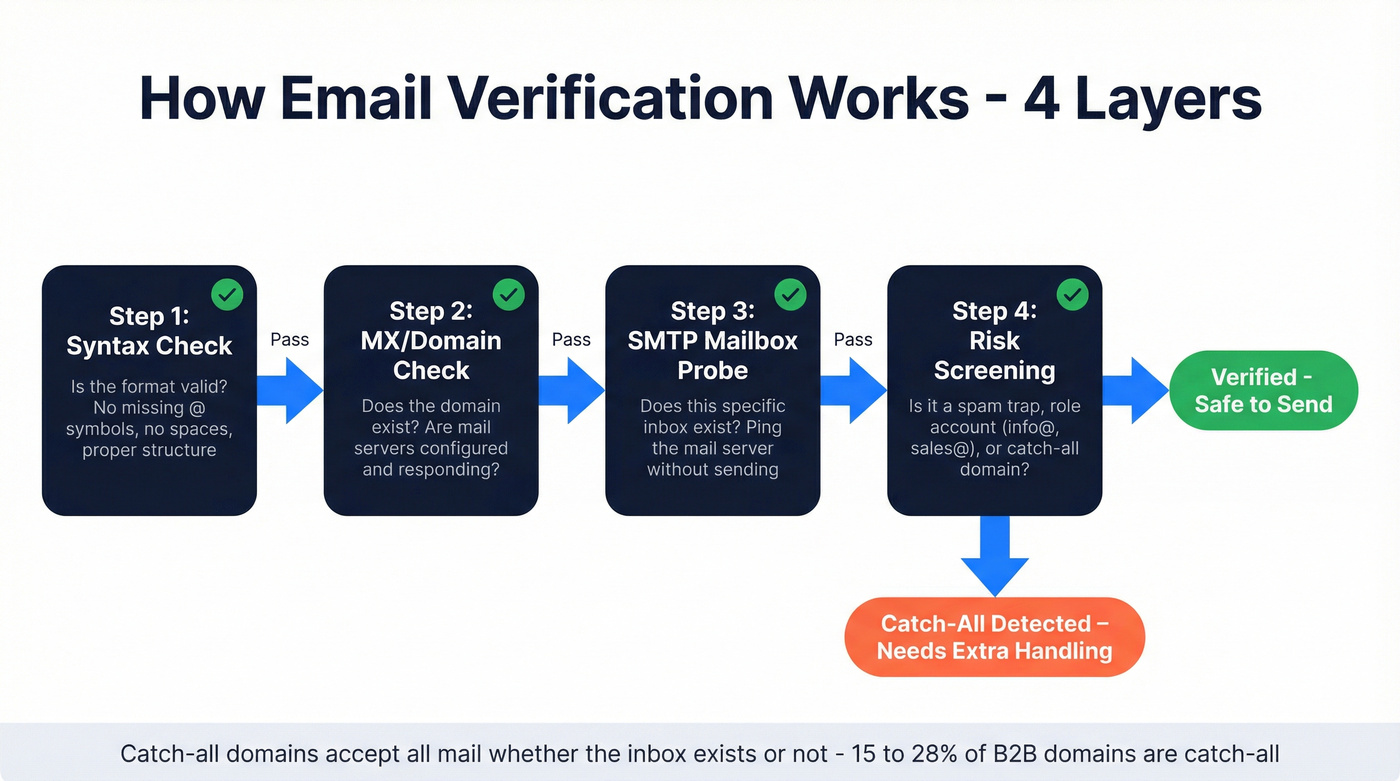
Let's be honest - if your current tool doesn't handle catch-all detection, you don't actually have a verified list. You have an expensive guess. (Related: what a hard bounce really means for your sender reputation.)
Domain Email Finder Comparison
| Tool | Free Tier | Starting Price | Best For | Accuracy |
|---|---|---|---|---|
| Prospeo | 75 emails/mo | ~$0.01/email | Accuracy + verification | 98%, catch-all handling |
| Hunter | 50/mo | $49/mo | Brand recognition | 11.2% hard bounce in testing |
| Snov.io | 50/mo | $39/mo | All-in-one outreach | Not independently verified |
| Apollo | 75 credits/mo | $59/user/mo | Free tier volume | Not public |
| Skrapp | 100/mo | $39/mo | Budget domain search | Basic verification only |
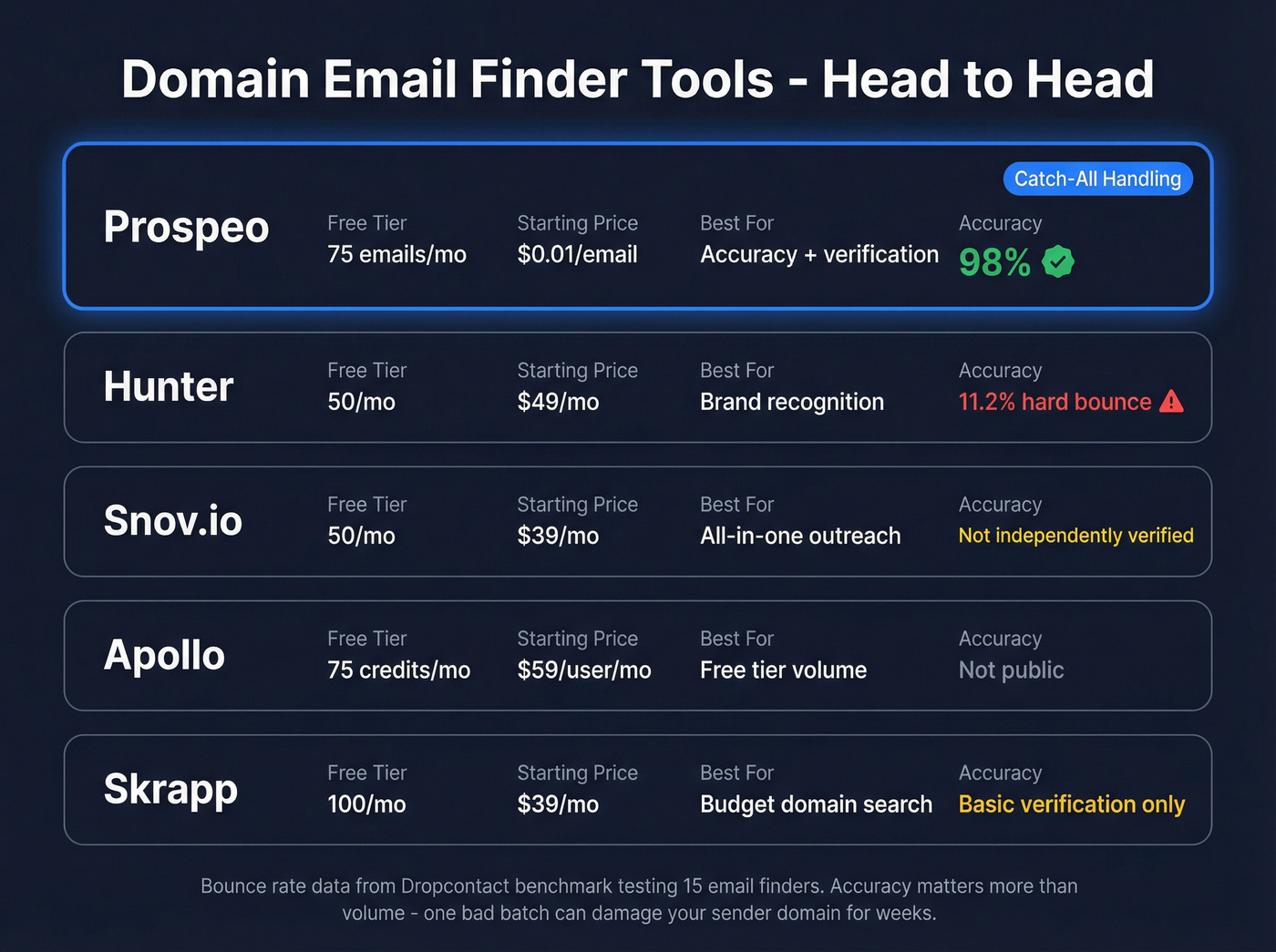
We've run domain searches across hundreds of accounts over the past year. The tool that consistently delivers without needing a separate verification step is Prospeo - 98% accuracy, catch-all handling, and a free tier that lets you test before committing a dollar. (If you’re evaluating options, compare email checker tools and email hunter tools side by side.)
Every guessed email you send without verification chips away at your sender reputation. Prospeo's 5-step verification - including catch-all detection and spam-trap removal - keeps your bounce rate under 2% so your domain stays clean. 75 free emails per month, no credit card.
One bad batch kills your domain. Start with data that's already verified.
FAQ
Is it legal to find someone's email from their domain?
Yes - finding publicly available business emails is legal in most jurisdictions. Sending must comply with CAN-SPAM (US) and GDPR (EU), which means including an unsubscribe link and honoring opt-outs within 10 business days. Legitimate B2B outreach to professional addresses is standard practice.
What's a catch-all domain and why does it matter?
A catch-all domain accepts email sent to any address at that domain, even fabricated ones. Between 15-28% of B2B domains are catch-all, so standard SMTP verification can't confirm the recipient actually exists. Tools with dedicated catch-all detection flag these before they inflate your bounce rate.
How many domain emails can I find for free?
Prospeo offers 75 free emails per month with full verification included. Skrapp offers 100, Apollo offers 75 credits, and Hunter and Snov.io each offer 50. All free tiers are enough to test accuracy on real domains before you pay - start with your top 10 target accounts and compare results side by side.