How to Be a Better SDR (2026 Operating System)
$15k worth of "activity" can die in one afternoon: 200 emails sent to unverified addresses, a domain reputation hit, and a call block full of dead numbers. If you're trying to figure out how to be a better sdr in 2026, stop chasing more touches and start controlling the inputs that create connects, meetings, and pipeline.
The best SDRs I've worked with look almost boring: tight lists, short copy, clean handoffs, and a ruthless focus on conversations that turn into real opportunities. That "boring" consistency is what real sales development skills look like in practice.
Look, if your week is a blur of tabs and "checking in" emails, you're not behind on effort. You're behind on a system.
What you need (quick version)
Checklist (the non-negotiables):
- A relevance filter: a clear ICP + 2-3 "reasons to care" per persona (not per company).
- A numbers ladder: activity -> connect rate -> quality conversations -> meetings -> show rate -> proposal progression.
- A deliverability baseline: authenticated sending domain, unsubscribe, bounce control, complaint control.
- A call system: pre-built call lists, a 30-second opener, and a follow-up pattern you run every time.
- A qualification framework: SPICED for first calls , MEDDPICC fields for handoff.
- A weekly improvement loop: 30-ish minutes of coaching, 2 call/email reviews, one micro-skill to fix.
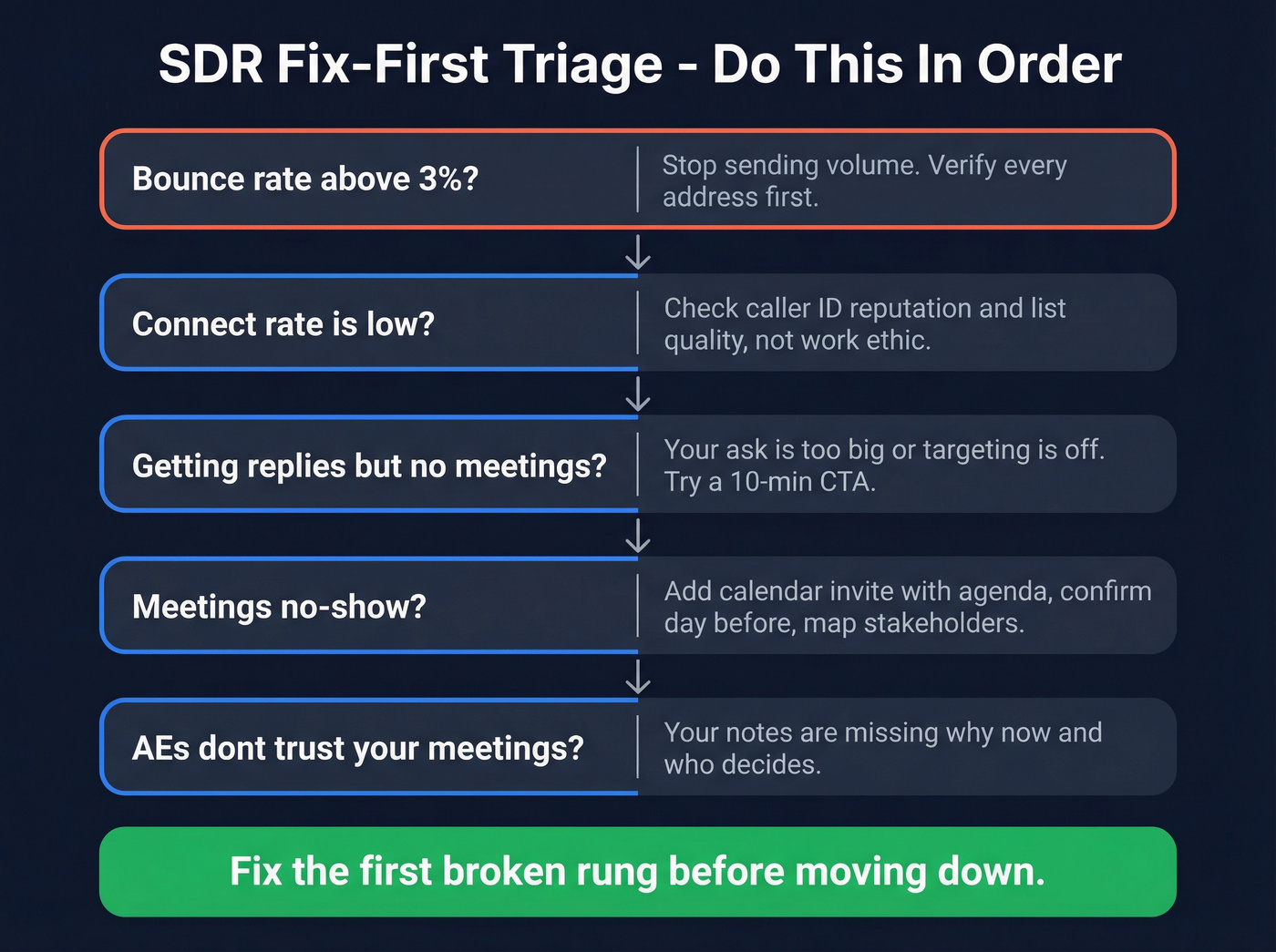
Fix-first triage (do this in order):
- If your bounce rate is >3%: you're not allowed to send volume. Period.
- If your connect rate is low: it's usually caller ID reputation + list quality, not "work ethic."
- If you get replies but no meetings: your ask is too big or your targeting is off.
- If meetings no-show: your confirmation + agenda + stakeholder mapping is weak.
- If AEs don't trust your meetings: your notes and qualification are missing the "why now" and "who decides."
Gartner's 632-buyer survey (Aug-Sep 2024) makes the stakes clear: 61% prefer a rep-free experience and 73% avoid suppliers who send irrelevant outreach. Translation: sloppy targeting doesn't just "not work" - it trains buyers to ignore you.
If you only fix 3 things this week
- Cut your list size in half and double your relevance. Pick 30 accounts, not 300. You'll book more meetings with fewer targets because you'll actually know who you're calling and why.
- Make bounces your #1 enemy. Clean/verify before you send. A 4% bounce rate is you lighting your domain reputation on fire.
- Stop asking for 30 minutes. Earn the next step with a 10-minute "compare notes" CTA, then expand.
The 2026 outbound reality (why old SDR advice fails)
Outbound used to be a volume game with a light dusting of personalization. Now it's a relevance game where deliverability and compliance are table stakes.
Here's what "rep-free preference" means tactically:
- Micro-CTAs win. Buyers don't want a "demo." They'll tolerate a 10-minute sanity check.
- Self-serve assets matter. If your website can't answer basic questions, your outreach creates friction instead of momentum.
- Thread the buying group early. One contact is a lottery ticket; 6-12 stakeholders is a plan.
- Opt-out must be frictionless. If unsubscribing is annoying, complaints go up - and your inbox placement goes down.
Another Gartner number that should change how you message: 69% of buyers see inconsistencies between website info and seller info. Before you pitch, read your own site like a skeptical buyer. If your email promises something your website doesn't back up, you just triggered distrust.
Hot take: most SDR teams don't have a "messaging problem." They have a truth problem - they overpromise, then wonder why buyers ghost.
How to be a better SDR: the numbers ladder (benchmarks + self-diagnosis)
Benchmarks aren't there to shame you. They're there to tell you what to fix first.
Two benchmark sets matter most:
- 6sense's BDR survey (262 respondents): 21 attempts per contact, 53-day cadence, 9 people per account, 60% using AI tools.
- Bridge Group highlights: the full report's gated, but Crunchbase summarizes key numbers.
Benchmarks table (activity + conversion ranges)
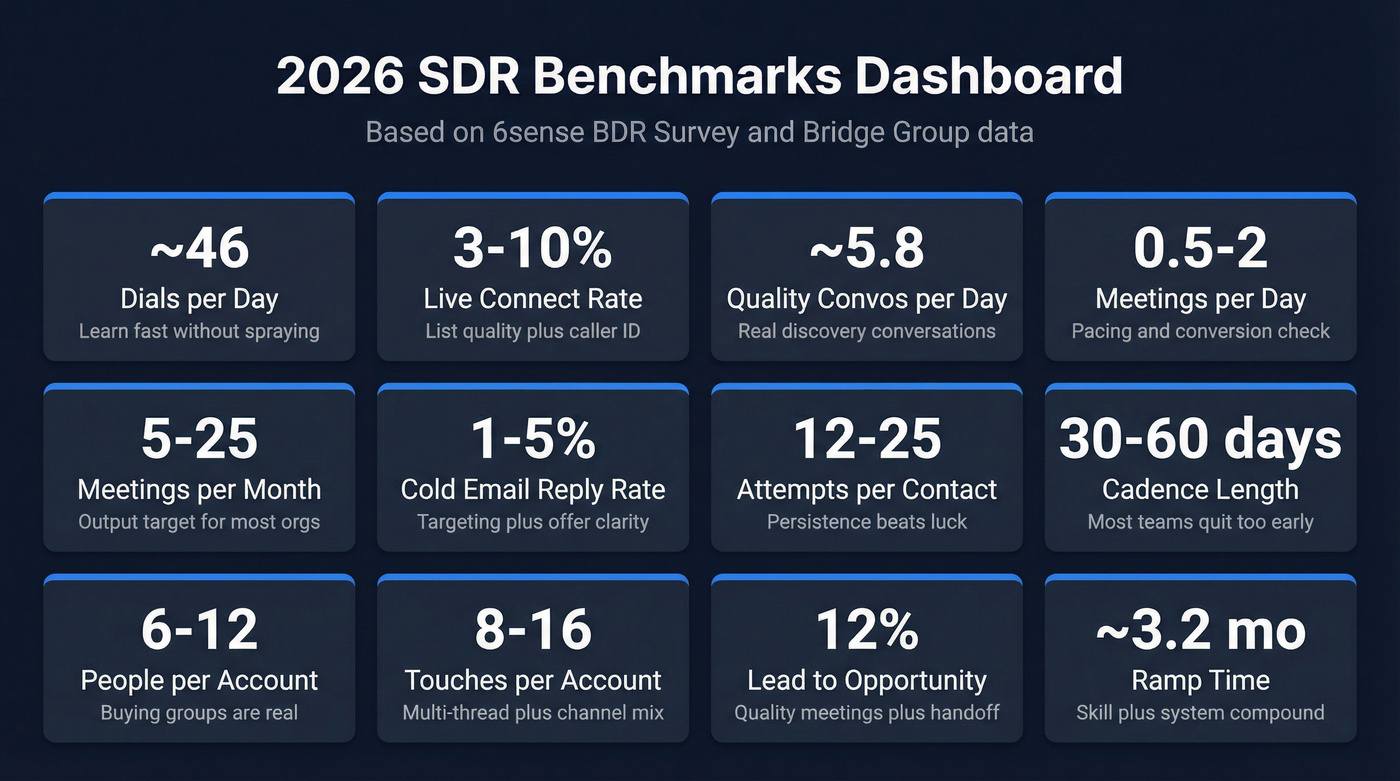
| Metric | Healthy range | Why it matters |
|---|---|---|
| Dials/day | around 46 | Enough volume to learn fast without spraying |
| Live connect rate | 3-10% | List quality + caller ID reputation |
| Quality conversations/day | around 5.8 | Real discovery, not "not interested" |
| Meetings/day | 0.5-2 | Pacing check (are you converting?) |
| Meetings/month | 5-25 | Output target for most SDR orgs |
| Cold email reply rate | 1-5% | Targeting + offer clarity (not "clever copy") |
| Attempts/contact | 12-25 | Persistence beats luck |
| Cadence length | 30-60 days | Most teams quit too early |
| People/account | 6-12 | Buying groups are real |
| Touches/account (total) | 8-16 | Multi-threading + channel mix |
| Lead -> opportunity (SaaS) | 12% | Quality of meetings + handoff discipline |
| Ramp time | ~3.2 months | Skill + system compound |
Diagnose -> Fix -> Template (use this every week)
Diagnose: which rung is broken - connects, replies, meetings, show rate, or progression? Fix: change one lever at a time (list, offer, channel mix, opener, CTA). Template: run a standard SDR cadence script/cadence so you can compare results.
"Below benchmark?" troubleshooting map (reply rate vs connect rate vs show rate)
If reply rate is low (email):
- Fix targeting first (wrong persona = zero replies).
- Then fix copy (too long, too "pitchy," too many links).
- Then fix deliverability (bounces/complaints quietly kill you).
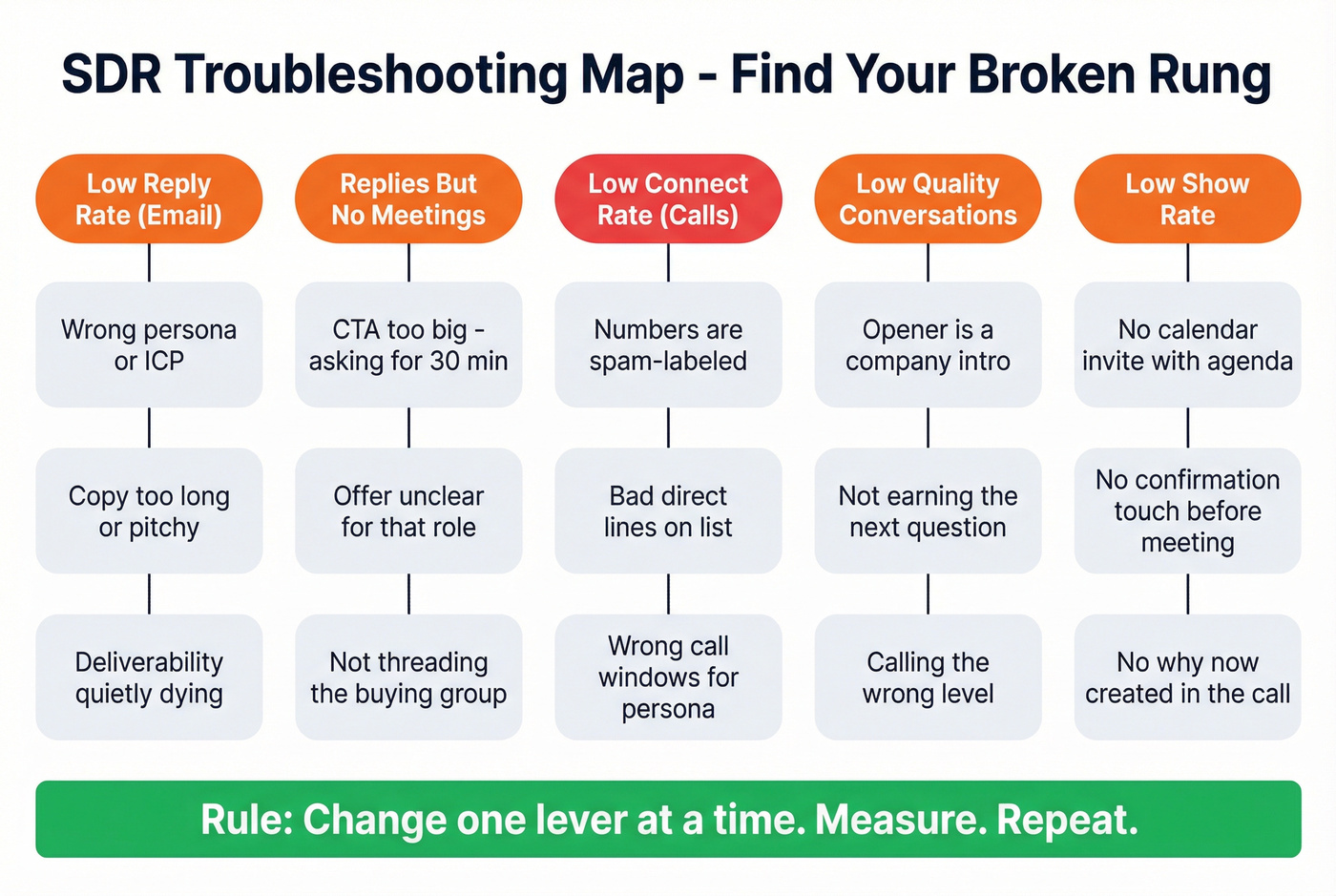
If reply rate's fine but meetings are low:
- Your CTA's too big ("30 minutes this week?").
- Your offer's unclear (what problem you solve for that role).
- You're not threading the buying group.
If connect rate is low (calls):
- Your numbers are spam-labeled or your caller ID reputation's weak.
- Your list has too many wrong/direct lines.
- Your call windows are wrong for the persona.
If connects happen but conversations are low quality:
- Your opener's a company intro instead of permission-based.
- You're not earning the next question.
- You're calling the wrong level.
If meetings book but show rate is low:
- No calendar invite with agenda + expected attendees.
- No confirmation touch the day before / morning of.
- No "why now" created in the meeting.
KPI definitions (so your dashboard isn't fiction)
If your team can't agree on definitions, your metrics are noise. Use these:
- Live connect: a human answers and you exchange at least one sentence (not voicemail).
- Quality conversation: you confirm role fit + a real pain/priority + next step (even if the next step's "not now").
- Qualified meeting: you captured pain + impact + critical event and you know who the decision involves. If you can't name the critical event, it's not qualified.
Comp reality check (use this even if you're not a manager): If SDRs get paid on meetings set, they'll set garbage. If they get paid on meetings that progress to proposals, qualification suddenly improves.

You just read that a 4% bounce rate lights your domain on fire. Prospeo's 5-step email verification delivers 98% accuracy - so your sends actually land. 143M+ verified emails, refreshed every 7 days, at $0.01 each.
Clean data is the foundation of every KPI on that benchmarks table.
Your daily operating system (time blocks that create meetings)
A common management mistake I've seen: optimizing for activity while pipeline stays flat. Activity without quality is noise. Protect selling blocks or your week disappears into admin, Slack, and tab chaos.
Here's a scenario I've watched play out too many times: an SDR spends Monday building a 400-lead list, blasts a sequence on Tuesday, gets a bounce spike by Wednesday, and by Thursday the whole team is arguing about "subject lines" while deliverability quietly tanks and the AE calendar stays empty.
Diagnose -> Fix -> Template
Diagnose: are you losing time to list building, follow-up, or CRM cleanup? Fix: lock time blocks and stop multitasking. Template: run the same blocks daily so you can improve them.
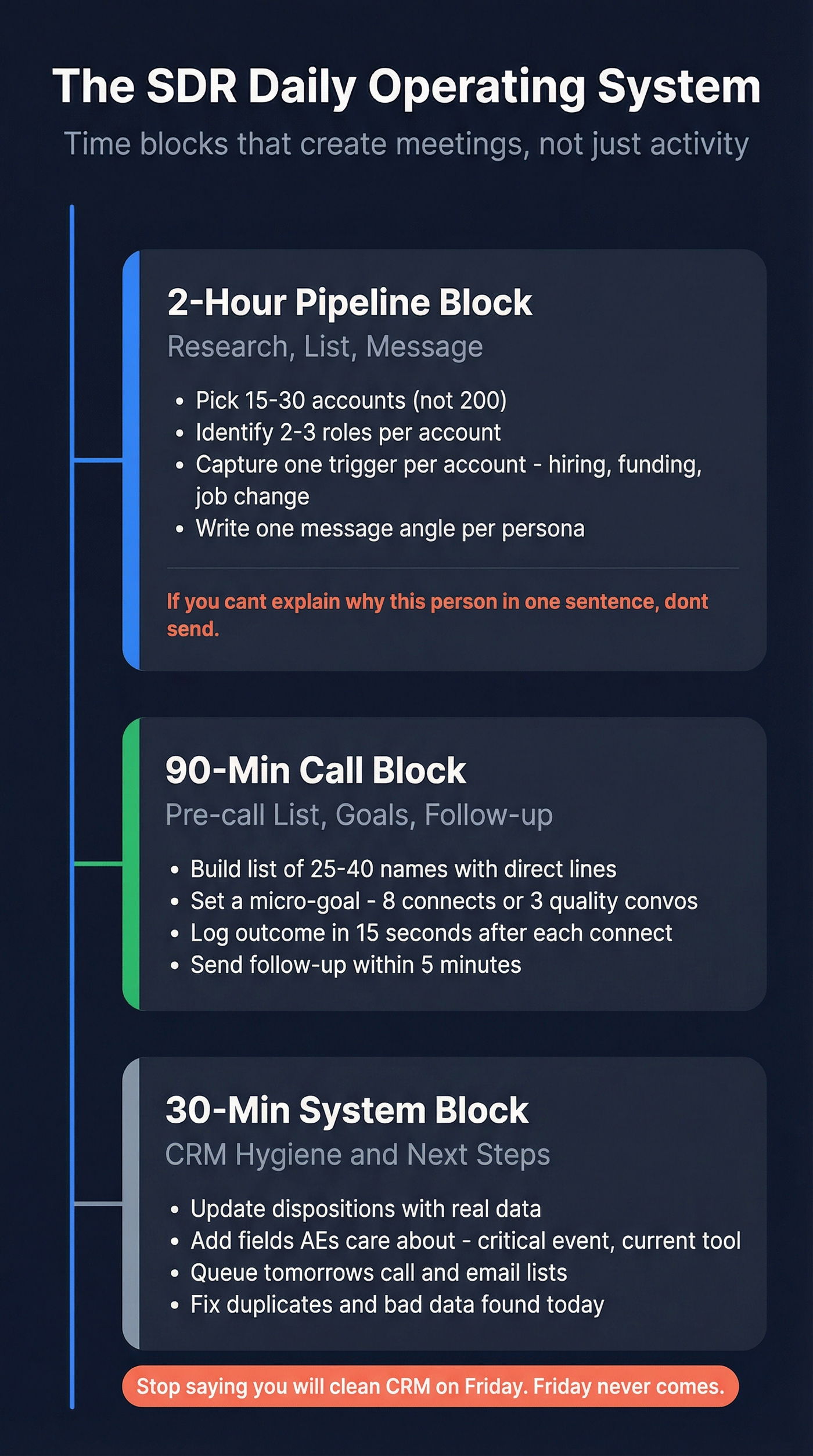
2-hour "pipeline block" (research -> list -> message)
Goal: build a list you can confidently contact today.
- Pick 15-30 accounts (not 200).
- Identify 2-3 roles per account (start with the role that feels pain first).
- Capture one trigger per account: hiring, headcount growth, new tooling, job change, funding, new initiative.
- Write one message angle per persona (reused across accounts).
Rule: if you can't explain "why this person" in one sentence, you're not ready to send.
90-minute call block (pre-call list, call goals, follow-up)
Goal: turn dials into conversations, not voicemails.
Before you start:
- Build a call list of 25-40 names with direct lines/mobile where possible.
- Pick a micro-goal: "8 connects" or "3 quality convos," not "100 dials."
- Put your follow-up in a snippet so you send it every time.
After each connect:
- Log the outcome in 15 seconds.
- Send the follow-up within 5 minutes (call-to-email pattern below).
30-minute "system block" (CRM hygiene + next steps)
Goal: make tomorrow easier.
- Update dispositions (no "left voicemail" as your only data).
- Add 1-2 fields AEs care about (critical event, current tool, decision process).
- Queue tomorrow's call list and email list.
- Fix duplicates and bad data you discovered today.
Stop doing this: "I'll clean CRM on Friday." Friday never comes.
How to be a better SDR at cold email (replies + deliverability)
Cold email still works - until you wreck deliverability. Then you "send" emails that never land and you blame copy. A lot of SDR skill development comes down to mastering the boring fundamentals: tight research blocks, short drafts, and consistent follow-up.
Diagnose -> Fix -> Template
Diagnose: are you losing to inboxing (deliverability) or relevance (targeting/offer)? Fix: protect domain reputation first, then iterate messaging. Template: run short plain-text emails with one observation + one question + soft CTA.
Deliverability rules that matter in 2026
Yahoo's sender requirements (enforced starting Feb 2024) include authentication (at least SPF or DKIM, and for bulk senders SPF + DKIM + DMARC), one-click unsubscribe, spam complaints <0.3%, and honoring unsubscribes within 2 days: https://senders.yahooinc.com/best-practices/

Operational safe limits (practical, conservative):
- Mature domain: 100-150 cold emails/day per domain (not per rep).
- New domain ramp: 10-20/day -> 60-80/day by week 4.
- Bounce rates: keep under 3%; treat 5% as an emergency.
Deliverability guardrails SDRs control
Authentication (non-negotiable):
- SPF: set it.
- DKIM: set it.
- DMARC: set it (at least p=none) and make sure it passes.
Unsubscribe (don't get cute):
- One-click unsubscribe header.
- Visible unsubscribe link in the body.
- Remove unsubscribes within 2 days.
Complaint + bounce thresholds (your red lines):
- Spam complaints: keep it under 0.3%.
- Bounces: keep it under 3%.
The fastest deliverability win is boring: clean your list before you send.
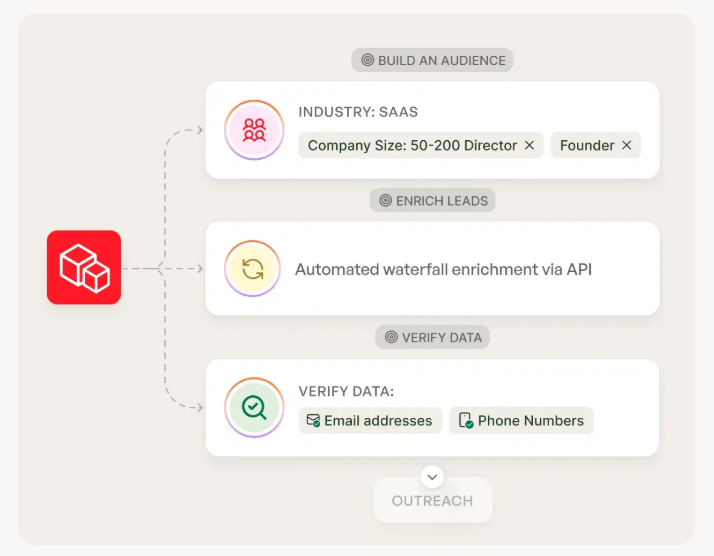
In practice, that means you need a data + verification layer you trust. Prospeo ("The B2B data platform built for accuracy") is built for SDR reality: 300M+ professional profiles, 143M+ verified emails, 125M+ verified mobile numbers, 98% email accuracy, and a 7-day data refresh cycle (vs a ~6-week industry average). If you're trying to protect deliverability while still moving fast, that's exactly the combo you want.
Safe sending limits + ramp schedule (copy/paste table)
| Week | New domain daily cap | Notes |
|---|---|---|
| Week 1 | 10-20/day | Plain text only |
| Week 2 | 20-40/day | Keep targeting tight |
| Week 3 | 40-60/day | Watch bounces daily |
| Week 4 | 60-80/day | Add light follow-ups |
| Mature | 100-150/day | Don't chase 500/day |
75-word cold email template (with 3 examples by persona)
Short, plain text, one observation, one pain question, soft CTA. I've seen meaningful lifts just by cutting fluff and making email #1 about earning a response - not explaining the product.
Template (75 words-ish):
Subject: quick question, {{first_name}}
Hi {{first_name}} - noticed {{observation}}.
Curious: how are you handling {{pain area}} today? Most {{role}} teams I talk to run into {{specific friction}} once {{trigger}}.
If it's relevant, I can share what we've seen work in a 10-min chat. Worth a quick compare?
-- {{your_name}}
Example 1 (VP Sales):
Observation: hiring 6 AEs in the last 60 days
Pain question: "How are you keeping pipeline coverage consistent while onboarding?"
Friction: "new reps burn lists + sequences get noisy"
Example 2 (RevOps):
Observation: job post for "Salesforce Admin / GTM Systems"
Pain question: "How are you keeping contact data clean across CRM + sequencer?"
Friction: "duplicates + bounce spikes + bad routing"
Example 3 (Marketing Ops / Demand Gen):
Observation: new ABM tooling on the site
Pain question: "How are you deciding which accounts are actually in-market?"
Friction: "intent noise + SDRs chasing the wrong accounts"
Sequence rules (when to stop, when to switch channel)
Use 6sense as your persistence anchor: 21 attempts per contact and 53 days is average. That doesn't mean 21 emails. It means a mix.
Rules I run:
- Stop emailing when: they reply (even "no"), they unsubscribe, or you hit 2 bounces.
- Switch channel when: you've sent 2 emails with no reply - call next, then call-to-email.
- Change the angle after touch 4-5: new pain, new trigger, or new stakeholder.
- Multi-thread by default: aim for 6-12 people per account over the cadence.
Skip this if you're emailing the same person forever because "that's the lead." If you're not adding stakeholders by touch 3, you're basically hoping for luck.
Stop doing this: sending the same "checking back" email 5 times. That's how you train spam filters and buyers to ignore you.
Cold calling that raises connect rate (without "just dial more")
Cold calling didn't die. Unknown numbers did.
DestinationCRM (citing TNS) puts numbers on what you feel: 72% ignore unknown numbers, and people are 78% more likely to answer branded calls. Skill matters, but the phone layer matters too.
And yeah, it's frustrating watching reps get told to "smile and dial" while their numbers are getting spam-labeled into oblivion.
Diagnose -> Fix -> Template
Diagnose: is your problem connects or conversions? Fix: improve caller ID reputation + list quality before you grind more dials. Template: permission-based opener + tight follow-up pattern.
Compute your real connect rate + meetings/100 dials (last 60-90 days)
- Live connects = conversations with a human (not voicemail)
- Connect rate = live connects / dials
- Meetings per 100 dials = meetings booked / dials * 100
Example:
- 1,000 dials -> 60 connects (6%) -> 12 meetings
- Meetings per 100 dials = 1.2
Now you know what lever matters:
- If connect rate's 2%, fix phone reputation + list.
- If connect rate's 8% but meetings are low, fix opener + discovery + ask.
Connect-rate levers you can control:
- Local presence (match area code to region)
- STIR/SHAKEN attestation (A-level when possible; improves call authentication and reduces spam labeling)
- Rotating number pools (avoid burning one number)
- Caller ID reputation management (monitor spam labeling)
If your dialer supports local presence and number pools, turn them on today.
30-second opener + 2 objection handles (permission-based)
Permission-based beats "Did I catch you at a bad time?" (they'll always say yes). It's also one of the highest-leverage communication skills for BDRs and SDRs: you're earning attention instead of demanding it.
30-second opener: "Hey {{first_name}}, it's {{your_name}} with {{company}}. I know you weren't expecting me - can I tell you why I'm calling in 20 seconds, and you can hang up if it's irrelevant?"
Then: "I'm reaching out because {{reason tied to role + trigger}}. Quick question - how are you handling {{pain}} today?"
Objection 1: "Not interested." "Totally fair. Before I let you go - what are you using for {{category}} today? I'm figuring out if this is a 'never' or a 'not now.'"
Objection 2: "Send me an email." "I will. So I don't send something useless - what's the one thing you'd want to see in that email to decide if it's worth a conversation?"
Voicemail + "call-to-email" follow-up pattern
Voicemail's job isn't to sell. It's to make your email feel expected.
Voicemail (15-20 seconds): "Hey {{first_name}}, {{your_name}} at {{company}}. I'm calling because {{one-line reason}}. I'll send a quick email - if it's not relevant, just reply 'no' and I'll close the loop."
Call-to-email (send within 5 minutes):
Subject: just tried you
Hi {{first_name}} - just tried you by phone.
Reason I called: {{one-line trigger + pain}}. Quick question: are you the right person for {{problem}} or is that someone else on your team?
If it's easier, I can send 2 bullets and you can tell me if it's worth a chat.
-- {{your_name}}
Qualification that AEs trust (SPICED + MEDDPICC prompts)
SDRs don't get promoted for "setting meetings." They get promoted for setting meetings that turn into pipeline. In other words: sales development representative skills aren't just outreach - they're discovery, qualification, and clean internal communication.
Diagnose -> Fix -> Template
Diagnose: do AEs re-qualify from scratch? do deals stall because nobody knows "why now"? Fix: capture impact + critical event + decision path every time. Template: SPICED questions + a tight MEDDPICC handoff.
First-call question flow (SPICED in 8 questions)
- Situation: "How's {{process}} working today?"
- Situation: "What tools/teams are involved?"
- Pain: "What's the most annoying part of that?"
- Pain: "Where does it break at scale?"
- Impact: "What does that cost you - time, revenue, risk?"
- Impact: "What happens if nothing changes this quarter?"
- Critical Event: "Is there a deadline or event driving this?"
- Decision: "If you did change it, how would you evaluate options?"
Hard rule: if you can't name the critical event, it's not a qualified meeting.
MEDDPICC "must-capture" fields for handoff
You don't need full MEDDPICC on call one. But you do need:
- Economic buyer: Who signs? Will we meet them?
- Decision process: What are the steps from here to a yes/no?
- Paper process: Legal/security/procurement - what's involved and how long?
AE-ready handoff checklist (what to log in CRM)
- Problem statement in the prospect's words
- Why now (critical event)
- Stakeholders identified + missing stakeholders
- Current solution + what's broken
- Next meeting goal (what decision should happen?)
- Risks (competition, internal blockers, timeline)
The weekly improvement loop (how top SDRs compound)
Top SDRs don't "work harder." They compound faster. If you look at top-performing SDR traits, they're usually unsexy: consistent QA, fast feedback loops, and a willingness to fix one thing at a time.
Diagnose -> Fix -> Template
Diagnose: are your numbers flat because nobody's reviewing real calls/emails? Fix: make QA non-optional and time-boxed. Template: weekly standup + QA + coaching + scoreboard.
A coaching cadence that actually moves numbers:
- 32 minutes weekly coaching per rep
- Review 2 calls or email threads
- Coach with questions ("What did you notice?") instead of lectures
- Keep standup to 15 minutes: one win, one challenge, one help-needed
Operator truth: the best managers I've seen spend ~3 hours/week inside recordings and email threads, because that's where the real problems show up - not in dashboards, not in "more activity" pep talks, and definitely not in another slide deck about "tone."
Weekly cadence (standup, QA, coaching, enablement)
- Mon: 15-min standup + pick one micro-skill (opener, CTA, objection, follow-up)
- Tue/Wed: QA review (2 calls or 2 email threads)
- Thu: 32-min coaching (roleplay the micro-skill)
- Fri: scoreboard review (numbers ladder) + one tweak to targeting or messaging
Skip AI coaching tools until you're consistently doing weekly QA + roleplay. Tools don't fix avoidance.
Copy/paste call memo template (5-10 bullets)
SaaStr's guidance is right: 5-10 bullets is the sweet spot. https://www.saastr.com/one-simple-trick-to-make-your-sdrs-perform-better/
Call memo (paste into CRM):
- Who attended + titles:
- Why they took the call (trigger):
- Current workflow/tooling:
- Pain (in their words):
- Impact (time/$/risk):
- Critical event / deadline:
- Decision process (steps + timing):
- Economic buyer (name/title) + access plan:
- Competition / alternatives:
- Next step (date/time) + success criteria:
Why frameworks fail without reinforcement
Enterprise sales training can run $100k-$500k, and adherence decays 40-50% within 6 months without reinforcement. Weekly QA is the reinforcement, and it's one of the most practical sales training tips SDRs can apply without waiting for a new enablement program.
Your 30/60/90 plan (ramp targets + what to master first)
Ramp isn't "learn the product, then start selling." Ramp is learning just enough to book meetings, then learning the rest while you're booking.
Realistic ramp expectations:
- Month 1: 42% of target
- Month 2: 72% of target
- Month 3: >=100% of target
Days 1-30 (ICP + messaging + compliance + activity habits)
Outcomes by day 30:
- ICP + personas memorized (explain who you target in 20 seconds)
- 2 message angles per persona
- 1 call opener you can deliver naturally
- A clean daily routine you can repeat
Compliance gating (non-negotiable):
- Don't let new reps freestyle outreach before compliance basics are locked.
Activity habit (but not vanity):
- Build lists daily.
- Run one call block daily.
- Send email within safe limits, with clean data.
Days 31-60 (call reps, QA, first conversions)
Outcomes by day 60:
- You've listened to 15 hours of top calls.
- You can run SPICED without sounding robotic.
- You've booked real meetings and you know why they happened.
Your focus:
- One micro-skill per week.
- QA 2 calls + 2 email threads weekly.
- Multi-threading becomes default.
Days 61-90 (multi-threading + meeting quality + pipeline progression)
Outcomes by day 90:
- You're hitting full target (or you're close and you know exactly what's broken).
- Your meetings progress - AEs aren't re-qualifying from scratch.
- You're working accounts, not leads: 6-12 stakeholders touched over time.
Your focus:
- Multi-threading as a habit (6sense average is 9 people per account).
- Better meeting setting: agenda, stakeholders, "why now."
- Pipeline thinking: which meetings are likely to become proposals?
Wrap-up: your next 7 days
Pick one lever per channel and run it hard for a week:
- Email: cut to 75 words, verify your list, stay under safe limits.
- Calls: permission opener + call-to-email within 5 minutes.
- Meetings: no critical event = no qualified meeting.
If you're serious about how to be a better sdr, ignore "new hacks." Win with clean inputs, tight execution, and weekly QA - those are the SDR tips that still work when the market changes.
Low connect rates aren't an effort problem - they're a data problem. Prospeo gives you 125M+ verified mobile numbers with a 30% pickup rate, plus 30+ filters to build the tight, relevant lists that top SDRs swear by.
Cut your list in half, double your connects. Start with better numbers.
FAQ: becoming a better SDR in 2026
What KPIs should an SDR focus on to actually improve?
Track a ladder: activity -> connect rate -> quality conversations -> meetings -> show rate -> meetings that progress to proposals, reviewed weekly. If you're hitting activity but missing connects, fix list quality and phone reputation; if you're getting replies but no meetings, shrink the CTA to 10 minutes and tighten targeting.
How many touches should I run before I give up on a prospect?
Most outbound programs average about 21 attempts per contact over roughly 53 days, so quitting after 5-7 touches is usually premature. Mix channels (email + calls) and multi-thread 6-12 stakeholders per account, and change your angle after touch 4-5 instead of sending "checking in" repeatedly.
How many cold emails per day is safe in 2026?
A conservative ceiling is 100-150 cold emails/day per sending domain once warmed, and 10-20/day ramping to 60-80/day by week 4 on a new domain. Keep spam complaints under 0.3% and bounces under 3%; at 5% bounces, stop sending and clean your list.
What's the fastest way to improve cold call connect rate?
Improve the phone layer first: use local presence, rotate numbers, and aim for A-level STIR/SHAKEN attestation to reduce spam labeling. Then tighten your list to direct dials/mobile where possible and run a permission-based opener; a realistic target is moving from 2-3% connects to 5-8% within 2-4 weeks.
What's a good free tool to verify emails before outreach?
Prospeo's a strong free starting point because it includes 75 email credits plus 100 Chrome extension credits/month, and it's built around 98% email accuracy and a 7-day refresh cycle. If you're comparing options, prioritize tools that verify in real time and help you keep bounces under 3% before you scale volume.