

How to Build a B2B Marketing Structure That Actually Works
You just got promoted to Head of Marketing. You inherited four people with no clear structure, and the CEO keeps asking why marketing isn't generating pipeline. Meanwhile, marketing budgets sit at 7.7% of revenue and 39% of CMOs are actively cutting labor costs. You don't need more people - you need the right structure.
Here's the short version: build around three functions - Growth, Product Marketing, and Brand & Content - not job titles. Hire generalists first. Use tools and contractors to fill specialist gaps until you can afford dedicated headcount.
Three Mistakes That Kill Marketing Teams
Before building anything, let's clear the anti-patterns that sink most teams.
Marketing reports to the VP of Sales or Ops. We've seen this more times than we can count, and the consensus on r/marketing backs it up: when marketing reports through Sales or Operations, it becomes a support function. It loses strategic autonomy. It gets deprioritized every time sales has a fire drill. Strong marketing leadership requires a direct line to the executive table, not a pass-through from another department.
Hiring a junior marketer to "do everything." You post a role for a "Marketing Manager" who's supposed to run ads, write blog posts, manage events, build dashboards, and own the website. What you get is random acts of marketing - scattered effort with no compounding returns. Every B2B marketer who's lived through this knows the burnout it creates, and it's the single fastest way to lose a good hire.
No clear functional boundaries. When nobody knows who owns competitive intel, or whether lifecycle emails belong to growth or product marketing, you get turf wars and dropped balls. Gray-area roles create gray-area results.
The Three-Function Model That Scales
The model that works - whether you're three people or thirty - splits marketing into three functions. This isn't theoretical; it's the structure that shows up repeatedly across practitioner org charts and operator playbooks we've studied.
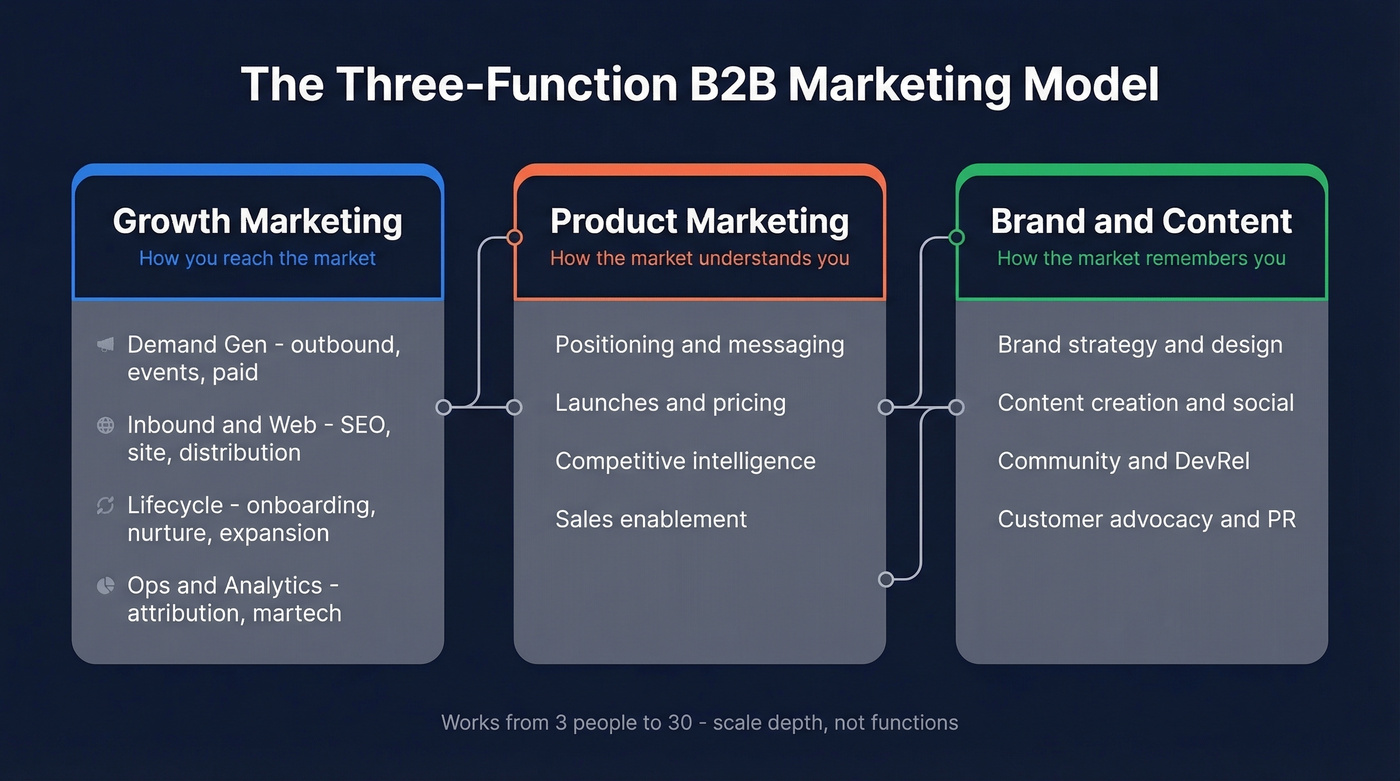
Growth owns how you reach the market. Product Marketing owns how the market understands you. Brand owns how the market remembers you.
Growth Marketing
Growth marketing is the umbrella. Demand gen is one sub-function inside it - not a synonym.
A complete growth function covers four areas:
- Demand Gen - outbound, events, paid acquisition
- Inbound & Web - SEO, website optimization, content distribution
- Lifecycle - onboarding, nurture sequences, expansion revenue
- Ops & Analytics - attribution, lead management, martech stack
When your growth team is two people, tools replace the data researcher you can't hire. Prospeo gives lean teams access to 300M+ profiles with 98% email accuracy at roughly $0.01 per email - the kind of thing that lets a two-person team punch well above its weight on outbound without burning through budget on a data vendor contract.
Product Marketing
Product marketing owns positioning, launches, pricing and packaging, competitive intel, and sales enablement. It's the bridge between what you build and how the market perceives it.
In smaller orgs, this is often the founder or a senior generalist. By Series B, it usually needs a dedicated person - the cost of bad positioning compounds fast. If your GTM involves selling to sales and marketing professionals, product marketing becomes even more critical because your buyers will immediately spot weak messaging. They've heard every pitch. They know the playbook.
Brand & Content
Brand strategy, content creation, design, social, and customer advocacy live here. Even when comms and PR sit outside the core marketing reporting line, they need a dotted line into this function. The best brand teams also own developer relations and community, particularly for developer-facing or API-first products.
Scaling Your Org by Stage
| Stage | Headcount | Focus |
|---|---|---|
| Seed / Pre-A | 1-3 generalists | Find 1-2 channels that work |
| Series A/B | 5-10, first specialists | Double down on proven channels, add specialists |
| Late-stage | 15-30, full coverage | Full depth across all three functions |
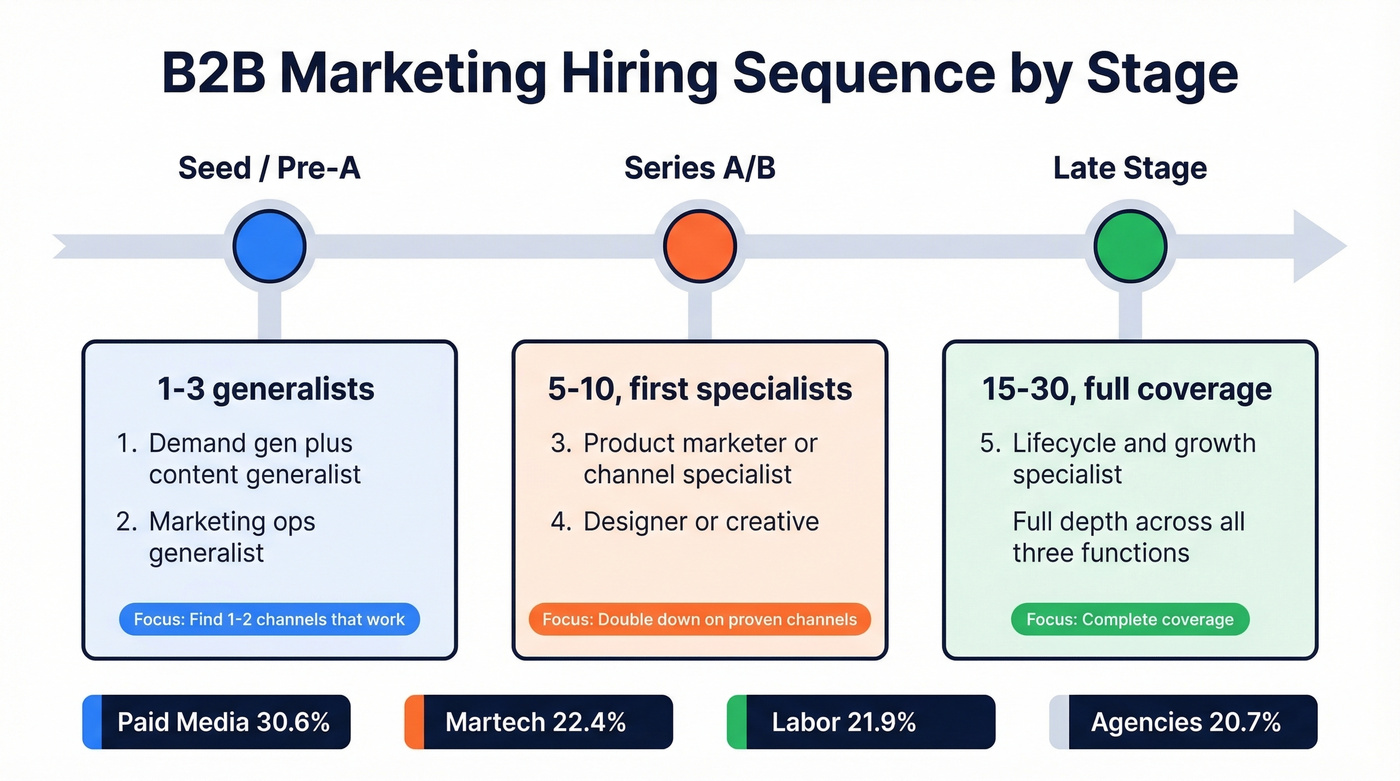
The hiring order matters more than the org chart. Here's the sequence we've seen work best:
- Demand gen + content generalist - your first marketer who can run campaigns and write
- Marketing ops - someone to own the stack, data, and reporting before it becomes a mess
- Product marketer or primary-channel specialist - depends on your GTM motion
- Designer/creative - because your generalist is burning out on Canva
- Lifecycle/growth specialist - to own the middle and bottom of funnel
Where the budget goes tells the same story. Paid media takes 30.6% of the average marketing budget, martech 22.4%, labor just 21.9%, and agencies 20.7%. The investment is shifting from people to platforms, which is exactly why your first three hires need to be people who can operate those platforms well.
Only 35% of B2B teams run marketing entirely in-house. Among those who outsource, 84% outsource content creation. If you're under ten people, outsourcing content is the norm, not a compromise. A common rule of thumb from operators who've run multiple reorgs: keep roughly 80% of work in-house, outsource 20% of niche specialist work.

Your first growth hire shouldn't spend half their week hunting for contact data. Prospeo gives lean marketing teams 300M+ profiles with 98% email accuracy and 125M+ verified mobiles - so a two-person team can run outbound like a ten-person squad at roughly $0.01 per email.
Stop hiring data researchers. Start closing pipeline.
How GTM Motion Changes Structure
Your go-to-market motion dictates where marketing headcount concentrates.
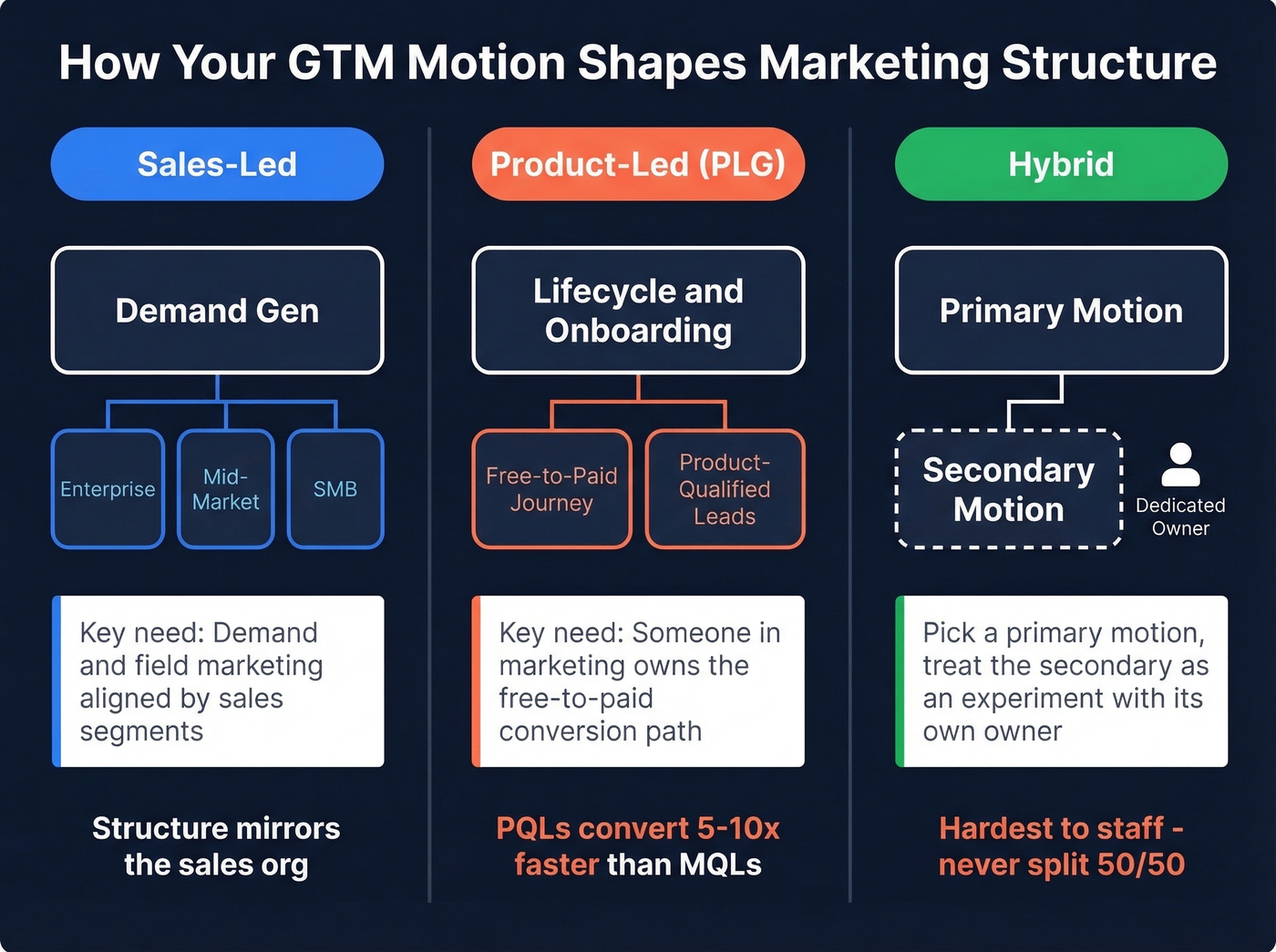
Sales-led orgs need demand and field marketing aligned by segment, mirroring the sales org. Enterprise, mid-market, and SMB each get their own demand gen motion. Structure follows the sales team's shape.
PLG orgs need lifecycle and onboarding ownership inside marketing. 97% of buyers want to try before buying, product-qualified leads convert 5-10x faster than MQLs, and a free offer yields 20-30% more signups than a demo-only funnel. If nobody in marketing owns the free-to-paid journey, you're leaving conversion on the table.
Hybrid orgs need both. That's why they're the hardest to staff. We've watched teams try to build for one motion while running the other, and it always ends in resource starvation for whichever motion the CEO cares about less that quarter. The fix is picking a primary motion and treating the secondary one as an experiment with a dedicated owner - not splitting everything 50/50 and hoping it works out.
Where Marketing Ops Sits
Marketing Ops is the function most teams hire too late. It covers planning, analytics, lead management and scoring, martech stack ownership, and email governance - the connective tissue that makes everything else work.
Where Ops reports depends on your company's center of gravity. In revenue-led orgs, centralize under RevOps with a dotted line to the CMO. In brand-led orgs, keep it under the CMO directly.
Here's the thing: if your average deal size is under $15k and your team is under ten people, skip the RevOps Manager title entirely. Hire a marketing ops generalist who can also touch Salesforce. The RevOps org chart is aspirational for most Series A companies. What you actually need is someone who keeps the CRM clean and the attribution honest.
How AI Is Reshaping the Org Chart
81% of B2B marketers use generative AI tools, but only 19% have integrated AI into daily workflows. That gap isn't technological - it's structural. Teams without clean data and clear ownership can't operationalize AI no matter how many licenses they buy.
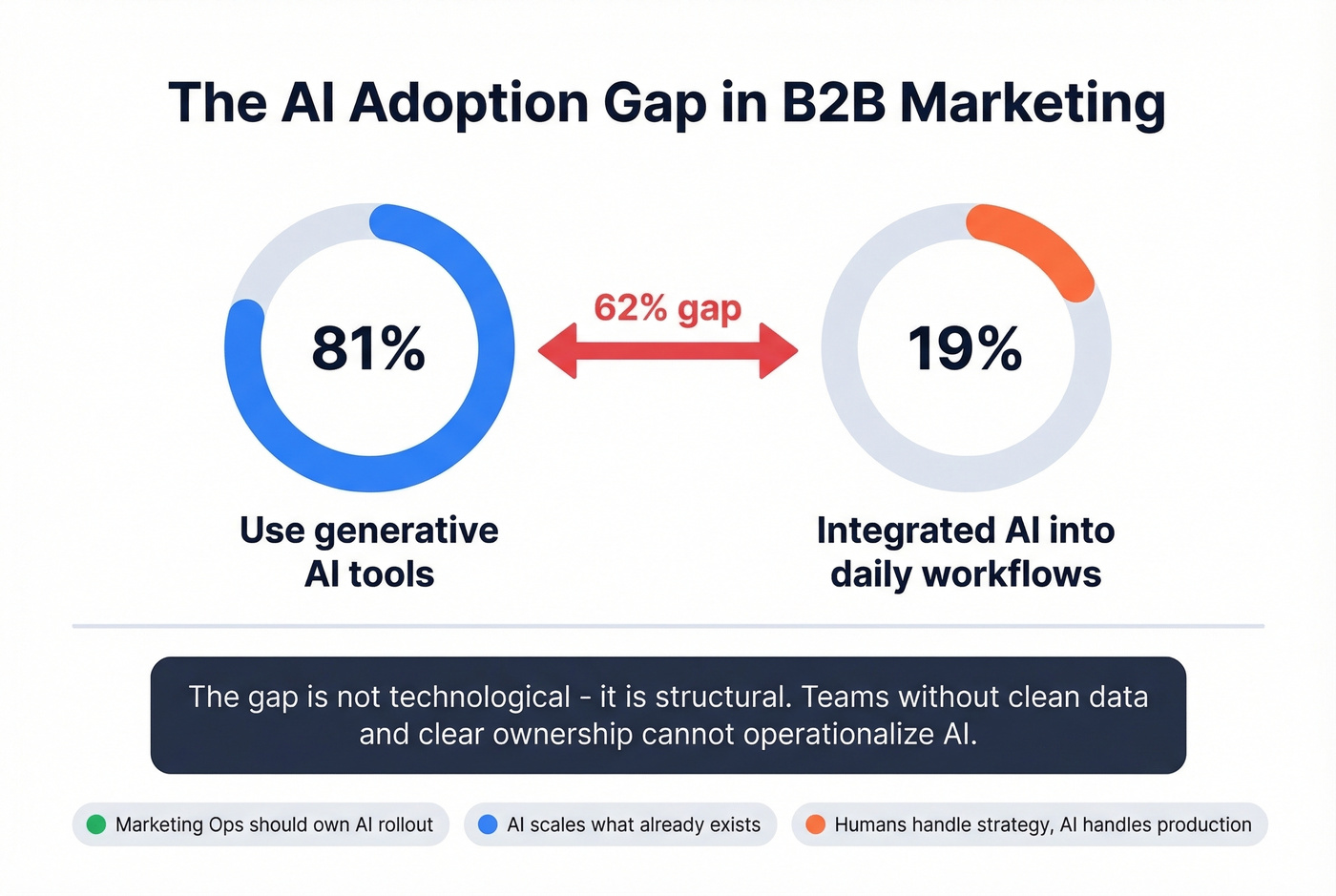
AI scales what already exists. Marketing Ops is best-placed to own the rollout because they already think in systems, data flows, and process design. The broader shift is from execution-heavy to decision-driven marketing - AI handles the production, humans handle the strategy. For executive marketing roles in particular, the new baseline isn't prompt engineering. It's AI thinking: structuring problems for AI, evaluating outputs, and integrating results into workflows that actually move pipeline.
Scaling from seed to Series B means every marketing dollar has to compound. Teams using Prospeo book 35% more meetings than Apollo and 26% more than ZoomInfo - with weekly-refreshed data that keeps your lifecycle sequences hitting real inboxes, not dead ends.
Give your growing team enterprise-grade data without the enterprise contract.
FAQ
What does a good B2B marketing structure look like at different sizes?
Marketing departments average about 5% of total company headcount - typically 2-5 people for SMBs. Structure around three functions (Growth, Product Marketing, Brand & Content) and fill gaps with contractors and tools rather than premature hires. This framework scales from seed to Series C without requiring a full reorg at each stage.
Should marketing report to the VP of Sales?
No. When marketing reports to Sales or Ops leadership, it becomes a support function and loses strategic autonomy. Marketing needs its own seat at the leadership table, even if the team is small. The reporting line shapes priorities more than any org chart redesign ever will.
What tools does a lean B2B marketing team need?
At minimum: a CRM (HubSpot or Salesforce), a data platform for verified contacts and prospecting, marketing automation, and analytics. Prioritize tools that replace headcount in your weakest function - for most early teams, that means outbound data and email automation first.
How do you decide between hiring and outsourcing?
Keep strategic functions - demand gen, product marketing, ops - in-house. Outsource production-heavy work like content creation (84% of B2B teams do) and design. The 80/20 rule works well: 80% in-house for core competencies, 20% outsourced for specialist or overflow work. Skip this advice if you're pre-revenue - at that stage, the founder is the marketing team, and that's fine.