

B2B Pain Points That Actually Matter in 2026
We ran a pipeline review recently for a SaaS company and couldn't explain why conversion dropped even though activity was up across every channel. More emails, more ads, more content - worse results. The culprit was data decay eating their targeting alive.
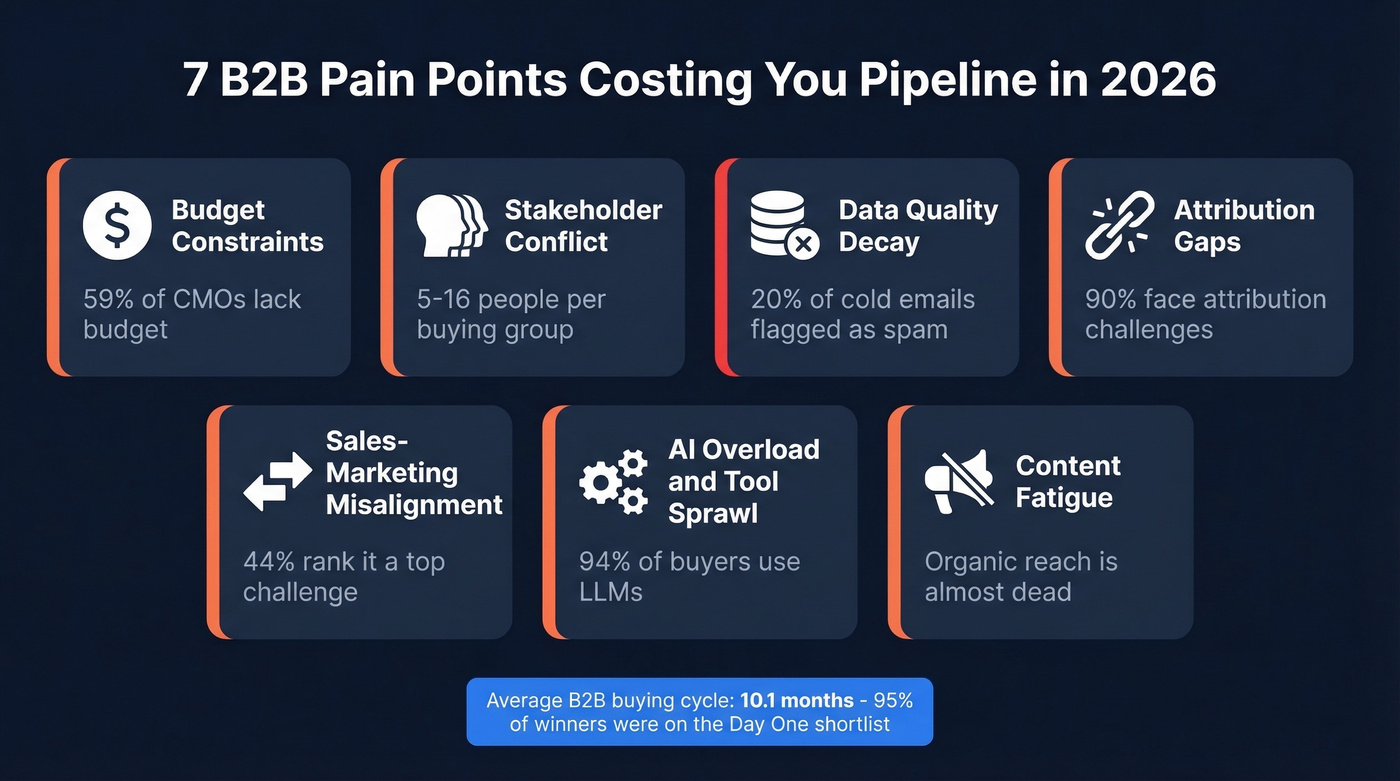
That pattern shows up everywhere. Across nearly 4,000 B2B buyers surveyed by 6sense, the average buying cycle now sits at 10.1 months, 95% of the time the winning vendor was already on the buyer's Day One shortlist, and buyers define purchase requirements 83% of the time before ever speaking with sales. Forrester's data is bleaker: 86% of B2B purchases stall, and 81% of buyers end up dissatisfied with the provider they chose. Everything feels harder because it is harder.
Here's what most teams get wrong: they can list 15 challenges but can't prioritize a single one. Fix the data layer first, and half the others get easier on their own.
7 B2B Pain Points Costing You Pipeline
Budget and Resource Constraints
48% of B2B marketing leaders cite budget, headcount, or resource cuts as their number-one challenge, per Heinz Marketing. Gartner's 2026 CMO Spend Survey backs it up: 59% of CMOs lack sufficient budget to execute their strategy. One mid-market CMO on Reddit summed it up: "We went from eight marketers to four and the pipeline targets didn't change."
You're being asked to do more with less, and the "less" part keeps shrinking. Financial pressure doesn't stop at marketing - procurement teams face the same squeeze when evaluating new vendors, stretching evaluation timelines even further.
Stakeholder Conflict and Longer Cycles
Buying groups now range from 5 to 16 people, and Gartner found 74% demonstrate unhealthy conflict during the decision process. Groups that actually reach consensus are 2.5x more likely to report a high-quality deal.
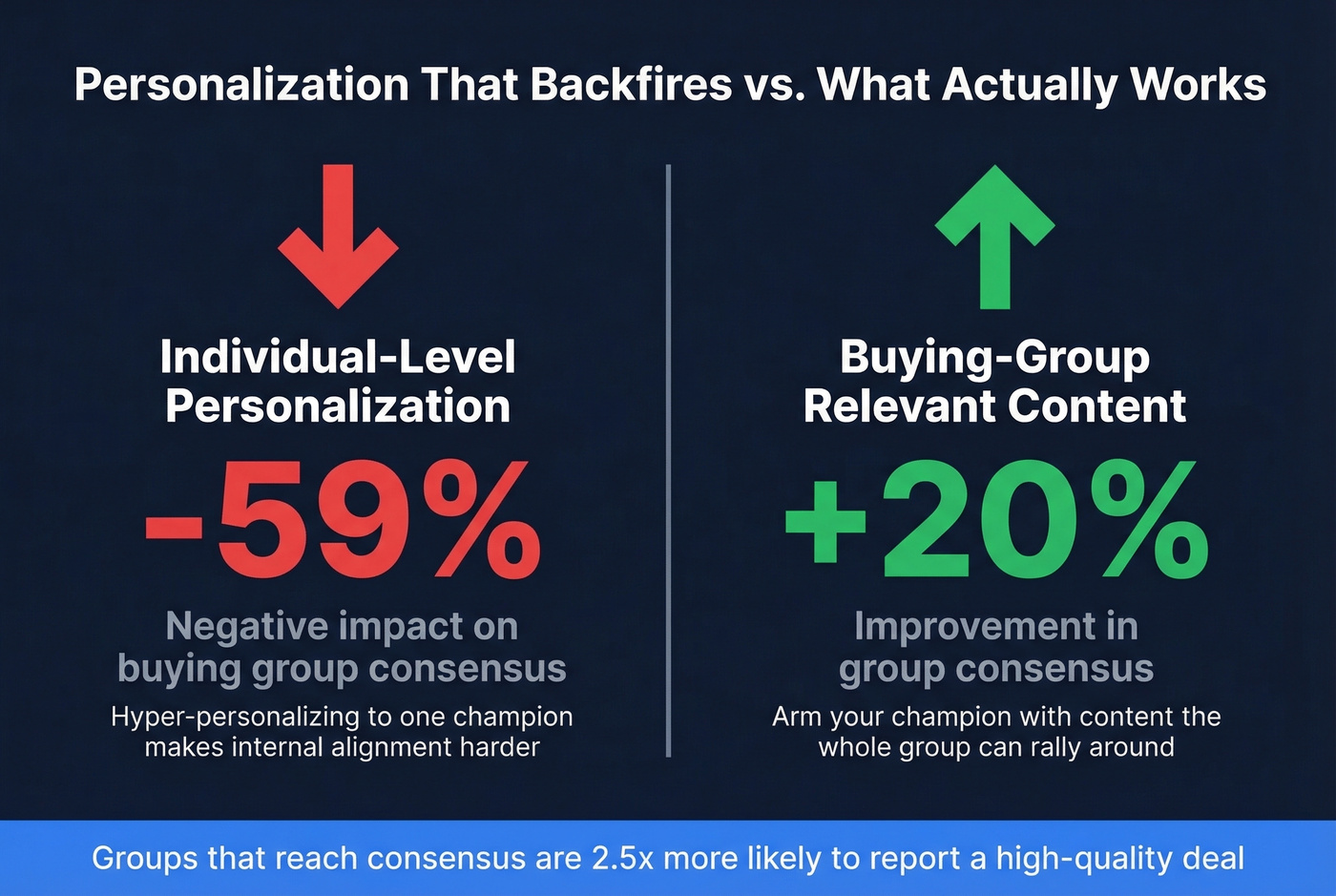
Here's the kicker: tailoring content for buying-group relevance improves consensus by 20%, while individual-level personalization has a 59% negative impact. If you're hyper-personalizing to one champion instead of arming them with group-relevant content, you're making the problem worse. The real blocker in B2B sales is often internal disagreement, not lack of interest.
Data Quality and Decay
The average cold email response rate is 5.1%, and almost 20% of cold emails get flagged as spam. "We spent months building sequences that were basically going to dead inboxes," a RevOps manager shared on r/sales. Bad data makes every other tactic fail - your sequences, your ABM plays, your personalization all collapse when bounce rates climb past 30%.
These technical issues compound fast. One stale field in your CRM cascades into broken routing, missed enrichment, and wasted ad spend. It's the kind of problem that doesn't announce itself until you're already bleeding pipeline.
Attribution and Proving ROI
Nearly 90% of B2B teams face attribution challenges due to fragmented, siloed data. Finance asks why you're spending five figures a month on marketing when pipeline is flat, and you can't connect a webinar three months ago to the deal that just closed.
As one demand gen leader put it: "I know the program works. I just can't prove it in a spreadsheet." Without clean attribution, every budget conversation becomes a fight you're not equipped to win.
Sales-Marketing Misalignment
44% of B2B marketing leaders rank alignment as a top challenge. When marketing generates leads that sales ignores, or sales blames marketing for pipeline gaps while running rogue outreach, everyone loses.
"We literally found out sales was emailing the same accounts with a completely different value prop," one marketing ops lead shared. The consequence isn't just friction - it's duplicated spend and contradictory messaging hitting the same buyers. These operational breakdowns are usually symptoms of disconnected systems rather than people problems.
AI Overload and Tool Sprawl
94% of buyers now use LLMs during their buying process, and 89% purchase solutions with AI features. But as one B2B founder on Reddit put it: "Everyone's using the same AI tools. Messaging sounds identical."
When every outbound sequence reads like it was written by the same model, differentiation evaporates. The tool isn't the advantage - the insight behind it is. The real challenge is integrating new capabilities without adding another disconnected platform to the stack.
Content Fatigue and Saturation
"Organic reach is almost dead" and "content fatigue is real" - that's the consensus on r/b2b_sales, not a hot take. Buyers are tuned out from the daily flood of "insightful" posts and gated PDFs.
The teams still winning are the ones with very specific positioning: one ICP, one problem, one clear outcome. In a market where every competitor publishes the same playbook, the inability to stand out matters more than the inability to produce content.

Stop paying for bounced emails. Prospeo verifies every contact with 98% accuracy, refreshed every 7 days.
Start free and only pay for verified contacts
How to Prioritize B2B Pain Points
Let's be honest - you don't have a pain point problem. You have a prioritization problem. We've used the 3-level framework from Callbox with dozens of teams, and it's the cleanest way to sort signal from noise:
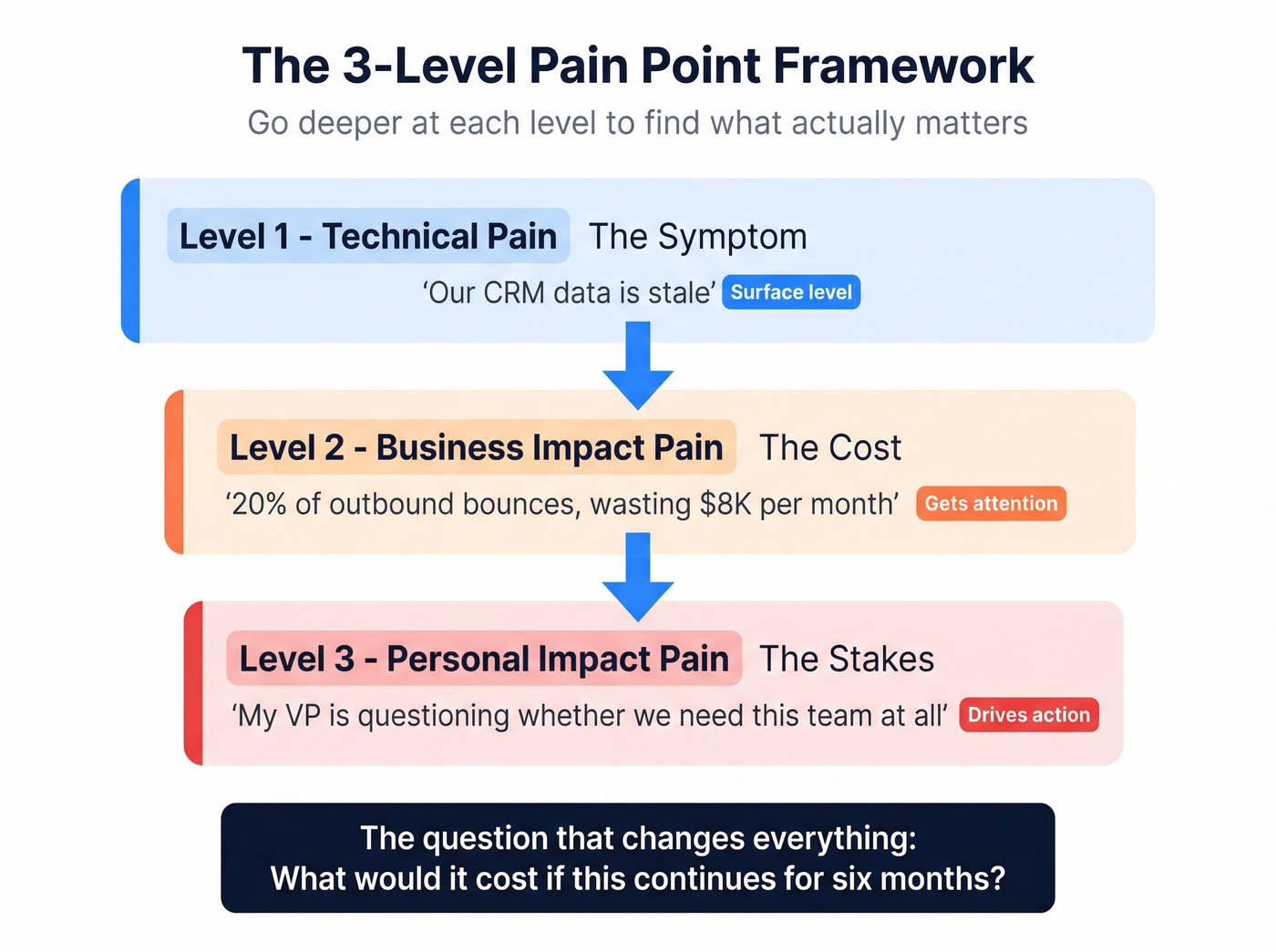
- Technical pain - the symptom. "Our CRM data is stale."
- Business impact pain - the cost. "Stale data means 20% of outbound bounces, tanking deliverability and wasting $8K/month."
- Personal impact pain - the stakes. "My VP is questioning whether we need this team at all."
Discovery questions that separate real pain from wish-list items:
- "What would it cost if this continues for six months?"
- "Who else in the org feels this problem?"
- "What have you already tried, and why didn't it work?"
- "If you solved this tomorrow, what's the first metric that moves?"
If the answers don't make someone uncomfortable, it's not a priority. April Dunford's positioning work reinforces this: don't chase every pain point your product could address. Nail the one where you're the obvious best answer, and let the rest go.
The Root Cause Most Teams Miss
Most of the challenges above share a common upstream cause: bad data. Personalization doubles cold email response rates, but personalization requires accurate data. Attribution requires clean contact records tied to the right accounts. Sales-marketing alignment falls apart when both teams work off different versions of the truth.
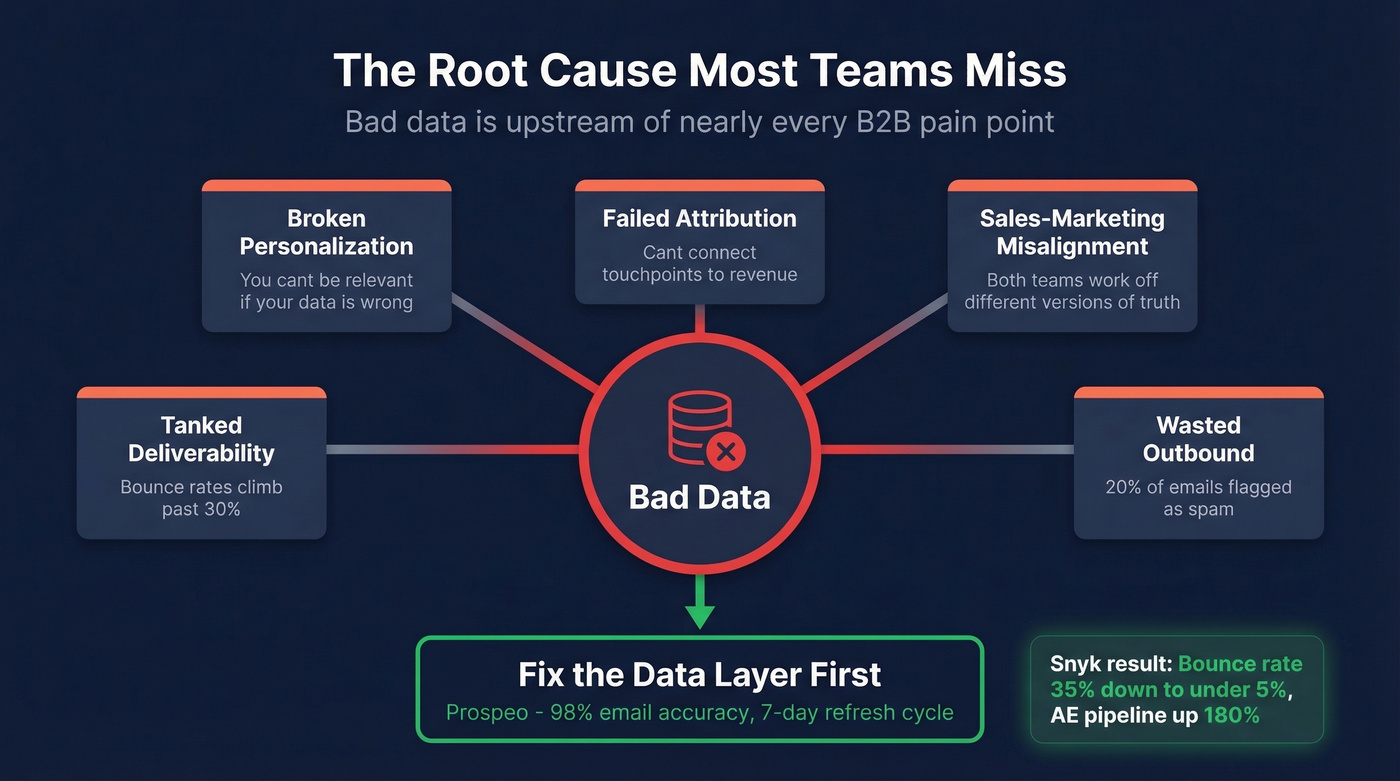
And across practitioner discussions, relevance and timing beat flattery-style personalization every time - but you can't be relevant if your data is wrong. When you map buyer frustrations back to their origin, the data layer is almost always where the chain breaks.

Prospeo addresses this at the source with 98% email accuracy on a 7-day refresh cycle, compared to the 6-week industry average. Snyk's 50-person AE team cut bounce rates from 35% to under 5% after switching, and AE-sourced pipeline jumped 180%. When reps stop cleaning lists and start selling, the downstream problems shrink fast.
Your outbound is only as good as your data. With 300M+ profiles and verified emails at ~$0.01 each, Prospeo keeps your pipeline full.
Try it free - no credit card required
FAQ
What are the most common B2B pain points in 2026?
Budget constraints, longer sales cycles with stakeholder conflict, data quality decay, broken attribution, sales-marketing misalignment, AI tool sprawl, and content fatigue. The biggest shift: buying groups now range from 5-16 people, 74% experience unhealthy internal conflict, and 95% of winners were already on the buyer's Day One shortlist.
How do you identify customer pain points in B2B sales?
Use the 3-level framework: start with technical symptoms (what's broken), escalate to business impact (what it costs in dollars or pipeline), then surface personal stakes (whose KPIs are at risk). The question that changes the conversation: "What would it cost if this continues for six months?"
How does bad data make B2B challenges worse?
When almost 20% of cold emails get flagged as spam and bounce rates climb past 30%, every outreach tactic underperforms. Switching to a provider with 98% email accuracy and a 7-day refresh cycle means reps spend time selling instead of cleaning lists - Snyk saw AE-sourced pipeline jump 180% after making that switch.