

B2B SaaS CAC in 2026: Benchmarks, Calculation, and How to Fix It
A founder posted on r/SaaS last quarter that CAC crept up ~30% year-over-year while pricing stayed flat. Margins compressed, the board asked questions, and nobody had a clean answer. That's the reality for most B2B SaaS teams right now - customer acquisition cost is climbing faster than revenue per customer, and the old playbooks aren't keeping up.
Why Customer Acquisition Cost Keeps Climbing
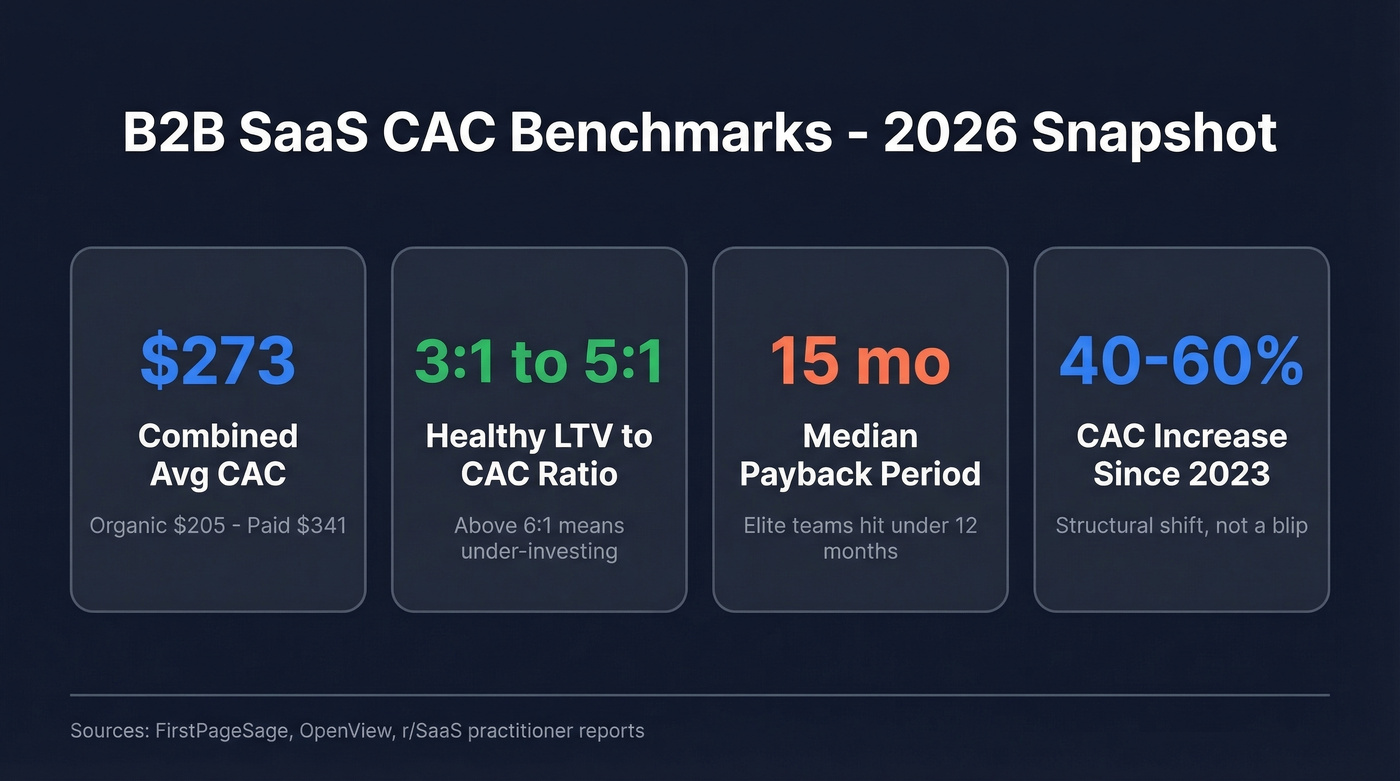
B2B SaaS CAC is up 40-60% since 2023. That's not a rounding error.
It's a structural shift driven by three forces hitting at once: ad platforms are more competitive, buyers take longer to convert, and every channel that worked cheaply three years ago has gotten crowded. Teams on Reddit report ~30% YoY increases while subscription pricing stays flat, and that math breaks eventually. When your cost to acquire a customer grows faster than what that customer pays you, no amount of fundraising fixes the problem - you just burn through it slower.
Quick-reference benchmarks:
- 2026 benchmark: ~$273 combined (organic ~$205, paid ~$341)
- Healthy LTV:CAC: 3:1-5:1. Above 6:1? You're under-investing.
- Median payback: 15 months. Elite companies hit under 12.
- Fastest fix: Clean your contact data before touching ad spend.
How to Calculate CAC for B2B SaaS
CAC = Total Sales & Marketing Spend / New Customers Acquired
Simple formula. The trap is in what you include. New-logo CAC counts only net-new customer costs. Blended CAC folds in upsell, expansion, and renewal spend. Most benchmark reports don't specify which they're using, and that's why published numbers vary wildly. We've seen teams calculate blended CAC, compare it to new-logo LTV, and convince themselves the unit economics work when they don't.
Don't forget hidden costs: fully loaded sales salaries (apply a 1.3x benefits multiplier), free trial infrastructure, demo environments, and travel. Leaving these out flatters your number and sets you up for a painful board conversation later.
Here's the thing about early-stage numbers: one YC founder reported a $46 figure from Google Ads, but only had 3-5 conversions and couldn't reconcile attribution with actual signups. If you're pre-PMF with fewer than 50 customers, use rolling 90-day windows and don't anchor on any single month's figure.

Every bounced email inflates your CAC. Prospeo's 98% email accuracy and 7-day data refresh cycle mean your outbound spend actually reaches real buyers - not dead inboxes. At $0.01 per verified email, cleaning up your contact data is the fastest lever to pull before you touch ad budgets or hire another rep.
Stop paying to send emails that bounce. Start with 75 free verified contacts.
2026 Benchmarks by Segment and Channel
By Segment
| Segment | CAC Range | Typical Sales Cycle |
|---|---|---|
| SMB | $100-$400 | 1-3 months |
| Mid-market | $400-$800 | 3-6 months |
| Enterprise | $800+ | 6-18 months |
A widely cited 2026 benchmark puts the combined figure at ~$273 (organic ~$205, paid ~$341). Your segment matters far more than the average - a self-serve SMB product and an enterprise platform with a six-month sales cycle live in different universes.
By Channel
| Channel | Avg CAC |
|---|---|
| Referrals | $150 |
| Facebook Ads | $230 |
| SEO / organic | $290 |
| Paid search | $802 |
| LinkedIn Ads | $982 |
| Outbound sales | $1,980 |
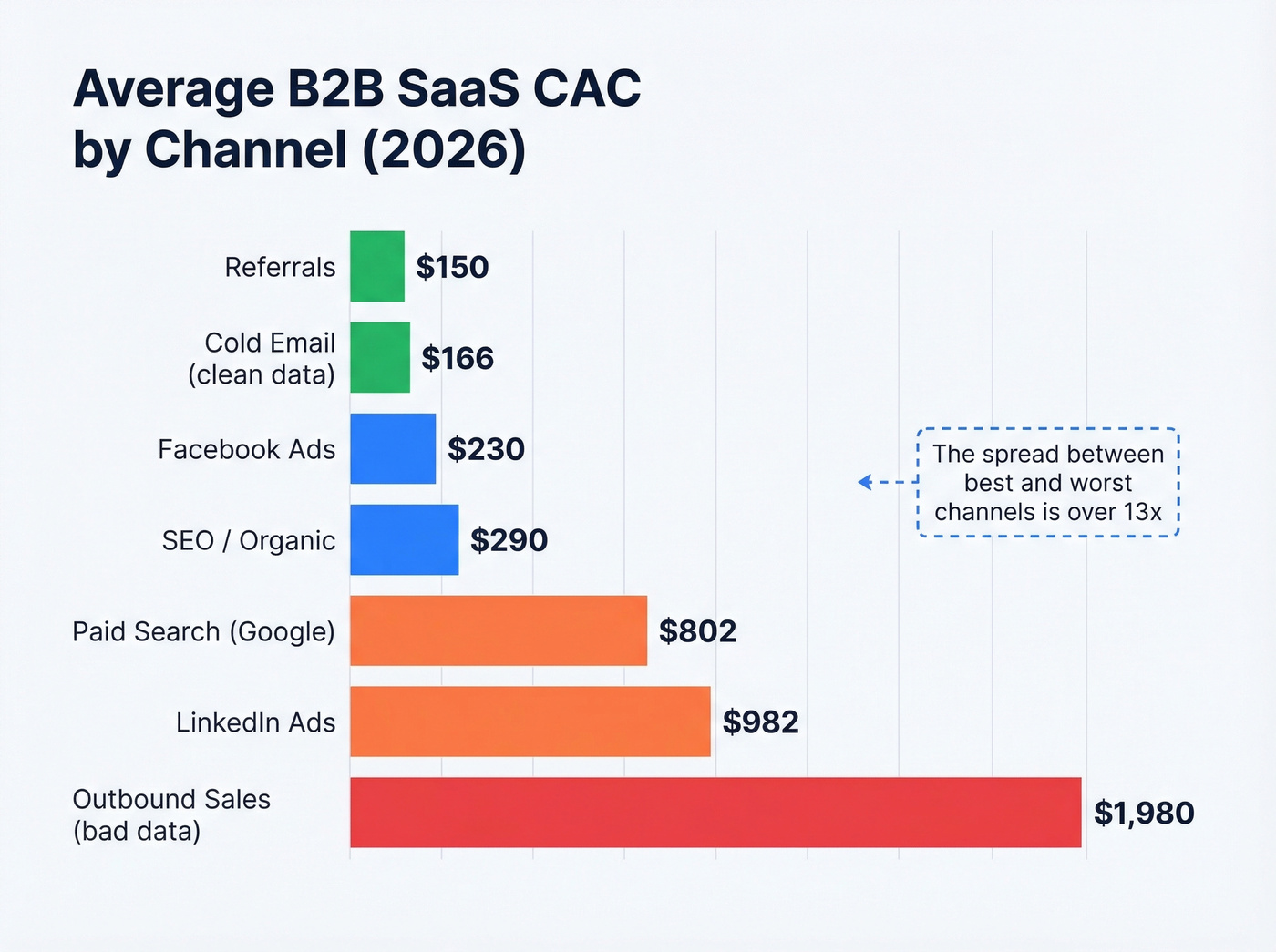
A practitioner on r/DigitalMarketing ran a 90-day test across five channels for a $497/mo SaaS product: cold email came in at $166, Reddit engagement at $150, and Facebook Ads at $1,500. The spread is enormous. If you're heavily weighted toward the most expensive channels, the fix usually isn't "spend less" - it's "allocate smarter."
Metrics That Sit Next to CAC
Customer acquisition cost alone is meaningless. Three companion metrics tell you whether your number is healthy or hemorrhaging.
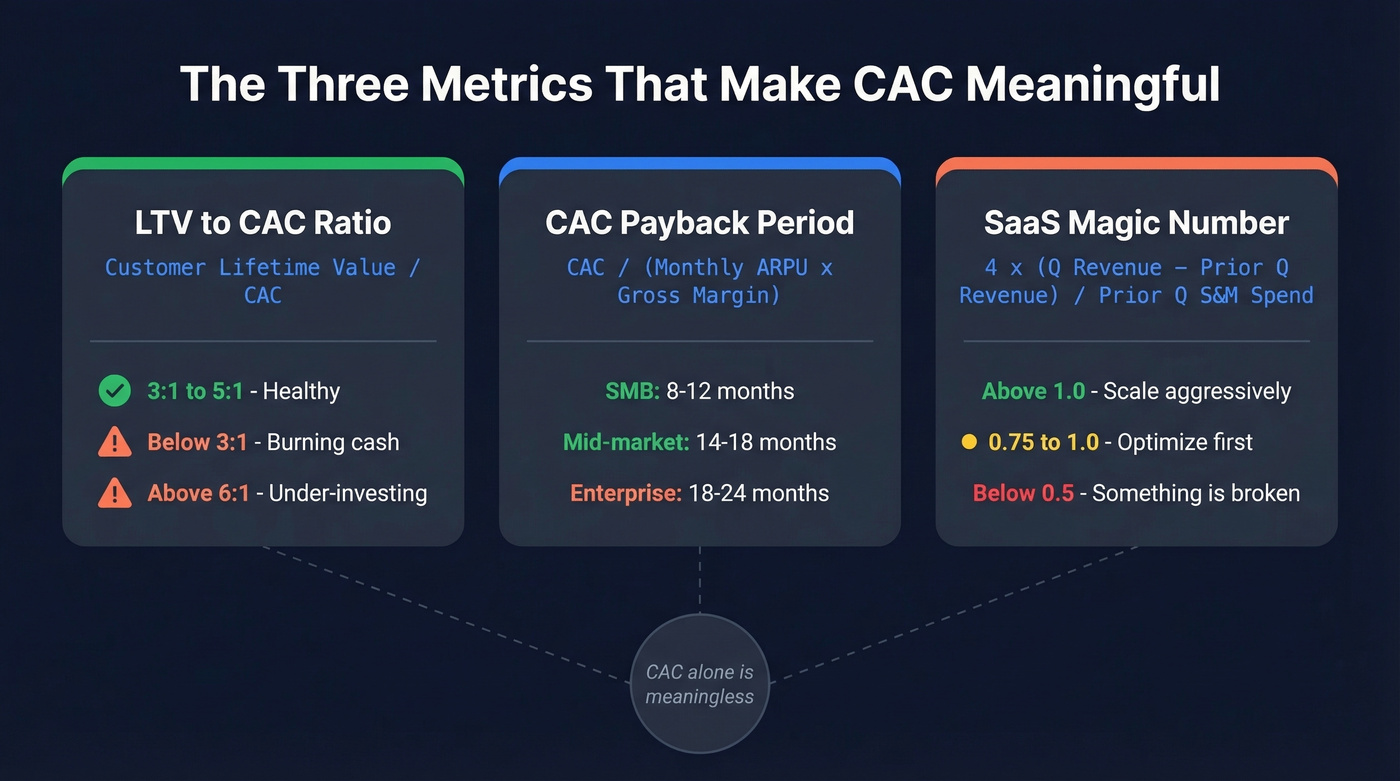
LTV:CAC ratio. Target 3:1 to 5:1. Below 3:1 and you're burning cash. But here's a take we don't see enough: above 6:1 usually means you're under-investing in growth. If your ratio is 8:1, you're leaving pipeline on the table. We've watched founders celebrate a high ratio when they should be worried about it - it often signals timidity, not efficiency.
CAC payback period. Based on a dataset of 939 B2B SaaS companies, the median payback is 15 months. SMB runs 8-12 months, mid-market 14-18, enterprise 18-24. The gross-margin-adjusted formula is more precise: CAC / (Monthly ARPU x Gross Margin). Use this version. The unadjusted formula makes 60% margin businesses look identical to 85% margin ones, and they aren't.
SaaS Magic Number. Formula: 4 x (current quarter revenue - prior quarter revenue) / prior quarter S&M spend. Above 1.0 means scale aggressively. Between 0.75-1.0, optimize first. Below 0.5, something's broken.
| Metric | Healthy | Concerning |
|---|---|---|
| LTV:CAC | 3:1-5:1 | <3:1 or >6:1 |
| CAC Payback | <15 months | >24 months |
| Magic Number | >0.75 | <0.5 |
How to Reduce B2B SaaS CAC
Four levers, ranked by speed of impact. One caveat: slashing acquisition cost too aggressively can starve growth. The goal is efficiency, not austerity.
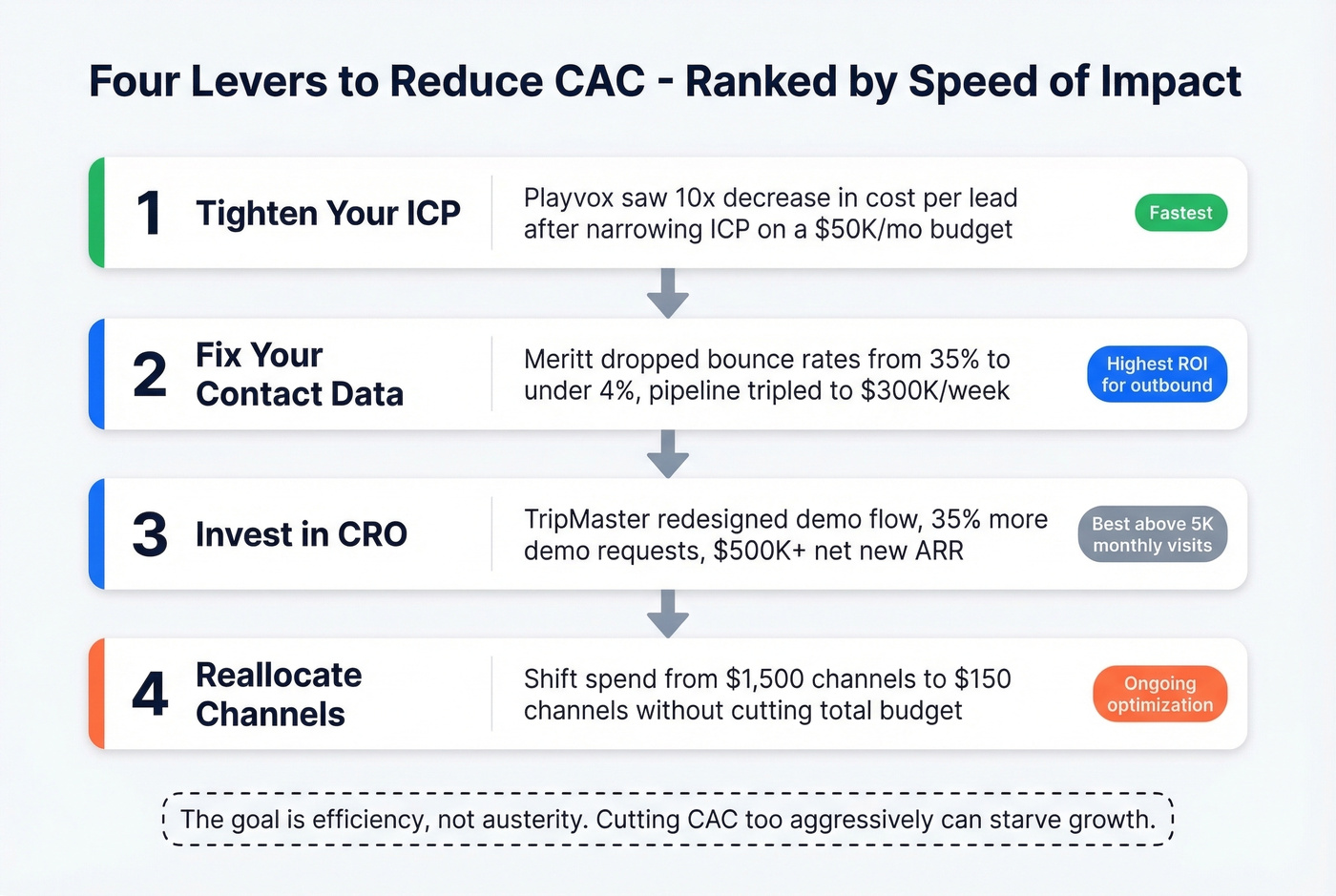
1. Tighten your ICP
Broad targeting is the fastest way to waste budget. Playvox saw a 10x decrease in cost per lead after narrowing their ICP and focusing a $50K/month budget on fewer, better-fit accounts. Let's be honest - most teams think they've already done this work. They haven't. If your ICP doc is a one-pager from 2023 that says "VP of Sales at mid-market SaaS companies," you're still spraying. Real ICP tightening means analyzing your best 20 customers by LTV, finding the 3-4 firmographic and behavioral traits they share, and ruthlessly excluding everyone else.
2. Fix your contact data
Bad data is the silent killer in outbound. High bounce rates don't just waste send credits - they torch sender reputation, which tanks deliverability on the emails that are valid. A team running outbound with 20%+ bounce rates often sees effective CAC double because half their messages never reach an inbox.
Prospeo verifies emails at $0.01 each with 98% accuracy and refreshes data every 7 days. Meritt switched and saw bounce rates drop from 35% to under 4% while pipeline tripled from $100K to $300K/week. That kind of data quality shift changes the unit economics of every outbound campaign you run.

3. Invest in CRO
You don't need more traffic. You need more of your existing traffic to convert. TripMaster redesigned their demo request flow and saw a 35% increase in demo requests, contributing over $500K in net new ARR. Skip this if your traffic is under 5,000 monthly visits - at low volumes, CRO tests take months to reach statistical significance, and your time is better spent on channels that drive volume first.
4. Reallocate channels
If you're spending on $1,500 Facebook Ads acquisition and ignoring $150 referral programs, the math is obvious. Prioritize channels that commonly land in the $150-$290 band - referrals and SEO at the low end - and you can often pull blended cost down without cutting total spend. For teams running outbound, the consensus on r/sales is that cold email still delivers the best CAC when your data is clean, which circles back to lever #2.
Outbound CAC hit $1,980 in the benchmarks above - but only when data is bad. Meritt switched to Prospeo and watched bounce rates drop from 35% to under 4% while pipeline tripled to $300K/week. Same team, same spend, radically different unit economics. That's what 98% accuracy and a 7-day refresh cycle do to your CAC payback period.
Cut your outbound CAC in half with data that actually connects.
FAQ
What's a good CAC for B2B SaaS in 2026?
A widely cited benchmark puts the combined figure at ~$273. But "good" depends entirely on deal size - a $500 acquisition cost is healthy for a $50K ACV product and disastrous for a $5K one. Always measure it relative to LTV, targeting a 3:1-5:1 ratio. OpenView's SaaS benchmarks report is a solid reference for segment-specific ranges.
How often should I recalculate CAC?
Monthly for channel-level numbers so you can shift budget quickly. Quarterly for blended figures reported to the board. Early-stage companies should use rolling 90-day windows - tracking trends over time matters more than any single snapshot.
What's the difference between CAC and CPA?
CPA measures cost per any conversion - a trial signup, a demo request. CAC measures cost per paying customer. A $50 CPA with a 10% close rate means a $500 customer acquisition cost. Track both, but CAC is the number your board cares about. ChartMogul's SaaS metrics guide breaks down the distinction well.
How does bad data inflate acquisition cost?
Bounced emails waste send credits and damage sender reputation, which lowers deliverability on valid addresses too. Teams running outbound with 20%+ bounce rates often see effective CAC double. Cleaning your list before every campaign - whether through Prospeo's verification or another provider - is the single highest-ROI fix for outbound-heavy teams.