

B2B SaaS Marketing Strategy: Pick 2-3 Channels and Commit
The median SaaS company now spends $2.00 to acquire every $1 of new ARR - up 60% in five years. That's not a data problem. It's a strategy problem.
A Reddit post framed it perfectly: growth feels like "do more of everything" - content, outbound, ads, partnerships - but bandwidth is finite and budgets aren't growing. Most guides tell you to run all ten channels. We're telling you to pick two or three and commit for a year. Here's why that works, and how to decide which channels deserve your money.
Three Rules Before You Start
Your ACV determines your GTM motion. Under $5K means product-led. $5K-$25K means hybrid. $25K+ means sales-led. Stop mixing motions that don't match your deal size.
Your ARR stage determines your channel count. Two to three channels, not ten. Early-stage companies that spread across six channels get mediocre results from all of them.
Commit for 12+ months. Channel-hopping is the single fastest way to waste budget. SEO takes 4-6 months to start producing leads and 2+ years to reach full potential. LinkedIn organic takes 6+ months. Even paid needs 6-12 months to optimize properly. If you're evaluating a channel after 90 days, you're not evaluating - you're guessing.
Choose Your GTM Motion First
Your average contract value dictates your entire go-to-market architecture. A $3K/year product can't support a sales team running 134-day deal cycles. A $50K/year product can't rely on self-serve signups alone.
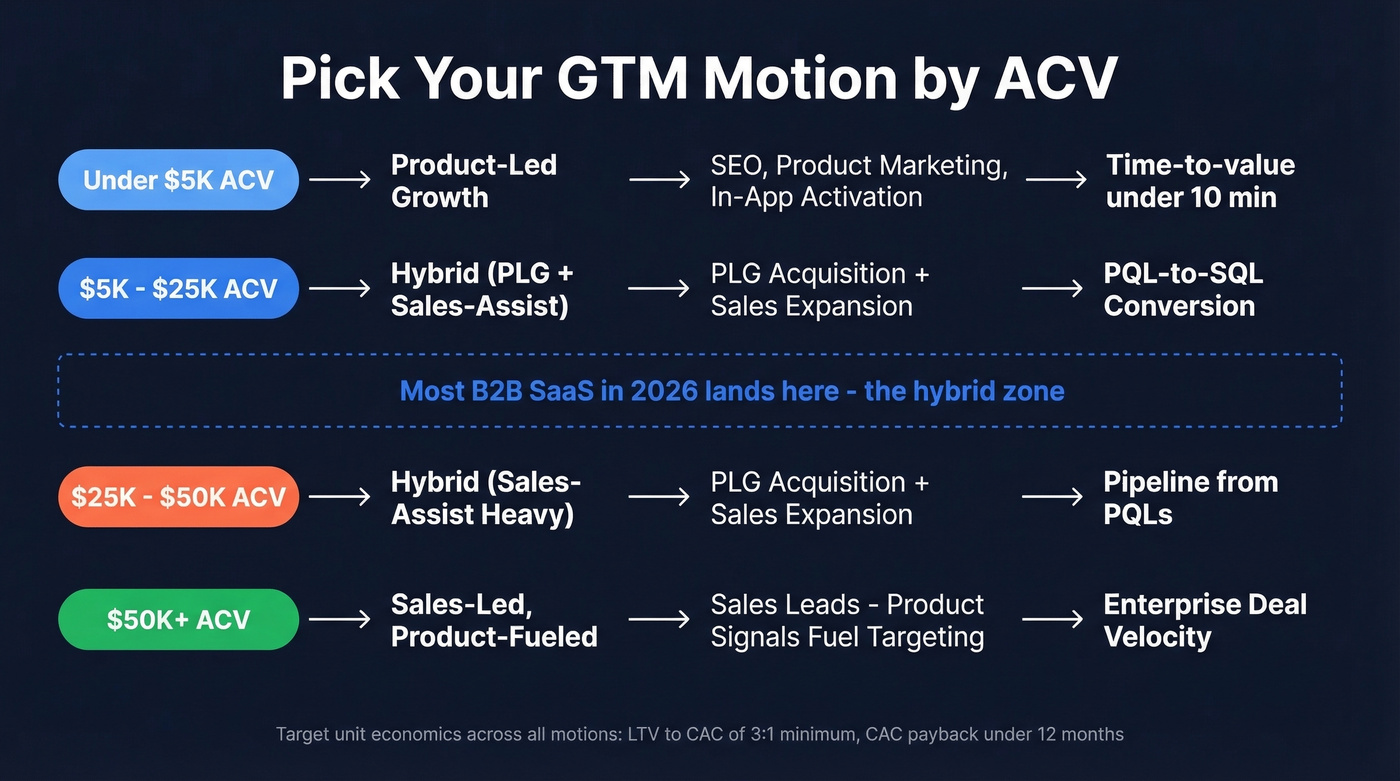
| ACV Range | Motion | Marketing Focus | Key Metric |
|---|---|---|---|
| Under $5K | PLG / self-serve | Product marketing, SEO, in-app activation | Time-to-value < 10 min |
| $5K-$25K | Hybrid | PLG acquisition + sales-assisted expansion | PQL-to-SQL conversion |
| $25K-$50K | Hybrid (sales-assist) | PLG acquisition + sales-assisted expansion | Pipeline from PQLs |
| $50K+ | Sales-led, product-fueled | Sales leads entirely; product signals fuel targeting | Enterprise deal velocity |
The hybrid model deserves special attention because most B2B SaaS in 2026 lands here. Your product acquires users through self-serve, then sales engages when product-qualified signals fire - five or more weekly active users in the same domain, three power features used by two distinct roles, or hitting a usage threshold like 1,000 events processed. That handoff between product and sales is where most hybrid companies leak pipeline, and it's where your marketing strategy either compounds or collapses.
Target unit economics don't change by motion: LTV:CAC of 3:1 minimum, CAC payback under 12 months. And marketing doesn't end at acquisition. A 5% improvement in retention drives 25-95% profit increases, and with median NRR at 101%, expansion revenue is increasingly a marketing function, not just a CS one.
Match Your Strategy to ARR Stage
Only 33% of seed-funded companies raise a Series A - and the median Series A now requires $2.5M ARR, up 75% from 2021. The companies that clear that bar aren't spending $15K/month on LinkedIn Ads at $500K ARR. They invest disproportionately in content and SEO, keep tools lean, and ignore everything that doesn't directly build pipeline.
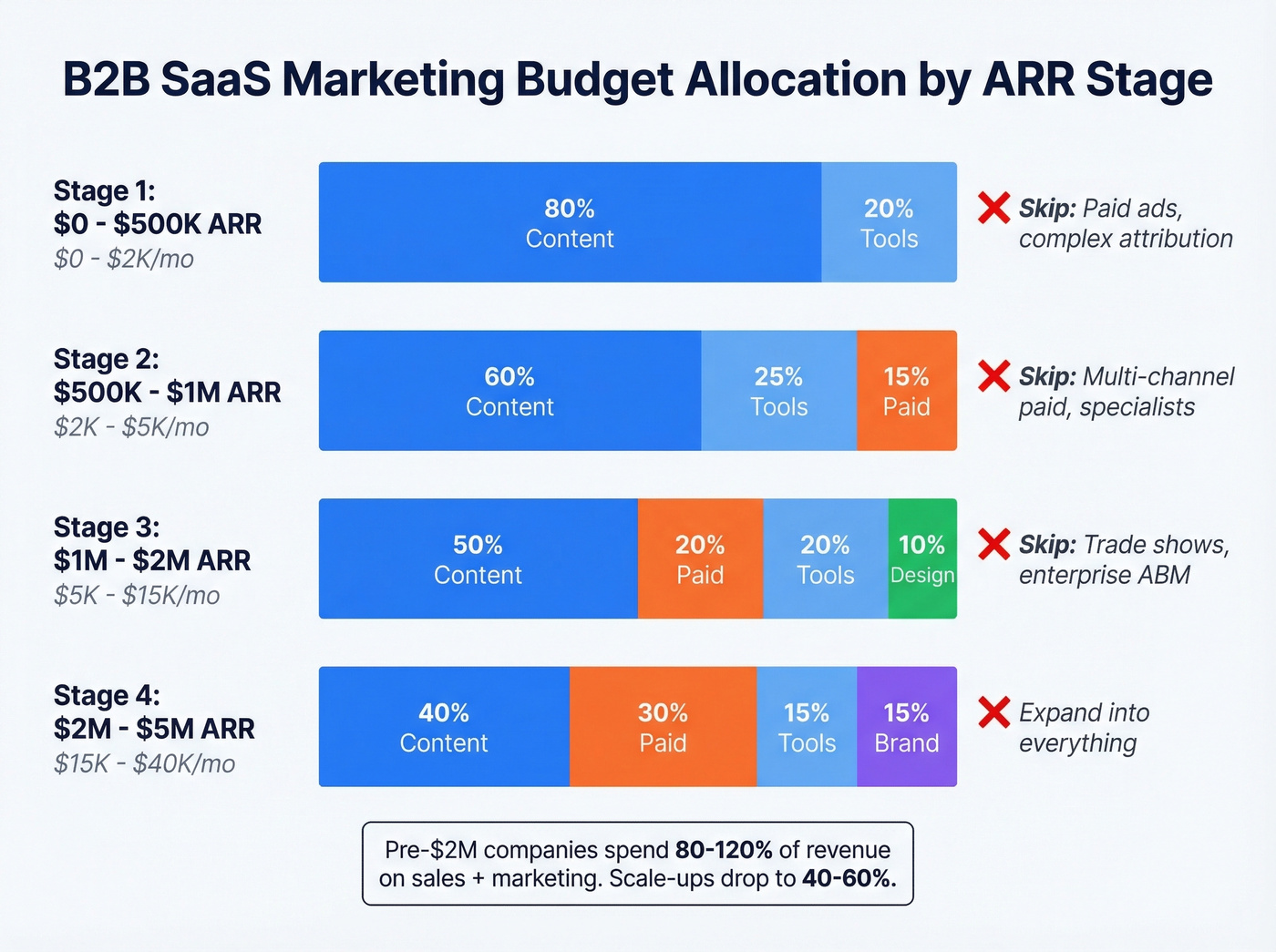
Gartner's 2026 CMO Spend Survey pegged marketing budgets at 7.7% of company revenue. But averages are misleading - stage matters far more.
| ARR Stage | Monthly Budget | Allocation | What to Ignore |
|---|---|---|---|
| $0-$500K | $0-$2K | Content 80%, Tools 20% | Paid ads, complex attribution |
| $500K-$1M | $2K-$5K | Content 60%, Tools 25%, Paid 15% | Multi-channel paid, specialists |
| $1M-$2M | $5K-$15K | Content 50%, Paid 20%, Tools 20%, Design 10% | Trade shows, enterprise ABM |
| $2M-$5M | $15K-$40K | Content 40%, Paid 30%, Tools 15%, Brand 15% | Nothing - expand here |
Early-stage companies (pre-$2M ARR) routinely spend 80-120% of revenue on sales and marketing combined. Scale-ups ($2M-$10M) drop to 40-60%, and mature companies ($10M+) settle into 20-35%.
The "What to Ignore" column matters just as much as the budget numbers. We've seen pre-seed founders burn $3K/month on Google Ads before they've written a single case study. That's backwards.

You just read that Meritt tripled pipeline from $100K to $300K/week by fixing bounce rates. That's what happens when your outbound channel runs on 98% accurate emails refreshed every 7 days - not the 6-week-old data most providers sell you.
Fix your data before you scale your channels. Start at $0.01 per verified email.
Pick Your Channels (and Commit)
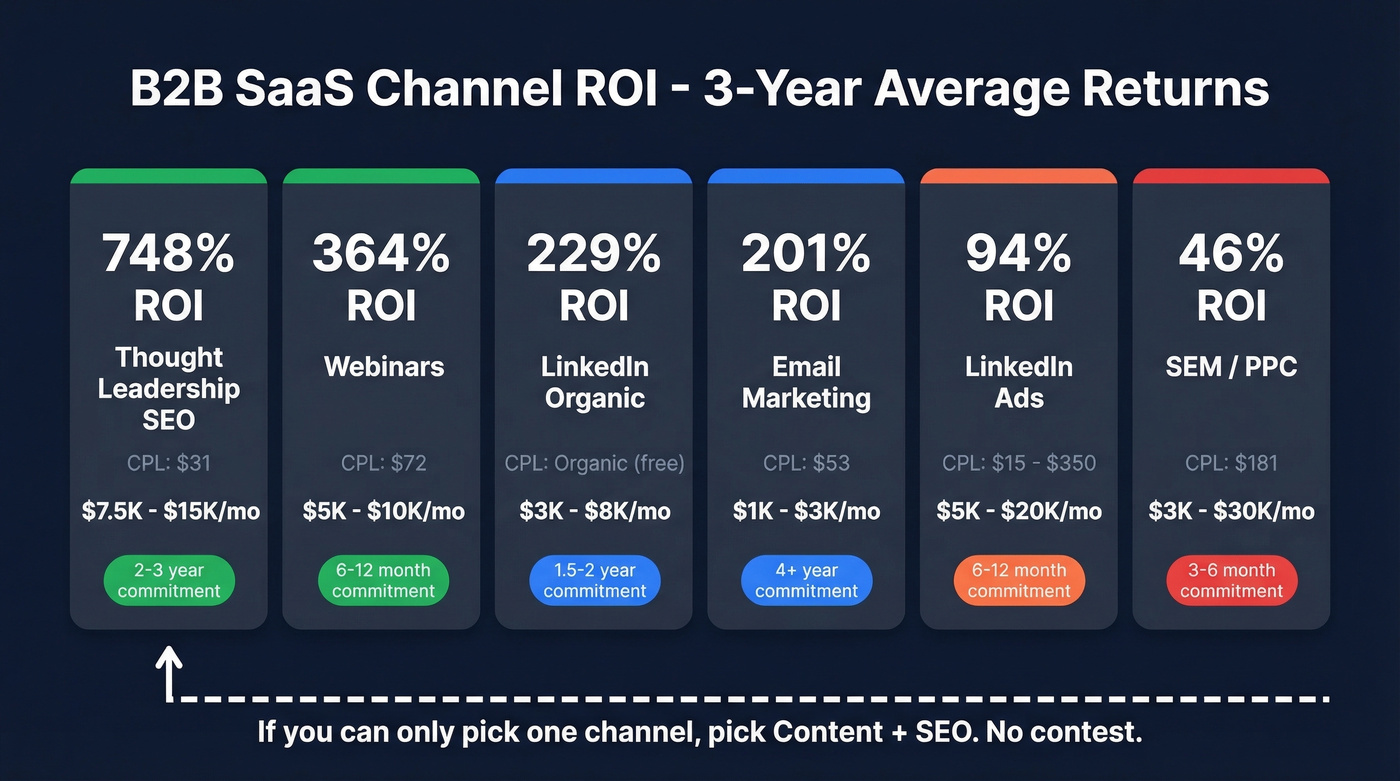
A study of 46 B2B SaaS companies found these three-year average returns:
| Channel | 3-Year ROI | Monthly Cost | CPL | Commitment |
|---|---|---|---|---|
| Thought Leadership SEO | 748% | $7.5K-$15K | $31 | 2-3 years |
| Webinars | 364% | $5K-$10K | $72 | 6-12 months |
| LinkedIn Organic | 229% | $3K-$8K | N/A (organic) | 1.5-2 years |
| Email Marketing | 201% | $1K-$3K | $53 | 4+ years |
| LinkedIn Ads | 94% | $5K-$20K | $15-$350 | 6-12 months |
| SEM/PPC | 46% | $3K-$30K | $181 | 3-6 months |
Content + SEO
748% three-year ROI makes thought leadership SEO the highest-returning channel in B2B SaaS - but it takes 2+ years to compound. At the early stage, this means founder-led content: original perspectives on problems your buyers face, not keyword-stuffed blog posts. The CPL of $31 is about 6x cheaper than PPC.
If you can only invest in one channel, this is it. No contest.
Outbound + Data Quality
Outbound is the fastest channel to generate pipeline, but it has a silent killer: bad contact data. If your bounce rate is 35%, you're not just wasting SDR time - you're actively damaging your domain reputation, which makes every future email harder to deliver.
Here's the thing: this is where data infrastructure matters more than messaging. One Prospeo customer, Meritt, dropped their bounce rate from 35% to under 4% after switching to verified data, and their pipeline tripled from $100K to $300K per week. That's not a copywriting win. It's a data quality win. Teams that fix contact accuracy before scaling outbound see measurable pipeline impact within 30 days, because a 98% email accuracy rate and a 7-day data refresh cycle eliminate the stale-data problem that causes those brutal bounce rates in the first place.
Skip outbound entirely if you haven't fixed your data. Seriously. More volume on bad data just accelerates domain damage.
Paid Acquisition
Let's be honest: if your average deal is under $8K and you're pre-$1M ARR, you probably shouldn't be running paid ads at all. The math rarely works. Most agencies won't tell you that because they make money managing your spend.
But when you're ready for paid, LinkedIn delivers higher lead quality - 14-18% MQL-to-SQL conversion versus Google's 7-12% - at a higher cost per click ($5.58 vs $2.69). 89% of B2B marketers use LinkedIn for lead gen, and 40% cite it as the most effective channel for high-quality leads. For budget splits within paid, allocate Google 35-45% and LinkedIn 25-35%, with the remainder across Bing and retargeting.
Email Nurture
Email returns $36-$42 per $1 spent and compounds over years. The distinction that matters: lifecycle sequences versus blasts. Segment by product usage, buying stage, and engagement signals. Email amplifies every other channel's output - it's what turns a webinar attendee into a demo request and a blog reader into a PQL.
The Brand Play Most Companies Skip
Demand gen without brand awareness is a leaky bucket.
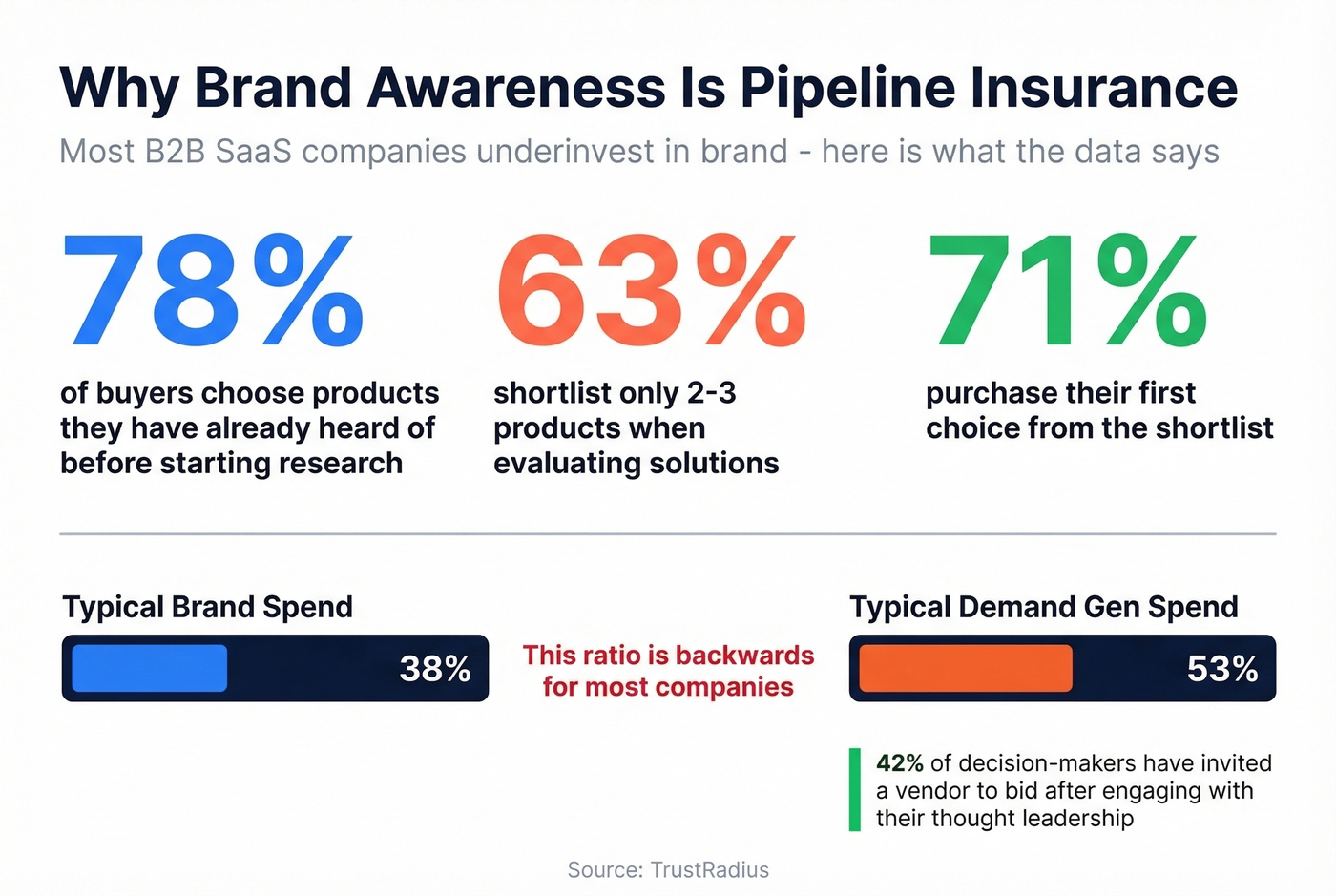
The numbers from TrustRadius make this painfully clear: 78% of buyers choose products they've already heard of before starting research. 63% shortlist only two to three products. And 71% purchase their first choice. If you're not on the shortlist before the buyer starts evaluating, your demo request form doesn't matter.
Yet most SaaS companies allocate just 38% of discretionary spend to brand awareness versus 53% to demand gen. We've watched companies pour money into bottom-funnel campaigns while wondering why conversion rates keep dropping - the answer is almost always that nobody recognizes their name when it shows up in an inbox or an ad. 42% of decision-makers have invited a vendor to bid after engaging with their thought leadership content. Brand isn't a vanity metric. It's pipeline insurance.
Optimize for AI Search
AI Overviews now appear in 55% of all searches, and 60% of Google searches end without a click. The opportunity is real: AI search traffic converts at 14.2% versus Google's 2.8%, and AI-referred sessions grew 527% between January and May 2025. A Princeton GEO study found that optimization increased visibility in AI results by up to 40%.
Answer the query in your first 40-60 words - that's what AI models pull. Cite credible sources and include specific statistics. Add expert quotations where natural. Structure content with clear headers and direct answers. This isn't a separate strategy. It's how you write content that works for both traditional and AI-powered search simultaneously, and it costs nothing extra if your content team is already producing quality work.
Your 90-Day Action Plan
Month 1: Audit and focus. Lock your ICP. One Reddit founder reported that narrowing from "general project managers" to "agency managers and founders" immediately improved signups. Kill underperforming channels. If bounce rates exceed 5%, fix your contact data before scaling outbound - you can't outrun bad data with better copy.
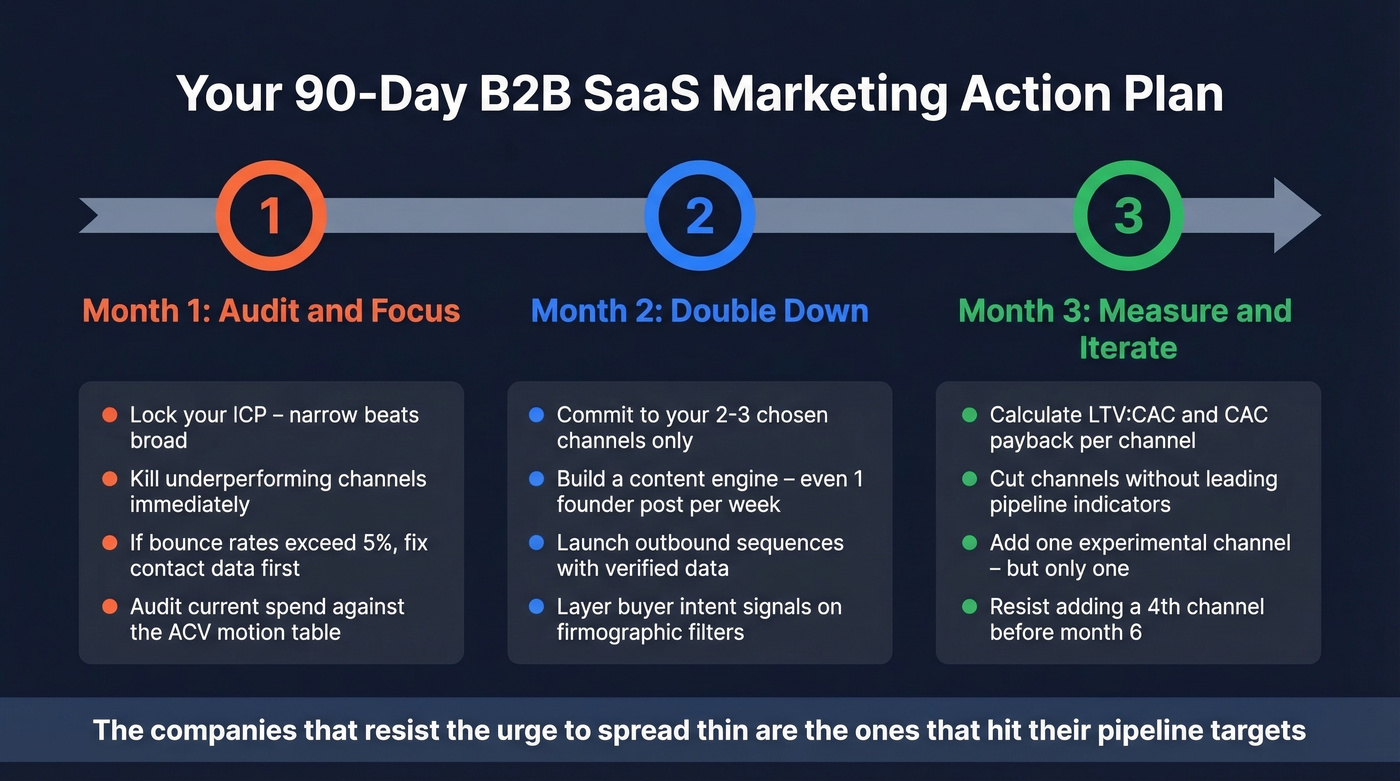
Month 2: Double down. Commit to your two or three chosen channels. Build a content engine, even if it's just the founder writing one piece per week. Launch or refine outbound sequences with verified data. Layer buyer intent signals on top of firmographic filters so outbound hits accounts already researching your category - tools tracking thousands of intent topics make this possible without enterprise budgets.
Month 3: Measure and iterate. Calculate LTV:CAC and CAC payback at the channel level. If a channel isn't showing leading indicators of pipeline contribution, cut it. Add one experimental channel - but only one. A focused B2B SaaS marketing strategy that compounds across two channels will always outperform a scattered approach across six. In our experience, the companies that resist the urge to add a fourth channel before month six are the ones that actually hit their pipeline targets.
Picking 2-3 channels and committing means every dollar has to count. Bad contact data silently drains your outbound ROI - 35% bounce rates destroy domain reputation and kill deliverability across every future campaign. Prospeo's 5-step verification and 7-day refresh cycle keep your pipeline channel performing while you compound the others.
Stop leaking pipeline to stale data. 15,000+ SaaS teams already switched.
FAQ
How much should a B2B SaaS company spend on marketing?
Early-stage companies (pre-$2M ARR) typically spend 80-120% of revenue on sales and marketing combined, with marketing budgets of $0-$15K per month. Scale-ups drop to 40-60% of revenue. Per Gartner's 2026 CMO Spend Survey, the average is 7.7% of company revenue - but your ARR stage matters far more than industry averages.
What's a good CAC for B2B SaaS?
SMB CAC runs $100-$400, mid-market $400-$800, and enterprise $800+. The metric that matters more is LTV:CAC ratio - aim for 3:1 minimum, with top performers hitting 4:1 to 7:1. Build your marketing budget and channel selection around these unit economics from day one.
How do I improve outbound email deliverability?
Start with data quality - if more than 5% of emails bounce, your contact data is the problem, not your copy. Warm your domain gradually, keep daily send volume under 50 per mailbox, and verify every address before sending. Prospeo's 5-step verification with catch-all handling and spam-trap removal keeps bounce rates under 4% for teams like Meritt and GreyScout.
Which marketing channels work best for early-stage SaaS?
Content and SEO deliver the highest three-year ROI at 748%, with a CPL of just $31 - roughly 6x cheaper than PPC. Pair that with outbound email for faster pipeline generation. Pre-$1M ARR companies should avoid paid ads entirely and invest in founder-led content plus one direct-response channel.