

B2B Sales Coaching: Why Most Programs Fail and How to Fix Yours
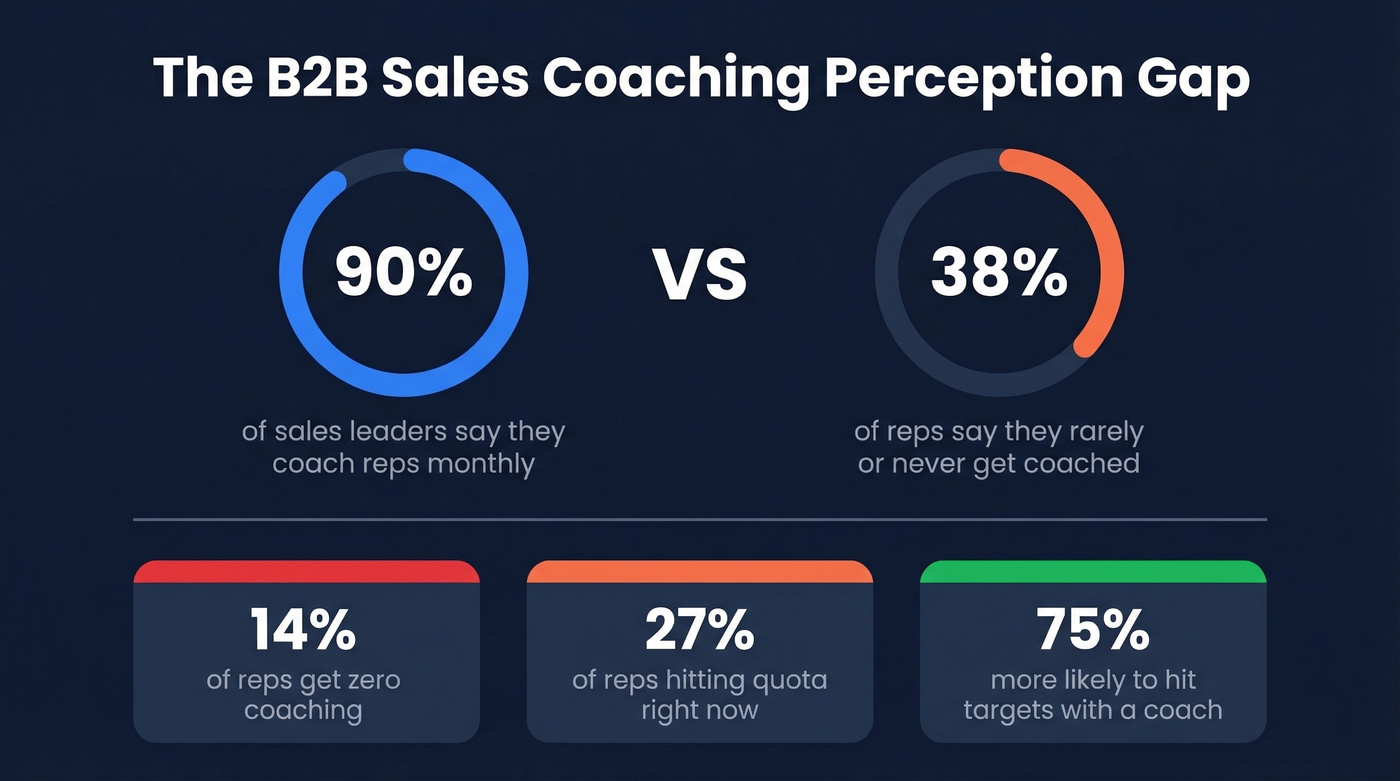
90% of sales leaders say they coach their reps monthly. Only 38% of reps say they rarely or never receive coaching. That gap isn't a rounding error - it's a structural failure in B2B sales coaching that explains why just 27% of reps are hitting quota right now.
Picture a founder running a team of 8 AEs with no VP of Sales. They're doing weekly 1:1s, but every session devolves into "walk me through your pipeline." Reps leave feeling inspected, not coached. Nothing changes. The founder goes looking for coaching programs and finds a wall of $997 courses and Slack groups masquerading as mentorship.
The Short Version
Stop running 1:1s as pipeline interrogation - use the 20/80 rule (20% inspection, 80% coaching). Adopt the 10/10/10 session template below; it takes 30 minutes per week and outperforms sporadic hour-long reviews. And fix your prospect data before you fix your coaching. Reps can't improve on conversations that never happen.
What Is B2B Sales Coaching, Really?
Sandler puts it cleanly: training builds skills, coaching builds behavior. Training is the classroom - onboarding, new tools, playbook alignment. Coaching is what happens after, in the 1:1s, the deal reviews, the call debriefs. It's accountability, reinforcement, and personalization rolled into a recurring cadence.
The Sandler coaching triad - Behavior, Attitude, Technique - captures the full picture. You're not just fixing how reps sell. You're shaping how they think about selling, how they show up, and how they handle the emotional weight of rejection. Organizations that invest in both training and coaching see reps ramp 30-50% faster, with lower attrition and more consistent forecasting.
Most companies do training. They buy a Sandler or Challenger license, run a two-day workshop, and check the box. The coaching part - the ongoing, personalized, weekly reinforcement - is where the program either compounds or dies.
Why Most Coaching Programs Fail
The Perception Gap
That 90% vs. 38% stat isn't just embarrassing - it's diagnostic. Leaders think they're coaching because they're having conversations. Reps don't feel coached because those conversations are about pipeline status, not skill development. Fourteen percent of reps receive no coaching at all. With only 27% of reps hitting quota, the connection between coaching failure and revenue failure is hard to miss.
Pipeline Interrogation Disguised as Coaching
"Walk me through your pipeline." If that's how your 1:1s start, you're not coaching - you're auditing. The rep spends 25 minutes defending deal stages while the manager mentally recalculates the forecast. Nobody learns anything.
The fix is the 20/80 rule: spend no more than 20% of your coaching time on inspection and 80% on actual skill development - call review, objection handling practice, removing blockers. Most managers have this ratio completely inverted.
The Manager Bandwidth Crisis
Even managers who want to coach can't find the time. The "megamanager" trend is real - average direct reports per manager rose from 10.9 in 2024 to 12.1 in 2025, per Gallup data. McKinsey's research shows frontline managers spend 30-60% of their time on admin and meetings, another 10-50% on individual contributor tasks, leaving just 10-40% for people management.
Do the math. A manager with 12 direct reports and 10 hours a week for people management gets roughly 50 minutes per rep - and that includes hiring, performance reviews, escalations, and everything else. Coaching gets squeezed into whatever's left, which is often nothing.
The ROI of Effective Sales Coaching
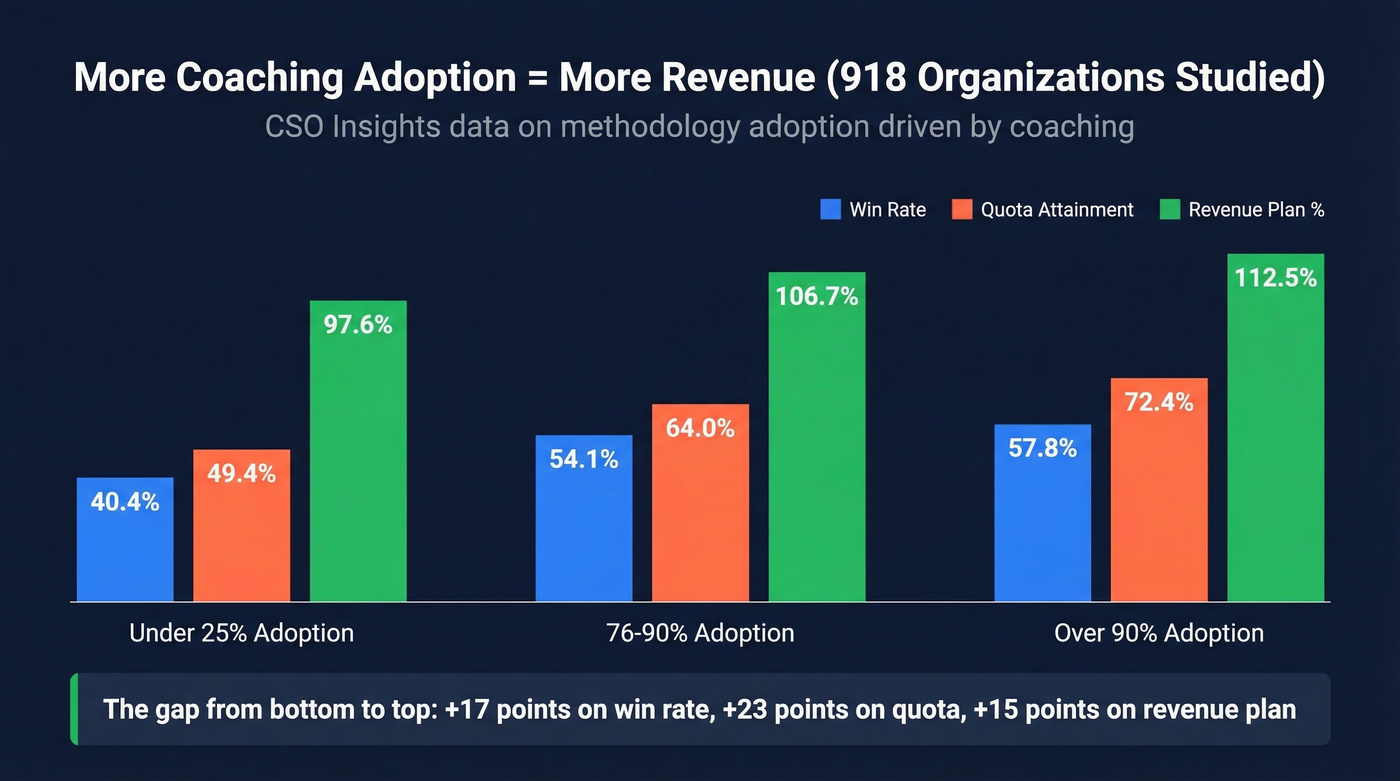
CSO Insights studied 918 organizations worldwide and found a clear stair-step pattern between methodology adoption (which coaching drives) and outcomes:
| Adoption Level | Win Rate | Quota Attainment | Revenue Plan |
|---|---|---|---|
| <25% | 40.4% | 49.4% | 97.6% |
| 76-90% | 54.1% | 64.0% | 106.7% |
| >90% | 57.8% | 72.4% | 112.5% |
The jump from bottom to top tier is massive: 17 percentage points on win rate, 23 points on quota attainment, and nearly 15 points on revenue plan. That's not marginal improvement - it's the difference between a struggling org and one that's consistently beating plan.
Salesforce's 2026 State of Sales adds another signal: 75% of sales reps say they're more likely to hit targets when they have a coach or mentor. Effective training programs deliver a 353% ROI per industry benchmarks. The sales training market itself is projected to grow from $10.32B in 2024 to nearly $19B by 2032 - companies are betting real money that developing reps works.

Coaching can't fix conversations that never happen. When 35% of emails bounce, reps lose confidence and managers lose visibility into real skill gaps. Prospeo's 98% email accuracy and 125M+ verified mobiles mean every rep actually reaches the prospect - so your coaching has something to work with.
Stop coaching reps on deals that died in the inbox.
The 30-Minute Coaching Template
The 10/10/10 Framework
Forget the hour-long monthly review. Weekly, consistent 30-minute sessions outperform them every time. The 10/10/10 structure breaks each session into three equal blocks:
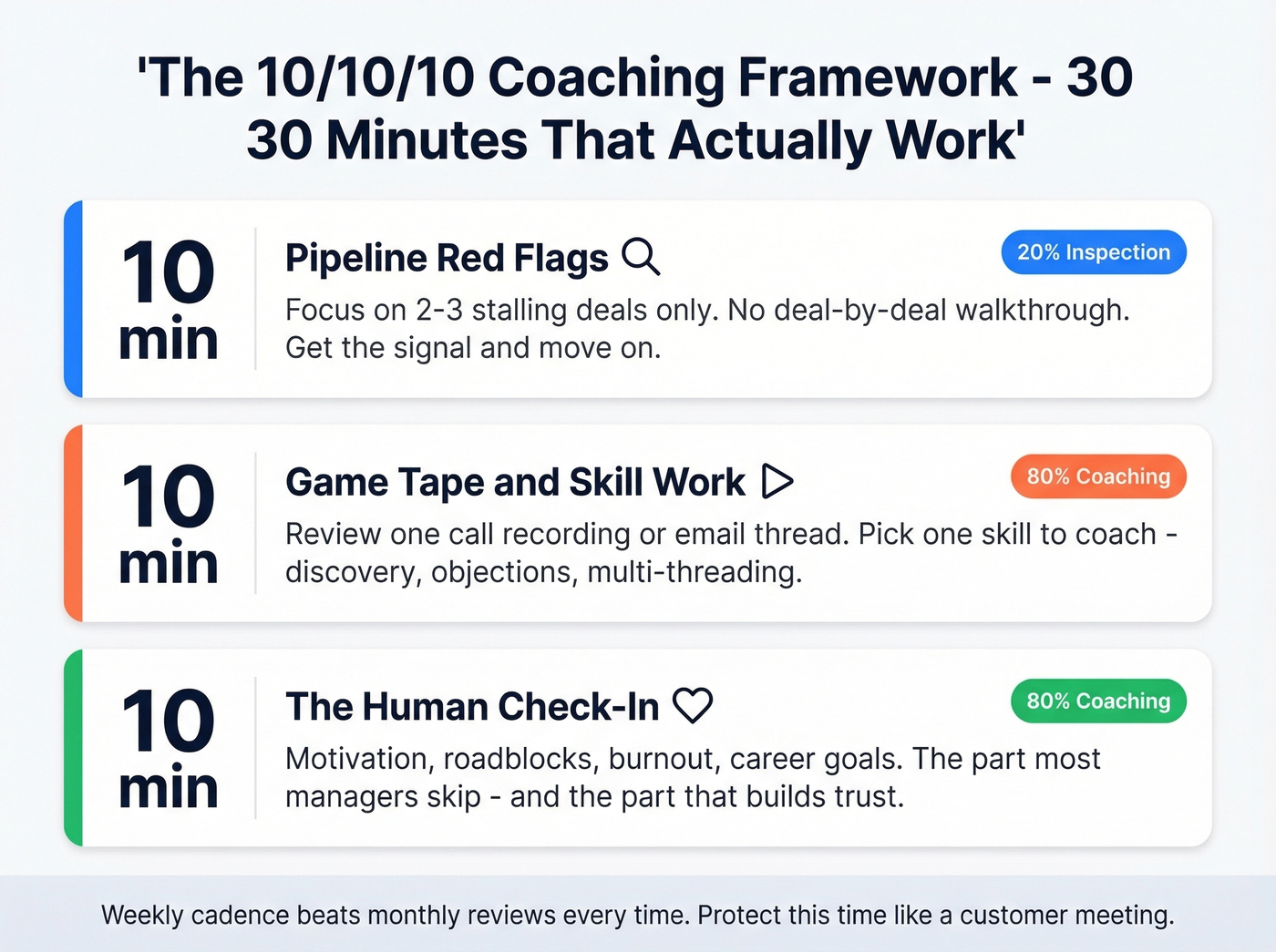
First 10 minutes - Pipeline red flags. Not a deal-by-deal walkthrough. Focus on the two or three deals that are stalling, at risk, or need a strategy shift. This is your 20% inspection window. Get in, get the signal, move on.
Next 10 minutes - Game tape and skill work. Review a specific call recording, email thread, or demo. Pick one skill to work on - discovery questions, objection handling, multi-threading. If the rep is dominating talk time and rushing past discovery, that's a coaching opportunity worth the full ten minutes.
Final 10 minutes - The human check-in. Motivation, roadblocks, burnout, career goals. This is the part most managers skip, and it's the part that builds trust. A rep who feels heard will take coaching seriously. One who feels interrogated won't.
Here's what this looks like in practice. An AE can look "fine" in pipeline but struggle on calls - rushing discovery, skipping stakeholder mapping, folding on pricing pushback. With 10/10/10, you catch the pattern in game tape, coach one skill for the next week, and follow up with another clip the week after. That's how behavior actually changes.
Seven Questions That Drive Results
Ditch "how's your pipeline looking?" and try these instead:
- What's your biggest forecast risk this week, and what's your mitigation plan?
- Which decision-makers haven't you unlocked yet in your top three deals?
- If you could improve one skill this week, what would move the needle most?
- What's the one deal you're most confident about - and why?
- Where did you get stuck in a conversation this week?
- What's one thing I could do differently to help you?
- Is there anything outside of work affecting your energy right now?
Questions 1-5 drive performance. Questions 6-7 build the relationship that makes coaching stick.
Building Your Coaching Program
Set the Cadence
Weekly 1:1s are the baseline. Only 26% of reps receive weekly coaching, but those who do show 25% higher quota attainment and 30% more deals won. The data is unambiguous.
Block 30 minutes per rep per week. Protect it like a customer meeting. If you manage 10 reps, that's five hours a week - significant, but non-negotiable if you want results. Layer in monthly deal reviews and quarterly skill assessments, but the weekly 1:1 is the engine.
Fix Your Data First
Here's a coaching problem nobody talks about: reps can't improve if they're not having enough real conversations. Salesforce reports that reps spend 60% of their time on non-selling tasks. A big chunk of that waste comes from chasing bad data - bounced emails, disconnected numbers, outdated contacts.
We've seen this pattern over and over. A manager coaches a rep on discovery technique, but the rep only runs a handful of real discoveries that week because half their outreach bounces. The coaching loop breaks before it starts. Businesses using data management tools are 58% more likely to beat their revenue goals.
We use Prospeo for this - 98% email accuracy and a 30% mobile pickup rate mean reps actually reach prospects, and the 7-day data refresh keeps contact info current. GreyScout cut rep ramp time from 8-10 weeks to 4 weeks after switching, with new reps practicing on live conversations from day one instead of fighting bounced emails. Aim to keep your bounce rate under 5% so coaching sessions review real calls and real objections - not excuses about bad contacts. (If you need a benchmark-driven breakdown, see our guide to bounce rate.)
The CSO Insights data is clear: methodology adoption drives quota attainment. But adoption stalls when reps spend hours hunting for contact data instead of running the plays you coached them on. Prospeo gives your team 300M+ profiles with 30+ filters - so reps spend time selling, not sourcing.
Cut list-building from 15 hours to 3 and give reps time to actually execute.
AI Sales Coaching Tools in 2026
AI coaching tools are useful, but they're a layer, not a solution. A Gong subscription doesn't fix a manager who doesn't know how to ask questions. That said, 81% of sales teams now use AI in some form, and AI-using teams report 83% year-over-year revenue growth vs. 66% for non-AI teams. Organizations using AI coaching tools see 20-25% improvement in rep proficiency and 15% faster ramp time, per Gartner and Forrester estimates.
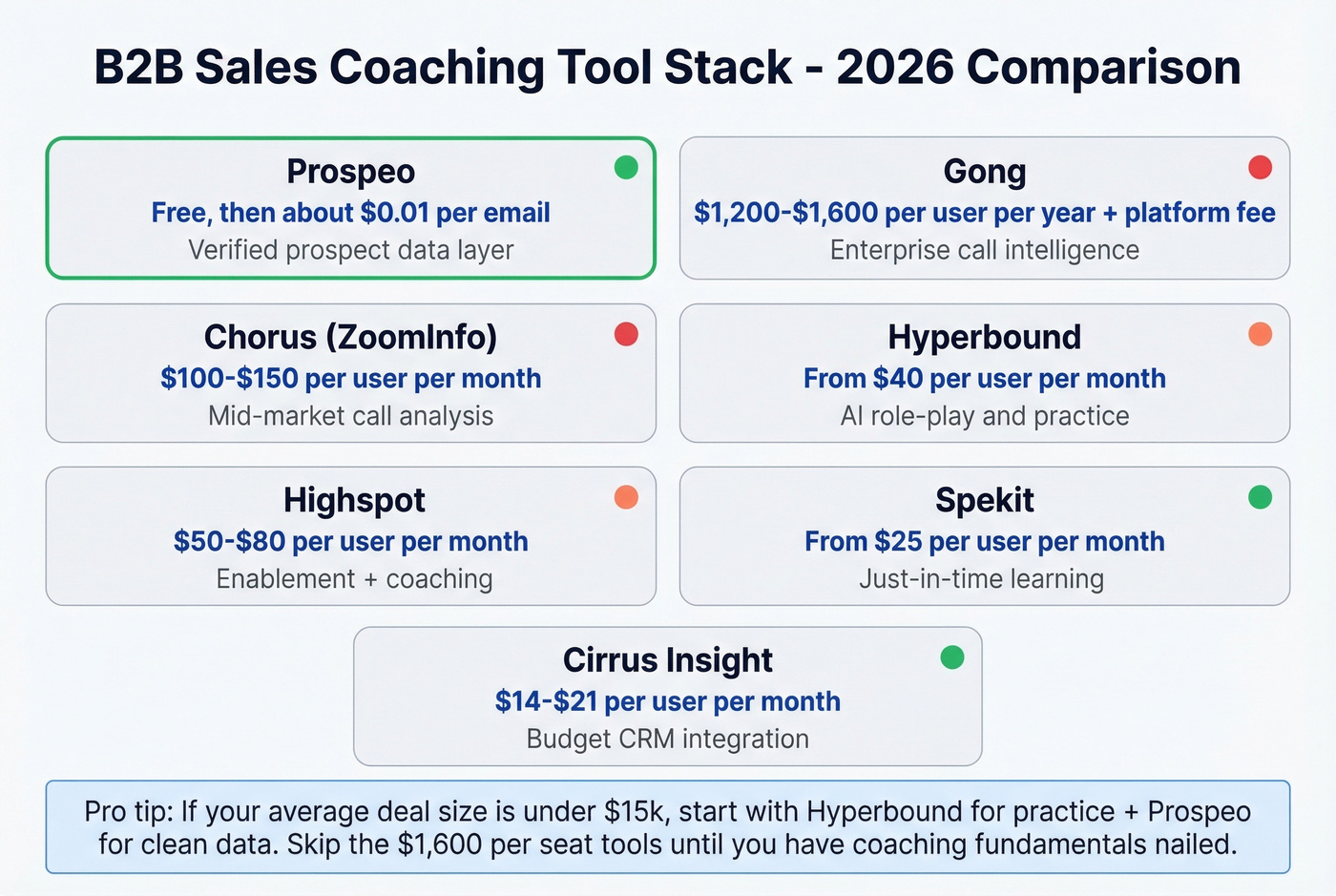
Here's how the tools stack up:
| Tool | Starting Price | Best For |
|---|---|---|
| Prospeo | Free; paid from ~$0.01/email | Verified prospect data layer |
| Gong | ~$1,200-$1,600/user/yr + platform fee | Enterprise call intelligence |
| Chorus (ZoomInfo) | ~$100-$150/user/mo | Mid-market call analysis |
| Hyperbound | From ~$40/user/mo | AI role-play and practice |
| Highspot | ~$50-$80/user/mo | Enablement + coaching |
| Spekit | From ~$25/user/mo | Just-in-time learning |
| Cirrus Insight | ~$14-$21/user/mo | Budget CRM integration |
Let's be honest: if your average deal size is under $15k, you probably don't need Gong-level call intelligence. A $40/user Hyperbound subscription for practice reps plus clean prospect data will move the needle more than a $1,600/user Gong seat that nobody reviews. Invest in coaching fundamentals before you invest in coaching software. (If you're evaluating stacks, start with our roundup of SDR tools and generative AI sales tools.)
For teams under 50 reps, Hyperbound's AI role-play is surprisingly effective for practice. Enterprise orgs already deep in the ZoomInfo ecosystem will find Chorus a natural add-on. For everyone else, start with Gong if you can afford it, Highspot if you need enablement bundled in, and Cirrus Insight if budget is tight. Skip Gong entirely if your team is under 10 reps - the ROI math doesn't work at that scale.
How to Choose a Sales Coach
What to Look For
The consensus on r/b2b_sales is clear: people want real 1:1 coaching from someone who's actually carried a quota recently, not a "$997 course + Slack group" package. Here's what separates legitimate coaches from the noise.
Recent quota-carrying experience - ideally within the last 3-5 years, not a decade ago. Someone who closed enterprise deals in 2023 understands today's buying committees. Someone who last sold in 2015 doesn't. (If you're building a manager bench, our guide to sales leadership is a useful companion.)
Specific methodology expertise like MEDDIC, Sandler, Challenger, or Command of the Message rather than generic "sales mindset" content. You want a structured cadence with clear milestones, not ad-hoc calls when you feel like it. And measurable outcomes they can point to - win rate improvements, ramp time reductions, quota attainment lifts. (For a practical qualification framework, see MEDDIC sales qualification.)
Format that matches your need. A founder with 8 AEs and no VP of Sales needs a different engagement than an enterprise CRO looking to upskill 50 managers. Match accordingly: 1:1 for founders and individual contributors, cohort-based for teams, on-demand for supplemental learning. Expect to pay $500-$2,000/month for quality 1:1 coaching, $200-$500/seat for cohort programs.
Red Flags
Skip anyone who leads with a high-ticket course and a community Slack channel as the "mentorship" component. Avoid coaches whose advice boils down to "build rapport" and "always follow up" - that's not coaching, it's platitudes. Be wary of anyone with a short B2B tenure who pivoted to coaching suspiciously fast. No structured curriculum? No client results they'll share? Keep looking.
Programs Worth Knowing
The coaching and training market breaks into three tiers, and the right choice depends on your situation.
1:1 Coaching is the highest-impact format for founders without a VP of Sales or individual reps who need targeted improvement. Closed Won (Brian LaManna), From Demo to Close (Mor Assouline), and Ian Koniak are consistently recommended in practitioner communities. These engagements run $500-$2,000/month and deliver the most personalized feedback.
Cohort-Based Programs work well for teams that need a shared methodology and peer accountability. Winning by Design and Sandler are the gold standard for methodology. PClub (Chris Orlob) is excellent for tactical skills like cold calling and discovery. SalesLabs (Thibaut Souyris) focuses on outbound-specific coaching.
On-Demand and Content-Based Learning fills the gaps between structured sessions. Josh Braun's content on cold outreach is consistently excellent. Sell Better and Will Aitken produce high-quality free content. TA Sales (Tom Alaimo) covers the full SaaS sales stack. (To tighten execution between sessions, use these sales follow-up templates and refresh your sales prospecting techniques.)
Our recommendation: Winning by Design or Sandler for methodology foundations, PClub for tactical skills, and a 1:1 coach for founders who need a sounding board and management guidance. Layer in on-demand content for continuous learning between sessions.
FAQ
What's the difference between sales coaching and sales training?
Training builds skills through structured curriculum - workshops, certifications, playbooks. Coaching builds behavior through ongoing, personalized feedback in 1:1s and deal reviews. Organizations investing in both see reps ramp 30-50% faster with lower attrition.
How often should you coach sales reps?
Weekly, for 30 minutes using the 10/10/10 framework. Only 26% of reps get weekly coaching, but those who do show 25% higher quota attainment and 30% more deals won. Sporadic monthly reviews can't match that consistency.
Can AI replace a human sales coach?
No. AI tools like Gong and Hyperbound scale call analysis and role-play practice, but they can't build trust, read emotional context, or adapt to a rep's career trajectory. Use AI to surface insights - the manager still needs to act on them.
How do you measure coaching ROI?
Track win rate, quota attainment, ramp time, and deal velocity before and after implementing a structured cadence. CSO Insights data shows organizations with >90% methodology adoption hit 57.8% win rates versus 40.4% at <25% adoption - a 17-point swing.
Does prospect data quality affect coaching outcomes?
It does more than most people realize. When bounce rates exceed 10%, reps don't get enough live conversations to practice on. Keeping bounce rates under 5% with verified data means coaching sessions review real calls and real objections instead of excuses about bad contacts.