

B2B Sales Cycle Length: 2026 Benchmarks, Trends & How to Close Faster
Everyone says B2B sales cycles are getting longer. The latest 6Sense data says the opposite - average cycles dropped from 11.3 months to 10.1 months year over year. The difference? Process, not luck.
If someone just asked "why do our deals take so long?" and you need a real benchmark to answer them, keep reading. The average cycle runs 2-9 months depending on deal size, industry, and buyer company size, and three levers move the needle most: multi-thread every deal, send proposals within 24 hours, and fix your contact data so reps aren't chasing ghosts for the first three weeks.
What Is Sales Cycle Length?
Sum the days from opportunity creation to closed-won across all deals, then divide by the number of deals closed. Simple formula, but the measurement start point matters a lot. Some teams measure from first touch or MQL creation, which skews results based on channel mix. HockeyStack's research uses deal-created date specifically - and that's the approach we recommend because it keeps your benchmark clean regardless of whether leads came inbound or outbound.
Some services businesses measure all the way to first invoice collected. Worth considering if cash-to-close lag is significant for your model.
2026 Benchmarks by Deal Size
Deal size is the most intuitive predictor of cycle length, but it's not as dominant as you'd think. Here's the Focus Digital ACV ladder alongside SaaStr's practitioner heuristics:
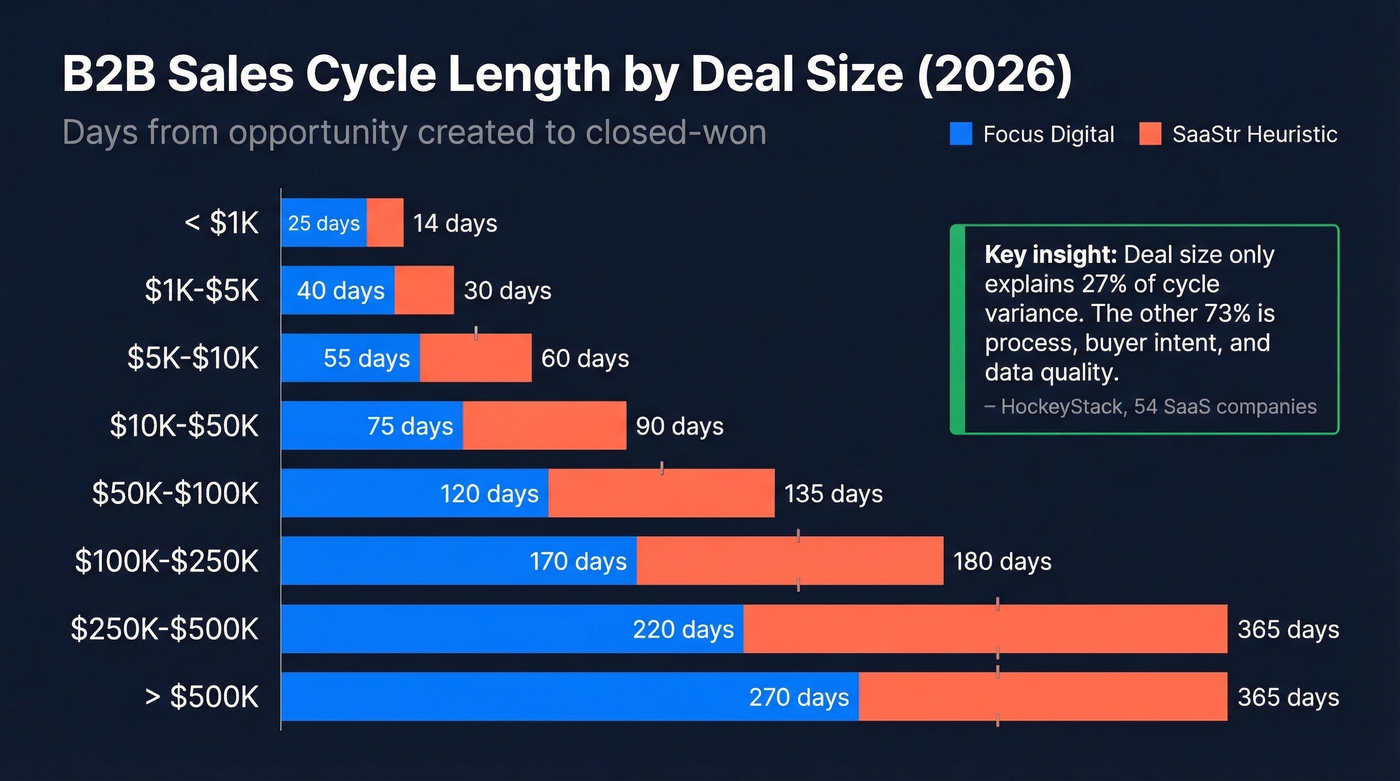
| ACV Tier | Focus Digital (Days) | SaaStr Heuristic |
|---|---|---|
| < $1K | 25 | ~14 days |
| $1K-$5K | 40 | ~30 days |
| $5K-$10K | 55 | 30-90 days |
| $10K-$50K | 75 | ~90 days |
| $50K-$100K | 120 | 90-180 days |
| $100K-$250K | 170 | 3-9 months |
| $250K-$500K | 220 | 6-18+ months |
| > $500K | 270 | 6-18+ months |
SaaStr also cites a Gong-wide benchmark: the average deal is $97K with a 69-day cycle. That's faster than most people expect at that ACV.
Here's the thing - HockeyStack ran a regression across 54 B2B SaaS companies and found an R-squared of just 26.8%. Deal size explains only about 27% of cycle variance. The other 73% is process, buyer intent, and data quality. If you're blaming long cycles on "we sell enterprise deals," you're probably wrong about what's actually slowing you down.

Deal size only explains 27% of cycle length variance. The rest is process and data quality. Prospeo gives your reps 98% accurate emails and 125M+ verified mobiles so they reach real buyers on day one - not week three.
Cut weeks off every deal by fixing the data problem first.
Benchmarks by Industry
The average length varies dramatically across verticals, sometimes by a factor of two or more:
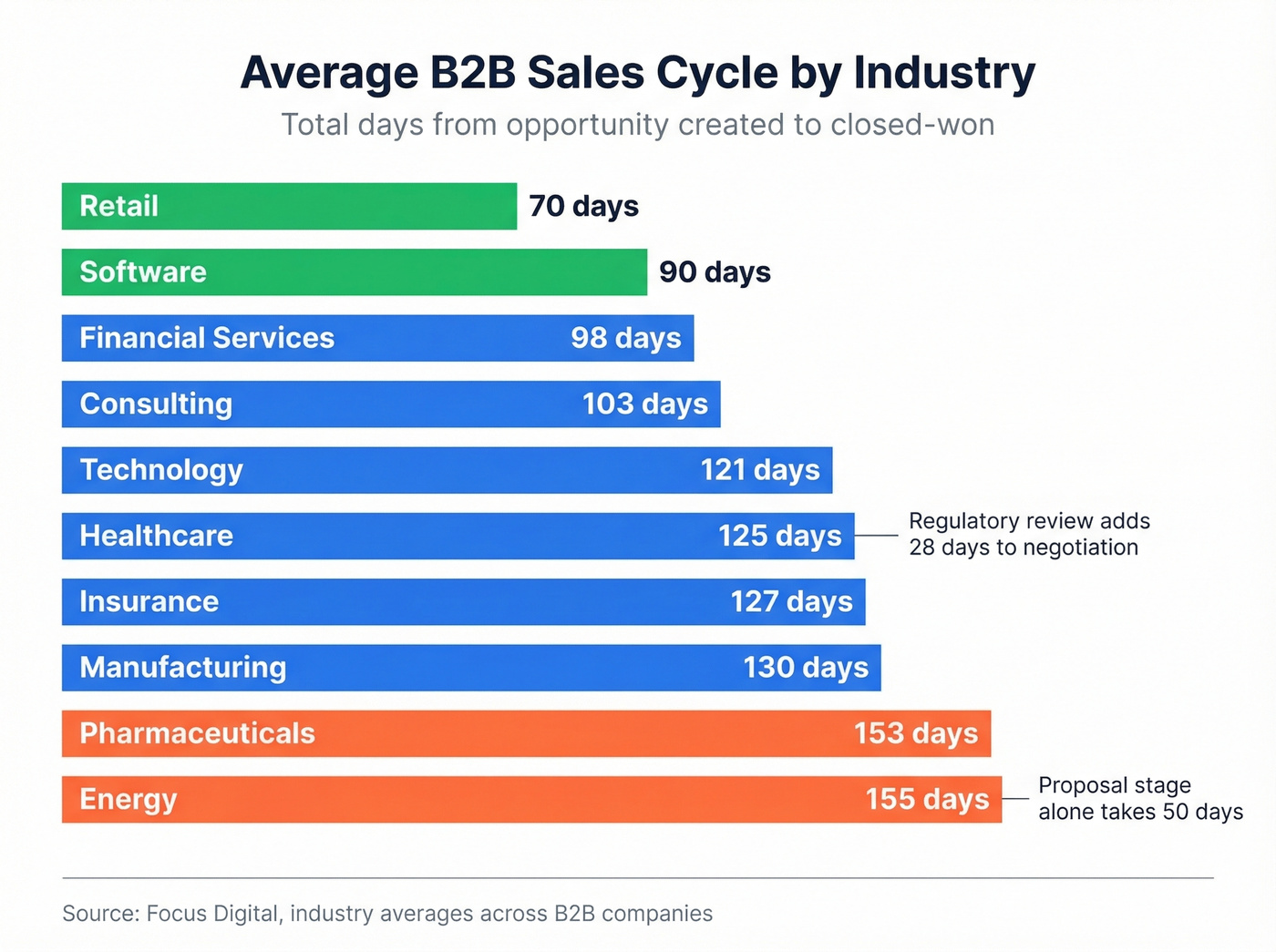
| Industry | Total Days |
|---|---|
| Retail | 70 |
| Software | 90 |
| Financial Services | 98 |
| Consulting | 103 |
| Technology | 121 |
| Healthcare | 125 |
| Insurance | 127 |
| Manufacturing | 130 |
| Pharmaceuticals | 153 |
| Energy | 155 |
Where does time actually concentrate? In Software, the proposal stage eats 30 days and negotiation takes 25. Healthcare is similar but back-loaded - proposals run about 40 days and negotiation adds 28, reflecting regulatory review layers. In Energy, proposals alone run 50 days. If you're selling into energy, pharma, or manufacturing, your bottleneck is mid-funnel, not top-of-funnel.
On r/sales, an agency owner pegged their cycle at about 4 months from qualified lead to first invoice paid, while a client selling expensive machinery into FMCG and pharma ran closer to 9-12 months - consistent with these benchmarks.
By Company Size
Bigger companies mean more stakeholders, more procurement layers, and longer late-stage drag. The numbers tell a clear story:
| Employee Count | Total Days |
|---|---|
| 1-10 | 38 |
| 11-50 | 57 |
| 51-200 | 77 |
| 201-500 | 95 |
| 501-1,000 | 115 |
| 1,001-5,000 | 135 |
| 5,001-10,000 | 158 |
| 10,001+ | 185 |
For 10,001+ employee companies, negotiation takes 50 days and closing takes 45 - that's 95 days just in the final two stages. If you're selling enterprise and wondering why deals stall after the demo went great, this is why. The demo isn't the finish line; it's barely the halfway mark.
By Lead Source
This is the data most teams overlook entirely. The channel your pipeline comes from changes cycle length as much as deal size does.
| Channel | Low Complexity | Medium | High Complexity |
|---|---|---|---|
| Referrals | 20 days | 40 days | 60 days |
| SEO / Inbound | 28 days | 50 days | 75 days |
| Cold Calling | 60 days | 85 days | 110 days |
| Trade Shows | 80 days | 100 days | 150 days |
Referral deals close 3-4x faster than trade show leads depending on deal complexity. If you're running a high-ACV motion and your pipeline is mostly event-sourced, you've found your cycle-length problem.
Why B2B Buying Cycles Keep Expanding
Buying committees have roughly doubled. In 2015, the average B2B purchase involved 5.4 decision-makers. Gartner's latest data shows 8-13 stakeholders depending on deal complexity. Every additional person adds calendar time, alignment meetings, and approval loops.
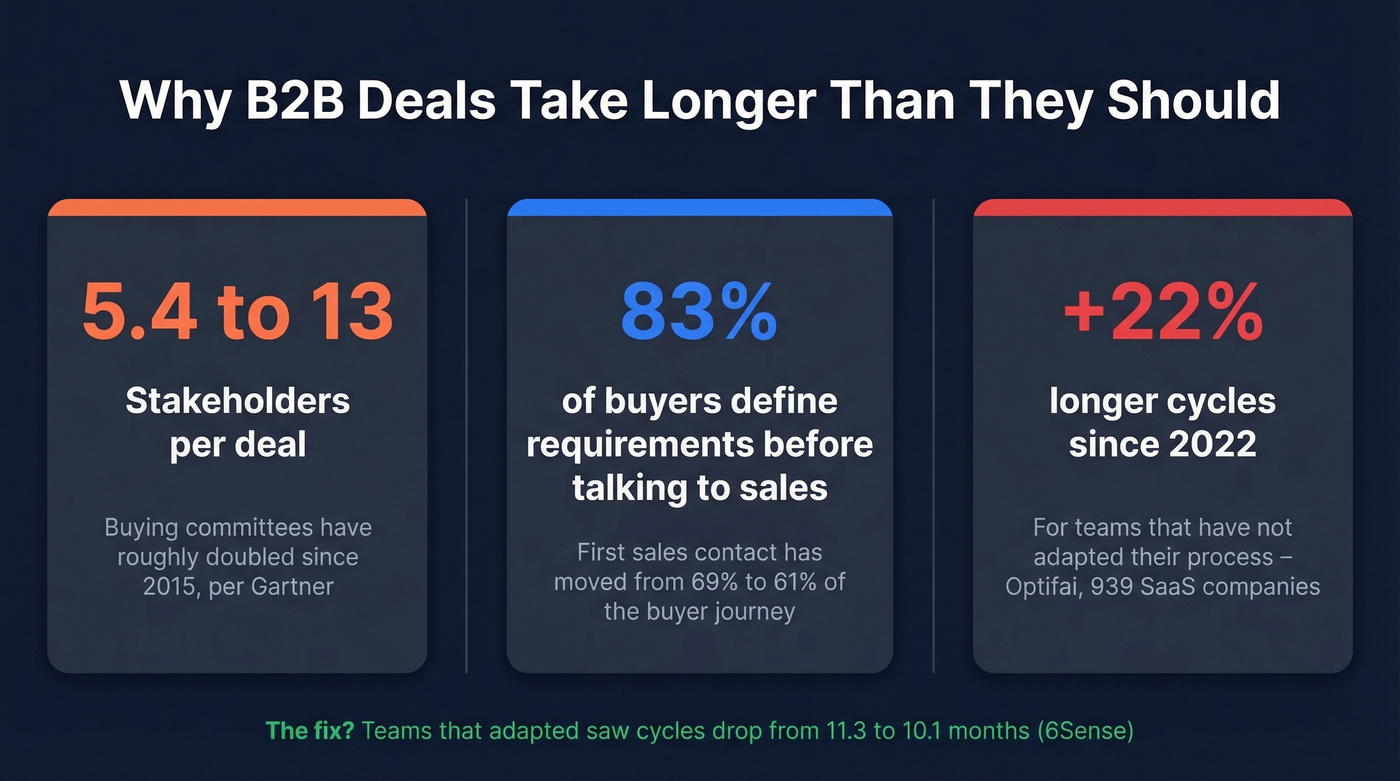
The other shift: 83% of buyers now mostly or fully define their requirements before talking to sales. The point of first sales contact has moved from 69% to 61% of the buyer's journey - sellers are getting in earlier, which partly explains the cycle compression in 6Sense's data. But the research phase still happens without you, and Optifai's analysis of 939 B2B SaaS companies found cycles lengthened 22% since 2022 for teams that haven't adapted their process.
Let's be honest: if your ACV is under $50K and your average cycle exceeds 90 days, you don't have a market problem. You have an execution problem. We've seen teams cut 3+ weeks just by fixing data quality and sending proposals faster.
How to Shorten Your B2B Sales Cycle
Five tactics with quantified impact, ranked by how much they actually move the needle:
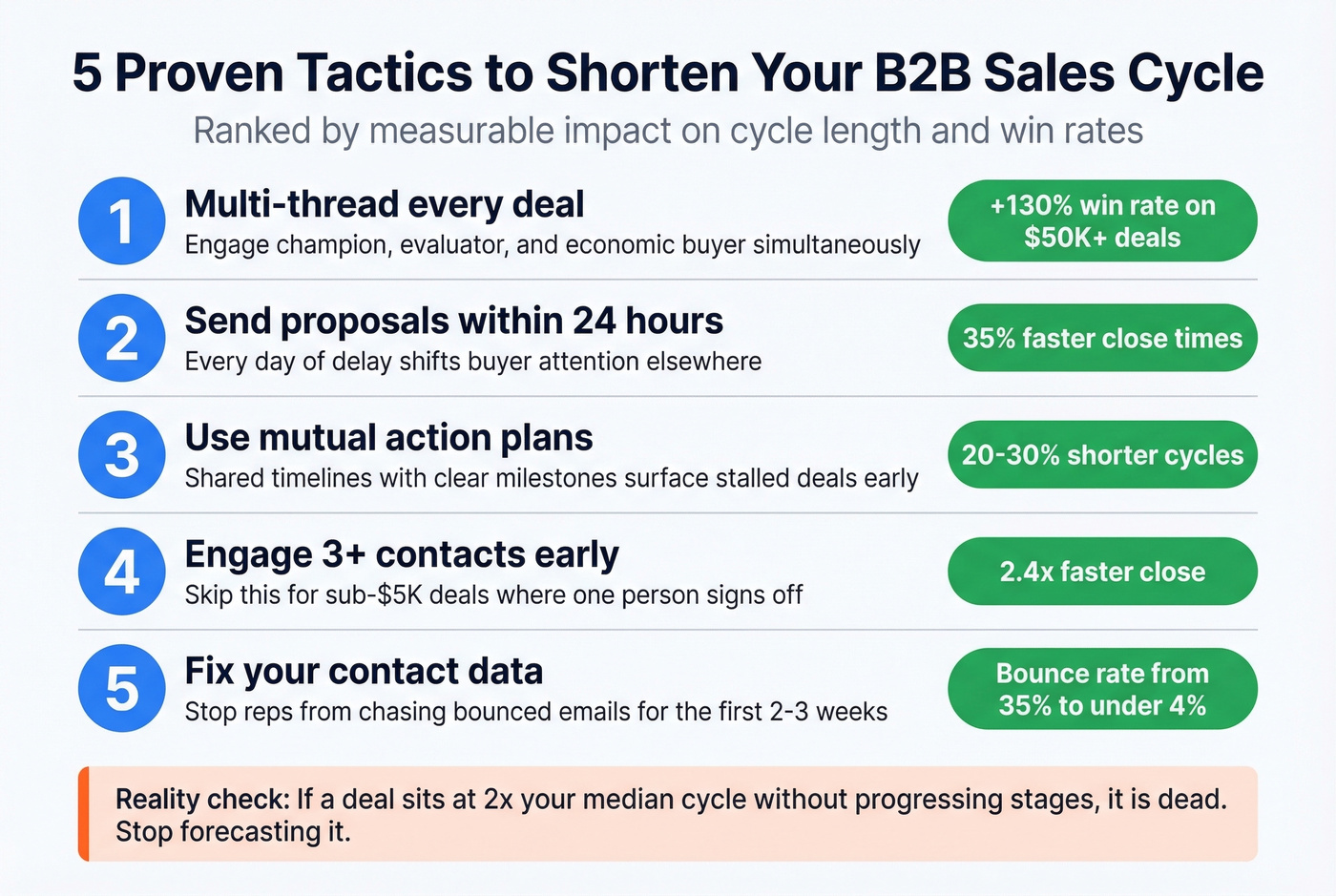
1. Multi-thread every deal. Gong's analysis of 1.8 million opportunities found closed-won deals have twice as many buyer contacts as closed-lost. On deals over $50K, multi-threading boosts win rates by 130%. If your reps are single-threaded on a six-figure deal, they're gambling.
2. Send proposals within 24 hours. Optifai found that deals where proposals go out same-day close 35% faster. Every day of delay is a day the buyer's attention shifts elsewhere.
3. Use mutual action plans. Shared timelines with clear milestones reduce cycle time by 20-30% and surface stalled deals earlier. This is especially critical for enterprise deals where that 95-day negotiation-to-close window can quietly balloon if nobody's tracking it.
4. Engage 3+ contacts early. Deals with three or more contacts engaged close 2.4x faster - champion, evaluator, and economic buyer all in motion simultaneously. Skip this if you're selling sub-$5K deals where a single decision-maker signs off; multi-threading a $3K deal just adds overhead.
5. Fix your contact data. Your reps aren't slow - they're chasing bounced emails and disconnected numbers for the first 2-3 weeks of every deal. When 35% of emails bounce, early pipeline becomes a data cleanup exercise instead of selling. Meritt switched to Prospeo and cut their bounce rate from 35% to under 4%, tripling pipeline from $100K to $300K per week. With 98% email accuracy on a 7-day refresh cycle, reps reach real people on the first attempt instead of burning weeks on dead contacts.
If you're seeing high bounce rates, start with email bounce rate benchmarks and fixes, then tighten your email deliverability so your best reps aren't punished by infrastructure.
One more thing: if a deal has been sitting at 2x your median cycle without progressing stages, it's dead. Stop forecasting it. These tactics won't resurrect zombie deals, but they'll prevent new ones from becoming zombies.
Multi-threading boosts win rates by 130% on $50K+ deals - but only if your reps can actually reach 3+ stakeholders. Prospeo's 300M+ profiles with 30+ filters let you map the entire buying committee in minutes, not weeks.
Engage every decision-maker before your competitor finds the first one.
FAQ
How long is the average B2B sales cycle by industry?
Retail averages 70 days, Software 90 days, Healthcare 125 days, Manufacturing 130 days, and Energy 155 days. The biggest bottleneck in most verticals is the proposal-to-negotiation stage, not initial prospecting.
How do you calculate sales cycle length?
Total days from opportunity created to closed-won, summed across all deals and divided by deals closed. Use the opportunity-created date - not first touch - to keep benchmarks comparable across inbound and outbound channels.
What's the fastest way to shorten a long sales cycle?
Multi-threading deals and sending proposals within 24 hours deliver the largest measurable impact - up to 35% faster close times and 130% higher win rates on deals above $50K, per Gong and Optifai data.
How does bad contact data extend your sales cycle?
Bounced emails and disconnected numbers inflate early pipeline stages by 2-3 weeks per deal. Verified email tools reduce bounce rates from 35%+ to under 4%, cutting that dead time so reps start selling from day one instead of cleaning lists.