

How to Build a B2B Sales Team That Actually Performs in 2026
Most B2B sales teams are structured by accident. Someone promotes the best AE to "manager," hires a couple of SDRs off a job board, and wonders why pipeline got worse instead of better. Building a B2B sales team that works isn't a talent problem - it's a sequence problem. You need systems before headcount, structure before scale, and clean data before anything else.
Quick version:
- Pick a structure model based on team size - Island for under 10 reps, Assembly Line for 10-20, Pods for 20+.
- Build systems before headcount. CRM, deal stages, playbook first. Then hire in pairs.
- Equip reps with verified contact data (98%+ email accuracy) before investing in anything else.
Structure Models That Work
Your structure determines how leads flow, who owns what, and where deals stall. Get it wrong and you'll see handoff friction, rep burnout, and slower deal velocity - regardless of how talented your people are.
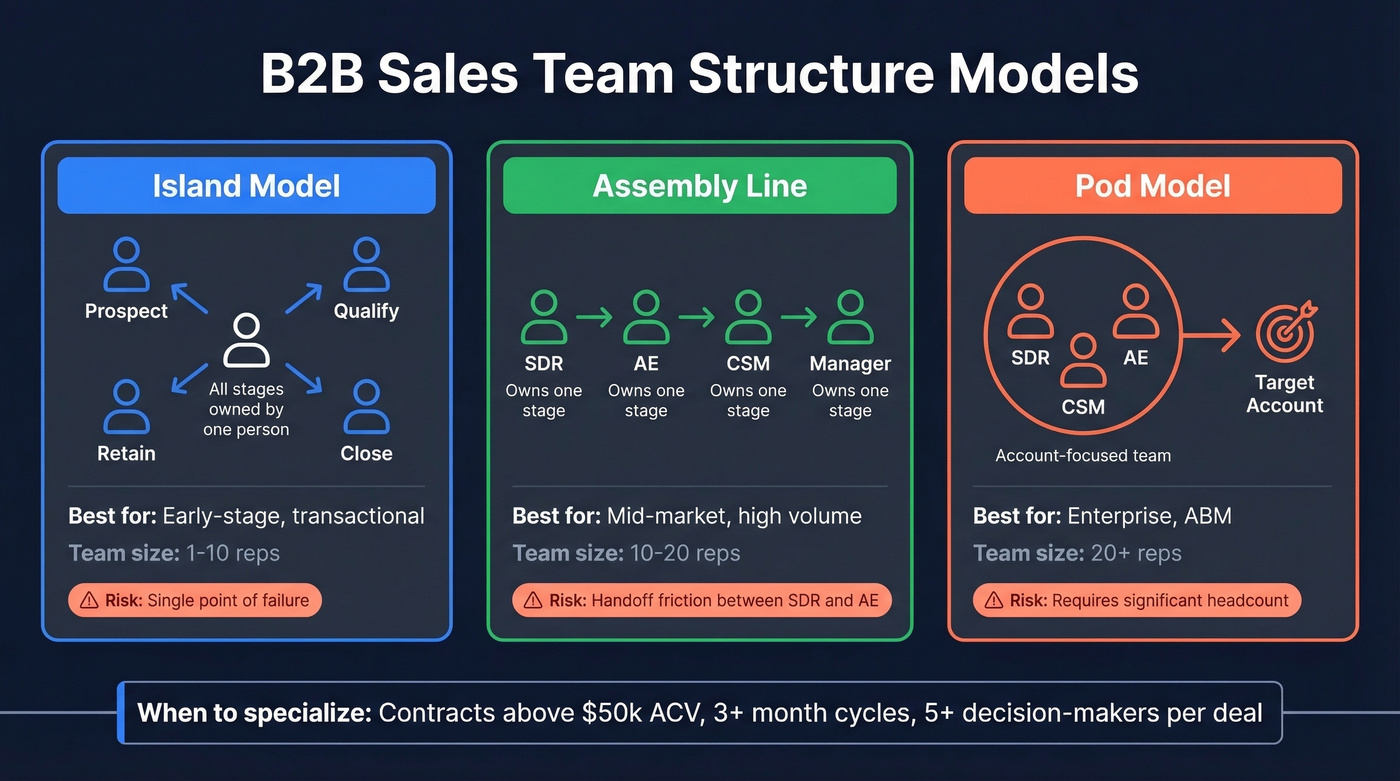
| Model | Best For | Team Size | Risk |
|---|---|---|---|
| Island | Early-stage, transactional | 1-10 reps | Single point of failure |
| Assembly Line | Mid-market, high volume | 10-20 reps | Handoff friction |
| Pod | Enterprise, ABM | 20+ reps | Requires headcount |
The Island model works when reps own the full cycle - prospect to close. It's fast and simple, but if one rep leaves, their entire pipeline walks out the door. The Assembly Line splits responsibilities: SDRs qualify, AEs close, CSMs retain. It scales well, but in our experience, this model breaks down fastest at the SDR-to-AE handoff - deals slip through the seam and nobody owns the gap. Pods group cross-functional units around target accounts, ideal for enterprise and ABM motions, but you need the headcount to staff them properly.
When should you specialize? Once you're selling contracts above $50k annually, dealing with 3+ month sales cycles, and navigating 5+ decision-makers per deal. Below those thresholds, generalist reps usually outperform a fragmented org. Single account ownership boosts ACVs by 40% compared to hunter-farmer models - in practice, that often pushes teams toward pods or island-style ownership in enterprise instead of rigid handoff-heavy assembly lines.
Core Roles and How They're Evolving
The traditional lineup - SDR/BDR, AE, CSM, Sales Manager - still forms the backbone. But the job descriptions are shifting fast. 85% of B2B organizations expect hybrid sales roles to predominate over the next three years, and McKinsey's data shows two-thirds of B2B buyers are now comfortable with remote or digital interactions, though 40% still prefer in-person for new suppliers. That tension is reshaping every role on the team.
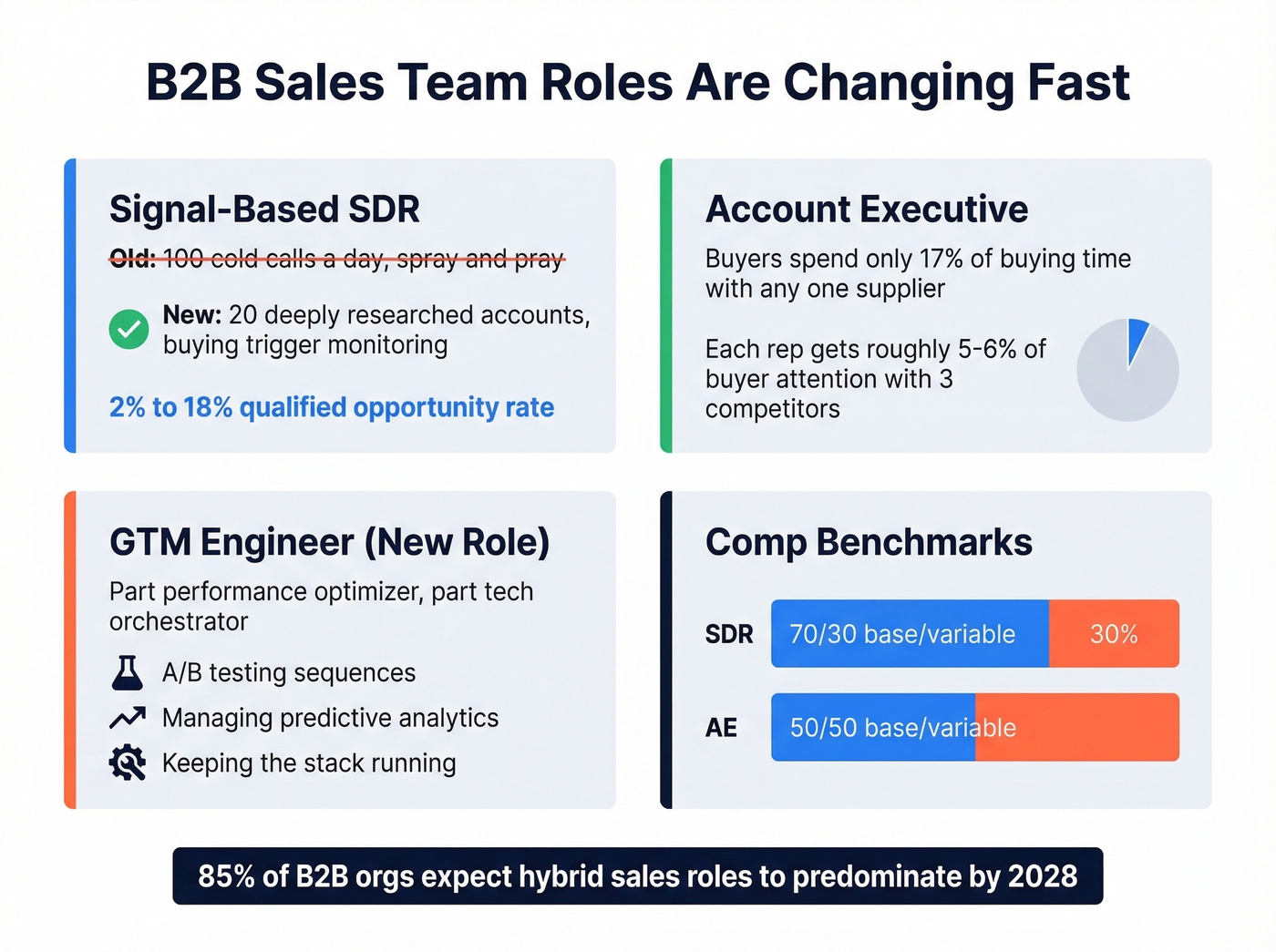
The biggest shift is in SDR work. The old model of 100 cold calls a day and spray-and-pray is dying. B2B buyers spend just 17% of their total buying time with any one supplier, and if you have three competitors, each rep gets roughly 5-6% of the buyer's attention. Signal-based SDRs now monitor buying triggers and focus on 20 deeply researched accounts instead of blasting 200. One team that made this switch saw their qualified opportunity rate jump from 2% to 18% in four months. That's not incremental improvement - that's a different job entirely.
A newer role gaining traction is the GTM Engineer - part performance optimizer, part tech orchestrator, responsible for A/B testing sequences, managing predictive analytics, and keeping the stack running. This role is a glimpse of the future, where technical fluency matters as much as relationship skills.
On comp, SDRs typically sit at 70/30 base/variable, AEs at 50/50 for quota carriers.
Building From Scratch
Here's the thing: the sequence matters more than the speed. We've seen teams hire five SDRs before they have a CRM with defined deal stages, then wonder why nobody can forecast anything.
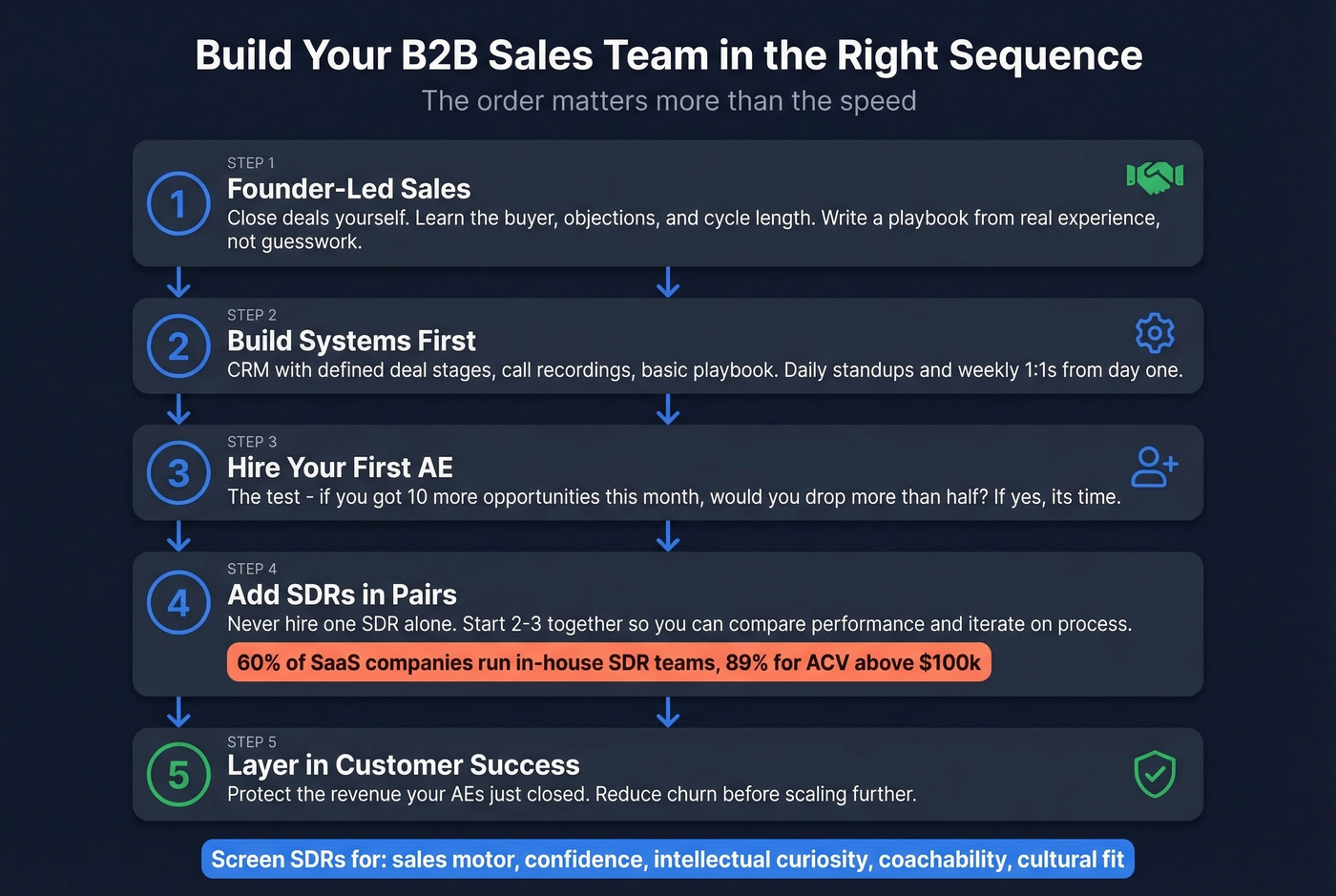
1. Founder-led sales first. Close enough deals yourself to understand the buyer, the objections, and the cycle length. One founder on r/sales described this as "the only way to write a playbook that isn't fiction." He's right.
2. Build systems. CRM, deal stages, call recordings, a basic playbook. This is the infrastructure your first hires will run on. Establish a daily standup cadence and weekly 1:1s from day one - don't wait until you have "enough people."
3. Hire your first AE. The test: if you got 10 more opportunities this month, how many would you drop? If the answer is more than half, it's time.
4. Add SDRs in pairs. Never hire a single SDR as a "toe in the water." Start 2-3 together so you can compare performance and iterate on process. 60% of SaaS companies run in-house SDR teams, and that number climbs to 89% for companies with ACV above $100k.
5. Layer in Customer Success to reduce churn and protect the revenue your AEs just closed.
When interviewing SDRs, screen for five things: sales motor, confidence, intellectual curiosity, coachability, and cultural fit. Skills can be trained. Drive can't.

You just read that signal-based SDRs outperform spray-and-pray by 9x. But signals mean nothing if your contact data bounces. Prospeo gives your B2B sales team 300M+ profiles with 98% email accuracy and 125M+ verified mobiles - refreshed every 7 days, not 6 weeks. Starting at $0.01 per email, no contracts.
Equip your reps with data that actually connects them to buyers.
KPI Benchmarks That Matter
Here are the benchmarks your B2B sales team should track:
| KPI | Benchmark | Why It Matters |
|---|---|---|
| Win rate | 20-30% | Below 20% = qualification problem |
| Pipeline coverage | 3-4x quota | Below 3x = not enough top-of-funnel |
| Sales cycle | 3-6 months | Longer = deal complexity or stalls |
| Ramp time | 3-6 months | Budget for zero productivity in months 1-2 |
| Deal slippage | <20% | Above 20% = forecasting is fiction |
| Turnover | <15%/year | Above 15% = culture or comp issue |
| Efficiency ratio | 3:1+ | Revenue per dollar of sales cost |
Two things stand out from recent Marketbridge benchmarks. Growth leaders operate with an average of three customer segments versus two for laggards, and 33% of high-growth companies set targets based on opportunity potential rather than existing revenue. If you're still setting quotas off last year's numbers plus 15%, you're leaving money on the table. The highest-performing teams segment quotas by opportunity potential and adjust quarterly - it's a fundamentally different approach to territory planning, and one that separates the teams hitting 120% from the ones stuck at 85%.
The Tech Stack That Earns Its Keep
The typical SDR tech stack runs $475-$1,000 per rep per month. The average enterprise runs nearly 300 SaaS tools, most of which overlap. Let's be honest about what actually matters.
Use this: A CRM (HubSpot for simplicity, Salesforce for enterprise), a data/enrichment platform, an engagement tool like Outreach or Salesloft, and conversation intelligence like Gong.
Skip this if you're under 50 reps: Anything that duplicates what your CRM already does, any "AI assistant" your reps won't open after week two, and any tool that requires a dedicated admin to maintain.
The foundation of the entire stack is data quality. Bad emails mean burned sending domains. Bad phone numbers mean wasted SDR hours. Prospeo's database covers 300M+ profiles with 143M+ verified emails and 125M+ verified mobiles, all refreshed on a 7-day cycle - compared to the 6-week industry average. Where many data providers charge $80-$300/month per user, Prospeo starts free and scales at roughly $0.01 per email. GreyScout cut rep ramp time from 8-10 weeks to 4 weeks after switching, which is what clean data actually does in practice.

In-House vs. Outsourced SDRs
This decision comes down to math, not philosophy. We've run the numbers on both models:
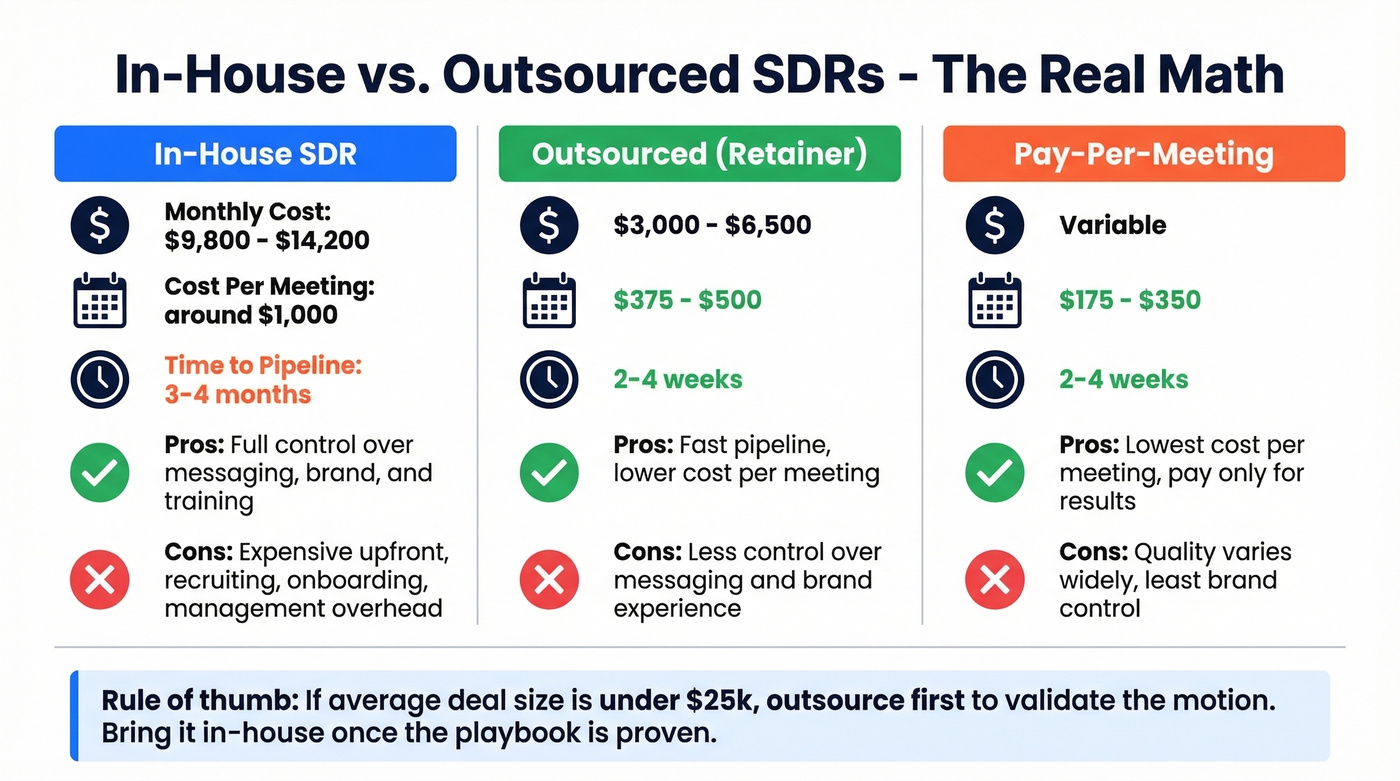
| Model | Monthly Cost | Cost/Meeting | Time to Pipeline |
|---|---|---|---|
| In-house SDR | $9,800-$14,200 | ~$1,000 | 3-4 months |
| Outsourced (retainer) | $3,000-$6,500 | $375-$500 | 2-4 weeks |
| Pay-per-meeting | Variable | $175-$350 | 2-4 weeks |
In-house SDRs are expensive upfront - factor in recruiting, onboarding, tools, management overhead, and 3-4 months before they generate real pipeline. Outsourced teams get to pipeline faster and cost less per meeting, but you lose control over messaging and brand experience.
Look, if your average deal size is under $25k, you probably don't need a full in-house SDR team yet. Outsource to validate a new market or ICP, then bring it in-house once the playbook is proven. The consensus on r/sales leans the same way - most founders who went in-house too early wish they'd tested the motion with an agency first.
Scaling Mistakes That Kill Sales Orgs
Three pitfalls kill more sales organizations than bad hiring:
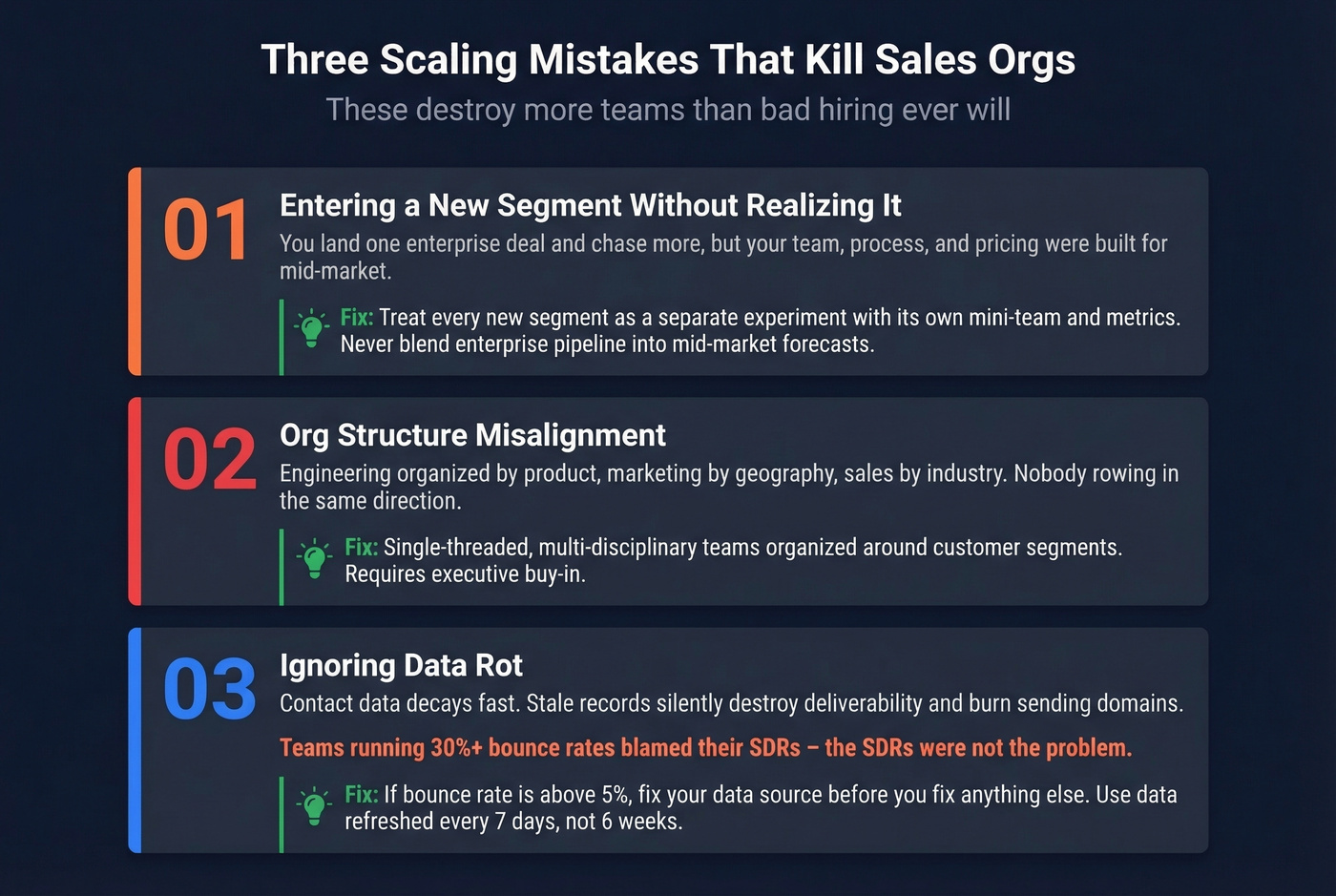
Entering a new segment without realizing it. You land your first enterprise deal and start chasing more, but your team, process, and pricing were built for mid-market. The fix: treat every new segment as a separate experiment with its own mini-team and its own metrics. Don't blend enterprise pipeline into your mid-market forecast - it'll wreck both.
Org structure misalignment. Engineering is organized by product line, marketing by geography, sales by industry vertical. Nobody's rowing in the same direction. Single-threaded, multi-disciplinary teams organized around customer segments cut through this, but it requires executive buy-in that most companies don't have until the pain gets bad enough.
Ignoring data rot. This one's frustrating because it's so preventable. If your bounce rate is above 5%, fix your data source before you fix anything else. Contact data decays fast, and stale records silently destroy deliverability. We've talked to teams running 30%+ bounce rates who blamed their SDRs for low meeting counts - the SDRs weren't the problem. (If you need a baseline, start with email bounce rate benchmarks and remediation.)
You're budgeting $475-$1,000/rep/month on your SDR stack. Bad data makes all of it worthless - burned domains, wasted dials, fiction forecasts. Prospeo delivers 143M+ verified emails and 125M+ verified mobiles at 90% less than ZoomInfo. Teams using Prospeo book 26% more meetings with cleaner data.
Stop paying enterprise prices for data that bounces.
FAQ
How many SDRs per AE should a B2B sales team have?
The standard ratio is 1 SDR per 1-2 AEs in outbound-heavy motions; enterprise teams with longer cycles often go 1:1. Start with pipeline math - if AEs have capacity but not enough meetings, add SDRs. If AEs are drowning in unqualified meetings, the problem is SDR training, not headcount.
What's the biggest mistake when building a sales team?
Hiring before building systems. Without a CRM, defined deal stages, and a repeatable playbook, new reps have nothing to follow and no way to ramp. Process first, headcount second. Every founder who skips this step ends up rebuilding six months later.
How long does it take to ramp a new B2B sales rep?
Plan for 3-6 months, with essentially zero productivity in months one and two. Teams using verified contact data with 98%+ email accuracy and weekly refresh cycles see faster ramp because reps spend less time chasing bad numbers and more time in actual conversations.
What's a good free tool for B2B prospecting data?
Prospeo's free tier includes 75 verified emails and 100 Chrome extension credits per month - enough for a solo founder or small team validating outbound. Hunter offers 25 free searches monthly but caps enrichment. For teams running real campaigns, credit-based pricing without contracts scales better than seat-based models. HubSpot's free CRM pairs well with either for managing the pipeline side.