

B2B Predictive Analytics: What Works in 2026
A distributor was hemorrhaging customers - 30% of annual sales walking out the door. They pointed a predictive model at churn signals, and within eight months, they'd recovered $5-10M in run-rate revenue. The predictive analytics market is racing toward $35.5B by 2027 at a 21.9% CAGR, and in a McKinsey survey of 2,500+ respondents, 64% of B2B companies said they expect to increase spending on predictive analytics.
Most B2B predictive analytics programs never get close to that distributor's results.
Here's the thing: churn prediction is the highest-ROI entry point, not lead scoring. First-party data, clearer signals, faster payoff. But none of it matters if your CRM data is a mess. Models trained on dirty data produce expensive noise. And you don't need a six-figure contract to start - clean contact data, intent signals, and your existing CRM get you 80% of the value.
The Business Case for Revenue Growth
McKinsey's research shows B2B analytics outperformers achieve up to five percentage points higher return on sales than their peers. On a $50M revenue base, that's $2.5M in additional profit - not theoretical, but measurable.
The buyer side makes the case even stronger. Gartner surveyed 632 B2B buyers in late 2024 and found 61% prefer a rep-free buying experience. Even more telling: 73% actively avoid suppliers that send irrelevant outreach, and 69% report inconsistencies between information on a supplier's website and what sellers actually provide. B2B predictive analytics isn't a nice-to-have. It's the mechanism that keeps your outreach coherent and your accounts from blacklisting you.
Why Most Programs Fail
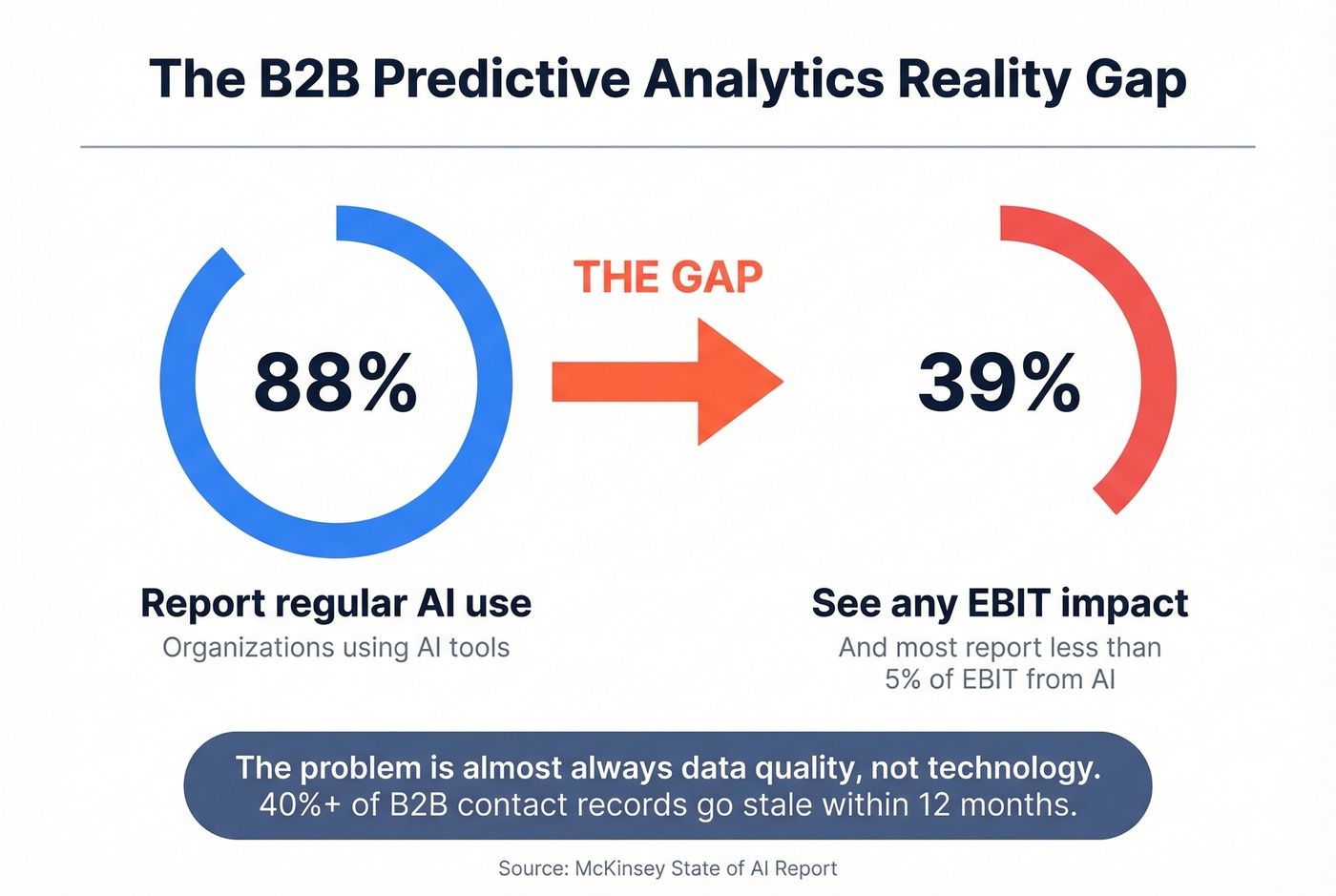
88% of organizations report regular AI use, but only 39% attribute any EBIT impact to it. Most of those report less than 5% of EBIT coming from AI. The gap between "we bought a platform" and "it's making us money" is enormous, and in our experience, it's almost always a data problem, not a technology problem.
Practitioner discussions across Reddit and B2B communities tell the same story. A BI consultant evaluating predictive tools for churn and LTV described the core fear perfectly: spending six months in "deployment hell" only to deliver a black box that the Chief Risk Officer won't trust. Three concerns surface consistently - explainability for stakeholders, integration complexity, and data readiness as the actual bottleneck. That last one is the killer. It's the one most vendors don't want to talk about.
Use Cases That Deliver
Start Here: Churn Prediction
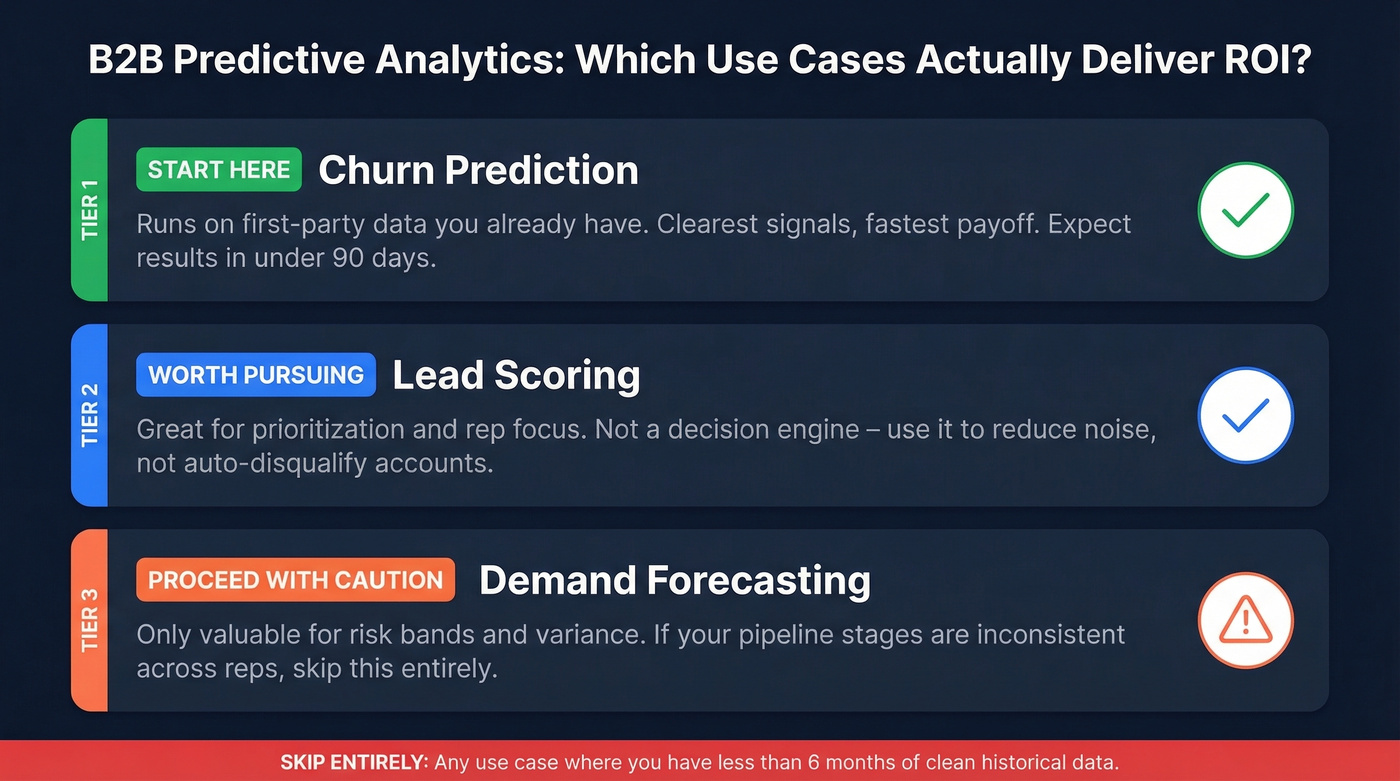
Churn prediction delivers the most reliable ROI for revenue teams because it runs on first-party product usage data, ties directly to contract timelines and revenue events, and has fewer lifecycle-stage ambiguities than acquisition models. We've seen churn models deliver measurable results in under 90 days when the data foundation is solid - it's the use case where signal-to-noise actually works in your favor.
Worth Pursuing: Lead Scoring
Predictive lead scoring is useful but only as a noise-reduction tool, not a definitive intent signal. Marrina Decisions found it works best for prioritization and planning, not as an autonomous decision engine. Use it to help reps focus. Don't use it to auto-disqualify accounts.
This is one of the most common predictive marketing analytics examples - and one of the most frequently misapplied.
Proceed With Caution: Demand Forecasting
Forecasting models add value when they highlight risk bands and variance, not when they promise precise numbers. If your pipeline stages mean different things to different reps, no model can save you.
Skip entirely any use case where you don't have at least a few months of clean historical data (ideally 6+). Predictive models without history are just random number generators with nice dashboards.

Every predictive model in your stack is only as good as the contact data feeding it. Prospeo delivers 98% email accuracy, a 92% API match rate, and 50+ enrichment data points per contact - refreshed every 7 days, not every 6 weeks. Layer in Bombora intent data across 15,000 topics and your scoring models finally have clean signals to work with.
Stop training predictive models on CRM data that's 40% garbage.
Tools and Platforms in 2026
Let's break down what's actually available, with real pricing where we could find it:
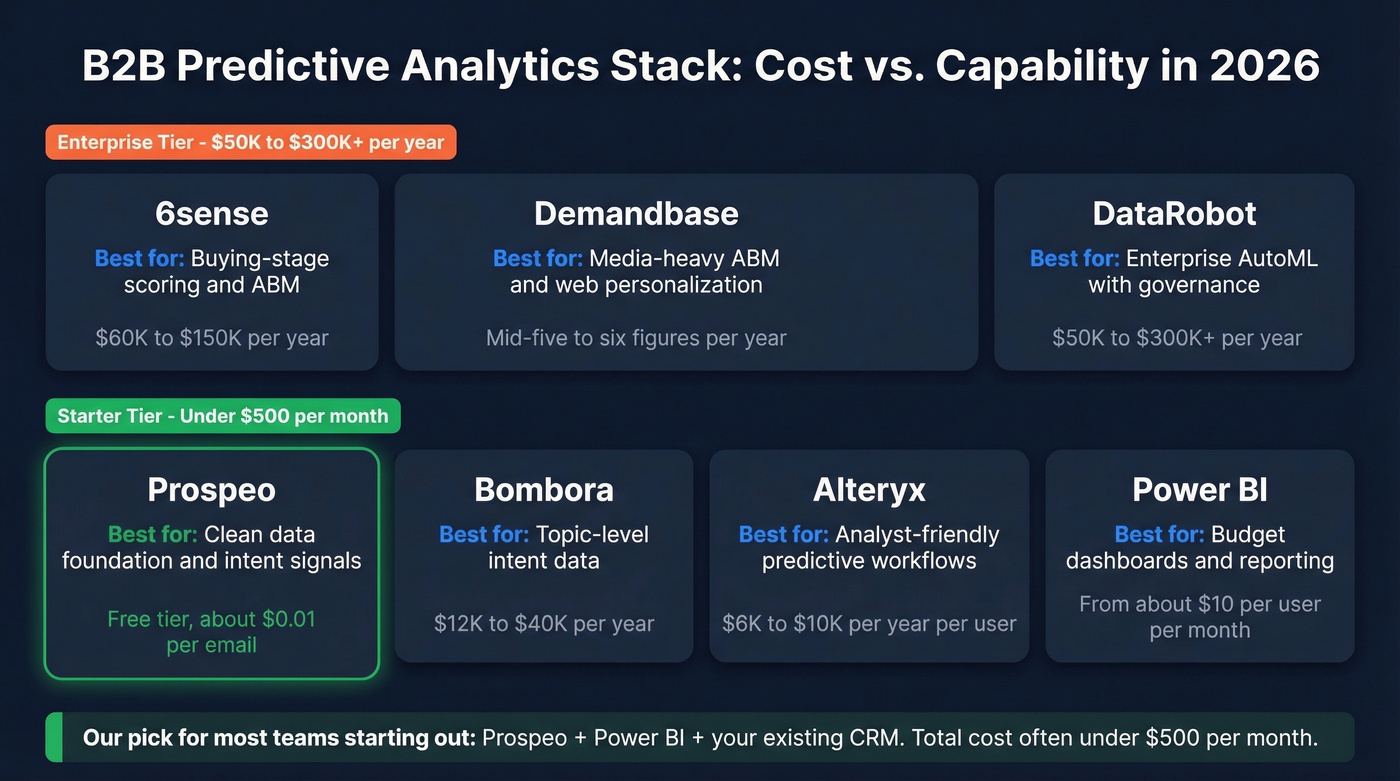
| Tool | Best For | Pricing |
|---|---|---|
| Prospeo | Clean data + intent signals | Free tier; ~$0.01/email |
| 6sense | Buying-stage scoring, ABM | ~$60K-$150K/yr (mid-market) |
| Demandbase | B2B advertising + ABM | Mid-five to six figures/yr |
| Bombora | Topic-level intent signals | $12K-$40K/yr |
| DataRobot | Model building + governance | ~$50K-$300K+/yr |
| Alteryx | Analyst-friendly predictive | ~$6K-$10K/yr per user |
| Tableau / Power BI | Dashboards + reporting | Power BI from ~$10/user/mo; Tableau from ~$15-$75+/user/mo |
Our pick for most teams starting out: Prospeo for data foundation, Power BI for visualization, your existing CRM for orchestration. For small teams, total cost is often under $500/month.

The Data Foundation Matters Most
Predictive models are only as good as the contact data feeding them. This is where we've watched teams burn months of work - they'll invest in a sophisticated scoring engine, then feed it a CRM where 40% of email addresses bounce. The model dutifully scores garbage contacts as high-priority, reps waste cycles chasing dead ends, and leadership concludes "predictive doesn't work for us."
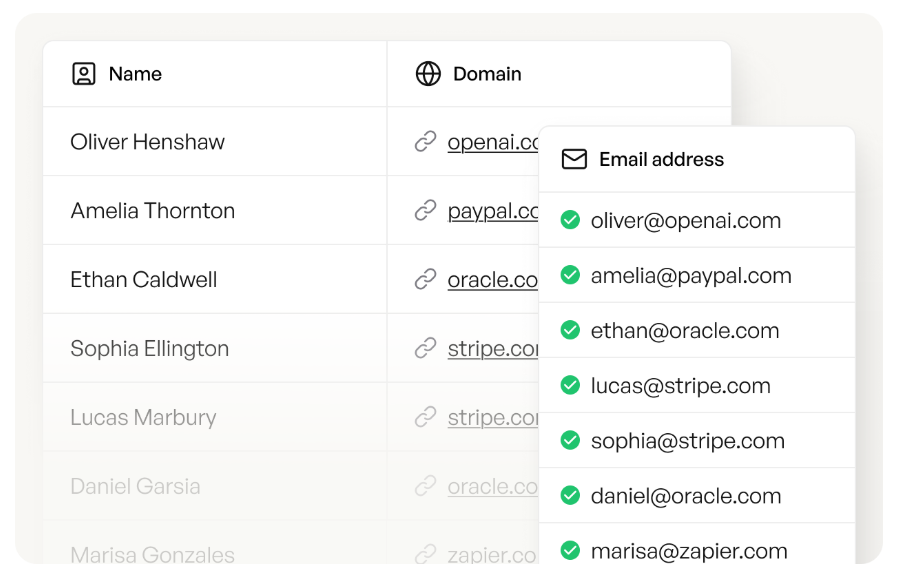
Prospeo addresses this with a 98% email accuracy rate and a 7-day data refresh cycle versus the 6-week industry average. The API match rate is 92%, enrichment returns 50+ data points per contact, and you get Bombora-powered intent data tracking 15,000 topics - all self-serve with transparent pricing and no annual contract.

6sense vs. Demandbase
Choose 6sense when your priority is predictive buying-stage scoring and sales orchestration. It's the stronger analytics engine.
Choose Demandbase when your strategy is media-heavy ABM with a native B2B DSP and web personalization.
Both are custom-quote enterprise tools landing in the mid-five to six figures annually. Real talk: if your average deal size is under $25K, neither platform will pay for itself. Prove value with a lighter stack first.
DataRobot, Alteryx, and the BI Layer
DataRobot handles enterprise AutoML with strong governance and explainability - important when stakeholders need to understand why the model made a decision. Alteryx is the best option for analyst-heavy teams that want data prep and predictive insights without full MLOps. Power BI is the budget visualization pick; Tableau offers more flexibility for complex dashboards.
How to Start Without Wasting Six Figures
1. Fix your CRM data first. If 40%+ of your contacts are stale - and in our experience, that's conservative - no predictive model will help. Verify existing records with an enrichment API before doing anything else. This isn't the optional step. It's the prerequisite.
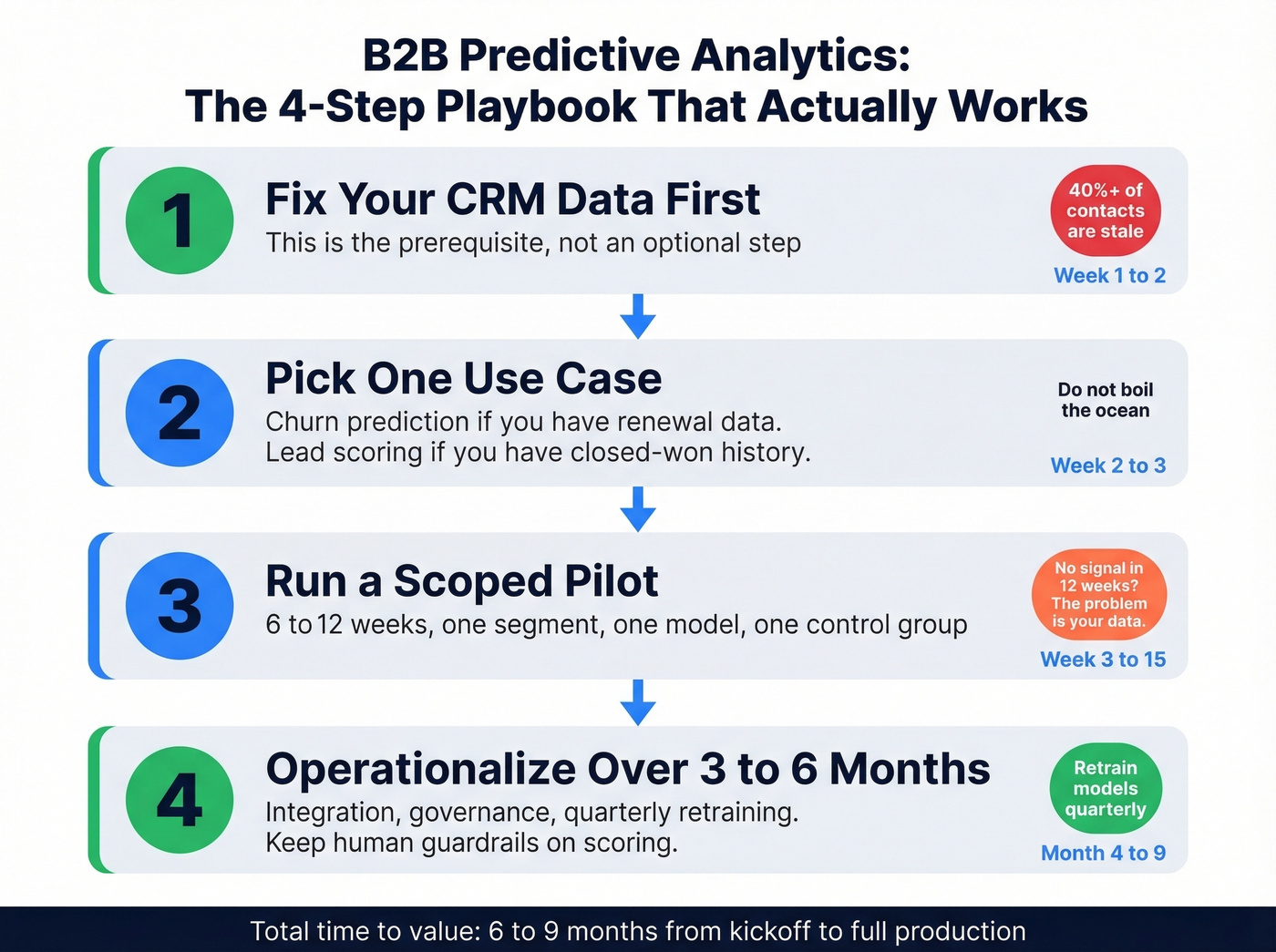
2. Pick one use case. Churn prediction if you have renewal data. Lead scoring if you have enough closed-won history. Don't boil the ocean.
3. Run a scoped pilot. Six to twelve weeks, one segment, one model. Measure against a control group. If it doesn't show signal in 12 weeks, the problem is your data, not the approach.
4. Operationalize over 3-6 months. Integration, governance, retraining cadence. Keep human guardrails - review score performance against sales acceptance rates and retrain quarterly. Behavioral models in particular need regular recalibration as buyer engagement patterns shift, so build that into your roadmap from day one rather than treating it as a future optimization.
Measuring Predictive Analytics ROI
Most teams can't measure ROI well. A 6sense benchmark found that while 82% of teams have adopted ABM, fewer than 25% rate their measurement practices as even fair.
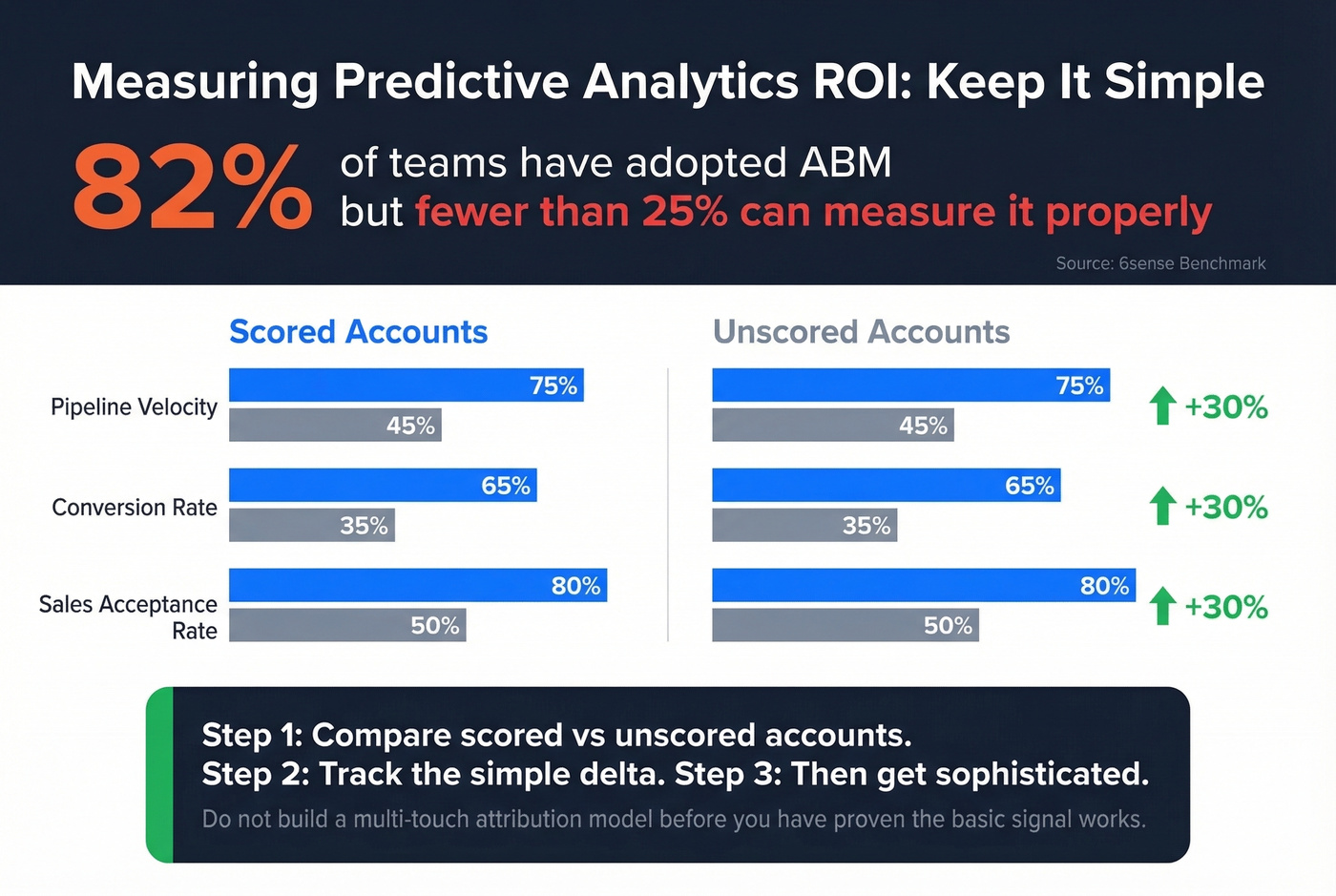
Compare pipeline velocity and conversion rates on scored versus unscored accounts. That's it. Don't build a multi-touch attribution model before you've proven the basic signal works. Track the simple delta first, then get sophisticated.
You don't need a six-figure platform to start with B2B predictive analytics. Prospeo gives you verified contact data, intent signals, and CRM enrichment at ~$0.01 per email - no contracts, no sales calls. Pair it with your existing BI tools and CRM for a predictive stack under $500/month.
Get enterprise-grade data foundations without enterprise pricing.
FAQ
Do I need a data science team?
No. AutoML platforms like DataRobot handle model building for SQL-heavy analysts without dedicated data scientists. For many teams, clean contact data plus intent signals layered into existing CRM scoring delivers 80% of the value with zero ML expertise.
How long until it shows ROI?
Expect 6-12 weeks for a scoped pilot on one use case and one segment. Full operationalization takes 3-6 months. Churn prediction typically shows measurable revenue impact fastest because it relies on first-party data with clearer signals.
What's the minimum budget?
You can start for under $500/month with verified contact data at ~$0.01/email, Power BI from ~$10/month per user, and your existing CRM. Enterprise platforms like 6sense or Demandbase run $60K-$300K+/year - worth it only after you've proven value with a pilot.
What's the biggest mistake teams make?
Buying a six-figure platform before cleaning their CRM. Over 40% of B2B contact records go stale within 12 months. Run enrichment and verification on your existing database first - if your foundation is garbage, even the best predictive model outputs noise.