

B2B Sales vs B2C Sales: Key Differences in 2026
Every guide comparing B2B sales vs B2C sales opens with "B2B takes longer." That's true, but it's about as useful as saying "the ocean is wet." The real question is how much longer, why it's longer, and what that means for your career, your comp plan, and the tools you need.
The defining difference isn't cycle length - it's how many people can kill your deal before it closes.
Here's the quick version:
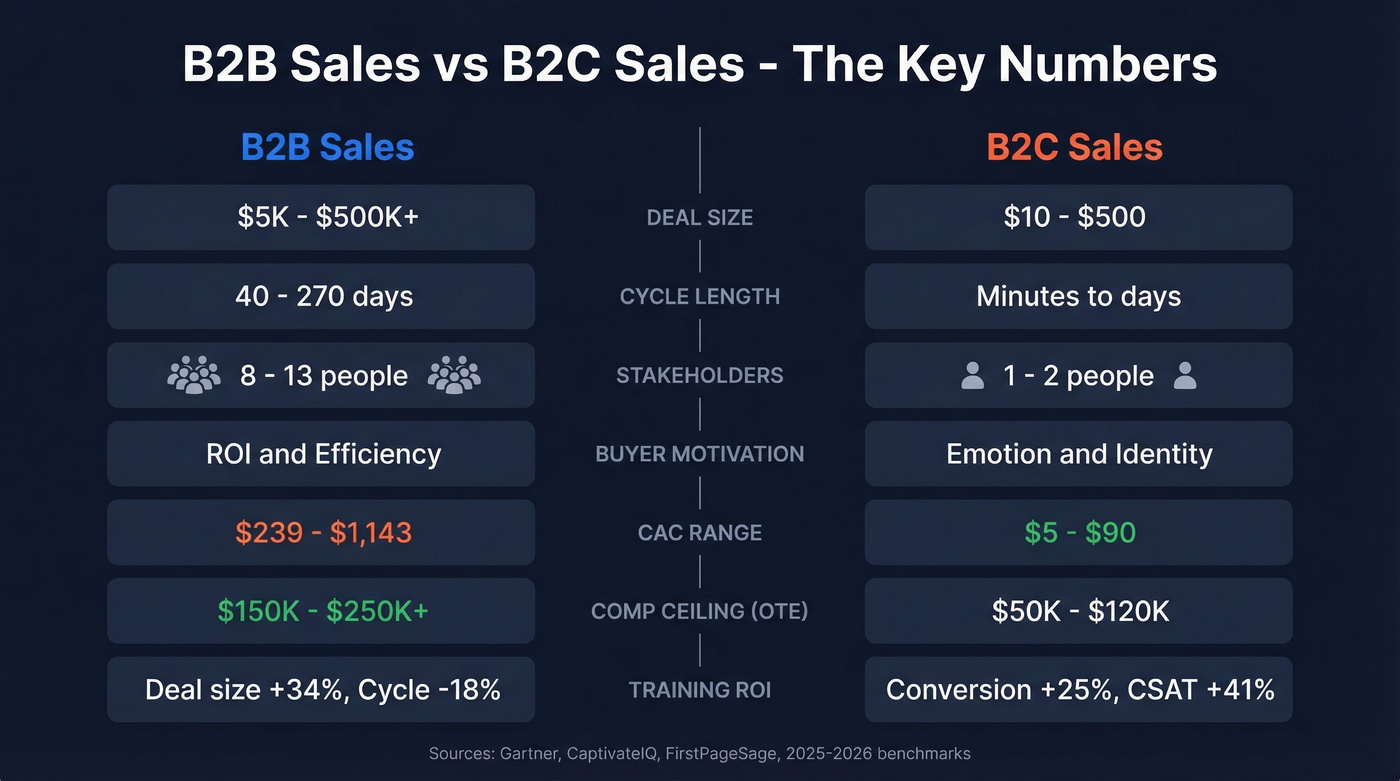
- Cycle length: B2B deals run 40-270 days depending on deal size. B2C closes in minutes to days.
- Stakeholders: A B2B deal now involves 8-13 people (Gartner). B2C? One - maybe two if your spouse has opinions about the new car.
- Comp ceiling: Mid-market B2B AEs earn $150K-$175K OTE. B2C comp tops out lower unless you're selling luxury real estate or high-end automotive.
If you're deciding between B2B and B2C careers, jump to the "Which Is Right for You?" section. If you're building or restructuring a sales team, the cycle length and CAC data below will be most useful.
Side-by-Side Comparison
| Dimension | B2B Sales | B2C Sales |
|---|---|---|
| Deal size | $5K-$500K+ | $10-$500 typical |
| Cycle length | 40-270 days | Minutes to days |
| Stakeholders | 8-13 per deal | 1-2 |
| Buyer motivation | ROI, efficiency | Emotion, identity |
| CAC range | $239-$1,143 | $5-$90 |
| Comp ceiling (OTE) | $150K-$250K+ | $50K-$120K |
| Key metrics | Deal size, cycle, retention | Conversion rate, AOV |
| Training ROI | Deal size +34%, cycle -18% | Conversion +25%, CSAT +41% |
The global B2B eCommerce market hit $11.54 trillion in 2024 and is projected to reach $60.62T by 2034 at an 18% CAGR. B2C eCommerce sits around $6.4T globally, with US retail eCommerce alone expected to reach $1.8T by 2028. B2B is the bigger pond - and the one where individual deals actually move the needle.
Sales Cycle Length
The median B2B SaaS sales cycle is 84 days. That median hides enormous variation based on deal size.
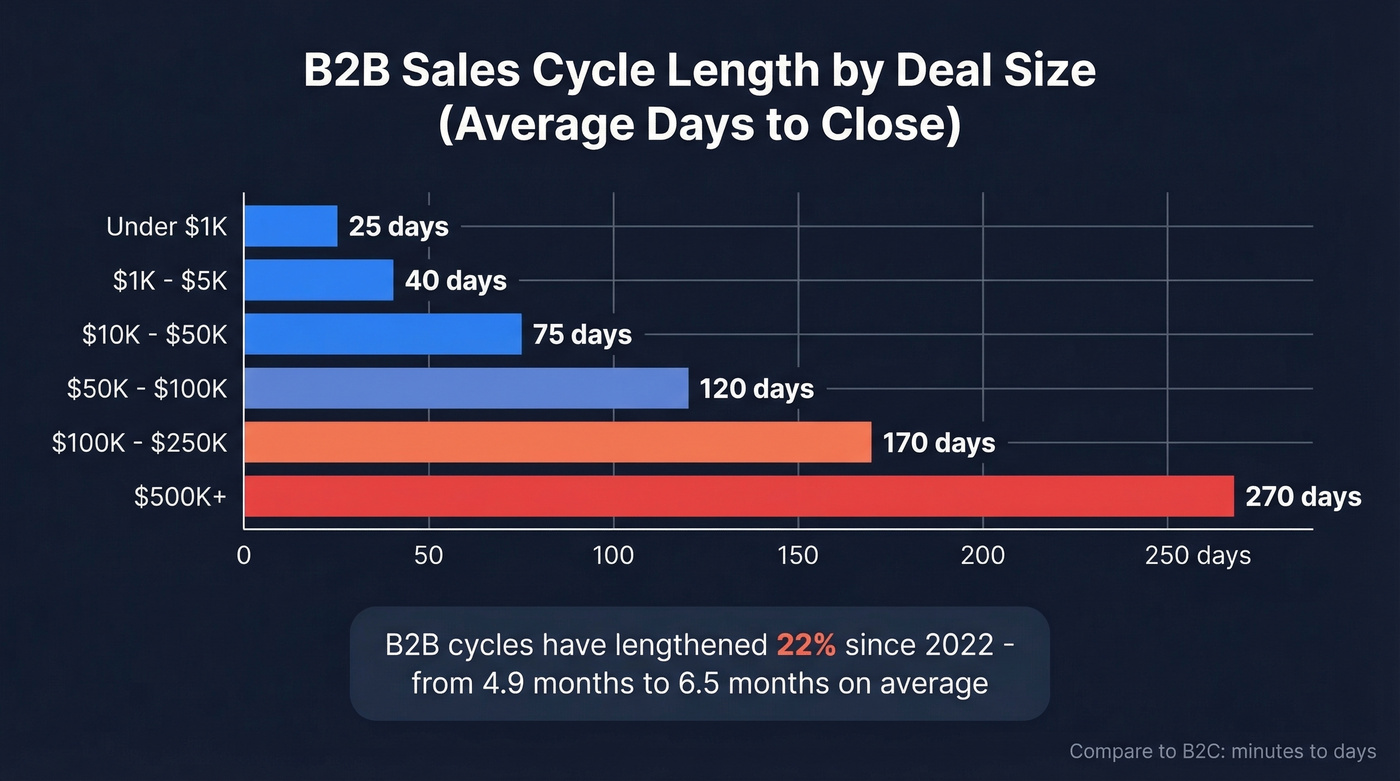
| ACV Range | Avg. Days to Close |
|---|---|
| Under $1K | 25 |
| $1K-$5K | 40 |
| $10K-$50K | 75 |
| $50K-$100K | 120 |
| $100K-$250K | 170 |
| $500K+ | 270 |
Industry matters too. Software averages 90 days, manufacturing runs 130, healthcare 125, and energy stretches to 155. Prospect company size is another variable most guides ignore: selling to a 10-person startup averages 38 days, while enterprise accounts with 10,000+ employees average 185 days. Compare all of that to B2C, where the "cycle" is often the time between someone seeing an ad and tapping "Buy Now."
Here's the thing: it's getting worse. B2B sales cycles have lengthened 22% since 2022. More stakeholders, more procurement red tape, more legal review. The average cycle has stretched from 4.9 months in 2019 to 6.5 months today, and this widening gap is one of the most tangible ways the difference between selling to businesses and selling to consumers shows up in day-to-day work.
A B2C rep can close dozens of deals in a day. A B2B enterprise AE might close a handful all year. Neither is better - they're fundamentally different games.
Buying Committees - The Real Bottleneck
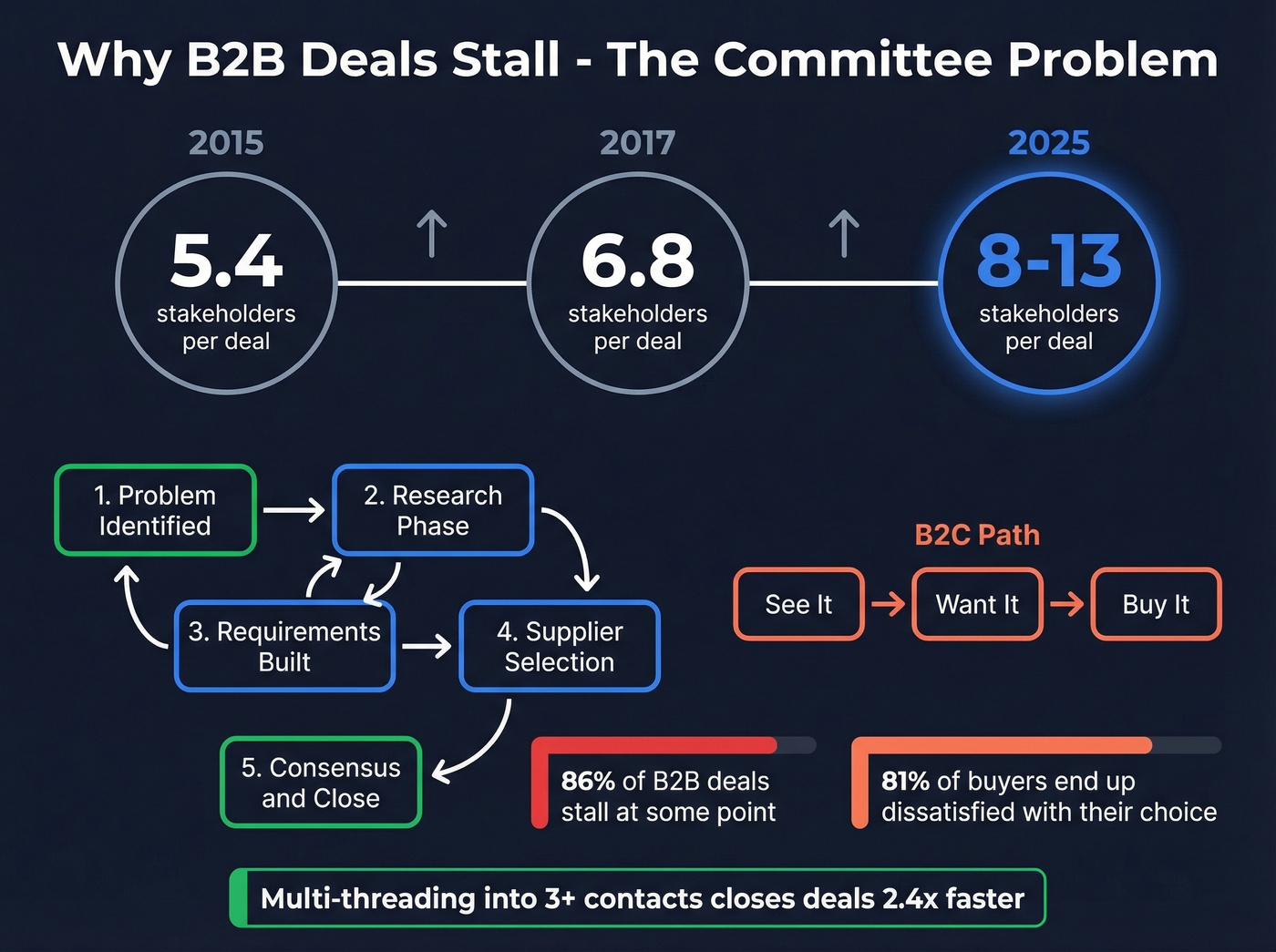
This is where B2B gets genuinely hard. The number of people involved in a B2B purchase has nearly doubled in a decade: 5.4 stakeholders in 2015, 6.8 by 2017, and 8-13 today depending on deal complexity.
In B2C, you're convincing one person. Maybe their partner weighs in on the kitchen renovation. That's it.
In B2B, you're navigating a committee where any single member can stall or kill the deal. Forrester found that 86% of B2B purchases stall at some point, and 81% of buyers end up dissatisfied with the provider they chose. That's not a sales problem - it's a committee-consensus problem. The typical B2B buying process follows a non-linear path through problem identification, research, requirements building, supplier selection, and consensus, with loops back at every stage. B2C buying is comparatively linear: see it, want it, buy it.
We've watched this play out dozens of times. One deal we tracked had a VP champion ready to sign in week three. Procurement added four months of security questionnaires and legal redlines. The negotiation-to-close phase alone ate 35-40% of total cycle time. The rep who saved that deal did it by multi-threading into procurement and legal before the champion even asked for budget approval.
That brings up the most actionable stat in this article: multi-threading into 3+ contacts within an account closes deals 2.4x faster. If you're single-threading enterprise deals in 2026, you're leaving money and time on the table.
Earning Potential
Let's talk money. The CaptivateIQ 2025 benchmarks put mid-market B2B AE OTE at $150K-$175K, with a 50/50 base-variable split as the dominant structure. Enterprise AEs at well-funded companies often land $200K-$250K+ OTE.
But here's the reality check: average quota attainment is 74%, and only 16% of reps actually hit full quota. That $175K OTE becomes about $130K for the median performer.
On the B2C side, comp varies wildly by vertical. UK data tells a similar story at lower absolute numbers: automotive sales managers around PS41K OTE, luxury retail consultants at PS29K base, insurance sales execs around PS25K base. In the US, top B2C earners in real estate or luxury automotive can clear $150K+, but those are outliers. The ceiling is higher in B2B. The ramp is longer. A B2C rep can be productive in weeks; a B2B enterprise AE takes 6-9 months to close their first deal. You need the financial runway - and the patience - to survive that ramp.

Multi-threading into 3+ contacts closes deals 2.4x faster - but only if those contacts are real. Prospeo gives you 98% verified emails and 125M+ direct dials so every thread connects to an actual decision-maker, not a dead inbox.
Stop single-threading with bad data. Start closing B2B deals faster.
Customer Acquisition Cost
B2B CAC is higher in absolute dollars, but it's justified by dramatically higher lifetime value. Here are combined CAC benchmarks by industry:
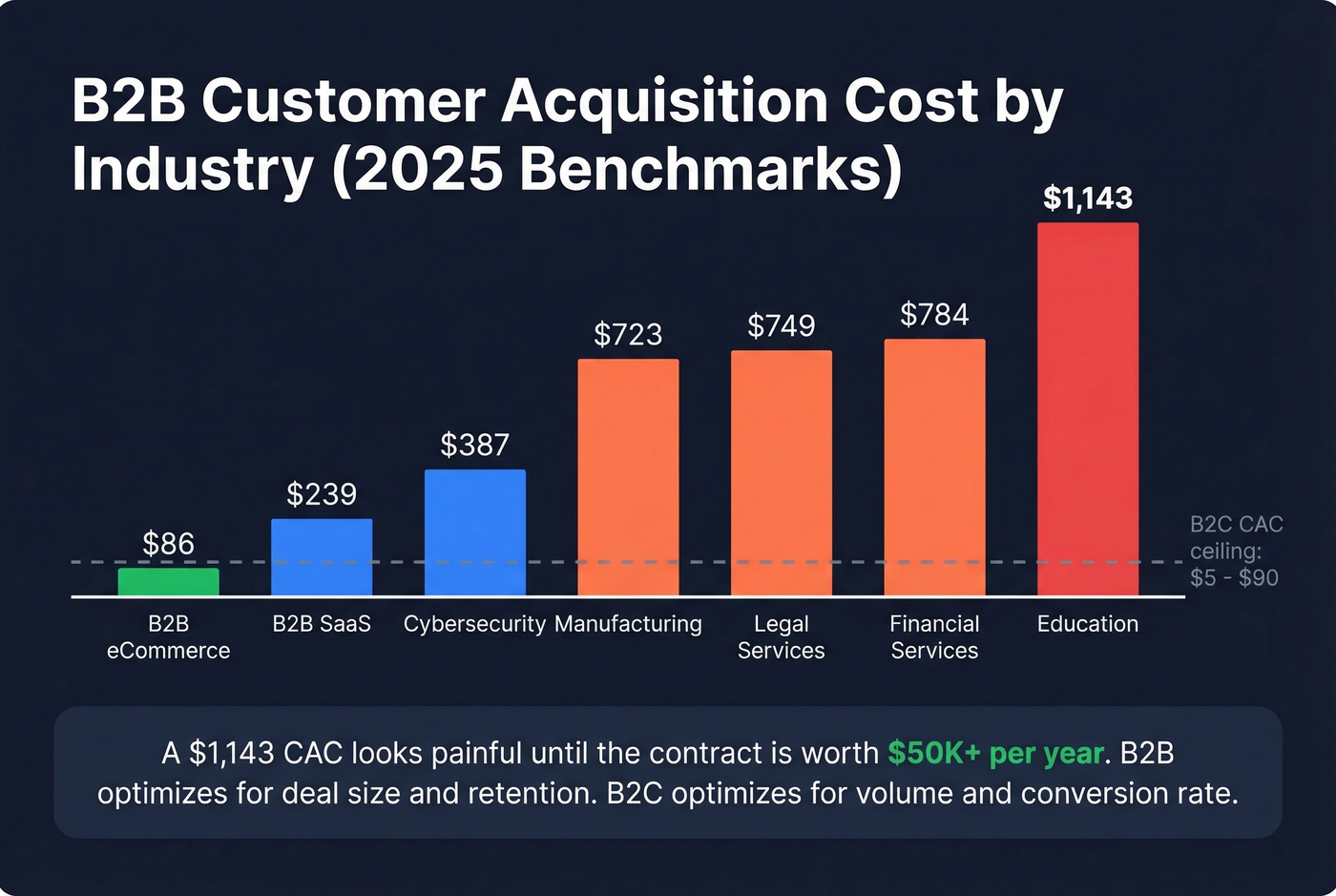
| Industry | Combined CAC |
|---|---|
| B2B eCommerce | $86 |
| B2B SaaS | $239 |
| Cybersecurity | $387 |
| Manufacturing | $723 |
| Legal Services | $749 |
| Financial Services | $784 |
| Education | $1,143 |
B2C CAC typically runs $5-$90 depending on category, with eCommerce on the lower end and financial products higher. The math works differently: B2C optimizes for volume and conversion rate, while B2B optimizes for deal size and retention. A $1,143 CAC in education looks painful until you realize the contract is worth $50K+ annually.
How B2B Buying Is Changing
The line between B2B and B2C buying behavior is blurring faster than most sales orgs have adapted. Product-led growth means B2B buyers now expect B2C-like self-serve experiences. They want to try before they talk to sales.
The numbers back this up. 94% of B2B buyers now use LLMs during their buying process. Average sales cycle length dropped from 11.3 months to 10.1 months between 2024 and 2025 in one large-sample study - which seems to contradict the longer-term trend of cycle lengthening. The most likely explanation is that AI is compressing research phases without reversing the structural forces (bigger committees, more compliance) that stretch everything else. First contact with vendors moved earlier, from 69% to 61% of the buyer's journey, pulling outreach forward by roughly 6-7 weeks.
B2B buyers are doing more homework before they ever talk to your reps. They're reading case studies, checking G2 reviews, and asking ChatGPT whether your product is worth a demo. By the time they book a call, they've already formed an opinion. That 81% buyer dissatisfaction stat from Forrester? It's partly because buyers feel they know more about the problem than the rep does by the time they connect.
The reps who win are the ones who engage early with useful insights, not the ones who wait for inbound leads to show up fully qualified.
Our hot take: if your deal size sits below $10K, you probably don't need a six-month enterprise sales motion. Treat it like a high-consideration B2C sale - fast demos, self-serve trials, and a rep who closes in days, not quarters. The companies blending consumer-grade speed with B2B rigor at the lower end of the market are eating everyone else's lunch.
Prospecting and Pipeline Building
B2B and B2C diverge most sharply in day-to-day prospecting work. B2B outbound is wide open - businesses are fair game for cold email, cold calls, and direct outreach. B2C prospecting is heavily constrained by DNC lists and TCPA regulations. As one r/sales poster put it, B2B "seems way better" partly because you can actually reach your prospects without a compliance lawyer breathing down your neck.
But B2B reps still spend only 28-30% of their time actually selling. The rest goes to CRM updates, internal meetings, and chasing bad contact data - which compounds every other time-waster. When your "verified" email list bounces 25% on the first sequence, you've wasted hours of prospecting time and damaged your domain reputation. We've tested dozens of data providers over the years, and the difference between 98% and 85% email accuracy is the difference between a productive week and a wasted one.

The minimum B2B stack is three tools: a CRM like HubSpot or Salesforce, a data platform like Prospeo for verified emails and direct dials, and a sequencing tool like Instantly, Lemlist, or Outreach for automated follow-up. Skip the ten-tool Frankenstacks. Three tools that integrate cleanly beat ten that create data silos every single time.
If you're tightening your outbound motion, start with sales prospecting techniques and a clean lead generation workflow before you add more tools.
B2B cycles are 22% longer than 2022. You can't afford to waste months chasing outdated contacts. Prospeo refreshes all 300M+ profiles every 7 days - 6x faster than competitors - so your pipeline reflects reality, not last quarter's org chart.
Shorten your sales cycle with data that's never more than a week old.
Which Is Right for You?
Go B2B if you want higher comp ceilings, enjoy complex problem-solving, and can handle 6-9 month deal cycles without losing motivation. B2B rewards patience, strategic thinking, and relationship building across multiple stakeholders. The ramp is longer, but the payoff compounds - companies that redesign training for B2B-specific skills see deal sizes increase 34% and cycles shorten 18%.
If you're leaning enterprise, read up on enterprise B2B sales and what the enterprise sales rep role actually looks like day to day.
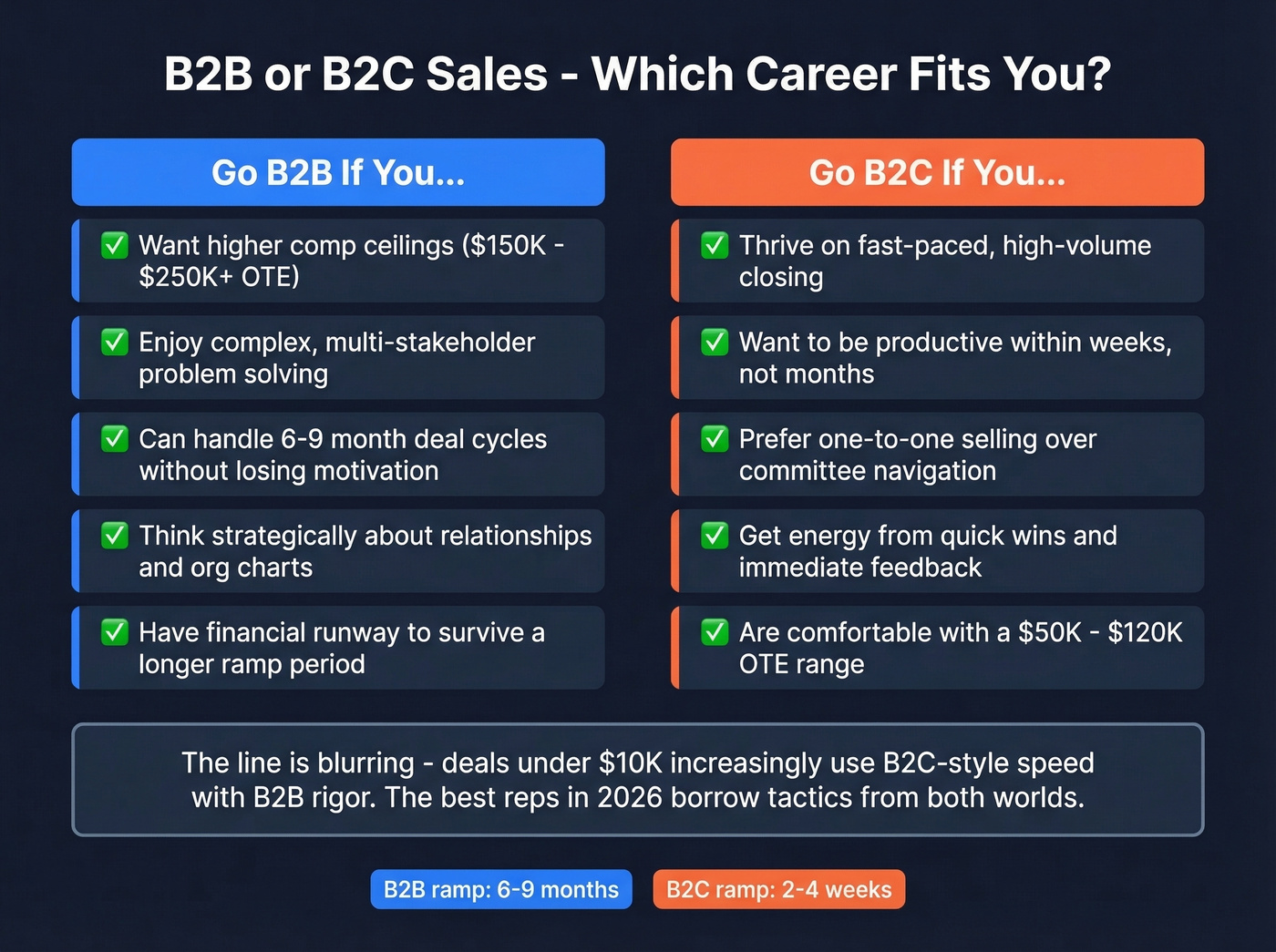
Go B2C if you thrive on fast feedback loops, high transaction volume, and the energy of closing multiple deals daily. B2C rewards speed, emotional intelligence, and the ability to read individual buyers quickly. Teams that invest in B2C-specific training see conversion rates jump 25% and customer satisfaction rise 41%.
If you're transitioning from B2C to B2B, your objection handling and rapport-building skills transfer directly. What doesn't transfer: the patience for multi-stakeholder navigation and 6-month nurture cycles. Your first enterprise deal will feel agonizingly slow compared to closing a consumer sale in 20 minutes. That's normal. The skills that made you great at B2C - reading people, handling objections, building trust - are the foundation. You just need to learn to apply them across 8-13 people instead of one.
FAQ
Is B2B sales harder than B2C?
Neither is objectively harder - they're hard differently. B2B has longer cycles of 84-270 days, larger buying committees of 8-13 people, and only 16% of reps hit full quota. B2C has prospecting restrictions from DNC/TCPA regulations, lower per-deal comp, and relentless volume pressure. Pick the type of hard you prefer.
Can you switch from B2C to B2B?
Yes, and many successful B2B reps started in B2C. Objection handling and relationship skills transfer directly. The adjustment is patience - your first enterprise deal can take 6-9 months - and learning to navigate multi-stakeholder buying committees instead of closing one person at a time.
What's the main difference between B2B and B2C selling?
Decision-making complexity. B2C involves one buyer making a largely emotional decision in minutes to days. B2B involves 8-13 stakeholders making a committee-driven decision over months, with ROI justification, procurement review, and legal approval at every stage. Everything else - cycle length, comp structure, prospecting tactics - flows from that core difference.
What tools do B2B sales teams need?
At minimum: a CRM like HubSpot or Salesforce, a data platform for verified emails and direct dials, and a sequencing tool for outreach automation. These three cover pipeline building, contact management, and automated follow-up. Don't overcomplicate it.