

The B2B Startup Marketing Strategy Most Guides Get Wrong
Your investor just asked about your go-to-market plan. You pulled up three "B2B marketing strategy" articles, and every one assumed you have a 12-person marketing team, a $200K quarterly budget, and a Marketo instance. You don't. You have a founder, a Notion doc, and maybe $2K/month.
A solid B2B startup marketing strategy starts from that reality - not an enterprise fantasy. Only 33% of seed-funded companies successfully raise Series A, and the ones that do aren't running the playbook those enterprise guides describe.
What Actually Works (Quick Version)
Here's the channel sequence for B2B startups spending under $5K/month:
- Cold email and direct outreach - pipeline in weeks, not months.
- Partnerships - find companies selling to your ICP who aren't competitors.
- Content and SEO - the long game. Expect 6-12 months before it compounds.
- Paid ads - only after you've validated messaging with proof points.
The guardrails: keep LTV:CAC at 3:1 or better, CAC payback under 12 months. If a channel can't hit those numbers, kill it.
The Channel Order Most Founders Get Backwards
Most founders start with content or paid ads because those feel like "real marketing." But only 5% of B2B buyers are actively in-market at any given time. Cold email lets you reach that 5% directly and get immediate feedback on your messaging. SEO delivers the highest ROI long-term, but PostHog's team documented the reality: 5-6 months to see meaningful traction, 12 months before it truly compounds. Meanwhile, Gartner projects traditional search volume will drop 25% by 2026 as AI answers eat into organic clicks - making direct outreach channels even more critical for startups that can't wait a year for results.
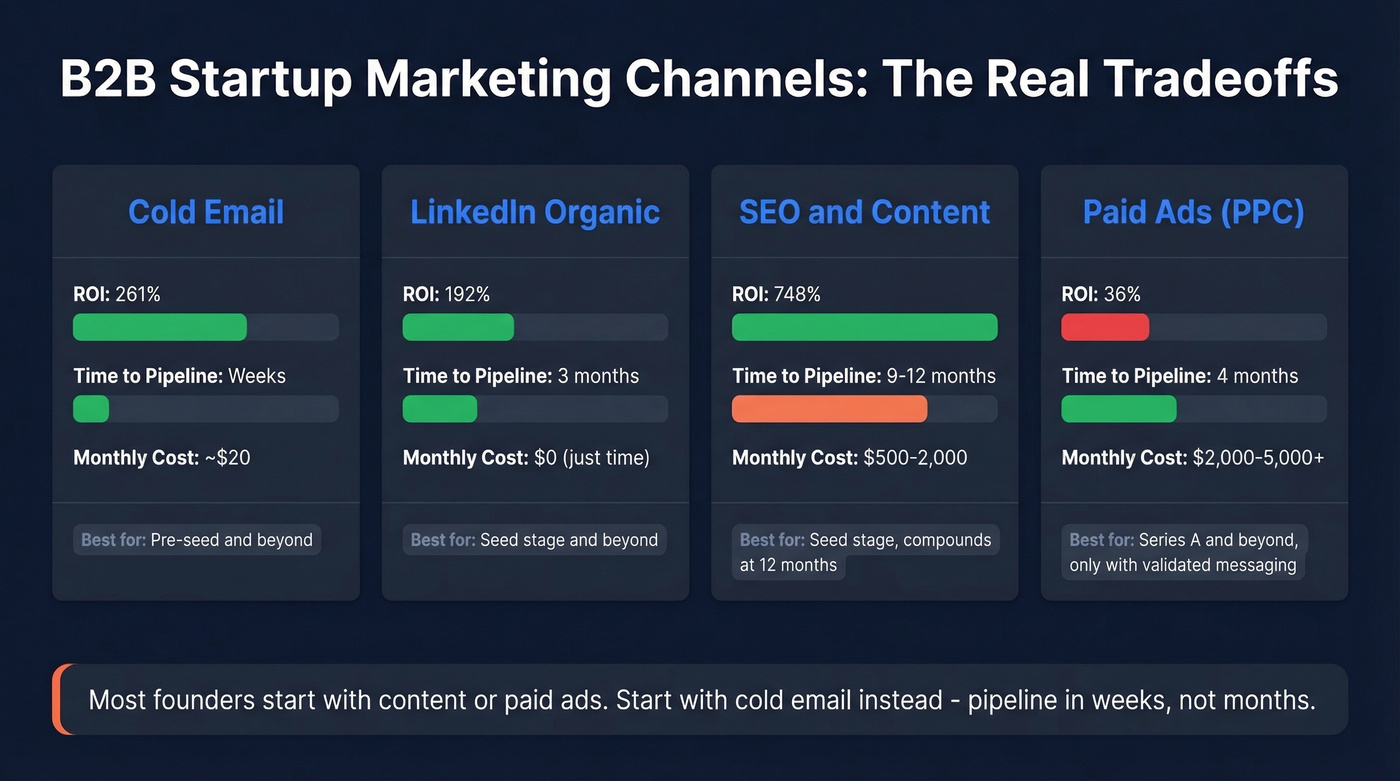
We've seen this pattern repeatedly: a founder posts on LinkedIn and their company blog for months, sees zero pipeline, and concludes "content marketing doesn't work." Content works. It just doesn't work first. Cold email works first - but only if the data's clean. Bounced emails torch your domain reputation, and keeping bounce rates under 3% with verified data at roughly a penny per email makes outbound viable on a near-zero budget.
| Channel | ROI | Breakeven | Best Stage |
|---|---|---|---|
| Cold email | 261% | ~7 months | Pre-seed+ |
| LinkedIn organic | 192% | ~3 months | Seed+ |
| SEO/content | 748% | ~9 months | Seed+ (compounds at 12mo) |
| Paid ads (PPC) | 36% | ~4 months | Series A+ |
SEO wins on ROI but loses on speed. Cold email wins on speed and costs almost nothing. Paid ads deliver the worst ROI and require validated messaging to even function. Yet founders keep launching Google Ads campaigns in month one.
Marketing Strategy by Startup Stage
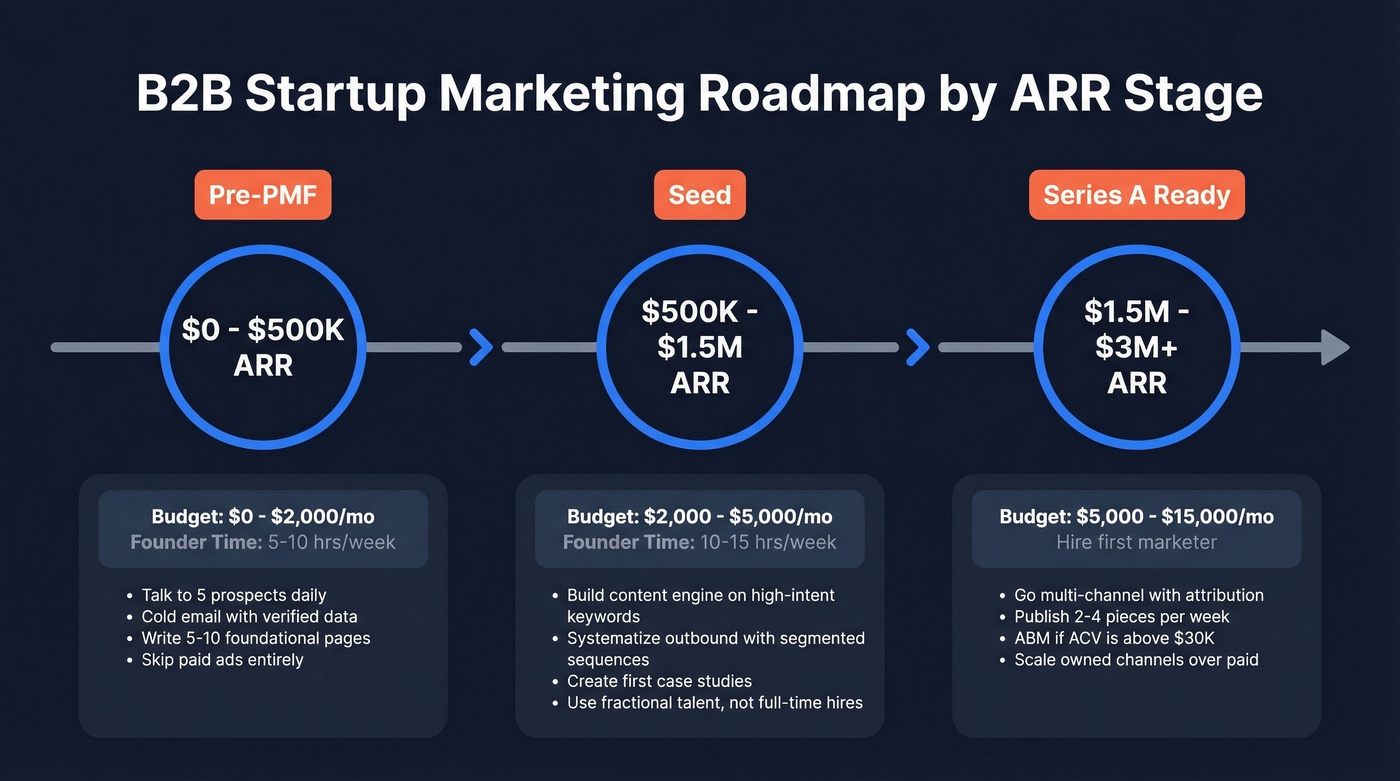
| ARR Stage | Monthly Budget | Founder Time | Focus |
|---|---|---|---|
| $0-$500K | $0-$2,000 | 5-10 hrs/week | Outbound, conversations |
| $500K-$1.5M | $2,000-$5,000 | 10-15 hrs/week | Content engine, SEO |
| $1.5M-$3M+ | $5,000-$15,000 | Hire first marketer | Multi-channel, attribution |
Pre-PMF ($0-$500K ARR)
This stage is founder-led everything. Your marketing strategy is talking to prospects. The boring fundamentals compound: talk to five prospects daily, send targeted messages instead of mass blasts, share insights in communities, and follow up at least three times. The second and third touch often yield the best conversations. For bootstrapped growth especially, these free, high-touch tactics are the only ones that make financial sense.
Ignore paid acquisition, complex attribution, and brand campaigns. Spend 5-10 hours a week on outbound and customer research, and the rest building product. Write 5-10 foundational content pieces so your website isn't empty when prospects look you up, but don't pretend content is your growth engine yet.
Seed ($500K-$1.5M ARR)
Now you've got signal on what resonates. Build a content engine targeting high-intent keywords - the searches buyers make when actively looking for a solution. Systematize outbound with marketing support. Create your first case studies. Start segmented email sequences instead of one-size-fits-all blasts.
Plan 10-15 hours a week between yourself and a fractional hire. The math doesn't work for full-time specialists yet - a marketing manager runs $137K-$142K/year, and covering SEO, content, and demand gen costs $370K+ in salary alone. Use tools and fractional talent instead.
Series A-Ready ($1.5M-$3M+ ARR)
This is where you scale into a repeatable growth machine. Go multi-channel: organic, email, social, and paid if messaging is validated. Build attribution from content to pipeline to revenue. Compete on depth, not breadth - one great article outperforms 25 generic ones. PostHog found that a single newsletter issue drove more clicks than a $5,000 sponsorship, which tells you everything about the value of owned channels at this stage. Aim for 2-4 pieces per week to maintain momentum.
If your ACV is above $30K, this is when ABM becomes appropriate - targeted account plays with personalized content and multi-threaded outreach.

Most startup marketing guides skip the hardest part: finding verified contact data for your ICP without burning your budget or your domain. Prospeo gives you 30+ filters to build targeted prospect lists by funding stage, headcount, tech stack, and job title - with 98% email accuracy and a 7-day refresh cycle so your outbound never runs on stale data.
Build your first prospect list free - 75 verified emails, no credit card.
Build Your Outbound Engine First
Do this:
- Build a targeted prospect list using filters like industry, headcount, funding stage, and job title - then verify every email before sending
- Write 3-5 personalized email variants, A/B test subject lines, and follow up at least three times
- Track bounce rates weekly and pull any domain showing issues
Skip this if you're pre-revenue:
- Sending 500+ emails/day from a fresh domain
- Using generic templates with nothing but {first_name} personalization
- Running outbound without verified data
The average B2B cost per lead runs ~$200. Outbound with clean data cuts that dramatically. But bad data kills outbound faster than bad copy - bounced emails burn sender reputation, and once that's gone, even good emails land in spam. In our experience, bounce rates above 5% start degrading deliverability fast. Prospeo's 98% email accuracy and 7-day data refresh cycle keep you well below that threshold, and the free tier gives you 75 verified emails per month to test messaging before spending anything.
If you want to go deeper on sequencing, start with a B2B cold email sequence and keep a swipe file of cold email subject line examples.
At $0.01 per verified email, Prospeo fits inside a $0-$2K/month startup budget without flinching. The free tier gives you 75 emails to validate messaging before you spend a dollar, and bounce rates stay under 3% - protecting the domain reputation your entire outbound engine depends on.
Stop paying enterprise prices for startup-stage prospecting.
PLG vs Sales-Led: Pick Your Path
Your ACV determines your channel mix more than any other variable. PLG companies are valued 30%+ higher than peers, per OpenView's research. But PLG isn't a strategy - it's a distribution model. It works when you're targeting a large market with self-serve signup, transparent pricing, low-cost acquisition channels, and quick time-to-value.
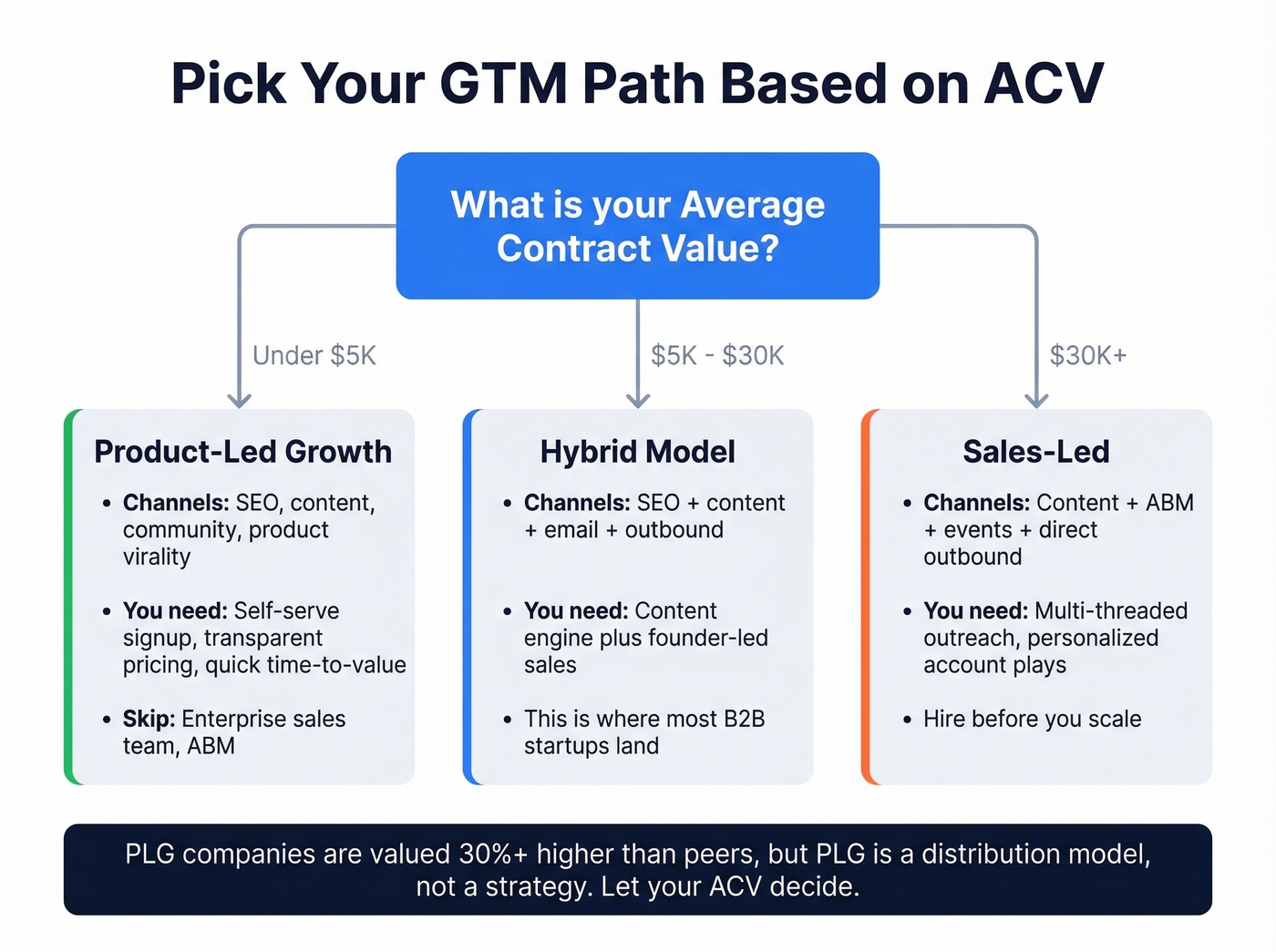
Here's the thing most marketing guides won't tell you: if your deal size is under $10K, you probably don't need ZoomInfo-level data infrastructure or a sales team. You need a product people can try and a founder who sends cold emails.
- Under $5K ACV - PLG, SEO, content, community, product virality
- $5K-$30K ACV - SEO + content + email + outbound (hybrid)
- $30K+ ACV - Content + ABM + events + direct outbound
If you’re still defining your ICP, use an Ideal Customer Profile template before you scale any channel.
Mistakes That Burn Cash
A mediocre PR firm costs $8K-$15K/month. Pre-PMF, that's money on fire. You can't outsource positioning when you haven't figured out positioning yet. The same applies to brand marketing agencies - they need a strategy to execute against, and you don't have one until you've closed enough deals to see patterns.
Let's be honest: if your head of marketing has never owned a revenue commit, they're too junior for this stage. We've seen startups hire "marketing managers" who run great campaigns but have no idea how to connect activity to pipeline. Every marketing dollar needs a line to revenue right now. SaaStr's Jason Lemkin flags this consistently - early-stage founders over-index on search strategy relative to its actual pipeline contribution in the first 12 months.
I once watched a pre-seed founder spend $12K on a "brand sprint" with an agency. Three weeks later he had a new logo, a color palette, and zero customers. Don't be that founder.
Growth Metrics That Actually Matter
- CAC payback: 12 months or less for SMB, 18 months or less for mid-market
- LTV:CAC: 3:1 minimum - below that, you're subsidizing customers
- Pipeline Velocity = (SQLs x Win Rate x ASP) / Sales Cycle Days
- Website conversion: average is 1.8%, target 3-5%
- MQL to SQL: 10-30% is the healthy range
- Marketing-sourced pipeline: 30-60% of revenue targets
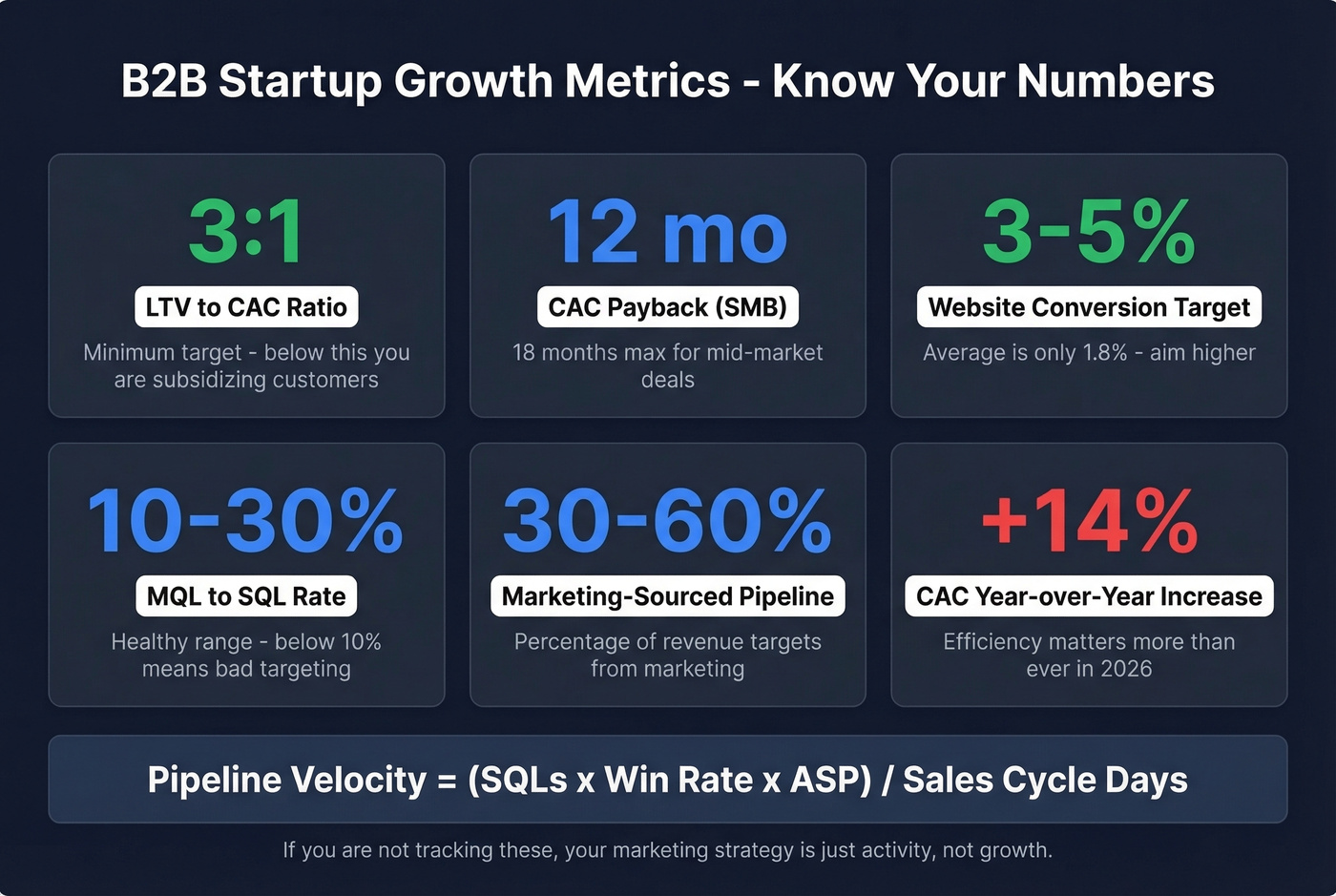
The macro picture isn't getting easier. New-customer CAC is up 14% year-over-year, and SaaS ARR growth has normalized to ~26% YoY. Efficiency matters more than ever. Bad data inflates CAC silently - bounced emails waste sequences, burn domains, and skew every downstream metric. Tracking these numbers rigorously is how you drive revenue instead of just burning through runway.
Any B2B startup marketing strategy that doesn't tie every channel back to these benchmarks is just activity, not growth.
FAQ
What's the first marketing channel for a B2B startup?
Cold email. It delivers immediate messaging feedback, builds pipeline in weeks, and costs almost nothing with verified data. A free tier of 75 emails/month is enough to test positioning before spending a dollar. Layer in content and SEO once you've validated through real conversations.
How much should a startup spend on marketing?
B2B companies average 7-9% of revenue on marketing. Pre-$500K ARR, spend $0-$2K/month. At $500K-$1.5M ARR, budget $2K-$5K/month. Approaching Series A, allocate $5K-$15K/month across outbound, content, and early paid experiments.
When should a startup hire a marketer?
After $500K ARR, consider a fractional marketer. A full-time specialist costs $137K-$142K/year. Before that threshold, founders should handle marketing directly - 5-10 hours per week of outbound builds the foundation no hire can replicate.
How do I keep bounce rates low on cold outreach?
Use a data provider with real-time verification - bounce rates above 5% degrade deliverability fast. A 5-step verification process with a 7-day refresh cycle maintains 98% email accuracy, keeping most campaigns under 3% bounce. Verify every list before sending, and monitor domain health weekly.