

Bad Leads Cost More Than You Think - Here's How to Fix Them
A RevOps lead we know ran the numbers last quarter: out of 8 meetings booked by the SDR team, 4 were close-lost within two weeks. Not because the reps couldn't sell - because the leads were never going to buy. Wrong title, wrong budget, wrong stage. Meanwhile, reps spent 60% of their time on non-selling tasks, and the meetings that did happen chewed up the other 40% on prospects who were never a fit.
That's the bad leads problem. It's worse than most teams realize.
The Quick Version
Most bad leads stem from a fit problem (wrong ICP), a data problem (dead contacts), or an execution problem (poor discovery, weak follow-up). Each requires a completely different fix.
If your SQL rate is below 60%, start with a qualification framework - BANT, CHAMP, or MEDDIC depending on deal complexity - and a shared sales-marketing definition of "qualified." Before you blame the leads, check your data: 30% of B2B contact data decays every year, and only 27% of generated leads are ever contacted by sales in the first place.
What Are Bad Leads, Really?
"Bad leads" is a lazy catch-all label. It covers everything from wrong ICP to no-shows to dead email addresses to "the AE didn't like the call." When everyone uses the same phrase for completely different problems, nobody fixes anything. The phrase becomes a blame bucket that lets both marketing and sales avoid accountability.
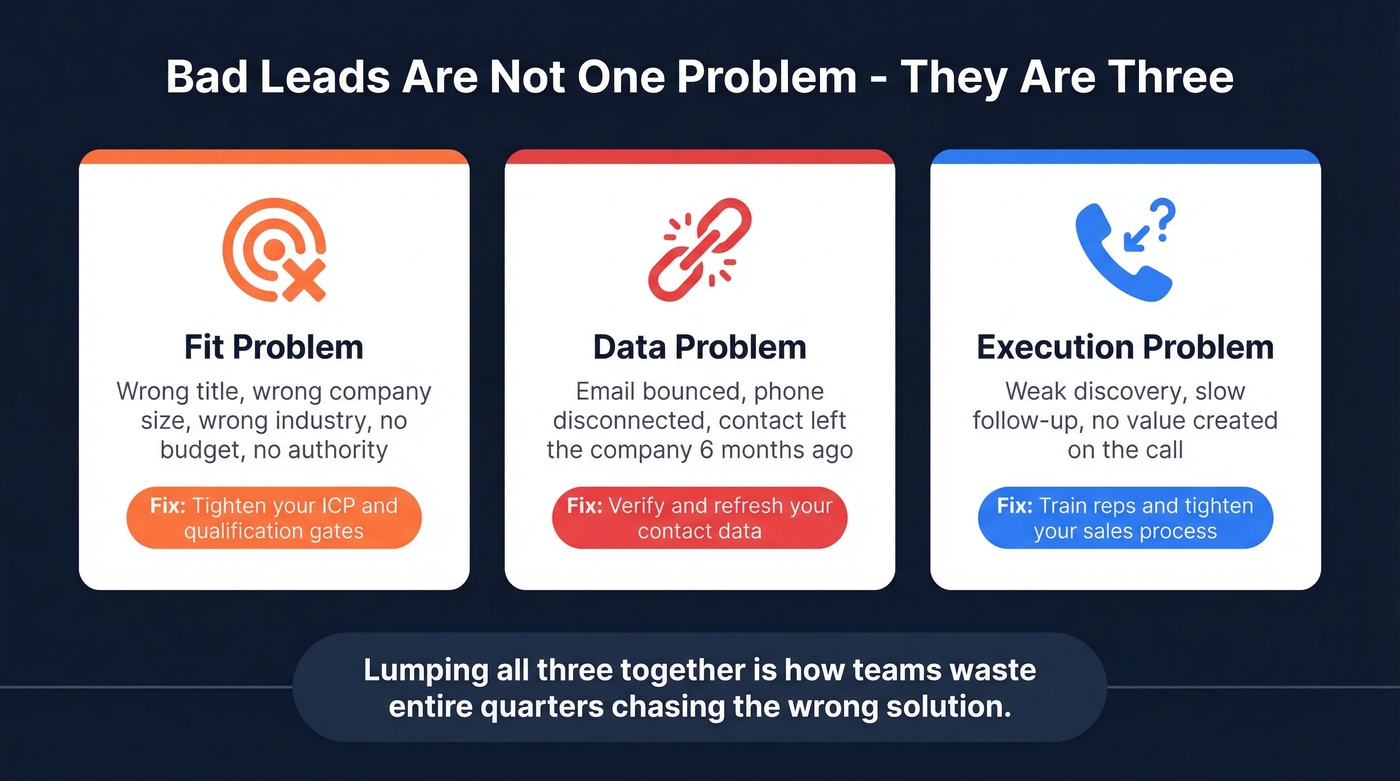
Let's split it into what it actually is.
A fit problem means you're reaching people who were never going to buy - wrong title, wrong company size, wrong industry, no budget, no authority. These should've been filtered out before they ever reached a rep's calendar. A data problem means the lead might've been perfect, but the email bounced, the phone number was disconnected, or the contact left the company six months ago. An execution problem means the lead was qualified and reachable, but the rep didn't run strong discovery, failed to create enough value, or followed up too slowly. Lumping all three together is how teams waste entire quarters chasing the wrong solution.
Only 7% of salespeople consider marketing leads "very high quality." That stat should terrify every demand gen leader. But it also means 93% of sales teams are working with leads they don't trust - and the root cause isn't always what they think it is.
The Real Cost of Poor Lead Quality
Nearly 79% of marketing leads never convert into sales. That's not a rounding error - that's the majority of your pipeline evaporating before it reaches a rep's calendar. Worse, only 27% of generated leads are ever contacted by sales at all. The rest sit in a CRM rotting.
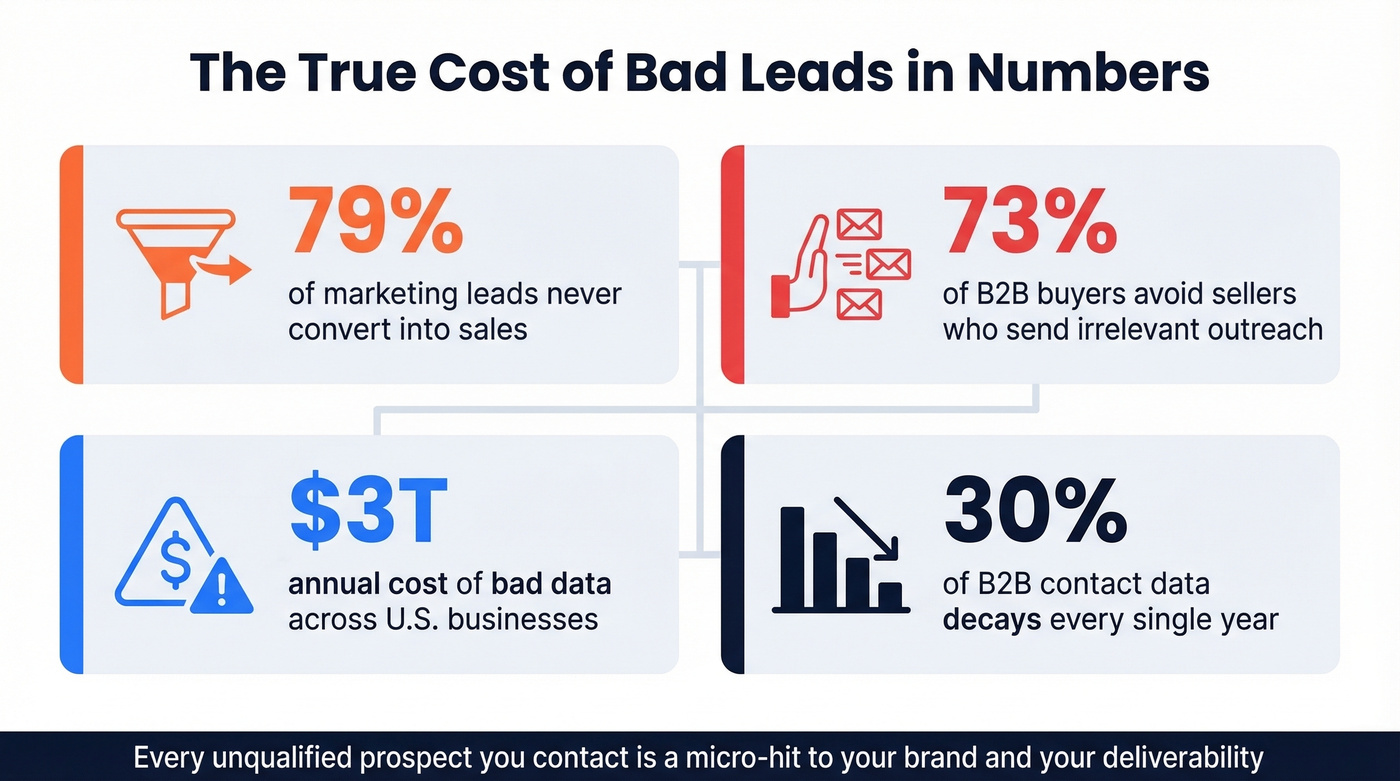
The financial damage compounds fast. Organizations lose 20-30% of annual revenue to poor data quality, and according to Harvard Business Review, the broader cost of insufficient data exceeds $3 trillion annually across U.S. businesses. It's not just wasted ad spend or SDR hours - 73% of B2B buyers [actively avoid sellers](https://corporatevisions.com/blog/b2b-buying-behavior-statistics-trends/) who send irrelevant outreach. Every unqualified prospect you contact is a micro-hit to your brand.
Then there's the deliverability angle that nobody talks about until it's too late. Send enough emails to dead addresses and your domain reputation tanks. Once that happens, even your good leads stop seeing your messages. The cost isn't just the leads themselves - it's the collateral damage to every campaign that follows, compounding into months of lost selling capacity per year across your entire team.
Why You're Getting Bad Leads
Junk leads don't appear out of nowhere. They're manufactured by broken processes. Here are the root causes we see most often:
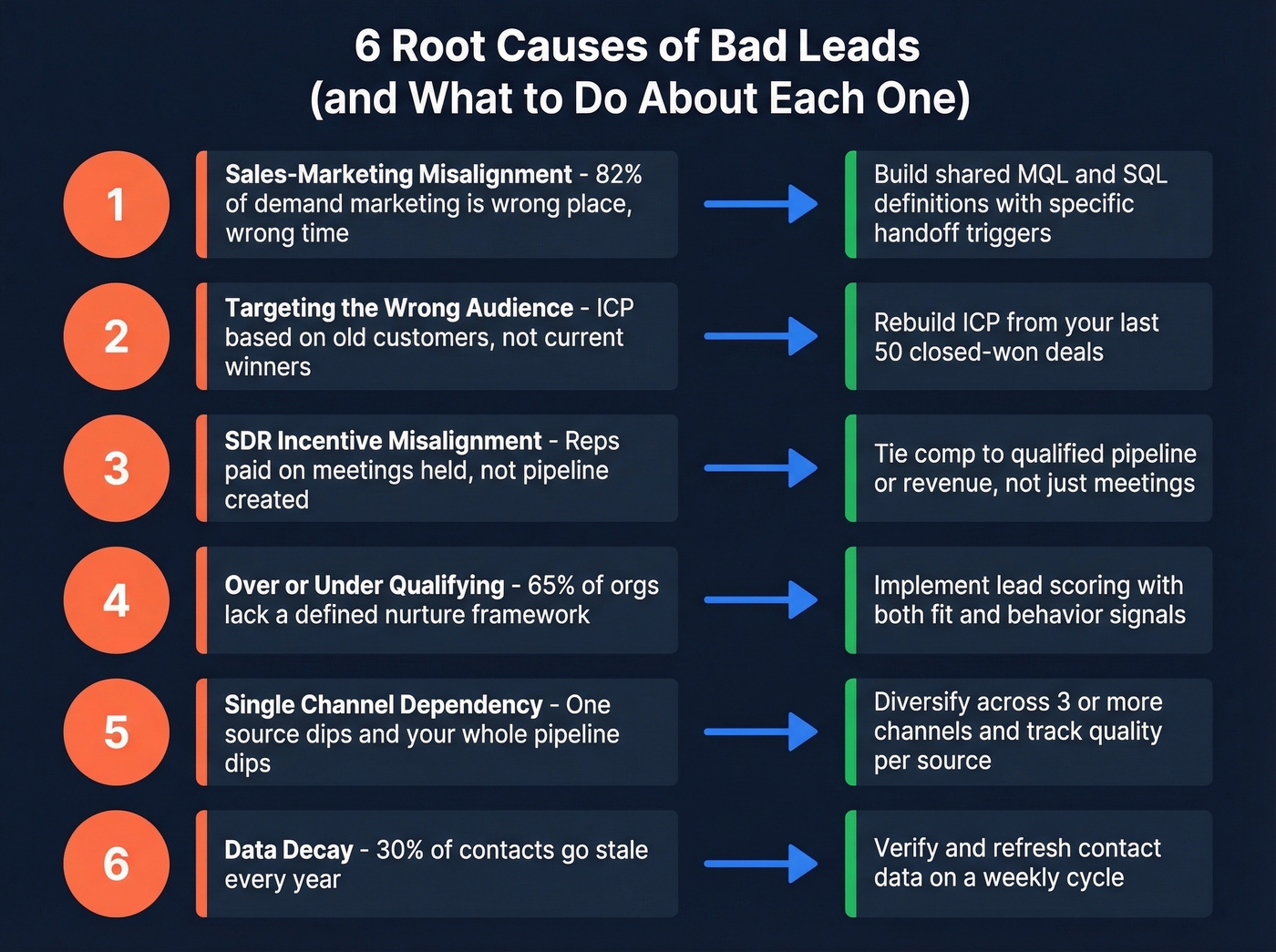
Sales-marketing misalignment. 82% of demand marketing is "wrong place, wrong time" because marketing and sales don't share a definition of "qualified." Marketing hits their MQL target. Sales says 90% are garbage. Both are right - they're just measuring different things.
Targeting the wrong audience. If your ICP hasn't been updated since your last funding round, you're probably reaching companies that look like your customers from two years ago, not the ones closing today. Poor lead quality is almost always a targeting problem before it's anything else.
SDR incentive misalignment. Here's the thing: when SDRs are paid on meetings held, they'll book meetings that should never exist - including recycling recent close-lost accounts under the pretense of "showing what's new." The meeting happens. The AE is furious. The lead was never real. Fix the comp plan or accept the garbage pipeline.
Over- or under-qualifying. Too many gates and you starve the pipeline. Too few and you flood reps with noise. Standardized lead scoring fixes this, but 65% of organizations lack a defined nurture framework to begin with. Effective nurturing generates 50% more sales-ready leads at 33% lower cost - but you can't nurture what you haven't scored.
Single-channel dependency. Relying entirely on one source - paid search, content syndication, cold outbound - concentrates risk and narrows your lead profile. When that channel's quality dips, your entire pipeline dips with it.
Data decay. 30% of B2B contact data decays every year. People change jobs, companies get acquired, phone numbers get reassigned. If you aren't refreshing your data regularly, a growing chunk of your "leads" are ghosts - and list quality issues will silently erode every campaign you run.

Data decay is the silent killer behind most bad leads. 30% of B2B contacts go stale every year - but Prospeo refreshes all 300M+ profiles every 7 days, not the 6-week industry average. With 98% email accuracy and 5-step verification that catches spam traps and honeypots, your reps stop wasting hours on bounced emails and disconnected numbers.
Stop feeding your team dead contacts. Start with data you can trust.
How to Identify Bad Leads
Spotting unqualified or unreachable prospects before they waste rep time requires two things: a qualification framework for fit and a scoring model for behavior.
Qualification Frameworks Compared
Not every framework fits every sales motion:
| Framework | Best For | Core Question | Weakness |
|---|---|---|---|
| BANT | High-volume, transactional | Budget and timeline? | Too simple for complex deals |
| CHAMP | Mid-market, consultative | What challenge to solve? | Needs more discovery skill |
| MEDDIC | Enterprise, multi-stakeholder | Who's the champion? | Heavy training investment |
| GPCT | Long-cycle, strategic B2B | What are their goals? | Slow; not for quick triage |
If your average deal is under $15K, you probably don't need anything beyond BANT. We've watched teams overcomplicate qualification frameworks because it feels rigorous, but the real bottleneck is almost never framework sophistication - it's whether anyone actually uses the framework consistently. Use BANT for quick triage on high-volume inbound, CHAMP for mid-market consultative sales, and MEDDIC for enterprise deals where you need to map the entire decision process.
Lead Quality Filtering That Works
Qualification frameworks tell you who to talk to. Lead scoring tells you when. The best lead quality filtering models use two separate pillars: fit (who they are) and behavior (what they've done).
A sample fit scoring rubric:
| Signal | Points |
|---|---|
| Job title VP/Director | +20 |
| Company size 100-500 employees | +15 |
| Industry SaaS/Tech | +15 |
| Personal email address | -10 |
| Pricing page visit | +15 to +20 |
| Single blog post view | +3 to +5 |
Negative scoring is the part most teams skip - and it's the most important. Without it, a college student who downloads every whitepaper on your site scores higher than a VP who visited your pricing page once.
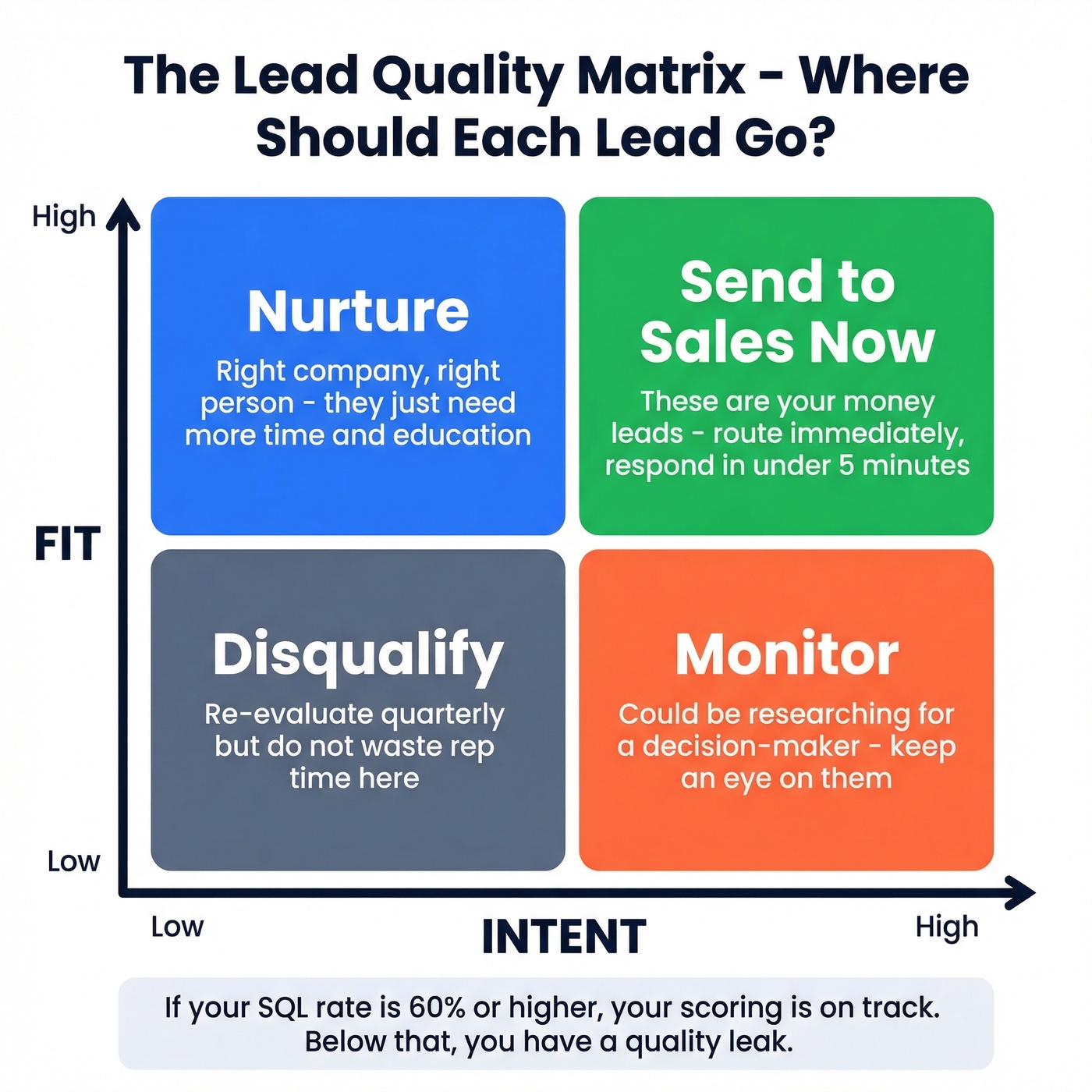
Think of it as a 2D matrix. High Fit + High Intent goes straight to sales. High Fit + Low Intent goes into nurture. Low Fit + High Intent gets monitored - they might be researching for a decision-maker. Low Fit + Low Intent gets disqualified, though it's worth re-evaluating that bucket quarterly since circumstances change. If your SQL rate is 60%+, your qualification and scoring are generally on track. Below that, you've got a quality leak somewhere in the model.
Fix the Sales-Marketing Disconnect
The single biggest source of bad leads isn't a data problem or a targeting problem - it's a definitions problem. Marketing and sales literally mean different things when they say "qualified lead."
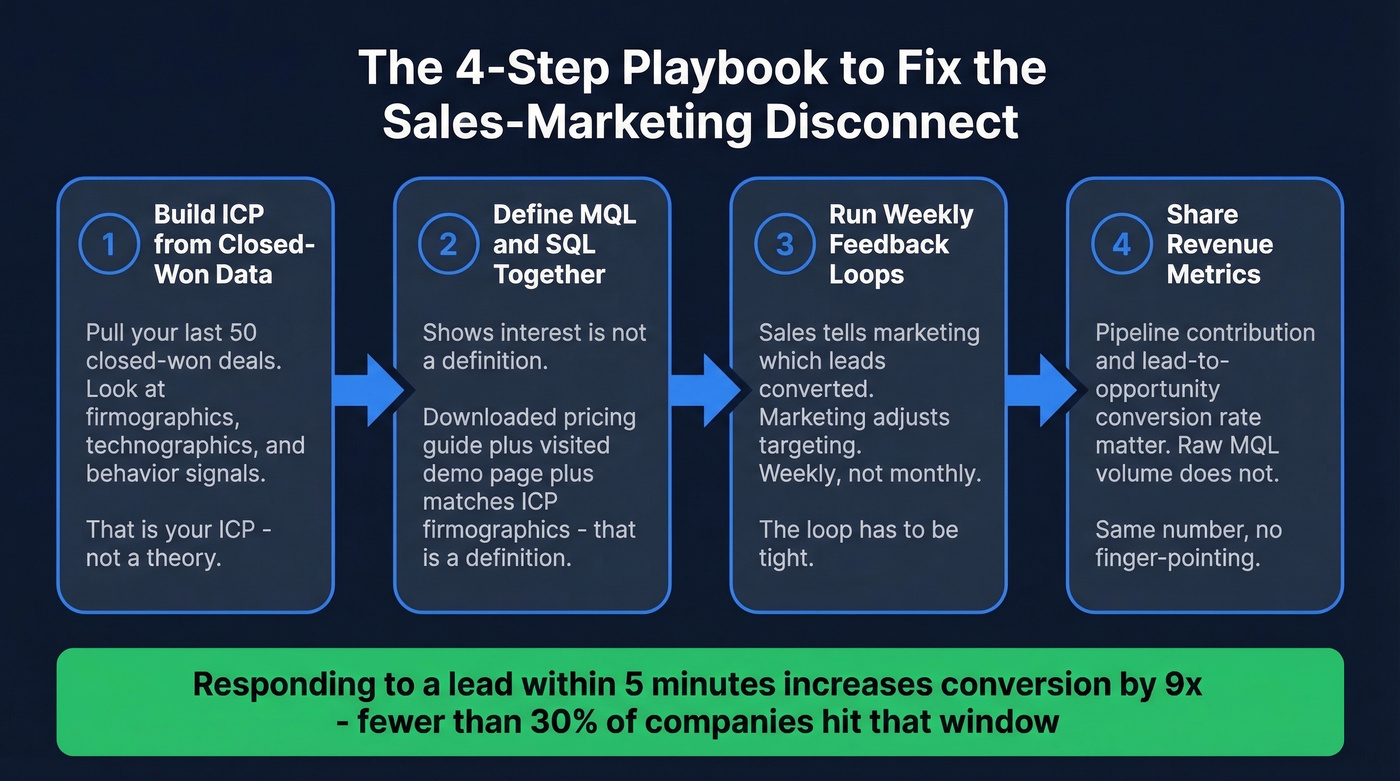
The playbook that actually fixes this starts with building a shared ICP from closed-won patterns. Don't theorize about your ideal customer - pull the last 50 closed-won deals and look at firmographic, technographic, and behavioral signals. That's your ICP. Then document MQL and SQL definitions with specific handoff triggers. "Shows interest" isn't a definition. "Downloaded pricing guide + visited demo page + matches ICP firmographics" is.
Run weekly feedback meetings - not monthly. Sales tells marketing which leads converted and which didn't. Marketing adjusts targeting. The loop has to be tight.
Shift to shared revenue metrics: pipeline contribution and lead-to-opportunity conversion rate matter. Raw MQL volume doesn't. When both teams own the same number, the finger-pointing stops. One stat that should change how you think about follow-up: responding to a lead within 5 minutes increases conversion rates by up to 9x. Fewer than 30% of companies hit that window consistently. Speed-to-lead is a process problem, not a lead quality problem - but it gets blamed on "bad leads" constantly.
Clean Your Data Before You Blame Your Leads
We've seen this play out dozens of times: a team runs an outbound campaign, gets an 18% bounce rate, and nearly 40% of replies come from people outside the target role. The conclusion? "Our leads are terrible." The actual problem? The data was stale before the first email ever sent.
An 18% bounce rate doesn't mean 18% of your leads are unqualified. It means 18% never had a chance. Companies lose an average of $15 million annually to poor data quality, and 44% of sales reps cite outdated data as their biggest headache.
The fix: verify before you send. Run your list through email verification, segment by deliverability status, and only send to verified addresses. For inbound, add real-time form verification to catch typos and disposable addresses at the point of capture. Prospeo's 5-step verification checks syntax, domain, server response, catch-all handling, and spam-trap removal - with 98% email accuracy and a 7-day refresh cycle. Snyk cut bounce rates from 35-40% to under 5% across 50 AEs. Meritt went from 35% to under 4% and tripled pipeline. There's a free tier (75 emails/month) to test on your current list.
Bad leads tank deliverability, and once your domain reputation drops, even qualified prospects never see your emails. Prospeo's proprietary email infrastructure delivers 98% accuracy at $0.01 per email - with catch-all handling, spam-trap removal, and honeypot filtering built in. Teams using Prospeo cut bounce rates from 35%+ to under 4%.
Kill your bounce rate before it kills your domain.
The 5-Minute Bad Lead Audit
Before you overhaul your entire lead gen strategy, run this quick diagnostic:
- Check your SQL rate. Below 60%? You've got a quality leak - either in scoring, ICP definition, or handoff criteria.
- Measure your bounce rate. Above 5%? That's a data problem, not a lead problem. Fix the data first.
- Compare lead ICP match to closed-won profile. If there's a gap between who you're targeting and who actually buys, your targeting is off.
- Verify emails and phone numbers before outreach. Stale data decays fast - run your list through verification before your next campaign, not after it bounces.
- Review SDR comp structure. Are reps incentivized on meetings booked or meetings that convert? Perverse incentives create perverse leads.
- Check time-to-first-contact. Are you hitting the 5-minute window? If not, good leads are dying on the vine while you debate whether they're "qualified."
Most bad lead problems aren't mysterious. They're diagnostic. Run the audit, find the bottleneck, and fix the specific problem instead of blaming "lead quality" as an abstraction. Skip the full-funnel overhaul if your bounce rate is the obvious culprit - clean the data first, then reassess whether you actually have a lead quality problem or just a data hygiene one.
FAQ
What's the difference between a bad lead and an unqualified lead?
An unqualified lead specifically fails your qualification criteria - wrong budget, no authority, no timeline - but can sometimes be nurtured into a qualified one. A "bad lead" is a broader label that also includes dead contacts and wrong emails, which need to be cleaned or replaced rather than nurtured.
What's a healthy MQL-to-SQL conversion rate?
For most B2B companies, an SQL rate of 60% or higher signals a healthy funnel. Below that threshold, you likely have a lead quality or qualification gap - either your ICP definition is too broad, your scoring thresholds are too low, or your data has decayed past the point of usefulness.
How do you fix bad lead data without an enterprise budget?
Start with email verification. Prospeo offers a free tier (75 emails/month) and paid plans at roughly $0.01 per verified email - no contracts required. Run your existing list through verification before your next campaign, and you'll immediately see how much of your "bad lead" problem is actually a stale data problem.
How much time do reps lose to low quality leads?
Between researching wrong-fit prospects, crafting outreach to dead contacts, and running discovery calls with people who lack budget or authority, reps can lose 10-15 hours per week on leads that won't close. Diagnosing whether you have a fit, data, or execution problem matters - each hour spent on unqualified leads is an hour not spent on deals that could actually move.