

The BANT Framework: What It Actually Is, Why Teams Misuse It, and How to Make It Work in 2026
Your VP just mandated BANT for all discovery calls. SDRs are now interrogating prospects with a 20-question checklist. Show rates are dropping. The AE team is rejecting 77% of meetings as "unqualified." Sound familiar?
The BANT framework is supposed to prevent this - not cause it. Qualification matters: nearly 67% of B2B deals fail because of poorly qualified leads, and 86% of B2B purchases stall somewhere in the buying process. But the way most teams use BANT is the problem, not the framework itself.
Below: a scoring model, a discovery script, and the data to know when BANT is enough and when to graduate to MEDDIC or CHAMP.
What Is BANT in Sales?
BANT stands for Budget, Authority, Need, Timeline. IBM created it in the 1950s to qualify prospects - back when a single decision-maker often controlled a single budget line and buying cycles were measured in handshakes, not Slack threads.
The purpose is simple: determine whether a prospect has the money, the power, the pain, and the urgency to buy. Four pillars, four gates. If a lead clears enough of them, it's worth your team's time. If it doesn't, move on.
That core logic hasn't changed. What's changed is everything around it - buying committees ballooned, budgets became fluid, and buyers now define their requirements 83% of the time before they ever talk to a rep. The framework needs updating, not replacing.
One thing before we break down each pillar: BANT works best when applied after you've defined your ICP. Qualifying leads against Budget, Authority, Need, and Timeline is meaningless if those leads don't fit your ideal customer profile in the first place. Get your ICP right, then use the method to prioritize within it.
The Four Pillars of BANT
Budget: Beyond the Dollar Amount
The worst qualification question in existence is "What's your budget?" Ask it in the first five minutes of a discovery call and you've lost the room. Prospects either don't know, won't tell you, or give you a number designed to anchor low.
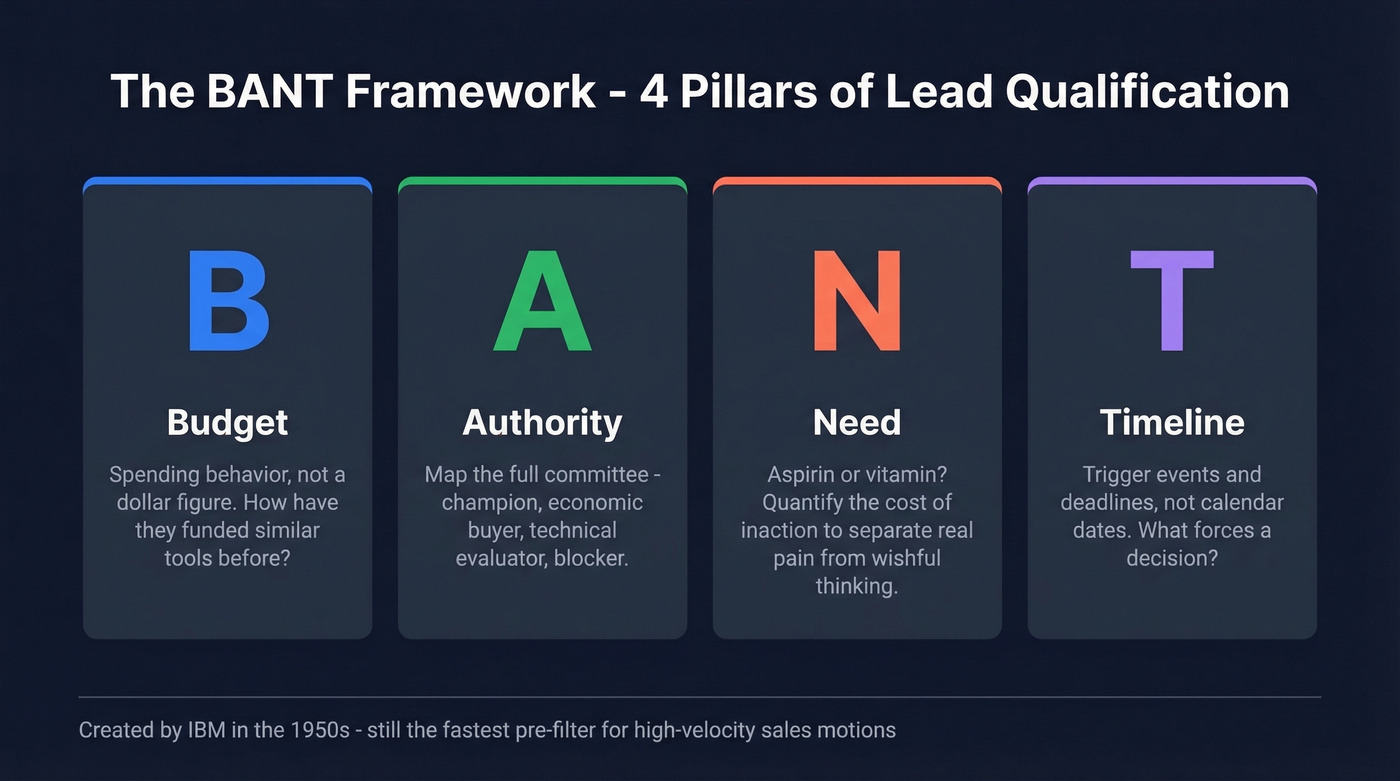
Modern budget qualification is about spending behavior, not a specific figure. Has the prospect invested in similar solutions before? Do they have a procurement process, or does the champion have discretionary spend? Are they reallocating budget from something else, or requesting new budget - and if so, what's that approval cycle look like?
For SaaS purchases specifically, budget qualification should include total cost of ownership - implementation, training, and the switching cost if the tool doesn't work out. A $30K/year platform that requires $50K in integration work is really an $80K decision, and your prospect's finance team knows it even if your champion doesn't.
HubSpot's framing gets this right: treat budget as a pattern of spending, not a single number. Ask "How have you funded similar initiatives in the past?" instead of "What's your budget for this?" The first question gets you real intelligence. The second gets you a wall.
Ask this: "What did you invest in [related solution] last year, and how was that funded?" Not this: "Do you have budget allocated for this project?"
Authority: Map the Committee
Here's the thing: there's no single decision-maker anymore. Forrester's data shows the average B2B purchase involves 13 people, and 89% of purchases involve two or more departments. Asking "Are you the decision-maker?" puts people on the defensive and rarely surfaces the real buying dynamics.
Instead, map the committee. You need to identify four roles:
- The champion - your internal advocate who sells when you're not in the room
- The economic buyer - the person who controls the budget and signs the check
- The technical evaluator who validates the solution against requirements
- The blocker who can kill the deal with a single objection
Sometimes one person fills multiple roles. Often they don't. Your job is to know who sits where before you're three meetings deep and discover the CFO has never heard of you.
Ask this: "Walk me through how your team evaluated and approved the last tool you purchased in this category." Not this: "Are you the person who signs off on this?"
Need: Vitamins vs. Aspirin
Buyers arrive to your call having done most of their homework - they define purchase requirements 83% of the time before speaking with sales. Your job isn't to discover their pain from scratch. It's to quantify it and elevate it from a "nice to fix" to a "must fix now."
The distinction that matters: is your solution a vitamin or an aspirin? If the prospect can live with the status quo for another 12 months, you don't have a qualified need - you have a future pipeline entry.
Let's break this down with a quick test. Ask the prospect what happens if they do nothing for six months. Then put a dollar figure on it together:
Cost of inaction formula: (hours wasted per week x hourly cost x 26 weeks) + (revenue leaked per month x 6 months) = the number that turns a vitamin into an aspirin.
If that number is smaller than your ACV, the deal probably isn't real yet. If it's 3-5x your ACV, you have genuine urgency. This calculation does more to qualify Need than any open-ended "what are your biggest challenges?" question ever will.
Timeline: Milestones, Not Calendars
"When do you want to buy?" is another question that deserves retirement. 47% of businesses take 6-9 months to finalize a software purchase. Asking for a calendar date early in the process gets you a made-up answer.
What actually matters is triggers and competing priorities. A contract renewal forcing a decision. A board meeting where results need to be shown. A new fiscal year starting. A competing initiative eating the same resources. These are the real timeline signals - not a date someone invented to get you off the phone.
Picture this: your prospect says "Q3" when you ask about timing. That tells you nothing. But if they say "Our Salesforce contract renews September 15 and we need a migration plan approved by the August board meeting," now you have a real timeline with real consequences for missing it.
How to Build a BANT Scorecard
Every sales blog tells you to "use a scorecard." Almost none of them actually give you one. Here's a working model adapted from a Salesforce admin implementation that uses Custom Metadata Types to store questions, answers, and scores.
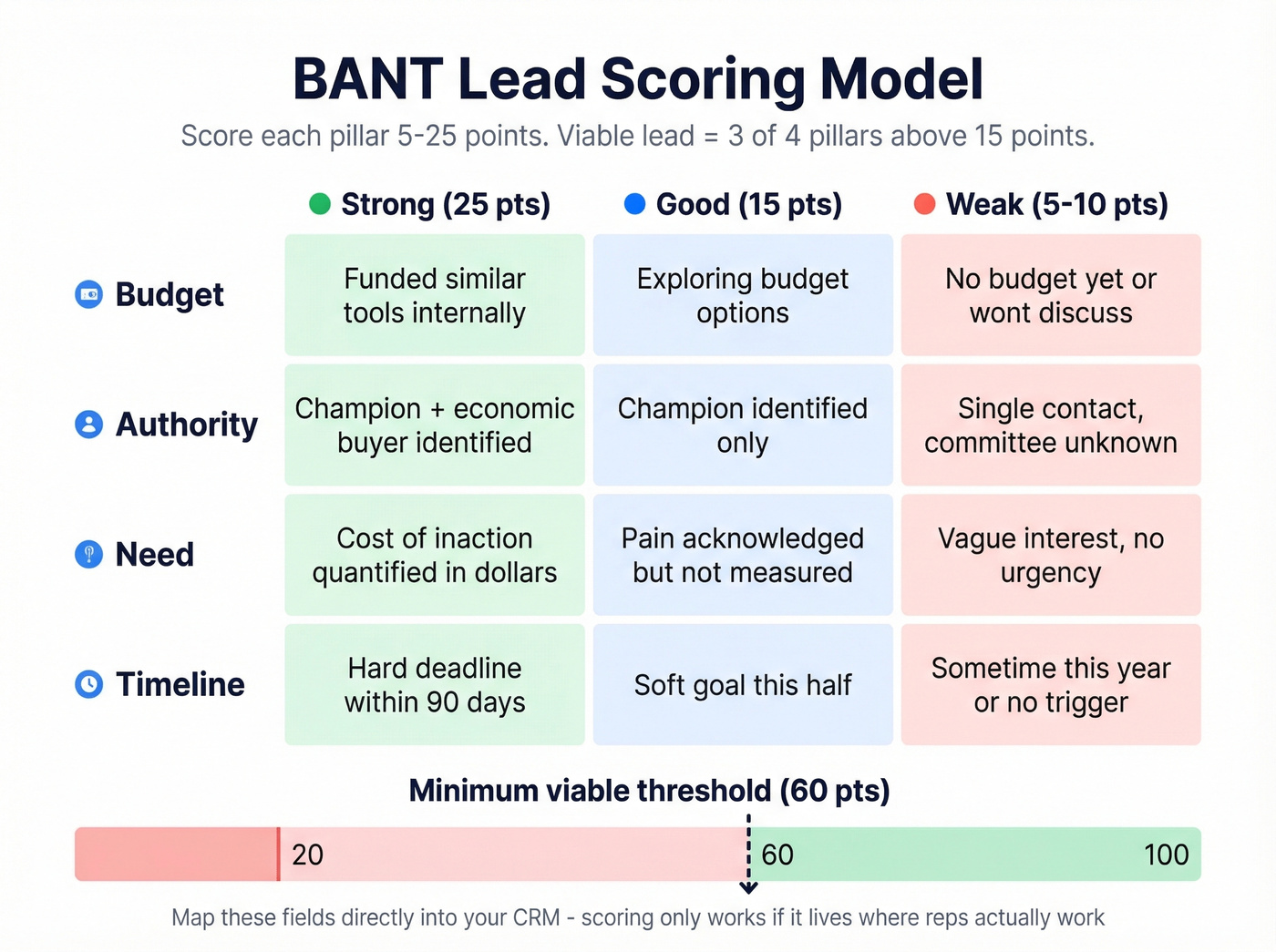
| Pillar | Question | Strong (25 pts) | Good (15 pts) | Weak / No Signal (5-10 pts) |
|---|---|---|---|---|
| Budget | Prior spend on similar? | Yes, funded internally | Exploring budget | "No budget yet" or won't discuss |
| Authority | Committee mapped? | Champion + buyer ID'd | Champion only | Single contact or unknown |
| Need | Cost of inaction? | Quantified ($) | Acknowledged pain | Vague interest or no urgency |
| Timeline | Trigger event? | Hard deadline <90 days | Soft goal this half | "Sometime this year" or none |
The rule: a lead is viable if it scores above threshold on 3 of 4 pillars. Perfect scores are rare - and honestly, if all four pillars are green, the deal is probably further along than your pipeline stage suggests.
Map these fields directly into your CRM. Create a Score child object under Opportunity (or a custom field set if you're in HubSpot) and auto-populate it on creation. Scoring is only useful if it lives where reps actually work, not in a spreadsheet no one opens.
Track three metrics to know if your qualification process is working: lead-to-opportunity conversion rate, average sales cycle length, and forecast accuracy quarter over quarter. If those numbers aren't improving within 90 days of implementation, the problem isn't the framework - it's how your team is applying it.

You just mapped the buying committee - champion, economic buyer, technical evaluator, blocker. Now you need verified contact data for every one of them. Prospeo gives you 98% accurate emails and 125M+ verified mobile numbers so you can reach the full committee, not just the one person who filled out your form.
Stop qualifying leads you can't actually reach.
BANT Discovery Call Script
This isn't a script to read verbatim. It's a structure, adapted from Apparate's discovery framework and stripped to the essentials.
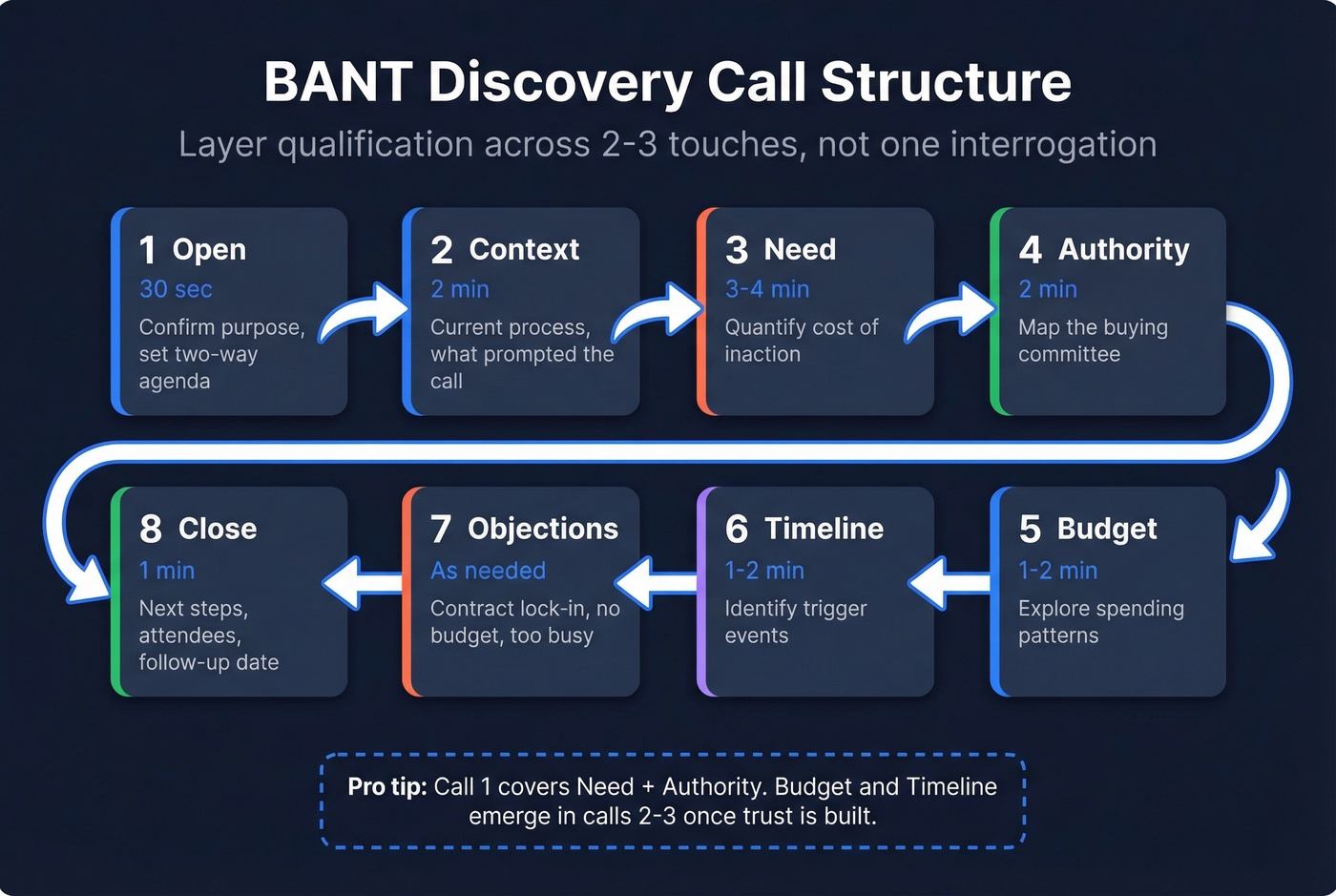
- Open (30 seconds): Confirm the meeting purpose and set a two-way agenda. "I'd like to understand your situation, share how we've helped similar teams, and figure out together if there's a fit. Fair?"
- Context (2 minutes): Ask about their current process and what prompted the conversation. Don't jump to qualification questions yet.
- Need (3-4 minutes): Dig into the problem. Quantify the cost of inaction. "What happens if you don't solve this in the next 6 months?"
- Authority (2 minutes): Map the buying process. "Walk me through how your team evaluated the last tool like this."
- Budget (1-2 minutes): Explore spending patterns. "How have you funded similar initiatives?"
- Timeline (1-2 minutes): Identify triggers. "What's driving the timing here?"
- Objection handling: Have responses ready for the big three - contract lock-in ("When does it renew? Let's have a comparison ready before that date."), no budget ("Is this a timing issue or a priority issue?"), and too busy to evaluate ("What if we ran a 15-minute pilot with your existing data?").
- Close (1 minute): Confirm next steps, attendees, and timeline for the next conversation.
Modern qualification should be layered across 2-3 touches, not crammed into one call. Your first discovery call covers Need and Authority. Budget and Timeline often emerge in the second or third conversation, once trust is established. Trying to check all four boxes in 30 minutes is exactly how BANT becomes an interrogation.
Is BANT Dead?
The "BANT is dead" take is everywhere. Here's what the data actually says.
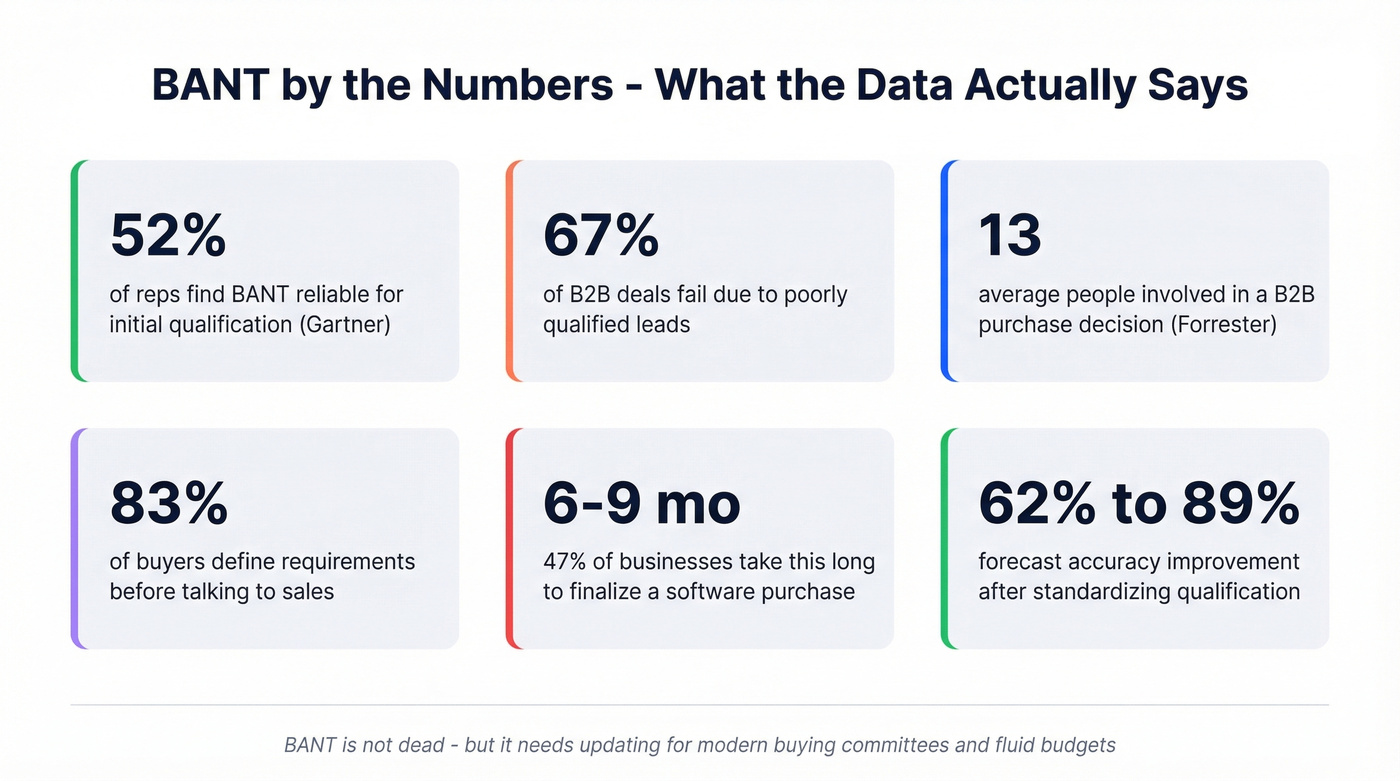
The case for BANT: Gartner's research shows 52% of reps find it reliable for initial qualification, and 41% value its flexibility. For high-velocity SMB motions with short cycles and small buying committees, it's still the fastest pre-filter available. One analysis gives an example of forecast accuracy improving from 62% to 89% after standardizing on a qualification framework - the discipline matters more than the specific methodology.
The case against: Apparate analyzed 4,000+ cold email campaigns and found BANT-centric qualification correlated with falling conversions. Shifting to engagement-first approaches increased conversions over 50%. And with 86% of B2B purchases stalling somewhere in the buying process, rigid, checkbox-style gates add friction in deals that are already complex.
Reddit practitioners are blunter. One SDR on r/salesdevelopment put it this way: "BANT criteria... meaning business want meetings with those with their wallet out ready to buy... not realistic when only 2-3% of your addressable market are actually in buying mode." On r/SalesOperations, an SDR booking 26 meetings a month reported that AEs only accepted 2-3 as qualified under strict BANT - a 77% rejection rate that was destroying morale. And on r/sales, the consensus is that all frameworks "boil down to the same fundamentals": need, budget, stakeholders, timeline.
The verdict: BANT isn't dead - checkbox BANT is. Use it as a pre-filter for high-velocity SMB deals with short cycles. For enterprise, layer MEDDIC on top.
Modernizing BANT for 2026
Look, if your deal size is under $10K and your sales cycle is under 60 days, BANT is still the best qualification framework available. The teams chasing MEDDIC for $5K deals are over-engineering their process and burning rep time on paperwork instead of pipeline. Save the heavy frameworks for deals that justify them.
Five shifts that turn BANT from a 1950s relic into a 2026 workflow:
Lead with empathy, not interrogation. Sybill's modernization guidance nails this: listen first, then weave qualification questions into a natural conversation. Prospects can smell a checklist from a mile away.
Spread qualification across multiple touches. First call: Need and Authority. Second call: Budget and Timeline. Trying to qualify all four pillars in one conversation is why SDRs sound like robots.
Layer with MEDDIC or CHAMP for complex deals. BANT tells you if a deal is worth pursuing. MEDDIC tells you if you can win it. They're complementary, not competing. (If you need a deeper set of prompts, use these MEDDIC discovery questions.)
Prepare for AI-armed buyers. Forrester reports 95% of buyers anticipate using genAI in their purchase process - meaning your prospects arrive to calls with AI-generated comparisons and requirements before you even open your mouth. Your discovery questions need to go deeper than what ChatGPT already told them.
Revisit BANT mid-deal. Budgets shift, champions leave, timelines slip. A lead that was green on Authority in month one can be red by month three. Re-qualify at every stage gate.
Your BANT scorecard is only as good as the leads feeding it. Prospeo's 30+ search filters - buyer intent, technographics, funding, headcount growth - let you pre-qualify prospects before discovery even starts. Layer in Bombora intent data across 15,000 topics to find buyers already researching your category.
Qualify on data signals before the first call, not during it.
BANT vs. Other Frameworks
The framework you choose should match your sales motion, not your VP's last conference keynote. Here's how they stack up:
| Framework | Best For | Deal Size | Key Strength | Key Weakness |
|---|---|---|---|---|
| BANT | SMB, high-velocity | Under $25K | Speed and simplicity | Misses buying politics |
| MEDDIC | Enterprise | $50K+ | Forecast accuracy | Slows short cycles |
| CHAMP | Mid-market, consultative | $15K-$75K | Pain-first, buyer-centric | Can get loose |
| GPCTBA/C&I | Strategic, exec-level | $100K+ | Outcome-focused | Overly complex |
| NEAT Selling | Modern consultative | $10K-$50K | Economic impact focus | Less proven at scale |
We've seen teams agonize over framework selection for months. Don't. Use BANT as a pre-filter for high-velocity SMB. Graduate to MEDDIC for enterprise. CHAMP works well for mid-market consultative motions. The framework matters less than the discipline of using one consistently - teams that standardize on any qualification method see measurably better forecast accuracy than teams that wing it. (If you're rebuilding your process, start with sales process optimization and then standardize your lead scoring.)
FAQ
What does BANT stand for?
BANT stands for Budget, Authority, Need, and Timeline - four pillars IBM created in the 1950s to qualify sales prospects. It remains one of the most widely used qualification models in B2B sales, particularly for high-velocity SMB motions with deal sizes under $25K and sales cycles under 60 days.
Is the BANT framework outdated in 2026?
The core logic isn't outdated - the rigid, interrogation-style application most teams default to is. Modernize it by spreading questions across multiple touches, leading with empathy instead of checklists, and layering deeper frameworks like MEDDIC for enterprise deals above $50K with complex buying committees.
What's the best alternative to BANT?
MEDDIC is the go-to for enterprise deals above $50K with long sales cycles and multi-department buying committees. CHAMP works well for mid-market consultative sales where leading with challenges resonates better than leading with budget. For high-velocity SMB, BANT is still the fastest pre-filter available.
How do you score BANT leads?
Assign 25, 15, or 5-10 points per pillar based on signal strength, then set a threshold requiring 3 of 4 pillars above minimum. Map scores directly into your CRM as fields on the Opportunity object - scoring only works if it lives where reps already spend their time, not in a standalone spreadsheet.
What tools help with BANT qualification?
You need three things: a CRM for tracking scores (Salesforce or HubSpot), a conversation intelligence tool for auto-tagging qualification signals from call transcripts, and a data verification platform like Prospeo to ensure your contact records are accurate and reachable before you dial. Clean data is the foundation - without it, even the best scorecard is grading incomplete information.