

9 Battle Card Examples With Actual Copy You Can Steal
It's Tuesday morning. A rep pings the #sales Slack channel: "Jumping on a call with Acme Corp in 20 - they're also looking at [Competitor X]. Anyone have a one-pager?" Silence. Or worse, someone links a 14-page PDF from last year that nobody's read. The rep wings it, the deal stalls, and product marketing wonders why their "competitive assets" aren't moving the needle.
68% of sales opportunities are competitive. A third of deals are lost directly to a competitor - and nearly half of those losses are considered winnable. That's why filled-in battle card examples reps can actually use, not blank templates, are worth their weight in pipeline.
Here's the short version: start with ONE competitor battlecard for your #1 rival, not nine types at once. Every card needs three layers - context (Know), talk tracks (Say), and proof (Show). Only 19% of battlecards include proof points, which is a big reason they collect dust. Below are 9 filled-in examples you can copy, customize, and ship this week.
What Is a Sales Battlecard?
A sales battlecard is a short, scannable reference asset - typically one page - that a rep pulls up before or during a call to handle competitive situations, objections, or positioning questions. It's not a whitepaper. It's a cheat sheet.
The organizing lens that separates useful cards from shelf-ware is Know, Say, Show: give reps the context they need, the words to actually say, and the proof to back it up. Every example below maps to this framework.
Why Most Battlecards Fail
Let's be honest: most battlecards are context dumps. A wall of competitor facts with zero guidance on what to do with them.
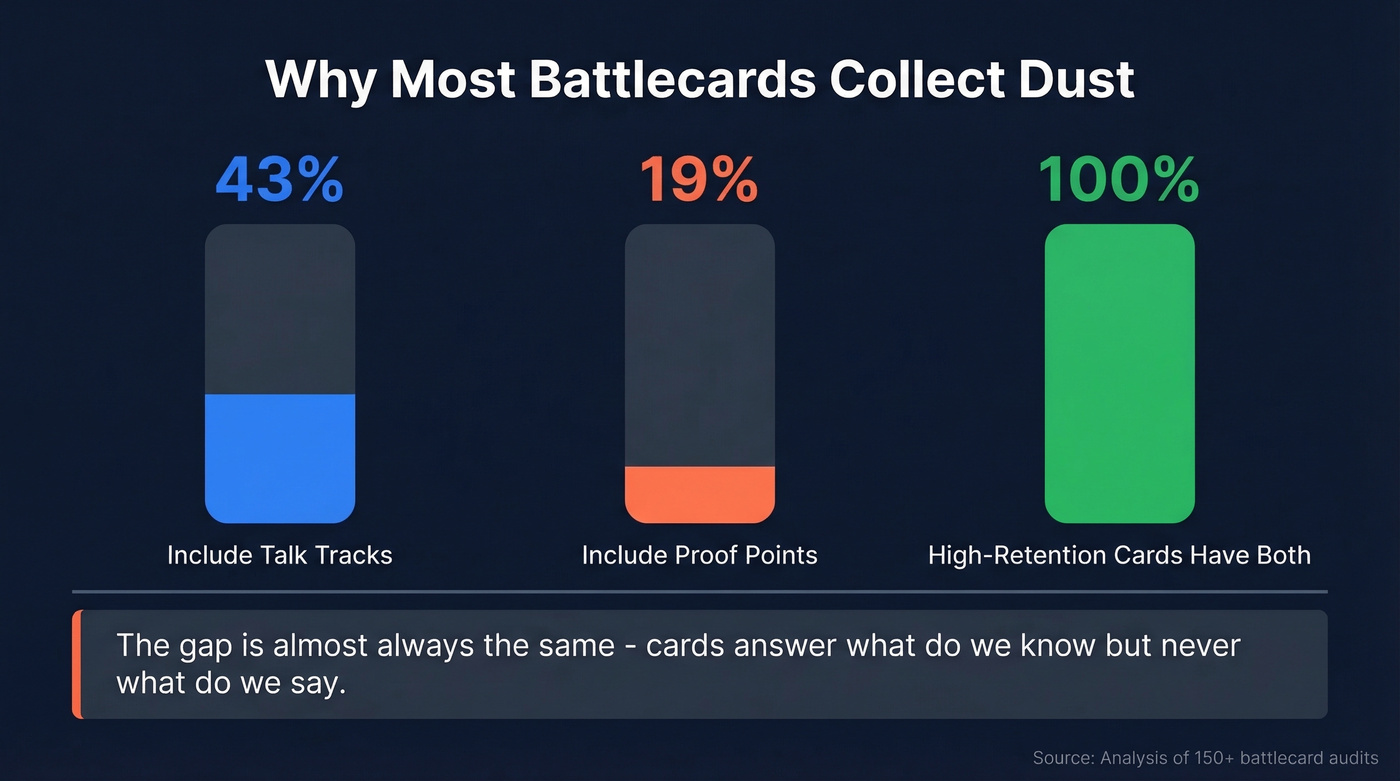
An analysis of 150+ battlecard audits paints a brutal picture. Only 43% included talk tracks - the actual words a rep should say on a call. Only 19% included supporting proof points. Cards were 1.5X less likely to include prescriptive guidance on when and how to use the intel. The pattern is clear: 100% of the highest-retention battlecards included both talk tracks and proof, while cards without those layers get opened once and forgotten.
A survey of 1,200+ CI professionals explains why adoption stays low. Large CI teams are 3X more likely to report strong battlecard adoption than solo practitioners, and teams using a dedicated CI platform are more than 2X as likely to see strong adoption compared to teams storing cards in Google Drive or SharePoint.
The anti-pattern has a name: the "Wikipedia card." It reads like a competitor's About page - company history, founding year, headquarters, product overview - without a single sentence a rep can use on a call. 78% of CI leaders say they provide battlecards, but only 65% are satisfied with adoption. The gap is almost always the same problem: the card answers "what do we know?" but never "what do we say?"
The Know, Say, Show Framework
Multiple frameworks exist - Know/Say/Show, Crayon's ABC model, Swing Education's "To Ask / To Know / To Show." They all say the same thing in different words.
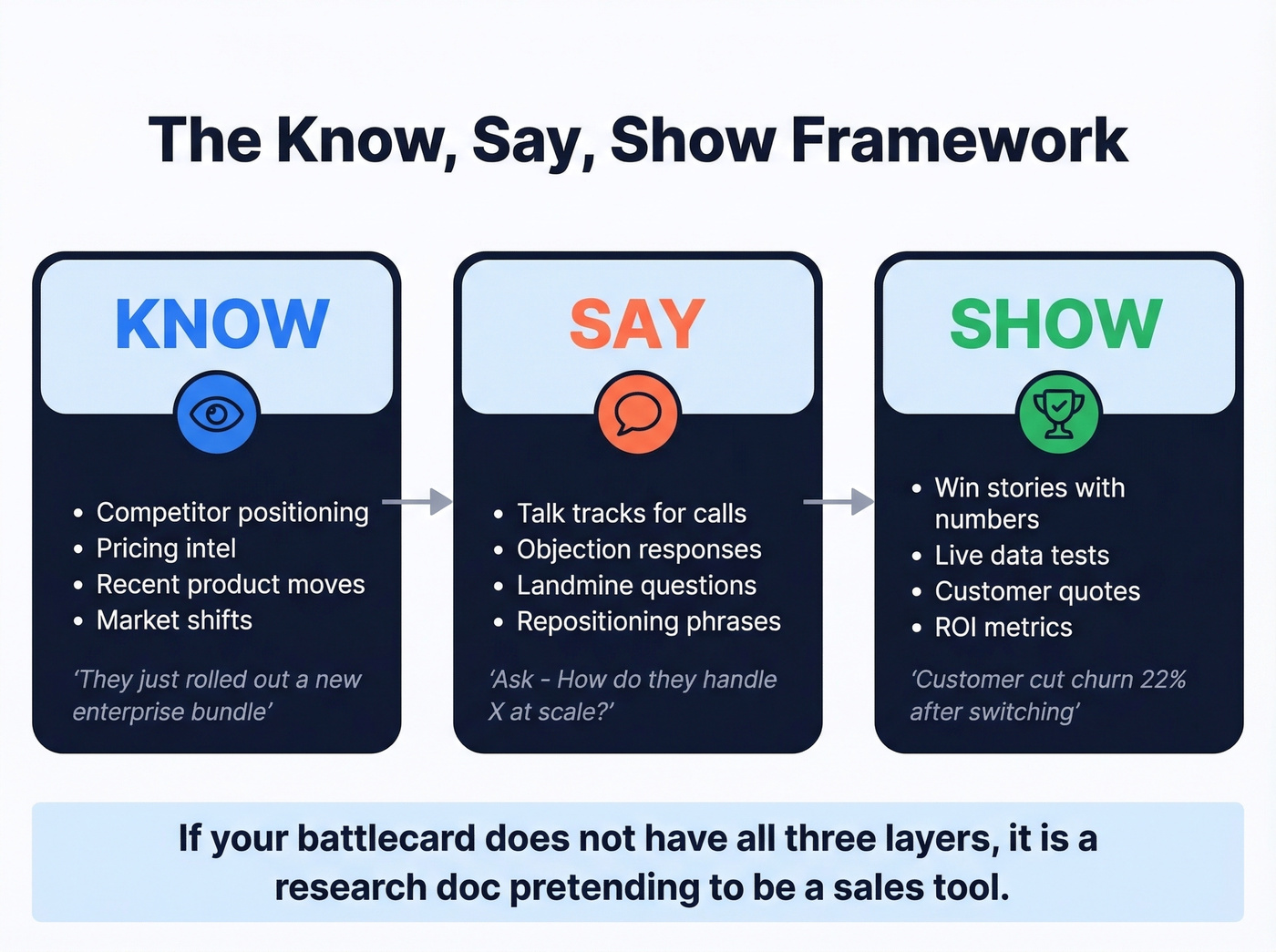
| Layer | What It Contains | Example |
|---|---|---|
| Know | Competitor positioning, pricing, recent moves | "They just rolled out a new enterprise bundle" |
| Say | Talk tracks, objection responses, landmine Qs | "Ask: How do they handle X at scale?" |
| Show | Proof points, win stories, data, demos | "Customer cut churn 22% after switching" |
If your battlecard doesn't have all three layers, it's a research doc pretending to be a sales tool.

Every battlecard example above needs real proof points to work. 98% email accuracy, 125M+ verified mobiles, 7-day data refresh - these are the numbers your reps can drop on competitive calls because they're verifiable. Stop filling your "Show" layer with vague claims.
Give your reps proof points that actually hold up on live calls.
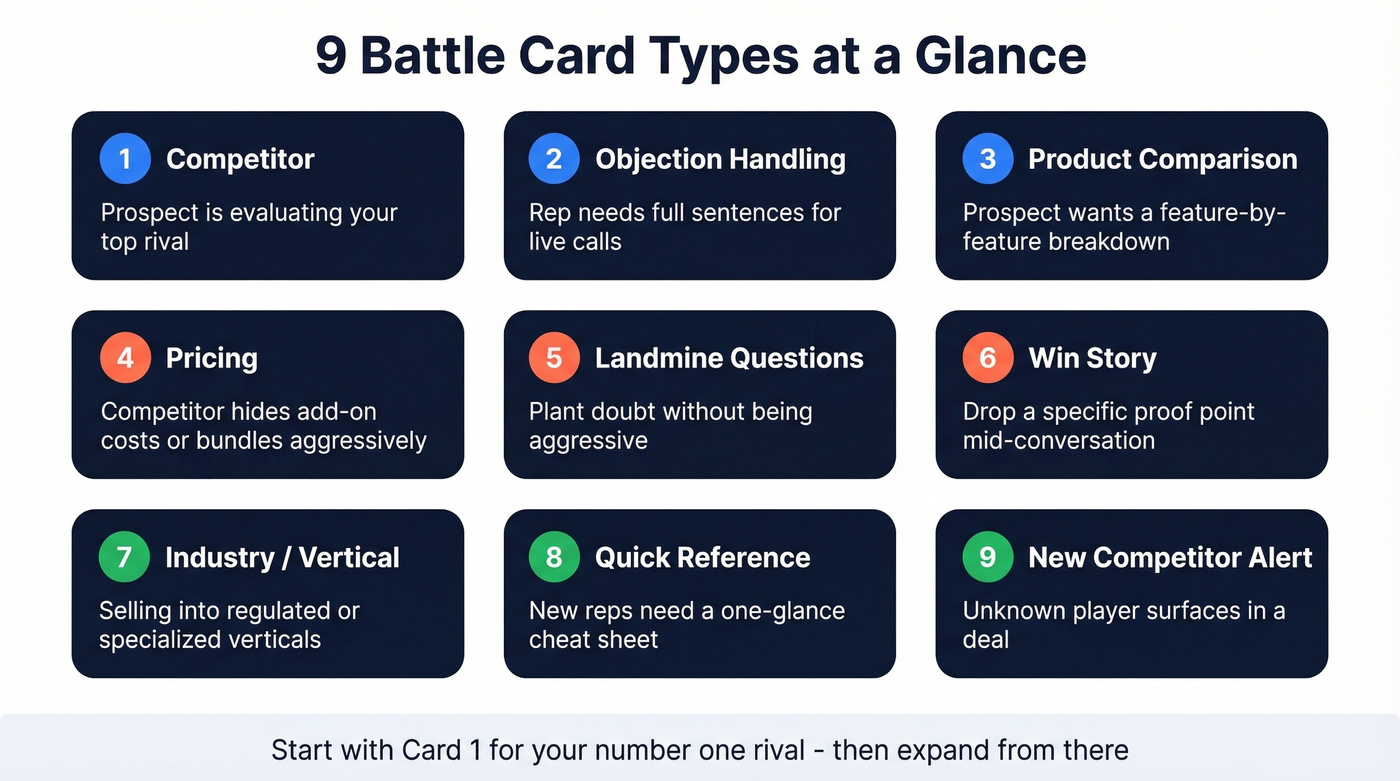
9 Filled-In Battle Card Examples
Each example includes the type, when to use it, a filled-in text block you can copy, and a note on why it works. For a visual gallery of 20+ real-world battlecards from companies like Salesforce, Cisco, and DocuSign, Dock's library is worth bookmarking.
1. Competitor Battlecard
When to use: A prospect mentions they're evaluating your top rival. This is the most common type you'll build, so get it right first.
Competitor: [Competitor Name] Their positioning: "[Their one-line pitch]" Where they win: [1-3 honest strengths: brand, enterprise footprint, specific workflow] Where we win: Higher verified email accuracy (98%), faster data refresh (7 days), self-serve onboarding, no annual lock-in Key differentiator: Our verification runs on proprietary infrastructure - not third-party email providers Landmine Q: "How often does your provider do a full re-verification of the database (not just job-title updates) - and what's your current bounce rate on outbound?"
This works because it gives the rep a positioning snapshot, an honest assessment of where the competitor is strong, and one surgical question that exposes a real gap. Reps trust cards that don't pretend the competitor is terrible at everything.
2. Objection-Handling Battlecard
Most reps freeze when they hear "your product seems more expensive" mid-call. This card gives them full sentences they can adapt in real time - not bullet points they have to interpret under pressure.
Objection 1: "Your product seems more expensive." Response: "If you compare total cost to outcomes, we usually come out lower once you factor in the add-ons other providers charge for. We bundle verified emails, verified mobile numbers, intent data, and API access so you're not nickel-and-dimed. Want me to run a side-by-side cost-per-usable-contact comparison for your team size?"
Objection 2: "We've already invested in [Competitor]." Response: "Totally fair. A lot of teams run both tools in parallel for 30 days before switching. The typical trigger is data quality: bounce rates drop fast when you move from stale lists to verified contacts. If you're open to it, we can run a pilot on your own list so you can see the difference."
Objection 3: "We need something our whole GTM team can use." Response: "We integrate with Salesforce, HubSpot, and Outreach, so the data flows into the tools your team already lives in. That keeps adoption high because reps don't have to change their workflow."
Only 43% of battlecards include talk tracks. This card is already in the top half just by existing.
3. Product Comparison Battlecard
When to use: Prospect asks for a feature-by-feature breakdown.
| Feature | Us | Competitor |
|---|---|---|
| Email accuracy | 98% verified | Varies by provider |
| Data refresh | Every 7 days | Often 4-6 weeks |
| Mobile numbers | 125M+ verified | Often sold as an add-on |
| Intent data | Included (15,000 topics) | Often sold as an add-on |
| Contract | Self-serve, no contracts | Often annual |
Talk track: "Happy to do a live data test - pick 50 contacts from your ICP, and we'll show you match rates and accuracy side by side. That usually settles the comparison faster than any slide deck."
Tables are scannable in seconds. The talk track at the bottom converts the comparison into an action the rep can take on the call.
4. Pricing Battlecard
Skip this card if your competitor's pricing is public and comparable. Use it when the competitor bundles aggressively or hides add-on costs - which is most of the time in B2B data.
Our pricing: Credit-based and transparent. Around $0.01 per verified email, free tier included, no contract, cancel anytime. Their pricing: Enterprise data providers typically run $15K-$40K/year depending on seats and modules, usually on annual terms. Anchor and reframe: "Their base price can look lower until you add the modules that matter: verified mobiles, intent, and API access. The question isn't sticker price - it's cost per usable contact and how much time your team wastes cleaning bad data." Proof: "Our average customer pays around $0.01 per verified email. Ask your current provider what their effective cost per usable contact is - most teams have never calculated it."
Pricing objections aren't about the number. They're about perceived value. The "anchor and reframe" technique shifts the conversation from sticker price to cost-per-outcome.
5. Landmine Questions Battlecard
This is the biggest differentiation play in competitive selling. These questions plant seeds of doubt without being aggressive - they arm the prospect with the right questions to ask, which naturally surfaces the competitor's weaknesses.
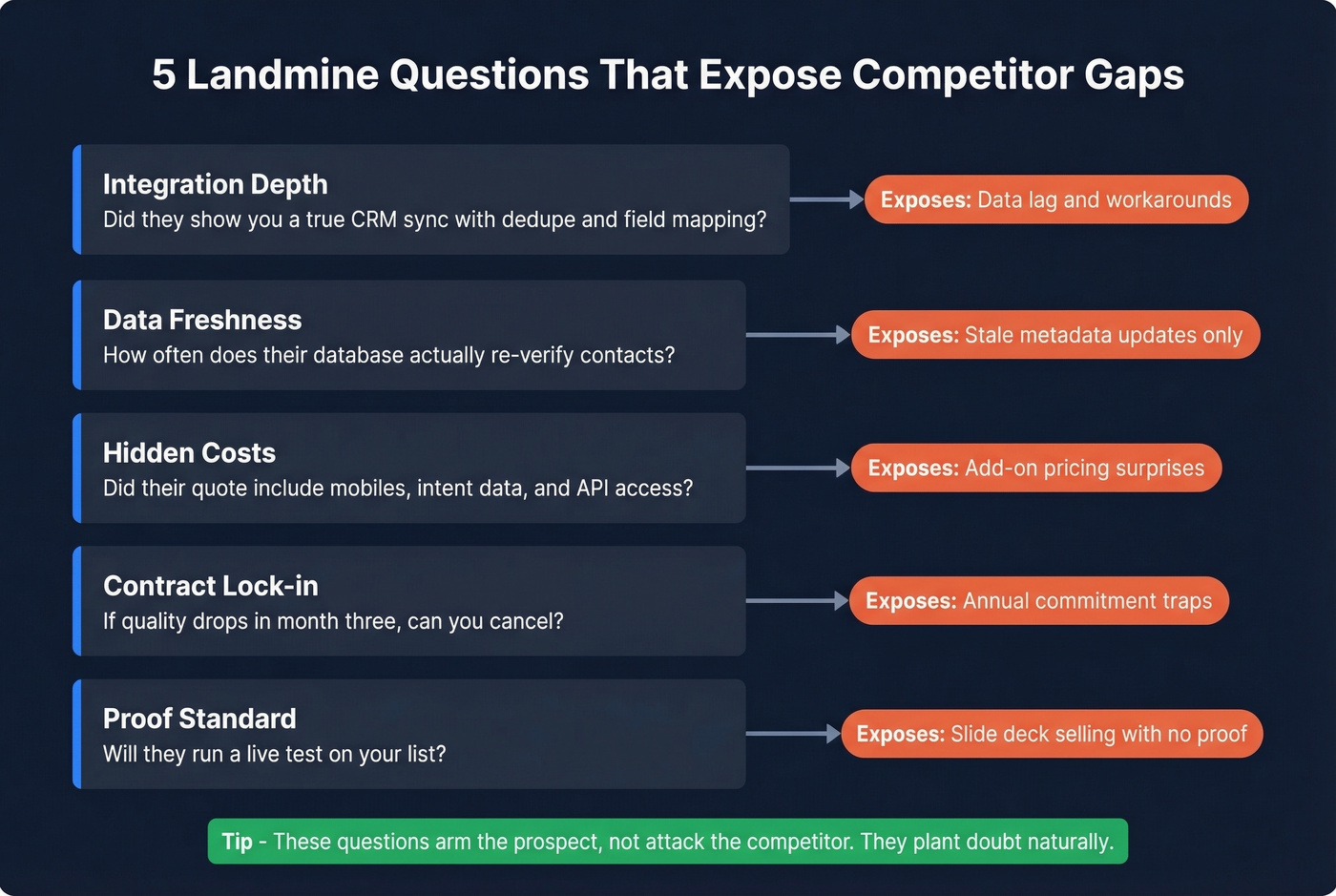
- Integration depth: "When you evaluated [Competitor], did they show you a true CRM sync with dedupe + field mapping - or is it a workaround that creates data lag?"
- Data freshness: "How often does their database actually re-verify contacts? Some providers say 'monthly refresh' but only update metadata like job titles, not email validity."
- Hidden costs: "Did their quote include verified mobile numbers, intent data, and API access - or are those separate line items?"
- Contract lock-in: "If data quality doesn't meet expectations in month three, can you cancel - or are you locked into an annual commitment?"
- Proof standard: "Will they run a live test on your list and commit to a bounce-rate target - or are they asking you to trust a slide deck?"
Most battlecard articles talk about "landmines" conceptually but don't give concrete, copy-paste questions. That alone makes this card worth building first.
6. Win Story Battlecard
Only 19% of battlecards include proof points. A mini case study with a specific result gives reps something concrete to reference.
Customer: Snyk Problem: Previous data provider had 35-40% bounce rates on outbound sequences. AEs were spending 4-6 hours/week prospecting. Result: Bounce rate dropped to under 5%. AE-sourced pipeline increased 180%. 200+ new opportunities per month.
Short. Specific. Memorable. That's all a rep needs to drop a proof point mid-conversation without fumbling through a 12-page case study PDF.
7. Industry / Vertical Battlecard
When to use: Selling into a regulated or specialized vertical where generic messaging falls flat.
Vertical: Financial Services / FinTech Key pain points: GDPR and CCPA compliance for outbound data; audit trails for data sourcing; procurement teams that require DPA documentation before vendor approval Compliance language: "All contact data is GDPR-compliant with opt-out enforcement. DPAs are available on request to speed up procurement." Relevant proof: "We can share data sourcing documentation and DPA language early so legal doesn't become the critical path."
A fintech buyer doesn't care about your feature list - they care about whether legal will block the deal. Vertical cards let reps speak the prospect's language from the first call.
8. Data Quality Battlecard
A battlecard with wrong data is worse than no battlecard. We built this example using Prospeo's actual numbers to show what a filled-in data quality card looks like.
Our data: 300M+ professional profiles, 143M+ verified emails (98% accuracy), 125M+ verified mobile numbers. 5-step verification with catch-all handling, spam-trap removal, and honeypot filtering. Refresh cycle: Every 7 days - full re-verification, not just metadata updates. Legacy provider comparison: Typical refresh cycle is 4-6 weeks. Email accuracy often lands around 79-87% at major providers. Many rely on third-party data sources instead of proprietary verification. Cost per contact: ~$0.01/email vs. ~$1.00/email at enterprise providers. Landmine Q: "Ask your current provider whether their verification is real-time or batch - and when the last full re-verification of their database actually ran."
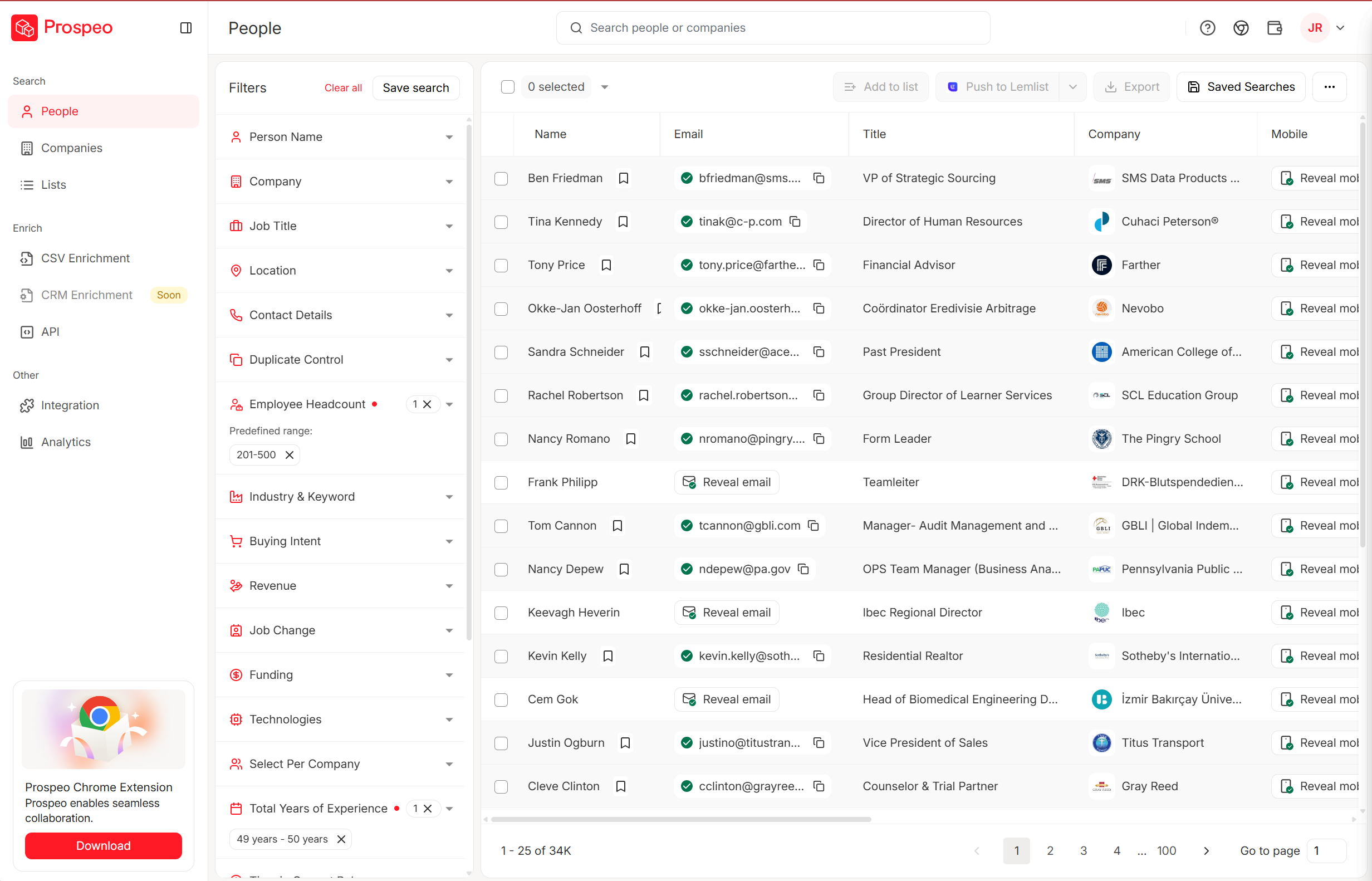
Data accuracy is the foundation every other battlecard sits on. If the contact info is stale, the pricing comparisons and talk tracks don't matter because the rep can't reach the prospect in the first place.
9. Prospect-Specific Battlecard
When to use: High-value target account where a generic card won't cut it. This is the highest-effort card type, but for enterprise deals, it's the one that closes.
Account: [Target Account Name] What we know: [Funding stage], [employee range], [HQ/regions], [key product line] Tech stack: [CRM], [sequencing tool], [current data provider] Recent signals: [new hires], [new exec], [job posts], [product launch], [new market] Tailored talk track: "You're scaling outbound right now - that means data quality issues scale with it. At your volume, even a 5% bounce rate turns into hundreds of wasted touches per week." Matched proof: "[Similar company] switched data providers and saw pipeline increase 140% in the first quarter."
Account-level intel transforms a generic pitch into a conversation that feels researched and relevant. We've found these cards work best when sales and marketing co-build them - reps bring the field context, marketing brings the proof points and positioning.
Rolling Out Cards Reps Actually Use
Building great battlecards is half the battle. Distribution is the other half - and it's where most programs die.
The 5-minute rule is real: if reps spend more than 5 minutes searching for a battlecard, they default to memory. Your cards need to live where reps already work - embedded in Salesforce or HubSpot opportunity records, pinned in Slack channels, or linked in Notion workspaces. Not buried in a Google Drive folder three levels deep.
Here's the thing: don't build 9 cards. Fix 3. Start with your top competitor, your most common objection, and one win story. Get those three cards into reps' hands, measure whether they actually get used, and iterate. We've seen teams spend months building a "complete competitive library" that nobody opens. The teams that win start small and expand based on rep feedback.
One adoption tactic that works better than anything else: have your top-performing rep demo how they use the card on a real call. Record it. Share it. Nothing drives adoption faster than watching someone close a deal with the exact asset you're asking people to use. Update cards monthly at minimum, and immediately after competitor pricing changes, product launches, or significant wins and losses.
You can also use ChatGPT or Claude to draft initial battlecard sections - feed it your competitor's pricing page, recent press releases, and G2 reviews, then ask for a Know/Say/Show breakdown. The output needs heavy editing since AI doesn't know your actual win/loss patterns, but it cuts first-draft time from hours to minutes. The consensus on r/sales is that AI-drafted cards are a solid starting point as long as a human who's actually been on competitive calls does the final pass.
Measuring Battlecard ROI
Kompyte reports customers see up to a 30% increase in win rate after implementing battlecards. Even a conservative 10% lift on competitive deals pays for the program many times over.
The KPIs worth tracking: competitive win rate (the only metric that ultimately matters), rep usage/views (are cards being opened before competitive calls?), ramp time (do new reps hit quota faster?), and deal cycle length (do competitive deals close faster when cards are used?). The best measurement approach is CRM-based: tag opportunities where a battlecard was referenced, then compare win rates against opportunities where it wasn't. That gives you a clean before/after signal.
Tools and Templates
$15K+/year battlecard platforms are overkill for teams under 20 reps. A well-maintained Google Slides template or Notion page will outperform an expensive platform that nobody logs into.
| Tool | Best For | Price | Notes |
|---|---|---|---|
| Playwise HQ | Bootstrapped teams | Free-$450/mo | Google Slides integration |
| Crayon | Mid-market CI | ~$15K-$47K/yr | Full CI platform |
| Klue | Enterprise CI | ~$16K+/yr | Audit + analytics |
| Kompyte | Semrush users | Custom | AI-powered updates |
| Seismic | Enterprise enablement | ~$30K+/yr | Full enablement suite |
| Slides / Notion | DIY / no budget | Free | Manual updates |
For free starting points, Playwise HQ's Google Slides template covers the basics - competitor profiles, strengths/weaknesses, objection handling, and product comparisons. The Notion template marketplace has six battlecard templates worth browsing.
For teams that want to skip the manual data entry, your battlecard is only as good as the data feeding it. If your contact data refreshes every 6 weeks instead of every 7 days, the numbers in your cards go stale between quarterly updates - and reps stop trusting them.
If you're building a broader enablement system, pair battlecards with a lightweight competitive intelligence strategy and a repeatable sales process optimization cadence so updates don't die after launch.
That landmine question - "What's your current bounce rate?" - only works if your own data survives the same test. Prospeo's 5-step verification and proprietary email infrastructure keep bounce rates under 4% for teams like Snyk and Meritt. Your battlecard is only as strong as the data behind it.
Run a free data test before your next competitive deal.
FAQ
What's the difference between a battlecard and a sales playbook?
A battlecard is a one-page, single-competitor cheat sheet a rep pulls up during a live call. A sales playbook covers the full sales process, methodology, and multiple scenarios. You need both, but they serve completely different moments - one is reactive, the other is strategic.
How often should you update battlecards?
Monthly at minimum for your top 3 competitors, and immediately after pricing changes, product launches, or significant wins and losses. Stale data kills trust. If a rep finds last quarter's pricing on a card, they'll never open it again.
Who should own battlecard creation?
Product marketing creates the content, sales enablement handles distribution and adoption metrics, and reps contribute field intelligence from live deals. The best programs assign clear ownership at each stage so cards don't rot in a shared drive.
What data tools keep battlecard stats accurate?
Platforms with weekly data refresh cycles prevent the stale-number problem that plagues most competitive cards. Enterprise providers refreshing every 4-6 weeks leave your proof points outdated between quarterly reviews - which is exactly why we built Prospeo's refresh on a 7-day cycle.