

The Real Benefits of Lead Generation - Backed by Data, Not Buzzwords
Ninety-two percent of B2B buyers already have a vendor in mind before they start evaluating options. The winning vendor sits on the buyer's Day One shortlist 95% of the time. If those numbers don't make you rethink how you approach pipeline, nothing will.
The biggest benefit of lead generation isn't more leads. It's fewer, better ones that actually close. Most articles on this topic hand you vague promises - "grow your business," "increase revenue," "build relationships." None of that's actionable. The real story is in the data: which channels pay back fastest, why 79% of marketing leads never convert, and what separates the teams compounding pipeline from the ones burning budget on bad lists.
Here's what we've learned from the numbers, real case studies, and the patterns we see across thousands of outbound campaigns.
The Short Version
Lead gen is existential, not optional. 95% of winning vendors are on the buyer's Day One shortlist. If you aren't generating awareness before the buying cycle starts, you've already lost.
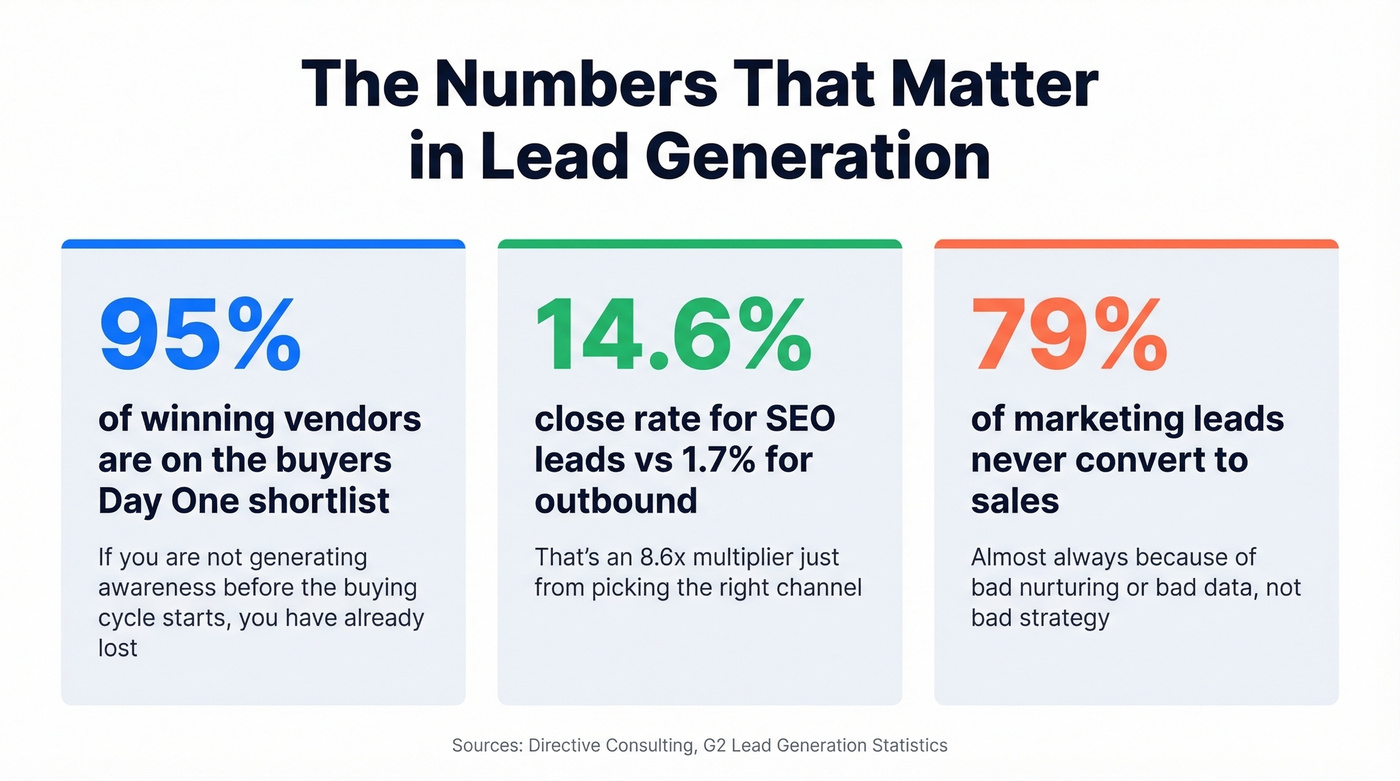
Channel selection matters more than volume. SEO leads close at 14.6% vs 1.7% for outbound. That's roughly an 8.6x multiplier on your close rate from picking the right channel alone.
Data quality is the foundation. 79% of marketing leads never convert - almost always because of bad nurturing or bad data, not bad strategy.
Predictable Revenue Growth
Lead generation turns revenue from a hope into a system. A commercial roofing company, Damschroder Roofing, invested in digital lead gen and generated $2-3M in annual revenue directly from SEO, PPC, and local search - a 30X+ ROI with 200+ inbound calls per month and a single $1M contract from a website lead. That's not a tech startup with VC money. It's a roofing company, and the mechanics work the same whether you sell SaaS or shingles.
One MSP operator on Reddit described closing a $10K MRR deal by treating lead gen as a full-team system - marketing, inside sales, and account management all feeding the pipeline. Build a system that generates qualified inbound interest, and revenue becomes predictable instead of episodic.
Higher-Quality Pipeline
More leads isn't the goal. Better leads is. SEO-driven leads close at 14.6% vs 1.7% for outbound. That's not marginal - it's an order of magnitude.
Lean into inbound if your buyers research before they buy, your content can rank for problem-aware keywords, and your sales cycle rewards educated prospects. Lean into outbound if you're in a new category where buyers don't know to search, you're targeting a narrow ICP under 5,000 accounts, or you need pipeline this quarter rather than next year.
The best teams do both. But if forced to pick one first, inbound builds a compounding asset while outbound builds a linear one. And here's a stat that reinforces the quality-over-quantity thesis: 56% of buyers say there's too much content. Your lead gen assets need to be genuinely useful, not just another PDF nobody reads.
Lower Customer Acquisition Costs
The average cost per lead across industries is $198.44. That number hides enormous variance - a SaaS lead from paid search might cost $300-$500, while an organic lead from a ranking blog post costs almost nothing at the margin.
AI tools are compressing these costs fast. AI in sales can cut customer acquisition costs by up to 60%, and 78% of organizations already use AI in at least one business function. The teams layering AI into enrichment, scoring, and personalization are pulling ahead on unit economics while everyone else debates which chatbot to buy.
Systematic prospecting saves time and money simultaneously when you automate the repetitive parts - enrichment, scoring, list building - and let reps focus on conversations that actually close.
Channel ROI You Can Measure
This is the table most articles won't give you, based on published B2B benchmarks:
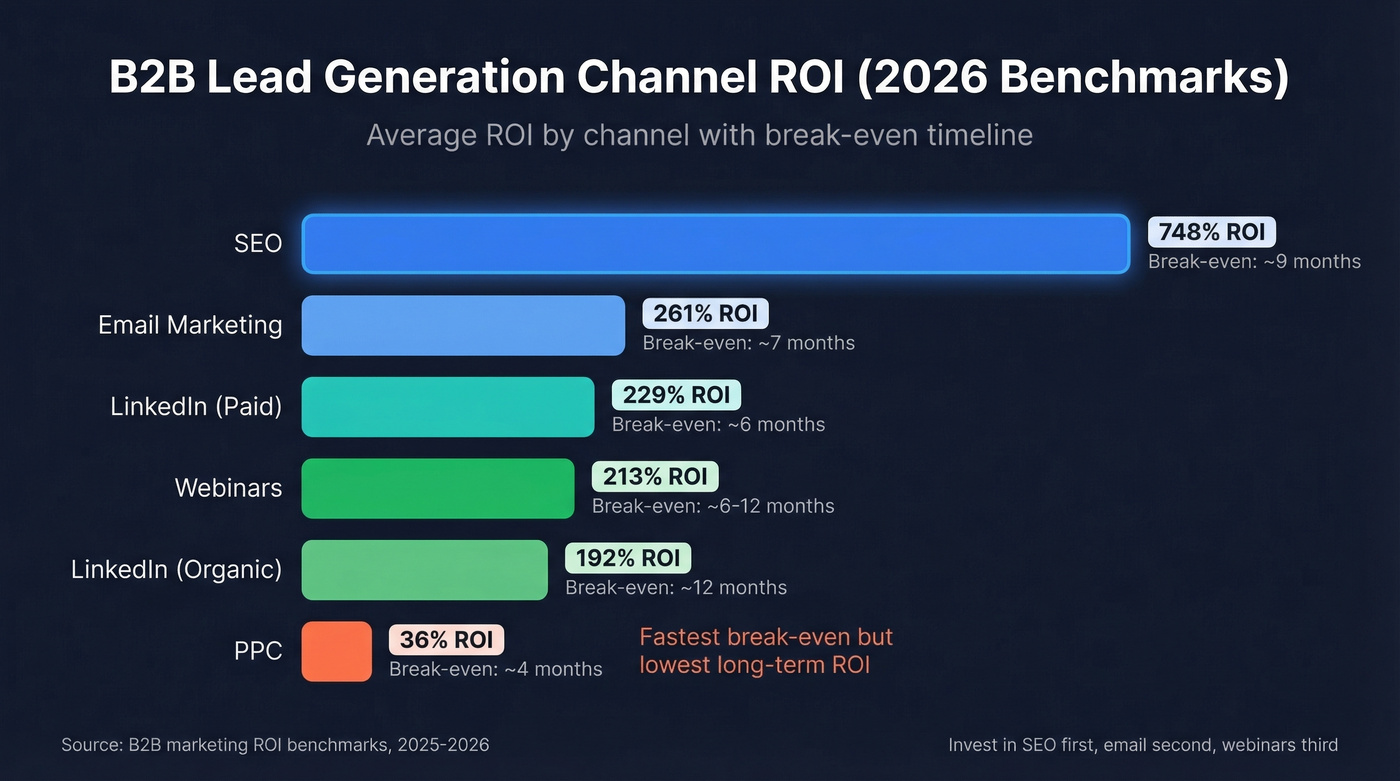
| Channel | ROI | Break-Even | Best For |
|---|---|---|---|
| SEO | 748% | ~9 months | Compounding pipeline |
| 261% | ~7 months | Nurture + retention | |
| LinkedIn (paid) | 229% | ~6 months | Targeted ABM |
| Webinars | 213% | ~6-12 months | Mid-funnel education |
| LinkedIn (organic) | 192% | ~12 months | Thought leadership |
| PPC | 36% | ~4 months | Fast, testable demand |
Invest in SEO first, email second, webinars third. PPC breaks even fastest but delivers the worst long-term ROI. LinkedIn paid is underrated for ABM. Lead-to-customer conversion is the #2 most important KPI for marketers according to HubSpot's 2026 State of Marketing Report - so track revenue per channel, not just lead volume.
Shorter Sales Cycles
The average B2B buying cycle runs 10.1 months. That's a long time to babysit a deal.
Lead scoring and nurturing compress that timeline by ensuring reps spend time on buyers who are actually ready. Prospects who rack up 9+ demo views close at 8-10x higher rates - not because of the demo itself, but because engagement depth signals intent. Good lead gen systems surface those signals early so sales doesn't waste months on tire-kickers.

79% of marketing leads never convert - and bad data is almost always the culprit. Prospeo's 5-step verification delivers 98% email accuracy, so every lead you generate actually reaches a real buyer. At $0.01 per email with a 7-day refresh cycle, your cost per lead drops while your pipeline quality climbs.
Fix your data foundation and watch your close rates compound.
Better Sales-Marketing Alignment
85% of B2B marketers struggle to connect marketing performance to business outcomes, and 41% report misalignment between marketing-generated leads and sales expectations. Lead generation forces the conversation. When marketing owns a pipeline number - not just MQLs, but actual revenue contribution - the handoff to sales gets cleaner. We've seen the single act of agreeing on what counts as a "qualified lead" cut sales-marketing friction in half at companies that actually commit to it.
Competitive Positioning
Here's the stat that should keep you up at night: the "pre-contact favorite" wins roughly 80% of deals, and 41% of buyers already have a preferred vendor before they even start evaluating.
Lead generation isn't just about filling your pipeline. It's about being the name that comes to mind when a buyer first recognizes they have a problem. That's brand and demand working together, and it's the advantage most companies undervalue until they're losing deals to competitors who showed up earlier.
B2B vs B2C: Different Playbooks
The core advantages apply to both contexts, but you can't copy-paste a strategy between them.
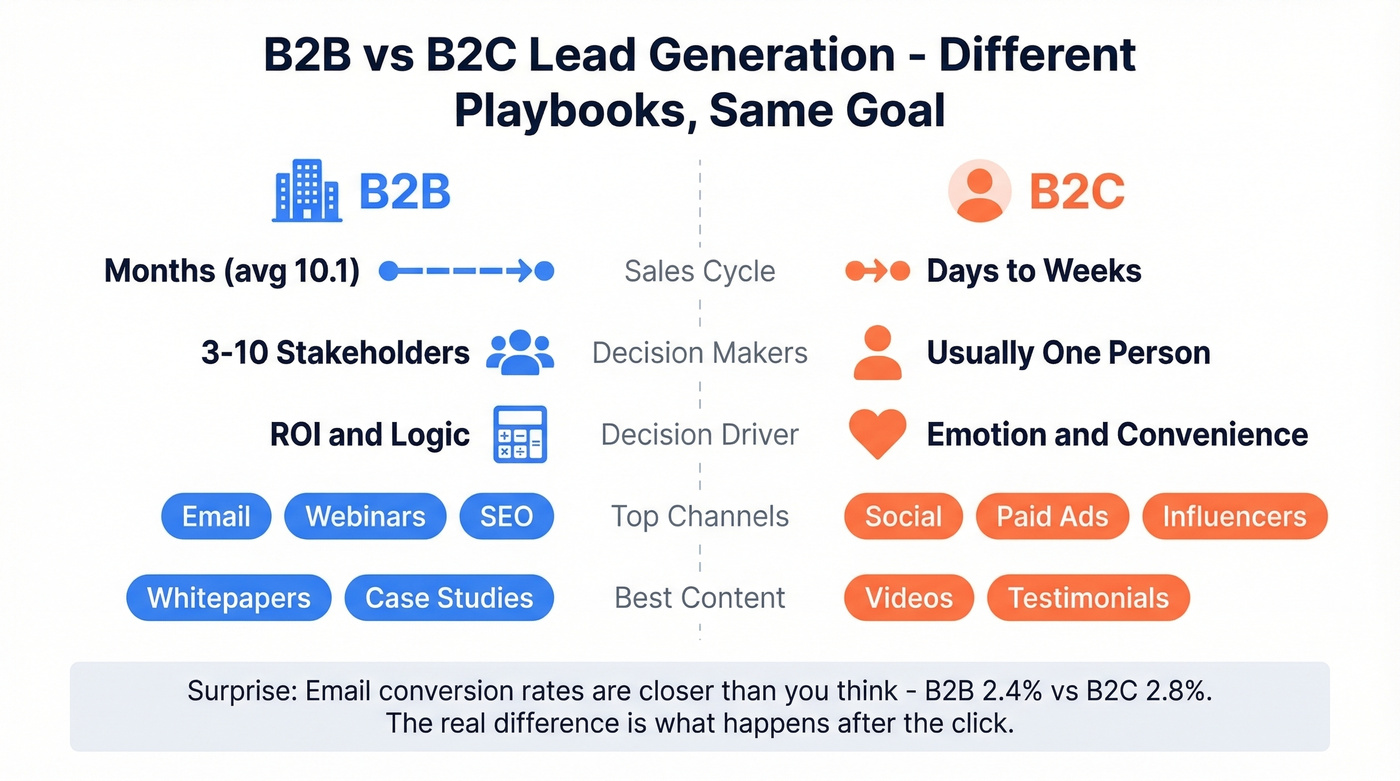
| Dimension | B2B | B2C |
|---|---|---|
| Sales cycle | Months (avg 10.1) | Days to weeks |
| Decision-makers | 3-10 stakeholders | Usually one person |
| Decision driver | ROI, logic | Emotion, convenience |
| Top channels | Email, webinars, SEO | Social, paid ads, influencers |
| Best content | Whitepapers, case studies | Videos, testimonials |
The real difference isn't conversion rates - B2B email converts at ~2.4% vs B2C's ~2.8%, closer than most expect. It's what happens after the click. B2B requires multi-touch nurturing across months. B2C can often close in a single session. Your lead gen stack needs to reflect that reality.
Why Lead Generation Fails
Look, 79% of marketing leads never convert into sales. That's not a lead gen problem - it's a nurturing and data quality problem. One Reddit marketer described spending six months doing outreach on professional networks, cold email, and Reddit prospecting, getting just 4-5 replies per month, mostly "no." They called it "mentally exhausting." That's what happens when you have activity without a system.
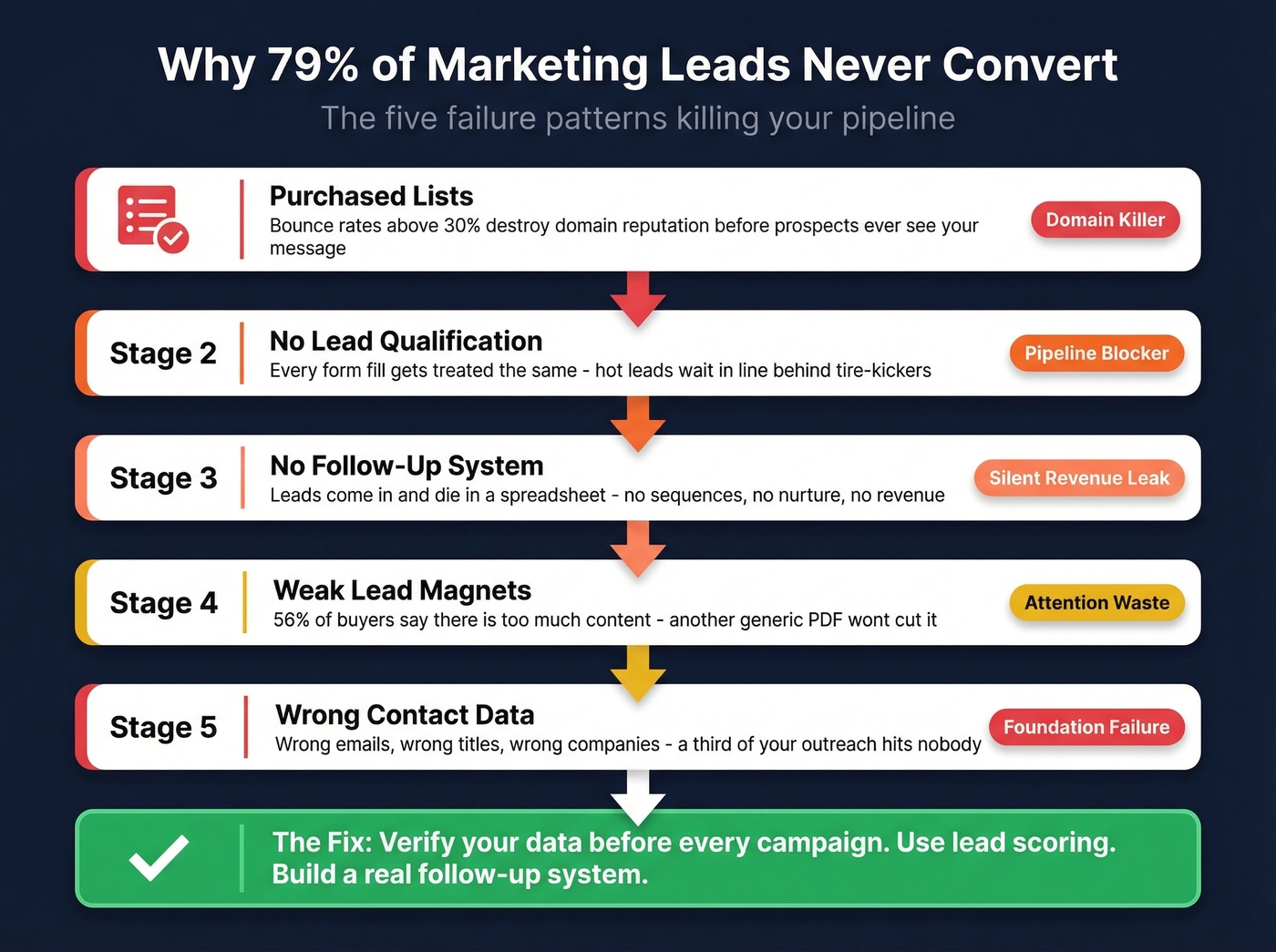
The failure patterns we see repeatedly:
- Purchased lists that bounce at 30%+
- No lead qualification - every form fill gets treated the same
- No follow-up system - leads come in and die in a spreadsheet
- Weak lead magnets nobody actually reads
- Wrong emails, wrong titles, wrong companies
That last one is the silent killer. If a third of your emails bounce, you aren't just wasting rep time - you're destroying your domain reputation. Run your list through an email verification tool before every campaign. Prospeo's 5-step verification includes catch-all handling, spam-trap removal, and honeypot filtering, which are the kinds of problems that tank deliverability before a single prospect reads your message.
How AI Is Reshaping Lead Gen
78% of organizations now use AI in at least one business function, up from 55% in 2023. In sales and marketing, AI tools are driving leads up by 50% and cutting acquisition costs by up to 60%. Gartner projects 95% of seller research workflows will begin with AI by 2027.
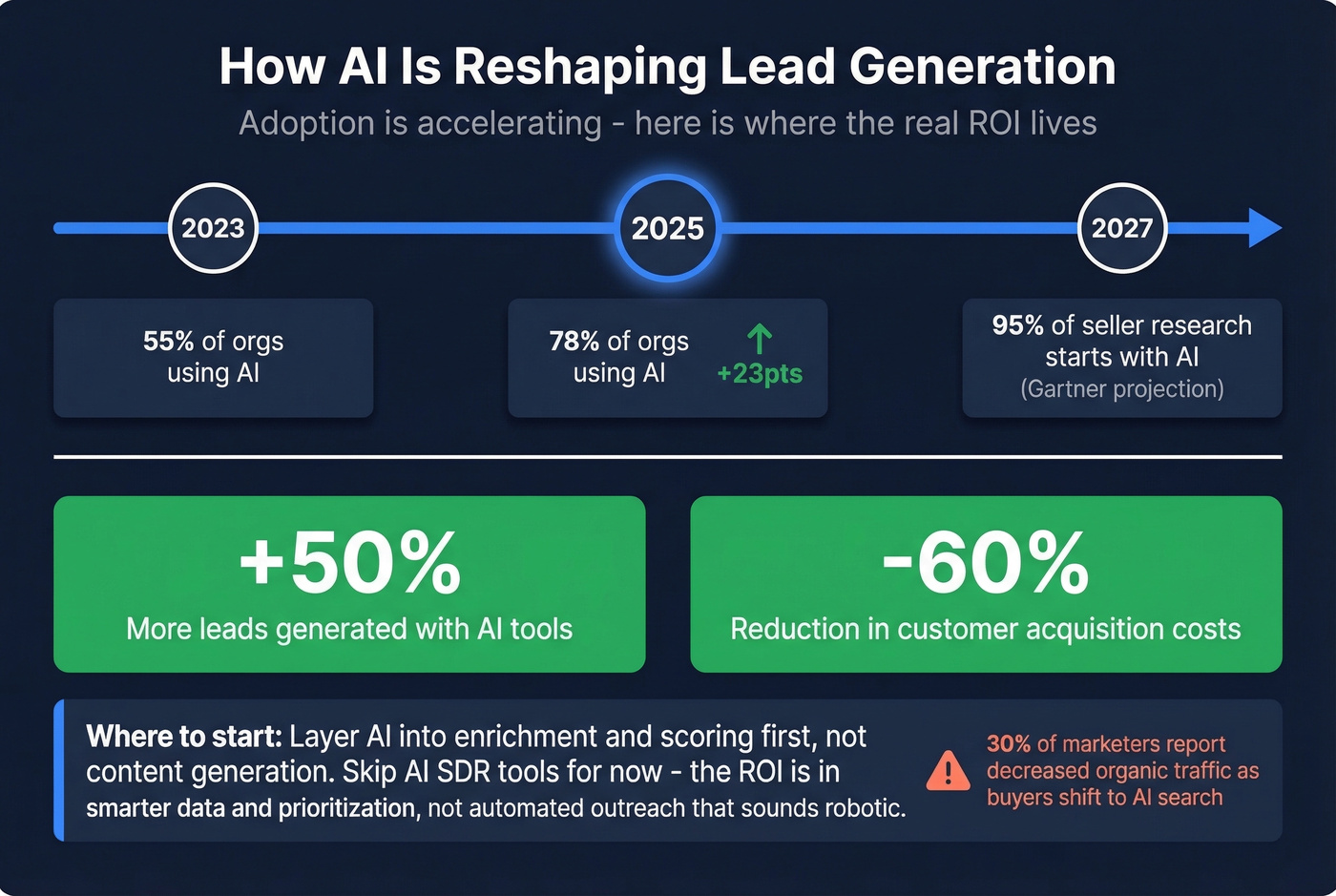
Around 30% of marketers report decreased organic search traffic as buyers shift to AI tools for research - which is exactly why 92%+ are now optimizing for both traditional and AI-powered search.
In our experience, the teams that layer AI into enrichment and scoring first - not content generation - see the fastest payback. Skip AI SDR tools for now. The ROI is in smarter data and prioritization, not automated outreach that sounds robotic.
Building Your Lead Gen Stack
You don't need 15 tools. You need five categories covered well.
Capture & CRM: HubSpot's free CRM works until you outgrow it. Salesforce once you need deeper customization and enterprise reporting.
Outreach: Instantly or Smartlead for high-volume cold email. Outreach or Salesloft for structured AE sequences.
Enrichment & verification: Prospeo gives you 300M+ profiles with 98% email accuracy and a 7-day data refresh cycle. The free tier includes 75 emails + 100 Chrome extension credits per month - enough to validate data quality before committing.

Analytics: Google Analytics or HubSpot reporting to track which channels produce revenue, not just leads.
Automation: Zapier or Make to connect everything. Zapier has a free plan, with paid plans from $19.99/month billed annually.
Let's be honest: if your average contract value is under $10K, you probably don't need a $30K/year data platform. A focused stack with verified data and one good outreach tool will outperform an enterprise suite you only use 20% of. Skip the bloated all-in-one platforms unless you've got the team to actually configure them.
If you need a starting point, compare a few free lead generation tools before you buy anything.
You just saw that SEO leads close at 14.6% vs 1.7% for outbound. But outbound catches up fast when your contact data is accurate. Teams using Prospeo book 35% more meetings than Apollo users and 26% more than ZoomInfo - because 98% verified emails and 125M+ direct dials mean reps talk to real buyers, not bounce logs.
Turn lead generation from a cost center into a revenue system.
FAQ
What's the biggest benefit of lead generation?
Predictable revenue growth. Companies with systematic lead gen land on the buyer's Day One shortlist - and 95% of deals go to those vendors. Without it, you're relying on referrals and luck, neither of which scales.
How much does lead generation cost?
Average cost per lead is $198.44 across industries. SEO delivers 748% ROI but takes ~9 months to break even. PPC breaks even in ~4 months but returns only 36%. Most B2B teams should budget $2,000-$10,000/month depending on channel mix.
Why do most leads never convert?
79% of marketing leads never become sales, almost always due to poor nurturing and handoff - not the prospecting itself. The fix: shared lead definitions, automated follow-up, and scoring that prioritizes engagement over form fills.
How does data quality affect lead generation results?
Bad data destroys outreach before it starts. Teams routinely see bounce rates drop from 35-40% to under 5% after switching to verified email tools - protecting domain reputation and ensuring messages actually reach inboxes.
Is lead generation worth it for small businesses?
Yes. The roofing company above started with digital lead gen and hit $2-3M in annual revenue. SEO and email have the highest ROI of any channel, and both can be started for under $500/month. The compounding dynamics of inbound content and verified outbound lists work regardless of team size - you just need fewer tools and tighter targeting.